Germany doubles down on gas: the next phase of the Energiewende
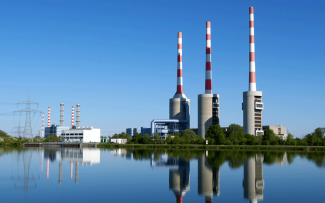
Germany has adopted a new financial support mechanism to incentivise energy companies to build a series of new gas-fired power plants, which are expected to enter operation in late 2031 and early 2032. The scheme is intended as a transitional measure ahead of the introduction of a capacity market as the long-term solution for ensuring the availability of adequate generation capacity. The new gas-fired units will play a complementary role in a power system increasingly dominated by renewable energy sources, while also enabling the scheduled phase-out of coal-fired power plants without compromising the security of electricity supply.
Under the adopted guidelines, new gas-fired units must be designed to allow for future conversion to hydrogen. The process of drafting the mechanism clearly illustrates how German policymakers have gradually recalibrated – and, in practice, lowered – their expectations regarding the prospects for developing a hydrogen economy. This evolution highlights Germany’s distinctive approach to implementing the Energiewende: a strong commitment to established strategic directions and objectives, coupled with a tendency to avoid revising the underlying assumptions for as long as possible, relying instead on often costly adaptation measures within the existing framework.
On 10 July, the Bundesrat approved the Electricity Supply Security and Capacity Act (Strom-Versorgungssicherheits- und Kapazitätengesetz, StromVKG), which had been passed by the Bundestag the previous day. The new legislation introduces Germany’s first mechanism to compensate power plant operators for keeping generation capacity available. This marks a departure from the country’s existing energy-only market model, under which operators are paid only for the electricity they sell.
Under the new mechanism, two auctions for new generating units with a combined capacity of 9 GW are scheduled to take place in the second half of this year, on 8 September and 29 December. One of the main eligibility criteria is the so-called long-duration requirement, defined as the ability to supply power continuously for at least 10 hours and to resume operation after a three-hour interruption. Although the mechanism is formally open to a range of technologies, including energy storage, these eligibility criteria effectively favour new gas-fired power plants.
A further auction for 2 GW of capacity is scheduled for 2027. Unlike the two earlier auctions, it will not be subject to the long-duration requirement, while operators of existing generating units will also be eligible to participate. Coal-fired units are effectively excluded, owing to the auction’s eligibility criteria, notably the emission limit of 550 g CO₂/kWh, as well as the provisions of Germany’s coal phase-out legislation. All units selected through these auctions must be ready to begin operation between 1 November 2031 and 31 October 2032.
Under the StromVKG, new gas-fired power plants must be designed to be hydrogen-ready so that operators can convert them to burn hydrogen in the future, although the legislation does not specify the technical requirements for meeting this criterion. By 2045 at the latest, when Germany aims to achieve climate neutrality, these units will have to operate without using fossil fuels. A separate financial support mechanism is intended to accelerate the transition to hydrogen by covering the difference in operating costs between burning hydrogen and natural gas. To this end, the legislation provides for two additional auctions with a combined capacity of 4 GW. Projects selected in the first auction (2 GW) will be required to switch to hydrogen by 2040, while those selected in the second (2 GW) will have to do so by 2043.
The mechanism established under the StromVKG is intended as a transitional instrument until the planned introduction of a capacity market in 2032, which is intended as the long-term solution. The details of the future capacity market have yet to be agreed, with the relevant legislation expected to be adopted in 2027. That legislation will also set out the financing arrangements for the transitional mechanism established under the StromVKG. Current plans envisage a new surcharge on electricity bills to cover its costs, estimated at €1-3 billion in 2031. The overall design of the system outlined above was provisionally agreed with the European Commission earlier this year. However, the mechanism cannot take effect until it receives formal approval from the Commission, which will first assess its compatibility with EU state aid rules.
Energy context: in search of the optimal energy mix
Germany’s power sector is at an advanced stage of its transformation.[1] It relies increasingly on renewable energy sources, primarily wind and solar power. In 2025, renewables accounted for almost 58% of the country’s electricity generation, and the Energiewende policy framework envisages their share of the generation mix increasing to 80% by 2030. Although reaching this level by the end of the decade appears unlikely, the current and projected pace of wind and solar deployment leaves little doubt that Germany’s power system will become increasingly dependent on renewable energy sources in the years ahead. Crucially, these sources are weather-dependent, limiting both their controllability and dispatchability.
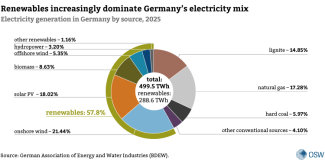
Meanwhile, Germany shut down its last nuclear power plants in 2023, with all decommissioned reactors already undergoing dismantling,[2] and is continuing its phase-out of coal-fired power generation.[3] Since the relevant legislation was adopted in 2020, Germany has closed coal-fired units with a combined capacity of 14 GW and transferred a further 7.5 GW from the market to the grid reserve. Lignite-fired power plants with a combined capacity of 14.3 GW and hard coal-fired plants totalling 7.6 GW continue to operate in Germany’s power system, with a further 7.2 GW of coal-fired capacity scheduled for phase-out by 2029. Under the current legislation, the last coal-fired power plants will be shut down by the end of 2038.[4]
To ensure the security of electricity supply even during periods of low wind and solar generation, the power system must also have sufficient dispatchable and controllable generation capacity. At present, coal- and gas-fired units primarily complement renewable generation. Under the Energiewende, however, natural gas-fired power plants are expected to assume this back-up role once coal-fired generation is phased out, supported by energy storage, flexibility services and other technologies. Consequently, replacing decommissioned coal-fired power plants with new gas-fired facilities remains a key prerequisite for a successful coal phase-out. According to the latest report by Germany’s energy regulator, the Federal Network Agency (Bundesnetzagentur, BNetzA), the country will require between 22.4 GW and 35.5 GW of additional dispatchable generation capacity by 2035 to support its energy transition, depending on the scenario.
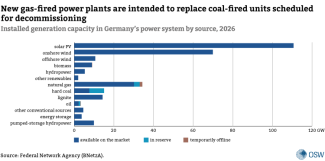
Despite long-standing demand for additional generation capacity, German energy companies have been reluctant to invest in new gas-fired units. Such investments remain too risky under the energy-only market model, where operators are paid only for the electricity they sell, as the growing share of renewables steadily reduces the operating hours of conventional units, thereby eroding their revenue potential. It is impossible to predict whether, or over what time frame, such investments will generate a return. Consequently, major German energy companies seeking to invest in new gas-fired units, preferably at the sites of former coal-fired plants, have for several years urged successive governments to provide support, ideally through the introduction of a capacity market, which they view as a solution that has already proved effective in neighbouring countries.
For many years, while several other EU member states, including France, Poland and Belgium, were introducing capacity markets, Germany resisted adopting such a mechanism. This reluctance stemmed from a number of factors. For a long time, the prevailing view in German debate was that the market itself should primarily ensure the security of electricity supply. Under this approach, temporarily high prices during periods of supply shortages would provide sufficient revenues for so-called peaking power plants, while a capacity market was seen as unnecessary state intervention that would further drive up electricity prices through the surcharge needed to finance the mechanism. Secondly, critics argued that it would unnecessarily subsidise older, unprofitable coal-fired units. Thirdly, there were high expectations that large-scale energy storage would be deployed more quickly and eventually assume the role of complementing renewable generation. Finally, during the previous decade Germany’s power system still had a substantial capacity surplus, which has since been markedly reduced by the nuclear and coal phase-outs. Instead of introducing a capacity market, in the mid-2010s Germany opted to establish strategic reserve mechanisms (Netzreserve and Kapazitätsreserve) as an additional safeguard for the security of electricity supply.
Political context: paralysing compromises
The need to build new gas-fired power plants on a large scale has generally attracted little controversy in Germany, as it has long been regarded as one of the fundamental assumptions underpinning the Energiewende. However, the financial support mechanism for these investments has been the subject of a protracted political dispute in recent years. German plans have been further complicated by EU rules, which require any such mechanism to be approved by the European Commission, thereby forcing the government to negotiate its proposals with Brussels.
The first proposal for a subsidy scheme to support the construction of new gas-fired units, discussed in Germany under the name Kraftwerksstrategie (Power Plant Strategy), was put forward by Olaf Scholz’s government (the SPD-Green-FDP coalition) in mid-2023. Notably, Vice-Chancellor and Minister for Economic Affairs and Climate Action Robert Habeck of the Green Party was responsible for developing the proposal. At the time, the government presented the proposed mechanism as part of Germany’s decarbonisation agenda rather than as an instrument for ensuring the security of electricity supply. The plan, which Habeck had provisionally agreed with the European Commission, envisaged auctions for new generating units with a total capacity of almost 24 GW. Of this, nearly 9 GW would be allocated to units designed to run on hydrogen from the outset, while the remaining 15 GW would comprise gas-fired power plants required to switch from natural gas to hydrogen by 2035 at the latest.
Habeck’s proposal assumed that Germany’s power system would be ‘almost fully’ decarbonised by that time. However, it quickly triggered a coalition dispute between the Greens and the FDP. The primary source of controversy was the cost of the scheme, estimated at around €60 billion over a 15-year period, with the bulk of the expenditure earmarked to cover the costs of hydrogen-based generation. Part of the funding would come from electricity consumers, with the remainder to be provided by the federal budget. Ultimately, a November 2023 ruling by the Federal Constitutional Court on the Climate and Transformation Fund derailed these plans, forcing the government to make substantial budget cuts.[5]
The second version of the scheme, developed in the first half of 2024 and agreed both among the coalition partners and with the European Commission, significantly altered Habeck’s original proposal. Firstly, it reduced the scale of the mechanism to a total of 12.5 GW. The planned auctions to support the construction of new gas-fired units would cover a total of 10 GW of capacity, with half of the new units required to switch to hydrogen eight years after commissioning and the remainder by 2045 at the latest. Auctions for a further 2 GW would support existing gas-fired units. The plan also provided for the construction of units designed to run on hydrogen from the outset, with a combined capacity of 0.5 GW. Finally, for the first time, the agreement envisaged the introduction of a capacity market in Germany from 2028 as the long-term solution. The cost of the mechanism was estimated at €15-20 billion. However, the legislation required to implement the subsidy scheme failed to pass through the legislative process before the coalition government collapsed and a snap federal election was held in February 2025.
The new CDU/CSU–SPD coalition, which took office in the spring of 2025, initially intended to expand the planned mechanism once again. The coalition agreement included a pledge to support the construction of new gas-fired power plants with a combined capacity of 20 GW and, ultimately, to introduce a capacity market. However, the new Minister for Economic Affairs and Energy, Katherina Reiche (CDU), failed to secure approval for her proposal in negotiations with the European Commission, which considered such a large-scale support scheme unjustified. The mechanism ultimately agreed with the Commission was scaled back to a maximum of 12 GW, broadly in line with the previous proposal. The key changes sought by the new German government primarily involved relaxing the hydrogen-related requirements. Compared with the previous version of the mechanism, new gas-fired units will still have to be built as hydrogen-ready (although it has not been specified what this term means in practice), but their operators will have more time to switch fuels – until 2045. In addition, they will gain a second path to decarbonisation through the use of carbon capture technology.
However, the final weeks of work on the StromVKG were dominated by a debate among politicians and experts over the scale of the need for new gas-fired units and the extent to which energy storage could replace them as a source of backup capacity during periods of low wind and solar generation. In particular, some experts raised concerns over the long-duration requirement, arguing that it clearly favours gas-fired power plants in the planned auctions despite their formal technology neutrality.
Hydrogen context: a dream of the future
In both official documents and in political and expert discussions in Germany, the transition from natural gas to hydrogen remains a cornerstone of the country’s strategy for decarbonising the power sector. At the same time, however, the three-year process of drafting the StromVKG clearly illustrates how German policymakers have gradually recalibrated their expectations to reflect the actual prospects for the hydrogen economy and related technologies. Progress in this area has proved far slower than anticipated at the beginning of the current decade. Olaf Scholz’s government projected that electrolysers with a combined capacity of 10,000 MW producing so-called green hydrogen would be operational in Germany by 2030. In reality, by the end of the first quarter of 2026, operational capacity totalled just 180 MW, while projects with a combined capacity of 1,271 MW were under construction. Crucially, all of these projects have relied on financial support from EU, federal or state sources. Additional projects with a combined capacity of 7,227 MW are at the planning stage, but most have remained at that stage for months or even years while awaiting more favourable investment conditions. It remains uncertain whether they will proceed at all, as some have already been cancelled.
By contrast, hydrogen transmission infrastructure is being developed broadly in line with the adopted plans, which are relatively ambitious.[6] By the end of 2025, a total of 525 km of the network had been commissioned, most of it comprising one of the two strings of the OPAL pipeline, the onshore extension of Nord Stream that previously transported Russian gas to Germany. However, given the slow pace of investment in hydrogen production and imports, it remains unclear when, and to what extent, the emerging infrastructure will be utilised.
Beyond ensuring the availability of hydrogen, the planned transition from natural gas to hydrogen in gas-fired power plants will also require overcoming significant technological hurdles. For example, turbines capable of burning 100% hydrogen for electricity generation are still under development. Another major challenge is the high cost of generating electricity in such plants. Given these uncertainties, during the drafting of the StromVKG, particularly its provisions governing the future fuel switch, Germany’s energy industry lobbied for maximum flexibility in the hydrogen-related requirements applying to the planned auctions for new gas-fired units, while maintaining its long-term vision of hydrogen’s role in the power sector.
In a significant departure from the previous government’s proposal, power plants covered by the support scheme will no longer be required to switch to hydrogen. Instead, the CDU/CSU–SPD coalition has introduced an alternative decarbonisation pathway based on carbon capture and storage (CCS) technology. This means that, despite the requirement for new gas-fired units to be designed as hydrogen-ready, operators will be able to choose a different decarbonisation method if it proves more cost-effective. However, most representatives of Germany’s energy industry doubt that CCS can be commercially viable for gas-fired power plants, given the high investment costs and the relatively low number of operating hours expected in a power system dominated by renewables. Even so, CCS may prove to be a viable option for units operating within chemical clusters, where captured carbon could also be used in other industrial processes. It is also worth noting that the development of Germany’s infrastructure for carbon capture, transport and storage remains at an early stage.[7]
Coal context: an unwelcome yet still indispensable fuel
The mechanism introduced under the StromVKG, together with the capacity market envisaged as the long-term solution, is fundamental to Germany’s further progress in phasing out coal. If the construction of new gas-fired units does not begin promptly, the current schedule for decommissioning coal-fired units will be impossible to maintain. In recent years, the lack of investment in new generation capacity has prompted BNetzA to block the planned closure of many older hard coal-fired units. Having designated them as essential to the operation of the power system, the agency has transferred them to the strategic reserve until 2031 or until the commissioning of new power plants to replace them.
Failure to secure sufficient new generation capacity could force changes to the decommissioning schedule for units slated for closure around the turn of the decade or lead to the broader use of strategic reserve mechanisms. In an extreme scenario – albeit one that has been discussed among German experts – the state could even be required to assume responsibility, in some form, for coal-fired units if energy companies can no longer operate them profitably while their continued availability remains essential to the security of the power system. One option considered in the past involved establishing a dedicated state body to take over such unprofitable yet indispensable coal-fired assets from private companies and manage them until their eventual decommissioning.
Neither the country’s main political parties (with the exception of the AfD, which rejects the Energiewende altogether) nor business and industry are challenging Germany’s coal phase-out or the current target of completing the process by 2038. Instead, stakeholders, particularly energy companies and the Länder (federal states), are focused on securing commercially viable conditions for building new gas-fired units to replace older coal-fired power plants, viewing this as essential to preserving their business model and safeguarding employment, particularly as coal-mining regions such as Lusatia near the Polish border undergo structural transformation.
Gas context: a long-term bridging solution
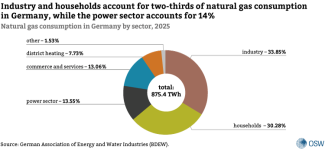
Commissioning numerous new gas-fired power plants and the gradual replacement of coal-fired units in Germany’s power system will significantly increase natural gas consumption in this sector. At the same time, given the current structure of gas consumption across the economy (the power sector accounts for just 14%; see Figure 3) and the observed and expected trends in other sectors – declining industrial gas consumption driven by decarbonisation and by cyclical and structural changes, as well as lower gas demand for heating as heat pumps increasingly replace gas- and oil-fired boilers – it remains unclear whether higher gas consumption in the power sector during the 2030s will increase overall gas demand across the economy or merely alter its sectoral distribution.
Moreover, in political and expert debate in Germany and, more broadly, across the EU, gas-fired power plants have long been presented as a transitional solution in the energy transition. They are often described as a bridging technology, paving the way for a power system based entirely on renewables through the planned replacement of fossil natural gas with low-carbon hydrogen, particularly so-called green hydrogen. However, as the prospect of using hydrogen in the power sector continues to recede and the many challenges associated with developing the hydrogen economy become increasingly apparent, it is ever more pertinent to ask whether natural gas will indeed remain merely a transitional fuel. Its role in Germany’s power system may prove more enduring than current strategic documents envisage, with potential implications for the country’s long-term climate policy objectives.
The Energiewende, German-style: mind over matter
The drafting and subsequent evolution of the StromVKG provide a clear illustration of Germany’s distinctive approach to the energy transition. The strategic objectives and direction adopted – reflecting a political, economic and social compromise forged through years of debate – are treated as an enduring point of reference that is only rarely subject to fundamental revision, even when efforts to achieve these objectives encounter technological, economic or geopolitical constraints.
Rather than altering course, German policymakers tend to adjust the policy instruments by introducing transitional solutions, creating additional, often costly, support mechanisms, or postponing the implementation of earlier commitments. This approach preserves the political continuity of the Energiewende but also increases the complexity of the overall framework and the costs of its operation. It also buys time in the expectation that technological advances and changes in market conditions will ultimately enable Germany to achieve its original objectives without fundamentally revising them.
However, over the longer term – particularly if structural constraints persist or deepen amid rising political, economic and social costs – a policy centred solely on modifying the instruments of the existing strategy may eventually prove unsustainable. In the German context, only then is a fundamental reassessment likely to extend beyond the measures used to achieve the objectives of the energy transition to encompass at least some of the underlying assumptions, which have so far remained largely beyond the scope of substantive debate.
[1] See the entry ‘Energiewende (zwrot energetyczny)’ [in:] ‘Kultura polityczna Niemiec. Krótki kurs’, OSW, osw.waw.pl.
[2] Ibid., the entry ‘Atomausstieg (odejście od atomu)’.
[3] Ibid., the entry ‘Kohleausstieg (odejście od węgla)’.
[4] M. Kędzierski, Germany bids farewell to coal. The next stage of the Energiewende, OSW, Warsaw 2022, osw.waw.pl.
[5] For more details, see: M. Kędzierski, S. Płóciennik, ‘Germany: the Constitutional Court deprives the government of €60 billion earmarked for transformation’, OSW, 17 November 2023, osw.waw.pl.
[6] See: M. Kędzierski, ‘Germany: green light for the hydrogen network’, OSW, 24 October 2024, osw.waw.pl.
[7] Idem, ‘Germany Opens the Door to CCS’, OSW, 26 November 2025, osw.waw.pl.