Faster – lower – stronger: the policies of Fico’s fourth government in Slovakia
Although Robert Fico has been the dominant figure in Slovak politics over the past two decades, his fourth term as prime minister exhibits a number of features that distinguish it from his previous administrations. For the first time, he has been compelled to implement a policy of fiscal consolidation, thereby disappointing a significant portion of his electorate. As a consequence of these measures, Slovakia’s performance has deteriorated across a number of key economic indicators. Fico has emphasised pro-Russian themes more strongly than during his earlier terms in office, appealing to a new and more radical electorate. He has also shown a greater willingness to exploit issues related to morality and social norms, using them both to deepen divisions within an opposition already fragmented on such matters and to divert attention from controversial reforms. His political camp has proved particularly determined in introducing legal changes designed to reduce the risk of prosecution for abuses of power. Amendments to criminal law have improved the legal position of influential figures linked to the governing camp. These changes have attracted criticism from EU institutions and, together with Bratislava’s opposition to sanctions against Russia, have for the first time placed Fico so clearly outside the European Union mainstream. Nevertheless, the Slovak prime minister continues to demonstrate considerable skill in domestic politics, maintaining a parliamentary majority despite frequent conflicts among coalition partners. At the same time, in many areas of foreign policy he remains a pragmatist, distinguishing his approach from that of Viktor Orbán.
Domestic politics: ‘divide and rule’
A notable success of Fico’s government, in office since autumn 2023, has been its ability to secure the passage of legislation in the National Council despite numerous frictions within the ruling camp. The three-party governing coalition controls fewer than half of the seats in parliament (74 out of 150) and commands a majority only with the support of five non-affiliated MPs. The dominant force within the alliance is Smer–Social Democracy (Smer–SD), Prime Minister Fico’s left-wing nationalist party, which holds 41 seats and controls 9 of the 17 ministries (including two only formally, in order to secure the backing of independent MPs and avoid renegotiating the coalition agreement). The remaining coalition partners are Hlas–Social Democracy (Hlas–SD), a centre-left party (25 seats and 6 ministries), and the Slovak National Party (SNS; 8 seats and 2 ministries). Three of the five non-affiliated MPs supporting the government are defectors from the SNS who are affiliated with the far-right Rural Party.
The parties forming the ruling camp have lost a substantial share of their support since the election and, according to recent polls, could now expect to retain barely 60% of the seats they won in 2023. The sharpest decline has affected Hlas, the only coalition party that could in future contemplate an alliance with the principal parties of the current opposition. By contrast, the greatest gains have been recorded by the far-right extra-parliamentary Republic movement, which competes directly with both the coalition’s nationalist partners and Smer for voters. This may not necessarily be unwelcome news for Fico, who has previously signalled his openness to a post-election alliance with the party.
The decline in support for the governing coalition parties has largely resulted from unpopular fiscal consolidation measures (see below: The economy: lack of vision and ‘belt-tightening’). As early as autumn 2024, the first measures introduced in this area were viewed negatively by 73% of Slovaks.[1] Particular public resentment was directed at the increase in the standard VAT rate from 20% to 23%, a measure criticised by as many as 67% of voters supporting Prime Minister Fico’s party. More recent and broader polling data indicate that 71% of Slovaks are dissatisfied with the government’s domestic policy and 66% with its foreign policy, with approval ratings standing at 26% and 29% respectively.[2] In autumn 2025, 65% of voters overall expressed a desire for Fico’s government to resign, including 12.5% of his own party’s electorate.[3]
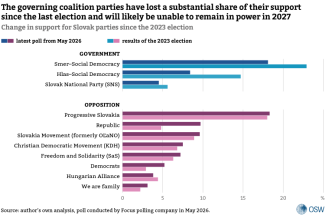
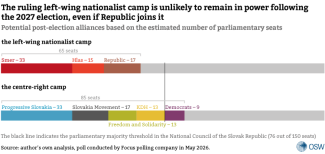
In order to divert attention from unpopular fiscal consolidation measures, Fico has focused his communication with voters on more abstract themes, such as national sovereignty, reducing the risk of involvement in war, and defending ‘common sense’ on issues of morality and social norms. The latter issue in particular has enabled him to drive a wedge between opposition parties. Although the opposition has sought to present a united front criticising the prime minister’s policies, it remains divided on issues such as the introduction of registered partnerships and attitudes towards abortion. At the same time, according to the latest opinion polls, the formation of a government will be impossible without the participation of both of the principal centre-right opposition blocs. On the one hand, these comprise the more socially liberal parties, such as Progressive Slovakia (PS), Freedom and Solidarity (SaS), and the Democrats; on the other, the more conservative forces, namely the Christian Democratic Movement (KDH) and the Slovakia Movement (formerly OĽaNO).
A clear example of attempts to divide the opposition was the constitutional amendment adopted in September 2025 with the votes of the ruling camp, the KDH and some MPs from the Slovakia Movement. Fico promoted the amendment under the slogan of creating a ‘bulwark against progressivism’. It included, among other provisions, recognition of only two sexes, stricter rules governing the adoption of children, and a clause affirming the primacy of national law over EU law in matters concerning ‘national identity’ (particularly with regard to the protection of human life and dignity, marriage and parenthood, as well as culture and language). The amendment intensified tensions within the opposition camp, thereby emboldening Fico to pursue a further round of similar constitutional changes, this time concerning the constitutional entrenchment of a conscience clause.
Reforms of the judiciary and law enforcement agencies: a ‘safety net’
Although the government’s programme emphasises the intention to strengthen the ‘democratic character of the state’, there are numerous indications that, in practice, this slogan serves as a ‘smokescreen’ for retaliatory actions against the opposition and attempts to evade responsibility for breaches of the law. While in opposition, Fico and his political camp repeatedly portrayed themselves as victims of political repression, even in the face of well-documented prosecutorial allegations and rulings delivered by independent courts. They unsuccessfully sought to alert the European Commission to these alleged persecutions. Consequently, the Slovak prime minister now contrasts what he describes as the Commission’s current activism with its earlier passivity in the face of supposed ‘violations of human rights’.
During the initial phase of the current administration, Fico’s government enacted amendments to criminal law that effectively guaranteed impunity for numerous defendants linked to the ruling camp. Two institutions were abolished: the Special Prosecutor’s Office (ÚŠP) and the National Criminal Agency (NAKA), whose investigations between 2020 and 2023 had exposed extensive abuses committed under Fico’s earlier governments, including direct political interference in police operations and the judiciary. Fico himself, while in opposition, narrowly avoided losing his parliamentary immunity and came close to being placed in pre-trial detention. In this particular case, however, even commentators usually critical of the prime minister expressed doubts as to whether detention was justified as a preventive measure.
The legal changes resulted, among other things, in reduced penalties for corruption offences and shorter limitation periods, while institutional and personnel changes slowed investigations and, in some cases, redirected them altogether. Consequently, Dušan Kováčik, the former Special Prosecutor (and thus head of the ÚŠP), was released from prison after beginning to serve an eight-year sentence for corruption. The position of a number of businessmen and former state officials linked to Smer also improved significantly. In some cases, individuals previously accused of wrongdoing were even granted the status of injured parties in proceedings in which investigators probing their alleged abuses themselves became the subject of criminal charges. This applies, for example, to the oligarch Norbert Bödör and the former police chief Tibor Gašpar, who subsequently joined Smer and now serves as one of the party’s deputy speakers of parliament (while his son – whose attachment to his father is evidenced by a tattooed portrait of him – heads the counter-intelligence service). Under the previous government, both men had spent more than a year in prison. The corruption case against Peter Žiga, a former minister in two Fico governments and currently an MP for Hlas as well as a deputy speaker of parliament, was discontinued following the introduction of the new limitation periods, although he had faced a potential sentence of up to five years’ imprisonment. Peter Kažimír, the governor of the central bank (formerly affiliated with Smer and now closely associated with Hlas), was convicted of corruption, although the judgment has not yet become final. However, following the amendments to criminal law, the court could impose only a financial penalty, whereas previously comparable offences had carried custodial sentences of up to five years.
As the term progressed, however, Fico encountered a series of further obstacles arising from the operation of institutional checks and balances, reluctance to deepen disputes with European institutions, and divisions within the ruling camp itself. In December 2025, the Constitutional Court struck down legislation abolishing the office responsible for protecting whistle-blowers reporting actions detrimental to the public interest and replacing it with a new institution. Simultaneous pressure from the European Commission – which made the disbursement of subsequent tranches of Slovakia’s National Recovery and Resilience Plan conditional upon compliance – together with opposition from the coalition partner Hlas, ultimately compelled the government in March 2026 to abandon these plans altogether. In a similar vein, the Constitutional Court blocked several controversial provisions of the amendments to criminal law (in 2024), as well as tighter controls over non-governmental organisations, and attempts to further weaken the position of crown witnesses (the latter two in February 2026). Meanwhile, the risk of losing European funds brought an end to the prime minister’s much-publicised proposal, put forward at the turn of 2026, to abolish the Public Procurement Office.
Common courts repeatedly acted in defence of leading investigators who, prior to 2023, had handled the country’s largest corruption cases, including those involving figures linked to the current ruling camp. Interior Minister Matúš Šutaj Eštok was ordered to pay approximately €120,000 in a case concerning the protection of personal rights, while his ministry was fined €160,000 for unlawfully suspending investigators from service and transferring them.
The economy: lack of vision and ‘belt-tightening’
In contrast to the above-mentioned reforms – perceived as crucial for the consolidation of power but exposing the government to external criticism – the adopted austerity packages have been aimed at securing goodwill within the EU. Bratislava has sought to signal to Brussels that it is a responsible partner undertaking measures to reduce the budget deficit. The original objective was to lower the deficit from 5.3% of GDP in 2023 (the fifth highest in the EU) to 3% in 2026. It is now almost certain that this target will not be achieved. Consequently, a new and less ambitious target for this year has been adopted, namely a deficit of 4.1% of GDP. This reflects constraints arising from concerns about voters’ negative reactions to overly radical measures, as well as an unwillingness to depart too far from the government’s left-wing roots. Fico frequently emphasises his concern for the standard of living of ordinary Slovaks and, while in opposition, sharply criticised his political opponents for failing to do enough in this regard.
Smer therefore sought to structure the introduction of new fiscal burdens in such a way that the poorest social groups – an important segment of the party’s electorate – would be affected as little as possible. For example, at the beginning of 2025 the standard VAT rate was increased from 20% to 23% (while the reduced rate rose from 10% to 19%), yet the rate applied to basic food products was lowered from 10% to 5%. Subsequently, this preferential category was expanded to include, for example, admission to cultural events.
The government has also sought to ensure that electricity and gas prices for households remain low, largely continuing the policy pursued by its predecessors. Consequently, according to Eurostat data for the second half of 2025, Slovakia ranked among the ten EU member states with the lowest household electricity prices (measured in PPS, i.e. adjusted for purchasing power differences), while in the neighbouring Czech Republic such prices were almost twice as high. Slovakia also recorded the third-lowest household natural gas prices in the EU. An adjustment introduced at the beginning of 2026 involved replacing universal subsidies for energy bills with more targeted support, based primarily on household income per family member. Nevertheless, these measures still cover as many as 90% of households. Those not qualifying for subsidies pay around one-third more for energy. Expenditure on support in this area is expected to amount to approximately 1.2% of budget expenditure in 2026 (compared with more than 9% at the height of the energy crisis in 2023).
The preliminary assessment of these measures is therefore ambiguous: while it is difficult to speak of the fulfilment of the promise to preserve the ‘welfare state’ proclaimed in the government programme, there has generally been no decline in living standards. Following a decline in 2023, real wages increased over the subsequent two years at an annual rate of approximately 4.5%, that is markedly faster than in Germany and at a level comparable to that in the Czech Republic. Nevertheless, for many voters of the governing coalition parties, the budgetary ‘belt-tightening’ has proved disappointing, and 2025 was widely perceived as the most difficult year since the pandemic-stricken year of 2022.[4] Among the 34% of Slovaks who, in the survey, assessed the previous year as worse than they had expected at its outset, the largest group (54%) identified the deterioration of the country’s overall economic situation as the principal reason for this assessment. Public discontent has also been fuelled by the abolition of a public holiday – a move carrying symbolic significance, as the government of a former communist politician appealing to nostalgia for the past removed the commemoration of the beginning of the Velvet Revolution of 1989 – as well as by the temporary suspension of two additional public holidays.
Only limited progress has been made towards achieving the objective, set out in the government programme, of ‘supporting sustainable growth and a competitive economy’. Although recession was avoided, GDP growth remained modest, particularly in 2025, when year-on-year growth failed to exceed 1% in any quarter – a markedly weaker performance than that recorded in Poland or the Czech Republic. During Fico’s tenure, Slovakia fell from 9th place in the EU at the end of 2023 to 19th in this category. In terms of public debt, it dropped from 14th to 16th place, while in Transparency International’s Corruption Perceptions Index it fell from 19th to 23rd among EU member states. The country also maintained or worsened its already low ranking with regard to GDP per capita measured in PPS (24th), actual individual consumption (AIC) (23rd), and innovation performance (24th). At the same time, the increase in the corporate income tax rate from 21% – already high by regional standards – to 24% from 2025 onwards has further undermined the country’s competitiveness.
Against this background, several factors stand out positively: the government’s consistency in developing nuclear energy, its efforts to attract investment in the automotive sector, the low level of unemployment, and Slovakia’s relatively favourable demographic structure by EU standards. The latter, however, is rapidly deteriorating, while Fico’s government has not only failed to undertake more substantial measures in this area but has also significantly reduced support for families with children. Despite the need to implement budgetary cuts, it has nevertheless preserved benefits directed at senior citizens – the key electoral group of the parties forming the ruling camp.[5] A persistently high level of emigration, particularly among young people, also remains a major problem. As many as three quarters of 16- and 17-year-olds consider emigrating, with 38% declaring themselves certain to do so, often without any intention of returning.[6]
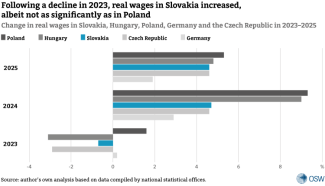
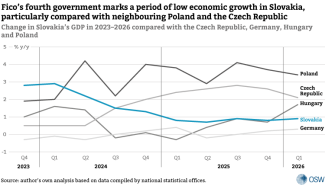
Table. Slovakia compared with other EU member state
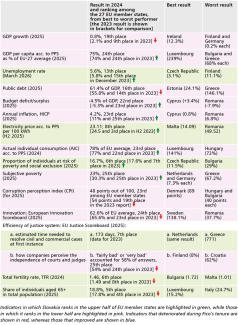
Source: author’s own analysis based on data compiled by Eurostat, the European Commission and Transparency International.
Foreign policy ‘in all four directions of the world’
Fico does not challenge Slovakia’s membership of either the EU or NATO, although he occasionally speaks of a crisis within both organisations while simultaneously seeking to maintain good relations with partners outside the Western world, including Russia and China – an approach he describes as a foreign policy conducted ‘in all four directions of the world’. The essence of this strategy lies in diplomatic balancing, which is intended to create new opportunities for Slovakia and facilitate the pursuit of key national interests, particularly in the fields of investment and energy policy. However, in practice, it has often resulted in the country’s marginalisation within the European Union, contrary to the claim, maintained by Fico since his third government (2016–2018), that Bratislava’s objective is to belong to the EU’s ‘core’ or ‘inner circle’. Since returning to office in 2023, Fico has emphasised his scepticism towards Brussels more frequently than in the past. This has not, however, prevented him from seeking assistance from the European Commission when expedient, for example during disputes with Kyiv over the transit of energy commodities.
Nevertheless, on many important issues Slovakia remains closer to the EU and NATO mainstream. Moreover, in the key areas of military modernisation and the expansion of nuclear energy, Fico has opted for closer partnership with the United States. Bratislava had already reached defence expenditure of close to 2% of GDP in 2020, at a time when this remained the Alliance’s target benchmark. This was achieved primarily through government-to-government agreements with the United States. During Fico’s previous premiership, Slovakia signed a contract for the purchase of nine UH-60M Black Hawk helicopters, while the Pellegrini government – in which Fico played a pivotal role as leader of the largest coalition party – ordered 14 F-16 fighter jets. Advanced negotiations are also under way on the acquisition of four additional jets. Likewise, the US company Westinghouse is widely expected to secure, in 2027, a record-breaking contract for the construction of a new reactor unit at the Bohunice Nuclear Power Plant.[7] Fico has refrained from engaging in more far-reaching criticism of either the United States or Russia (beyond general references to violations of international law), a stance that has helped to preserve his access to direct talks with the leaders of both countries. At the same time, his meetings with Vladimir Putin, together with the government’s conservative domestic agenda and controversies surrounding the rule of law, contributed to Smer’s expulsion from the Party of European Socialists in October 2025. This brought to an end two decades of membership, although that membership had in any case been suspended since 2023.
Although Fico has abandoned the intensive efforts to diversify energy supplies pursued by his predecessors, Slovakia’s dependence on Russia in this sphere has declined during his tenure. At the end of 2024, following Ukraine’s decision not to renew the transit agreement, supplies via the Bratstvo (Brotherhood) pipeline ceased. These were only partially replaced by Russian gas delivered through the TurkStream pipeline from the south. In 2025, for the first time in Slovakia’s history, the majority of gas imports during a whole year came not from Russia but from alternative sources, including the United States, Qatar, and Norway. Non-Russian supplies accounted for roughly two-thirds of total imports, compared with one-third from Russia, whereas Russia had previously accounted for approximately 90% of Slovakia’s gas imports. The largest state-controlled energy company SPP, is nevertheless in discussions with Gazprom regarding increased deliveries ahead of the EU’s planned definitive ban on Russian gas imports, scheduled to take effect in November 2027. As regards oil, supplies of Russian crude via the Druzhba pipeline were suspended at the end of January 2026 and resumed only in late April. The dispute with Ukraine centred on damage to transmission infrastructure. At the same time, Croatia’s refusal to facilitate the transport of Russian oil via the alternative Adria pipeline has necessitated its replacement with crude sourced from other suppliers, including Norway, Kazakhstan and Libya. Unlike Hungary, Slovakia has unequivocally rejected the Russian participation in the expansion of its nuclear energy sector.
The Fico government’s policy towards the Russo–Ukrainian war has been marked by ambivalence. Since the launch of Russia’s full-scale invasion of Ukraine, the Slovak prime minister is among the very few heads of government of EU member states – alongside those of Austria and Hungary – who have visited Moscow and met with Vladimir Putin, thereby contributing to the erosion of EU unity in relation to the Kremlin. In an effort to appeal to pro-Russian and anti-American voters, the parties of the governing coalition in Bratislava frequently employ – particularly in their domestic political messaging – narratives that reflect Kremlin propaganda. Indeed, 35% of Fico’s party supporters would like to see Russia emerge victorious from the ongoing war, whereas only 5% favour a Ukrainian victory.[8] Such rhetoric resonates with these voters, as do statements expressing scepticism about Ukraine’s prospective membership of NATO. Among Smer supporters, the proportion favouring Slovakia’s continued membership of the Alliance is almost identical to that advocating withdrawal from it. This has encouraged Fico – who had already lost much of his more moderate electorate (particularly following the formation of Hlas) and now competes with the far right, especially the Republic movement – to adopt a more radical tone. After returning to office for a fourth term as prime minister, he claimed, for example, that the Russo–Ukrainian war had begun in 2014 as a result of the actions of ‘Ukrainian fascists’.[9] Emphasising the need for an immediate ceasefire, openly questioning Ukraine’s ability to regain territory occupied by Russia, and stressing opposition to the deployment of Slovak troops to Ukraine also formed part of the government’s electoral strategy during the 2024 presidential election campaign. These themes proved effective in mobilising the electorate and contributed to the success of the ruling camp’s candidate.
Notwithstanding the increasingly hostile rhetoric directed at Kyiv in the context of the dispute over the Druzhba pipeline, Bratislava undertook a number of constructive initiatives towards Ukraine. In doing so, it sought to distinguish itself from Budapest, not least in order to secure greater tolerance from Brussels for controversial domestic reforms. Even before the Druzhba dispute, Fico had expressed ‘unconditional’ support for Ukraine’s European aspirations, and he returned to this position after oil transit through the pipeline resumed, despite criticism from his coalition partners in the SNS. In October 2025, the third round of intergovernmental consultations with Kyiv in thirteen months took place. The topics discussed during the meeting included Slovak support for the rehabilitation of Ukrainian veterans, the development of cross-border transport infrastructure, and measures facilitating the employment of Ukrainian citizens in Slovakia. A few days after meeting Vladimir Putin in Beijing, Fico held talks with President Volodymyr Zelensky in the Ukrainian city of Uzhhorod in September last year. Following the meeting, the Ukrainian president emphasised the importance of maintaining pragmatic relations between the two countries. A similarly positive tone characterised the leaders’ subsequent meeting on the sidelines of the European Political Community summit in Yerevan in May. Bratislava has also continued to provide military assistance to Ukraine through commercial contracts, including substantial quantities of artillery ammunition. In autumn 2025, Defence Minister Robert Kaliňák announced a new package of support for Ukraine during a visit to Kyiv, becoming the first minister of Fico’s government to travel to the Ukrainian capital.
Bratislava has sought to deepen its relations with China. During Prime Minister Fico’s visit to China in autumn 2024, Xi Jinping described Slovakia as a ‘strategic partner’. While this designation is largely a diplomatic courtesy rather than a reflection of Slovakia’s actual importance in Beijing’s strategic outlook, China may nevertheless view Bratislava as a useful channel for expanding its influence within the European Union, particularly following the change of government in Hungary. Beijing may also hope to exercise indirect influence through Fico’s nominee to the European Commission, Maroš Šefčovič, who is responsible for trade policy. For its part, Bratislava is seeking Chinese investment, particularly in the automotive sector, and is keen to preserve projects already under way despite rising tensions between the EU and China. Slovakia, which already has the highest per capita car production in the world, is expected to become home to manufacturing facilities operated by Volvo, owned by China’s Geely Group, and by the electric vehicle battery producer Gotion, which are due to open in 2027. In the 2024 EU vote on tariffs on Chinese electric vehicles, Bratislava – like Berlin – opposed their introduction. This position is also shaped by Slovakia’s close integration with the German automotive industry (the country’s largest automotive plant belongs to the Volkswagen Group) and by significant direct exports to China of vehicles manufactured in Slovakia, which have fuelled concerns about potential Chinese retaliatory measures.
Fico has advocated the revival of Visegrád cooperation, although this objective may be complicated by potential tensions with Hungary’s new government. An immediate source of friction is the amendment to the Slovak Criminal Code adopted in December, which criminalises challenges to the so-called Beneš Decrees. The issue became a subject of debate in the Hungarian election campaign, in which Péter Magyar, leader of the victorious Tisza party, used it to criticise Orbán for his passivity in the face of measures perceived as detrimental to ethnic Hungarians living beyond Hungary’s borders. This criticism resonated particularly strongly with regard to Slovakia, not least because it has the highest proportion of ethnic Hungarians in the region (approximately 8% of the population).
Outlook
The unpopular process of fiscal consolidation and a foreign policy marked by internal contradictions have contributed to an erosion of support for the parties of the ruling camp. Following the election scheduled for early autumn 2027, Fico’s party is likely to find itself in opposition, while the continued parliamentary representation of its coalition partners is increasingly uncertain. They have adopted different strategies to secure their political futures. The nationalists have chosen the path of openly challenging the prime minister’s policies from the right, whereas Hlas – following the unsuccessful attempt by its young leader, Matúš Šutaj Eštok, to emulate Fico’s political style – appears to be returning to the original vision of its founder, now President Peter Pellegrini. Pellegrini came to embody a ‘Smer with a human face’, prompting many centre-right parties to regard Hlas as a potential coalition partner after the 2023 election. At the same time, the shared and often controversial past of many leading figures in both Hlas and Smer may continue to favour a pragmatic alliance of convenience between the two parties in the future.
Proposals for the governing coalition parties to contest the next election as part of a broader left-wing nationalist alliance are being discussed with increasing frequency, accompanied by a potential increase in electoral thresholds. Throughout its periods in office, Fico’s party has never precipitated a snap election, and there is little indication that this pattern will change. The prospect of losing power – and, for some coalition partners, the risk of failing to secure parliamentary representation altogether – is therefore likely to ensure that the next parliamentary election takes place as scheduled in late September or early October 2027. Following this election, the current centre-right opposition will most likely face the familiar challenge of overcoming its internal divisions. One of the key issues capable of uniting these parties may be the articulation of a compelling vision for the country’s development – something that successive Fico governments have thus far conspicuously lacked.
[1] ‘Konsolidačný balík kriticky vnímajú aj voliči vládnych strán. Najväčšie obavy panujú zo zvýšenia DPH’, SCIO, 21 October 2024, agenturascio.sk.
[2] ‘S domácou politikou Ficovej vlády je nespokojných 71% Slovákov, pri zahraničnej je to 66%’, 360tka, 2 January 2026, 360tka.sk.
[3] ‘Dve tretiny občanov Slovenska chce demisiu vlády Roberta Fica!’, SCIO, 4 December 2025, agenturascio.sk.
[4] ‘Ako sme na Slovensku spokojní s rokom 2025?’, Go4insight, 28 December 2025, go4insight.com.
[5] See K. Dębiec, ‘Slovakia’s depopulation: balancing support for children and senior citizens’, OSW Commentary, no. 668, 30 May 2025, osw.waw.pl.
[6] ‘Odchod zo Slovenska podľa prieskumu zvažuje alebo plánuje 75 percent mladých’, Sme, 30 April 2026, sme.sk.
[7] See K. Dębiec, ‘The Fico–Trump meeting: Slovakia turns to US nuclear technologies’, OSW, 22 January 2026, osw.waw.pl.
[8] M. Kern, J. Koník, ‘Prieskum: Pri napadnutí by Slovensko bránila len štvrtina obyvateľov. Najmenej voliči SNS’, Denník N, 1 July 2024, dennikn.sk.
[9] ‘„Kořeny války na Ukrajině jsou v roce 2014, kdy ukrajinští fašisté vraždili civilisty ruské národnosti,“ řekl Fico po pozastavení členství Smeru v PES’, Czech Television, 13 October 2023, ct24.ceskatelevize.cz.