Technocratic renewal: main directions and prospects for Péter Magyar’s government policy
Péter Magyar’s assumption of power in Hungary, together with his party securing a constitutional majority, brings an end to Fidesz’s 16-year dominance and opens the way for far-reaching state restructuring. The TISZA government has a distinctly technocratic profile and relies on experts from the private sector and public administration. The new authorities’ priorities will include unlocking approximately €18 billion in EU funds frozen as a result of rule-of-law disputes and holding their predecessors accountable for abuses of power. The new government has announced plans to rebuild the rule of law, pursue de-oligarchisation, reset relations with the EU and NATO, change the economic growth model and gradually reduce dependence on Russian raw materials. However, the direction of reform, as reflected in the programme, public declarations and initial post-election measures, does not imply a complete dismantling of the existing power structure. A more likely scenario is one of controlled institutional transformation, under which the core elements of the system will remain intact – namely a strong decision-making centre, an active role for the state in the economy and the selective continuation of identity-based policies – while the rules governing the political system are revised in order to increase transparency, pluralism and oversight mechanisms.
In practice, TISZA’s rule may amount not to a complete dismantling of Viktor Orbán’s model, but rather to its liberalisation and modernisation. Despite favourable political conditions, the durability of Magyar’s project will depend primarily on the government’s ability to reconcile costly social commitments with the need to consolidate public finances and overcome the institutional resilience of the previous system.
Structure and profile of the TISZA government
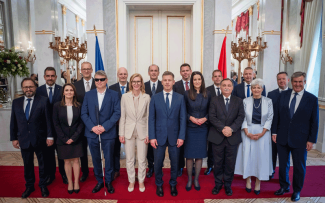
On 12 May, the TISZA government was sworn in after the party secured a landslide victory in the April election, bringing an end to the 16-year period of Fidesz dominance.[1] Unlike the outgoing government, which included 12 ministries, Magyar’s cabinet comprises 16. This reflects a further separation of public policy areas into a larger number of specialised ministries, thereby abandoning the so-called ‘super-ministries’. Although the increased number of ministries suggests decentralisation, in practice key decisions are likely to remain concentrated at the level of the prime minister. The TISZA government is characterised by a pronounced technocratic and expert-driven profile. Magyar has announced plans to form a cabinet based on competence and professionalisation, presenting it as an alternative to the personalised political model that emerged during Orbán’s rule. This implies a greater role for experts, managers and individuals with experience in the private sector and in managing large organisations, while maintaining a strong decision-making centre in the Prime Minister’s Office. The durability of this model will depend on the government’s ability to preserve cohesion within a group that brings together individuals whose ideological orientations do not always converge, as well as on ministers with limited political experience being able to establish public credibility.
The technocratic core of the cabinet corresponds both to the declared concept of depoliticising the state and to a management model resembling corporate standards. Operationally, this is likely to strengthen mechanisms for interministerial coordination, and place greater emphasis on efficiency and the achievement of objectives. A key role in this system is expected to be played by the Prime Minister’s Office, headed by Bálint Ruff, which is responsible for ensuring coherence across government activities. His appointment – given his previous analytical and journalistic background – is unusual, but aligns with the broader strategy of building a new institutional base. At the same time, some of the appointees have experience – albeit not at the highest levels – within the administration during the Fidesz era, including András Kármán, Anita Orbán, Dávid Vitézy and Romulusz Ruszin-Szendi. This points to a pragmatic approach to personnel selection and to the government’s limited human resources. Links to the former left remain limited, with only Bálint Ruff and Judit Lannert fitting this profile. The inclusion of figures enjoying public recognition is also intended to strengthen the government’s social legitimacy.
Table. Government line-up and ministers’ profiles
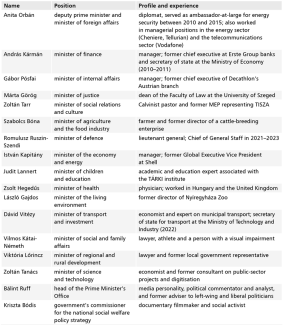
Source: Magyarország Kormánya, kormany.hu/kormanyzat.
Domestic policy: profound state restructuring and the dismantling of the NER system
Constitutional reform and the restoration of the rule of law following Péter Magyar’s assumption of power are intended to take the form of a coordinated legislative and institutional process aimed at reconstructing the principles governing the political system and restoring a genuine separation of powers. The key instrument will be the use of the government’s two-thirds parliamentary majority to introduce rapid constitutional amendments and reforms to key laws governing the political system. A central priority will be unlocking approximately €18 billion in EU funds from the Cohesion Fund and the Recovery and Resilience Facility, which remain conditional on reforms relating to rule of law, anti-corruption measures, transparency in public procurement, and media freedom.
An important point of reference will be the dismantling of the NER system (System of National Cooperation) created by Fidesz – a centralised model of governance based on political and economic networks. The planned reforms include strengthening the independence of the judiciary and the prosecution service, joining the European Public Prosecutor’s Office (EPPO), and rebuilding checks and balances through an enhanced role for parliament, regulatory institutions and greater transparency in the legislative process. The government has also announced broader systemic changes, including limiting the prime minister to two terms of office and reforming the method of electing the president in order to increase the office’s democratic legitimacy. However, this process will be constrained by the resilience of NER structures and the lengthy terms of office held by key officeholders, which may generate institutional tensions. At the same time, the first signs of weakening within the Fidesz camp are already evident, including some MPs declining to take up their mandates and growing distance between sections of the economic elite and the party.
Anti-corruption policy and greater transparency of state institutions are among the government’s main priorities. Plans include the establishment of the National Office for Asset Recovery and Protection (VNVH), which will be responsible for identifying and recovering assets derived from corruption and financial abuses committed during the Fidesz era. The institution is expected to cooperate with law enforcement bodies and EU institutions, while also analysing financial flows and ownership structures. Alongside this, the government has announced plans to establish specialised units focused on economic crime, digitalise and increase the transparency of public procurement procedures, and tighten regulations concerning conflicts of interest and asset declarations. These measures are also intended to support de-oligarchisation by limiting the influence of privileged business elites on the state and increasing transparency in political and economic networks.
The announced process of accountability will also include wide-ranging vetting procedures and the declassification of secret service archives, intended to expose the mechanisms through which the state functioned and the informal networks of influence that emerged after 1989. Magyar has announced a symbolic ‘day of truth’ for 22 October – on the eve of the 70th anniversary of the 1956 uprising. These measures are intended to support the restoration of the state’s credibility in the eyes of society and EU partners, but they also carry the risk of escalating political conflict and further intensifying polarisation.
The government has also announced plans to improve state efficiency, reduce politicisation and enhance the quality of public services. A key priority will be the depoliticisation of public administration through a greater role for competitive recruitment procedures, the professionalisation of management, and limiting the ruling party’s influence over staffing decisions, although a partial replacement of senior personnel in institutions linked to the NER system is also likely. The reforms will also include increasing the transparency of decision-making processes, digitalising administrative procedures, and reforming the management of state assets and state-owned enterprises.
At the same time, reforms of public services are planned, particularly in healthcare and education. In healthcare, the focus is expected to be placed on increasing funding, improving access to services and reducing regional disparities, while in education the emphasis will be on improving the quality of teaching and partially depoliticising the system. Measures aimed at expanding the autonomy of local governments are also possible. However, the scale and pace of the reforms will depend on the condition of the state budget, the unfreezing of EU funds, and the administration’s capacity to implement change.
Economic policy: a shift towards productivity while maintaining social transfers
Péter Magyar’s government has announced plans to revise the existing economic growth model by moving away from the selective support of large foreign investors in favour of increasing productivity and diversifying the economy. This implies reducing discretion in industrial policy and linking support for investors to developmental outcomes such as technology transfer, the development of local supply chains and higher value added. A key element of this reorientation is expected to be strengthening the small and medium-sized enterprise (SME) sector through reducing administrative barriers, improving access to financing and increasing SMEs’ share of public procurement. At the same time, the government plans to increase spending on research and development, and support the digital economy, and sectors with higher productivity.
Industrial policy will remain active but is expected to rely on more transparent and institutionalised support mechanisms. The government has announced a review of existing investment agreements, particularly in the electromobility and battery production sectors, and plans to make future assistance conditional on economic and environmental criteria. At the same time, openness to foreign direct investment will be maintained, with greater emphasis placed on geographical and sectoral diversification. The reforms are intended to be linked to improvements in the quality of state institutions and regulatory transparency, with the aim of reducing investment risks and improving the business climate. In the longer term, the objective is to transition away from a growth model based on low labour costs and public subsidies towards a more innovative economy. However, the scope of change will be constrained by Hungary’s heavy dependence on foreign investment and exports, as well as by institutional inertia, pointing to the gradual nature of the reforms.
TISZA has announced a more disciplined and transparent fiscal policy aimed at stabilising public finances and restoring the state’s credibility. The objective is to reduce the general government deficit to below 3% of GDP by 2030, while simultaneously increasing spending on healthcare and education. Financing is expected to rely on reducing inefficient expenditure, recovering funds lost through abuses and unlocking EU funding. The government also assumes that improving the quality of state institutions and increasing investor confidence will reduce debt-servicing costs and increase budget revenues.
The government plans to simplify the tax system and increase its progressivity. The programme envisages reducing income tax on the minimum wage from 15% to 9%, as well as lowering the tax burden for those earning below the median wage. At the same time, redistributive measures are planned, including a 1% tax on assets exceeding 1 billion forints (approximately PLN 11 million). The simplified tax regime for small businesses (KATA) is also expected to be reinstated, with the aim of reducing administrative barriers and limiting the size of the informal economy.
Magyar’s government has announced plans to expand social policy instruments while preserving key elements of the existing model, including subsidised household energy prices. This mechanism is expected to continue to serve a stabilising function, although gradual adjustments remain possible. The main social transfers are also expected to remain in place, including the 13th and 14th month pensions. The programme further envisages doubling family and maternity benefits, introducing a one-off childbirth grant and increasing the minimum pension. The government has also announced plans to increase housing construction, support the rental market and expand student accommodation infrastructure. The social policy model will therefore combine the retention of costly protective mechanisms with a moderate expansion of benefits, thereby increasing pressure on public finances. Implementing these measures will be complicated by fiscal tensions arising from the need to pursue budgetary consolidation while simultaneously raising public expenditure. In 2025, the budget deficit stood at 4.7% of GDP and public debt at 74.6% of GDP, while average economic growth between 2023 and 2025 amounted to only 0.1%. The success of the reforms will depend on the pace at which EU funds are unlocked, reductions in inefficient expenditure, and the maintenance of macroeconomic stability.
The energy policy of Magyar’s government is expected to take the form of a gradual reorientation, combining the diversification of energy sources with the preservation of price stability and security of supply. The strategic objective is to reduce dependence on Russia by phasing out Russian energy imports by 2035. However, this process is expected to proceed gradually and at a slower pace than the EU would prefer. Russia currently accounts for approximately 80–85% of Hungary’s gas imports and 70–80% of its oil imports. TISZA’s programme envisages accelerating the energy transition through the development of renewable energy sources – particularly solar power – improving energy efficiency, and greater integration with the EU market. EU funding, the expansion of transmission infrastructure, and regional cooperation are expected to play a key role. At the same time, the government has signalled that some existing energy ties with Russia will be maintained during the transitional period. The government has also announced a review of long-term agreements concluded with Moscow – including the agreement concerning the expansion of the Paks nuclear power plant – with regard to their economic viability, transparency, and compliance with EU regulations.
Foreign policy: pragmatic reintegration with the West
TISZA’s priority is to restore trust in relations with the European Commission and the EU’s core member states. The primary objective is to unlock approximately €18 billion from the Cohesion Fund and the Recovery and Resilience Facility, while also reducing financial penalties linked to migration policy, securing access to loans under the SAFE programme, and reintegrating Hungarian universities into the Erasmus programme. The party has declared its readiness to deepen integration in selected areas, including meeting the criteria for euro adoption by 2030, while avoiding explicitly federalist rhetoric. TISZA supports the protection of the EU’s external borders and the preservation of a significant role for member states in migration policy. It views EU membership primarily as a foundation for economic modernisation and regulatory stability.
Magyar’s party regards NATO as the primary guarantor of security and seeks to restore Hungary’s status as a predictable ally. This implies abandoning Orbán’s confrontational style of politics and reintegrating into the mainstream of transatlantic cooperation. TISZA declares its alignment with NATO and EU positions on the Russia–Ukraine war, but – like the previous government – opposes Hungary supplying weapons to Ukraine. The party has announced a review of foreign military missions, the abandonment of plans to deploy a contingent to Chad and the maintenance of alliance commitments, including the gradual increase of defence spending to 5% of GDP by 2035. At the same time, the government intends to develop the defence industry, strengthen cybersecurity, and increase oversight of military expenditure.
TISZA’s approach to Russia is markedly more critical than that of Fidesz. The party supports reducing energy dependence on Russia and maintaining the EU’s common sanctions policy. It has also pledged to refrain from using vetoes as an instrument in relations with Brussels. At the same time, TISZA stresses that Hungary should not become militarily involved in the Russia–Ukraine war. In practice, this would mean moving away from the political closeness to Russia, characteristic of the Orbán era, while preserving working relations – particularly in the energy sector.
TISZA’s position on Ukraine forms part of its declared reintegration with the EU and NATO. The party supports maintaining the EU’s common position on Kyiv and criticises the previous government’s use of vetoes, although its MEPs have repeatedly abstained or voted against certain instruments of financial support for Ukraine. The party opposes the supply of weapons from Hungary and emphasises the conditional nature of its support for Ukraine’s EU membership. Magyar has announced plans to hold a referendum before ratifying any future accession treaty. At the same time, the new government has signalled its willingness to pursue a more constructive dialogue with Kyiv on the rights of the Hungarian minority in Transcarpathia, treating the issue as a bilateral matter rather than as an instrument for blocking EU decisions. Nevertheless, support for Ukraine will remain conditional on progress in the protection of minority rights.
TISZA has declared its intention to rebuild stable transatlantic relations based on cooperation with the United States regardless of the political configuration in Washington. Unlike Fidesz, the party does not base its messaging on personal relationships with US politicians, but instead focuses on restoring Hungary’s credibility within the broader Western community. The United States is viewed as the principal guarantor of security and a key economic partner.
In relations with China, TISZA has announced a cautious revision of the existing policy. It does not intend to terminate cooperation on key economic projects, but seeks to subject them to greater transparency, parliamentary oversight, and compliance with EU standards regarding state aid, procurement and environmental protection. The party criticises the financing of infrastructure projects through Chinese loans and plans to review existing agreements. Particular importance is attached to the environmental impact of investments in the battery sector and to increasing the involvement of local communities in decision-making processes. At the same time, the party opposes the widespread use of temporary workers from third countries.
One of the main objectives of foreign policy is expected to be the rebuilding of trust within the Visegrád Group. However, TISZA views regional cooperation as a complement to European integration rather than as an alternative to relations with Brussels. This implies an effort to ‘normalise’ the V4 and restore cooperation in practical areas such as energy and infrastructure, without adopting a confrontational stance towards the EU. A symbolic indication of this approach was Magyar’s first foreign visit, which was to Poland. A potential obstacle to resuming regional cooperation may be tensions with the government of Robert Fico over the situation of the Hungarian minority in Slovakia and the Beneš decrees. Magyar has criticised Slovak legislation penalising challenges to the decrees and has signalled that the further development of bilateral relations will depend on resolving these issues.
The new government has announced that it will continue supporting the approximately 2 million Hungarians living outside the country’s borders, albeit in a more pragmatic and less ideological form than under Fidesz. Magyar has confirmed that dual citizenship and the right to vote by post will be maintained, while also announcing a review of the functioning of the system and greater transparency in diaspora funding. TISZA has also signalled its intention to depoliticise relations with minority organisations and to respond actively to violations of linguistic, educational and local self-government rights through bilateral dialogue as well as EU and international mechanisms.
Prospects and key risks
The prospects for implementing Magyar’s government programme are relatively favourable, primarily due to its constitutional majority and strong political mandate, which enable the rapid introduction of legislative and institutional changes. This may also be supported by clear political momentum in favour of resetting relations with the EU and, consequently, the potential unfreezing of EU funds. These resources constitute a key factor in stabilising public finances, supporting economic growth and financing part of the reform agenda. Another important advantage is the government’s technocratic profile, which may strengthen its capacity to implement public policies and improve the effectiveness of state governance. Internationally, a more predictable and cooperative foreign policy could help restore Hungary’s credibility within the EU and NATO.
Meanwhile, the scale and pace of the reforms will be constrained by a number of structural factors. The key challenge remains the resilience of the NER system created by Orbán as a network of institutional and personal connections encompassing the administration, prosecution service, economy and media. This may result in delays in implementing reforms, the selective application of new regulations, and disputes over competences. An additional constraint lies in the lengthy, often constitutionally protected terms of office held by key officeholders, which hinder rapid personnel changes and any genuine transformation of institutional practices. At the same time, the new leadership appears determined to remove representatives of the previous system from positions of power, particularly President Tamás Sulyok, whom Magyar has repeatedly called on to resign. Processes of accountability, vetting and de-oligarchisation – while forming one of the main pillars legitimising the new government – may also lead to an escalation of internal political conflict.
The main risks to the durability of Magyar’s government programme lie in the fiscal sphere, which could in turn lead to an erosion of public support. The adopted policy model assumes the simultaneous consolidation of public finances alongside the maintenance or expansion of costly social welfare instruments – including energy subsidies and social transfers – as well as increased spending on healthcare and education. This may generate significant budgetary pressures and suggests that the costs of the reforms have been underestimated. A key factor underpinning fiscal stability will be the unfreezing of EU funds. Delays in negotiations with the EU or the partial loss of funding – including resources from the Recovery and Resilience Facility – could significantly reduce the state’s fiscal space, forcing spending cuts or increased borrowing. In such a scenario, the government would face a choice between maintaining costly social policies and pursuing fiscal consolidation objectives, which could undermine the credibility of its economic strategy.
Consequently, the greatest political risk for Magyar’s government stems from the potential gap between public expectations – namely improving living standards and maintaining social transfers – and the state’s actual fiscal capacity. If the process of fiscal consolidation requires socially unpopular decisions, this could lead to a gradual erosion of support, particularly during the initial phase of the government before the positive effects of institutional and economic reforms become visible.
[1] I. Gizińska, ‘Elections in Hungary: the triumph of Péter Magyar’, OSW, 13 April 2026, osw.waw.pl.