The tragic consequences of Kyiv’s shortage of anti-ballistic defence capabilities. Day 1595 of the war

The Kostiantynivka area remains the scene of the most intense fighting. On 3 July, General Valery Gerasimov, Chief of the General Staff of the Armed Forces of the Russian Federation presented a report to Vladimir Putin regarding the complete capture of the town. A day later, Volodymyr Zelensky denied these claims, whilst Major Andriy Kovalov, a spokesperson for the General Staff of the Armed Forces of Ukraine (AFU), stated that Kostiantynivka remains under the control of Ukraine’s Defence Forces. These conflicting statements stem from the fact that a significant part of the town remains in the grey zone, although it is most likely that Russian forces have taken control of the majority of the urban area, that Ukraine only holds pockets of resistance in the northern part.
Although fighting for Kostiantynivka effectively began in September 2025, the pace at which Russian sub-units are infiltrating the town has accelerated in recent weeks. A similar situation is unfolding in the Kupiansk area, where Russian forces are reportedly advancing towards the northern part of the town of Kupiansk-Vuzlovyi (reports of groups penetrating the town centre should be regarded as premature at this stage). The DeepState group, which monitors the situation on the front line, estimates that the occupying forces seized 84 km² of Ukrainian territory in June, whilst the number of Russian assaults increased by 4.4%. This demonstrates that Russia has overcome the slowdown in the pace of its advance which was observed at the start of this spring (according to exaggerated estimates from Russian sources, the Russians occupied over 370 km² in June). This demonstrates the effectiveness of the tactic of infiltrating small sabotage groups in densely built-up areas and the reduced effectiveness of Ukraine’s unmanned aerial vehicles. The ‘drone line’ concept implemented by the AFU proves to be far more effective in open terrain, whereas in urban areas Russian assault groups exploit the opportunities for covert approaches and the concentration of forces.

Over the past week, Russian forces have stepped up their attacks on Kyiv, carrying out two massive and combined air strikes within the space of just a few days. First, on the night of 1 to 2 July, Russia carried out one of the largest attacks on the Ukrainian capital, using nearly 500 strike drones and 74 missiles, 28 of which were ballistic. As a result, damage was reported at around 130 locations, including 20 multi-storey residential apartment blocks and private homes. Ambulance stations and medical facilities were also hit, as well as a logistics centre and energy infrastructure facilities. According to Russian sources, defence industry facilities were also reportedly destroyed, including the Radionix plant (which manufactures, amongst other things, electronic components for Fire Point’s Flamingo missiles), Athlon Avia (a drone manufacturer) and Antonov (which assembles unmanned aerial vehicles). In total, 30 people were killed in the attack and over 100 were injured.
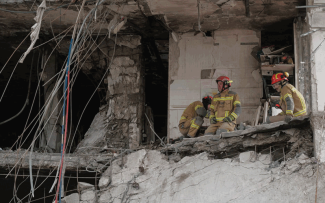
Another strike on Kyiv took place during the night of 5–6 July, this time involving 419 aerial munitions, including 29 ballistic missiles. Around 30 residential buildings were damaged, including high-rise buildings. 19 people were killed under the rubble, and over 60 were injured. In the village of Vyshneve, near Kyiv, an ammunition depot located amongst residential buildings was struck. As a result of the explosion, around 100 houses were damaged, seven people were killed and 29 were injured. Several hundred people were evacuated from the village due to the risk of further explosions. Given the scale of the explosion and its consequences, President Zelensky instructed the Security Service of Ukraine (SBU) to investigate the circumstances of the incident. Yurii Ihnat, a spokesperson for the Ukrainian Air Force, admitted that the strikes were the result of a severe shortage of missiles for the Patriot air defence systems. This was confirmed by Serhii Beskrestnov, an adviser to the Ukrainian Minister of Defence, who reported a critical shortage of missiles capable of intercepting ballistic missiles.
Apart from Kyiv, Zaporizhzhia is the target of daily attacks and remains within range of devastating glide bombs. The situation is similar in Kharkiv, where on 1 July Russian forces struck with at least seven glide bombs, killing a child and injuring more than 30 people. On 5 July, a drone attack there killed three people and injured 16. In Kherson, drone strikes continue to target civilian cars (30 June and 3 July), public transport vehicles (on 1 July, two people were killed and more than a dozen injured in such an attack) and administrative buildings (2 July). Other targets included Mykolaiv, where drone strikes hit multi-storey residential buildings on 2 and 4 July (11 people injured), Sumy (4 July), Dnipro (4, 5 and 6 July) and Odesa (4, 5 and 6 July).
According to data published by the Ukrainian Air Force Command, from the evening of 30 June to the morning of 7 July, Russia used a total of 1,437 attack drones and their decoys, as well as 155 various types of cruise and ballistic missiles. A total of 1,303 such targets were reportedly destroyed by air defence systems or neutralised.

On 1 July, the Ukrainian Defence Forces struck an oil refinery in Ufa and a Russian defence industry facility in Penza Oblast. The oil refinery in Ufa is located over 1,300 km from the Ukrainian-Russian border and has now been hit for the second time; however, there is still no information regarding the consequences of the attack. On 2 July, the Lukoil-Nizhegorodnefteorgsintez refinery in Kstovo, in Nizhny Novgorod Oblast, was reportedly struck – this is the fourth-largest oil refinery and the country’s second-largest fuel producer in terms of output.
On 4 July, the Ukrainian Defence Forces struck oil port infrastructure near St Petersburg and the main base of the Russian Federation’s Baltic Fleet in Kronstadt. Local Russian media reported that the St Petersburg Oil Terminal, one of Russia’s largest oil product transhipment terminals in the Baltic region, had likely been hit.
On 6 July, Russian sources reported an attack on the Yaroslavl Refinery, the port of Kerch and several facilities in occupied Crimea. Satellite images confirm a fire in the area of the refinery, which is owned by Slavneft. Meanwhile, in Kerch, an oil and gas terminal at the seaport is said to have caught fire following the attack. On the same day, the commander of Ukraine’s Unmanned Systems Forces, Robert ‘Magyar’ Brovdi, reported that Ukrainian drones had struck two oil tankers in the Sea of Azov. The Omsk Oil Refinery – located almost 2,500 km from the border with Ukraine – was also hit. According to a statement from the General Staff of the AFU, this facility was the last of Russia’s 11 largest fuel producers remaining out of range of long-range Ukrainian strikes.
In addition to the Omsk facility, the Ukrainian Ministry of Defence reported on 1 July that the Ukrainian Defence Forces had struck 11 refineries, seven fuel logistics facilities and eight military installations located on Russian territory in June. The attacks covered an area stretching from occupied Crimea and Krasnodar Krai to Western Siberia, with the maximum effective strike range exceeding 2,000 km (measured from the Russian-Ukrainian border). Meanwhile, according to the Polish analytical group Rochan Consulting, Russian refineries have been struck at least 194 times since the start of 2026, representing an 11-fold increase compared with the same period last year.

The SBU reported that it had prevented two Russian operations targeting the Ukrainian defence sector. In Lviv, an agent was detained who was allegedly preparing to set fire to a production hall at the premises of an arms manufacturer. In the second case, a research fellow at a Ministry of Defence academy was detained, having been alleged of passing on documentation concerning new Ukrainian strike drones to Russian military intelligence. The suspect was also alleged to have deliberately issued negative opinions about projects by Ukrainian arms manufacturers.

The Ministry of Defence has launched the first phase of a programme guaranteeing monthly drone deliveries to military units. The project is being implemented in collaboration with the General Staff and is intended to ensure a more consistent and predictable supply of unmanned aerial vehicles to brigades. Units will be able to select equipment via the DOT-Chain system and, if a particular model is unavailable, they will receive an equivalent with similar specifications. Deliveries are set to begin in July, and the programme will be gradually extended to other types of armaments and military equipment.
The Ukrainian government has standardised the rules for recruiting foreign volunteers in order to increase their intake into the Armed Forces. On 3 July, Defence Minister Mykhailo Fedorov announced the adoption of a procedure concerning foreign nationals and stateless persons who wish to voluntarily join the Ukrainian army. The new rules cover the entire process – from arrival in Ukraine to the signing of a military contract. Only Ukrainian companies listed by the Centre for the Recruitment of Foreigners and Stateless Persons will be authorised to handle candidates’ applications; these companies will be responsible for their documentation, insurance, travel arrangements, accommodation and meals.
The government has tightened the rules for how companies can be designated as being critical to the economy. This step is being taken to limit the possibility of deferring the mobilisation of these companies’ employees. Under the regulation of 1 July, existing decisions on the status of enterprises will remain in force only until the end of their validity period—at the latest until 1 September. By that time, companies must confirm that they meet the new criteria, primarily an appropriate level of remuneration – at least three times the minimum wage. According to the Minister for the Economy, Oleksiy Sobolev, the number of people covered by the exemption has increased by 300,000 over the last 12 months (in May, he reported that the figure stood at 1.4 million employees).
On 4 July, President Zelensky announced the decision to establish a new Academy of the Ukrainian Naval Forces in Odesa. He made the announcement to mark Naval Forces Day, presenting the initiative as part of the development of the Ukrainian Navy and Odesa itself, and as a response to the needs of the naval forces. Meanwhile, on 5 July, Dmytro Pletenchuk, spokesperson for the Ukrainian Navy, reported that, since the Black Sea export corridor began operating, over 8,000 civilian vessels had already used it. According to Pletenchuk, the stable security of the route, which has been operating for over two and a half years, has enabled Ukraine to return to pre-war export volumes for certain categories of goods. He emphasised that the corridor’s operation relies on the activities of unmanned vessels operated by the Ukrainian Navy and other components of the Defence Forces, which have paralysed the operations of the Russian fleet.

Russia is using the MAX messaging app to recruit residents of the occupied territories of Ukraine. According to the National Resistance Centre, residents of these areas receive messages via the app encouraging them to join the Russian army’s unmanned systems units. The campaign is aimed primarily at young people and those in financial difficulty. In reality, it is intended to replenish the Russian army’s personnel losses and, once they have signed a contract, recruits will be assigned to infantry units or assault squads.
A report published on 1 July by the US Centre for Strategic and International Studies provided estimates of the rising casualty rate in the Russian army – from February 2022 to June 2026, these were expected to have reached as many as 450,000 killed and 1.4 million total casualties (killed and wounded). Furthermore, Russia’s monthly losses, exceeding 30,000 men per month in 2026, have likely already outstripped the recruitment rate, which stands at around 27,000 per month. The ratio of Russian to Ukrainian casualties rose in the first half of 2026 to almost 8:1, compared with a ratio of between 2:1 and 3:1 for much of the war.

On 30 June, during a visit by Swedish Defence Minister Pål Jonson to Kyiv, an agreement was signed for Ukraine to purchase 16 JAS-39 Gripen multi-role fighter aircraft in the latest E/F version, along with a package of armaments, spare parts and training. The cost of the transaction will be 24.6 billion Swedish kronor (approx. $2.5 billion) and they are due to be delivered between 2029 and 2030. This is the first implementation agreement under a framework agreement for 150 of these aircraft which Ukraine intends to purchase using funds from a €90 billion loan from the European Union. To complement the agreement, Sweden has announced its 22nd military aid package for Ukraine, comprising a donation of 16 JAS-39 Gripen fighter aircraft in the older C/D variant, with deliveries to begin in spring 2027. Importantly, this package is also set to include MBDA Meteor air-to-air missiles – the most advanced and longest-range missiles at the disposal of European nations.
On 30 June, Denmark announced its 30th military support package for Ukraine, worth 4.4 billion Danish kroner ($670 million), of which 1.3 billion kroner ($200 million) will be allocated to orders for the Ukrainian defence industry. This includes, amongst other things, additional donations of ammunition, weapons and other equipment for the Ukrainian defence, as well as increased funding for Danish training programmes for Ukrainian soldiers.
On 30 June, Ukraine purchased 155 mm artillery shells and propellant charges worth several tens of millions of euros from Rheinmetall; these are due to be delivered in 2027. On 2 July, the Ukrainian Ministry of Defence announced that it plans to purchase around 100 PAC-3 MSE missiles using funds from a European Union loan. On 3 July, the Norwegian company KONGSBERG and the Ukrainian defence technology firm DevDroid signed an agreement paving the way for extensive, long-term cooperation on the production of existing unmanned systems and the development of new ones.
On 4 July, during President Zelensky’s visit to the Navy headquarters in Odesa Oblast, it was revealed that the Navy is equipped with Norwegian Naval Strike Missiles (NSM), which were supplied by an undisclosed donor, most likely Norway itself.