Bulgaria’s elections: Radev secures a breakthrough victory
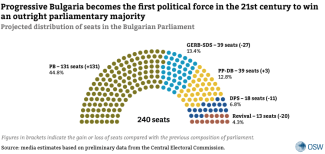
Following the parliamentary elections held on 19 April, the conservative-social bloc Progressive Bulgaria (PB), led informally by former president Rumen Radev, has emerged as the clear winner. With 97.5% of votes counted so far, it has secured 44.7% of the vote, translating into approximately 130 seats and an outright majority in the 240-seat parliament. Second place has gone to Boyko Borisov’s centre-right GERB-SDS with 13.4%, followed by the pro-European coalition We Continue the Change – Democratic Bulgaria (PP-DB) with 12.8%. Other parties entering parliament include the Movement for Rights and Freedoms (DPS; 6.8%), which nominally represents the Turkish minority, and the nationalist Revival (4.3%). Voter turnout was estimated at 50%, the highest level since 2017.
PB’s victory is likely to stabilise the country’s political situation. At the same time, the alliance may struggle to meet public expectations regarding the implementation of deep reforms and the tackling of corruption. Radev has called for restoring relations with Russia and has criticised support for Ukraine, but he is unlikely to block EU assistance to this country.
Commentary
- The election result represents a major success for Progressive Bulgaria, which has become the first political force in the 21st century to secure an outright majority. Radev’s bloc was the favourite, but the scale of its victory has come as a surprise: only a handful of polls gave it more than 35% of the vote. By contrast, GERB-SDS recorded its worst result on record, having lost support in the wake of last year’s mass protests. Faced with mounting public pressure, the government of Rosen Zhelyazkov resigned in December 2025 (see: ‘Bulgaria: government falls under pressure from public protests’). A month later, Radev also stepped down as president to engage in party politics (see: ‘Bulgaria: President Radev resigns’).
- PB rode a wave of public frustration stemming from more than five years of political instability. The latest election was the eighth since 2021; during that period, only Zhelyazkov’s cabinet remained in power for more than a year. By resigning, Radev sought to tap into the protesters’ anti-corruption sentiment and to capitalise on his personal popularity. As head of state, he had enjoyed the highest level of public trust among politicians and cultivated an image of independence from party structures. During the campaign, he employed broad and often populist slogans to attract the widest possible range of voters. According to an Alpha Research poll, PB drew its strongest support (34%) from those aged 18–30, who were seen as the driving force behind last year’s protests. The electorate of Radev’s bloc is diverse: 25% of its voters did not take part in the previous elections held in October 2024, 11% voted the pro-European PP-DB and 12% supported the nationalist parties Revival or MECh (Sword).
- The overriding objective of the victorious bloc is to ‘dismantle the oligarchic-corruption model’, embodied by Borisov and the oligarch and DPS leader Delyan Peevski. PB aims to curb their influence through measures such as appointing a new Supreme Judicial Council and tightening oversight of public procurement. However, the party has not presented a credible plan for reforming state institutions and tackling corruption, relying instead primarily on slogans (see: ‘The president’s new clothes: Bulgaria ahead of parliamentary elections’). Moreover, key judicial reforms will require cross-party cooperation, most likely with PP-DB, to secure a two-thirds majority in parliament.
- The next parliament is set to become more consolidated. During its previous term, as many as nine parties held seats owing to increasing fragmentation. This time, several parties will fail to enter parliament, including GERB-SDS’s partners in Zhelyazkov’s cabinet – the national-conservative There Is Such a People (ITN) – and, for the first time in its history, the post-communist Bulgarian Socialist Party – United Left (BSP-OL). The nationalist camp has also been markedly weakened: MECh and Majesty have failed to cross the electoral threshold, while Revival will lose more than half of its deputies.
- A future PB government may steer Bulgaria away from the EU’s foreign policy mainstream. As president, Radev criticised sanctions on Russia and military aid to Ukraine, but during the campaign he shifted his focus to domestic issues. Only on the final day of the campaign did he state that he would not seek to block the EU’s support mechanisms for Ukraine, while also declaring that he did not intend to participate in them, echoing the stance of the Czech Republic, Slovakia, and Hungary. At the same time, he voiced support for ‘normalising’ relations with Moscow and resuming imports of Russian energy resources. In the past, however, Radev used such rhetoric mainly for domestic political purposes and to appeal to pro-Russian voters; in his dealings with Western partners, he adopted a far more constructive stance than, for example, outgoing Hungarian Prime Minister Viktor Orbán.