


The president’s new clothes: Bulgaria ahead of parliamentary elections
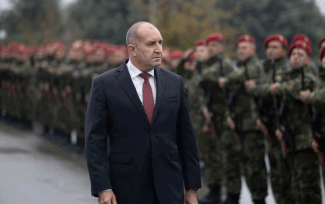
On 19 April, Bulgaria will hold its eighth parliamentary election in five years. Unlike previous elections, this one is likely to produce a clear winner. Current polling suggests that the frontrunner is Progressive Bulgaria (PB) – a new political force with a centre-left (but socially conservative) profile. The former president Rumen Radev, who stepped down in January 2026, is PB’s unofficial leader. A victory for PB could help stabilise the political landscape and bring greater cohesion to the fragmented National Assembly.
Even so, PB is unlikely to secure a governing majority on its own. The choice of coalition partners will therefore be critical, particularly with regard to the direction of foreign policy. During the campaign, Radev has avoided setting out clear positions on future domestic and international priorities, relying instead on broad slogans. His track record as president, however, suggests that Bulgaria may adopt a moderately Eurosceptic stance and pursue the normalisation of relations with Russia.
Radev’s gambit
The snap parliamentary election was triggered by the resignation of Rosen Zhelyazkov’s government under pressure from mass protests.[1] In late November and early December 2025, hundreds of thousands of people took to the streets across the country, demanding the cabinet’s dismissal in response to systemic corruption and the politicisation of public institutions. The notion of a ‘captured state’ has come to be associated with Boyko Borisov – former prime minister and leader of the then largest ruling party, Citizens for European Development of Bulgaria (GERB) – and Delyan Peevski, an influential oligarch under US and UK sanctions and head of the Movement for Rights and Freedoms (DPS), which nominally represents the Turkish minority.
Radev used the latest political crisis to enter party politics. On 19 January, he stepped down as president a year before the end of his second and final term.[2] He thus hoped that the pledge in his farewell address – to dismantle the corrupt, oligarchic model of power – would resonate with protesters. At the same time, he sought to capitalise on his high public trust ratings (44% a week before his resignation)[3] and his image as a politician outside the party establishment. Bulgaria’s constitutional system allowed him to transfer his duties to Vice President Iliana Iotova. Time and procedural constraints prevented him from registering a new party. Instead, in early March he brought together three marginal groupings to form a coalition, Progressive Bulgaria, which will contest the April parliamentary elections.
An ideological and organisational ‘big tent’
The organisational core of PB consists of the former president’s close associates. Although Radev is the public face of the project, its formal leaders are Galab Donev – a former caretaker prime minister (2022–2023) and head of the presidential office (2023–2026) – and Dimitar Stoyanov, who served for many years as secretary general (2017–2022) and secretary for security (2023–2026) to the head of state. Alongside them, leading positions on PB’s electoral lists are held by ministers from interim governments formed by Radev during the political crisis.
Until December 2023, the president could appoint successive caretaker prime ministers at his discretion, thereby effectively steering the country’s affairs. The presidential powers were subsequently reduced. Following constitutional amendments, the president now selects the head of an interim government from a group of ten senior state officials, including the speaker of parliament and the ombudsman.[4] PB’s electoral lists also include active politicians – former members of the post-communist (and previously pro-Russia) Bulgarian Socialist Party – United Left (BSP–OL), which supported Radev in the presidential elections of 2016 and 2021 – as well as representatives of the nationalist Internal Macedonian Revolutionary Organisation – Bulgarian National Movement (VMRO–BND), which also backed him. The lists further feature respected local figures – doctors, entrepreneurs, and military officers – as well as athletes, including an Olympic karate champion.
Since stepping down, Radev has avoided setting out clear ideological positions and has kept his media appearances to a minimum. When he does speak publicly, he tends to rely on broad and general slogans. The central message of his campaign has been a promise to ‘dismantle the oligarchic-corruption model’ – a system whose long-standing presence provoked mass protests at the end of 2025.
Bulgaria ranks last in the EU on Transparency International’s Corruption Perceptions Index, tied with Hungary, and has recorded its lowest score since the current methodology was introduced. Addressing corruption is therefore the core pillar of PB’s electoral platform. However, the platform offers few specifics as to how public institutions would be reformed. One of the few concrete proposals is to appoint a new Supreme Judicial Council, which would, in turn allow for the replacement of the prosecutor general, who has been serving unlawfully in an acting capacity for the past eight months. This step would require a two-thirds majority in parliament.
In the field of economic policy, PB has put forward a set of proposals that may prove difficult to reconcile. It pledges to maintain a liberal fiscal framework, including a flat income tax rate of 10%, a low budget deficit, and tax relief for businesses. At the same time, it promotes social measures such as higher wages and reduced inequality. These proposals may resonate with voters. Despite steady economic growth – averaging 4% between 2021 and 2025 – and low unemployment of 3.5% in 2025,[5] Bulgaria remains the EU’s poorest country by many indicators, with up to 30% of its population at risk of poverty.[6]
On international issues, PB declares active cooperation within the EU and NATO, albeit ‘with particular emphasis on protecting Bulgarian national interests’. This may signal a more assertive stance by PB towards selected EU policies, for example in the areas of energy, climate, or the budget. As regards the war in Ukraine, it tersely supports a ‘just and lasting peace’.[7]
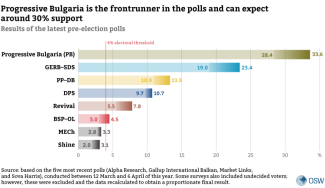
Radev’s strategy, close to the concept of a non-ideological party (a so-called catch-all or big tent party), is intended to attract the broadest possible spectrum of voters. His media restraint and widely accepted anti-corruption, reform-oriented message also allow him to maximise the advantages of his position as a former president, seen as a non-partisan authority. So far, this approach has produced the desired effect. PB is the clear leader in the polls and has a realistic chance of securing around 30% of the vote (see Appendix). Radev has stated that he will not steer the party ‘from the sofa’, suggesting that his ambition is to assume the post of prime minister.
The ‘centre-east’ project
Radev’s track record as head of state suggests that PB will ultimately adopt a nationalist-left and moderately Eurosceptic profile. For years, he remained closely aligned with the ideological foundations of the BSP–OL, which supported him – namely social conservatism and socially oriented economic policies. However, his ambitious, though largely unspecified, domestic reform pledges were not reflected in the actions of the interim governments he appointed, including that of Donev, which operated without parliamentary backing.
Radev also shared with the post-communist camp an ambivalent attitude towards the EU and NATO, alongside a recognition of historically strong ties with Moscow. As president, he avoided openly criticising Russia’s full-scale invasion of Ukraine and opposed the provision of Bulgarian military support to Kyiv. This cautious approach resonates with segments of Bulgarian society. Only 14% view Russia as an enemy of the EU, compared with a European average of 48%, while 29% assign primary or sole responsibility for the outbreak of the war to Ukraine, compared with a European average of 9%.[8]
At the same time, Radev balanced his domestically critical rhetoric towards the West with a more pragmatic approach in his relations with EU and NATO partners. He supported Euro-Atlantic cooperation and, drawing on his background as a former air force commander, favoured increased defence spending. This dual approach has led some analysts to describe his political project as ‘centre-east’: positioned between competing domestic camps, while leaning moderately towards sovereigntist and pro-Russian positions in foreign policy.[9]
More voters, fewer parties in parliament
Last year’s public mobilisation is likely to translate into higher voter turnout. The protests against Zhelyazkov’s government saw an unprecedented level of participation among young people. However, the protests did not give rise to a new political movement. Instead, they temporarily boosted support for the pro-European coalition We Continue the Change – Democratic Bulgaria (PP–DB), which co-organised the demonstrations and included some of their active participants on its electoral lists. Radev also supported the public opposition to the government, although protesters distanced themselves from any association with him. Even so, his anti-corruption messaging may enable his party to benefit from this wave of public mobilisation. Regardless of how individual parties perform, forecasts point to higher turnout, likely exceeding 50% – its highest level since the 2017 election.
Bulgaria has a long-standing pattern of coalition or minority governments. In the 21st century, no party has governed alone. Since 2021, inter-party antagonisms have pushed the country into a cycle of repeated snap elections.[10] This reflects both limited support for the leading party – no party has secured more than 30% of the vote since 2017 – and the design of the electoral system. The Hare–Niemeyer method, used since 2014 to allocate seats, favours small and medium-sized parties with strong regional bases at the expense of nationwide winners. It was intended to ensure balanced representation, including for the party representing the Turkish minority, which accounts for around 8% of the population and is concentrated in a limited number of constituencies. In practice, however, it can produce paradoxical outcomes. For example, such a party may secure a seat in areas where it receives as little as 1% of the vote, including in Sofia.[11] The relatively low electoral threshold of 4% further weakens the largest party and contributes to the fragmentation of parliament.
A strong result for Radev’s party is likely to favour the consolidation of the National Assembly. In the previous term, it comprised as many as nine parties. Some of these have been significantly weakened by the emergence of the former president’s political project. Compared with the parliamentary elections of October 2024, 63% of supporters of the centre-left BSP–OL, 47% of the pro-Russia Revival party and 21% of the liberal PP–DB now intend to vote for PB.[12] At the same time, parties that benefited from the period of political instability may fail to cross the electoral threshold, including the nationalist MECh and Majesty, as well as the populist There Is Such a People (ITN). Well-established parties are also in crisis. The BSP–OL has been discredited by its participation in the last government, while the Alliance for Rights and Freedoms (APS), led by Ahmed Dogan and representing the Turkish minority, has been marginalised under pressure from the rival oligarch Peevski, who competes for the same electorate. Increased voter mobilisation may also weaken GERB, which for the first time in its history, risks securing less than 20% of the vote.
Coalition scenarios
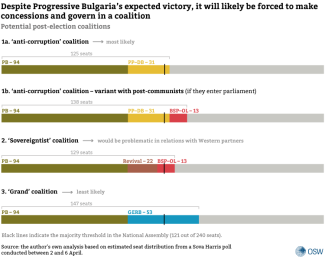
Despite PB’s expected victory, it is unlikely to be able to form a government on its own. A projected result of around 30% would give it approximately 85–95 seats in the 240-member National Assembly. A majority could be secured through a coalition with the pro-European PP–DB, which shares with Radev calls for the reform of public institutions and an anti-corruption agenda. Its leader, Asen Vasilev, has not ruled out cooperation with the former president’s party in order to carry out reforms of the judiciary. He himself served as finance minister in 2021 in one of the interim governments appointed by the head of state. However, this brief cooperation quickly turned into conflict, and in subsequent years Radev sharply criticised PP–DB, including over its attempt to form a rotating government with GERB.[13]
Differences over foreign policy may also stand in the way of an agreement between the two parties. PP–DB is close to the EU mainstream position and supports, among other things, continued military assistance to Ukraine and sanctions on Russia – positions contested by Radev. During the election campaign, he also criticised the caretaker prime minister Andrey Gyurov (a former PP MP) for signing an intergovernmental agreement on security cooperation with Kyiv.
Given the divergence with PP–DB on foreign policy, Radev may seek cooperation with the nationalist camp. Broadly, he shares with the most radical group in this camp, Revival, a commitment to the normalisation of relations with Moscow, an anti-corruption agenda, and a conservative approach to social issues. Such a coalition could, however, prove problematic in terms of its image, particularly in relations with Western partners. Revival is openly pro-Russia, having signed a cooperation agreement with Vladimir Putin’s United Russia party, and is anti-EU and revisionist towards North Macedonia and Ukraine.[14]
Throughout his presidency, Radev sought to avoid open conflicts with key international partners. At the same time, nationalist parties have lost support following the emergence of Progressive Bulgaria, and cooperation with them may not be enough to secure a majority. The same challenge applies to other, potentially more viable partners – the less radical MECh or the BSP–OL, which is ideologically close to Radev – as they may fail to cross the electoral threshold. In such circumstances, he could attempt to form a minority government, relying on ad hoc support from Revival or PP–DB. This would, however, result in an unstable cabinet with limited capacity to govern.
A ‘grand coalition’ with GERB appears unlikely, although it cannot be ruled out in the absence of other options. Its leader has signalled a willingness to cooperate with Radev, but such an arrangement would be problematic for the former president. For years, he was a vocal critic of GERB and supported protests against the governments of Borisov and Zhelyazkov. Entering into such a coalition would also contradict his pledge to ‘dismantle the corrupt, oligarchic model’ and would significantly reduce the prospects for domestic reform. Even so, a desire to retain power could prompt Borisov to make concessions, for example on judicial reform. At present, the only clear ‘red line’ for Radev appears to be cooperation with Peevski’s DPS, as this would entail significant reputational costs. Moreover, Peevski is unlikely to relinquish his extensive influence over the judiciary, which underpins both his political and financial interests.
A sovereigntist turn?
A potential Radev government would likely diverge from the EU mainstream in certain areas. If he were to become prime minister, he might seek to block or at least slow the ratification of further sanctions on Moscow and aid packages for Kyiv. He could also advocate the resumption of imports of Russian hydrocarbons, which Bulgaria has not purchased since 2024, at least under long-term contracts.[15] At the same time, he would probably pursue a more pragmatic approach at the EU level – closer to that of Slovak Prime Minister Robert Fico than to Hungarian Prime Minister Viktor Orbán, who has obstructed EU decision-making. Radev shares with Fico both a nationalist-left orientation and a background in the local structures of the former communist party.[16]
The direction of Sofia’s foreign policy will ultimately depend on the coalition that emerges. Cooperation with mainstream pro-European and pro-NATO partners such as PP–DB or GERB, possibly alongside BSP–OL, could constrain Radev’s neutralist or pro-Russia tendencies. In recent years, international issues have also taken a back seat in Bulgaria due to the prolonged political crisis. As a result, Radev may prove willing to align foreign policy with the positions of his coalition partners who have co-governed the country over the past few years.[17] By contrast, an alliance with nationalist parties would likely sharpen Eurosceptic and sovereigntist rhetoric, while reinforcing Bulgaria’s negative perception within the international community as an unpredictable and internally unstable member of the EU and NATO.
APPENDIX
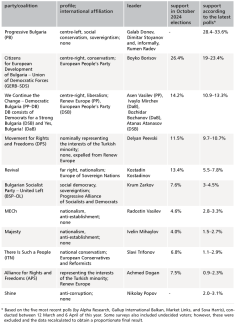
Table. Key political actors in Bulgaria and their levels of support
[1] J. Nowinowski, ‘Bulgaria: government falls under pressure from public protests’, OSW, 12 December 2025, osw.waw.pl.
[2] Idem, ‘Bulgaria: President Radev resigns’, OSW, 20 January 2026, osw.waw.pl.
[3] ‘„Маркет ЛИНКС”: ГЕРБ-СДС остава първа сила, но с драстичен спад’, bTV Новините, 12 January 2026, btvnovinite.bg.
[4] Ł. Kobeszko, ‘Amendments to the Bulgarian constitution: a way to overcome the political crisis’, OSW, 5 January 2024, osw.waw.pl.
[5] Data from the Bulgarian National Statistical Institute – nsi.bg.
[6] ‘People at risk of poverty or social exclusion in 2024’, Eurostat, 30 April 2025, ec.europa.eu.
[7] Програма на коалиция, Прогресивна България, 2025, progresivnabulgaria.com.
[8] Data based on a survey conducted by the ECFR in November 2024 in 14 European countries (including 11 EU member states). See J. Puglierin, A. Varvelli, P. Zerka, Transatlantic twilight: European public opinion and the long shadow of Trump, European Council on Foreign Relations, 12 February 2025, ecfr.eu.
[9] The term ‘centre-east project’ was coined by the Bulgarian analyst and sociologist Parvan Simeonov.
[10] See Ł. Kobeszko, ‘A country of interim governments. The political crisis in Bulgaria and the attempts to solve it’, OSW Commentary, no. 600, 3 June 2024, osw.waw.pl.
[11] Historically, the Hare–Niemeyer method has also favoured the so-called urban centre-right – pro-European, liberal-conservative parties that draw most of their support from Sofia, which is home to around 20% of the country’s population.
[12] П. Куртева, ‘Готовност да гласуват на предстоящите избори са заявили около 51%, сочи проучване на „Галъп интернешънъл болкан“’, Българската телеграфна агенция, 9 March 2026, bta.bg.
[13] See Ł. Kobeszko, ‘Bulgaria: a failed government reshuffle and another early election’, OSW, 11 April 2024, osw.waw.pl.
[14] J. Nowinowski, ‘A nationalist voice of protest: the resurgence of radical parties in Bulgaria’, OSW Commentary, no. 683, 27 August 2025, osw.waw.pl.
[15] A subsequent journalistic investigation revealed instances of Russian oil being supplied to Bulgaria by vessels belonging to the so-called shadow fleet. See M. Tkach, ‘Russia continues to ship oil directly to the EU despite sanctions, investigation finds’, Ukrainska Pravda, 26 November 2024, pravda.com.ua/eng.
[16] Radev was a member of the Bulgarian Communist Party from 1985 to 1990, which at the time was a requirement for obtaining an officer’s rank in the armed forces. When he ran in the 2016 presidential election, he was supported by the BSP, but he did not join the party.
[17] In recent years, both PP–DB and GERB governments have pursued a largely reactive foreign policy, albeit one aligned with the EU mainstream.