Parliamentary elections in Slovenia: a close result with a slight advantage for the Freedom Movement
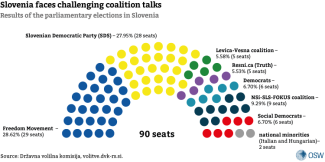
In Slovenia’s parliamentary elections held on 22 March, the liberal Freedom Movement of Prime Minister Robert Golob emerged victorious with 28.62%, edging out Janez Janša’s conservative Slovenian Democratic Party (SDS, 27.95%). Five other parties also entered the unicameral parliament. Third place went to a centre-right coalition comprising New Slovenia – Christian Democrats (NSi), the Slovenian People’s Party (SLS), and FOKUS. It was followed by the Social Democrats (SD, a coalition partner), the centre-right Democrats, and the Levica-Vesna (L-V) coalition. The populist Resni.ca party came last (see Chart). In the 90-member National Assembly, two seats are reserved for national minorities – Italian and Hungarian.
The small gap between the two largest parties and the highly fragmented parliament will make it challenging to form a stable majority. The governing Freedom Movement has a greater chance of forming a coalition, but early elections cannot be ruled out.
Commentary
- The near tie between the two largest parties, together with a fragmented parliament, will complicate coalition talks. The populist Resni.ca has emerged as a potential kingmaker. It has an anti-establishment profile, but its leaders have spoken out forcefully against forming a coalition with Janša, blaming him for restrictions imposed during the COVID-19 pandemic. Resni.ca has already set stringent conditions for forming a coalition government, demanding control of the interior, foreign, and finance portfolios. The Democrats could also play an important role. This party emerged from a split within the SDS and is led by Anže Logar, a former foreign minister in Janša’s government.
- The liberal Freedom Movement has a greater chance of remaining in power. It performed better than predicted in pre-election polls, although it lost 12 seats compared with the previous term and will be unable to form a government with its existing left-green coalition partners, who hold a combined 40 seats, which is short of the 46 needed for a majority. To remain in power, Golob would need to attract the Democrats and possibly also Resni.ca. Neither party ruled out this option during the campaign.
- Janša fell short of the expected victory and his chances of returning to power are slim. Since last year, polls have indicated a likely win for the former prime minister, however, the final poll published on Friday, just ahead of the election, showed a slight lead for the Freedom Movement. The SDS improved its result by just one seat compared with the 2022 election. Janša’s natural coalition partners are NSi-SLS-FOKUS and the Democrats, but such an alliance would command only 43 seats. Even with the support of two conservative representatives of national minorities, it would still fall one vote short of a minimum majority, meaning it would need to secure the backing of at least some Resni.ca MPs. However, the SDS is demanding a recount and is challenging the procedure for early voting by post and voting outside one’s place of residence.
- The election campaign was primarily driven by polarisation between the two main rivals, with little attention paid to public policy. On this front, the opposition (SDS) called for economic deregulation and increased defence spending. Golob’s cabinet aims to spend up to 3% of GDP on defence, while Janša pledged to meet NATO’s expectations of 5%. The government focused on proposals to support private housing investment and curb speculation in this market. The Freedom Movement also called for Palestinian independence and criticised Donald Trump’s policies. By contrast, the SDS emphasised its support for the US president and its good relations with Israel. Both parties favour EU enlargement to the Western Balkans, although Janša has criticised the current EU Commissioner for Enlargement, Marta Kos, citing her links to Golob. The SDS and the Freedom Movement also share a critical stance towards Russia, although Janša has been more explicit in his support for Ukraine.
- In the final stage of the campaign, the outcome was influenced by a wiretapping scandal and the presence of an Israeli intelligence company in Ljubljana. Initially, the recordings appeared likely to undermine the governing camp, as they purported to contain evidence of corruption within the ruling elite. Ultimately, however, the scandal backfired on the SDS, when non-governmental organisations revealed that representatives of the Israeli firm Black Cube had been in contact with Janša. Government politicians linked this fact to the recordings, noting that the company had been hired for similar operations in other countries, including Romania and the United States. Janša later confirmed that he knew one of the company’s executives and had met him ‘socially’. The Slovenian Intelligence and Security Agency (SOVA) also documented the activities of Israelis in Slovenia, exposing foreign interference in the campaign, including bot attacks. This could have shifted public sentiment shortly before the vote, particularly given that Slovenian public opinion tends to sympathise with Palestine. The involvement of the Tel Aviv-based private firm may have been perceived as interference in national sovereignty and an attempt to oust one of the EU’s most outspoken critics of Israel.