The Great Russian Firewall
I. THE INTERNET AS AN ELEMENT OF SOCIAL LIFE IN RUSSIA
II. THE LAST DOMAIN OF FREEDOM IS SHRINKING.. 3
III. THE KREMLIN’S GOALS IN ITS STRUGGLE WITH RUNET AND ITS EFFECTS TO DATE
IV. THE KREMLIN’S RECENT OFFENSIVE AGAINST RUNET: OBJECTIVES AND TOOLS
V. THE REGIME VS RUNET: PROSPECTS
APPENDIX. The most popular online platforms and social networks in Russia
MAIN POINTS
- In recent decades, the internet in Russia (Runet) has been widely used as a means of accessing information, a platform for social interaction and an important part of the lifestyle of the Russian public, particularly among younger generations. For a long time, it remained a relatively free space, used primarily for entertainment and services, but also for the exchange of opinions. Estimates from 2023 indicated that content from independent media regularly reached between 6 and 9% of Russia’s adult population.
- The growing importance of the internet and social networks, combined with the increasingly authoritarian nature of Russia’s political regime, has made the government more determined to restrict the freedom of Runet – the segment of the internet under state jurisdiction.
- Since the start of the full-scale war against Ukraine, the Russian authorities have undertaken increasingly effective efforts to censor the internet and restrict citizens’ access to cyberspace. This is both a consequence of, and a key element in, reinforcing the neo-totalitarian trajectory of domestic policy. The years 2024–2025 marked a qualitative shift, characterised by regular shutdowns of mobile and fixed internet access in selected regions. During such periods, only websites and services that are on a government-approved list remain accessible. Efforts have also intensified to replace foreign platforms and online services with domestic equivalents, which are kept under full control of the security services.
- The Kremlin’s goal is internet ‘autarky’: the creation of a self-contained online ecosystem that satisfies users’ needs for information, entertainment and public services, while isolating Russians from independent sources of information and enhancing surveillance capabilities. This is intended to facilitate large-scale, uninterrupted indoctrination of society and prevent the self-organisation of discontented citizens via the internet. From the authorities’ perspective, this represents one of the essential conditions for ensuring the regime’s stability amid growing economic problems, the lack of meaningful progress on the front line, and the rising social cost of the war – especially in the context of the so-called State Duma elections scheduled for September 2026.
- While a fully effective information blackout in Russia still appears unlikely, the government’s actions are likely to result in a further increase in self-censorship and political apathy among internet users, as well as a significant reduction in the reach of independent media. As a result, predicting the dynamics and scale of public protest is likely to become even more difficult.
1. THE INTERNET AS AN ELEMENT OF SOCIAL LIFE IN RUSSIA
The internet is widely used in Russia and forms an integral part of everyday life for the population. By the end of 2025, 136 million people – around 94% of the population – were online.[1] According to data from Mediascope, a company that monitors media trends, 84% of Russians accessed the internet daily between January and March 2025, spending an average of 4 hours and 33 minutes online. The highest usage rate (92%) is recorded among those aged 12 to 54. People aged over 65 use the internet far less frequently (48%) and for a shorter duration – just over two hours.[2] The Russian search engine Yandex is the leading provider, although Google remains relatively popular. Among online platforms, the Russian service VKontakte (VK) dominates as the main social network, while Telegram and WhatsApp are the most widely used messaging apps. The position of the latter is becoming increasingly uncertain due to the imposition of new restrictions.[3] Despite efforts by the Russian authorities to slow its performance, YouTube remains the most popular video platform, although domestic competitors such as VK Video and Rutube are becoming increasingly important. Russians also frequently use e-commerce platforms like Ozon, as well as multifunctional portals such as Mail.ru, which offer services including email, news, and classified ads.[4]
An analysis of user preferences on VK – the most popular social network among Russians, with 92.5 million monthly users according to the platform, representing 64.3% of the country’s population[5] – offers insight into the types of content that attract the most attention. The dominant trend is a strong preference for video content, particularly short, entertainment-focused clips such as celebrity parodies, videos of cute animals, or make-up tutorials. As many as 73% of users watch such content, citing a desire to relax and improve their mood. This is the main motivation for engaging with these types of videos and aligns with a broader global trend.[6]
In surveys, Russians also indicate more pragmatic reasons for going online, such as access to various services, including banking, ordering taxis and food, shopping, or navigation.[7] Meanwhile, a report by the agencies We Are Social and Meltwater, which examined broader internet trends in Russia, found that the primary use of the internet is to search for information – cited by 80.4% of respondents. Other common online activities include following news and current events (66.1%), staying in contact with family and friends (65.6%), watching videos, series and films (64.0%), researching brands and products (43.4%) and playing computer games (34.6%).[8]
In Russia, television remains the main source of information in terms of reach and public trust, with 65% of respondents expressing confidence in this medium. At the same time, the combined audience for various online news sources now exceeds that of television news. Moreover, the internet is more frequently used for this purpose by younger, better-educated and more affluent respondents.[9] The authorities are well aware of both the vast potential and the risks posed by the internet as a source of information and a platform for communication. As a result, they have resorted to shutting down independent channels, imposing restrictions and seeking to gain control over online traffic.
2. THE LAST DOMAIN OF FREEDOM IS SHRINKING
Amid the expanding control of the regime over political and social life over the past two decades, the internet in Russia remained a space in which independent social and political activity was still possible, albeit to a limited extent. Although only a minority of the population engaged in such activity, it nevertheless had tangible socio-political consequences. It played an especially important role during the mass protests of 2011–2012 (following the parliamentary and presidential elections), and later through the political activities of Alexei Navalny and his Anti-Corruption Foundation, particularly between 2011 and 2020. During this period, activity moved beyond the virtual sphere, and the authorities opted for a harsh response. Navalny rose to prominence in Russia through the internet – initially as a civic activist and blogger, and later as a politician capable of coordinating the efforts of his supporters via new media.
Following Russia’s full-scale invasion of Ukraine in February 2022, the Russian government moved almost immediately to tighten censorship, which has gradually assumed the character of a comprehensive information blockade. Pressure on Western social media networks was intensified,[10] while the remaining independent Russian media operating inside the country were effectively outlawed and forced into exile.[11] In this context, the internet – as a globally accessible tool – remained the last channel of communication for those within Russia who not only sought independent information but also wished to maintain contact with the outside world.
Independent media, having been forced out of the country, began to develop new strategies to reach audiences inside Russia. Most established groups on social media platforms, primarily Telegram, where they published their content – allowing them to rebuild their readership and, in some cases, attract new followers. Larger outlets offered dedicated apps and privacy – enhancing tools such as VPNs, while others communicated with their audiences through newsletters, voice messages, or by creating communities on the darknet.
Although some of these outlets lost part of their audience in Russia after the 2022 invasion due to blocks and restrictions, new approaches to engaging domestic users allowed them to partially regain their reach, which has remained relatively substantial. There is no comprehensive and up-to-date data on this issue. However, estimates from the European Fund for Journalism in Exile (JX Fund), an organisation supporting media in exile, indicated that in 2023 up to 6.7–9.6 million individual users accessed independent media regularly, of whom at least 5.4–7.8 million were located inside Russia. Overall estimates suggested that content from independent media reached 6–9% of Russia’s adult population on a regular basis.[12] As journalists themselves have noted, the consumption of opposition media is subject to fluctuating patterns. Readership tends to increase during crisis situations that citizens perceive as posing a threat to their personal safety. This pattern was observed, for instance, following the announcement of the so-called partial mobilisation (September 2022), during Yevgeny Prigozhin’s mutiny (June 2023) and after Ukrainian forces entered Kursk Oblast (August 2024). Citizens’ responses in these cases suggest a clear awareness of censorship in state-controlled media and a lack of trust in such outlets when reliable information is needed most.
Despite tightening state control, there are still communities and channels active within the Russian internet – primarily on social media – which, while not openly opposing the authorities, operate independently and at times engage in selective criticism of the regime. These include various groups representing specific interests, such as the relatives of those killed or missing at the front, who exchange information and advice on how best to assert their rights. Another notable community is that of pro-war bloggers – so-called ‘milbloggers’ – whom the Kremlin has repeatedly sought to co-opt and bring into line.
This group, which operates mainly on Telegram, expresses patriotic views and supports the war, but also criticises the manner in which it is being conducted, arguing that it is inefficient, and denounces instances of extreme violence and corruption within the military. Such content is unwelcome from the authorities’ perspective, as it contradicts the official propaganda narrative of a heroic army and its successes – a narrative the Kremlin seeks to preserve by limiting alternative accounts. Despite exerting pressure, the authorities have so far tolerated the existence of these islands of independence. Silencing them entirely would, in effect, mean closing down the last remaining channels of feedback on what is actually happening at the front and on the mood among soldiers and their families – communities that are strategically important from the standpoint of conducting the war.
3. THE KREMLIN’S GOALS IN ITS STRUGGLE WITH RUNET AND ITS EFFECTS TO DATE
For years, the Kremlin has been striving to develop a model of ‘digital totalitarianism’ inspired by China’s system of surveillance, censorship, and control of public sentiment. These efforts intensified in 2024–2025, driven by Russia’s deepening economic difficulties,[13] significant losses at the front coupled with the failure to break through Ukrainian defences, and growing public fatigue over the cost of the war.[14]
The Russian government is pursuing an ambitious social engineering project: to shape society – particularly the younger generations[15] – in such a way that it fully identifies with the country’s political leadership and state policies, while developing a deep distrust of anything the state deems ‘suspicious’ or ‘hostile’. The elimination of pluralism online is primarily justified by the alleged need to protect Russians from a supposed ‘cognitive war’ waged by the West. Liberal-democratic values are portrayed as tools designed to destroy Russian identity and provoke instability and the eventual collapse of the state. According to regime officials, the internet has always been used by Western intelligence services for hostile propaganda and subversive operations targeting the Russian Federation.[16]
The Kremlin’s overriding objectives are the consolidation and future reproduction of a neo-totalitarian model of governance,[17] the lifelong retention of power by Putin and his inner circle, and the transfer of that power – along with wealth accumulated through corruption – to the next generation of the power elite. The vestedboth the state and the nation. Other motivations include the ambition of the security services and the repressive apparatus to preserve and strengthen their position. This includes expanding their powers to monitor and manage social activity, as well as justifying the claim that law enforcement agencies should receive increased budgetary funding, as they are indispensable to the regime‘s survival. In the background, however, there are also efforts by specific influence groups and members of the political-business elite to advance their own interests. For instance, the active lobbyists advocating the removal of foreign platforms from the Russian market include cybertechnology firms with close ties to the Kremlin.[18]
The systemic offensive against Runet has been under way for over a decade. It began in 2012, following Vladimir Putin’s return to the presidency, and at that time formed part of a broader campaign targeting civil rights and freedoms. A key milestone in advancing the Kremlin’s objectives was the 2019 law on the ‘sovereign Runet’, which enabled the creation of infrastructure for the centralised control of data flows on the internet. Telecommunications operators were required to implement special software – so-called ‘technical means of countering threats’ – designed to filter and centrally block data packets.[19]
The key censorship body is the Federal Service for Supervision of Communications, Information Technology and Mass Media (Roskomnadzor, RKN), although other state institutions are also involved in this process, including the repressive apparatus – primarily the Federal Security Service, supported by the Ministry of Internal Affairs.
Following the launch of the full-scale invasion of Ukraine, the crackdown on freedom of speech online intensified further. This forms part of a broader strategy built around digital surveillance, the amplification of war propaganda and repression against anti-regime circles.[20] It is also linked to efforts to replace Western software in state institutions and domestic enterprises, in line with Putin’s decree of March 2022.[21]
Year after year, the Russian authorities have increased pressure on foreign corporations to censor the internet. For example, in 2024 they demanded that Google remove 784,000 different items of content – a record number since statistics began in 2009. The company complied with only a small fraction of these requests.[22] While some of them are legitimate and aimed at combating crime, a growing trend towards the politicisation of this tool is evident in Russia’s rising share of the total number of similar requests received by Google worldwide. In the first half of 2025, they accounted for nearly 60%.[23] The security services hold significantly greater leverage over Russian telecommunications operators and the administrators of websites, services, and social media platforms.[24]
At present, after years of failed attempts, the government has learnt to block selected content and websites with increasing effectiveness. The expansion and refinement of available censorship and surveillance tools marks a qualitative shift and signals the transition to the final stage of dismantling the space for free expression. This stage is defined by the following specific objectives:
- gaining full control over all internet resources, with priority given to platforms popular among the Russian public;
- outlawing or cutting off access to content and tools on Runet that cannot be brought under control, and creating Russian substitutes that are fully supervised by the authorities;
- subjecting society to mass surveillance that tracks all forms of citizens’ online activity (de-anonymisation);
- preventing citizens from mobilising online, organising protests, or disseminating criticism of the authorities – including through the complete shutdown of internet access in selected areas, without disrupting the functioning of state institutions and their digital infrastructure;
- instilling in society a reflex of deep self-censorship, fear and mutual distrust (the authorities actively encourage denunciation), while creating an unrestricted space for the top-down dissemination of approved views and for shaping how citizens think about Russia and the outside world.
4. THE KREMLIN’S RECENT OFFENSIVE AGAINST RUNET: OBJECTIVES AND TOOLS
Actions aimed at restricting the free functioning of the internet in 2024–2025 focused on the following key priorities:
- Minimising the ability to bypass censorship and internet content blocks
Firstly, this has involved blocking VPNs (Virtual Private Networks – tools that create encrypted connections and help protect online activity from surveillance). This process has been ongoing since 2021, but reached its peak in 2024, when Roskomnadzor blocked 197 VPN services.[25] It is worth noting that the authorities have succeeded in persuading some Western tech giants – particularly Apple – to cooperate in this regard. The App Store removed over 100 VPNs from its offering for Russian users, while pressure on Google Play led to the removal of only six.[26] In addition to blocking specific VPN services – circumvented by activists through VPN generators – the authorities have attempted to block connections that indicate users are trying to access privacy-enhancing tools.[27]
On 1 September 2025, legislation came into force banning, under penalty of a fine, the advertising of tools that enable circumvention of internet blocks. New provisions were also introduced that treat the use of VPNs as an aggravating circumstance in the commission of an offence. Digital Development Minister Maksut Shadayev has stated explicitly that the promotion of VPNs is a deliberate act by Western countries aimed at destabilising the situation in Russia.[28] At the same time, the use of VPNs in ways that do not violate Russian law – such as ensuring corporate digital security – remains permitted. Advertising VPN services that comply with the law (i.e. those that do not grant access to banned websites) is also permitted.
Secondly, in 2025 administrative penalties were introduced for deliberately searching online for extremist materials (in practice, this often refers to anti-war or anti-regime content). This marks a qualitative shift, as Russians will be punished merely for accessing banned content – whereas previously penalties applied only to its distribution. The first case under these provisions was launched in November.[29]
- Obstructing (or preventing) access to the most popular foreign or foreign-registered platforms
In May 2025, during a meeting with Russian business leaders, Putin explicitly called for the ‘strangling’ of foreign platforms (including Zoom and Microsoft Teams),[30] leaving no doubt as to the Kremlin’s intentions.
To date, such actions have primarily targeted:
- YouTube
Until recently, YouTube (YT) was the most popular online platform in Russia. In March 2024, its monthly user base reached 96 million, compared to 90 million for VKontakte, which is under Kremlin control. The platform experienced noticeable surges in viewership during major events. In 2024, these included the death of Alexei Navalny in February, the terrorist attack at Crocus City Hall in March, and the incursion of Ukrainian forces into Kursk Oblast in August. In September 2024, the authorities took steps to throttle YouTube on computers and smart TVs, and in December extended these measures to mobile devices. They did so under the pretext that the platform was violating Russian law, with officials demanding that it lift restrictions on state propaganda channels. As a result, by February 2025, traffic on the platform had dropped by 80%, and the number of Russian users had fallen to below 90 million. In the same period, VKontakte – the main beneficiary of the measures taken against YouTube – reached 92 million users.[31]
Formally, YouTube was neither banned nor fully blocked, most likely due to concerns over a negative public reaction. Instead, the authorities opted for a ‘soft’ approach, whereby users, frustrated by access issues, would turn to domestic alternatives such as VK Video or Rutube (see below), despite their more limited appeal.
- WhatsApp and Telegram
In April 2025, Putin signed a law banning state institutions, businesses and entities providing public services from communicating with clients via foreign messaging apps. At the same time, the government has sought to reduce the appeal of these platforms by restricting their key features. In August, there were significant disruptions to voice calls, prompting users to rely increasingly on traditional, unencrypted mobile phone calls, which are easier for the security agencies to monitor.[32] By October, both apps were subject to partial blocks, with over 60% of Russia’s population reporting access issues.[33] Telecom operators, acting on government orders, also began preventing the registration of new accounts on both messaging apps via SMS or phone calls, in an effort to stem user growth. The State Duma openly declared that these were appropriate measures which would support the development of the ‘national messaging app’ known as Max (see below).[34]
These restrictions are often justified as part of the fight against cybercrime. However, according to the Russian central bank, nearly half of all fraud cases involve regular mobile networks and SMS, while only 16% involve messaging apps.[35] Domestic alternatives to foreign messaging services also do not protect users from criminals – a fact even acknowledged by Kremlin spokesperson Dmitry Peskov.[36]
Since 2018, when the government failed in its attempt to block Telegram, the app has become a symbol of resistance and freedom of speech, despite hosting both opposition and expert content, as well as pro-Kremlin disinformation. In recent years, however, doubts have been mounting over the policies of the platform’s owner, Pavel Durov. Although there is no evidence of systemic cooperation with Russia’s security and control apparatus, experts no longer consider the platform secure. There have been documented instances of user data being handed over to the security services, as well as cases of censorship, including the closure of channels inconvenient to the authorities.[37] Telegram has also begun efforts to open an agency in Russia,[38] signalling a willingness to comply with the country’s repressive legal framework.
- Creating domestic alternatives to foreign services and platforms
To avoid widespread public dissatisfaction caused by restrictions on foreign platforms and online services, the Kremlin is attempting to replace them with domestic equivalents that are fully controlled by the security services. These alternatives are intended to eventually offer comparable quality and a similar range of services.
So far, this has been the weakest link in the Kremlin’s strategy to ‘sovereignise’ the internet. Platforms such as VK Video, launched in 2021, and Rutube (founded in 2006 and currently used – according to official figures – by over 80 million users per month), owe their growth primarily to the exclusion of foreign competition. However, they cannot match the functionality or user convenience of their Western counterparts and require substantial state funding to operate. The losses of the VK holding, controlled by the Kovalchuk brothers – a clan close to Putin – amounted to nearly 95 billion roubles in 2024 (over one billion dollars), almost three times more than in 2023.[39]
The attempt to replicate the above-mentioned Chinese solutions is exemplified by the project to develop the ‘national messaging app’ Max – a super-app modelled on China’s WeChat, combining the functions of a messaging service, a public services platform for citizens, social media, a search engine, a payment system, and an e-commerce platform. The relevant legislation was passed in June 2025, and the VK holding was made responsible for implementing the project – a move likely to provide a boost to its finances. As of 1 September 2025, Max must be pre-installed on all devices sold in Russia (smartphones, tablets, computers, and smart TVs). The authorities are pressuring officials and public sector employees to create accounts on the new messaging service and to use it actively. The same applies to schools and universities. Russians searching for relatives missing at the front are also required to set up an account on the state-run platform. According to official data, the Max app had over 55 million users in November 2025,[40] although most do not treat it as a source of information. It is used primarily for voice calls, which are blocked on foreign messaging services. Independent research shows that only 4% of users – fewer than 6 million people – follow content published on Max channels.[41]
Thanks to its built-in algorithms and full cooperation with the Russian security services, Max enables the monitoring of virtually all aspects of users’ activity and behaviour, as well as their indoctrination.[42] In autumn 2025, accounts began to be blocked for users who attempted to disable the app’s surveillance functions.[43] At the same time, it does not offer adequate protection against data leaks – a shortcoming even criticised by the FSB.[44] Registration on the messaging service requires a Russian or Belarusian SIM card, indicating cooperation between Russia’s FSB and Belarus’s KGB. The likely monopolisation of the market by Max will therefore hinder communication between Russians and political exiles, making it even more difficult to reach Russian society with credible information.
- Shutting down internet access in selected areas
Alongside long-tested methods of blocking selected online content and communication channels, regional or local internet shutdowns are now being implemented with increasing frequency. The government had already employed such shutdowns in 2018–2019, but for a long time they were accompanied by serious side effects: selectively cutting access to the internet paralysed the functioning of other elements of the online infrastructure. In 2025, shutdowns in selected areas had become regular and systemic[45] – most often introduced under the pretext of protecting the population from Ukrainian drone attacks. These disruptions can last for hours, days, or even weeks, as seen, for example, in Nizhny Novgorod Oblast. In early November, it was announced that internet access had been cut in Ulyanovsk and several other parts of Ulyanovsk Oblast, allegedly to protect critical infrastructure, until the so-called ‘special military operation’ is over.[46]
Since autumn 2025, the authorities have employed a new method of blocking internet access: everything is disconnected except for websites and services included on a so-called whitelist. This list comprises online resources deemed by the authorities to be ‘a priority for the population’. It includes censored news outlets, entertainment portals, and apps that provide access to public services, all designed to form a closed ‘ecosystem’ that enables citizens’ day-to-day functioning while simultaneously ensuring their loyalty. Various interest groups have been involved in lobbying to influence the composition of the whitelist.[47]
The principle that everything which is not forbidden is allowed has thus been replaced by a new one: only what is explicitly permitted is accessible. The whitelist system, rolled out since September in at least 30 regions, prevents access to blocked content even when VPNs are used. It constitutes a partial response to Russians’ growing digital awareness. According to the independent Levada Center, as of March 2025, 36% of respondents reported using a VPN – an increase of 11 percentage points year-on-year.[48]
- Placing popular digital content creators, platforms and blogs under state supervision
Under the amended Law ‘On Information’ which came into force on 1 November 2024, owners of all channels on messaging apps or pages on social media with more than 10,000 subscribers are required to register in Roskomnadzor’s special ‘blogger register’. Failure to comply enables the authority to block the channel or social media account and to impose a fine. It is also forbidden to post any advertisements on unregistered sources or to repost, in whole or in part, content published by them.
- Cutting off funding for ‘non-conformist’ entities
Since 1 September 2025, it has been prohibited to place advertisements on websites belonging to organisations labelled as ‘undesirable’, ‘extremist’, or ‘terrorist’ (accusations of extremism and terrorism are increasingly used to target critics of the regime), as well as on platforms that are blocked in Russia, including Instagram, Facebook, and X. At the same time, the definition of advertising remains quite vague.[49]
- Significant expansion of the scope of data collection on internet users to enable tracking of their online activities
Under a government decision effective from 1 January 2026, the period over which online platforms (including social media, messaging apps, and service portals) are required to store user data – such as voice messages, text messages, images, and metadata – will be extended from one year to three years.[50] The FSB has also demanded that banks install special software by 2027 to enable the storage of user correspondence, voice communications, and metadata generated through activity on banking apps.[51]
According to media reports, Roskomnadzor is forming specially trained teams tasked with analysing the behaviour of individual internet users, creating psychological ‘profiles’ based on expressed values and beliefs, assessing levels of ideological ‘conformity’, and employing information warfare strategies and tactics – including methods of emotional manipulation.[52] Roskomnadzor is also increasingly using artificial intelligence to conduct mass analysis of online content in search of banned topics and non-conformist comments.[53]
5. THE REGIME VS RUNET: PROSPECTS
The Kremlin’s victory in the ‘battle for Runet’ is not a foregone conclusion, as long as the technological contest between the censorship apparatus and digital activist communities continues. However, there is growing evidence of the authorities’ increasing determination and effectiveness. The drive to ‘sovereignise’ the internet – like the broader escalation of repression – correlates directly with worsening economic problems, the failure to break through Ukrainian defences, and mounting public fatigue with the protracted war.
Although shutting down the internet generates serious costs for the economy,[54] this is unlikely to deter the Kremlin. Its strategic objective remains the preservation of political and social stability, particularly in the run-up to the so-called parliamentary elections scheduled for September 2026. In the regime’s logic, elections of this scale – even if largely symbolic – always carry potential risks for the system.
In this context, it is likely that the government aims to bring Runet under full control during the first months of 2026. Any large-scale internet shutdowns during the election period may be justified by claims of alleged foreign interference in the voting process. Protests, if they occur, will be suppressed at an early stage, while state propaganda will intensify its efforts to convince the public of the benefits of the ‘sovereignisation’ of the digital domain. At the same time, members of the Duma are openly calling for full de-anonymisation of internet users in the coming years.[55] As a result, the authorities’ efforts to shape socially desirable attitudes and behaviours will be framed in terms of both purported benefits (security, protection of Russian identity) and negative pressure (intimidation and repression).
Against this backdrop, tensions can be expected to grow among interest groups within Russia’s power elite. These tensions may develop along both economic-financial and political lines. While the security ministries push to eliminate all communication channels not fully under their control (the government is working on legal amendments that would require telecom operators to shut down internet access at the FSB’s request)[56], the economic bloc within the government and the central bank are likely to raise concerns about the costs of ‘digital autarky’ for the functioning of businesses. Meanwhile, the Presidential Administration’s domestic policy department may seek to delay the closure of foreign segments of the internet, given their role in pro-Kremlin campaigning and communication with the regime’s politicised supporters.
It cannot be ruled out that, before removing foreign messaging apps from the Russian market, the authorities will attempt to force the companies behind them into full cooperation. Notably, the Kremlin’s spokesperson has defended the continued operation of WhatsApp and Telegram in Russia, arguing that Max should face competition in order to develop.[57] At the same time, Russian MPs and regional officials continue to use Telegram as their primary channel of communication with the public.[58]
One of the most damaging consequences of a potential Kremlin success in ‘sovereignising’ the internet would be the elimination of secure communication channels between independent groups in exile (and foreign media) and residents of Russia. This would significantly hamper the distribution of independent information. On the one hand, it would make society more vulnerable to indoctrination under the information monopoly of the authorities; on the other, it would further marginalise active émigré communities, which already have limited influence over domestic sentiment.
Another consequence of the Kremlin’s actions would be the closure of relatively free avenues for expressing discontent on social media by pro-regime groups – such as soldiers’ families, military bloggers, or nationalist circles – who criticise only certain government decisions from a ‘patriotic’ standpoint. This would eliminate a kind of safety valve and feedback channel that has allowed the authorities to monitor genuine public moods and make minor course corrections. In the future, this could increase the political risks faced by the Kremlin from these generally well-organised and combat-experienced groups.
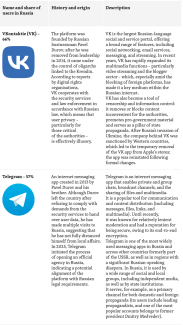
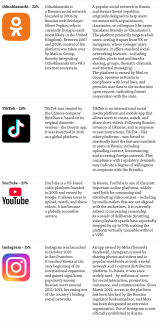
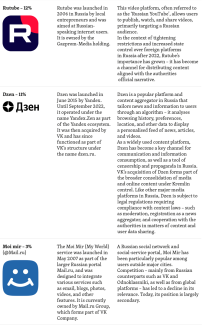
APPENDIX. The most popular online platforms and social networks in Russia
Based on survey data, the table below ranks the social networks used by Russians, from most to least popular: ‘Use of the internet, social networks, messengers, artificial intelligence and other online services: March 2025’, op. cit.
[1] Report by the agencies We Are Social and Meltwater – see S. Kemp, Digital 2026: The Russian Federation, DataReportal, 8 November 2025, datareportal.com.
[2] Data from the Mediascope report for the 4+ age group, measurement period: January–March 2025 – see П. Мордаев, Медиапространство, mediascope.net.
[3] Russian users can report accessibility issues on websites that monitor internet performance, such as Сбой.рф. According to information on disruptions affecting WhatsApp (сбой.рф/whatsapp), the highest number of such issues occurs in Moscow.
[4] Based on the reports: Аудитория девяти крупнейших социальных сетей в России в 2025 году: исследования и цифры, ppc.world, 29 October 2025; and D. Thuy, Leading online resources on desktop and mobile devices in Russia in October 2024, by monthly reach, Statista, 25 November 2025, statista.com; Digital 2025: ключевые данные из нового отчета DataReportal, byyd, 10 March 2025, byyd.me.
[5] See the data on VK in the report by We Are Social and Meltwater: Digital 2026: The Russian Federation, op. cit.
[6] ‘Тренды потребления контента. Какие форматы контента предпочитают пользователи ВКонтакте, каким авторам доверяют и где находят важную информацию’, Вконтакте, vk.com.
[7] Levada Center data from April 2025. See ‘Use of the internet, social networks, messengers, artificial intelligence and other online services: March 2025’, Levada Center, 7 May 2025, levada.ru.
[8] The data originates from the report by We Are Social and Meltwater. Digital 2025: ключевые данные из нового отчета DataReportal, op. cit.
[9] Levada Center data from April 2024. See ‘The role of television and the internet as the main sources of news and the top most popular Russian journalists’, Levada Center, 7 June 2024, levada.ru.
[10] K. Chawryło, ‘The Kremlin's cracdown on Western social networks’, OSW, 15 March 2022, osw.waw.pl.
[11] Eadem, ‘Russia: crackdown on Ekho Moskvy and Dozhd' TV’, OSW, 3 March 2022, osw.waw.pl.
[12] Sustaining independence. Current state of Russian media in exile, JX Fund, Research Report, Berlin, November 2023, jx-fund.org.
[13] I. Wiśniewska, F. Rudnik, ‘Russia's stagnating economy’, OSW, 21 October 2025, osw.waw.pl.
[14] ‘Больше половины россиян впервые заявили, что «очень устали» от войны’, The Moscow Times, 30 October 2025, moscowtimes.ru.
[15] M. Domańska, ‘The Making of a Homo Putinicus. Fascist ‘patriotic education’ in Putin’s Russia’ [in:] I. Garner, T. Kuzio (eds.), Russia and Modern Fascism, New Perspectives on the Kremlin’s War Against Ukraine, ibidem Press, 2025.
[16] ‘Путин: Интернет возник как проект ЦРУ, так и развивается’, Вести.Ру, 24 April 2014, vesti.ru.
[17] M. Domańska, ‘Putin's neo-totalitarian project: the current political situation in Russia’, OSW Commentary, no. 489, 17 February 2023, osw.waw.pl.
[18] These include the Technology Investment Fund run by Putin’s daughter, Katerina Tikhonova, as well as the state-owned conglomerate Rostec. А. Басманов, ‘Цифровая Терешкова’, Новая газета Европа, 23 July 2025, novayagazeta.eu.
[19] For more information, see M. Domańska, ‘Gagging Runet, silencing society. 'Sovereign' Internet in the Kremlin's political strategy’, OSW Commentary, no. 313, 4 December 2019, osw.waw.pl.
[20] In particular, this refers to the proliferation of repressive legislation targeting so-called foreign agents and the practice of accusing regime opponents of terrorism and extremism. For a broader analysis of the tightening of domestic policy in recent years, see M. Domańska, ‘Putin's neo-totalitarian project…’, op. cit.; eadem, K. Chawryło, ‘War dictatorship: power and society in Russia’, OSW Commentary, no. 433, 22 March 2022; M. Domańska, ‘Russia 2021: Consolidation of a dictatorship’, OSW Commentary, no. 419, 8 December 2021; eadem, ‘Tightening the screws. Putin's repressive laws’, OSW Commentary, no. 380, 18 February 2021, osw.waw.pl.
[21] А. Басманов, Цифровая Терешкова, op. cit.
[22] ‘Российские власти в 2024 году потребовали от Google удалить рекордные 784 тысячи единиц контента’, Вёрстка, 1 May 2025, verstka.media.
[23] ‘Почти 400 тысяч единиц контента потребовали удалить российские власти от Google за полгода’, Вёрстка, 3 November 2025, verstka.media.
[24] ‘25 000 блокировок – новый рекорд военной цензуры’, Роскомсвобода, 5 August 2025, roskomsvoboda.org.
[25] N. Garina, ‘The Cat and Mouse Game of Internet Censorship and Circumvention in Russia’, Russia.Post, 27 June 2025, russiapost.info.
[26] S. Darbinyan, ‘Western Tech Companies Are Capitulating to Russian Censors. Here's How Russians Can Fight Back’, The Moscow Times, 24 June 2025, themoscowtimes.com.
[27] N. Garina, ‘The Cat and Mouse Game...’, op. cit.
[28] ‘В правительстве связали рекламу VPN с попытками Запада «раскачать ситуацию» в России’, The Moscow Times, 22 July 2025, moscowtimes.ru.
[29] ‘ФСБ задержала студента через несколько часов после того, как он натолкнулся на «экстремистский» материал в интернете. Данные, судя по всему, передал оператор T2’, Агентство, 6 November 2025, agents.media.
[30] И. Ромалийская, ‘Как по указанию Путина будут "душить" Zoom и Microsoft в РФ – и как это скажется на пользователях и бизнесе. Объясняет юрист по киберправу’, Настоящее Время, 27 May 2025, currenttime.tv. According to Forbes data, in 2024 Zoom was the most popular video conferencing service in Russia, holding a 67.5% share of the market.
[31] ‘«ВКонтакте» в первый раз обошел YouTube по месячному охвату’, Коммерсантъ, 15 January 2025, kommersant.ru. Earlier, in 2021, throttling methods were tested on Twitter after it refused to censor content at the request of Russian authorities.
[32] ‘После блокировки звонков в Telegram и WhatsApp вырос трафик мобильной связи – его легче контролировать’, The Insider, 28 August 2025, theins.ru.
[33] See the communication from Агентство. Новости on Telegram, 22 October 2025, t.me/agentstvonews. In early December 2025, Roskomnadzor also announced the blocking of the FaceTime and Snapchat messaging apps.
[34] ‘В Госдуме одобрили блокировку регистрации в Telegram’, The Moscow Times, 31 October 2025, moscowtimes.ru, as cited in: web.archive.org.
[35] А. Стариков, ‘Удар по доносчикам, или О будущем России без Telegram и WhatsApp’, The Moscow Times, 24 August 2025, moscowtimes.ru.
[36] ‘Песков не увидел разницы для мошенников между Max и другими мессенджерами’, РБК, 5 September 2025, rbc.ru.
[37] ‘«Телеграм» раскрывает данные о пользователях в России, преследуемых по статьям о терроризме, утверждает ФСБ’, Важные истории, 18 March 2025, istories.media; ‘В РКН заявили, что «Телеграм» удалил по их требованию больше 373 тыс. публикаций или каналов’, Важные истории, 7 April 2025, istories.media; ‘Пропал не только «ВЧК-ОГПУ»: прокуратура за четыре года требовала удалить более 140 каналов и чатов в Telegram’, Вёрстка, 7 April 2025, verstka.media.
[38] ‘Telegram Begins Legal Process of Opening Office in Russia’, The Moscow Times, 17 July 2025, themoscowtimes.com.
[39] ‘Убыток VK в 2024 году вырос почти втрое по сравнению с прошлым годом’, Медуза, 20 March 2025, meduza.io.
[40] А. Розанова, А. Хмурковская, ‘В мессенджере Max зарегистрировались более 55 млн пользователей’, РБК, 14 November 2025, rbc.ru.
[41] A survey by the independent research company Russian Field – see ‘У каналов в Max оказалось меньше 6 млн читателей’, Агентство, 27 November 2025, agents.media.
[42] By default, Max gains access to the microphone, camera, all user and device data, geolocation, contact lists and correspondence, including message drafts. All of this data – unlike data on WhatsApp or Telegram – is stored on Russian servers. The neural network used within the messenger also attempts to shape users’ political views and to encourage self-censorship. ‘Раскрыты новые опасности использования мессенджера Mах’, Холод, 5 September 2025, holod.media.
[43] ‘Max начал блокировать россиян, поставивших себе сторонний клиент мессенджера с отключённым сбором личных данных’, Вёрстка, 1 October 2025, verstka.media.
[44] ‘Faridaily: ФСБ выдвинула список претензий к мессенджеру Maх. По мнению спецслужбы, его пока нельзя подключать к госуслугам из-за риска утечек’, Медуза, 6 August 2025, meduza.io.
[45] In mid-2025, the number of shutdowns increased dramatically: 655 were recorded in June, compared to just 69 in May (by contrast, only 296 such incidents occurred worldwide throughout 2024). See S. Sorochinskaia, ‘Fearing Ukrainian Drones, Russia Sets Records for Internet Blackouts’, Russia.Post, 9 July 2025, russiapost.info.
[46] ‘В Ульяновске отключили мобильный интернет «до окончания СВО»’, Медуза, 11 November 2025, meduza.io.
[47] The whitelist currently includes all websites, platforms and services belonging to state institutions, Yandex services, the most popular social networks – Vkontakte and Odnoklassniki – e-commerce platforms Wildberries and Ozon, the services of several banks (including Sberbank, Alfa-Bank and Gazprombank), the main telecommunications operators’ services, Mail.ru, Rutube, Kinopoisk, and – according to some sources – the betting platform Fonbet, whose owner is linked to the head of the Presidential Security Service. See ‘Опубликован «белый список» сайтов, к которым будет доступ при отключении интернета в России. В него вошли сервисы «Яндекса», Ozon, Wildberries и «Магнит»’, Медуза, 5 September 2025, meduza.io.
[48] ‘Почти 40% россиян перешли на VPN после блокировки YouTube’, The Moscow Times, 22 April 2025, moscowtimes.ru.
[49] ‘Власти запретили рекламу на сотнях тысяч сайтов, в Instagram и Facebook. Штрафовать могут даже за раскрутку блогерами и сайтами собственных проектов’, Агентство, 25 March 2025, agents.media.
[50] ‘Власти обязали интернет-ресурсы хранить данные пользователей три года вместо одного. Эта информация по требованию передается ФСБ’, Важные истории, 5 November 2025, istories.media.
[51] See RBC’s communication Новости. Главное on Telegram, 29 October 2025, t.me/rbc_news.
[52] ‘Роскомнадзор обучит сотрудников выявлять «неблагонадежных» россиян в интернете’, The Moscow Times, 10 February 2025, moscowtimes.ru, as cited in: web.archive.org.
[53] N. Garina, ‘Social Media in Russia: What Is Allowed, What Is Not, and How the Law, Monitoring Techniques and Technologies Are Evolving’, Russia.Post, 11 September 2025, russiapost.info.
[54] According to estimates, one hour of a mobile internet shutdown in a region costs nearly 750 million roubles. Even in 2023, when such shutdowns were less frequent, the Russian economy is estimated to have lost approximately 4 billion dollars as a result. Н. Глухова, Л. Борисенко, ‘Где и как в России отключают интернет’, Новая газета Европа, 8 July 2025, novayagazeta.eu; S. Sorochinskaia, ‘Fearing Ukrainian Drones...’, op. cit.
[55] ‘В Госдуме пообещали полностью лишить россиян анонимности в интернете’, Холод, 21 October 2025, holod.media.
[56] М. Арялина, Я. Суринская, ‘Операторы будут обязаны прекратить оказание услуг связи по требованию ФСБ’, Ведомости, 10 November 2025, vedomosti.ru.
[57] ‘«У Max должна быть конкуренция». Песков заявил, что Telegram и WhatsApp должны работать в России’, Медуза, 5 September 2025, meduza.io.
[58] Г. Лейба, ‘Госдума предпочитает проверенное’, Коммерсантъ, 31 October 2025, kommersant.ru.