Germany’s new heating law: rethinking the Wärmewende at the cost of slower decarbonisation
Friedrich Merz’s government has pushed through a sweeping overhaul of the so-called heating law, the central policy instrument for transforming the heating sector. Its previous version was one of the most controversial pieces of legislation adopted during the last parliamentary term. It was widely perceived as an attempt to ban the installation of popular heating systems such as gas boilers and to force consumers to switch to heat pumps instead. The new law rehabilitates gas and oil boilers by allowing their installation once again, provided they are operated using mandatory blends of so-called green fuels. In effect, this marks a shift in Germany’s previous approach to decarbonising the heating sector, known as the Wärmewende. However, the new framework raises a number of serious concerns relating to the challenge of securing adequate supplies of low-emission alternative fuels, the impact on future heating costs for users of gas and oil systems, and the implications for Germany’s ability to meet its climate policy targets.
While the new law may ease social tensions surrounding the Wärmewende in the short term, it fails to address the fundamental problem facing the transformation of the sector: its fragile public legitimacy. Over the longer term, it may actually heighten the risk of further social tensions over the decarbonisation of the heating sector and their potential political consequences.
On 10 July, the Bundestag and Bundesrat adopted the Building Modernisation Act (Gebäudemodernisierungsgesetz, GModG), which comprehensively amends the 2023 legislation governing the installation of heating systems in Germany.[1] First, the new law abolishes the general rule introduced three years ago requiring new heating systems to operate on at least 65% renewable energy. Second, it removes the provisions banning the use of fossil-fuel boilers after 2045. Third, it once again permits the installation of new systems using natural gas and heating oil, provided they are operated with steadily increasing shares of biofuels (such as biomethane, bio-LPG and biogenic oil) or low-emission hydrogen, including hydrogen-derived synthetic fuels. The mandatory blending requirement will rise to at least 10% from 2029, 15% from 2030, 30% from 2035 and 60% from 2040 (the so-called Bio-Treppe). Consumers will be responsible for complying with this requirement by selecting the appropriate tariffs from their suppliers.
Fourth, the new law introduces minimum shares of renewable or low-emission gaseous fuels (Grüngasquote) and liquid fuels (Grünheizölquote) in the fuel used in all gas and oil-fired heating systems already in operation. Responsibility for complying with this requirement will rest with the companies placing these fuels on the market. The required share will start at 1% in 2028 and rise thereafter, with the details to be set out in a separate law expected in December this year. The blending requirement will apply only to households, with industry exempt. Moreover, the law introduces a rule for rented properties under which tenants and landlords will share the costs of biocomponent blending, CO2 emission charges and network charges (in the case of gas), with blending costs split in a 70:30 ratio and the charges split 50:50.
Alongside the amendment to the law, the German government revised its subsidy programme for energy-efficiency upgrades to buildings and the replacement of heating systems (Bundesförderung für effiziente Gebäude). The ceiling for eligible costs was reduced from €30,000 to €28,000 and is set to fall by a further €750 every six months. The revised scheme also differentiates financial support more sharply according to applicants’ incomes. The basic grant covers 30% of eligible costs, while an additional income-related bonus ranges from 10% to 40%, depending on household income. The third component of the scheme is a bonus for rapid heating system replacement, which currently amounts to 16% of the costs incurred and is set to fall by 4 percentage points every six months until it is phased out in 2028. However, even if an applicant meets all the relevant conditions, total support is now capped at 80% of eligible costs. At the current ceiling, this translates into a subsidy of up to €22,400 for replacing a heating system.
The decarbonisation context – Wärmewende
Legislation governing the installation of heating systems in Germany is one of the key instruments of the strategy to transform the heating sector, including district heating, known in Germany as the Wärmewende. This transformation involves phasing out the use of fossil fuels for heating buildings.[2] The politically favoured technologies in this process are primarily heat pumps and connections to district heating networks. The Wärmewende is one of the main pillars of Germany’s energy transition and is rooted in the broader framework of the country’s climate policy, whose stated goal is to reduce greenhouse gas emissions to the point of achieving climate neutrality by 2045.[3]
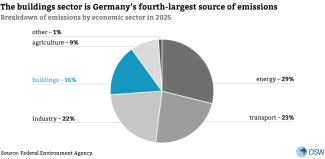
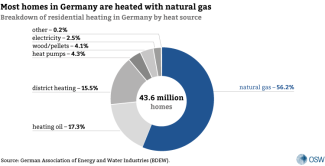
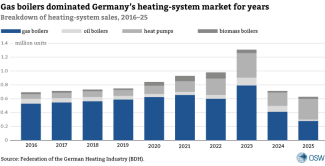
Accounting for 16% of total greenhouse gas emissions, the buildings sector is the fourth-largest source of emissions in the German economy (see Chart 1). In 2025, it released 103 million tonnes of CO2 equivalent into the atmosphere, approximately 90% of which came from heating. The sector’s relatively high emissions reflect the widespread use of fossil fuel-based heating systems. According to official statistics, more than half of Germans heat their homes with natural gas, while almost one in five rely on heating oil (see Chart 2). The technologies favoured by policymakers still account for a clear minority of heating systems in Germany’s residential buildings. In recent years, however, there has been a marked shift towards heat pumps, particularly in new construction, where their share has risen from 32% to 74% over the past decade. Despite this trend, gas boilers continued to dominate overall heating-system sales by a wide margin for many years (see Chart 3). Last year marked the first time that more heat pumps were installed (299,000) than gas boilers (277,000).
Progress in reducing emissions in the buildings sector has been too slow for Germany to meet its national climate targets, both in the medium term (a 65% reduction by 2030 compared with 1990 levels) and in the long term, as the country aims to achieve climate neutrality by 2045. Alongside transport, heating is among the sectors where emissions have been falling most slowly and where sectoral targets have regularly been missed.
The political context – a departure from controversial provisions
Transforming the heating sector is a far more challenging aspect of the Energiewende than the ongoing transition in the power sector, as it requires regulations that directly affect people’s daily lives and influence decisions concerning their own property – specifically, who should install what type of heating system, when and at what cost. Incentive-based measures, such as subsidies for replacing heating systems and improving the energy efficiency of buildings, are expensive and have failed to deliver the expected pace of emissions reductions. Regulatory measures, such as legal limits on how long fossil-fuel boilers may remain in operation and higher emissions charges, generate social tensions, as they are perceived as attempts to impose behaviour favoured by policymakers, and also increase the risk of exacerbating energy poverty.
In 2023, the previous government, at the initiative of Vice-Chancellor Robert Habeck (the Greens), attempted to significantly accelerate the Wärmewende through legislation governing the installation of heating systems. The core of those regulations was a general rule requiring newly installed systems to run on at least 65% renewable energy, and policymakers made no secret of their preference for heat pumps. Seeking to encourage Germany’s heating industry to expand its heat-pump production capacity, Habeck said he expected annual sales on the German market to reach 500,000 units in the second half of the decade, while setting a target of 6 million installed units by 2030, compared with around 2 million in operation at the end of 2025. The second objective was to initiate a shift away from natural gas in the heating sector. The government therefore framed the new regulations not only as a decarbonisation measure but also as part of efforts to reduce Germany’s dependence on gas imports, seeking to capitalise on the political momentum created by the gas crisis triggered by Russia’s invasion of Ukraine.
The so-called heating law sparked enormous controversy even while still in draft form. It became the target of weeks of fierce media criticism, as it was widely perceived as an attempt to ban the installation of popular gas boilers (a poll at the time showed that three quarters of respondents opposed this move) and compel people to switch instead to heat pumps, which are more expensive to purchase and install, although cheaper to operate. The controversial legislation ultimately triggered one of the most serious crises within the governing coalition at the time: the Greens were determined to push it through, while neither the SPD nor the FDP wanted to bear political responsibility for a widely criticised law. Although a substantially watered-down version, with numerous exemptions and transitional periods, ultimately entered into force, the new law became one of the main reasons for a marked decline in polling support for both the Greens – by around 5 percentage points during the dispute – and Robert Habeck himself. It also heightened tensions surrounding the transformation of the heating sector, fuelling a culture war of sorts over heat-pump technology. In addition, it destabilised the heating-system market, triggering a surge in demand for gas boilers in 2023, followed by an overall decline in sales. Moreover, many Germans began postponing purchases in anticipation of possible changes to the rules.
During last year’s election campaign, ‘scrapping Habeck’s heating law’ became one of the main and most heavily promoted pledges of both the CDU/CSU and the AfD in the broader field of energy and climate policy. During negotiations with the SPD on forming a new government, the Christian Democrats ultimately secured the inclusion of this measure in the coalition agreement. From the outset, however, it was clear that the intention was not to repeal the law in its entirety, but rather to remove its most controversial provision requiring new heating systems to operate on at least 65% renewable energy. Friedrich Merz’s government presents the new GModG primarily as a break with what it portrays as the Greens’ policy of mandates and prohibitions, and as a restoration of property owners’ freedom to choose their heating technology.
Rehabilitating gas and oil boilers
In essence, the new version of the heating law marks a shift in Germany’s approach to decarbonising heating: moving away from state regulation of permissible heating technologies towards decarbonising the fuels they use. However, electrifying the sector through the wider adoption of heat pumps remains the clearly preferred solution, as demonstrated by the continued provision of generous subsidies for their installation. The change instead involves opening up an alternative route for those who prefer gas and oil boilers, which have traditionally been very popular in Germany. At the same time, property owners who choose to install these systems after the new rules enter into force will have to purchase gaseous or liquid fuels containing an appropriate and gradually increasing share of so-called green fuels deemed to be carbon-neutral. For heating systems already in operation, the mandatory minimum blending requirements (Grüngasquote and Grünheizölquote) will perform the same function.
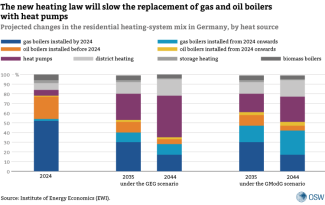
While the 2023 heating law (Gebäudeenergiegesetz, GEG) sent a clear political signal that Germany was moving away from gas and oil boilers primarily in favour of heat pumps and connections to district heating networks, the GModG rehabilitates these technologies and once again recognises them as compatible with the energy transition. Following a period of stagnation, this will most likely lead to a renewed increase in their sales and allow them to remain popular on the market for longer than they would have under the previous legal framework. According to the prevailing view among market analysts, this is unlikely to halt the trend towards replacing gas and oil boilers with heat pumps, which are expected to remain the dominant choice, although it will significantly slow it. For example, a forecast by the Institute of Energy Economics (Energiewirtschaftliches Institut, EWI) suggests that under the previous legal framework the share of heat pumps in the heating sector would have risen from 6% today to 27% in 2035 and 43% in 2044. Under the new legislation, it is projected to rise more slowly, to 19% and 26% respectively. By contrast, the share of gas boilers, instead of falling sharply from 54% today to 40% in 2035 and 28% in 2044, is now expected to decline ‘only’ to 47% and 42% respectively, while the share of oil boilers is projected to drop from 23% to 14% and 9%.
However, the new approach to decarbonising the heating sector presents a number of fundamental challenges. The first is ensuring adequate supplies of so-called green fuels to meet the statutory requirements. Current production in Germany is limited, while the potential for expansion remains far short of the demand likely to result from gas and oil boilers retaining their expected dominant position in the German heating sector. For example, Germany’s annual production of biomethane, envisaged as the primary ‘green’ substitute for natural gas, currently stands at 12 TWh, of which only 8% (1 TWh) is used for heating; the energy sector consumes 56%, while the production of transport biofuels accounts for 31%. According to Germany’s biogas industry, the theoretical maximum for domestic biomethane production is 78 TWh. However, the EWI estimates that under the new legal framework demand for biomethane in the heating sector alone could rise to 30–75 TWh within a decade, depending on how the heating-system market develops. By 2045, it could reach as much as 196 TWh, assuming a mandatory switch to 100% use of so-called green fuels. At the same time, as decarbonisation progresses, demand for biomethane will also rise in the energy sector and, particularly, in transport. The latter has for years employed a similar mechanism to encourage the blending of so-called green fuels (Treibhausgas-Minderungsquote), a factor that will further intensify competition for biomethane supplies. Imports could theoretically offer a solution, however, current volumes remain small at around 1–2 TWh, while the prospects for future supplies remain uncertain. Supporters of the GModG most frequently point to Ukraine as a potential future source of biomethane imports. In recent years, the country has actively promoted itself in Germany as a prospective partner in this field. However, Ukraine still faces a number of barriers to scaling up production and exports. A similar challenge applies to the production of ‘green’ heating oil, but given its much smaller scale and the long-standing trend away from oil boilers in Germany, this issue is less significant than in the case of gas boilers.
The second fundamental problem with the new regulations is the emerging risk of a so-called cost trap for those who decide to install gas or oil boilers under the new legislation. Earlier analyses had already clearly indicated that the design of the decarbonisation process would gradually drive up the prices of fossil heating fuels in the coming years. In the case of natural gas, for example, even setting aside uncertainty over wholesale gas prices, further increases are expected in both CO2 emission charges (as the EU’s ETS 2 replaces Germany’s nEHS mechanism) and network fees (as fixed infrastructure maintenance costs are spread across a shrinking number of users). The introduction of mandatory biofuel blending adds another factor that will gradually push up the prices of fossil heating fuels. For example, biomethane is on average two to three times more expensive than conventional natural gas. As a result, the GModG may reduce pressure on households when they decide whether to replace their heating system, but at the same time create the challenge of high operating costs for those systems in the future. Even supporters of the GModG do not dispute this effect; the only uncertainty concerns the scale of the increase. The German Economic Institute (Institut der deutschen Wirtschaft) estimates that the overall cost of heating a property with a gas boiler under the new regulations could double by 2040. Meanwhile, market analysts largely agree that, once all relevant factors are considered, heat pumps are already the more cost-effective option for most types of property. Their much higher purchase and installation costs – on average around twice those of gas boilers before factoring in state subsidies that narrow the gap – are offset by lower operating costs over the longer term.
The third expected consequence of the new law is a slower decline in demand for natural gas in Germany’s heating sector over the coming years, an effect stemming from gas boilers remaining a popular option on the market for a longer period of time. Combined with the projected increase in gas consumption in the power sector,[4] this could mean that overall gas demand across the German economy will not fall but instead remain at current levels for at least the next decade.
Finally, a further consequence will be slower emissions reductions in the heating sector. According to the Federal Environment Agency (Umweltbundesamt, UBA), the previous version of the heating law, particularly the ‘65% renewables’ rule, was the single most important factor accelerating the sector’s decarbonisation, even though progress remained too slow to meet Germany’s climate policy targets. Slower electrification of the sector will result in higher emissions than would otherwise have been the case. Meanwhile, the effectiveness of the new approach to decarbonising the fuels used in gas and oil boilers remains unclear.
A step backwards for climate policy
The new version of the heating law has drawn criticism from experts. The main concerns relate to the complexity of the new measures and the reliance on untested and unproven instruments, compounded by the absence of credible estimates as to whether the adopted approach is feasible at all. The explanatory memorandum to the law itself repeatedly acknowledges that reliable forecasts cannot be provided for key elements of the new framework, including the availability of low-emission alternative fuels and their impact on heating-fuel prices and emissions reductions. Against this backdrop, the GModG has received a harsh assessment from the National Regulatory Control Council (Nationaler Normenkontrollrat, NKR), an independent council of experts that reviews draft legislation before the Bundestag for regulatory quality and impact assessment. Its chair described the law as “one of the weakest drafts in terms of both legislative quality and practical grounding to have been submitted to the NKR in recent years.”[5] Companies in the energy sector are deeply divided over the law. Those that benefited from the previous regulations, such as heat-pump manufacturers and installers and municipal utilities expanding district heating networks, have expressed dissatisfaction. By contrast, those who stand to benefit from the new law – the gas industry, including boiler manufacturers, and the biogas sector – regard it as a political shift in the right direction.
Finally, proponents of the Wärmewende regard the new heating law as a clear step backwards for Germany’s climate policy, amounting to a de facto abandonment of efforts to meet emissions-reduction targets in the heating sector. Given the considerable uncertainty surrounding the development of the market for so-called green fuels, the question is whether allowing the continued use of fossil fuel-based technologies, on the assumption that fossil fuels will later be replaced with low-emission alternatives, will actually deliver the intended emissions reductions or instead lock in gas infrastructure and delay the decarbonisation of the buildings sector.
This problem, in turn, has prompted serious concerns over the GModG’s compatibility with Germany’s Basic Law. A number of legal opinions, including some commissioned by CDU MPs, indicate that the new heating law effectively postpones emissions reductions in the buildings sector, contrary to the Federal Constitutional Court’s landmark 2021 ruling, which effectively elevated the pursuit of decarbonisation to a constitutional obligation and held that deferring emissions reductions and thus shifting the burden onto future generations was incompatible with the Basic Law.[6] Several environmental organisations specialising in climate litigation have already announced plans to challenge the GModG before the Court.
Conclusions: the risks of fragile public legitimacy
The new heating law is one sign of the declining importance of climate policy among the priorities of Germany’s ruling elites. In essence, it represents the abandonment of an unpopular and controversial instrument, though one that has proved effective at accelerating emissions reductions, in favour of measures designed to ease public discontent, at least in the short term, albeit clearly at the expense of the pace of the transition. This does not signify a retreat from decarbonising the heating sector, but rather an effort to moderate and slow the changes when they generate excessive costs. In this sense, the GModG forms part of a broader process of adjusting the Energiewende that the Merz government has been pursuing in areas where the wider costs of the transition – whether fiscal, social, political or economic – have proved too high, albeit without altering either its underlying model or its fundamental direction. Similar adjustments have also been introduced to the support system for renewables and to the scale and pace of the expansion of the power grid and the development of the hydrogen economy.
At the same time, the German government appears to have factored in the likelihood that the existing emissions-reduction targets will de facto be missed, while retaining them de jure because of a lack of political willingness to revise them, whether by relaxing them or pushing back their deadlines. From the perspective of the ruling elites, formally questioning these targets would trigger an unwelcome reaction from significant sections of the political and expert communities, the media and interest groups committed to maintaining the current direction and pace of the Energiewende.
The measures adopted in the GModG may ease social tensions surrounding the Wärmewende in the short term, but they fail to address the fundamental challenge facing the transformation of the heating sector: its fragile public legitimacy. In a survey conducted last year on German attitudes towards the transformation of the heating sector, as many as 50% of respondents stated that climate-neutral heating was not important to them, compared with 35% who considered it important. At the same time, 75% said they were unwilling to bear higher costs for the sake of decarbonising the sector, while only 19% expressed a willingness to do so. Moreover, 82% said they did not believe that the country’s political elites would be able to carry out the transition in a socially just manner. Against this backdrop, the future enforcement of the measures set out in the GModG, which will steadily increase heating costs for users of popular fossil fuel-based systems, could further heighten the long-term risk of social tensions over the decarbonisation of the heating sector and their potential political consequences.
Irrespective of this, the implementation of the EU emissions trading system for the buildings and transport sectors (ETS 2) remains a key element of Germany’s strategy for transforming the heating sector. Germany is one of the EU member states where a national carbon-pricing mechanism already operates in these sectors of the economy. Under Germany’s equivalent of ETS 2, the nEHS, a tonne of CO2 currently costs €55–65, adding between a few and more than 10% to the prices of natural gas, heating oil, petrol and diesel. From Berlin’s perspective, implementing ETS 2 therefore primarily means extending carbon pricing in these sectors to the remaining EU member states and, particularly from the perspective of German business, creating a more level playing field for competing companies across EU member states. At this stage, the German debate has paid surprisingly little attention to the social risks associated with the long-term effects of ETS 2, including the rising costs of heating with fossil fuels, although AfD politicians have raised these concerns regularly. Many representatives of Germany’s political, business and expert elites appear insufficiently aware that the adverse effects of this mechanism could become a serious political and social problem not only in Central and Eastern European countries, but also in Germany itself. For the government in Berlin, the apparent priority is to launch ETS 2 and consolidate it at EU level, while the future trajectory of carbon prices under the system remains a secondary concern. As with the current debate over reforming ETS 1, Berlin will likely remain open to future adjustments aimed at mitigating the mechanism’s adverse effects, but without undermining its fundamental logic.
[1] For more detail, see: M. Kędzierski, ‘Germany: a controversial heating law’, OSW, 14 September 2023, osw.waw.pl.
[2] See the entry ‘Wärmewende’ [in:] Kultura polityczna Niemiec. Krótki kurs, OSW, osw.waw.pl.
[3] See the entry ‘Energiewende (zwrot energetyczny)’ [in:] Kultura polityczna Niemiec. Krótki kurs, OSW, osw.waw.pl.
[4] See: M. Kędzierski, ‘Germany doubles down on gas: the next phase of the Energiewende’, OSW Commentary, no. 743, 20 July 2026, osw.waw.pl.
[5] ‘Normenkontrollrat zerpflückt schwarz-rotes Heizungsgesetz’, Der Spiegel, 14 May 2026, spiegel.de.
[6] See: M. Kędzierski, ‘Orzeczenie w sprawie polityki klimatycznej – prezent dla Zielonych’, OSW, 12 May 2021, osw.waw.pl.