OSW update. Hungary election, no. 5
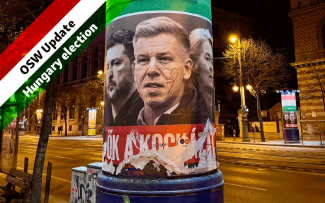
- The outcome of the parliamentary elections remains uncertain. In most polls, the opposition TISZA party holds a significant lead, but the ruling Fidesz party can count on a number of factors within the electoral system that work in its favour (including the shape of single-member constituencies), and perhaps also on the mobilisation of its voters in the final stage of the campaign. The results in a dozen or so ‘swing’ constituencies will be decisive.
- A profound political change would only be possible if the opposition were to secure two-thirds of the seats in the unicameral parliament. If TISZA fails to secure this majority, Fidesz will retain significant influence over key state institutions. The use of legal and procedural instruments in the period between the elections and the formation of the new parliament could be of particular significance, as this may affect the scope and pace of any handover of power.
- The risk of political tensions remains high, particularly in scenarios involving a close result. The parties to the political dispute may contest the election result and accuse each other of external interference – Fidesz would claim Ukrainian influence, while TISZA would claim Russian influence.
- A potential conflict over legitimacy could shift from the institutional to the social level, leading to mobilisation and protests. This applies particularly to a situation where a party that won fewer votes secures a majority of seats, which is possible under the current electoral system. At the same time, the inability to break Fidesz’s dominance, despite the emergence of a strong political alternative, may lead to growing public frustration.
- The reaction of the EU member states and international partners will also be of key importance to the post-election dynamics. Swift recognition of the election results by key external actors may help to stabilise the situation and reduce tensions, whilst cautious or divergent positions may be exploited by the parties to the dispute to undermine the mandate of the new government.
OPINION POLLS
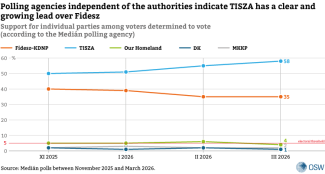
- The widely respected Medián Institute shows there has been a clear upward trend for TISZA in recent months. A survey conducted in March indicates that Magyar’s party leads by 23 percentage points among voters who say they intend to vote, representing an increase of 3 points compared to February (see Figure 1). If this result were to be reflected in the vote on 12 April, TISZA could even secure a constitutional majority of two-thirds of the seats.
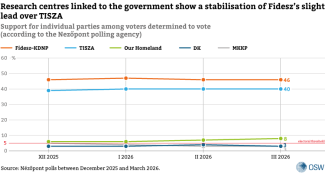
- A poll by the government-linked Nézőpont institute indicates that Fidesz maintains a lead over TISZA of around 6 percentage points (see Figure 2). This survey takes into account the preferences of all active voters – both those declared explicitly and those identified through follow-up questions and statistical methods.
- Polls by centres not affiliated with the government show a clear upward trend for TISZA and a growing lead over Fidesz. In contrast, polling organisations affiliated with the government indicate that Fidesz’s lead is stabilising. This stems from differing survey methodologies and may point to the political and communicative function of these polls. Divergent trends may influence voter behaviour, including the mobilisation of the opposition electorate or demobilisation in the event of a perceived lead by one side.
- The differences between the polls increase uncertainty regarding the actual distribution of support and make it difficult to predict the election result with precision. Consequently, the dynamics of the final days of the campaign and voter turnout will be of significant importance. The outcome will hinge on results in a dozen or so single-member constituencies where Fidesz and TISZA are closely matched.
POSSIBLE POST-ELECTION SCENARIOS AND THEIR IMPLICATIONS
- A TISZA victory securing a majority of seats: change with limitations
Probability: high
This scenario assumes a situation in which Péter Magyar’s party wins the parliamentary elections and takes power, but fails to secure a constitutional two-thirds majority in parliament. This makes it impossible to carry out a profound reform of the system within the existing legal framework. This is because the system has been shaped by Fidesz’s long-standing rule and is based on an extensive catalogue of mechanisms designed to safeguard its stability, including both regulations requiring a qualified majority and institutions capable of blocking or delaying decisions. The state enters a phase of structural dualism: the new parliamentary majority forms the government, whilst key state institutions – including the constitutional judiciary, oversight bodies, the public prosecutor’s office and part of the administrative apparatus – remain to varying degrees under the influence of the previous administration, which limits the new cabinet’s actual capacity to act. The office of the president also remains in the hands of Fidesz (although in the Hungarian political system it has limited powers).
Immediately after the elections, it is possible to challenge the results through a multi-tiered appeals system, which – even if it does not lead to a change in the outcome – allows for a delay in its final confirmation and creates scope for the outgoing parliament to act. The 30-day period between the elections and the formation of the new parliament is of particular significance. During this term the outgoing government, possessing a qualified majority – though lacking political legitimacy – can make constitutional changes, including even expanding the list of laws requiring a two-thirds majority.
An additional factor limiting the scope for manoeuvre in the event of a change of government is the long terms of office of the leadership of key institutions (e.g. the Governor of the Hungarian National Bank serves until March 2031), which allow the previous government to retain its influence regardless of the election result. In practice, this poses a serious obstacle for the new government in areas crucial for systemic change, such as judicial reform, media reform and electoral rules. Action remains possible in the sphere of day-to-day management, though without the ability to undermine the foundations of the political system. At the same time, one should expect a pragmatic adjustment by parts of the business community, including entities linked to the Treasury, which – driven by access to public resources – may seek to cooperate with the new government.
The consequence of this arrangement may be political conflict shifting from the institutional to the social level. Rivalry takes the form of social mobilisation, disputes over legitimacy and growing polarisation. The TISZA government may be forced to compensate for legislative restrictions through social pressure; in the longer term, the risk of an erosion of trust in state institutions also increases. At the same time, the inability to carry out structural reforms limits the possibility of a lasting improvement in the rule of law. From the perspective of relations with the EU, this scenario implies there will be no rapid normalisation, though it may open the way for a partial release of funds.
- Fidesz victory and securing a majority of seats: retaining power with limited capacity
Probability: medium-high
This scenario envisages the opposite situation, in which Fidesz wins the parliamentary elections but fails to secure a two-thirds constitutional majority in parliament. This means that the current ruling camp retains executive power, whilst its previous dominance and ability to further shape the institutional system are curtailed. The political system remains essentially unchanged, but its further consolidation faces barriers arising due to the lack of the qualified majority which the party had enjoyed for almost the entire 16-year period of its rule.
In this configuration, Fidesz retains control over key state institutions and the administrative apparatus. At the same time, the lack of a two-thirds majority limits the ability to pass or amend so-called constitutional laws and to make changes to the constitution, which in previous years constituted the primary instrument for consolidating the system of power. The government is therefore forced to operate under a more restricted legislative regime, based on a simple majority.
In political and social terms, this scenario favours relative short-term stability, whilst maintaining a high level of polarisation. The opposition may intensify its mobilisation efforts, but its ability to exert a real influence on the decision-making process remains limited. One key element of this scenario is the potential need to seek support from other groups, primarily the far-right Our Homeland party, which – due to a partial ideological convergence – could act as a coalition partner. This cooperation could enable Fidesz (should it secure close to two-thirds of the seats and Our Homeland cross the electoral threshold) to regain the ability to make decisions requiring a qualified majority, though it would entail the risk of a further radicalisation of the political discourse and an increase in the influence the more extreme circles have on the government’s agenda.
From the perspective of relations with the EU, this scenario implies a continuation of the current political line, albeit with a potentially slightly greater inclination towards pragmatic concessions. The lack of a constitutional majority limits the scope for any further tightening of the institutional course, which may contribute to a partial de-escalation of tensions. At the same time, no fundamental change should be expected in the areas of the rule of law or foreign policy, and relations with the EU will remain largely conflictual.
- A victory for TISZA with a two-thirds majority: a complete systemic overhaul
Probability: medium-low
This scenario assumes a situation in which TISZA wins the parliamentary elections and secures a two-thirds constitutional majority in parliament, which is the only option which enables the opening up of the possibility of a complete, legal overhaul of the institutional system shaped by Fidesz governments. This implies a change not only of government, but also – potentially – of the model of the state itself, including the constitution, constitutional laws and the composition of key institutions.
If a qualified majority were secured, the new government would have the capacity to carry out a systemic transformation within the existing legal framework, including reforms of the judiciary, the media, electoral rules and state oversight mechanisms. In this sense, it would be the only scenario enabling the dismantling of elements of the illiberal system through legal and institutional means.
At the same time, this scenario carries a certain risk of constitutional conflict during the post-election transfer of power. From Fidesz’s perspective, the loss of a constitutional majority would pose a real threat to the party’s fundamental interests, which may prompt it to use the available legal and political instruments to delay or limit the effects of a potential defeat. Possible actions include challenging the election results, invoking emergency mechanisms, and legislative measures taken by the outgoing parliament. In an extreme scenario, this could lead to a situation described as a ‘legal constitutional coup’, i.e. an attempt to prevent the effective transfer of power despite the election result.
In social terms, this scenario would entail a high level of mobilisation and polarisation in the short term, particularly in the post-election phase, during which the nature of the transfer of power would be decided. Should the conflict escalate, protests and social tensions cannot be ruled out, especially if institutional actions were perceived as being an attempt to circumvent the election result. If, however, the election results were recognised, the system would enter a phase of political transformation. TISZA could carry out broad institutional reforms, though their pace and scope would depend on the ability to maintain political cohesion and manage public expectations.
From the perspective of relations with the EU, this scenario opens up the possibility of a faster normalisation of relations and the release of EU funds. The EU would likely support the transformation process through financial and expert instruments, whilst monitoring its progress. In the event of a peaceful transfer of power, this would be the most significant signal of a reversal in the trend of the erosion of the rule of law.
- Fidesz victory with a two-thirds majority: further consolidation of the system
Probability: low
This scenario assumes a situation in which Fidesz secures a constitutional two-thirds majority in parliament, granting it full control over the legislative process and the ability to further shape the institutional system. This signifies not only the continuation of the government but also the possibility of a further consolidation of the model of the state established after 2010.
If the qualified majority is maintained, the government will have unlimited capacity to make systemic changes within the existing legal framework, allowing it to further strengthen its control over state institutions. This applies in particular to the judiciary, the media, regulatory bodies and checks and balances. The absence of effective institutional barriers means that the legislative process remains fully subordinate to the parliamentary majority, and the opposition’s ability to influence state policy is negligible.
This scenario also implies the entrenchment and potential extension of the existing model of economic governance, based on a strong role for the state, selective support for chosen sectors, and links between the political and economic elites (see OSW update. Hungary election, no. 4). The authorities are taking steps to strengthen their control over various areas of social and economic life (including the media and non-governmental organisations)
In political terms, this scenario favours short-term stability whilst perpetuating a high level of polarisation. The opposition remains deprived of any real means of influencing the decision-making process, which limits its ability to exert influence at the institutional level and encourages a shift of activity towards the sphere of civic mobilisation. In the social sphere, Fidesz’s entrenched dominance may lead to growing apathy and disillusionment among opposition voters, particularly when even a relatively strong and promising political alternative is unable to break the existing balance of power.
In terms of foreign policy, this scenario creates the conditions for a continuation of the current line on Russia and a confrontational policy towards the EU. Hungary may maintain energy cooperation with Moscow and use EU instruments – including its veto – to pursue its own political interests. This would lead to further tensions in relations with its European partners and reinforce Hungary’s position as a difficult partner in EU decision-making processes.
Key risks associated with the post-election situation
- Dispute over legitimacy – challenging the election result
The risk of the losing side challenging the election results encompasses both legal and political actions, and could become one of the key factors destabilising the situation immediately after the vote (particularly in the event of a potentially close result in scenarios 1 and 2). Formally, it is possible to initiate a multi-tiered appeals process, involving challenges to the results at the level of electoral commissions, courts and constitutional bodies. Even if these actions do not lead to a change in the final result, they may delay its confirmation and create space for narratives of electoral irregularities to take hold. This applies in particular to a situation where a party securing relatively fewer votes obtains a parliamentary majority. In this case, it is possible to challenge the government’s mandate as being formally legal but politically ‘unauthorised’, which may heighten tensions and hinder post-election stabilisation.
Mutual accusations of electoral manipulation or external interference is also significant element of this risk. These may take the form of allegations of influence from foreign actors (e.g. Russia or Ukraine). Such narratives, even if unsupported by clear evidence, can be used to mobilise the electorate, undermine the credibility of institutions and construct an alternative interpretation of the election result. As a result, a parallel dispute arises over the legality and legitimacy of the government, which may persist even after the formal conclusion of the electoral process.
- Delaying the transfer of power through legal and constitutional means
Delaying the handover of power by the outgoing Fidesz government (in scenarios 1 and 3) may take the form of multi-level procedural obstruction, the aim of which is not necessarily to undermine the election result, but to prolong the period of uncertainty and limit the new majority’s ability to act. In the initial phase, this may involve the intensive use of appeal channels – from election commissions to courts and constitutional bodies – which allows the formal, legal delaying of the certification of the results and the constitution of parliament.
The period between the announcement of the results and the first sitting of the new parliament is of key importance, as the outgoing majority can continue to take legislative action (albeit without political legitimacy). This may include amendments to constitutional laws, raising decision-making thresholds or modifying institutional procedures. In practice this limits the future government’s room for manoeuvre even before it is sworn in. Another significant instrument in this scenario is the possibility of invoking states of emergency or existing crisis regimes. The Hungarian legal system permits the broad application of the so-called ‘state of threat’, which allows for governance by decree and the restriction of standard parliamentary procedures. Maintaining or extending this state in the post-election period could de facto suspend some mechanisms of democratic control and delay the new government’s full assumption of power, especially if accompanied by restrictions on political mobilisation and protests. An additional mechanism delaying the transfer of power could be the role of the president, who – by nominating a candidate for prime minister who lacks parliamentary majority support – can prolong the process of forming a government and, consequently, delay its swearing-in.
- Social mobilisation
The highest likelihood of protest mobilisation occurs in scenarios where there is a disconnect between the election result and the public’s perception of the government’s legitimacy (a close result in Scenario 1) or where there is a dispute over the electoral process itself. In conditions of heightened political tension, widespread social mobilisation is possible, encompassing demonstrations, protests and other forms of civic engagement. The scale of these actions will depend on the perceived legitimacy of the election result (on both sides) and the ability of the political elite to accept it. Protests may be concentrated in the largest urban centres and take both peaceful and more confrontational forms, particularly if political rhetoric escalates. At the same time, in the absence of visible political results, there is a risk that some participants will move from mobilisation to weariness and apathy, which may weaken the public’s willingness to engage in political processes – this risk applies particularly to TISZA voters, since it is a movement with a grassroots background.
- Mixed international reactions
Divergent or delayed positions from external partners – in particular EU member states, EU institutions and the United States – could become a significant destabilising factor. The lack of swift and unequivocal recognition of the result outside Hungary encourages the emergence of competing narratives regarding its legality and legitimacy, which may be exploited by the parties to the dispute to strengthen their own political positions. In particular, statements suggesting the need to verify the electoral process or making cooperation conditional on specific actions by the new government may be interpreted as an indirect challenge to the election result.
- Delayed votes from abroad
Delays in counting and incorporating votes cast abroad into the official results may prolong the period of post-election uncertainty, particularly in the event of a close result. In the case of Hungary, this applies both to votes cast by citizens residing abroad and to voters from the diaspora who hold citizenship (see OSW update. Hungary election, no. 2); their preferences may significantly influence the final distribution of seats. These votes are usually counted with a delay (typically after about a week), as they are not tallied electronically but physically delivered to the country by consuls. In practice, this means that the preliminary results announced on election day may not present the final outcome, which creates scope for competing interpretations and premature declarations of victory. This situation fuels political tensions, especially if the margins between the main parties are narrow and every additional block of votes could determine who wins the parliamentary majority.
Table. Post-election scenarios – implications and risks
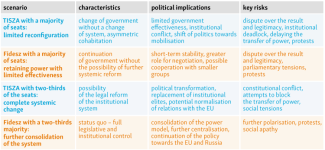
Source: OSW’s own analysis.
KEY DEVELOPMENTS
An attempt to infiltrate TISZA’s IT systems revealed
On 25 March, the investigative website Direkt36 published an interview with whistleblower Bence Szabó, an officer in the cybercrime department of the National Bureau of Investigation (NNI). In the interview, he revealed the background to an investigation conducted in 2025, which turned out to be an attempt by the Hungarian secret services to infiltrate TISZA. The account suggests that the original investigation concerned two individuals suspected of possessing child pornography. However, during the course of the investigation, there was an unusual intervention by the Office for the Protection of the Constitution (AH), which is alleged to have put pressure on the police to carry out searches and initiate proceedings. The seized devices did not yield any evidence in the case, but revealed correspondence of a political nature. According to the investigators’ findings, both men were associated with the TISZA party and were responsible for its IT systems. The evidence suggests that they were subjected to attempts at recruitment and intimidation, aimed at destabilising the group’s technical infrastructure. The team handling the case began to suspect that these actions might form part of an intelligence operation, one which had potentially been carried out by the Hungarian secret services. The operation was reportedly led by an anonymous coordinator using the pseudonym “Henry”. Szabó’s exposure of the scandal made him one of the key figures in the election campaign and a symbol of opposition to Orbán’s regime.
These reports gained further publicity following an interview with an IT specialist working with TISZA, known by the pseudonym Gundalf, whom the government had previously attempted to discredit as a Ukrainian agent. Excerpts from archived conversations between the secret services and 19-year-old were also published. In an interview with the website 444.hu, he admitted that he had deliberately misled the Hungarian services by passing on false information. Péter Magyar described the whole affair as “Orbangate” and stated that it was reminiscent of “the darkest days of communism”. Its revelation is part of a growing information war ahead of the elections, featuring mutual accusations of intelligence operations, foreign interference and abuses by the state apparatus.
Investigative journalist accused of espionage
Orbán’s government spokesperson, Zoltán Kovács, accused investigative journalist Szabolcs Panyi of sharing data on Foreign Minister Péter Szijjártó with the secret services of another EU country so that Szijjártó could be bugged. In response, Panyi told Politico that the Hungarian foreign intelligence services had been monitoring his private conversations, and that the intercepted communications were allegedly passed on to the Hungarian Intelligence Service (IH) and subsequently used by Orbán’s inner circle to discredit him. Panyi claims that he was warned about the surveillance by sources within the government administration. The journalist points out that the actions against him began in mid-2025 and intensified following the publication of a report by the Direkt36 portal concerning an attempt by a Hungarian intelligence officer to recruit EC officials. In recent days, the authorities in Budapest have taken legal action against Panyi. Justice Minister Bence Tuzson announced that a complaint had been filed, accusing him of collaborating with foreign intelligence services, whilst the head of the Prime Minister’s Office, Gergely Gulyás, publicly accused the journalist of “spying against his own country”, announcing further prosecutorial action. Panyi has been covering corruption and security issues for years, including the influence of Russia and China in the region. He was involved, among other things, in the international investigation into the Pegasus project, which revealed the use of spyware against citizens, including himself.
Allegations of systematic vote-buying by Fidesz
The organisation “De! Akcióközösség” has released a documentary exposing large-scale vote-buying. The authors’ findings suggest that the practice may involve as many as approximately 500,000 residents of the province, who allegedly received money, food and other benefits – including alcohol or other intoxicants – in exchange for supporting the ruling party. Accounts from the participants and organisers of these activities suggest that vote-buying is not an isolated occurrence, but forms part of a broader, systemic mechanism based on the exploitation of voters’ economic dependence, particularly among the Roma population in the country’s poorest regions. The practices mentioned include direct cash payments, the distribution of goods (food, fuel, livestock), organising transport to polling stations, and exerting pressure on voters by making access to employment at public works conditional on their vote. According to some interviewees, these activities are coordinated locally with the involvement of local government officials linked to the ruling camp. At the same time, there are views that similar practices have also occurred in the past, including during the terms of previous political administrations. The publication of this material has intensified the debate over the credibility of the electoral process.
Publicising the crisis in the army
Captain Szilveszter Pálinkás, a serving officer in the Hungarian armed forces and the face of the government’s military recruitment campaign, painted a picture of a deepening institutional crisis and declining morale in the army in an interview with the Telex news website. He pointed to growing dissatisfaction among soldiers, a decline in the appeal of military service, and increasing plans to leave which, in his view, could soon lead to a weakening of the state’s operational capabilities. The scale of the problem – partly measured by the number of applications for discharge from service – is unprecedented and could result in a significant loss of personnel, especially following the lifting of restrictions related to the “state of emergency”. The officer sees the sources of tension primarily in the reforms of the Ministry of Defence, including the centralisation of management, changes to the payments system (including the abolition of allowances and overtime pay) and the deterioration of service conditions and equipment. In his view, these measures, combined with the political leadership’s lack of competence, have led to an erosion of professionalism and a devaluation of the military profession. At the same time, he points to a growing discrepancy between the official narrative regarding the modernisation of the army and the actual functioning of units, which further undermines confidence among personnel.
One key theme of the interview is the allegations regarding the increasing politicisation of the armed forces, manifested, among other things, in personnel and operational decisions being motivated by political considerations. Pálinkás draws attention to growing mistrust of the command and internal tensions, including those linked to the presence of groups perceived as being associated with the opposition. Controversy also surrounds reports of a military mission in Chad, which Pálinkás claims is being pushed by individuals linked to the ruling camp, including the Prime Minister’s son, Gáspár Orbán (Pálinkás studied with him at the elite British military academy, Sandhurst). He assesses this project as strategically questionable and high-risk, even pointing to the possibility of significant casualties among the troops. These revelations two weeks before the elections may have significant political implications, reinforcing the opposition’s narrative of the erosion of state institutions. At the same time, they point to deeper, structural weaknesses in the security sector that go beyond the current political dispute and may affect Hungary’s credibility as a NATO partner.
The incident at the gas pipeline in Serbia and the dispute over its interpretation
On Easter Sunday, Serbian President Aleksandar Vučić announced the discovery of a ‘high-impact’ explosive device near a gas pipeline in the north of the country. According to his account, the find could have posed a serious threat to the population and led to disruptions in gas supplies. The gas pipeline forms part of the TurkStream system, through which Russian gas is transported via Turkey, Bulgaria and Serbia to Hungary. Vučić informed Prime Minister Orbán of the incident, who convened an emergency meeting of the National Defence Council. As a result, the decision was made to deploy the army to protect the infrastructure on the Hungarian side of the border. The Hungarian Foreign Minister described the incident as a “terrorist attack”, noting that it forms part of a series of actions attributed to Ukraine in recent weeks. These allegations were rejected by the spokesperson for the Ukrainian Ministry of Foreign Affairs, Heorhii Tykhyi, who stated that the incident was most likely a Russian false-flag operation. Meanwhile, according to Đuro Jovanić, director of the Serbian Military Security Agency (VBA), the country’s security services had information that a group of migrants might attempt to sabotage infrastructure.
In recent weeks, Hungarian security experts have pointed to the possibility of similar incidents occurring on Hungarian or Serbian territory. In their view, incidents of this kind could be exploited to create a sense of threat conducive to political mobilisation, and in an extreme scenario – as a justification for declaring a state of emergency and interfering with the electoral calendar. Péter Magyar referred to these predictions, suggesting that the planting of explosives near the gas pipeline could have been a false-flag operation by the Hungarian government.
J.D. Vance’s visit: legitimising the government’s narrative ahead of the elections
US Vice-President J.D. Vance expressed unequivocal support for the Hungarian government during a joint press conference with Viktor Orbán in Budapest, just a few days before the election. In his speech, he criticised EU institutions, accusing “Brussels bureaucrats” of attempting to influence Hungary’s economic situation and interfering in the election campaign. In his speech, Vance spoke highly of Orbán and his relationship with the Trump administration, highlighting their joint efforts to “defend Western civilisation”, covering issues such as migration, social policy and conservative values. However, he stressed that he did not intend to tell Hungarians how to vote, and that his presence was intended as a signal of opposition to what he saw as external political pressure from the EU. The Vice-President presented Hungary as an example of effective energy policy, highlighting the government’s efforts towards energy security and independence, and suggesting that other EU countries should follow this model.
Orbán emphasised that, following Donald Trump’s election, Hungarian-American relations had entered a “golden age”, pointing to increased investment and economic cooperation. He also announced a deepening of strategic cooperation in the defence and space sectors, without revealing any details. Orbán emphasised the importance of the alliance with the US for national security and criticised EU policy, blaming Brussels for the lack of progress in ending the war in Ukraine. Regarding the energy situation, he highlighted the scale of the problems in Europe, attributing their causes to EU actions, but did not refer to US actions (e.g. towards Iran) that may influence commodity prices. He also emphasised that the issue of ‘overt and serious’ interference by foreign intelligence services in the electoral process in Hungary had been raised in his talks with Vance.
Vance’s visit is primarily symbolic and serves as a show of support for Orbán during the election campaign, reinforcing his message on sovereignty and external pressure. Its direct impact on the election result remains difficult to definitively assess – especially as the US Vice-President is not widely recognised in Hungary. The significance of the visit may be greater in the context of setting the interpretative framework after the election, particularly in the event of a close result. In this scenario, the message of international support for the government and of external interference could influence perceptions of the election’s legitimacy and the post-election dynamics.
The only country without an approved SAFE plan
According to media reports, the European Commission has not yet approved Hungary’s plan under the SAFE programme, which is intended to finance the purchase of arms and military equipment. As a result, Hungary remains the only EU country whose application has not been accepted by Brussels. Unofficially, it is suggested that the decision to ‘freeze’ the plan, worth around €16 billion, is linked to Budapest’s blocking of EU financial aid for Ukraine. In particular, this concerns opposition to a €90 billion loan which, in the view of some member states, violates the principle of sincere cooperation. Reservations regarding the Orbán government’s policies also include the blocking of further sanctions packages against Russia, the delaying of military support mechanisms for Ukraine, and ongoing concerns regarding standards of the rule of law and transparency in the spending of public funds. There are clear signs in Brussels that a decision on Hungary’s SAFE plan may be postponed until after the elections.