OSW update. Hungary election, no. 4
- Economic policy has been one of the key themes of the campaign ahead of the parliamentary elections on 12 April. The opposition TISZA movement led by Péter Magyar has placed these issues at the core of its messaging, while the ruling Fidesz has sought to divert public attention from the challenging economic situation by focusing on alleged external threats to the country.
- The deteriorating macroeconomic situation has become a significant factor shaping voter attitudes. Previously, Fidesz’s stable support was largely based on extensive social benefits, including family support programmes and administrative controls on energy prices. However, after 2022 Hungary experienced one of the highest inflation rates in the EU and a slowdown in economic growth, including two episodes of technical recession in 2023–24, as public finances deteriorated and the forint weakened.
- As a result, the election campaign is evolving into a dispute over Hungary’s future development model. The ruling Fidesz is defending its current course, based on the state’s active role in the economy, efforts to attract large foreign investors (in recent years, particularly in electromobility-related industries), and extensive social policy instruments. By contrast, TISZA is emphasising the need to reform institutions, ensure greater transparency in foreign investment, and curb clientelist and corrupt practices which, in its view, have undermined the effectiveness of economic policy.
- Another important element of the pre-election debate regarding economic policy is the issue of securing access to EU funds. A portion of these remains frozen under the conditionality mechanism owing to the rule-of-law dispute between the Hungarian government and the European Commission. Unlocking these funds is a key campaign pledge of TISZA.
POLLS on the assessment of the economic situation in Hungary
Conclusions
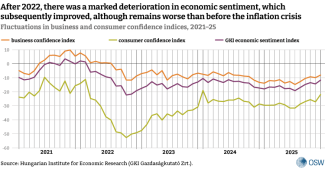
- After 2022, economic sentiment in Hungary deteriorated markedly as a result of high inflation, rising living costs, and an economic slowdown. This trend is reflected in the GKI economic sentiment index, calculated as a weighted average of business and consumer confidence indices. The decline was particularly pronounced among consumers (see Figure 1). Although a partial recovery followed in subsequent years, the level of consumer and business confidence remains lower than before the inflation crisis.
- The assessment of the state of the economy may now play a greater role than in the previous electoral cycle. During the 2022 parliamentary elections, voters could still recall an eight-year period of relative prosperity (2012–19); however, by 2026 this period has receded further into the past. As a result, the ruling party can no longer rely as heavily on the experience of long-term economic improvement.
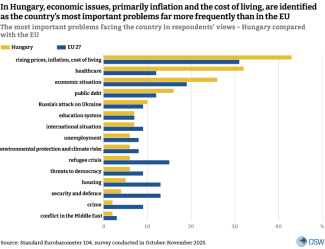
- Economic and social issues dominate public perception. The most important concerns include rising prices, inflation, and the cost of living (43%), which respondents cite far more frequently than the EU average (see Figure 2). These are followed by the functioning of the healthcare system (32%), the overall economic situation of the country (26%), and the state of public finances (16%). Consequently, the campaign is unfolding in an environment of markedly heightened public sensitivity to issues related to the cost of living and access to public services.
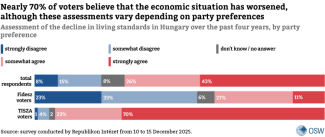
- Assessments of the decline in living standards are strongly polarised by political affiliation. Among TISZA’s voters, a staggering 93% believe that living standards have fallen over the past four years, whereas among the Fidesz-KDNP electorate only 38% share this view and 56% reject it (see Figure 3). Across society as a whole, 69% of respondents report that living conditions have deteriorated. This indicates that party preferences significantly influence perceptions of the economic situation: opposition voters are nearly unanimous in their negative assessment, whereas supporters of the ruling camp are far more likely to express positive evaluations.
POSITIONS OF FIDESZ AND TISZA on key economic policy issues
Economic model and drivers of growth
Fidesz: The economic model pursued by the current government is based on a strong role for the state in shaping the structure of the economy, while maintaining a relatively attractive environment for foreign direct investment (FDI) in selected industrial sectors. The government has followed an active policy of attracting foreign capital through generous subsidies and political concessions to countries such as China. At the same time, it has supported the development of a domestic class of entrepreneurs, politically linked to the ruling party, by granting selected companies preferential access to public financing and state contracts. Another important element of this model is an active fiscal and credit policy, aimed at supporting corporate investment and household consumption. During periods of economic slowdown, the government has sought to sustain growth momentum through expansionary fiscal measures, sectoral subsidies, and social programmes. However, this growth remains highly dependent on the economic performance of Germany, Hungary’s main trading partner, and on the availability of EU funds, which constituted a vital source of investment financing prior to their partial suspension.
TISZA: The party’s economic programme envisages a departure from the growth model based on a strong role for the state and the selective support for large foreign investors. In TISZA’s view, this model fosters economic clientelism and restricts market competition. Magyar has criticised the current system as excessively politicised and closely linked to the ruling elite, which, in his assessment, undermines economic productivity and discourages private investment. TISZA advocates a development model based on transparent state institutions, restoring the rule of law, and strengthening the private sector, particularly small and medium-sized enterprises (SMEs). Its programme also provides for an increase in spending on research and innovation to 2% of GDP by 2030, the development of transport infrastructure, and a stronger orientation of the economy towards sectors with higher added value. Furthermore, TISZA plans to diversify the structure of the economy, support innovation and the digital economy, and open up to investors from various regions of the world. In the longer term, it intends to launch consultations on adopting the euro and to prepare a potential roadmap for its introduction.
Restoring access to EU funds through improvements in the rule of law would serve as a key driver of economic growth, alongside rebuilding investor confidence. This is intended to boost investment and growth dynamics while helping to stabilise public finances. The party’s programme also envisages recovering part of the public funds that, according to the party, have been siphoned off from the state budget as a result of corruption and non-transparent public procurement practices. TISZA has pledged to conduct an audit of public spending, including EU funds, and to strengthen oversight institutions.
Fiscal policy and public finances
Fidesz: Public finances have been used as a tool to stabilise the business cycle and implement the government’s economic and political priorities. A significant portion of expenditure has been allocated to family support programmes, social welfare, and subsidies for large industrial investments, particularly in the automotive and battery production sectors. This model also assumes maintaining a high level of public investment, especially in transport and energy infrastructure. At the same time, the government has employed extraordinary fiscal instruments, such as sectoral taxes and price regulations, to increase budget revenues and mitigate the effects of economic crises. In recent years, the budget deficit and public debt have increased, a development the government has justified by the need to sustain economic growth and protect households from the effects of external shocks.
TISZA: The party has pledged to conduct a more disciplined and transparent fiscal policy, aimed at stabilising public finances and increasing the state’s credibility. Its programme envisages reducing the budget deficit to below 3% of GDP by 2030 while increasing spending in selected public sectors, primarily healthcare and education. The funding for these new programmes is expected to come from public funds lost to corruption and subsequently recovered, a reduction in inefficient budget expenditure, and restored access to EU funds, which, according to the programme, could significantly expand the state’s financial capacity. Economic growth and restored investor confidence are also expected to reduce public debt servicing costs and increase budget revenues.
Tax system
Fidesz: The current tax system is based on relatively low levels of income and capital taxation, and a high share of indirect taxes, which constitute one of the primary sources of budget revenue. Key elements include a flat personal income tax (15%) and one of the lowest corporate income tax rates in the EU (9%), which are intended to enhance the country’s investment attractiveness and encourage the inflow of foreign capital. At the same time, the government has maintained a high VAT rate (27%), reinforcing the fiscal importance of consumption taxes in the structure of state revenues. Another essential component of the tax system is an extensive range of allowances and preferences for families, including tax deductions for those raising children and tax exemptions for selected social groups. These instruments form a key part of demographic policy and serve as a tool to support household consumption. The government has also applied sectoral taxes and temporary extraordinary levies on specific industries – such as banking, retail, energy, and telecommunications – enabling it to increase budget revenues during periods of fiscal strain, while also influencing the functioning of strategic sectors of the economy. As a result, the tax system combines elements of a pro-investment tax policy with the flexible use of fiscal tools to pursue current economic and budgetary objectives.
TISZA: The party has pledged to reform the tax system with the aim of simplifying it and making it more progressive, while reducing the burden on lower earners. Its programme envisages lowering income tax on the minimum wage from 15% to 9%, and reducing tax liabilities for those earning below the median wage, which is intended to increase household disposable income. To enhance the progressivity of the tax system, the party aims to introduce a 1% tax on assets exceeding 1 billion forints (approximately €2.6 million), targeting the wealthiest segment of society. In addition, TISZA plans to reinstate a simplified lump-sum tax regime for small businesses, which has been significantly curtailed by the government in recent years.
Policy towards enterprises and attitudes to foreign investment
Fidesz: The government has pursued a selective policy towards enterprises, adopting markedly different approaches across individual sectors. The state has sought to maintain a competitive environment for foreign industrial investors by offering a system of subsidies, tax relief, and infrastructure support, including the development of industrial zones, energy networks, and transport links. These instruments are designed to enhance the country’s attractiveness to investors and strengthen its position in European supply chains. Particular emphasis has been placed on investment in sectors with high export potential, primarily the automotive industry and the production of batteries for electric vehicles, which have become key pillars of Hungary’s industrialisation strategy in recent years. The importance of capital inflows from Asia – primarily from China, but also from South Korea – has increased markedly in recent years, reflecting the government’s sustained efforts to attract such investment as part of its strategy to diversify economic partners and reduce dependence on investors from Western Europe. These projects are concentrated mainly in the electromobility sector, reinforcing Hungary’s role as one of Europe’s primary hubs for component manufacturing.
The government’s economic policy also includes support for selected domestic enterprises through preferential access to public financing, state contracts, and large-scale infrastructure projects, often benefiting companies politically linked to those in power. At the same time, there is clear sectoral differentiation in burdens: while industrial investors have benefited from preferential conditions, entities operating in the services sector – particularly banking, telecommunications and energy, which are to a large extent linked to foreign capital – have faced additional regulatory and fiscal burdens.
TISZA: The party has criticised the existing economic development model based on attracting large-scale industrial investments, particularly in the automotive and battery production sectors, through substantial public subsidies. It seeks to replace this model with increased investment in human capital, particularly in education and the healthcare system. The party’s programme envisages increasing the transparency of public procurement and limiting political influence over the allocation of public funds, which is intended to improve market functioning and boost investor confidence. In its approach to enterprises, TISZA emphasises the need to restore a level playing field and curb economic clientelism. It has also pledged to strengthen the position of SMEs and reduce administrative barriers to doing business, notably by shortening administrative processing times for companies to the EU average.
TISZA’s economic programme envisages maintaining openness to foreign investment, which remains one of the key drivers of Hungary’s economic growth. It emphasises the importance of FDI for industrial modernisation and job creation, while promising a more transparent and selective approach by the state to supporting investment. During the campaign, TISZA’s representatives have repeatedly criticised the government’s current policy of aggressively attracting investments in the electric vehicle battery production sector, primarily from China. In this context, the party has announced plans to review agreements concluded with investors, including assessing their compliance with existing environmental standards and the principles of transparency in public spending. It seeks to make state support conditional on delivering long-term benefits for the economy, such as technology transfers, the development of local supply chains, and the creation of higher value-added jobs. The party’s programme also highlights the need to diversify the sources of foreign capital inflows. Furthermore, TISZA has pledged to improve the country’s relations with EU institutions and to restore the predictability of the regulatory environment, which is intended to increase Hungary’s attractiveness to Western investors.
Labour market and employment policy
Fidesz: The government continues to prioritise maintaining high levels of employment and increasing labour force participation. To this end, it has introduced flexible labour market regulations intended to support investment and reduce labour costs while increasing the ability of companies to adjust employment to changing economic conditions. Public works programmes, aimed primarily at the long-term unemployed and residents of less developed regions, constitute one of the key instruments of the government’s employment policy. They are designed to reduce structural unemployment and support the labour market integration of groups with the lowest levels of participation. As part of changes to the education system, the government has lowered the upper age limit of compulsory schooling, enabling some young people to enter the labour market earlier. Another important element of the government’s strategy is the development of vocational and technical education tailored to the needs of industry and foreign investors, particularly in the manufacturing sector. The vocational education system has been more closely aligned with businesses through dual education programmes and cooperation between schools and industrial firms. In response to growing labour shortages, stemming largely from labour emigration and an aging population, the government has gradually permitted a controlled inflow of foreign workers, mainly from Asian countries, particularly in industrial and service sectors facing labour deficits.
TISZA: Regarding the labour market, the party focuses on raising wages and improving working conditions, aiming to reduce the scale of labour emigration and encourage some workers residing abroad to return. Its programme also envisages modifying the public works system, which, according to TISZA, in its current form often entrenches low levels of labour market participation rather than facilitating re-entry into the labour market. The proposed changes would align this system more closely with training programmes and skills development initiatives. At the same time, TISZA aims to suspend the recruitment of non-EU workers from mid-2026. It argues that in recent years some companies have used the rising number of third-country workers as a means of keeping labour costs low. Investment in education and the vocational training system is also expected to play an important role in labour market policy. The party’s programme envisages increased spending on employee training and upskilling, including the expansion of reskilling programmes for those working in sectors of declining economic importance. The aim of these measures is to better align workers’ skills with the needs of the economy and to enhance productivity.
Social policy and public services
Fidesz: The government’s social policy has focused on an extensive system of support for families with children, including tax relief, housing subsidies, subsidised loans, and various forms of cash transfers. These instruments constitute a pillar of the state’s demographic policy, aimed at increasing the fertility rate and improving the financial situation of families. At the same time, they serve a macroeconomic function by supporting domestic demand and consumption, which is one of the key components of the current economic growth model. In recent years, the government has also used social policy as a tool to mitigate the effects of inflation and rising living costs. One of its flagship instruments is a household energy subsidy scheme, based on administrative price controls for individual consumers. This mechanism is intended to protect household incomes from the impact of price increases and to stabilise consumption levels. At the same time, the government has introduced other protective measures, including price caps on selected food products and administrative limits on fuel prices, aimed at reducing the impact of rising living costs on the financial situation of the population.
Another important feature of the system is the high degree of centralisation of public services, particularly in education and healthcare. In recent years, the state has taken greater control over the management of schools and healthcare institutions, with both sectors placed under the authority of the Ministry of the Interior. At the same time, the public services system remains burdened by structural problems, such as staff shortages, wage pressures, and limited investment in parts of the infrastructure.
TISZA: The party’s programme envisages expanding social policy while simultaneously improving the quality of public services, which are expected to become one of the pillars of the country’s development and help reduce growing social inequalities. The party has pledged to maintain some of the existing support instruments, such as the 13th and 14th pension payments and the system of energy price reductions, as well as to launch new social programmes. The proposed measures include doubling the number of residential units constructed and expanding a rental housing scheme aimed at improving access to housing for younger generations, as well as increasing the number of places in dormitories by 50% to improve study conditions and student mobility. The party’s programme also provides for doubling family and maternity benefits, introducing a one-off childbirth grant, and raising the minimum pension together with additional annual payments for pensioners.
At the same time, the programme envisages a significant increase in healthcare spending – to 7% of GDP by 2030 – and reforms to the education system, notably through expanding the autonomy of schools and universities and restoring compulsory schooling until the age of 18. The proposed changes are intended to improve the accessibility and quality of public services and to strengthen the economy’s long-term growth potential through investment in human capital.
Table. Comparison of the economic policy frameworks of Fidesz and TISZA
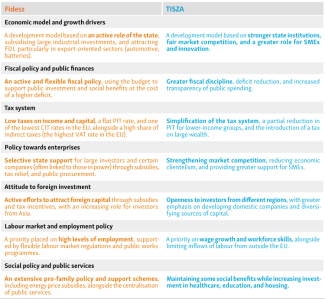
Source: author’s own compilation.
KEY DEVELOPMENTS
15 March as a major test of mobilisation for both sides
The Hungarian national holiday commemorating the 1848 revolution was one of the most significant events of the campaign. Large gatherings of both government and opposition supporters took place in Budapest, serving as political rallies aimed at mobilising their respective constituencies. In a speech addressed primarily to his supporters, Prime Minister Viktor Orbán framed the election as a clash between his ‘peace camp’ and forces which, in his narrative, could draw Hungary into a conflict linked to the war in Ukraine. His speech also included sharp remarks directed at his political opponents and EU institutions, aligning with the government’s long-standing rhetoric on defending national sovereignty. At this stage, Fidesz’s core campaign message is based on an anti-Ukraine narrative, as underscored by Orbán’s statement that on 12 April Hungarians will decide whether “he or Volodymyr Zelensky should be prime minister”. While Orbán primarily addressed his own electorate (and did so in an unusually brief speech), Magyar sought to appeal to a broader segment of society and present himself as a future prime minister, emphasising the need for social reconciliation. The leader of TISZA portrayed his movement as a continuation of the 1848 tradition of freedom, emphasised the importance of firmly anchoring Hungary in the EU and NATO, and criticised the rule of Fidesz, accusing it of entrenching systemic corruption, politicising state institutions, and undermining the quality of public services. He also referred to the possibility of Russian interference in the elections. Both Fidesz and TISZA claimed success in terms of turnout. Messaging related to these events will be leveraged in the coming weeks during the final stage of campaign mobilisation.
The TISZA rally saw an incident in which a large Ukrainian flag was briefly displayed within the crowd by a group that quickly dispersed. According to findings by investigative outlets, this may have been a coordinated political provocation by Fidesz. Evidence supporting this theory includes the presence of individuals linked to Fidelitas, the ruling party’s youth organisation, and to the DDÜ agency, which manages Fidesz’s online communication, including the so-called digital civic circles. The entire operation was brief and conducted in a manner that enabled media footage to be captured quickly. Pro-government media and senior officials, including Foreign Minister Péter Szijjártó, immediately seized upon the incident, portraying the appearance of the flag as evidence of the TISZA movement’s ‘pro-Ukrainian’ and ‘pro-war’ stance.
Reports of Russian influence operations
The Washington Post reported that Russian intelligence services may have considered undertaking actions aimed at influencing the outcome of Hungary’s parliamentary elections. According to the findings, officers of Russia’s Foreign Intelligence Service (SVR) explored the use of extraordinary measures, described as a potential ‘gamechanger’ in the campaign, including staging an assassination attempt on Orbán. An internal report, obtained and verified by European services, suggested shifting Fidesz’s campaign away from socio-economic issues towards state security and stability. The US newspaper also reported, citing European security services, that Hungary had for years enabled Russia to gain direct insight into the EU’s decision-making process. According to the findings, during breaks in meetings of the EU Council, Foreign Minister Péter Szijjártó regularly contacted his Russian counterpart Sergei Lavrov to provide updates on the progress of discussions and possible outcomes. In practice, this meant that Moscow could receive near real-time information on the positions of the EU’s individual member states and the dynamics of negotiations within the EU, significantly enhancing its ability to respond to and influence the EU’s actions.
Meanwhile, controversy arose over the appointment of Daria Boyarskaya, a Russian national and former interpreter for Vladimir Putin, as a coordinator of the ODIHR observation mission ahead of the parliamentary elections in Hungary. Some NGOs and experts argue that her previous ties to the Kremlin could undermine confidence in the mission. For this reason, Hungarian human rights organisations have called for her to be removed from election monitoring duties. However, the OSCE leadership has rejected these allegations, stressing that Boyarskaya underwent standard vetting procedures, acts as an international civil servant, and is bound by strict rules of impartiality.
Deadlock over EU loan for Ukraine
During the European Council meeting on 20 March, the EU’s leaders failed to persuade Orbán to drop his veto on financial support for Ukraine. The summit ended without a breakthrough, prompting the participants to openly criticise the position of the Hungarian government, which has made the lifting of its veto primarily conditional on Ukraine repairing the damaged Druzhba pipeline transporting Russian oil. In an effort to break the deadlock, two days before the summit Brussels announced that Ukraine had agreed to an external inspection of the infrastructure and that the EU would fund the repairs. However, pressure on President Zelensky to accept the mission did not change Hungary’s position. Orbán has used the dispute with the EU and his hardline stance on support for Ukraine as tools to mobilise his electorate, emphasising themes of sovereignty and energy security. By blocking decisions at the EU level, he has reinforced his narrative of defending national interests.
CPAC as a campaign tool for Orbán
Another edition of the Conservative Political Action Conference (CPAC), one of the key international gatherings of conservative circles, took place in Budapest. CPAC Hungary serves as a platform for transnational cooperation among right-wing actors and as a forum for presenting a shared political agenda, which includes opposition to migration, criticism of European integration and an emphasis on national sovereignty. This year’s edition, the fifth held in Hungary, featured high-profile participants such as Javier Milei, Eduardo Bolsonaro, Irakli Kobakhidze, Geert Wilders, Alice Weidel, and Mateusz Morawiecki. The event also formed part of the ongoing election campaign, reinforcing the narrative that Orbán enjoys broad international political support. In his speech, the prime minister vowed that if victorious, his camp would “batter down the gates of the progressives in Brussels”, framing the election as a clash between two visions of Europe: sovereigntist and liberal. Meanwhile, US President Donald Trump expressed his “full support” for Orbán in a video message. A notable absentee was US Vice President J.D. Vance, who, according to unofficial reports, had been expected to attend the event. However, his potential visit to Budapest ahead of the elections, widely viewed as a signal of support for Orbán, remains likely.
A new phase of the Fidesz campaign: Orbán at open rallies
In the final stretch of the campaign, Orbán has launched a nationwide tour of open public meetings. Until now, Fidesz’s campaign tour had primarily involved the ministers János Lázár and Péter Szijjártó; the prime minister’s direct involvement represents a new development. Over the past week, Orbán has visited several cities, including Eger, Kaposvár, and Dunaújváros. These appearances have followed a repetitive script: after brief speeches by local Fidesz politicians, Orbán delivers his own address, focusing on threats related to Ukraine, before leaving the event without engaging with the participants or the media. The open format of these gatherings marks a departure from previous campaign practices: in recent years, the prime minister has communicated with voters mainly in controlled settings before invited audiences.
On social media, Orbán has compared attendance at his rallies with that of local events featuring Magyar, sometimes juxtaposing towns of different sizes, for example Dunaújváros and Paks. In practice, Fidesz has organised its events in central locations in larger cities, mobilising participants from surrounding towns to boost turnout. The choice of locations is not random: it primarily targets areas where Fidesz has the greatest potential to improve its results and gain an advantage, often referred to as Hungary’s swing states. These events also constitute a response to Magyar’s campaign, which in recent months has focused on touring the country and engaging directly with voters. However, Orbán’s rallies are tightly controlled, with no opportunity for the audience to ask questions.
Fidesz’s election disinformation: ‘lookalike’ candidates
The campaign has seen cases of candidates being registered with surnames confusingly similar to those of well-known opposition politicians. The most widely reported case occurred in Kaposvár, where an independent candidate named Péter Tisza was registered, although he ultimately withdrew from the election. According to media reports, he is a former police officer convicted of fraud who changed his name in order to create confusion. Similar cases have been recorded elsewhere: for example, a candidate named Péter Magyar, formally running as an independent, was registered in a constituency in Vas County.
These practices form part of a broader repertoire of electoral techniques developed after Fidesz came to power in 2010. In the previous electoral cycles, so-called ‘shell parties’ were registered primarily to obtain public funding and fragment the opposition vote. Moreover, candidates with similar names appeared on ballots, increasing the risk of voter confusion. This phenomenon was particularly evident in the 2014 and 2018 elections, when more permissive regulations facilitated the registration of opaque political entities. These regulations were subsequently tightened; however, the mechanism remains in place and continues to increase informational uncertainty, particularly among less engaged voters.
[1] The GKI economic sentiment index is calculated in line with the European Commission’s methodology. It is a weighted average of the consumer confidence index (based on household assessments of their financial situation over the past year, expectations for the next 12 months, views on the country’s economic outlook and plans to purchase durable goods) and the business confidence index, which reflects companies’ expectations regarding changes in employment and prices over the next three months.