OSW update. Hungary election, no. 2

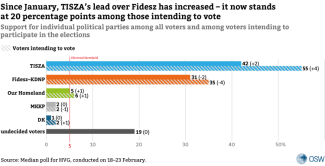
- The parliamentary elections on 12 April will test the functioning of Hungary’s electoral system in unprecedented political circumstances, with opinion polls indicating that a single opposition party – TISZA – has a lead over the governing camp for the first time in years.
- After taking power, Fidesz carried out a comprehensive overhaul of the electoral system. It implemented reforms in stages during the 2010–2014 term and subsequently introduced targeted amendments ahead of subsequent elections.
- Although the changes were adopted in line with democratic procedures, due to its two-thirds constitutional majority in parliament, in practice they proved to be largely beneficial for Orbán’s party.
- The electoral system strongly favours the winner, particularly when the opposition is fragmented. This has enabled Fidesz to secure a two-thirds parliamentary majority despite receiving below 50% of the vote.
- If TISZA wins the election, it could also benefit from these mechanisms. However, certain elements of the system would continue to favour Fidesz.
- Simulations indicate that TISZA would need a nationwide lead of around 3 percentage points over Fidesz to secure a parliamentary majority. By contrast, Orbán’s party could achieve a majority with a result close to a tie, or even after garnering slightly fewer votes than TISZA.
- To obtain a constitutional majority, TISZA would require a significantly larger vote advantage, around 17 percentage points, compared with approximately 13 points in Fidesz’s case.
THE POLLS
THE 2026 ELECTIONS AS A TEST OF FIDESZ’S ELECTORAL SYSTEM
Key elements of the electoral system and their significance for Fidesz and TISZA

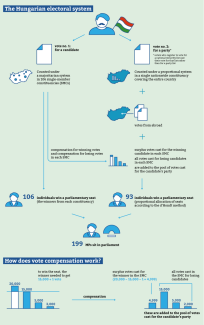
The electoral system combines proportional and majoritarian elements. The unicameral parliament has 199 members elected under a mixed system:
- 106 seats are filled in single-member constituencies under a first-past-the-post system
- 93 seats are allocated from national party lists on a proportional basis
In practice, voters cast two votes: one for a candidate in a single-member constituency and one for a party list, without the option of indicating a preferred candidate. Voting takes place in a single round in both the majoritarian and proportional tiers.
Significance: Single-round single-member constituencies, as a rule, favour the strongest political grouping, particularly in conditions of fragmented competition. When support levels are closely matched, however, they may benefit either Fidesz or TISZA, as the outcome depends primarily on the concentration of votes in individual constituencies rather than on the nationwide result. In practice, this mechanism favours the party with extensive local structures and control over state institutions – in this case, Fidesz. However, if the governing camp weakens and the electorate consolidates around a single main challenger, single-member constituencies may accelerate the conversion of shifting public sentiment into parliamentary seats, in this case to TISZA’s advantage. The proportional component, by contrast, serves a stabilising function for both parties. For Fidesz, it allows partial compensation for potential losses in single-member constituencies in the context of a more balanced contest. For TISZA, it constitutes a key mechanism for converting nationwide support into seats despite a weaker local organisational base.

The electoral threshold applies only to the proportional tier, which covers 93 seats allocated from national lists. It stands at 5% for a single party list, 10% for a coalition of two parties and 15% for a coalition of three or more parties. For example, in 2022 the six-party opposition coalition ran as a single joint list. In practice, this arrangement favours parties that can comfortably clear the threshold and indirectly benefit from the elimination of smaller competitors. Votes cast for lists that fail to enter parliament effectively increase the share of seats allocated to larger parties in the proportional tier.
Significance: The electoral threshold, particularly when combined with single-member constituencies and the compensatory mechanism, strengthens the largest parties at the expense of smaller ones and encourages a bipolar contest between the ruling Fidesz party and TISZA as the main opposition force. For TISZA, the threshold does not currently pose a barrier to entering parliament, but it carries significant strategic implications. It means that part of the opposition electorate’s vote may be ‘wasted’ if it goes to smaller parties that fail to meet the required minimum. This dynamic becomes more significant given that three parties – Our Homeland, the Hungarian Two-Tailed Dog Party and the Democratic Coalition – are polling around the 5% threshold. Fidesz may therefore benefit from a fragmentation of opposition votes among several smaller formations. TISZA, in turn, may attract more anti-government voters who fear losing their vote should their preferred party fail to cross the threshold.

The compensatory mechanism involves adding so-called surplus votes from single-member constituencies to the pool of votes cast for party lists. In the 2011 reform, this mechanism was modified to the benefit of the winning party. The compensatory pool not only includes all the votes cast for candidates who lost in single-member constituencies, but also the surplus votes obtained by winning candidates, calculated as the difference between their result and the number of votes required to secure the seat (see the infographic The Hungarian Electoral System below). These votes are then added to those cast directly for party lists, and on this basis the 93 national list seats are allocated using the d’Hondt method. This solution differs from classic mixed systems, in which compensatory mechanisms primarily aim to offset the losses of parties defeated in single-member constituencies, thereby strengthening the proportionality of the election outcome. In Hungary, by contrast, the adopted method results in a double premium for the winners – first through them securing a seat in a single-member constituency, and then because they have increased their vote total in the proportional tier.
Significance: The mechanism facilitates the translation of a relatively small electoral advantage into a clear parliamentary majority. It constitutes one of the key structural features of Hungary’s electoral system which, in line with a ‘winner takes all’ logic, systemically favours the largest party at the expense of proportional representation. This arrangement provides an additional premium to the party that dominates in single-member constituencies and may strengthen either Fidesz or TISZA, depending on the outcome of the majoritarian contest.
Table. The impact of the compensatory mechanism on the number of seats won by Fidesz in the last three parliamentary elections

Without the compensatory mechanism, Fidesz would not have secured a constitutional majority in previous elections, which requires a minimum of 133 seats.

The boundaries of single-member constituencies were redrawn as part of the 2011–2013 electoral reform and subsequently subject to targeted adjustments, including the most recent one in December 2024. Formally, they were established on the basis of the relative equality of population size, allowing for a deviation of up to 15% from the average. In practice, however, significant demographic differences between constituencies are seen. The more opposition-leaning a constituency, the larger its average population, while those more supportive of the government are relatively smaller, which increases their effective weight in terms of seat allocation. Combined with the single-round, first-past-the-post system, this arrangement amplifies the weight of votes cast in pro-government constituencies and favours the parliamentary overrepresentation of voters from smaller localities at the expense of those in larger cities and the capital.
Significance: The architecture of single-member constituencies largely corresponds to the geographical distribution of political support ahead of the forthcoming elections. Fidesz dominates in rural areas and smaller localities, while TISZA achieves its strongest results in large cities, including Budapest. As a result, Fidesz stands a greater chance of securing a seat advantage, as it wins more often in less densely populated constituencies. The way these boundaries have been drawn therefore constitutes one of the key structural factors limiting TISZA’s prospects in the majoritarian contest.

Hungarian citizens residing outside the country have only been entitled to vote since the 2014 elections. Those who are not registered as residents in Hungary, primarily members of Hungarian minorities in neighbouring states, may participate by postal ballot. They are entitled to cast only one vote, for a party list, and do not have the right to vote in single-member constituencies. The mechanism operates differently for those living abroad who retain registered residence in Hungary, mainly recent emigrants. They may cast both votes, in a single-member constituency and for a party list, but cannot do so by post. There is a limited number of polling stations at consulates, which reduces turnout and diminishes the impact of this group’s participation on the final result.
Significance: In practice, ethnic Hungarians living in neighbouring countries – primarily in Romania, Serbia, Slovakia and Ukraine – overwhelmingly support the Fidesz–KDNP list. In the 2022 elections, 456,000 voters from this group were registered, of whom 265,000 cast their ballots. A significant majority obtained Hungarian citizenship through a simplified procedure introduced shortly after Viktor Orbán came to power. In recent electoral cycles, more than 90% of postal votes were cast for the governing camp, which translated into one additional seat in 2014, none in 2018 and two in 2022. The overall effect should therefore be regarded as limited. However, in the context of a close contest it may prove significant for parliamentary arithmetic. In the forthcoming elections, support for Fidesz among ethnic Hungarians living abroad may be lower than in previous cycles. This reflects the growing reputational challenges facing the governing camp within this group, particularly among the minorities in Slovakia, Ukraine and Romania, who have criticised Orbán for prioritising ties with leaders in those countries with whom he is ideologically aligned over the interests of the minority itself. Péter Magyar has also addressed this issue, seeking to construct an alternative narrative centred on a more active and credible defence of the rights and interests of Hungarian minorities, for example regarding the Beneš decrees in Slovakia. These efforts may weaken the previously near-uniform mobilisation of the diaspora electorate in support of Fidesz. At the same time, TISZA can rely on support from emigrants, who are concentrated mainly in Western European countries. This group is estimated at around 300,000 to 500,000 people, a significant proportion of whom are eligible to vote, although only around 50,000 participated in the last elections. The diaspora is generally critical of the government, which in previous elections worked in favour of opposition parties. However, its actual impact on the outcome has been limited due to procedural barriers associated with their participation in the vote.

Hungary recognises 13 national minorities, including German, Roma, Croat, Slovak and Serb. Their participation in parliamentary elections follows a separate procedure. Voters who wish to cast their ballot as representatives of a minority must register in advance in that capacity. This requires them to forgo voting for a national party list and instead cast their vote for a separate list representing their minority. To secure a seat, a minority list faces a reduced electoral threshold set at one quarter of the average number of votes required for a candidate to win a seat from a national list. In practice, only the German minority regularly meets this condition, securing one seat. The remaining minorities send only spokespersons to parliament, who do not have voting rights.
Significance: The mechanism for representing national minorities has a limited impact on the overall parliamentary arithmetic. In practice, however, it favours Fidesz, as the representative of the German minority has so far consistently supported the party.
Source: OSW analysis.
KEY DEVELOPMENTS
The TISZA party’s election platform
Magyar’s party has published a 240-page platform in participation with over a thousand experts and organisations. The document presents a systemic alternative to the 16 years of Orbán’s rule, while distancing itself from the earlier socialist-liberal governments. The platform begins with a diagnosis of the state’s structural dysfunction, which TISZA attributes to systemic corruption and the subordination of public institutions to political interests. The party pledges not only a change of government but also a restructuring of the model of state governance. This would include strengthening oversight mechanisms, limiting the number of terms in office for a prime minister and joining the European Public Prosecutor’s Office.
The platform prioritises the economy and public services. TISZA declares that it will restore investor confidence, support small and medium-sized enterprises and strengthen the redistributive role of the tax system, including through a wealth tax on the richest and lower income tax for those earning below the median wage. The document envisages increased healthcare spending to 7% of GDP, wage rises in the public sector and education reform, including restoring compulsory schooling until the age of 18 and school autonomy. It also sets out extensive support instruments for families, including doubling child and maternity benefits, as well as support for pensioners. The broad expansion in social spending would be financed through unblocked EU funds, economic growth and public assets recovered from oligarchs.
In foreign and security policy, TISZA promises to firmly ‘anchor’ Hungary in Europe and to rebuild relations with its Western partners, while emphasising the primacy of sovereignty and opposing the deployment of Hungarian soldiers in the Russia–Ukraine war. The party announces a revision of the ‘Opening up to the East’ policy, the diversification of energy sources and a gradual reduction of the dependence on Russia by 2035, including a ‘comprehensive review’ of the agreement with Rosatom on the expansion of the Paks nuclear power plant. With regard to Ukraine, it declares conditional support for its EU membership, dependent on the fulfilment of accession criteria and the outcome of a possible national referendum. It also advocates a restrictive stance on illegal migration.
The platform combines liberal institutional elements, such as the rule of law and European integration, with a distinctly social economic profile and security themes that are also present in Fidesz’s narrative, including peace and border protection. The ambitious scale of spending pledges raises questions about their financial feasibility. Nonetheless, the document represents a coherent attempt to present the party as being capable of taking power and implementing a major shift in the state’s political and economic course.
Controversy surrounding János Lázár’s remarks about the Roma
Roma people account for 6–8% of Hungary’s population and constitute one of the groups most affected by poverty, social exclusion and discrimination. In this context, remarks made by the Minister of Construction and Transport, János Lázár, during a meeting with voters provoked widespread outrage. He suggested that staff shortages in cleaning train toilets could be addressed by drawing on an ‘internal reserve’, meaning Hungary’s Roma population. Initially, the minister downplayed the criticism, describing it as ‘liberal moralising’. He later issued a public apology and acknowledged that he had discussed the matter with the prime minister. The controversy quickly spread to social media, particularly TikTok, which is popular among Roma youth, where the minister’s remarks faced widespread condemnation. Some Roma activists who had previously been loyal to Fidesz also criticised his statement. At the same time, the governing camp sought to counter accusations of anti-Roma sentiment by highlighting the activity of Evelin Gáspár, an influencer of Roma origin and press spokesperson for Foreign Minister Péter Szijjártó, and by publishing social media content in which Orbán spoke positively about Romani musical culture. Lázár is regarded as one of the most prominent figures in the ruling camp and is sometimes mentioned as a potential successor to the current prime minister. His remarks may undermine Fidesz’s position among Roma voters, a group in which the party has recorded relatively strong results in recent years.
The first layer of concrete poured for Paks II
On 5 February, the first layer of concrete was poured in the town of Paks for the expansion of the nuclear power plant, marking the project’s transition into the main construction phase. The plan envisages Russia’s Rosatom constructing two VVER-1200 units, with a significant share of the financing provided through a Russian loan. The ceremonial launch of construction works, attended by the Director General of the International Atomic Energy Agency, Rafael Mariano Grossi, and Rosatom’s CEO Alexei Likhachev, was intended to underscore that, despite considerable delays, the project is gaining momentum and has become irreversible. Orbán’s government presents Paks II as proof of the state’s effectiveness and its ability to deliver strategic investments despite criticism from the EU. The project fits into Fidesz’s core narrative of energy sovereignty, stable energy prices and protecting households from the effects of the energy crisis and inflation. Although Paks II has entered a new phase, the project has not yet been legally finalised at the EU level. On 11 September, the Court of Justice of the European Union annulled the European Commission’s March 2017 decision approving Hungary’s state aid for the expansion of the plant. Orbán’s cabinet hopes that the advanced stage of construction will increase pressure on the commission to reinstate the final approval for the investment. At the same time, the project faces complications on the side of the supplier. In mid-February, Rosatom announced the termination of its contract with the German company Siemens Energy, which had been due to supply automated process control systems (APC TP) for the new reactors. This role will now be taken over by France’s Framatome.
Crisis surrounding Samsung’s Hungarian factory
The Telex news portal revealed that in spring 2023 the government received a classified report from the security services detailing serious breaches of safety and environmental standards at the Samsung SDI battery plant in the town of Göd. According to the document, employees were exposed to toxic and carcinogenic substances at concentrations far exceeding the permitted limits. The company allegedly failed to provide full data on the matter and did not take adequate remedial action. Despite internal concerns, the government refrained from taking remedial measures, citing political risks and the potential damage these steps could inflict on Hungary’s investment image. Samsung reportedly employed substantive remedial measures only after it was suggested that political protection might be withdrawn. The incident has become part of a broader debate about the costs of a development model based on attracting Asian industrial capital, particularly in the battery sector. The reports undermine the government’s narrative of it having total control over the safety of strategic investments and they may fuel local protests against battery factories. Magyar described the case as evidence of the government’s double standards: on the one hand proclaiming the defence of the national interest, and on the other shielding foreign investors at the expense of citizens’ health and of transparency. He called for a revision of investment policy and the resignation of the foreign minister.
A sex scandal in the campaign: pressure on the TISZA party leader
In early February, an anonymous website appeared online displaying a still image of a bedroom and announcing the release of a video recorded on 3 August 2024. In response, Magyar acknowledged that an intimate encounter with his former partner had taken place in that room at the time, with mutual consent. He claimed that the situation may have been part of a planned discrediting operation involving the security services. The case may have an ambiguous impact on the party’s polling. Public debate has centred on two competing narratives. Government supporters argue that the incident calls into question Magyar’s moral credentials, while opposition circles and the independent media point to the possible instrumental use of the state apparatus. As a result, the dispute concerns not only the recording itself but also campaign standards and the extent to which politicians’ private lives can be probed. The consequences will depend on the content of any material that may be released, which has not yet occurred, and on how it is perceived: either as undermining the credibility of a candidate for prime minister or as evidence of a ‘dirty’ campaign by Fidesz. Previous attempts to discredit the TISZA party leader have not adversely affected his support levels.
Marco Rubio visits Budapest, and Viktor Orbán goes to Washington
On 16 February, the US Secretary of State paid a visit to Budapest, during which he expressed support for Orbán. The visit began with the signing of a US–Hungarian intergovernmental agreement on civil nuclear energy cooperation. Washington has clearly encouraged Budapest to opt for American small modular reactor (SMR) technology and pledged support for turning Hungary into a regional hub for the development of this technology. Holtec International’s readiness to cooperate on systems for the storage of spent nuclear fuel is also an important element of the agreement. During a joint press conference with Orbán, Rubio emphasised President Trump’s close personal relationship with the Hungarian prime minister, describing it as the foundation of a ‘golden era’ in bilateral relations and a shared strategic interest. He stated unequivocally that decisions taken by the US administration – including the temporary exemption of Budapest from sanctions on Russian oil – stem from this relationship. In the context of the parliamentary elections, he underlined that Trump is ‘deeply engaged’ in ensuring Orbán’s success. For the Hungarian prime minister, the visit provided an opportunity to reinforce the message that the future of favourable Hungarian–American relations depends on his personal ties with the US leader.
In the same week, Orbán took part in the first meeting of the Peace Council in Washington as one of the few EU leaders invited as a founding member. He made almost no reference to the situation in Gaza, instead focusing on criticism of the EU and Ukraine and praising the United States for engaging in dialogue with Russia. In his opening address, Trump declared firm support for Orbán ahead of the parliamentary elections. The event had a clear symbolic dimension, strengthening the government’s narrative of Hungary’s international agency and its privileged position in relations with the US administration.