OSW update. Hungary election, no. 3
- The importance of foreign policy in Hungary’s electoral campaign has increased markedly, although it has not traditionally been one of the principal axes of voter mobilisation. As early as the April 2022 elections – held shortly after Russia’s invasion of Ukraine – international issues played a significant role, serving as a tool for consolidating the Fidesz electorate around the slogan of ‘keeping Hungary out of the war’.
- Fidesz has built its campaign around slogans centred on defending the country against external threats (embodied by Ukraine and ‘Brussels’). This serves to mobilise the electorate, discredit the opposition as a force ‘directed from abroad’, and divert attention from the country’s principal domestic problems (including economic challenges). The governing party presents itself as the sole guarantor of the defence of national interests, of keeping Hungary within the ‘camp of peace’, and of maintaining low energy prices through cooperation with Russia.
- TISZA has focused its campaign primarily on domestic issues, while in the fields of foreign policy and security it promises change but avoids making explicit commitments. Both the party’s programme, published in February, and statements by its leader, Péter Magyar, leave a degree of interpretative flexibility in this regard, which may be seen as an attempt to maintain broad electoral support and reduce vulnerability to attacks from Fidesz.
- In the sphere of foreign policy, TISZA seeks to cultivate an image of a responsible and pro-European force capable of restoring the confidence of international partners. In this context, the party emphasises the need to normalise relations with the EU, strengthen transatlantic cooperation, and gradually reduce cooperation with Russia.
- Foreign policy has become part of a broader debate concerning Hungary’s strategic orientation and the model of its functioning in Europe. At the same time, it has evolved into an important arena of symbolic competition between Fidesz and TISZA – a dispute over the choice between continuing a policy of balancing and clearly embedding the country within the mainstream of European integration.
PUBLIC OPINION POLLS REGARDING KEY AREAS OF HUNGARY’S FOREIGN POLICY
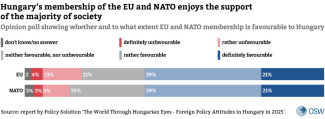
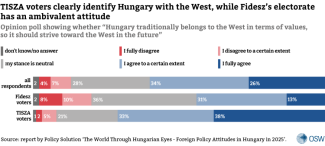
- Public support for the country’s Western orientation remains strong. Sixty per cent of respondents believe that Hungary should move in a Western direction (see Chart 2), and the same proportion view membership of the EU and NATO positively (see Chart 1). Despite several years of tensions with certain Western partners and the government’s confrontational rhetoric, institutional anchoring within Western structures continues to enjoy durable social legitimacy.
- A strong polarisation of electorates is evident with regard to strategic orientation. Among TISZA voters, 71% support a pro-Western orientation, whereas among Fidesz voters the figure stands at only 44% (see Chart 2). This difference indicates that the dispute over the strategic direction of foreign policy has become one of the principal axes of division within the political landscape.
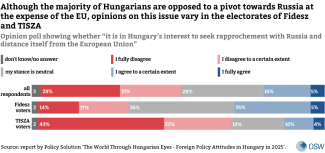
- Public support for rapprochement with Russia at the expense of the EU remains limited. The proposition that such a shift is necessary is rejected by 66% of TISZA voters and by nearly 50% of society as a whole (see Chart 3). Among Fidesz voters, support for such rapprochement is around one and a half times higher than among TISZA voters, which confirms this group’s greater susceptibility to narratives emphasising the need for cooperation with Moscow.
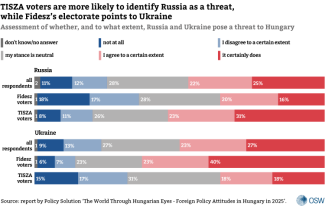
- In the perception of Hungarians, the threats posed by Russia and Ukraine are viewed as almost equivalent. TISZA voters more frequently identify Russia as the principal source of danger (54%), whereas within the Fidesz electorate the conviction that Ukraine poses a threat is markedly stronger (63%; see Chart 4). Across society as a whole, Ukraine (50%) and Russia (47%) are perceived as almost equally significant sources of danger. The near-identical assessment of the aggressor and the victim in the ongoing war is primarily the result of Fidesz’s narrative targeting Ukraine and portraying Russia as a reliable energy supplier. At the same time, the significant share of neutral attitudes indicates the susceptibility of part of society to competing narratives.
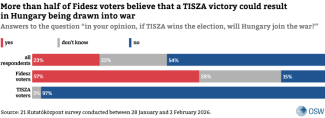
- The security narrative constitutes a central element in the mobilisation of the Fidesz electorate. More than half of its voters believe that a TISZA victory would lead to Hungary’s involvement in the war, compared with 23% of respondents overall (see Chart 5). This suggests that the issue of military risk is being effectively used as a tool for consolidating the government’s support base.
THE STANCE OF FIDESZ AND TISZA ON KEY ISSUES IN HUNGARY’S FOREIGN POLICY

Fidesz: The governing party sharply criticises the current shape of the EU and seeks to build an alternative to the mainstream through cooperation among right-wing parties. This orientation intensified after the party’s representatives left the European People’s Party (EPP) and subsequently co-founded the Patriots for Europe (PfE) group. Fidesz advocates strengthening the intergovernmental character of the EU and limiting its influence over the internal affairs of the Member States. It also opposes the EU’s policy towards Russia (calling for the lifting of sanctions and the continuation of energy cooperation) and China (for example, as regards tariffs on electric vehicles). The party further criticises what it describes as the civilisational direction of change in Europe, particularly in areas such as migration or issues of morality and social norms. Relations between Budapest and the EU institutions are burdened by a long-standing dispute over the rule of law, the consequence of which has been the freezing of funds under the conditionality mechanism. At the same time, the government employs a tactic of blocking or delaying decisions in the European Council as a means of exerting pressure in negotiations concerning issues such as sanctions against Russia and support for Ukraine.
TISZA: The priority of Magyar’s party is to rebuild trust in relations with the European Commission and the core EU member states. In practical terms, this entails seeking to unlock EU funds (which would be recovered through cooperation with the European Public Prosecutor’s Office) and stabilising Hungary’s position within EU structures. TISZA expresses readiness to deepen integration in selected areas – including, in the longer term, meeting the criteria required for the adoption of the euro – while at the same time avoiding explicit federalist declarations and signalling a more assertive approach in matters such as agriculture and the future multiannual financial framework. The party also distances itself from the EU’s migration policy, advocating stronger protection of the Union’s external borders and the preservation of a significant role for member states in shaping the rules governing the admission of refugees. At the same time, it emphasises the economic benefits of EU membership, presenting the Union as the primary framework for modernisation, a source of regulatory stability, and a key driver of economic development.
An analysis of voting patterns in the European Parliament (EP) conducted by the European Policy Centre indicates that in many areas TISZA’s position is close to that of Fidesz. TISZA MEPs, who belong to the EPP, voted in almost half of cases in the same way as Fidesz representatives sitting in the Patriots for Europe (PfE) group, thereby placing Magyar’s party to the right of the mainstream within the EPP. The greatest convergence concerns areas in which the politician appears deliberately to demonstrate that Viktor Orbán’s narrative portraying him as a ‘puppet of Brussels’ is unfounded. This includes opposition to further institutional integration, the use of the Article 7 procedure, increasing support for Ukraine, and a liberal migration policy.

Fidesz: The party regards membership of the Alliance as the foundation of the country’s security, while at the same time emphasising the primacy of national decisions regarding the scale and form of engagement. In the context of the Russian–Ukrainian war, it calls for the cessation of Western military supplies to Kyiv and opposes the transit of weapons through Hungary to Ukraine. Orbán’s government delayed its consent to the accession of Finland and Sweden to NATO. At the same time, under Fidesz rule Hungary has sought to maintain the image of a constructive ally by participating in selected international missions (including KFOR, although in recent years the foreign engagement of the Hungarian armed forces has focused primarily on non-NATO and non-EU mission in Chad). In 2023, defence spending exceeded 2% of GDP and is planned to reach 5% of GDP within ten years. Over the past decade, the modernisation of the armed forces has included the acquisition of modern equipment (including armoured, artillery, and air systems) as well as the development of the domestic defence industry. A key partner is the German company Rheinmetall, which has established production facilities in Hungary (including for combat vehicles and ammunition).
TISZA: From a strategic perspective, Magyar’s party regards security policy as part of a broader reintegration of Hungary into the mainstream of transatlantic cooperation, moving away from the selective and confrontational style of alliance policy pursued in recent years. It regards NATO membership as the fundamental guarantee of security and of the country’s lasting anchoring within Western structures, advocating predictable and closely coordinated cooperation with partners. In the context of the war in Ukraine, the party emphasises solidarity with NATO and the EU, while at the same time ruling out the deployment of Hungarian troops to the front and opposing the reintroduction of conscription. It also announces a review of foreign military missions with regard to their consistency with the national interest (including the termination of the mission in Chad). In financial terms, the party declares that it will maintain allied commitments and increase defence spending to 5% of GDP by 2035, combined with the development of the defence industry and cybersecurity capabilities, as well as stronger oversight of defence expenditure (including measures aimed at curbing corruption in the armed forces).

Fidesz: The government’s approach to the United States largely depends on the balance of political forces in Washington. During periods of tension with Democratic administrations – including disputes over the rule of law, relations with Russia and China, and the approach to Ukraine – Orbán’s government has resorted to sovereignty-based rhetoric, criticising the American ‘liberal establishment’ and portraying the United States as a source of political and ideological pressure. At the same time, Fidesz has consistently emphasised its closeness to the Republican Party. Following Donald Trump’s return to the White House, Hungary has become one of the closest partners of the current US administration among EU member states. This cooperation rests on the ideological convergence between the elites of the MAGA movement and Fidesz, as well as on Orbán’s direct contacts with Trump. In the government’s narrative, this relationship is presented as the foundation of a ‘golden era’ in bilateral relations and as confirmation of a shared strategic interest.
Under Fidesz rule, Hungary has become the Central European state with the least developed energy and military cooperation with the United States (in these areas, Budapest has instead prioritised Russia and Germany, respectively). In order to further secure the goodwill of the Trump administration, since 2025 Orbán’s government has emphasised the importance of cooperation with the United States for the diversification of energy supplies, while at the same time seeking greater flexibility in sanctions policy. Decisions signalled by Washington – including the temporary exemption of Hungary from restrictions concerning Russian oil – are presented as the result of the direct relationship between the two leaders. The political alliance with the US president is intended to reinforce the narrative of Budapest’s international agency and its privileged position in relations with the United States, particularly in the context of disputes with Brussels. This theme has been prominently highlighted during the electoral campaign. Trump’s support for Orbán is portrayed as confirmation that maintaining the current government guarantees the stability of transatlantic relations – including in the fields of energy and sanctions policy.
TISZA: The party emphasises the importance of stable transatlantic relations based on cooperation within NATO and predictable, partnership-based contacts with the US administration – regardless of which political force holds power in Washington. Unlike Fidesz, it does not build its message around personal ties with specific politicians, but instead emphasises the need to rebuild trust in relations with the West as a whole. The United States is viewed primarily as a key guarantor of security in the region and an important economic and investment partner. Politically, TISZA signals its readiness for more constructive cooperation with the US administration on issues of security, support for Ukraine, and the coordination of policy towards Russia. At the same time, it links the improvement of relations with Washington to the normalisation of relations with the EU, arguing that a stronger position for Budapest within Euro-Atlantic structures requires reducing tensions with Brussels. The party’s approach to the United States may therefore be described as less ideological and more oriented towards rebuilding Hungary’s credibility within the broader Western community. This course is reflected in the involvement of Anita Orbán, who originates from the former pro-Atlantic wing of Fidesz, which no longer exists.

Fidesz: The party’s policy towards Russia is shaped primarily by energy interests and forms part of a broader strategy of ‘balancing’ in foreign policy. Orbán’s government has consistently developed cooperation with Moscow in the energy sector, regarding it as a means of diversifying external relations and strengthening autonomy vis-à-vis the EU. Key elements include long-term gas contracts, oil supplies via the Druzhba pipeline, and the expansion of the Paks nuclear power plant carried out by Rosatom. Following Russia’s full-scale invasion of Ukraine in 2022, Hungary became the only EU member state to maintain almost unchanged energy cooperation with Moscow. At the same time, it has sought exemptions from EU sanctions imposed on Russia – particularly in the energy sector – and has opposed further tightening of restrictive measures. The Hungarian authorities emphasise the need to preserve channels of communication with the Kremlin: since 2022, Orbán has met Vladimir Putin three times, while the foreign minister has visited Russia on more than a dozen occasions. In rhetorical terms, Fidesz avoids explicitly pro-Russian declarations; in practice, however, Budapest’s position in many areas aligns with Moscow’s interests (including blocking Western support for Ukraine, maintaining energy cooperation, and attempting to obstruct sanctions against Russia).
TISZA: The party’s approach to Russia is markedly more critical than the line presented by the governing camp and is consistent with its declared pro-European and pro-Atlantic orientation. Magyar’s party advocates firmly anchoring Hungary within the mainstream of EU and NATO policy towards the Kremlin, as well as reducing energy dependence on Moscow. TISZA has announced a review of existing agreements with Russian entities — including those concerning cooperation in the nuclear sector — and a gradual reduction in reliance on Russian energy resources, setting the objective of ending their import by 2035 (a considerably more distant date than 2027, the target set by the EU). This process would involve the development of alternative supply routes, investment in renewable energy sources, and deeper integration with the EU energy market. In political terms, the party supports maintaining the EU’s common line on sanctions and opposes the instrumental use of veto power in negotiations with Brussels. At the same time, it emphasises that Hungary should not become directly involved militarily in the Russian–Ukrainian war. Strategically, TISZA views relations with Russia primarily through the prism of European security and allied solidarity, considering the existing Budapest–Moscow model of relations to be a factor that weakens Hungary’s position within the EU.

Fidesz: Although Orbán’s government recognises Ukraine’s sovereignty and territorial integrity as well as initially condemning Russia, Hungary was the only neighbouring Western state that did not provide it with military supplies. Budapest argues that its priority is to ‘stay out of the war’ and to minimise the costs to the Hungarian economy. An important element of Budapest–Kyiv relations remains the issue of the rights of the Hungarian minority in Transcarpathia. The Hungarian government takes a critical view of Ukrainian language and education regulations, regarding them as limiting the rights of this community and making any improvement in bilateral relations conditional on legislative changes in this area.
Within the EU, Hungary has repeatedly blocked or delayed decisions concerning financial assistance to Kyiv and sanctions against Russia, using the veto as a means of exerting pressure in broader negotiations with Brussels – particularly in the context of disputes over EU funds and energy issues. Fidesz strongly opposes Ukraine’s accession to the EU, blocking the opening of the first negotiation cluster and emphasising the alleged risks this would pose to Hungary’s economy and security.
The anti-Ukrainian narrative has become a central element of Fidesz’s electoral campaign. It portrays Ukraine as a state that obstructs energy supplies from Russia to Hungary (see further: Key developments) and poses a threat to the Hungarian economy (particularly in the event of its accession to the EU). In Fidesz’s narrative, the party’s continued rule is presented as the only guarantee that state budget funds will not be directed to Ukraine. At the same time, government rhetoric depicts the opposition TISZA as inclined towards a ‘pro-war’ course and linked to the interests of Kyiv. Magyar himself is portrayed as a ‘puppet’ of Kyiv whose victory would allegedly entail consent to financial transfers and military support for Ukraine, its accelerated accession to the EU, or even the deployment of Hungarian soldiers to the front (although TISZA has advocated none of these measures).
TISZA: Magyar’s party’s position is consistent with its declared course of reintegrating Budapest into the mainstream of EU and NATO policy. From a strategic perspective, the party views support for Ukraine as part of broader European solidarity and as a condition for restoring Hungary’s credibility within Western structures. At the same time, TISZA operates in a highly polarised political environment in which the issue of Ukraine serves as one of the main instruments of voter mobilisation for Fidesz. Consequently, the party adopts a cautious tone on this matter and avoids unequivocal declarations, seeking not to provide the governing camp with arguments for accusing it of pursuing a ‘pro-war’ course or acting in the interests of external actors.
TISZA distances itself from the confrontational veto tactics employed by the government and advocates maintaining a common EU position on support for Kyiv, although the party’s MEPs have on several occasions opposed or abstained in votes concerning financial assistance. The party is also against Hungary providing Ukraine with direct military supplies. Regarding Ukraine’s EU membership, TISZA declares support for Kyiv’s aspirations while emphasising the conditional nature of the accession process and announcing the organisation of a national referendum on the issue. At the same time, it signals the need for a constructive dialogue with Ukraine on the rights of the Hungarian minority in Transcarpathia, perceiving this issue as a matter of bilateral relations rather than as a means for blocking decisions at the EU level.

Fidesz: The governing party’s approach to China forms part of the ‘Opening up to the East’ policy pursued since 2010. Budapest views Beijing as an important economic partner, a source of capital and technology, and a means of diversifying Hungary’s international relations. In political terms, the government avoids confrontational rhetoric towards the People’s Republic of China and consistently opposes EU initiatives that could lead to a tougher stance on Beijing. A key dimension of cooperation consists of infrastructure and industrial investments – including the participation of Chinese companies in the modernisation of the Budapest–Belgrade railway line and the establishment in Hungary of factories producing batteries for electric vehicles. Budapest seeks to maintain Hungary’s position as a hub for Chinese investment in Central Europe, justifying this through a narrative centred on a model of economic growth based on attracting foreign capital, developing export-oriented industry, diversifying economic partnerships beyond the EU, and creating jobs. An important component of this cooperation also involves Chinese state loans financing infrastructure projects, which the Hungarian government presents as an alternative to EU funds frozen under the conditionality mechanism. At the same time, this policy has generated controversy both at the EU level and in domestic debate, due to insufficient transparency of contracts, growing credit obligations, and the potential consequences for security and the environment.
TISZA: The party advocates a cautious revision of the government’s current policy. It does not seek to terminate cooperation in the implementation of the principal Hungarian–Chinese economic projects, but announces that they should be subordinated to principles of greater transparency, parliamentary oversight, and compliance with EU standards in the areas of public procurement, state aid, and environmental protection. TISZA supports embedding relations with China within the framework of the EU’s common policy. It criticises the financing of infrastructure projects through loans, pointing to fiscal risks and the insufficient transparency of agreements, which – according to the party’s declarations – would be subject to review. In its narrative, significant emphasis is also placed on the environmental impact of investments in the battery sector – the party announces tighter regulatory oversight in this area and greater involvement of local communities in the decision-making process. At the same time, the party opposes the employment of temporary workers from third countries, arguing that priority should be given to the domestic labour force.

Fidesz: Budapest regards the V4 format primarily as a useful instrument for coordinating the interests of Central European states vis-à-vis the EU, particularly in areas such as migration, energy policy, and disputes over competences with Brussels. Between 2015 and 2021, the V4 served as an important platform for cooperation between Hungary and Poland in opposing the relocation of migrants and in disputes over the rule of law. Fidesz emphasised the importance of the region as a bloc capable of balancing the influence of the EU’s ‘core states’ and strengthening the intergovernmental character of integration. After 2022, however, the cohesion of the Visegrad Group weakened as a result of differing approaches to the Russian–Ukrainian war – especially between Budapest and Warsaw. For Fidesz, Visegrad cooperation was of secondary importance compared with the priority of maintaining close relations with Russia, and the party was prepared to accept the price of freezing relations with regional partners. At the same time, it continues to view the V4 as a potential instrument for restoring regional coordination, should political conditions allow.
TISZA: The main opposition party declares its intention to rebuild trust in relations with the states of the Visegrad Group. At the same time, it sees regional cooperation as a complementary instrument to the main current of European integration, rather than as an alternative to relations with key partners in the EU. In practice, this means seeking to ‘normalise’ the V4 and restore its functionality in selected areas (including energy and infrastructure) – without giving the format a confrontational character vis-à-vis Brussels. Anita Orbán, the prospective foreign minister in a potential TISZA government, has announced that the reactivation of cooperation within the V4 would be one of the priorities after taking power. Magyar, in turn, has repeatedly declared that his first foreign visit as prime minister would be to Warsaw, which would symbolise a reset in relations with Poland and the rebuilding of regional policy coordination.

Fidesz: Fidesz’s approach to Hungarian minorities living outside the country constitutes one of the enduring pillars of its national policy and a key element of the party’s identity-based messaging. Since 2010, the government has consistently developed instruments of support for ethnic Hungarians in neighbouring states (Romania, Slovakia, Serbia, and Ukraine), including simplified procedures for obtaining Hungarian citizenship, financial transfers to educational and cultural institutions, and support for local political elites. A crucial element of this policy is the granting of voting rights in parliamentary elections to individuals holding Hungarian citizenship but residing abroad. This electorate – concentrated primarily in Transylvania, southern Slovakia, and Vojvodina – votes overwhelmingly for Fidesz, translating into one to two parliamentary seats and providing the party with a stable electoral base (see ‘OSW update. Hungary election, no. 2’). In symbolic terms, the government presents this policy as the implementation of the principle of the ‘unity of the nation beyond borders’. At the same time, in recent years certain tensions have emerged within this approach. According to some minority groups, Budapest has at times been inclined to prioritise relations with political leaders representing similar ideological values, or the possibility of forming alliances in the European Council, over the defence of the interests of local Hungarian communities (for example, in relations with Slovakia following Robert Fico’s return to power).
TISZA: The opposition’s approach to Hungarian minorities living outside the country is more pragmatic and less ideological than that of Fidesz. The party does not challenge the existing instruments of support (citizenship, voting rights, educational programmes), but signals the need for greater transparency in financing and for the depoliticisation of relations with minority organisations. It emphasises that policy towards ethnic Hungarians abroad should be subordinated to the long-term interests of local communities rather than to short-term party calculations. At the same time, TISZA declares its opposition to all forms of discrimination against Hungarian communities in neighbouring states and announces that it would respond actively to violations of linguistic, educational, and local self-government rights – using bilateral dialogue as well as EU and international mechanisms.
KEY DEVELOPMENTS
The crisis over the Druzhba pipeline
The Russian attack on the Druzhba oil pipeline on 27 January led to the suspension of Russian oil deliveries to Hungary and Slovakia, triggering political tensions with Ukraine and a dispute with Croatia. The government in Kyiv explained the interruption on technical grounds– namely, the destruction of a pumping station near Brody as a result of Russian shelling. Budapest disputes this explanation, claiming that the suspension of transit is purely political in nature. Foreign Minister Péter Szijjártó announced the suspension of diesel exports to Ukraine and stated that Hungary is also considering halting electricity and gas supplies to that country. At the same time, the MOL group has contracted maritime deliveries that are expected to arrive at the Adriatic terminal at the beginning of April and be transported to Hungary and Slovakia via the Adria pipeline. Although the supply of fuels to the Hungarian market remains stable in the short term, the crisis has also triggered a dispute between Budapest and Zagreb. The Hungarian side expects to be allowed to transit Russian oil through Croatian infrastructure. Zagreb, however, points to the need for consultations with the European Commission and the US authorities, arguing that sanctions apply to Russian oil transported by sea.
As a form of pressure on Ukraine, Budapest blocked the adoption of a €90 billion EU loan for Kyiv as well as the EU’s twentieth sanctions package against Russia, making its consent conditional on the resumption of transit. Viktor Orbán published an open letter addressed to the President of Ukraine on social media, calling for the reopening of the pipeline. At the same time, he accused Volodymyr Zelensky of allegedly coordinating actions with Brussels and the Hungarian opposition aimed at bringing a pro-Ukrainian government to power in Budapest. Orbán also stated that Hungary had obtained a detailed report on the attack on the pipeline, which – according to satellite data – remains fully operational, a claim intended to demonstrate a lack of political will in Kyiv to make the infrastructure available. This message forms part of a broader strategy of constructing a sense of threat emanating from Ukraine and portraying the opposition as an actor linked to external interests. At the same time, the Hungarian government decided to strengthen the protection of key energy infrastructure by deploying military units and intensifying aerial patrols. These measures were justified by the alleged risk of destabilisation attributed to Kyiv. The militarisation of infrastructure protection forms part of the campaign narrative concerning external threats and the need to defend the country’s sovereignty.
The escalation of tensions with Ukraine as a central element of Fidesz’s campaign
At the beginning of March, a sharp exchange took place between Prime Minister Orbán and President Zelensky over disruptions to oil supplies via the Druzhba pipeline. Orbán accused Kyiv of blocking the flow of crude and declared that Hungary would not tolerate energy blackmail. In response, Zelensky suggested that if Budapest continued to block the EU loan for Ukraine, he would pass the Hungarian prime minister’s phone number to Ukrainian soldiers. The day after this statement, Hungarian authorities – assisted by the Counter-Terrorism Centre (TEK) – intercepted two armoured vehicles transporting approximately $100 million in cash and gold as part of a regular Ukrainian banking transfer between the state-owned Oschadbank and Austria’s Raiffeisen Bank. Seven bank employees were also detained. The Ukrainian side maintains that the transport was lawful and was seized illegally, whereas Hungary’s National Tax and Customs Administration (NAV) announced the opening of a criminal investigation on suspicion of money laundering. On 6 March, Ukraine’s Foreign Minister Andrii Sybiha, reported that those detained were safe and had returned to Ukraine. According to the Hungarian authorities, however, they were expelled from the country. The confiscated cash and gold remain in Hungary, while Kyiv has demanded their return, accusing Budapest of theft. In response to the incident, Ukraine’s Ministry of Foreign Affairs advised its citizens to refrain from travelling to Hungary, citing a lack of security guarantees in the face of what it described as the “arbitrary actions of the Hungarian authorities”.
Zelensky’s strong reaction provides Orbán’s government with arguments that reinforce the anti-Ukrainian campaign being conducted ahead of the parliamentary elections. For several months, the authorities in Budapest have portrayed Ukraine as an aggressive and unpredictable state that threatens Hungary’s security and the stability of energy supplies. In this context, Zelensky’s emotional statements and the dispute surrounding the intercepted financial transfer may be used in campaign messaging as confirmation of the government’s narrative concerning ‘Ukrainian pressure’ and the need to pursue a firm policy towards Kyiv. Consequently, by responding to Budapest’s actions, the Ukrainian president partly aligns with the logic of Orbán’s political provocation, thereby reinforcing the message that Fidesz directs at its own electorate. Magyar adopted a more balanced position than the government, while at the same time seeking to avoid the impression that he was siding with Kyiv. During a campaign speech, he stated that his party condemns Zelensky’s threats towards Orbán, but simultaneously criticised the prime minister for “incitement, threats and spreading fear” in relations with Ukraine.
Talks between Budapest and Moscow and reports of Russian interference in the campaign
On 3 March Viktor Orbán held a telephone conversation with Vladimir Putin concerning the situation in the Middle East and Ukraine, as well as the continuity of Russian energy supplies. The following day, Hungary’s foreign minister travelled to Moscow, where he met the Russian leader. In the Kremlin, Szijjártó reportedly secured an agreement to continue energy deliveries at an unchanged price and negotiated the release of two soldiers from Transcarpathia serving in the Ukrainian army who also held Hungarian citizenship. After the talks, the minister brought them to Hungary on a government aircraft and presented the operation as the result of Budapest’s “rational foreign policy”, emphasising that Russia “did not expect anything in return”. Putin, in turn, linked the continuation of energy cooperation with Hungary and Slovakia to their governments maintaining their current political course.
According to findings by the Hungarian investigative journalist Szabolcs Panyi, the Kremlin has established a special team of political technologists tasked with influencing Hungary’s parliamentary election. The group is reportedly overseen by Sergei Kiriyenko, the first deputy head of Vladimir Putin’s presidential administration. The aim of the operation is said to be to support the continued rule of Orbán’s government. Citing anonymous sources in European intelligence services, Panyi indicates that the Russian team may employ methods previously used in countries such as Moldova, including disinformation campaigns on social media, agent networks, and operations intended to shape public opinion. Some of these activities are reportedly coordinated from the Russian embassy in Budapest. Magyar has called for the expulsion of Russian intelligence agents from Hungary, accusing Orbán of allowing them to operate in the country and potentially influence the electoral process. According to the TISZA leader, the presence of Russian services in Budapest poses a threat to national security and the integrity of the forthcoming parliamentary election.
Controversy over the battery industry as a central element of TISZA’s campaign
Two weeks ago, the escalation of the scandal surrounding the Samsung SDI factory in Göd – involving reports of serious abuses and health risks to workers of which the authorities were allegedly aware of – was overshadowed by the uproar over an alleged video discrediting Péter Magyar (see ‘OSW update. Hungary election, no. 2’). Public attention was temporarily diverted to another issue, but TISZA has taken steps to bring the matter back into the spotlight. The party’s leader conducted an interview with a former employee of the plant, who spoke about serious abuses and health risks. The party has also expanded its narrative to include Debrecen: its candidate in the city, Zsolt Tárkányi, has begun to publicise alleged irregularities at the local battery factory. According to his information, at least two employees of the plant have recently suffered poisoning. Tárkányi, like Magyar, published a conversation with one of the affected workers. TISZA has also launched a petition calling for a public investigation and the identification of those responsible, both directly and politically. The significance of the issue goes beyond the immediate campaign narrative. According to a Medián survey from February, two-thirds of the public assume that the government was aware of serious health risks at Samsung’s factory in Göd. Even among Fidesz voters, the prevailing view is that the government may have been aware of the scale of the risks earlier. Overall, 64% of voters believe that the Göd scandal harms Fidesz’s electoral prospects. Among TISZA’s electorate, 86% share this view, while a third of Fidesz voters also believe that the issue negatively affects the party’s standing.
End of the signature collection period and the beginning of the campaign’s intense phase
On 6 March the stage of collecting signatures of support for candidates in the parliamentary election came to an end. After that date, parties can no longer nominate new candidates or replace those who withdraw from the race. In practical terms, this means that personal attacks may intensify in the coming weeks of the campaign, as the withdrawal of a candidate entails the loss of remaining votes already secured within the proportional representation system and a reduction in campaign funding. The largest parties – Fidesz and TISZA – gathered the required signatures within the first hours of the collection process. Our Homeland required several days to do so, while some smaller opposition parties failed to pass this stage, which has reduced the fragmentation of the opposition. From TISZA’s perspective, this means a partial ‘clearing’ of the political field – some former opposition parties, including the far-right Jobbik, will not contest the election. At the same time, it is advantageous for Fidesz that not all opposition parties have disappeared from the scene: the Democratic Coalition (DK) and the Hungarian Two-Tailed Dog Party (MKKP) have managed to field candidates, which may disperse votes among opponents of the government. In several constituencies, former opposition politicians are running as independent candidates (including the highly popular Ákos Hadházy), which may also limit support for Magyar’s party.
At the same time, the largest parties published the composition of their national lists. In the case of Fidesz, the top positions were taken by Viktor Orbán, Zsolt Semjén, László Kövér, Kinga Gál, and Alexandra Szentkirályi, while TISZA’s list is headed by Péter Magyar, Andrea Rost, László Gajdos, Ágnes Forsthoffer, and István Kapitány. The presence of well-known figures, such as the opera singer Andrea Rost on TISZA’s list, has the potential to mobilise voters. At the same time, the structure of the lists reflects internal hierarchies within the parties and sends a political signal, including through the presence of women among the top five candidates, which is intended to counter the image of a male-dominated political landscape.