The Russians are advancing towards Sloviansk and Kramatorsk. Day 1462 of the war
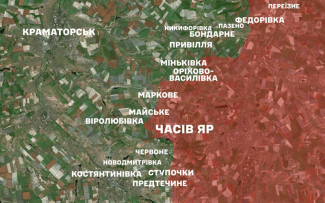

Russian forces continued their offensive in the direction of Sloviansk and Kramatorsk, where they drove the Ukrainians out of two more towns. From the north-east and south-east, they are approaching the key town of Rai-Oleksandrivka, currently the main point of Ukrainian resistance and the last major town east of Sloviansk. They also captured further areas in the arc north of Lyman. However, they have still not managed to enter the centre of the city (fighting continues on its northern and eastern outskirts), but they have consolidated their positions to the south of it, inear the road and railway line to Sloviansk. This is where they are closest to the city – less than 12 km away – but their potential attack from the north is hampered by the terrain: the Donets River floodplains and a network of reservoirs behind them.
Under Russian pressure, Ukrainian troops are gradually retreating from their last positions in Kostiantynivka, south of the Bakhmut-Pokrovsk road. Several city districts remain under Ukrainian control, while most of it is in a grey zone or has been captured by Russia. Russia has not managed to develop an offensive in the north-eastern part of Kostiantynivka. They have made slight progress north and west of Pokrovsk and Myrnohrad.
The conurbation of Sloviansk, Kramatorsk and Druzhkivka to the south, is the last urbanised part of Donbas remaining under Ukrainian control. The only major city outside of these where Ukrainian forces are currently offering direct resistance is Kostiantynivka. The Russian offensive on Sloviansk and Kramatorsk, although slow, is being conducted from three directions – south (from Pokrovsk and Kostiantynivka), east (from Bakhmut) and north (from Lyman). The main road supplying both cities from Kharkiv Oblast – the M03 motorway – is still under physical Ukrainian control. However, it lies in the “death zone” and is therefore permanently exposed to drone attacks and artillery fire. Both cities are only connected to Dnipropetrovsk Oblast by local roads, which, in the event of the loss of the communication route with Kharkiv Oblast, will significantly hinder Ukraine’s ssupplies. Cutting the M03 route northwest of Sloviansk will become one of Russia’s main objectives in the coming months.
The Russians have managed to relatively stabilise the situation in the eastern part of Zaporizhzhia Oblast, where they resumed their offensive west of the Haychur River and crossed the railway line again. Ukrainian forces continued their attacks south of Velykomykhailivka in Dnipropetrovsk Oblast, resuming the fight for the town of Ternove.
Volodymyr Zelensky and the commander-in-chief of the Ukrainian Armed Forces General Oleksandr Syrskyi commented for the first time on the Ukrainian offensive operations that have been ongoing for several weeks at the junction of the Zaporizhzhia and Dnipropetrovsk oblasts. They reported on significant territorial successes that had no confirmation in the actual situation – on 20 February, Zelensky announced that 300 km² had been recaptured on the “southern front”, and on 23 February, Syrskyi announced that 400 km² had been liberated as part of an “offensive operation” in the Oleksandrivsk direction, i.e. only in Dnipropetrovsk Oblast (which would mean Russia being completely driven out of this oblast). These reports have not been confirmed by Ukrainian OSINT sources; DeepState, considered the most reliable of them, has only slightly expanded the grey zone in the region in Ukraine’s favour. In reality, Ukrainian counterattacks in recent weeks have covered an area of approximately 100 km² in three directions in the Zaporizhzhia and Dnipropetrovsk oblasts. However, Ukraine’s moves did not lead to it regaining control of the area and, above all, expanded the grey zone.

On the night of 21–22 February, Russia carried out another massive attack on Ukrainian energy and transport infrastructure. Among others, the TETS-6 combined heat and power plant in Kyiv and the Trypilska Thermal Power Plant located south of it, substations in Mykolaiv and Bolhrad in Odesa region, and railway facilities in Mykolaiv and Zaporizhzhia were damaged. Damage to energy infrastructure resulting in power cuts also occurred in the Dnipropetrovsk and Poltava oblasts. The Ukrainian Air Force Command reported that Russia used 297 drones (including 200 strike “Shaheds”) and 50 ballistic and cruise missiles, of which 274 and 33 (mainly cruise missiles) were destroyed, respectively.
Russia continued to strike energy and logistics facilities in Odesa Oblast, as well as in areas directly behind the front line. Further attacks on substations in Odesa Oblast took place on 21–23 February. As a result of the last of these, 156,600 consumers in Odesa had their electricity supply cut off. On 23 February, port infrastructure in Chornomorsk was damaged. Energy and logistics infrastructure also suffered as a result of further strikes on Kryvyi Rih (on the evening of 17 February), Mykolaiv and Mykolaiv Oblast (18–19 and 21–22 February), Zaporizhzhia (18, 20 and 22–23 February) and Kharkiv (20 and 23 February). On 18 February, the railway station in Lozova in Kharkiv Oblast was destroyed, and on 20 February, further gas extraction facilities in Poltava Oblast were destroyed. According to Ukrainian sources, from the evening of 17 February to the morning of 24 February, the Russians used a total of 967 drones (including 630 strike drones) and 57 ballistic and cruise missiles. The defenders announced that they had destroyed 832 unmanned aerial vehicles and 33 missiles.

On 19 February, Ukrainian drones struck a fuel depot in Velikiye Luki in Pskov Oblast, causing a fire in the tanks. The damage was confirmed by satellite images published two days later. On 20 February, the Votkinsk Zavod ballistic missile factory in the Udmurt Republic was hit, and on 21 February, a gas processing plant in Neftegorsk in Samara Oblast was hit. The attacks caused fires at both companies, but did not cause significant damage. Strikes on the VNIIR-Progress plant in Cheboksary, the Chuvash Republic (18 February) and the Elektrovypriamitel plant in Saransk and the refinery in Saratov (22 February) were unsuccessful. An attack on the Druzhba Kaleykino oil pumping station in Tatarstan on 23 February led to a fire in oil tanks.
Ukrainian forces carried out further strikes on border energy infrastructure, mainly in Belgorod Oblast. The Belgorod combined heat and power plant was damaged again (19 and 23 February), as were local substations (18, 19 and 23 February). However, there is conflicting information about the attack on these facilities on 22 February. In Belgorod Oblast, power, water and heating outages have become permanent.
The Ukrainian General Staff reported successful attacks on Russian military facilities in occupied Crimea. On 21 February, drones reportedly hit two Be-12 flying boats at the Yevpatoriya aircraft repair plant and two FSB Border Guard Service Project 22460 Okhotnik patrol boats. Two days later, it is thought they struck the area where the missile squadron of the 15th Coastal Defence Missile Brigade is concentrated, damaging the Bastion launchers used to attack Ukraine. This information has not yet been confirmed. According to local sources, a massive Ukrainian attack on Sevastopol took place on 20 February (one civilian was killed and one was wounded).

On 19 February, Sweden’s Defence Minister Pål Jonson announced that the Swedish government has approved the 21st military support package for Ukraine. It is worth SEK 12.9 billion (€1.2 billion) and is intended primarily to strengthen air defence and the production of missiles and drones. €524 million of this amount will go to the Ukrainian production of so-called long-range missiles and drones used to attack targets in Russia, while €400 million has been earmarked for the previously announced Swedish-made Tridon Mk2 anti-aircraft systems and other equipment for air defence units (including anti-aircraft guns withdrawn from service in the Swedish Armed Forces), and €280 million will cover the costs of transferring grenade launchers from Swedish army stocks to the defenders, purchasing artillery ammunition and spare parts, and training Ukrainian soldiers.
The UK has pledged to provide Ukraine with £13 billion (almost €14.9 billion) in military aid, as announced on 20 February by Minister of State for Defence Readiness and Industry Luke Pollard. The funds will be used, among other things, to finance the mass production of Octopus interceptor drones in the UK.
On 20 February, Ukraine’s Defence Minister Mykhailo Fedorov announced that Poland continues to fund the operation of 29,000 Starlink satellite communication terminals in Ukraine. Polish funding for Starlink remains one of the key elements in maintaining civil and military communications in Ukraine during the ongoing war.

On 19 February, Defence Ministry Advisor Serhiy “Flash” Beskrestnov proposed introducing regulated sales of SIM cards – exclusively on the basis of a passport and with limits on the number of telephone numbers that can be used. In his opinion, this would make it more difficult for Russian forces using Ukrainian cards to control FPV drones via LTE networks. This decision would require legislative changes and a vote in the Verkhovna Rada. In Beskrestnov’s opinion, the solution would not provide a 100% guarantee of security, but rationing could significantly reduce the mass, uncontrolled purchase of thousands of SIM cards by people working for and subsequently transferring the cards to Russia.
On 23 February, Kostiantyn Milevskyi, Deputy Head of the Foreign Military Service Coordination Department of the Armed Forces of Ukraine, announced that volunteers from 75 countries had joined Ukraine’s Land Forces, with an average of 600 foreigners signing contracts each month. The total number of foreign volunteers who have served or continue to serve in the Land Forces has exceeded 10,000. Foreigners in the army have the same rights and obligations as Ukrainian citizens, with the difference that they can terminate their contract after six months of service.

The Russian Ministry of Defence has attempted to downplay the problem of Elon Musk blocking Starlink satellites used by Russia in the war against Ukraine. According to the version presented by the ministry on 18 February, the loss of access to the terminals was not the result of sanctions or technological blockades, but part of a disinformation operation planned by Russia. Representatives of the command stated that the army used Starlink exclusively to “mislead the enemy”. It was reported that Russian troops deliberately gave the impression of being dependent on American satellite infrastructure in order to confuse the enemy. The Ministry of Defence also argues that they did not need the Starlink system because they have alternative solutions that allegedly work better.
On 19 February, Kenyan authorities reported that over a thousand Kenyan citizens had been recruited to fight for Russia in the war against Ukraine. According to investigators, recruitment took place through agencies in Nairobi, and departures were facilitated by tourist visas. Transportation was by air via Abu Dhabi and Istanbul. Those who signed military contracts were promised monthly salaries ranging from €920 to €2,400. The media also report on recruitment agencies possibly cooperating with corrupt airport employees in the Kenyan capital, and representatives of national employment services and embassy staff – Russian ones in Nairobi and Kenyan ones in Moscow.
On 21 February, the Foreign Intelligence Service of Ukraine (FISU) announced that Russia was using educational, cultural and religious initiatives as tools to recruit citizens of African countries to participate in the war against Ukraine and work in the Russian Federation’s arms industry. Russian agitators offer young Africans employment in the security, transport and construction industries. Upon arrival in Russia, some of them end up in structures linked to the army or the defence industry. The Alabuga Start programme was cited as an example. Young women aged 18 to 22 are sent to the Alabuga Special Economic Zone in Tatarstan, where they participate in the production of military equipment, including unmanned aerial vehicles. The FISU reported that Russia combines recruitment with a wide range of alleged scholarships, language courses and short-term educational programmes at local universities. The activities of the Orthodox Church of the Moscow Patriarchate are also an important element of Moscow’s influence strategy. Between 2022 and 2026, its activity in Africa was set to increase significantly: at the beginning of this period, it was present in four countries, but this has risen to over 30.

On 20 February, the Ukrainian Prosecutor General’s Office revealed details of Operation Enigma 2.0, carried out jointly with the Moldovan services, which broke up an organised group preparing to assassinate prominent Ukrainians. A total of ten people were detained – seven in Ukraine and three in Moldova. According to the investigators’ findings, the network was operating under the supervision of the Russian special services. Its members are thought to have been collecting information about the place of residence and movements of potential victims, analysing their lifestyle and level of protection, and planning methods for their elimination. It is thought that Russia was offering a reward of up to $100,000 for each murder, depending on the recognisability and position of the potential victim. The group planned to kill, among others, the deputy head of the Main Directorate for the Treatment of Prisoners of War, Andriy Yusov, and military personnel fighting in foreign volunteer formations. The organiser and coordinator of the group was a 34-year-old Moldovan citizen who had previously served a prison sentence in Russia and was recruited there by the local intelligence services. After returning to Moldova, he created a hierarchical operational structure, recruiting mainly young men, including military academy graduates. The agents posed as couriers for logistics companies, taking photographs and marking the geolocation of possible targets on digital maps. Communication took place via closed channels and financing was performed via cryptocurrency wallets.
On the night of 22 February, a terrorist attack took place in Lviv, killing a 23-year-old police officer and injuring 24 people. According to the investigating authorities, at around 12:30 a.m., the emergency services operator received a report of a break-in at a shop on one of the streets. An explosion occurred when the first police patrol arrived at the scene. When the second patrol arrived, another improvised explosive device detonated. One of the people involved in planting the device was detained. Interior Minister Ihor Klymenko pointed to the highly probable involvement of Russian intelligence services in organising the attack. On 23 February, an explosive device detonated at a disused petrol station in Mykolaiv. Seven police officers who had parked their cars and were preparing to go on patrol were injured in the incident. On the same day, there was an explosion near a police station in Dnipro. According to preliminary data, no one was injured, but the shock wave damaged the building. The Ukrainian authorities reported that similar explosions had been recorded in recent weeks in various regions of the country, including Odesa and Kolomyia, which may indicate that they were part of a planned sabotage operation by the Russian intelligence services.

On 18 February, Ukrainian military intelligence (HUR) published data on individuals and structures involved in the export of children from temporarily occupied territories to Russia under the pretext of “cultural and educational trips”. The information was made available on the War and Sanctions website in the “Child Abductor’s” section. According to HUR, this practice is part of the “Cultural Map 4+85” project initiated by the Russian Ministry of Culture. The project is being implemented by the Roskontsert state institution. Officially, the aim of the programme is to “promote cultural awareness of Russia”. However, the interview emphasises that in reality, these measures serve to integrate Ukrainian children into the Russian socio-cultural space and shape their identity in the spirit of loyalty to the Kremlin, while also being part of a broader strategy referred to as “humanitarian aggression”, which aims to erase Ukrainian national identity.