To už se nevrátí
I. Czechoslovakia – a state that fulfilled its historical mission
1. Czechs and Slovaks on the eve of the First World War
2. The background and reasons for establishing a common state
4. Unifying and dividing elements
5. The first and second dissolution of Czechoslovakia
1. Evolution of political relations
2. The most recent political crisis
3. Not only Babiš – Slovaks in Czech politics and Czechs in Slovak politics
5. Interpersonal relations and culture
Conclusion: a model divorce and close, though no longer strategic, relations
Introduction
The Czechs and the Slovaks are often perceived in Poland – and consequently in debates on Central Europe – as a pair of nations that have been linked ‘since time immemorial’. This perspective overlooks the fact that Czechoslovakia, now slowly fading from memory, was, in the context of the past millennium, a relatively short-lived entity. Established in autumn 1918, it lasted only 20 years in its initial democratic form. Following the Second World War, most of the more than 40 years of Czech–Slovak coexistence unfolded under the period of real socialism (1948–1989), preceded by only a few years of illusory hopes for a return to democratic rule. The opening of public debate in 1989 and the launch of a joint systemic transformation soon led to the Velvet Divorce.
Even under the Austro-Hungarian monarchy, the two nations belonged to different administrative spheres: the Czechs, alongside Galicia (with Kraków and Lviv), were part of the ‘imperial’ Austrian-controlled Cisleithania,[1] while the Slovaks came under the ‘royal’ Hungarian-administered Transleithania. This division created differences not only in political traditions but also in legal systems. As the newly formed Czechoslovakia largely retained pre-existing legal frameworks, Catholic citizens discovered, for instance, that divorce was legally permitted in the Slovak part of the country (a legacy of Hungarian law), but not in the Czech part, where the Austrian Civil Code of 1811 still applied. Such discrepancies had to be harmonised – in the case of divorce, this was achieved to a large extent as early as 1919.
Legal disparities were compounded by socio-economic differences: within the Austro-Hungarian Empire, the territory of today’s Czech Republic was far more industrialised, whereas Slovakia remained predominantly agricultural. After 1918, the Czech elites adopted a strongly anti-clerical stance, which under communism provided fertile ground for more effective efforts at promoting atheism. Over time, this deepened the contrast with Slovaks, who to this day display a markedly higher level of religious practice and attachment to the Catholic Church (although a significant part of their elite was Lutheran). These differences widened following the dissolution of Czechoslovakia. Slovakia remains the only Visegrád Group (V4) country to have adopted the euro, and in 2024 its citizens celebrated the 15th anniversary of using the common European currency. The distinct historical experiences of the two societies also shape their differing attitudes towards Russia.
At the same time, the two countries and nations remain bound by enduring cultural and linguistic closeness, reinforced by a significant number of mixed families and migrants from the other state – though this relationship is marked by a notable asymmetry, owing to the Czech Republic’s considerably stronger appeal. This closeness is further deepened by student exchanges, a partially shared readership market, and the cross-border activity of businesses, journalists, experts, and popular cultural figures. The relatively peaceful dissolution of Czechoslovakia facilitated such interaction, as it left neither side with traumatic experiences to process or a desire for revisionist claims.
Moreover, the absence of public consultation in the decision to divide the Czechoslovak state, together with the widespread surprise that accompanied this development, has contributed to the enduring image of a country divided not by mutual animosity but by the political ambitions of individual leaders. Yet, as this analysis has shown, claims of harmonious coexistence between the two nations did not always reflect reality. Even today, some artists and journalists write of a country taken from them against the will of the majority – or rather two majorities – since a truly unified Czechoslovak society never came into being.
These factors have shaped the perception of ‘above-standard’ relations between the two states, including in the political sphere. Their successive leaders have upheld this image by making the other country the destination of their first foreign visit, rarely engaging in open criticism, and frequently coordinating positions on European policy. This cooperation has not always been smooth, and especially in Prague, debate about Slovakia often includes concerns over political developments – particularly since Robert Fico’s left-nationalist government came to power. There is also occasional ‘envy’ of certain Slovak political figures, most recently of former President Zuzana Čaputová, who from 2019 to 2023 stood in sharp contrast to her Czech counterpart, Miloš Zeman. At times, a sense of paternalistic sympathy arises in response to the actions of the ruling camp in Bratislava. Nevertheless, media interest in the neighbouring country remains markedly higher than in most other bilateral relationships.
Understanding the unique bond between the Czech Republic and Slovakia – and the constraints that accompany it – can help in accurately interpreting the dynamics of broader regional coordination. This is all the more important, given that one of the largest armed conflicts since the Second World War is taking place just beyond the eastern borders of Poland and Slovakia. Hungary’s divergent position on the war has, in effect, led to a collapse of political cooperation within the Visegrád Group. These divisions within the V4 on such a crucial geopolitical issue were further deepened by the change of government in Slovakia following the autumn 2023 elections. The rhetoric of Robert Fico’s cabinet regarding the war even led to the cancellation of Czech–Slovak intergovernmental consultations planned for spring 2024. As a result, relations between Prague and Bratislava have fallen to one of their lowest levels since 1993.
This study consists of two main parts, focusing respectively on the shared state and on contemporary Czech–Slovak relations following its dissolution. The first part explores the origins and character of Czechoslovakia, outlining both the elements that supported harmonious coexistence between its nations and the factors that created division. This section also includes a chapter analysing the country’s two dissolutions. The second part examines the evolution of political relations after the Velvet Divorce, with particular attention to interactions between the two governments in recent years. The following chapters investigate economic ties between the Czech Republic and Slovakia, as well as relations among their citizens and within the broader spheres of culture and education. The analysis covers basic demographic data and includes sections on mixed families and complex identities, mutual perceptions, student exchanges, and the intermingling of media and sport. The entire work is supplemented with numerous text boxes that provide deeper insight into selected issues.
Theses
- The exceptional nature of political relations between the Czech Republic and Slovakia is reflected in the disproportionately high level of mutual interest and the precedence given to visits by leading political figures. This stems from the legacy of their former shared state, linguistic kinship, and strong interpersonal ties. The foundation of close Czech–Slovak political relations over the past three decades has been the orderly and peaceful completion of the dissolution of their shared state. The Velvet Divorce was possible because the Czechs – as the larger partner – chose not to forcibly retain the smaller Slovakia. Moreover, the border between them was not a source of dispute, and their shared history is not burdened by armed conflict.
- Despite their overall closeness, Czech–Slovak relations have not always been without difficulties. Since 1993, there have been two periods of particular tension. The first lasted from the dissolution of Czechoslovakia until 1998, when the term of the Vladimír Mečiar’s cabinet in Bratislava came to an end. His administration pushed the country into international isolation, a trend compounded by authoritarian tendencies and numerous domestic political scandals. This situation significantly affected relations with Slovakia’s western neighbour.
- The most serious crisis in bilateral relations in recent years occurred in March 2024, when the Czech government, led by Prime Minister Petr Fiala, cancelled the intergovernmental consultations – a tradition partly initiated by his Slovak counterpart, Robert Fico. The Czech side cited differences in perspectives on key foreign policy issues. Czech–Slovak relations have been significantly affected by the diverging outlooks of the centre-right government in Prague and the left-nationalist bloc that has held power in Bratislava since autumn 2023, particularly regarding support for Ukraine and the rhetoric surrounding it. These tensions are further compounded by differences in political culture (with Czech politics being more moderate) and public opinion (with Slovak society tending to be more pro-Russian), which may hinder rapprochement even after the anticipated change of government in Prague in autumn 2025. The suspension of consultations is not merely a symbolic manifestation of the crisis – it also generates a range of practical problems. These frictions have highlighted the mistake of failing to establish various forms of sectoral cooperation. For example, the Czech Republic and Slovakia lack institutionalised cross-border collaboration, and without political impetus – especially following the cancellation of intergovernmental consultations – it is difficult to advance progress on numerous practical matters.
- Asymmetry is a key characteristic of Czech–Slovak relations at various levels. In economic terms, this refers to a disparity in capacity and wealth, which makes the Czech Republic more appealing to Slovaks seeking employment and enables Czech companies to cut costs by operating in their neighbour’s territory. In 2023, real GDP per capita in the Czech Republic was 12% higher. However, Slovakia has managed to narrow the gap from 38.5% in 2005, and its labour productivity – the highest in the Visegrád Group – offers promising prospects for convergence with the Czech Republic. Trade between the two countries continues to grow in absolute terms and remains significant, particularly given the size of their economies. Nonetheless, since the dissolution of Czechoslovakia, they have become less important trading partners in relative terms. This is the result of gradual trade diversification. Between 1993 and 2024, Slovakia’s share in Czech imports and exports dropped by 11–12 percentage points to 5–8%, while the Czech share in Slovak imports and exports fell by 34 and 42 percentage points, to 10 and 12% respectively. Since 1993, economic ties with Germany have become especially important for Prague.
- In terms of people-to-people dynamics, inequalities concern not only the intensity of migration but also the potential for cultural influence. The Czech Republic exerts significantly greater pull, which is why the number of Slovaks moving there clearly exceeds movement in the opposite direction. Many remain in the Czech Republic after completing their studies – a result of generally higher university standards, favourable admission rules, and an overall better standard of living. By contrast, Czechs living in Slovakia are on average significantly older, and their population has been gradually declining since the dissolution of Czechoslovakia. As a result, around 160,000 Slovaks live in the Czech Republic – three and a half times more than the number of Czechs in Slovakia. Although survey data show that the two nations still instinctively evoke positive associations with each other, the passing of generations who remember the shared state inevitably causes interpersonal relations gradually to lose their exceptional character.
- Czech–Slovak relations would probably not have been as intensive across so many areas, nor as positive for most of the period since their separation, without the legacy of Czechoslovakia. Paradoxically, the smooth division of the country also strengthened their ties, as it helped avoid the potentially destructive effects of a protracted disintegration of their shared statehood. In practice, that disintegration had already begun in mid-1992.
- In 1918, the unification of the two nations was primarily influenced by political and ethno-linguistic factors. Politically, the Czechs sought to strengthen their position vis-à-vis the German minority, while the Slovaks aimed to counterbalance the Hungarian minority and to secure protection against potential revisionist ambitions from Berlin (or Vienna) and Budapest. Centrifugal tendencies tended to intensify whenever the state failed to fulfil this protective role or when there were no perceived threats that could justify its existence as a safeguard. Such a situation arose in autumn 1938, when Prague yielded to the Munich dictate and Slovakia lost its southern territories to Budapest. In contrast, in the early 1990s, the absence of any perceived threat from Germany reduced Czech motivation to secure a stronger position within a larger state and even gave rise to concerns about becoming entangled in Slovak–Hungarian disputes.
- Despite their cultural closeness, Czechs and Slovaks have been and remain distinct nations. The assumption held by some proponents of Czechoslovakism – that years of living in a shared state would create a national monolith – proved to be misguided. At the time of Czechoslovakia’s founding, Slovaks were already almost fully formed as a national community, and sharing a state with the Czechs enabled them to complete this process. This union offered the Slovaks, who lacked a tradition of their own statehood, the opportunity to gain greater agency than would have been possible had they remained linked to Hungary. Among Slovaks, there was a discernible and natural drive – characteristic of every nation – to expand their role in governance and, over time, to establish a state of their own. These ambitions, and particularly the absence of autonomy for Slovakia as promised in the so-called Pittsburgh Agreement of spring 1918, arose as an issue almost from the outset of their coexistence. Efforts to forge even a secondary Czechoslovak identity were hindered by factors such as the 1938 decision to forgo war against Germany – a conflict that might have created a bond through shared sacrifice – and the long-standing Czech failure to grasp Slovak aspirations. Even in the 1980s, after decades of cohabitation, local sociologists maintained that it had not been possible to create a relatively unified Czechoslovak society.
- The fact that the shared state was dissolved twice demonstrates its ephemeral nature. After the first dissolution in 1939, Czechoslovakia was re-established in 1945, enabling the Slovaks to be counted among the victors of the Second World War, despite their earlier collaboration with the Nazis. The second dissolution occurred on 1 January 1993 and resulted from a series of negotiations between political forces elected in the June 1992 parliamentary elections. Until the final stages of the debate, the Slovak side had not clearly articulated a demand for independence. In the end, it was the Czechs who proposed the division, for which they considered themselves better prepared in terms of both human resources and economic capacity. For a long time, the Slovaks struggled to envisage such a separation, yet they gradually expanded their demands and crossed new thresholds, for instance by adopting the Declaration of Sovereignty.
- Czechoslovakia’s cohesion was undermined by differences between its two parts and the nations inhabiting them. While the Czech lands were already highly industrialised by 1918, Slovakia remained predominantly agricultural. This disparity affected levels of prosperity, and the gap was never entirely closed during the existence of the shared state. Among the arguments raised in the political debate following democratisation in 1989 was Czech reluctance to continue ‘subsidising Slovakia’.
- Immediately after the most recent division, it soon became clear that Slovakia was no longer as important for the Czechs as it had been in 1918. The Czechs turned towards the West, and this orientation was largely undisputed. Initially, Slovakia was perceived as a buffer separating the territory under Prague’s control from the unstable regions of Eastern and South-Eastern Europe. Czech elites widely promoted the idea that the Morava River, which flows between the two countries, marked a symbolic dividing line between East and West. The situation was influenced by Slovakia’s geopolitical ambiguity. In the 1990s in particular, the notion of Slovakia as a ‘bridge between East and West’ gained popularity, with the idea of maintaining military neutrality. This was intended to secure Slovakia’s advantageous position as a ‘gateway to the East’ while avoiding entanglement in conflicts among more powerful actors, over which, as a relatively small state, it would have had limited influence.
- In both Czech and Slovak public debates, the issue of the allegedly undemocratic nature of the dissolution regularly resurfaces. The separation was implemented by political forces that, at the time of their election, had not included such a proposal in their platforms, and the population was not consulted via a referendum. However, this line of argument overlooks several important constraints. The first relates to the difficulty of framing a suitable referendum question, as each side envisaged Czechoslovakia differently: the Czechs favoured a strong federal state, while the Slovaks aspired to the loosest possible union. The second constraint was that, following the mid-1992 elections, the state had, in practice, already showed signs of ceasing to function as a federation. Decisions taken by the central government in Prague were increasingly difficult to implement in Slovakia. Postponing the separation would only have aggravated these issues, heightening the risk of disorder or bilateral disputes.
I. Czechoslovakia – a state that fulfilled its historical mission
Although Czech and Slovak national ambitions grew steadily throughout the 19th century, at the outset of World War I, the idea of a shared state remained difficult to imagine for most leading politicians of either nation. Czech aspirations rarely extended beyond a desire to achieve parity with the Hungarians within the Habsburg monarchy. One key expression of this was their repeated pressure on Emperor Franz Joseph I to formally accept the crown of Bohemia. Though he promised to do so – twice, in fact, in September 1870 and again the following year – many Czechs were left with lasting bitterness, as these promises were ultimately unfulfilled. The Austrian ruler was unwilling to set a precedent that might embolden other national groups within the monarchy. At the same time, he did not wish to alienate the German population living in the Czech lands, who comprised around one-third of their inhabitants. Taking the Bohemian crown would have inevitably complicated his relationship with that community. This was because the oath taken by a Bohemian king – last sworn in 1836 by Ferdinand the Benign – included a promise not to diminish the lands of the Bohemian Crown and to seek their expansion.[2] This pledge was fundamentally at odds with the key demand of local Germans, who – recognising that it was no longer realistic to make Bohemia a fully German territory – instead called for the region to be divided along ethnic lines. It was this logic that underpinned the German minority’s opposition to Franz Joseph I accepting the Bohemian crown.
The stance of Czech politicians echoed the ideas promoted in the 19th century by František Palacký, the founder of modern Czech historiography, still remembered as the ‘Father of the Nation’. For a long time, he regarded the Austrian monarchy as the most suitable framework for the Czech nation and its lands, provided that Czech lands – taken as a whole – were granted the broadest possible autonomy. He famously remarked, ‘If Austria did not exist, we would have to create it”,[3] and dismissed concerns about being absorbed into the German sphere with the words, “We were here before Austria, and we will be here after it”.[4] This made the Austro-Hungarian Compromise of 1867 and the creation of the dual monarchy all the more disappointing to him, as he had hoped for a structure comprising several equal parts, not one privileging only two.
Tomáš Garrigue Masaryk held similar views at the outbreak of World War I. He earned his place in the Czech national pantheon only during the conflict and in its aftermath. Before then, he had criticised the programme for Czech statehood, arguing that a state in which more than one in three citizens spoke German, and which was surrounded by German influence – which he termed the ‘German plague’ – would struggle in future to defend itself or root itself in Czech traditions. In this view, the monarchy served as a buffer protecting the Czechs from ‘chauvinistic’ Germans on one side and ‘Russian autocracy’ on the other.
The weakness of the independence movement was largely a result of a deeply rooted belief in Bohemia in the continuity of Czech statehood under Habsburg rule. Until the first half of the 19th century, coronations of Bohemian kings still took place, often some time after the emperor had received his imperial regalia.[5] The prevailing voices called only for the restoration of full rights within that framework. The rapid economic and social development of the region, especially between about 1870 and 1914, further discouraged revolutionary change.[6] At the same time, however, this period of growth and prosperity enhanced the Czechs’ sense of self-worth and strengthened their national aspirations. Combined with the relative freedoms they enjoyed within the monarchy – particularly in comparison with the Slovaks – this meant that, while they were not yet seeking independence in 1914, Czech elites and society had matured sufficiently in the preceding years to be prepared for it. In fact, the only political group at that time openly calling for independence from the monarchy was the Radical Progressive Party, founded in 1897, which occupied a marginal position on the Czech political scene.[7] Its members were regarded as ‘too radical’ even by Masaryk.[8]
The situation was more difficult for the Slovaks, for whom attaining the level of self-government enjoyed in the Czech lands would have represented a major achievement. The autonomy within the Hungarian part of the Habsburg monarchy was demanded by their main – and until 1913 the only – political organisation, the Slovak National Party (SNS).[9] However, their limited political strength,[10] and the Hungarians’ firm resistance to ‘dividing the Crown of Saint Stephen’, meant that in practice the Slovaks had to place their hopes primarily in external factors. Above all, they looked to the prospect of a European conflict in which Russia would side against Austria-Hungary. They followed closely Russia’s actions in the Balkans, which had played a decisive role in securing autonomy or independence from the Ottoman Empire for various nations in that region, and they hoped a similar scenario might unfold within the Habsburg monarchy.
Great hopes were placed in the heir to the Viennese throne, Archduke Franz Ferdinand, who had presented a vision of the federalisation of the state based on ethnic boundaries. Though the plan was largely unrealistic, the Slovaks were one of the few national groups to support it. This political vision came to an end in 1914 with the Archduke’s assassination in Sarajevo, an event that may have contributed to the prolonged passivity of leading Slovak activists following the outbreak of war, as they waited to see how events would unfold.
The Slovak elite was smaller in number and politically weaker than its Czech counterpart, partly due to the ongoing process of Magyarisation. This led some Slovaks – who had not yet fully developed as a modern nation and lacked a tradition of statehood – to identify with the Hungarian state. At the same time, the position of Czechs – still largely calling only for autonomy within the Habsburg monarchy – offered little basis for the Slovaks to seriously consider forming a common state. As late as 1915, leading Slovak National Party figure Svetozár Hurban-Vajanský, often referred to as ‘the Patriarch of the Slovaks’, reacted to the first ideas of such a union by calling it ‘absolute madness’.
- The background and reasons for establishing a common state
Cooperation between Czech and Slovak activists during World War I, particularly abroad, laid the foundations for a Czecho-Slovak state. This cooperation was facilitated by linguistic proximity and financial support from émigré communities, especially those in the United States[11]. Czech–Slovak military units formed in Entente countries also played an important role, later helping to secure the borders of the newly established state. An external factor was equally decisive: the collapse of Austria-Hungary, brought about by the empire’s wartime defeat and growing centrifugal forces within the multi-ethnic Habsburg monarchy. The final efforts to preserve it failed – the manifesto by Emperor Charles I of 16 October 1918 (To My Faithful Austrian Peoples), which proposed transforming the monarchy into a federation of national states, found little support.
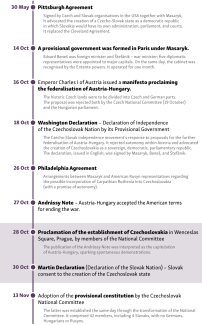
The last days of October 1918 proved crucial from both the Czech and Slovak perspectives. On 28 October, the establishment of the new state was proclaimed in Prague, and two days later the Slovaks confirmed their intention to join it through the Martin Declaration. The immediate trigger for declaring independence came with a note issued on 27 October by the Austro-Hungarian Foreign Minister, Count Gyula Andrássy the Younger, in which he accepted the terms of an armistice set by Washington. In it, he explicitly endorsed only the American stance on the ‘rights of the peoples of Austria-Hungary, especially the Czechoslovaks and the Yugoslavs’. While the author likely did not intend this as recognition of full independence, it was interpreted as such in subsequent reports and helped set in motion a chain of events.
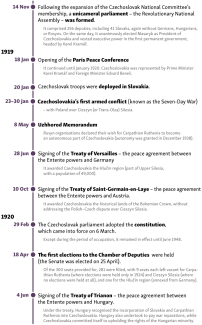
In the following days, Hungary’s new liberal-left Prime Minister, Mihály Károlyi, offered the Slovaks autonomy within Hungary. However, the offer came too late. This did not, however, mean a straightforward abandonment of the territory known in Hungary as Upland (Felvidék). Until mid-1919, Budapest made unsuccessful attempts to reclaim the area militarily. The heaviest fighting occurred in May and June 1919, after the communist coup in Hungary and the country’s suspension of hostilities with Romania. Carpathian Ruthenia also severed its centuries-long bond with Hungary. On 8 May 1919, the Central Ruthenian National Council expressed support, in the so-called Uzhhorod Memorandum, for joining Czechoslovakia. However, it was not the clashes with Hungary that constituted the first military engagement of the newly formed state. Those had already taken place in January 1919, when conflict erupted with Poland over the division of Cieszyn Silesia. One of the main reasons why Prague launched an attack in that area was its intention to secure access to the only railway connection between the Czech lands and eastern Slovakia – the Košice–Bohumín Railway.
The joint state with the Slovaks allowed the Czechs to achieve the goal articulated by Masaryk: escaping encirclement by German influence. The concept of a Czechoslovak nation was developed to secure a dominant position for the ‘Czechoslovaks’. According to the 1921 census, this artificially constructed nation comprised just under 65% of the population of Czechoslovakia. This framing helped gain Entente support for the new state – an outcome less likely had the Czechs been presented as the sole national core (see Chart 1 and Map 1). It also justified designating the Slovaks (nearly 2 million) as a constituent nation, while the far more numerous Germans (around 3.2 million) were classified as a minority (hence their use of the term Volksgruppe – ‘ethnic group’ – rather than ‘minority’). Moreover, it placed the Czechs (6.8 million) in a politically more comfortable position than they would have had in a state where nearly one-third of the population consisted of an unfriendly or even hostile German-speaking community (see Map 2).
The Czechs also drew on Swiss and American models. The latter was explicitly referenced in the so-called Washington Declaration of 18 October 1918, which proclaimed the creation of Czechoslovakia. The declaration was widely publicised in the United States and received a highly positive response from the American public.[12] At the same time, the unitary structure of the future state distinguished it from the USA and Switzerland. The failure to honour promises of a looser confederal or federal arrangement later led to disappointment among some Slovaks. Among the disillusioned was the Slovak diaspora in North America, which had generously supported Masaryk and his associates during the war, expecting that Slovakia would be granted autonomy. For Masaryk himself, references to the above-mentioned state models primarily meant embracing democratic principles and the assumption that the political nation would be formed by all citizens, regardless of the language they spoke.
Chart 1. Ethnic composition of Czechoslovakia in 1921
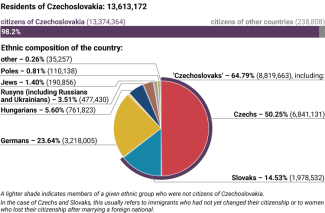
Source: author’s own study based on the 1921 census and data from national statistical offices.
Map 1. Ethnic groups dominant in various regions of Czechoslovakia
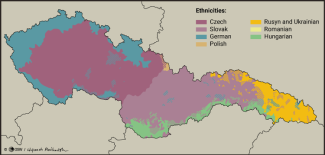
Source: based on a map prepared by the Military Geographical Institute (Vojenský zeměpisný ústav) in Prague in 1931, which was based on the results of the 1930 census. The division of the ‘Czechoslovak nation’ into Czech and Slovak components is delineated using a map derived from the same census and published in 1938 by Verlag Karl H. Frank.
Map 2. Ethnic composition of the individual parts of Czechoslovakia
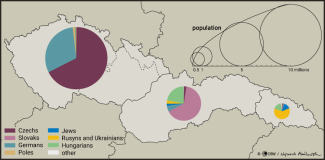
Source: based on the 1921 census results; supplementary data from: ‘Czech Demographic Handbook – 2022’, Czech Statistical Office, 23 November 2023, csu.gov.cz; G. Šamanová, ‘Národnost ve sčítání lidu v českých zemích’, Centrum pro výzkum veřejného mínění, 2005, cvvm.soc.cas.cz; Statistical Office of the Slovak Republic, scitanie.sk.
Following the collapse of Austria-Hungary – a large, multi-ethnic state – there were widespread concerns among the victorious powers (as well as among the Czechs and Slovaks themselves) about the ability of smaller political entities to survive on their own. The Allies also sought to avoid excessive instability in the region. France, in particular, aimed to create a network of substitute alliances to fill the void left by Russia, which had plunged into chaos. This was one of the reasons why Czech representatives at the Paris Peace Conference (and beforehand) lobbied for the creation of a state that would include not only the traditional Czech lands. In his most ambitious plans, Masaryk even envisioned broader regional consolidation through the creation of a corridor linking Czechoslovakia with Yugoslavia.
One of the major successes of the young state’s diplomacy was convincing the Allies to preserve the broadly understood historical borders of the Bohemian Crown (excluding the most contentious areas, raised mainly to create room for negotiating concessions – such as Lusatia and the Kłodzko Land – and without part of Cieszyn Silesia), even though the frontier lands were largely inhabited by Germans. Masaryk argued that without the industrial plants concentrated in those areas, the country would be economically fragile, and the loss of those regions would weaken its defences. As a result, Czechoslovakia inherited about 70% of the industry of the former monarchy, despite absorbing only around 25% of its population and 20% of its territory.[13] At the height of its interwar economic strength, it ranked among the wealthiest countries in Central Europe (see Map 3), with GDP per capita 12th on the continent (almost equal to Italy’s) and 18th in the world. Economic and security arguments were essential complements to references to Czech statehood traditions, particularly given that, at the same time, Hungarian historical claims to Slovakia were being firmly rejected.
Map 3. Real GDP per capita of Czechoslovakia in 1929 compared to other European countries
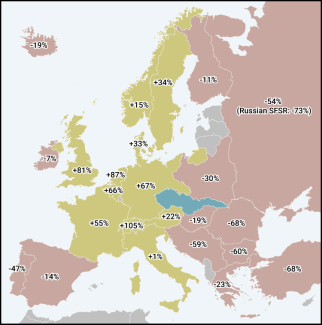
Source: author’s own estimates based on data from the Maddison Project (University of Groningen).
For the Slovaks, who had no tradition of their own statehood, union with the Czechs offered a greater degree of political agency than they had experienced within the Hungarian state. This was especially true after the creation of the dual monarchy in 1867, when Budapest pursued an approach to minority policy that was markedly different from that of Vienna. While in the Austrian half of the empire citizenship was understood as loyalty to the authorities regardless of ethnicity, and language questions constituted no major issue, the Hungarian half witnessed the advance of Magyarisation. Between 1875 and 1918 – roughly two generations – there were no secondary schools teaching in Slovak. In 1875, the Hungarian authorities banned the national cultural organisation Matica slovenská, which had been established only 12 years earlier. The development of a Slovak national elite was therefore severely constrained, and by 1918 such elites remained relatively small in number. This increased the role of nationally conscious Slovak emigrants in discussions with the Czechs, particularly those in North America – cities such as Cleveland, Pittsburgh, and Chicago probably hosted the largest Slovak communities in the world at the turn of the 20th century.[14] In this context, a joint state with the Czechs created opportunities to cultivate broader elites, notably through the reintroduction of education in the Slovak language and the establishment of cultural institutions. In 1919, Matica slovenská resumed its activities, a university was founded in Bratislava, and the following year the Slovak National Theatre was created. The Czechs largely replaced the Hungarians in public administration and other key sectors of society, as the Slovaks lacked a qualified workforce in sufficiently large numbers.
Thanks to diplomatic efforts, the Slovak part of the new state was extended to include territories with a predominantly Hungarian population. The Allies were persuaded by arguments about the importance of access to the Danube and the use of Europe’s second-longest river as a natural border. As a result, Hungarians made up 22% of the population in Slovakia. For many months after the end of the First World War it was far from certain that Pressburg – renamed Bratislava only in 1919 – would be included in Slovak territory. The city, which after internal debates became the capital of Slovakia as an administrative unit of the First Czechoslovak Republic, was inhabited at the outbreak of the war by only 15% Slovaks, with Hungarians and Germans accounting for 42% and 41% of its population respectively. The first post-war census showed Slovaks comprising barely one-third of the population, with Germans forming the largest group. This shift likely reflected changes in identity rather than large-scale migration. Slovaks educated in the Hungarian system under the former state had often advanced by remaining loyal to Budapest. Many did not possess a strongly developed national consciousness, and fluency in at least two languages was common. Some have even argued that in 1918, had a referendum been held, a majority of Slovaks might have opted to remain part of Hungary.[15]
Regardless of the favourable historical circumstances, it is difficult to imagine the birth of Czechoslovakia without two men who played a decisive role in its creation – Tomáš Garrigue Masaryk and Milan Rastislav Štefánik. Both were born under the Habsburg monarchy, in areas close to today’s Czech–Slovak border, just 50 kilometres apart.
Masaryk was born directly by that border, which in this region follows the course of the Morava River. He would later be elected to the country’s highest office four times and serve as president for a record 17 years. He was exceptionally well placed to think beyond the framework of a nation state. He had grown up in a multi-ethnic kingdom. His father, Jozef Maszárik, was Slovak (Tomáš changed the family name to the Czech form, Masaryk, during secondary school), and his mother, Terezie, spoke German more fluently than Czech. The future statesman came from the Slovácko region, sometimes referred to as ‘Moravian Slovakia’, which was culturally closer to western Slovakia than to Prague. In this regional sense of identity, he described himself as a Slovak, and the idea of a single Czechoslovak nation may have felt particularly close and natural to him.
He was the one who, as early as September 1914, put forward the concept of a joint state for Czechs and Slovaks. Over time, he gained the support of Czech and Slovak émigré organisations, as well as that of the domestic Czech anti-Austrian underground group, which consistently backed him and later became known as the Maffia. Masaryk’s emergence as the leading figure in the independence movement is all the more remarkable, considering that after the last pre-war elections to the Austrian Imperial Council in 1911, he was the sole representative of his own formation – the Czech Progressive Party – which, even among Czech political entities, ranked only 11th, receiving a mere 0.4% of the vote in the Czech lands (where it was also outperformed by eight German parties and two Polish ones). Especially towards the end of the war, Masaryk succeeded in gaining access to US President Wilson and influencing his decisions. This contributed to Wilson’s eventual abandonment of the idea of preserving Austria-Hungary – in his famous Fourteen Points, announced in January 1918, he had initially called only for the autonomous development of the empire’s ethnic groups.
In 1915, the idea of a joint state was adopted by Štefánik – a former student of Masaryk in Prague and 30 years his junior. He quickly became a key Slovak figure in the still vague project. By early 1916, he had assumed the post of vice-chairman of the newly established Czechoslovak National Council, which by the end of the war the Entente powers recognised as the representative body of the future state. As a high-ranking officer in the French army (he rose to the rank of general), he brought invaluable contacts with leading French politicians to the cause. Štefánik played a decisive role in creating the foundations of the Czechoslovak army – for most of the conflict he organised Czecho-Slovak legions in Allied countries (France, Russia, Serbia, and Italy), and in the new state he became the first Minister of War. His brilliant career was cut short by a plane crash in 1919, shortly after the formation of Czechoslovakia.
Among the key figures who significantly contributed to the creation of Czechoslovakia were Edvard Beneš, Andrej Hlinka, and Vavro Šrobár. The first of these served as head of the Maffia, later becoming secretary general of the Czechoslovak National Council and a delegate to the Paris Peace Conference. Following the establishment of the independent state, he remained Masaryk’s closest associate. Masaryk ensured that, throughout his presidency at Prague Castle – until 1935 – no one else was entrusted with control of the Ministry of Foreign Affairs.
Hlinka, meanwhile, played an important role in 1918 in persuading sections of the Slovak elite who did not fully identify with Štefánik, who had long lived outside Slovakia. It was largely under the influence of Hlinka – a politician, journalist, and priest revered as a martyr for the Slovak cause (having spent several years in prison before the war for speeches the Budapest authorities deemed ‘anti-Hungarian’) – that the underground Slovak National Council decided in May 1918 to back the Czecho-Slovak orientation. Hlinka openly advocated for this step, and his words at the time – ‘a thousand-year marriage with the Hungarians has failed’ and the two sides must part ways – became widely quoted. He was one of the signatories of the Martin Declaration, in which the Slovak elite endorsed the creation of Czechoslovakia. However, Hlinka’s initial enthusiasm soon gave way to disappointment over the lack of autonomy for Slovakia and his own political marginalisation. Despite being a co-founder and, from 1913 until his death in 1938, the chairman of the Slovak People’s Party,[16] he was not included in the new Czechoslovak government. His later attempt to advocate for greater Slovak political agency at the Paris Peace Conference – for which he travelled using a Polish passport issued under a false name – triggered a diplomatic scandal. Upon his return to Czechoslovakia, he was interned (despite holding a seat in parliament) on charges of treason, although he was released after regaining his parliamentary mandate. The party he led remained the largest political force in Slovakia throughout the First Republic and the principal advocate for its autonomy.
Šrobár was the only Slovak to sign the resolution declaring the independence of Czechoslovakia in Prague on 28 October 1918. As a member of the Executive Committee of the Slovak National Council, a body elected in Martin two days later, he acted as a liaison between the two nations during the formation of the new state. In its first government, he was one of only two ministers from Slovakia, alongside Štefánik.
Timeline of the creation of Czechoslovakia
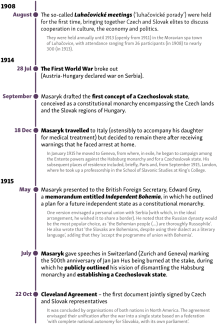
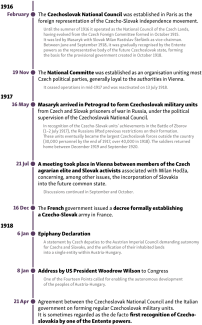
Political drivers
Czechs and Slovaks were primarily united by political and ethno-linguistic factors. Politically, the Czechs sought to strengthen their position in relation to the German minority, while the Slovaks aimed to do the same with regard to the Hungarian minority. Both also wished to safeguard themselves against potential revisionism from Berlin (or Vienna) and Budapest (see above). Whenever the Czechoslovak state failed to fulfil this function, or when such external threats were no longer perceived as pressing, centrifugal tendencies intensified. Such a situation occurred in autumn 1938, when Prague yielded to the Munich Agreement and, following the First Vienna Award, Slovakia lost its southern borderlands to Hungary. Separatist aspirations in Slovakia gained momentum, further fuelled by pressure from Nazi Germany. The Second Republic, formed at this time, adopted the name Czecho-Slovakia (with a hyphen – see box ‘The Hyphen War’), emphasising the distinct character of its Slovak component. Slovakia was granted long-awaited autonomy and, in March 1939, proclaimed independence, though in practice it became a satellite state of Nazi Germany. Nearly three decades later, during the crisis triggered by the Warsaw Pact invasion of post-war Czechoslovakia, Slovakia succeeded in pushing through formal federalisation from the beginning of 1969. After 1989, the two nations perceived external threats differently. The Czechs, following the post-war expulsion of Germans and the democratisation of their western neighbour, no longer felt insecure. The Slovaks were less confident in their position and for a long time sought to reconcile their desire for greater political agency with the preservation of a looser union with Prague (for example, in the form of a confederation). In particular, they were keen to maintain unity in defence policy.
The Hyphen War
At various points during the coexistence of Czechs and Slovaks, the smaller of the two constituent nations sought to emphasise its distinctiveness through the specific spelling of the state’s name – Czecho-Slovakia instead of Czechoslovakia. The best-known episode of this dispute occurred in the spring of 1990 and has gone down in history as the Hyphen War. The episode is referred to as Pomlčková válka by Czechs and Pomlčková vojna by Slovaks, with pomlčka being the word for dash in both languages. Later, linguists pointed out that the term was actually a misnomer – what was at stake in these debates was not a dash, which serves other functions such as introducing interjections, denoting dialogue, or replacing repeated elements in a sentence, but rather a shorter graphic mark, called a hyphen or spojovník in Czech and Slovak, used to form compound words. Interestingly, while the original name became established and entered the historical record in both countries, the correct form is usually used in English speaking environments.
Tensions over the state’s name can already be discerned in the linguistic duality of two key agreements signed by Masaryk in the United States before the formation of Czechoslovakia: the so-called Pittsburgh Agreement of 30 May 1918 (with representatives of Czech and Slovak organisations in the United States) and the Washington Declaration of 18 October 1918 (written in English and also signed by the Slovak Milan Štefánik, among others). The former used the term ‘Czecho-Slovak state’ (hyphenated), whereas the latter referred to a ‘Czechoslovak state’ (without a hyphen) and even mentioned a ‘Czechoslovak nation’. This was likely no accident: the first agreement was meant to win over Slovaks to the idea of a common state, while the second sought to convince the Entente powers that there was one large nation that would dominate the state, thereby avoiding the impression of creating a new version of the multi-ethnic Austro-Hungarian Empire.
The Martin Declaration adopted on 30 October 1918 by the Slovak National Council – the highest body representing the Slovak nation – referred to the Slovaks as part of the ‘Czecho-Slovak nation,’ which it claimed had the right to self-determination. The document used the spelling ‘Czecho-Slovak’ four times and ‘Czechoslovak’ once. There was no such ambiguity in the 1920 constitution of the First Republic, which consistently omitted the hyphen. Nevertheless, until that constitution was adopted, international communications generally used the hyphenated form – for example, it appears in both the English and French versions of the Treaty of Saint-Germain-en-Laye, the peace agreement signed on 10 September 1919 between the Entente powers and Austria. The first postage stamps – issued in December 1918 and designed by the renowned artist Alfons Mucha – were inscribed with ‘Czecho-Slovak Post’ (with a hyphen). In contrast, the authors of the provisional constitution of 1918 managed to avoid using the name of the state altogether in order to sidestep the controversy.
The intensifying Slovak campaign for autonomy in the 1930s, together with the weakening of Czechoslovakia following the Munich Agreement (30 September 1938), marked a new chapter in its history. From 1 October 1938, when the first German units began occupying the borderlands, the state is already referred to as the Second Republic. After President Beneš abdicated (5 October) and most Slovak political parties proclaimed autonomy in Žilina the following day, Jozef Tiso became the prime minister of the new autonomous government (7 October). Formal constitutional amendments were adopted only on 22 October (some constitutional scholars argue this was unlawful), and from the following day the state was officially named the Czecho-Slovak Republic (Česko-Slovenská republika). It lasted until 15 March 1939, when Germany started to occupy the remaining Czech lands and Slovakia declared independence shortly beforehand. In order to distance itself from these events, while still evoking the legacy of the First Republic’s golden years, the government-in-exile used the non-hyphenated spelling. A uniform version of the name – with an added adjective (Czechoslovak Socialist Republic) – was also used during the era of real socialism, which can further be explained by the communist authorities’ desire to suppress centrifugal tendencies.
Onomastic debates flared up again with renewed intensity after the opening of public discourse at the end of 1989. Whereas in Poland the constitutional amendment restoring the historical name Rzeczpospolita Polska (Republic of Poland) came into force on 31 December 1989, it took somewhat longer for the Czechs and the Slovaks to remove the word ‘Socialist’, associated with communism, from the country’s name. The debate was initiated by a speech in the Federal Assembly by President Václav Havel on 23 January 1990. He proposed that the country be renamed simply the Czechoslovak Republic (Československá republika; in both Czech and Slovak, only the first word of such names is typically capitalised). Czech deputies also supported dropping only the term ‘socialist’ and advocated the use of the established term ‘Czechoslovakia’. They invoked the negative associations linked to the hyphenated version used in the autumn of 1938.
Slovak deputies agreed on removing the word ‘socialist’, but they viewed the entrenched name without a hyphen as a symbol against which their compatriots had long struggled. The Slovak government therefore proposed a spelling with a hyphen and capital letters (Federácia Česko-Slovensko or Republika Česko-Slovensko). Over time, Havel accepted the hyphenated version with only one capital letter (Republika česko-slovenská)and even submitted it as a formal proposal himself. At the same time, however, he also supported a rival parliamentary bill that used no hyphen (and included ‘federation’ in the name), which provoked outrage among the Slovaks.
The heated debate unfolded not only in parliament but also in the media and on the streets. In Bratislava, some individuals even went on hunger strike until a version with a hyphen and capital letters was adopted. On 29 March 1990, the country’s name was finally changed, with the new title having two written forms: the Slovak version was Česko-slovenská federatívna republika (with a hyphen), while the Czech version omitted the hyphen. In international use, the latter became the standard. This was the result of a compromise reached when no unified proposal could secure approval. It was put forward by the rapporteur MP Miloš Zeman, who would later become Czech prime minister and president. Václav Havel, who had come directly from hospital, urged that the issue be resolved promptly ‘for international reasons’.
This solution failed to gain unequivocal support and sparked further controversy among Slovak public. That same evening, a demonstration erupted in Bratislava. Protesters carried slogans such as ‘We want the dash and a capital S’, and labelled the MPs who had voted for Zeman’s proposal as ‘traitors’. The name thus lasted only 25 days. The day after the change was implemented, further negotiations began, and on 5 April Havel convened a meeting of leading politicians from both sides, along with linguists, at his residence in Lány. He solemnly declared that the doors would remain locked until an agreement was reached.
The final agreement, proposed by the Slovak speaker of the federal parliament, Alexander Dubček, and in force until the dissolution of the common state, referred to the Czech and Slovak Federative Republic (with a spelling in capital letters that violated the rules of both languages). One might therefore say that the resolution to the Hyphen War turned out to be the conjunction ‘and’ (i in both Czech and Slovak). Nevertheless, in its abbreviated form, two names continued to circulate internationally in parallel: Czechoslovakia (used by Czechs) and Czecho-Slovakia (used by Slovaks), with translations reflecting the source language of the original.
The intensity of debate on what was, in practical terms, a minor issue – both in parliament and among the general public – foreshadowed the imminent collapse of the joint state. While optimists tried to interpret the compromise as a positive sign, proof that a mutually acceptable solution could be found, these hopes quickly faded after the parliamentary elections in June 1990, which triggered a serious debate over the degree of centralisation in the country and the distribution of powers among its institutions. Years later, Milan Zemko of the Institute of History at the Slovak Academy of Sciences observed: ‘Czech politicians and the media were asking why we were arguing over a triviality, but they themselves were unable to give ground for a long time’. He added that for Slovaks the matter was of symbolic importance, since a name could either signal ‘the fundamentally unitary nature of the state or emphasise that it consists of two equal parts’.[17]
Cultural and linguistic cohesion
The cultural – and particularly linguistic – proximity contributed to the emergence of the idea of a single nation and language, which featured in certain strands of thought in what are now the Czech Republic and Slovakia during the 19th century. This idea most often took the form of viewing the Slovak language as a dialect of Czech and later – especially in the interwar period – as the notion of a Czechoslovak nation or language. These concepts were primarily widespread among Protestant communities in both countries. Slovak Evangelicals continued to use the Czech Protestant translation of the Bible – the Kralice Bible from the late 16th century – until the second half of the 20th century, and their liturgy was conducted entirely in Old Czech.
The idea that Czechs and Slovaks constituted a single nation was first articulated among exiled Czech and Slovak Protestants at the end of the 17th century, when they found themselves together in Saxony after one of the Habsburg-imposed waves of re-Catholicisation. From the 15th to the 19th century, the language of Slovak literature was a Slovakised form of Czech.[18] It was not until the 1840s that a clearly separate path was pursued, initially through the work of national activist and codifier of the Slovak language, Ľudovít Štúr, who rejected the ‘offer’ of Czech national revivalists to adopt their language as a common tongue. The unequal status of both languages in the shared state – particularly evident during the First Republic – sensitised Slovak elites to the signs of Bohemisation of their language. Earlier, Slovak linguistic circles had sought to distance themselves from Hungarian influences, in response to the experience of Magyarisation at the turn of the 19th and 20th centuries.
After 1918, there were virtually no representatives of the Slovak elite who supported Czechoslovakism in an ethnic sense, although some indirect accounts suggest that Štefánik privately expressed such convictions. He is even said to have proposed naming the newly established country simply the Czech Republic.[19] A somewhat more resilient – though eventually also increasingly marginalised – approach in Slovakia accepted Czechoslovakism in a political sense (with Šrobár among its adherents). This concept, even in its ethnic interpretation, was quite popular among leading Czech figures. One of them was Beneš, Masaryk’s successor as head of state. As late as the 1940s, he insisted that ‘no one and never’ would convince him of the distinctiveness of the Slovaks as a nation, or of the Slovak language as anything more than a dialect (however, despite being raised mostly in Prague, the first post-war president of the country spoke fluent Slovak). A similar view was held by Ferdinand Peroutka, an influential interwar intellectual, who argued that only Czech should be used in written texts and formal situations.
Regardless, efforts to forge cohesion focused on highlighting past periods when the present-day Czech Republic and Slovakia (or their parts) constituted a single entity, as well as on individuals seen as bridging both nations. In both respects, options were limited. Apart from the Habsburg era, the shared past was primarily centred on the time of Great Moravia, which came to be portrayed in historiography as a kind of proto-Czechoslovakia. Interestingly, it lasted roughly as long as Czechoslovakia itself – founded in 833 and disintegrating by 907 – which, from a historical perspective, was a relatively brief period. Its actual relevance to Czechoslovakia was virtually negligible – not only due to its short duration, but also because of the gap of more than a thousand years. Moreover, for most of its existence, the core of Great Moravia encompassed Moravia and Slovakia, while the historical region of Bohemia was only incorporated around 888, and just six years later their paths diverged. According to some historians, the lands of the Vistulans tribe – largely overlapping with present-day Lesser Poland (with Kraków) – remained part of Great Moravia for significantly longer.[20]
In the shared mythology of the new state, the figures of Saints Constantine (Cyril) and Methodius served as a key reference to this historical period. The cult of the Thessalonian Brothers was revived in the second half of the 19th century in connection with the millennial anniversaries of their arrival in Moravia (1863), Cyril’s death (1869), and Methodius’s passing (1885). To mark the last of these events, Jan Matejko – the son of a Czech – painted a depiction of the missionaries, which still hangs in the basilica in Velehrad as a ‘gift from the Polish nation’. The brothers worked in the Great Moravian Empire, and between 869 and 885 Methodius also baptised the ruler of Bohemia, Bořivoj I. As apostles to the Slavs, they were ideally suited to promoting the harmonious coexistence of the two nations belonging to this ethno-linguistic group. Moreover, in the context of the First Republic – generally sceptical of the Catholic Church – their legacy was invoked e.g. by Masaryk and, centuries earlier, by Jan Hus, whom the president admired. Even after the dissolution of Czechoslovakia, the feast day of the missionaries (5 July) remains one of the relatively few non-exclusively religious public holidays observed by both successor states (see box ‘Disputes over the Holiday Act and the Marmaggi Affair’). The day is associated with the importance of acquiring knowledge, and in particular with cultivating care for one’s own language. Saint Cyril created the first Slavic script – Glagolitic – and, together with his brother, began translating the Bible and liturgical texts into the Slavic languages.
Today, there is no doubt that language – or more broadly, ethnic identity – draws the two countries and nations closer together. Czech and Slovak both belong (alongside Polish) to the group of West Slavic languages, and within it form the Czech-Slovak branch, also referred to as the southern branch. The similarity of dialects and customs is most evident along the border between the two countries, where the transition between dialects is fluid, creating a dialectal continuum. Eastern Moravian dialects, especially those of the Kopanice region, share many features with Slovak and are considered transitional. Some linguists even regard them as closer to Slovak. Their classification within a given language is also influenced by historical and political factors. Periods of shared statehood were marked by a strong influence of the Czech language – more widely used in the media and administration – on Slovak. This influence has not diminished following the division of Czechoslovakia. The reverse effect is much less common. Nevertheless, mutual passive bilingualism, particularly among middle-aged and older generations, remains widespread.[21]
Divergences and differences
Czechs and Slovaks were divided primarily by the fact that, despite cultural proximity, they constituted different nations – in defiance of attempts to deny this reality, first through a broad interpretation of the concept of the Czech nation and later by promoting the artificial construct of a Czechoslovak nation. At the time the joint state was established, the Slovak nation had already almost completed its process of formation, and sharing a state with the Czechs enabled the completion of the final stage of this development. The assumption held by some advocates of Czechoslovakism, above all Masaryk, that even if a Czechoslovak nation did not yet exist, it would emerge naturally through cohabitation within one state, proved unfounded. This did not occur and, as noted by Professor Jan Rychlík – a historian specialising in the history of Czechoslovakia and also an ethnologist – there are no known historical examples of two fully formed nations merging into one. By contrast, the reverse process can and does take place – for example, as a result of the division of a single nation into different states.[22] He argued that a natural phenomenon is the tendency for every nation to seek a degree of autonomy and eventually to pursue the establishment of its own state, as was also the case with the Slovaks.
That a relatively unified Czechoslovak society had not developed after decades of coexistence was a conclusion drawn even in the 1980s by local sociologists. In terms of structure and worldview, two clearly distinct components – Czech and Slovak – remained identifiable.[23] This, however, does not mean that under more favourable circumstances both nations could not have coexisted more harmoniously, or even developed a shared secondary identity (comparable with a European one). Such outcomes might have been encouraged, for example, by a joint military effort against Germany (which ultimately did not occur in 1938) or by greater Czech sensitivity to Slovak political aspirations.
Almost from the outset of coexistence within Czechoslovakia, Slovak ambitions for greater involvement in governance and the absence of autonomy for Slovakia – promised in the Pittsburgh Agreement signed by Masaryk in May 1918 – proved problematic. The latter, in particular, significantly eroded the trust of much of the Slovak elite towards Prague and was repeatedly cited as evidence that the state had been built on ‘a deception of the Slovaks’.[24] The Czechs initially talked about waiting for more stable times to address the issue, but later rejected the demand outright. They were driven by fears that granting autonomy would lead to similar claims from the German minority and, additionally, would expose the myth of the dominant ‘Czechoslovak nation’ as a fiction. While Slovak acceptance of Czechs holding administrative positions immediately after 1918 was initially met with understanding, by the 1930s – when a new generation of Slovaks emerged who were qualified to hold such roles – this state of affairs was increasingly resented. Czechs often interpreted the growing criticism as ingratitude. Similarly, Prague often failed to understand the swift articulation of new autonomist demands after 1989.
Slovak ambitions were only briefly and symbolically realised in 1969, when formal federation was introduced. It was the only substantial reform developed during the 1968 political liberalisation period – the Prague Spring – to come into effect. However, this occurred during the communist regime (1948–1989), a time when centralised governance intensified and centrifugal tendencies were actively suppressed. The ‘democratic centralism’ practised in communist states required unconditional subordination of lower administrative units to higher ones, effectively contradicting the principles of federalisation. While this state of affairs supported the continued existence of the unified state, it also fuelled Slovak disillusionment and discredited the idea of federation, which was increasingly regarded as yet another Czech manoeuvre to retain control over Slovakia.[25]
Differences in national identity are reflected in distinct historical memories and national symbols. The historical trajectories of the two nations are asynchronous: while the Czechs tended to look westwards, having for centuries been part of the Holy Roman Empire of the German Nation (with Prague even serving as its capital twice), the Slovaks oriented themselves more towards the south. From the first half of the 11th century until 1918, Slovak history was closely tied to Hungary. Between 1563 and 1830, eleven Habsburg rulers of Hungary were crowned in what is now Bratislava (then Pressburg), with only two coronations held elsewhere during that time.
As a result of these differences, key moments in Czech history – such as the Battle of White Mountain in 1620, which marked the end of the native nobility and the beginning of re-Catholicisation – held little significance for the Slovaks on the other side of the Morava River. Slovaks did not share the Czech reverence for the Hussite tradition.[26] Similarly, Catholic patron saints of the Czech lands such as St Wenceslas and St John of Nepomuk, meant little in Slovakia, where strong Marian devotion prevailed, and the cult of King Saint Stephen[27] had for years been promoted by Budapest. A symbolic reflection of these tensions was the prolonged debate over the form of the national holidays law, which was not adopted until 1925 (see box ‘Disputes over the Public Holidays Act and the Marmaggi Affair’).
To this day, Czechs and Slovaks interpret key figures of the common state differently. While Masaryk enjoys high regard in both nations, he is virtually untouchable only in the Czech lands. Slovaks generally view Beneš negatively, in contrast to the broadly favourable perception he retains among Czechs, despite ongoing debates about some of his political decisions. Conversely, Gustáv Husák – the leader of the Communist Party of Czechoslovakia during the 1970s and most of the 1980s – ranked seventh in a nationwide public broadcaster poll for the greatest Slovak in history conducted in 2019. This can be attributed to memories of relative economic improvement during his tenure, his role in securing federalisation, and respect for his contribution to the 1944 anti-German uprising. However, only 10% of Czechs assess his legacy positively, while more than half view it negatively.[28] A wave of indignation and astonishment among Czech politicians and journalists followed the laying of flowers on Husák’s grave by Prime Minister Fico and the nationalist leader of his junior coalition partner in January 2024, marking the anniversary of his birth.[29]
Disputes over the Public Holidays Act and the Marmaggi Affair
Czechoslovakia adopted the Public Holidays and Commemorative Days Act in 1925. Earlier, in 1919, there had only been agreement that 28 October should hold a special place in the calendar as a commemoration of the founding of the state (and that 1 May should also be included as Labour Day). For comparison, around the same time, similar matters were regulated in Poland, where in 1919 the celebration of the anniversary of the 3 May Constitution was established (11 November – National Independence Day – became a statutory holiday only in 1937), and the holiday calendar, based on church feasts, was formalised between 1924 and 1925. The protracted debates on this issue in Czechoslovakia stemmed from differences in the perception of various figures, events, or church holidays between Czechs and Slovaks, as well as within Czech society itself. These divergences translated into the actions of political parties.
As the state initially adopted Austro-Hungarian legislation and gradually amended it, the calendar in force at first remained that of the Habsburg monarchy. In the debates over its revision, the most contentious figures were St John of Nepomuk and Jan Hus. The former was one of the main patron saints of the Czech lands, whose feast day (16 May) had been a public holiday since the 1770s.[30] The latter was not commemorated with a holiday, yet he was counted among the most important historical figures by, for instance, President Masaryk. The link between John of Nepomuk and Hus was not accidental: especially from the 19th century, Czech elites increasingly believed that Vienna had promoted the cult of the former to marginalise the latter. In the early days of the First Republic, statues of the saint were sometimes destroyed as symbols of the previous regime. Attempts to introduce a holiday related to Hus failed twice (in 1920, proposed by Czech nationalists, and in 1923, by the left), in part due to opposition from Slovak MPs but also owing to the reluctance of Czech Christian Democrats, led by the Catholic priest Jan Šrámek (who headed the party in Moravia from 1919 and nationwide from 1922 to 1938).
The act of March 1925 ultimately designated the following as official holidays (specifically, ‘memorial days’ of Sunday status, i.e. work-free) in the state calendar: the anniversary of the burning of Jan Hus (6 July), which was often regarded as a hostile gesture by Catholics – most commonly Slovaks , but also many Czech Catholics; the feast of St Wenceslas (28 September), a figure largely indifferent to Slovaks; and the feast of Saints Cyril and Methodius (5 July). The inclusion of the latter proved to be a well-judged decision – it addressed the need for references to the relatively brief shared history of these lands (Great Moravia), and invoked the Czech and Slovak national revivals of the 19th century, which were rooted to a great extent in the cultivation of their respective languages. The Thessalonian Brothers remain particularly revered in Slovakia and Moravia as the fathers of Slavic literacy, which laid the foundations for later identity, and 5 July is still a public holiday in both the Czech Republic and Slovakia.
In addition to holidays clearly and exclusively associated with the Czechs – relating to Hus and St Wenceslas – 28 October carried a similarly problematic connotation for many Slovaks, as the Czechoslovak equivalent of an independence day. It commemorates events in Prague in which only one Slovak played a significant role (see Chapter 3 of this section), while its Slovak equivalent is the anniversary of the adoption of the Martin Declaration (30 October 1918), which was not included in the official calendar. An attempt to add this date was made in 1937 by Hlinka’s party, which was campaigning for Slovak autonomy. While Slovaks observed 28 October as a holiday nonetheless, for the Germans and Hungarians living in Czechoslovakia, the day – particularly in the early years of its existence – served as an opportunity to express opposition to state policy and their status as minorities. The exclusion, under the 1925 act, of Easter Monday, along with the days immediately following Christmas and Pentecost from the list of work-free days was also negatively received, not only in Slovakia. These were reinstated only through a regulation issued on 9 March 1939.
The government in Prague, however, supported the commemoration of the anniversary of Štefánik’s death (4 May) in Slovakia, honouring a figure considered significant for Czechoslovakia. The Slovak State established in 1939 distanced itself from holidays perceived as overly Czech – state holidays commemorating Hus, St Wenceslas, and the founding of Czechoslovakia were removed from the official calendar, with only the feast of Saints Cyril and Methodius retained (and the anniversary of the founding of the Slovak state on 14 March added – a date still marked in extremist circles today).
A key episode in the history of public holiday debates in interwar Czechoslovakia was the international dispute with the papacy sparked by the new law, known as the Marmaggi Affair. Francesco Marmaggi, the local apostolic nuncio, disapproved of the preparations for large-scale state celebrations of the first observance of the holiday commemorating Hus (6 July 1925), who at that time was regarded by the Catholic Church as a heretic who had defied the Pope. The final straw came when Masaryk flew a Hussite flag (bearing a chalice) over Prague Castle, which the nuncio interpreted as a provocation against Catholics, prompting him to leave the country in protest. Prague’s actions were criticised by Hlinka’s party, whose newspaper Slovák wrote of ‘the impudence of the Czech Hussites’ who ‘incited, insulted, and attacked the representative of the Holy Father’. The incident also met with disapproval from the German minority and from a significant portion of the Czech public – around 80% of whom still considered themselves Roman Catholic at the time.
Although diplomatic relations with the papacy were not severed, they were downgraded to the level of chargé d’affaires. This situation persisted until January 1928, when a new nuncio arrived in the country. His appointment was made possible by a compromise under which Prague pledged not to extend patronage to celebrations commemorating Hus. In addition, the boundaries of Slovak dioceses were to be adjusted so that no part of the country would fall under Hungarian ecclesiastical jurisdiction. This was formally achieved only in 1977, although from 1921 to 1925 these areas were gradually placed under the administration of Slovak clergy answerable directly to Rome. Relations between Czechoslovakia and the Holy See remained cordial until the end of the First Republic, aided by the successful celebrations in 1929 marking the millennium of the death of St Wenceslas. Marmaggi himself went on to assume the nunciature in Poland in 1928. The dispute over Hus was finally laid to rest in 1999, when Pope John Paul II, speaking on behalf of the Church he led, apologised for the unjust condemnation of the Czech theologian, describing him as a ‘reformer of the Church’.
The cohesion of Czechoslovakia was undermined by the asymmetry between its constituent parts. While the Czech lands were already highly industrialised in 1918, Slovakia remained predominantly an agricultural region. This disparity translated into differences in wealth.[31] Moreover, during the 1920s, Slovakia’s specialisation in agriculture was deliberately reinforced, further widening the industrial gap between these two parts of the country. It was only in the second half of the 1930s, in connection with national defence preparations, that efforts began to close this divide – a process that accelerated significantly during the Second World War. In the first decade after the war, disproportionately large amounts were allocated to industrial development in Slovakia – primarily in heavy industry – exceeding what would have been expected on the basis of its share of the population or national income.[32] The promotion of industrialisation in Slovakia was regarded as a key tenet of the policy aimed at equalising living standards across Czechoslovakia, thereby contributing to the country’s faster development and more harmonious functioning. The proportion of the Slovak population employed in industry increased from 14% in the 1950s to 36% three decades later. This shift was accompanied by an improved standard of living:[33] national income per capita in Slovakia, which had amounted to just 57% of the Czech figure in 1948, rose to 73% in 1960, 78% in 1970, and 85% in 1983.[34]
Although the disparity in wealth between Czechs and Slovaks was alleviated during the era of real socialism, it was never fully eliminated by the end of the shared state. One of the arguments raised in the political reform debate that began after democratisation in 1989 was the Czech reluctance to ‘continue subsidising Slovakia’. It is important to remember that these discussions took place amid rapid political transformation, during which real GDP per capita initially declined. The drop hit Slovakia much harder, as it was less prepared for the transition – real GDP per capita fell by 23% there between 1989 and 1992 (compared with 9% in the Czech lands and 13% in Poland).[35] As a result, the narrowing wealth gap seen at the end of the 1980s began to widen again in the early 1990s. Slovak real GDP, which in 1989 had stood at 91% of the Czech level, dropped to 77% by 1992.[36]
Czechs also outnumbered (and continue to outnumber) Slovaks. In 1918, there were more than three times as many Czechs as Slovaks in Czechoslovakia. Today, according to the 2021 population censuses in both countries, roughly twice as many people have Czech as their mother tongue as Slovak (see Charts 1, 8, and 9).
Czechoslovakia dissolved twice. The first dissolution occurred in 1939 as a result of the collapse of the Versailles order in Europe. The fragile Second Czechoslovak Republic did not survive for even half a year. By November 1938, owing to the Munich Agreement imposed by Germany, the First Vienna Award (regarding Hungary’s territorial claims), and the acceptance of an ultimatum from Poland (primarily concerning the Cieszyn Silesia region), the country had been stripped of 29% of its territory, 32% of its population, and around 40% of its industry. Although both Slovakia and Carpathian Ruthenia obtained autonomy within the reconfigured state, this paradoxically did not significantly improve interethnic relations. In the fluid and extremely complex international situation, mutual mistrust between the nations only deepened.
In autonomous Slovakia, the office of prime minister was assumed by Tiso. His party, the Hlinka Slovak People’s Party (HSĽS), dismantled political pluralism and began restricting civil rights. Amid a wave of anti-Czech sentiment, Czech teachers and administrative staff were expelled from Slovakia, often at the initiative of the ruling HSĽS. The party’s paramilitary wing, the Hlinka Guard, organised demonstrations against Jews (blaming them for the First Vienna Award) and, in the process, vandalised Jewish-owned shops and businesses. These actions foreshadowed the deportation of the Jewish population, which began in 1942. Over the course of the war, more than 70,000 Jews – approximately 80% of the Jewish population living in Slovakia in 1940 – were killed.
Relations between Czechoslovak President Emil Hácha and leading Slovak politicians were marked by significant tension. At a meeting in late 1938, Hácha accused them of seeking Slovak secession, a charge Tiso denied, even promising to exclude separatists from the Slovak government. However, by February 1939, during the formation of a new cabinet under the same leadership, the prime minister spoke extensively about building Slovak statehood and did not once mention Czechoslovakia. Hácha retaliated – in response to reports that Slovakia intended to declare independence on 10 March, he dismissed Tiso and his government the day before. On direct orders from Prague, Czechoslovak troops occupied Slovakia.
However, the person who played the decisive role in the dissolution of the Second Republic was Adolf Hitler. He exploited Czech–Slovak tensions to seize the remaining Czech territories, ultimately making the decision after a consultation meeting held on 10 March. He then invited Tiso to Berlin, followed – at Prague’s request – by Hácha. Tiso, though not formally a state official at the time, was received with honours due to his leadership of the party dominating Slovak politics. Hitler offered him a choice: to proclaim an independent Slovak state under German ‘protection’, or to see the territory handed over to Hungarian control.[37] Hácha, by contrast, was faced with a choice between a hopeless war with Nazi Germany or converting the remaining territories under his control into a German protectorate. Hitler was intent on ensuring Slovakia declared independence, as this act would mark the end of the Czecho-Slovak state. The post-Munich borders of that state had been guaranteed not only by France and the United Kingdom – with whom, under normal circumstances, the German leader would have entered into direct conflict upon invading their protégé – but also by Italy and Germany itself. Rome and Berlin had made their guarantees conditional on Prague resolving, within three months, the status of its Hungarian and Polish minorities, which it ultimately did.
The period between 14 March 1939 and 1945, when the Slovak State existed, is among the most critically assessed chapters in Slovak history (according to a 2018 survey, 46% of Slovaks view it unequivocally negatively, while 18% view it positively).[38] Nonetheless, it should be seen as a turning point for the Slovak people, as it made them realise that they could have their own state.
After the first dissolution of Czechoslovakia, the state was reconstituted in 1945 on the basis of an agreement between the communists and the government-in-exile (1940–1945) in London. This government, gradually recognised by the Allies, maintained the tradition of Czech-Slovak cooperation despite the country’s disintegration. As a result of its diplomatic efforts, the United Kingdom and France declared the changes brought about by the Munich Agreement null and void in 1942. Interestingly, the prime minister of the London-based government (and later, between 1945 and 1948, deputy prime minister in the re-established republic) was Jan Šrámek, a Czech Christian Democrat and Catholic priest – like Tiso. Despite Slovakia’s wartime collaboration with Nazi Germany, the re-establishment of a common state with the Czechs enabled Slovak politicians to argue that they had been on the side of the victors in the Second World War and thus to avoid territorial losses. The outbreak of the Slovak National Uprising in 1944 – the largest act of resistance in Slovakia during the war – was also motivated by the desire to rebuild Czechoslovakia (albeit on the basis of greater equality between the two constituent nations), rather than to reform the functioning of the Slovak state.
Timeline of the final dissolution of Czechoslovakia
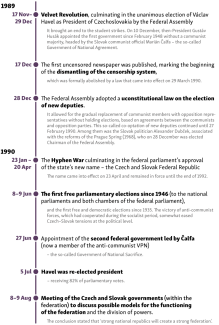
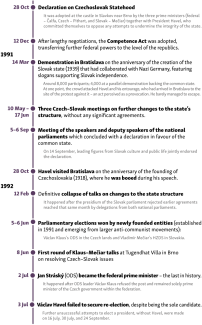
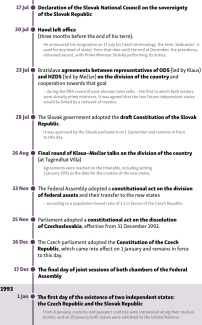
The second dissolution of Czechoslovakia took place on 1 January 1993 and resulted from a series of negotiations between political forces elected in the parliamentary elections of June 1992. These were the second free elections following the 1989 revolution, which had brought about a change in the political system and the democratisation of public debate. Consequently, previous regime began to surface more vocally in public discourse, including calls to enhance Slovakia’s role within the common state.
Slovaks did not, almost until the very end, explicitly demand independence. Most mainstream parties in Slovakia did not include such a goal in their programmes – with the exception of the Slovak National Party (SNS), which held just 10% of the seats in the Slovak National Council. Even the winner of those elections on the Slovak side, the Movement for a Democratic Slovakia (HZDS) led by Vladimír Mečiar, mentioned only vaguely a desire for Slovakia to attain ‘international legal subjectivity’.[39] During constitutional talks with the Czech side, HZDS gradually escalated its demands, moving in the direction of a confederation in which the constituent parts would retain a shared currency (albeit with two central banks) and a common defence policy. This concept was, by its nature, difficult for Prague to accept – a confederation functioning under conditions of asymmetry, where the smaller constituent held veto power over key decisions, would place an unequal burden on the stronger partner (in this case, the Czechs).
This was compounded by the personality and priorities of Václav Klaus, the leader of the Civic Democratic Party (ODS), which had won the last joint elections in the Czech part of the federation. A declared advocate of economic liberalism, Klaus aimed to carry out a rapid transformation of the political system in the Czech Republic and believed that the less developed Slovakia was hindering this process. Prior to the elections, ODS had expressed support for a common state and had ruled out only the option of a confederation among the possible constitutional arrangements preserving ties with the Slovaks.[40] However, the party also stated that, while the division of the state was ‘not part of the programme’, if it became necessary, ‘we are capable of handling it’. In the end, it was the Czechs (specifically Klaus’s government) who put forward the proposal to split the country, believing themselves better prepared in terms of both human resources and economic capacity. The Slovaks, for a long time, were unable to fully envisage such a scenario, but as local columnist Martin Šimečka put it, it was their ‘unspoken aspiration, albeit without concrete form’.[41]
Over time, the Slovak side began to cross successive boundaries, while the Czech side increasingly signalled its reluctance to fight for the preservation of the federation at all costs. Many historians point to the declaration of the ‘sovereignty of the Slovak Republic’, adopted by acclamation in the Slovak National Council on 17 July 1992, as the moment after which the dissolution became inevitable.[42] That same day, Václav Havel announced his resignation from the presidency of Czechoslovakia, effective (and executed) on 20 July. Earlier, on 3 July, he had failed to be re-elected to the office by parliament, despite being the sole candidate – a sharp contrast with his smooth victory in July 1990, when he had also run unopposed and secured 82% of MPs’ votes. In 1992, he secured sufficient support only from the Czech deputies of the Federal Assembly. The rejection of his candidacy by Slovak MPs was a clear sign of their resistance to the institution of a federal president. All subsequent attempts to appoint a new head of state between July and September 1992 proved unsuccessful. For more than five months – until the dissolution of the federation – the post remained vacant. During that time, the role of head of state was performed by the federal prime minister.
Havel had previously been one of the few high-ranking politicians to actively pursue reconciliation between the two nations amid an increasingly tense atmosphere. He worked to find a compromise that would preserve Czechoslovakia. He deliberately chose castles and palaces in both parts of the federation as venues for the talks, hoping that the dignified setting would foster more constructive negotiations. However, these efforts did not yield the desired results. According to a significant portion of the Slovak public, the president’s undoubtedly good intentions were not matched by sufficient understanding of the Slovak perspective. Some of his attempts to identify solutions acceptable to both sides were even described as ‘putting out a fire with petrol’ (see box ‘The dam dispute’).
In both Czech and Slovak public discourse, the issue of the supposedly undemocratic nature of the dissolution of Czechoslovakia resurfaces regularly. The process was led by political forces that had not included a split agenda in their electoral platforms, and the population did not express its opinion in a referendum (though the decisions of the prime ministers of both federal components were approved by parliament). However, this reasoning overlooks some important constraints. The first issue was the difficulty in formulating a clear referendum question, as each side understood the concept of Czechoslovakia differently. The Czechs tended to envision a strong federal state similar to Masaryk’s First Republic, which did not, however, enjoy the same popularity in Slovakia. The Slovaks, by contrast, imagined the loosest possible union between two states.[43] The second factor related to the reality that by the summer of 1992 – following the parliamentary elections held earlier that year – Czechoslovakia had, in practice, ceased to function as a federation. The rulings of the central authorities in Prague were increasingly difficult to enforce in Slovakia (see box ‘The dam dispute’). Any question put to a referendum would, therefore, have had to address not the preservation of an existing state, but the prospect of building a new one. Delaying the split might only have deepened the problems, raising the risk of chaos or bilateral conflict. The relevant decision was made by the two prime ministers in Brno after a series of talks. The most important elements of the forthcoming Velvet Divorce were agreed on 26 August 1992 – see the section Timeline of the final dissolution of Czechoslovakia.
The dam dispute
A clear symbol of the problems that plagued Czechoslovakia in its final years was the Slovak–Hungarian dispute over the construction of the Gabčíkovo–Nagymaros hydroelectric dam. For many Slovaks, it ultimately confirmed that their interests diverged from those of the Czechs, and that Prague was unable to take a clear stand in support of Bratislava on foreign policy issues important to Slovakia. At the same time, the conflict exposed the state’s inability to implement its international commitments.
The Slovaks wanted to complete the joint project initiated during the socialist era, while the Hungarians, concerned about its environmental impact and doubtful of its profitability, withdrew from the agreement and sought to block the Slovak part of the dam as well.[44] During difficult negotiations, Czechoslovak President Havel sided with Hungary – in 1991 he even called the project ‘a totalitarian gigantomania built in defiance of nature’, although he added that consideration should also be given to the fact that the facility was mostly completed. Meanwhile, the Czech ecologist serving as the federal environment minister, Josef Vavroušek, referred to the dam in talks with the Hungarians as ‘obsolete and unnecessary’. The matter escalated further in May 1992, when Hungary – observing continued construction on the Slovak side – unilaterally withdrew from the 1977 intergovernmental treaty under which the dam was to be built. Klaus reportedly held the view that Prague’s involvement in the dispute should be ‘minimal’.[45] Federal Prime Minister Jan Stráský (a Czech from Klaus’s party) allegedly told Mečiar – according to the latter’s account – ‘if war breaks out, it will be a conflict only between the Hungarians and us [Slovaks]. We shouldn’t expect the Czechs to fight for us’.[46] Given the turbulent political developments on the continent, including the war in Yugoslavia, the potential for escalation between Czechoslovakia and Hungary caused concern in Western Europe and prompted attempts at mediation.
The federal government in Prague and its counterpart in Budapest, following negotiations in 1992 mediated by the Commission of the European Communities (the predecessor of the European Commission), agreed that the dispute would be referred to the International Court of Justice (ICJ) in The Hague. A condition for this was that both parties would refrain from taking irreversible actions – meaning Hungary would cease filling the excavation near the town of Nagymaros, and Slovakia would halt construction of the dam on the Danube near Bratislava. When the federal government in Prague voted in autumn 1992 to approve these arrangements, the result was a split: five ministers supported continued work on the Slovak side of the river, and five opposed it. The vote corresponded exactly to the national divide within the cabinet – the Slovaks backed the project, while the Czechs opposed it. Although the decisive vote belonged to the prime minister, the Czech Jan Stráský, who sided with halting construction, the Slovaks did not comply. Prague informed Budapest that while it accepted the ICJ’s conditions, it was unable to enforce them on the Slovaks.[47] Admitting that the state could not make binding commitments of this kind meant it was forfeiting a crucial element of international legal personality.
The dam – in a scaled-down version – was opened in October 1992, and the now independent Slovakia pursued the case against Hungary at the ICJ. In its 1997 ruling, the Court found that Hungary had unlawfully suspended work on the project in 1989 and had subsequently abandoned it altogether. It also ruled that Hungary’s unilateral termination of the 1977 treaty in May 1992 had no legal effect.[48] At the same time, Czechoslovakia was entitled to build a substitute structure from 1991 onwards only on the Slovak side, but it should not have put it into operation in October 1992. An interesting detail is that, lacking a Slovak representative on the bench, Bratislava appointed Krzysztof Skubiszewski, former Polish foreign minister, from the pool of available candidates to sit as judge in the case.
The site became home to Slovakia’s largest hydroelectric power plant (8 × 90 MW), part of the energy generated by which is transmitted to Hungary. The pessimistic scenarios predicting an environmental disaster did not materialise. Moreover, thanks to improvements introduced for Danube navigation, river traffic became safer, with the dam forming part of the Rhine–Main–Danube waterway corridor.
II. After the Velvet Divorce
The strong political relations between the Czech Republic and Slovakia over the three decades since the dissolution of their common state rest on the fact that the process was completed in an orderly and peaceful manner. For this reason, it is often described as the Velvet Divorce – a term that also evokes the Velvet Revolution, the peaceful overthrow of the communist regime in Czechoslovakia.[49] The smooth split was made possible largely because the larger partner (the Czechs) did not attempt to retain the smaller one by force – in fact, it was the Czech side that proposed the ‘divorce’. Moreover, the shared history of the two nations contains no armed conflicts between them. The state border – following the Morava River in the south and then the ridges of the Carpathian Mountains – has never been a point of contention. It is also among the oldest borders in Europe: broadly defined in the 12th century, it has, in its essential form, long separated the domains of the Bohemian Crown and the Kingdom of Hungary. Another pillar of strong bilateral relations is the willingness of both Prague and Bratislava to show a degree of flexibility when practical considerations have required it.[50]
The division of most of Czechoslovakia’s assets was handled relatively quickly, using a 2:1 ratio in favour of the Czech Republic in accordance with population size – although there were exceptions, where territorial principles were applied instead. The National Assembly adopted the law regulating these matters on 13 November 1992, nearly two weeks before the formal legislation marking the state’s dissolution was passed. By the federation’s final phase, the future of 92% of the assets had already been settled. The pace and generally smooth nature of the negotiations were notably effective, especially when compared with other examples of state division or disintegration.[51] The process was formally completed in 2000, following talks between the Czech and Slovak prime ministers, Miloš Zeman and Mikuláš Dzurinda. The last major point of contention concerned a debt that, according to the Czechs, had arisen in their favour during the division of the central bank. Until the debt was settled, they retained part of Slovakia’s gold reserves as collateral. The dispute was resolved through an exchange of state-owned shares in two commercial banks – one Czech and one Slovak – then controlled by their respective state treasuries. Prime Minister Dzurinda retrieved Slovakia‘s share of the gold by transporting it aboard a government aircraft.
Difficult ‘post-divorce’ years
Czech–Slovak relations did not immediately become ‘special’ – as both sides have described them for years. In the immediate aftermath of the split, it became apparent that Slovakia no longer held the same strategic significance for the Czechs as it had in 1918. The Czech Republic was turning decisively towards the West, and this orientation raised little controversy. Unlike before the Second World War, Germany was no longer seen as a threat, and ties with it were viewed more as an opportunity. Nor was there any perceived danger connected to the German minority, whose share in the population of the Czech lands had fallen significantly due to expulsions – often violent, in response to the earlier occupation – from around 30% before the war to 0.5% by the early 1990s.[52] In this context, the Czech Republic‘s foreign policy concept developed in 1993 viewed Slovakia as a buffer separating the territories under Prague’s control from the unstable regions of Eastern and South-Eastern Europe.
Within Czech political circles, the idea gained traction that the Morava River symbolised a boundary between East and West. This stemmed in part from Slovakia’s fluctuating stance on its international orientation. Slovaks often regarded their country as a ‘bridge between East and West’, an outlook frequently accompanied by calls for military neutrality. In theory, this impartiality would give Slovakia a favourable position – as a ‘gateway to the East’ – while allowing it to avoid entanglement in the disputes of more powerful players, over which, given its relatively small size, it would in any case have had little influence. This approach was reinforced by the governments of Vladimír Mečiar, which maintained close relations with Russia. By doing so, the prime minister pushed the country into international isolation. This trend was further exacerbated by authoritarian tendencies and numerous domestic political scandals. Many of these cases could not be fully investigated or prosecuted by the competent authorities owing to Mečiar’s issuance of amnesties at the end of his term, when he was acting in the capacity of interim president.
One of the most difficult periods in modern Czech-Slovak relations was between 1996 and 1998, when relations cooled significantly. At that time, frustration was widespread in Slovakia over falling behind its Visegrád partners in the process of Euro-Atlantic integration. In the Czech Republic, meanwhile, there was a growing desire to emphasise that their state was now Czech, not Czechoslovak, which also had negative consequences for Slovaks living there. This was demonstrated by the issue of applying for dual citizenship: while Bratislava permitted it, Prague adhered to the principle of single nationality.[53]
The year 1997 brought Slovakia a series of setbacks on the international stage, for which Mečiar and his circle sought to blame the Czechs. Slovakia was excluded from the group of countries launching accession negotiations with the European Union due to its failure to meet political criteria; talks regarding its admission to the elite club of developed countries, the OECD, were suspended; and it was left off the list of regional states invited to join NATO, a development that caused frustration among the country’s leadership, regardless of the prime minister’s ambiguous stance towards the Alliance. This prompted the Slovak government to seek scapegoats abroad. The Czechs were often cast in this role, with Bratislava promoting the narrative that they were ‘quietly and persistently acting from a position that undermines Slovakia’s interests’.[54] Until 1998, Czech Prime Minister Václav Klaus generally avoided commenting on the situation across the Morava River. On the one hand, he was mindful of accusations made during earlier talks in the 1990s of ‘Pragocentrism’; on the other, he viewed relations with Bratislava as a lower priority, clearly favouring the development of ties with Berlin. Czech foreign ministers held a similar view. However, in 1997, as Slovakia was being compared to Belarus in international forums, Klaus agreed to meet his Slovak counterpart. In doing so, he extended a hand to the Slovaks in an attempt to help lift them out of their isolation.
A markedly different approach was taken by President Havel, who openly criticised the political situation in Slovakia. For example, he commented on the high-profile abduction of President Michal Kováč’s son, to which Bratislava responded by accusing the Czech leader of being unable to ‘shed his patronising tone towards Slovakia’. In 1997, he accused Mečiar of suffering from a ‘persecution mania’. This led to the Slovak ambassador to the Czech Republic being recalled for consultations and to the cancellation of a planned meeting between the prime ministers of both countries. Mečiar, however, did not remain silent – following a speech at an HZDS rally at the end of 1997, he made unpleasant remarks about Havel and his wife. In response, the Czechs sent a note of protest and cancelled a scheduled bilateral meeting between the foreign ministers.
The atmosphere of mutual distrust and resentment was also reflected in a media exchange in 1998. After the Czech leader expressed concern about the deteriorating state of democracy in Slovakia, HZDS – through its spokesperson – questioned the ‘health of President Havel’. Years later, Mečiar recalled that Havel had accused him of ‘rural nationalism’. By contrast, he described Klaus – who was more lenient towards him – as ‘the greatest Czech politician of the past century’.[55] Even in the summer of 1998, Czech Foreign Minister Jan Kavan unsuccessfully attempted to encourage Poland (including in conversations with the Polish media) to mediate in potential Czech-Slovak talks. Warsaw’s scepticism may have been influenced both by negative signals from Slovak diplomacy and by the approaching parliamentary elections in Slovakia.[56]
The turning point of 1998 and the deepening of cooperation
A turning point in bilateral relations came with the end of Mečiar’s rule following the formation of a new government on 30 October 1998. Although HZDS achieved the best result in the September elections, the broad anti-Mečiar coalition succeeded in removing the outgoing prime minister and acting president from power. The new cabinet was headed by Mikuláš Dzurinda, leader of the centre-right Slovak Democratic Coalition (SDK). The first high-ranking foreign guest to meet the new government was President Havel, on 7 November.
The government, enjoying a constitutional majority, reoriented foreign policy towards the West. Support from neighbouring countries within the revived Visegrád format (see box ‘Visegrád cooperation’) helped accelerate negotiations on Euro-Atlantic integration. The Czech government under Prime Minister Zeman, who had taken office in July 1998, played an important role in this process. Relations between the two countries began to intensify and improve at various levels – from expert and ministerial to the highest level. At the leadership level, a symbolic breakthrough came with the first official visit of a Czech government delegation to Slovakia since the split of the common state. This took place on 23 November 1998, with the most significant outcome being the agreement between Zeman and Dzurinda to conclude negotiations over Czechoslovakia’s assets within a year. Exactly one year and one day later, the Czech prime minister returned to Bratislava to sign the relevant documents.
The following years marked a period of expanding political and practical cooperation. In January 1999, the ministers of education signed an agreement allowing students from both countries to study in the other under similar conditions to those in their home country, without admission quotas. In the first academic year under the new rules (1999/2000), Czech universities admitted over 900 Slovak students (2% of all students) – more than ever before, even during the shared state. That same year, the Czech Republic amended its law on the acquisition and loss of citizenship. From September 1999, Slovaks residing in the Czech Republic could hold dual citizenship (Slovak legislation then in force already permitted this). The changes were particularly aimed at Slovaks who had lived in the Czech Republic since the dissolution of Czechoslovakia and who had held Czechoslovak citizenship as of 31 December 1992.[57] In May 2000, during Dzurinda’s visit to Prague, the two governments signed four intergovernmental agreements, including those on healthcare services and cultural cooperation. New border crossings were also opened, further strengthening bilateral contacts.
Slovakia was also making up ground in Euro-Atlantic integration. It received an invitation to join NATO – symbolically – during the Prague summit in 2002, becoming a member in March 2004. The deployment of a joint Czech–Slovak contingent to Kosovo (KFOR), operating from 2002 to 2005, was considered a significant step towards accession. Around the same time, Czech, Slovak, and Polish military cooperation deepened with the formation of a brigade comprising troops from all three countries. This brigade demonstratively operated under Slovak command and was headquartered in Topoľčany, Slovakia.[58] In February 2000, Slovakia began negotiations to join the EU as part of the so-called Helsinki group – the second wave of candidate countries – nearly two years after the Visegrád partners of the Luxembourg group. Nonetheless, with their support, it succeeded in acceding to the European Union in May 2004, like other V4 countries.
From autumn 1998 until 2023, the Czech Republic and Slovakia regarded their bilateral relations as above standard – and in many respects they were. One illustration of this closeness was the tradition whereby each new prime minister, president, or foreign minister of one country chose the other as the destination of their first foreign visit. In 2012, regular intergovernmental consultations were launched. Since both countries became members of NATO and the EU, the gap in their international standing has narrowed, creating more favourable conditions for partnership-based dialogue. However, disparities in their economic and demographic potential persist, and in strategic terms, ties with countries such as Germany have remained more significant for both sides.
The intensity of bilateral relations has fluctuated over the past quarter-century in line with political cycles, though major disputes have largely been avoided. Paradoxically, some of the few tenser moments came during the tenures of prime ministers from similar, economically liberal, political camps: Iveta Radičová, who led the Slovak government from 2010 to 2012, and Petr Nečas, her Czech counterpart from 2010 to 2013. Radičová – a professor of sociology and representative of the only V4 state to have joined the eurozone (in 2009) – occasionally commented on the Czech government’s decisions in a somewhat patronising tone, to which Nečas responded robustly. Their exchanges were played out through the media. In 2012, when Slovakia decided to join the so-called Fiscal Compact while the Czech Republic (together with the UK) expressed scepticism and ultimately declined to sign the agreement, Radičová went so far as to say that ‘the Czechs will get punched in the nose again’. Nečas replied: ‘the Czech government and the Czech prime minister do not advise the Slovak Republic, and that goes both ways’.[59]
Visegrád cooperation
An important aspect of Czech–Slovak relations is cooperation within the broader region of Central Europe, particularly within the Visegrád Group. The group’s origins are inextricably linked with Václav Havel. He assumed the office of President of Czechoslovakia at the end of December 1989, in the wake of political transformation. As early as 25 January 1990, in a speech to the Polish Sejm, he outlined the foundations of a plan for regional cooperation with Poland and Hungary.[60] He recalled Polish-Czechoslovak Solidarity, an underground movement active since 1981 in which he himself had participated, which brought together the new elites of both countries emerging from anti-communist opposition.
‘From this genuine friendship – based on a deep understanding of the fate that was imposed upon us; on the shared lesson it gave us; and above all on the common ideals that unite us, there should ultimately emerge strong coordination of our policies during the process that we and you call the return to Europe. In this matter, we should coordinate our efforts as closely as possible also with Hungary [...] and with other nations of our part of Europe. We should not compete with one another over who advances more quickly into this or that European body, but rather support one another in this effort, in the same spirit of solidarity with which you protested against our persecution in darker times, and we against yours’.
The focus on Warsaw and Budapest also stemmed from failed attempts to deepen regional cooperation with Austria, which showed no interest, and with Yugoslavia, which was excluded from consideration due to growing unrest that would eventually escalate into war.
In the same speech, Havel announced he would organise a high-level summit in Bratislava. This meeting took place in April 1990 and was attended by the leaders of Czechoslovakia, Poland, and Hungary – the latter two still drawn from the ranks of the communist-era nomenklatura. At the same time, the prime ministers of these countries, together with their foreign ministers and parliamentarians, held parallel discussions. During the event, participants agreed on the principles for coordinating their efforts regarding the dissolution of socialist-era structures – the Warsaw Pact and the Council for Mutual Economic Assistance. In the following months, they worked out the details of a new framework.
The culmination of this process came swiftly. On 15 February 1991, in the Hungarian town of Visegrád, the presidents of Poland (Lech Wałęsa) and Czechoslovakia (Václav Havel), along with the Hungarian prime minister (József Antall) – all former anti-communist opposition figures – signed the so-called Visegrád Declaration. It stated, among other things, that cooperation among the three countries ‘is essential for jointly creating the conditions that will support the full development of a democratic social system in each of them’, and that this cooperation represented ‘an important step on the path toward pan-European integration’.[61] Several practical steps were agreed, including harmonising approaches towards European institutions, regular security consultations, and ensuring favourable conditions for the development of economic cooperation. When the Visegrád Group was formed, its creators were mindful of the difficult history of interwar neighbourly relations and sought to build a platform for resolving problems at an early stage.
Czechoslovakia held the first presidency of what was then still the Visegrád Triangle at the turn of 1991–1992. After its dissolution, both successor states joined the format. However, the deepening of this cooperation was hampered by Slovak policies that led to the country’s exclusion from the first wave of Euro-Atlantic integration. It was not until a change of government in Bratislava in the autumn of 1998 that cooperation within the V4 regained momentum. In 2000, the group established its first – and so far only – permanent institution: the International Visegrád Fund (IVF). Its administrative body – the Secretariat – was located in Bratislava, the capital of the only country in the group that borders all the others. Another milestone was reached in May 2004, when all four countries achieved their goal of joining both the EU and NATO.
Although the declaration adopted in Kroměříž on 12 May 2004 by the four prime ministers stressed the ‘determination to further develop the cooperation of Visegrád Group states as members of the European Union and NATO’, the fulfilment of the main goals outlined in the 1991 document ushered in a period of searching for a new driving force for the format. During this time, cooperation intensified at the parliamentary level (in 2003, meetings of parliamentary speakers were initiated and have taken place regularly since 2006), as well as between ministries, think tank experts, and civil society (supported by IVF grants). The greatest fluctuations in intensity have occurred at the highest political level, where cooperation has proved most sensitive to political cycles and major international developments.
The group experienced temporary unity around issues such as migration and the fight against dual-quality goods in the EU – the latter particularly championed by Bratislava. Since 2020, however, the political dimension of the V4 has faced a deepening crisis. This was triggered by Czech and Slovak reluctance to be associated with the Hungarian and Polish governments, which were locked in disputes with Brussels over rule-of-law concerns. Matters worsened as Visegrád cooperation became a topic in domestic political debates, turning engagement with the V4 into a point of contention between parties. This led to governments abandoning the informal rule of refraining from public criticism of other V4 partners, further undermining mutual trust. As a result, Prague and Bratislava began placing more emphasis on an alternative regional cooperation format involving Austria – the Slavkov Triangle. Subsequent tensions concerned positions on the Russia–Ukraine war. Divergences on this issue – particularly Hungary’s and later Slovakia’s refusal to supply military aid to Kyiv – led to the suspension of traditional V4 prime ministerial consultations ahead of European Council meetings. The last such coordination meeting took place in October 2021, prior to Russia’s full-scale invasion of Ukraine.
Czech–Slovak political relations from the end of 2023 until the completion of this study (early 2025) can be described as the most strained since the end of Mečiar’s rule in 1998. They have been shaped by divergences in how key issues are perceived by the centre-right government in Prague and the left-nationalist camp in power in Bratislava. These tensions are further compounded by differences in political culture – typically more emotionally charged in Slovakia – as well as broader social disparities (see ‘A glimpse into the present and the past’ in subsection II.5). Some even argue that, in certain respects, bilateral relations have never been so poor since the split of Czechoslovakia. In the 1990s, the main line of tension ran between Mečiar’s Slovak government and Czech President Václav Havel. However, at that time Prime Minister Klaus’s cabinet continued to respect the principle of refraining from public comment on the neighbouring country’s political orientation.
The problematic Fico
The underlying causes of current tensions lie primarily in disagreements over the Russian–Ukrainian war. The Czech Republic is among the strongest supporters of Kyiv – through, for instance, its role in the ammunition initiative – whereas Slovakia, under the leadership of Robert Fico, has pursued a more ambiguous policy. This has involved halting military aid to Ukraine while adopting pro-Russian rhetoric for domestic political purposes.[62] Tensions between the Slovak prime minister and the Czech government intensified during the prolonged campaign ahead of Slovakia’s snap parliamentary elections (see box ‘Fico versus Prague’). Held on 30 September 2023, the election marked a decisive shift in the country’s leadership. Following a series of centre-right governments (from 2020 to 2023), which shared the Czech perspective, Fico’s administration came to power. During the campaign, he pledged to scale back support for Ukraine to humanitarian aid alone and to refocus the government’s attention on Slovak citizens, whom he claimed had been neglected. Even before the election, while still in opposition, Fico used rhetoric more strident than that of the Hungarian government, which is known for pursuing the most openly pro-Russian policy in the EU. As early as spring 2023, he referred to President Volodymyr Zelensky as an ‘American puppet’ and a ‘liar’, and described Ukraine as an ‘unreliable and untrustworthy partner’ with which Slovakia had had ‘the worst possible experience’. These remarks echoed sentiments held by a significant portion of the population, particularly among the electorate of his party, Smer–Social Democracy, where anti-American and pro-Russian sentiments are especially pronounced.
Fico versus Prague
The first tensions between Robert Fico and members of the centre-right government in Prague emerged while he was still heading the opposition party, which had been ahead in the polls for nearly a year prior to the election. In early February 2023, Fico criticised Petr Pavel – then the president-elect of the Czech Republic – for stating that Ukraine should join NATO once the war ended. Echoing conspiracy theories, Fico claimed that ‘no one can doubt any longer who is behind him [Pavel]’ and ‘how he was created’. After taking office, President Pavel and Foreign Minister Jan Lipavský (from Prime Minister Petr Fiala’s government) expressed concern during the first half of 2023 about the direction Slovak politics might take if Fico returned to power. In response, Fico issued a sharp rebuke in a social media post in May, calling on ‘Slovak and Czech progressives not to break the relationship between the Czech Republic and Slovakia’, and warning: ‘You are playing with fire’. He urged Czech politicians worried about his political comeback to ‘quit this dirty work and stop interfering in the affairs of the Slovak Republic’.
Further friction followed shortly before the elections in Slovakia. President Pavel stated that Fico’s views ‘correspond more closely to Russian propaganda than to our view of the world’, and added that Fico becoming prime minister would ‘to some extent’ undermine Czech–Slovak relations owing to differing positions on key issues. Fico, by then confident of victory, responded more cautiously. He acknowledged his disagreement with Pavel over the war in Ukraine but insisted this should not affect bilateral ties. He added that if such remarks from Prague were ‘meant to warn undecided voters that voting for Smer (Slovak for Direction) – Social Democracy would prompt the Czech political representation to deliberately freeze Czech-Slovak relations’, then such actions constituted ‘an unacceptable interference in the course of the Slovak election campaign’.
This stance did not, however, prevent Fico from securing the backing of two former Czech presidents and prime ministers – Miloš Zeman and Václav Klaus – as well as the public endorsement of Andrej Babiš, the leader of the ANO movement (which was leading in Czech opinion polls at the time) and former Czech prime minister (see box ‘A Slovak at the top of Czech politics’ in subchapter 3). Babiš endorsed both Fico’s party and Peter Pellegrini’s centre-left Hlas. He recorded a video in Bratislava delivering this message and posted it on his social media profile during Slovakia’s pre-election silence, two days before the vote.
Although on 24 November 2023 Fico made his first foreign visit as prime minister to the Czech Republic – in line with long-standing tradition – his meetings with Czech officials were marked by a chilly atmosphere. His visit was accompanied by critical coverage of the Slovak head of government in the local media. Furthermore, the trip had already been delayed: Fico had initially planned to stop in Prague as a layover on his way to the European Council summit (26–27 October 2023), but the Czechs had not been ready to receive him. Also in November, according to media reports, a meeting with President Pavel was in doubt until the final days, with speculation that he might ostentatiously distance himself from Fico. Ultimately, it was said that President Zuzana Čaputová persuaded Pavel against taking such a step. Čaputová, a member of a party in opposition to Fico, is ideologically close to Pavel and had even developed a personal rapport with him, including joint foreign visits that evoked the most cooperative periods of Czechoslovakia. Still, President Pavel commented via social media that ‘[Fico’s] pre-election rhetoric can no longer be part of current cooperation’. In doing so, he sought to pressure Bratislava to tone down its verbal attacks on Ukraine and recognise their international implications.
The heads of both chambers of the Czech Parliament initially declined to meet the Slovak prime minister, but the talks eventually took place. Notably, the Speaker of the Chamber of Deputies conspicuously wore a Ukrainian flag pin during her meeting with Fico (the following day, she and the President of the Senate visited the Ukrainian capital). Despite these tensions, Prime Minister Fico claimed that the Czech Republic and Slovakia agreed on all key matters except military support for Kyiv. His warmest meetings during the visit were informal ones with Andrej Babiš and Miloš Zeman, both of whom were no longer in public office and were critical – or even openly hostile – towards the Czech governing coalition. Even before this, signs of tension had been apparent. During their first encounter, Czech Foreign Minister Jan Lipavský broke with protocol by not greeting his Slovak counterpart, Juraj Blanár, outside the ministry building, as tradition would dictate.
Culmination of political tension
The lowest point in bilateral relations in recent years came on 6 March 2024, when Czech Prime Minister Petr Fiala cancelled the intergovernmental consultations scheduled for the following month. These meetings had been held regularly since 2012, and Fico himself had originally been among their initiators. Fiala cited ‘fundamental differences in views on key foreign policy issues’ and highlighted as an example the meeting between Slovak Foreign Minister Juraj Blanár and his Russian counterpart Sergey Lavrov (held on 2 March on the sidelines of a multilateral diplomatic forum in Turkey). Since 2022, only a Hungarian minister had taken a similar step among EU member states. At the same time, however, in line with declarations of a multi-vector foreign policy, Slovak Defence Minister Robert Kaliňák travelled to Greenville, South Carolina, to formally take delivery of the first two of 14 contracted F-16 fighter jets. The Blanár–Lavrov meeting itself produced relatively few substantive outcomes and was promoted more by the Kremlin than by Bratislava. According to the Slovak side, Blanár had stressed to the Russians the need to respect ‘international law as well as the territorial integrity and sovereignty of states’.
Prague – likely in an effort to show that its decision was not aimed at Slovakia as a whole but specifically at Fico’s government – received the leader of Slovakia’s largest opposition party, Progressive Slovakia, with full honours, thereby further escalating the dispute with the new government in Bratislava. A visit by President Čaputová to Prague was also promptly arranged. However, she had previously announced that she would not seek re-election, and presidents in both countries play largely ceremonial roles. The presidency ultimately passed to Pellegrini, a member of the ruling camp. Fico responded in kind by hosting in Bratislava the former Czech president Václav Klaus, a vocal critic of the current Czech government, and announced a forthcoming visit from another former president, Miloš Zeman, who shared similar views. Due to serious health problems, Zeman was able to travel there only in mid-June 2024 for the inauguration of the new Slovak president.
At the same time, Fico sought to counter Prague’s accusations of a pro-Russian shift. A key element of this effort was his organisation of the first-ever Slovak–Ukrainian intergovernmental consultations, followed later the same year by a second round. Kyiv found it difficult to reject such an initiative: Slovakia remains a significant supplier of artillery ammunition to Ukraine (albeit on a commercial basis), serves as an important corridor for various forms of assistance, and its support for Ukraine’s European aspirations also carries weight. Ukraine’s openness to pragmatic dialogue with Fico may also stem from a desire to weaken the Slovak–Hungarian alliance.[63]
Another stage in the dispute came when the most senior officials of the Czech Republic failed to attend the commemorations marking the 80th anniversary of the Slovak National Uprising (SNP) – a key state holiday prepared with considerable ceremony by the government in Bratislava. Prague was represented only by its ambassador and the chief of the general staff of the armed forces. It should be noted, however, that other NATO and EU partners made similar decisions regarding the level of their delegations. Meanwhile, cooperation at ministerial level continues – for example, between the defence ministries – and had previously been strengthened by centre-right governments in both countries. In August 2024, Bratislava approved a plan for the joint purchase of trucks for the armed forces, with Slovakia intending to procure more than 1,300 of them between 2025 and 2031.
The suspension of intergovernmental consultations not only symbolises the crisis but also creates tangible problems. The ongoing tensions have suddenly highlighted the mistake of not establishing various forms of thematic Czech–Slovak cooperation and of assuming that these would never be required. For instance, Poland and the Czech Republic have regular cross-border cooperation groups, whereas the Czech Republic and Slovakia do not. After the consultations were cancelled – and the political incentive disappeared – many matters proved difficult to move forward. Meanwhile, issues such as border management still require regulation in the context of persistently strained migration dynamics. As recently as between September 2022 and February 2023, fixed checks were in place at Czech–Slovak border crossings due to rerouted migration and pressure from Berlin. Other unresolved matters include the mutual recognition of e-prescriptions and cross-border ambulance operations.
Another challenge for both governments stems from the difference in their political orientation, which has resulted in a lack of party-level communication. In the past, such communications had at times been very active – for example, between Fico’s Smer and the Czech Social Democrats. Slovaks also tend to be particularly sensitive to such tensions, due to a long-standing perception that the larger Czech Republic is once again attempting to lecture them. The poor state of the political dimension of Visegrád cooperation, which under normal circumstances might provide a platform for reconciliation, does little to help efforts to overcome the crisis. Prague (and Warsaw) are drifting further apart from Bratislavaalso as a result of the controversial reforms being implemented domestically by Fico’s government.[64]
An interesting aspect of Slovak–Czech relations is the mutual presence of representatives of both nations in each other’s politics. The most prominent example of such a career is that of Andrej Babiš. Born in Bratislava, Babiš has lived in Prague (or its metropolitan area) since 1992 and has held Czech citizenship since 2000, while also retaining his Slovak citizenship acquired after the division of Czechoslovakia (see box ‘A Slovak at the top of Czech politics’). He has served as both prime minister and Minister of Finance, and currently heads the ANO movement, which holds a significant lead ahead of the crucial elections to the Chamber of Deputies scheduled for autumn 2025. His anticipated return to power is expected to bring a period of political calm in bilateral relations.
Babiš also brought another Slovak figure into Czech politics – Adriana Krnáčová, who has lived permanently in the Czech Republic since the mid-1990s and holds Czech citizenship. From 2014 to 2018, she served as mayor (primátorka) of Prague, representing ANO. From December 2017, when Babiš became prime minister, to November 2018, ethnic Slovaks simultaneously held the offices of prime minister of the Czech Republic and mayor of its capital. In 2020, Krnáčová left the party and devoted herself, among other things, to writing detective novels, often drawing on her time in charge of Prague’s municipal administration.
An interesting arrangement emerged at the Czech Ministry of Defence: since autumn 2023, Jana Černochová’s adviser has been her former Slovak counterpart, Jaroslav Naď, who also leads the Slovak opposition party Demokrati, which currently holds no seats in parliament. Another figure with Slovak roots is Jozef Síkela, nominated as the Czech Commissioner to the EU. The Slovak spelling of his name (spelt with a ‘z’ rather than the Czech ‘s’) signals his background. Síkela served as minister of industry and trade between 2021 and 2024. Though born, raised, and educated in the Czech Republic, his parents came from near the town of Levice in the Nitra region (his mother being a Slovak Hungarian). His father settled in the Czech Republic due to military service. Síkela’s ties to Slovakia extend further – between 2010 and 2015 he successfully led the country’s largest bank, Slovenská sporiteľňa (part of the Austrian Erste Group). However, even in this role, he communicated primarily in Czech.
The family history of Michal Šimečka, leader of the main opposition party to Fico’s government – Progressive Slovakia – points in the opposite direction. His grandfather, the philosopher and later dissident Milan Šimečka, originally from Bohumín, moved from the Czech lands to Bratislava in the 1950s, having studied in Brno. His son Martin – Michal’s father – was born in the Slovak capital and remains a well-known publicist in both countries; he once served as editor-in-chief of the influential Czech weekly Respekt. Michal Šimečka himself, born in Bratislava, studied in Prague, where he later worked for a think tank and served as an adviser to Foreign Minister Lubomír Zaorálek of the Czech Social Democratic Party.
Political marketing advisers active in both countries play a significant role in some Czech and Slovak political formations. Marek Prchal, a Czech and one of the architects behind ANO’s greatest electoral successes (Babiš mentioned him by name following the party’s victory in 2017), began assisting the Slovak liberal party Freedom and Solidarity (SaS) after a decade of collaboration with ANO (2013–2023). This introduced a new communication style with voters. Another Czech from Babiš’s marketing team, Marek Hanč, after ending his cooperation with him in 2021, went on to support the parliamentary campaign of Hlas (Slovak for Voice) party in Slovakia, and later the presidential bid of its leader, Peter Pellegrini.
Moving in the opposite direction were Slovaks Michal Repa and Martin Burgr, who had earlier contributed to the electoral successes of Zuzana Čaputová (victory in the 2019 presidential election) and Matúš Vallo (elected mayor of Bratislava in 2018). Repa, in particular, played a key role in Petr Pavel’s successful presidential campaign in 2022–2023. In autumn 2023, both strategists were hired by the Czech centrist party Mayors and Independents (STAN), assisting with the European Parliament elections (June 2024) as well as the regional and partial Senate elections scheduled for September 2024.
Although no Czech politician since 1993 can be directly compared to Babiš in this context, there have been instances of Slovaks assuming top leadership roles in Czechoslovakia. The longest such period was from 1969 to 1987, when Gustáv Husák, originally from the area of present-day Bratislava, served as first secretary. He succeeded Alexander Dubček, the architect of the Prague Spring reforms and a native of western Slovakia, who held the position from 1968 to 1969. Husák also served as the president of Czechoslovakia from 1975 to 1989. In the post-Second World War period of the common state, several Slovaks served as prime ministers: Viliam Široký from Bratislava (1953–1963), Jozef Lenárt from the northern Slovak region of Liptov (1963–1968), and Marián Čalfa from the area around Košice (1989–1992). Going further back, between 1935 and 1938, the office was occupied by Milan Hodža, who hailed from the Žilina region.
A Slovak at the top of Czech politics
Babiš is the most prominent political embodiment of the intermingling of Czech and Slovak societies after the dissolution of their shared state. Between 2017 and 2021 he served as Prime Minister, and prior to that (2014–2017) he was Deputy Prime Minister and Minister of Finance of the Czech Republic. Since the 2013 elections, he has continuously held a seat in parliament, having founded his own political movement – ANO 2011 – only 17 months earlier (2011 in the name refers to the year his first political project, the association Action of Dissatisfied Citizens – Akce nespokojených občanů – was established). As of early 2025, the party leads in opinion polls. ANO was initially conceived as ‘a right-leaning party with social awareness’. In practice, it has become a catch-all movement, adapting its platform to reflect current public sentiment and priorities. Despite its declared anti-corruption stance, one of Babiš’s motives for entering politics may have been to safeguard his own oligarchic interests, as he ranks among the wealthiest individuals in the Czech Republic and operates mainly in sectors heavily regulated by the state (such as agri-food and chemicals).
Babiš was born in 1954 in Bratislava, where he completed primary and secondary school and, like both his parents, studied at the University of Economics (VŠE, now the University of Economics in Bratislava). He spent part of his childhood and adolescence in Paris and Geneva, where the family relocated due to his father’s work in foreign trade enterprises and later as an economic diplomat. Upon graduating with honours from the Faculty of Commerce at VŠE, Babiš began working for a foreign trade company in the chemical sector (Chemapol, later renamed Petrimex) headquartered in Bratislava. Health issues exempted him from compulsory one-year military service; he suffered from thrombocytopenia, which had earlier required a year-long hospital stay during secondary education.
Two years later, he joined the Communist Party of Czechoslovakia. Soon afterwards, he became deputy director of one of Petrimex’s trade departments. Between 1985 and 1991, he lived in Rabat, the capital of Morocco, where he worked as a trade representative – holding a diplomatic passport, unusual for such posts – representing the interests of a dozen or so Czechoslovak foreign trade companies. He facilitated contracts for the import of Moroccan phosphate fertilisers and for the export of goods from his home country. According to records from Slovakia’s Nation’s Memory Institute (Ústav pamäti národa – ÚPN) – which Babiš disputes – he was registered as a collaborator in 1980 and, from 1982, as an agent of the Czechoslovak secret police (StB). In October 2024, with the backing of a sympathetic leadership at the Slovak Ministry of the Interior (which he had encouraged voters to support during the election campaign), he reached a settlement with the Slovak state. He withdrew his financial claims in exchange for a declaration stating that his inclusion in the list of agents had been unwarranted.
Upon returning home, Babiš became the director of one of Petrimex’s trade departments. Amid the impending dissolution of Czechoslovakia, he proposed opening a company office in Prague, which became the foundation of a subsidiary called Agrofert in January 1993. From the outset, he treated it as his own business venture. He formally gained control of the firm under murky circumstances: in 1995, its share capital increased through an investment from a Swiss entity, O.F.I. Babiš claimed the backers were ‘school friends from Switzerland’, though he never named them. Over the years, he transformed Agrofert into a giant of the chemical and agri-food industries, controlling the entire food production chain – from seed sales and farm equipment leasing to fertiliser supply, crop purchasing, and food processing. The conglomerate comprises more than 210 companies fully controlled and managed, and a further 50 in which it exerts at least some influence. It employs 29,000 people (18,000 in the Czech Republic alone, making it one of the country’s largest private employers by workforce size), and operates in 22 countries, including Slovakia (its second-largest employer base) and Germany (its second-biggest market by share of total sales).
Doing business in sectors heavily dependent on state regulation required close ties with political circles. In the second half of the 1990s, Babiš built such connections within the right-wing Civic Democratic Party (ODS), and soon afterwards within the Social Democratic Party. His cooperation was particularly effective with Stanislav Gross, a long-time Social Democratic MP, who served as minister of the Interior (2000–2004) and later prime minister (2004–2005). Even earlier, the government led by Miloš Zeman – from the same party – had chosen Agrofert’s offer during the first attempt to privatise the country’s largest petrochemical company, Unipetrol, despite it not submitting the strongest bid.
According to Babiš, his decision to enter politics dates back to May 2010. At that time, President Václav Klaus vetoed an amendment to the air protection law that would have increased the mandatory share of bio-components in fuels – a change Babiš had lobbied for over six months. He claimed that individuals close to Klaus demanded a bribe from him. On the business front, the future of a large rapeseed processing plant in Lovosice, in the Ústí Region – constructed at a significant cost (1.6 billion Czech crowns, around €65 million) – was suddenly at risk. This turn of events was especially painful for Babiš, as he had known Klaus since the 1990s and played tennis with him regularly. With elections approaching, it was difficult to overturn the veto while keeping to constitutional deadlines. However, at the initiative of the Social Democrats, MPs broke off the final session of parliament – in which the mandatory 10-day interval between readings could not have been observed – and, in a precedent-setting move, held a new, separate session just one day before the election. During that session, they successfully voted to override the presidential veto on the biofuels amendment.
ANO was soon established and, in the 2013 elections to the Chamber of Deputies, won nearly 19% of the vote, placing second and joining the governing coalition. In the next election, it won decisively with 30%, and Babiš became prime minister. He lost the post in 2021, when a broad alliance of five centre-right parties formed a government. Despite this, ANO secured the highest number of seats of any single list and, in terms of popular support (over 27%), trailed only slightly behind the Spolu (Together) coalition led by ODS. In the 2025 elections, Babiš’s party is expected to improve significantly in both metrics.
The party has demonstrated a strong ability to gauge public sentiment and adjust its messaging accordingly. Over the years, its platform has evolved from a focus on anti-corruption slogans and easing the burden on businesses, through pro-social proposals aimed at securing the pensioner vote, to an increasingly sovereigntist stance. A clear sign of this last shift was ANO’s departure from the European political family of liberals and its entry into the far-right Patriots for Europe project. For political purposes, Babiš has not hesitated to abandon previously held positions, such as his earlier support for adopting the euro – which he had advocated as a businessman – in favour of criticising both the common currency and the EU as a whole.
The economic bonds between the Czech Republic and Slovakia are no longer as strong as they were in 1993. For Prague in particular, economic relations with Germany have become a top priority. Nonetheless, the two successor states to Czechoslovakia remain closely linked in terms of infrastructure and maintain complementarity in certain aspects of their industrial and energy sectors – a legacy of their shared state. Combined with their cultural proximity, this continues to facilitate business between the two countries.
Trade relations
The close ties between the Czech Republic and Slovakia are clearly reflected in their trade and investment activity. From the Czech perspective, Slovakia ranks fourth among countries of import origin (4.6% in 2024, behind Germany, China, and Poland), and third among export destinations (7.4%, behind Germany and nearly equal with Poland) – see Chart 2. Czech trade with Slovakia, adjusted for population size, is more than three times higher than with Austria and Germany, nearly four times higher than with Hungary, and about five times higher than with Poland. In absolute terms, Czech exports to Slovakia are very close in value to those to Poland, while Czech imports from Poland are only 1.8 times higher than from Slovakia, despite Poland having a population nearly seven times that of Slovakia. A similar pattern applies to Germany: Czech exports there are 4.3 times higher, and imports from its Western neighbour 4.5 times higher, despite Germany’s population being 15 times larger than Slovakia’s.
From the Slovak perspective, too, trade with its western neighbour is disproportionately high relative to the Czech Republic’s size. In absolute terms, the Czech Republic is Slovakia’s second-largest export destination and source of imports, after Germany (both imports from and exports to the Czech Republic are around 1.6 times larger than those involving Poland) – see Chart 3. Moreover, when adjusted for population, the Czech Republic leads by a wide margin: Slovak trade with the Czech Republic is 1.5 times higher than with Hungary, 2.2 times higher than with Austria, and 4.6 times higher than with Germany.
Chart 2. Key trade partners of the Czech Republic in 1993, 2004, and 2024
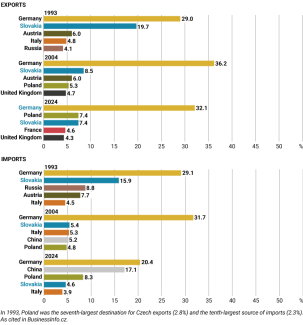
Source: Data for 2004 and 2024 from the Czech Statistical Office; data for 1993 from Zahraniční politika České republiky 1993–2004, Institute of International Relations (ÚMV), Praha 2004, and P. Hembera, Otevřenost ekonomiky a vývojové tendence zahraničního obchodu ČR na přelomu století, Brno 2005.
Chart 3. Key trade partners of Slovakia in 1993, 2004, and 2024
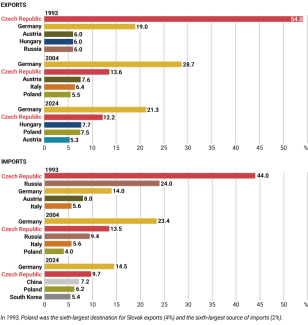
Source: Data for 2024 from the Statistical Office of the Slovak Republic; data for 1993 and 2004 based on information from the Ministry of Economy of Slovakia (for the first case through: M. Jandová, Zahraniční obchod Slovenské republiky 1993–2006, Brno 2007).
Although trade volumes between the Czech Republic and Slovakia have generally increased in absolute terms, the two countries have become progressively less significant to each other in this field. This trend stems from the gradual diversification of trade in both countries, particularly within the EU. It is most evident over the long term (see Charts 2 and 3), whereas in the past decade this process has slowed markedly and is now largely stagnant (see Chart 5). When recent data are compared with those from the first year following the dissolution of Czechoslovakia it becomes clear that Czech exports to and imports from Slovakia are much less significant. Slovakia accounted for as much as 19.7% of total Czech foreign sales, and imports from Slovakia made up 15.6% of the Czech Republic’s overall imports in 1993. Within three decades, Slovakia’s share fell by approximately 12 and 11 percentage points respectively. The shift is even more striking from the Slovak perspective: the Czech share of Slovakia’s exports and imports dropped from 54% and 44% respectively in 1993 to just under 12% and 10% in 2024, marking decreases of 42 and 34 percentage points. However, data covering a shorter timeframe show that Slovakia’s share in Czech exports and imports was indeed lower in 2024 than in 2014, but only by 0.7–1 percentage points (see Chart 5). In contrast, absolute values have grown rapidly over the same period. For example, the value of Czech imports from Slovakia rose by nearly 60% between 2014 and 2024, and Czech exports to Slovakia increased by as much as 65% (see Chart 4).
Chart 4. Value of Czech–Slovak trade, 2014–2024
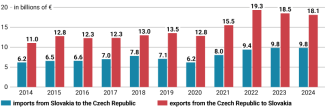
Source: based on data from the Czech Statistical Office.
Chart 5. Slovakia’s share in Czech imports and exports, 2014–2024
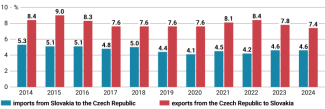
Source: based on data from the Czech Statistical Office.
The most important category in bilateral trade is machinery and transport equipment, accounting for 40% of both Czech exports to and imports from Slovakia in 2024. This includes not only vehicles but also components and equipment used in industry. This reflects the importance of industry – particularly the automotive sector – in both economies, where the share of industry in GDP and employment significantly exceeds the EU average. According to the Czech Statistical Office, in the 30 years since independence the country has exported more than 900,000 vehicles to Slovakia, while around 190,000 went in the opposite direction. Both countries rank among the top producers of passenger vehicles per capita: in 2023, Slovakia led with 198 cars per 1,000 inhabitants, followed by the Czech Republic with 129 (see box ‘Automotive powerhouses’).[65] Over the past 15 years, the value of this indicator nearly doubled in Slovakia and rose by about half in the Czech Republic.
Automotive powerhouses The Czech Republic and Slovakia have long ranked among the world’s leading producers of cars per capita. Slovakia’s rise to global dominance in this measure dates back to 2007, with the Czech Republic following closely behind. In 2023, nearly 1.4 million vehicles were produced in the Czech Republic and almost 1.1 million in Slovakia. This meant that more passenger cars rolled off production lines in these two countries combined than in the United States and Italy together.[66] At the same time, mounting challenges facing Europe’s automotive sector – including those related to electromobility – present a serious test for both Slovakia and the Czech Republic. Some automotive investments in the two countries are undertaken by the same foreign corporate groups. The largest vehicle manufacturer in both the Czech Republic and Slovakia – in terms of revenue and employment – is the Volkswagen (VW) Group. Its presence in the Czech Republic stems from the successful privatisation of the Škoda plants (now Škoda Auto), and in Slovakia from the acquisition of the Bratislava Automotive Works (BAZ). Strategic decisions regarding both were made in 1991, when the two countries were still united in a single state. Over time, VW acquired full ownership of these entities. The South Korean Hyundai Motor Group runs similar operations. In 2006, it launched serial production of Kia vehicles near Žilina, Slovakia, followed two years later by Hyundai car production in Nošovice, in the Czech region of Cieszyn Silesia. The two plants are located less than 85 km apart. The image of the Czech Republic and Slovakia as automotive powerhouses is reinforced by a growing network of operational and emerging factories producing passenger cars and other vehicles, alongside facilities run by component suppliers. In the Czech Republic, the third-largest car plant is Toyota’s factory in Kolín, in the centre of the country. It was initially established as a joint venture between the Japanese manufacturer and the French PSA Group. From 2005 to 2021, it produced compact city cars known as the ‘Kolín triplets’. Since then, the plant has been wholly owned by Toyota, which now assembles smaller models there: the Aygo and Yaris. In 2023, production shares among the Czech Republic’s three main passenger car manufacturers were: Škoda Auto – 62%, Hyundai – 24%, and Toyota – 14%. The Czech Republic is also a major producer of buses (Iveco and SOR), and is home to manufacturers of trucks (Tatra), motorcycles (Jawa), trailers and semi-trailers (Agados, Schwarzmüller, Panav), as well as car accessories and tyres (including Bosch and Continental). Altogether, the automotive sector accounts for 9% of Czech GDP and approximately one-quarter of its industrial output and exports. In Slovakia, in addition to Volkswagen and Kia, car production facilities are operated by Stellantis (in Trnava since 2006, originally as part of PSA) and Jaguar Land Rover (JLR; in Nitra since 2018). A new Volvo plant is under construction near Košice and is scheduled to begin producing only electric vehicles from 2027. In 2023, the breakdown of passenger car production among these four groups was: Kia – 32%, VW – 31%, Stellantis – 25%, and JLR – 12%. The country is also home to numerous component suppliers, with Mobis, Foxconn, Continental Matador, Faurecia, and SAS standing out in terms of revenue and/or workforce size. The automotive sector in Slovakia generates 13% of national GDP and accounts for half of the country’s industrial output and approximately 40% of its exports. Map 4. Key automotive plants in the Czech Republic and SlovakiaSource: author’s own analysis.
Investment ties
Both countries are important investment partners for one another. According to data from the Czech National Bank as of the end of 2022, the value of Czech accumulated foreign direct investment (FDI) in Slovakia exceeded €4 billion – nearly three times the figure for Poland and one third more than in Germany. From the Czech perspective, Slovakia ranks just behind the Netherlands, Luxembourg, Liechtenstein, and Cyprus, which are preferred for tax reasons, as well as Switzerland. Slovak FDI in the Czech Republic is estimated at €7.3 billion, ranking behind countries that are the source of major investments (Germany, France, Austria, Belgium, Switzerland) and those where investing firms are registered (the Netherlands, Luxembourg, Cyprus) – sometimes de facto domestic – but ahead of countries such as Poland and South Korea.
The strength of these mutual investment ties is also confirmed by data from the Slovak National Bank, reflecting the situation as of the end of 2022. According to these figures, Czech companies have invested €7.2 billion in Slovakia – 16 times more than Polish investors and twice as much as German investors – ranking second only to Austrian investors and entities registered in the Netherlands. The value of Czech investments in Slovakia also far exceeds the total invested by non-European countries. Meanwhile, Slovak investment in the Czech Republic amounts to €2.7 billion, making it by far the most important destination of Slovak business expansion and accounting for as much as 54% of Slovakia’s total FDI abroad.[67]
Among the domestic companies with extensive operations in both countries are the largest Czech defence conglomerate, Czechoslovak Group, which owns six subsidiaries in Slovakia (including MSM), and the Slovak–Czech financial group Penta, active in sectors such as pharmaceuticals, private healthcare, media, and real estate. Many foreign corporations – such as Volkswagen and Hyundai Motor Group in the automotive industry (see box ‘Automotive powerhouses’) – closely coordinate their activities and carry out major projects across both markets.
Differences in potential, prosperity, and business culture
A clear disparity in potential and prosperity characterises the economic relations between the two countries – an imbalance that had already complicated relations within Czechoslovakia. As a result, the Czech Republic exerts a stronger pull on Slovaks seeking employment. At the same time, operating in the eastern neighbour’s market can offer cost savings for Czech firms, particularly in view of the Czech Republic’s near-zero unemployment rate.
The Czech Republic has twice the population of Slovakia, but its GDP is 2.5 times greater. In 2023, real GDP per capita was 12% higher in the Czech Republic. This gap has narrowed significantly since Slovakia’s accession to the EU, when the difference was 38.5% (see Chart 6). Slovakia’s labour productivity provides a promising outlook: it leads the Visegrád Group in this respect. Between 2015 and 2022, its advantage over the Czech Republic in GDP per hour worked rose from $1.6 to $5.2. Currently, productivity in Slovakia exceeds that of the Czech Republic by 12% (OECD data), but this has not translated into notable improvements in wages in the Slovak private sector. From 2016 to 2023, net wages in the Czech Republic rose by 84% and are now the highest in the V4 group (€1,411), whereas in Slovakia they increased by just 40% – the lowest in the group – reaching €970.[68] This discrepancy stems partly from higher unemployment in Slovakia (which reduces wage pressure), but also from a heavier burden of taxes and social contributions on wages. Net pay in Slovakia represents 51% of the employer’s total cost, compared to 61% in the Czech Republic.
The Czech Republic also proves wealthier when measured by purchasing power standards (PPS). In 2023, the average Czech recorded a GDP per capita equivalent to 91% of the EU average, while for the average Slovak the figure stood at 73% (compared with 80% in Poland).[69] Moreover, as shown in Chart 7, the gap between the two neighbours has widened over the past decade. Nevertheless, the use of PPS-based GDP per capita is subject to considerable criticism among Slovak economists. They often highlight, among other issues, the significant disparities in wealth across different regions of the country, which are accompanied by corresponding variations in the prices of services.[70] Objections have also been raised concerning the Eurostat data revision in 2019, which affected figures dating back to 2016.[71]
A more accurate reflection of actual living standards is provided by Eurostat’s indicator of Actual Individual Consumption (AIC). In 2023, Czechs achieved 81% of the EU-27 average, while Slovaks reached 75% (compared with 86% for Poland).
Chart 6. Real GDP per capita in the Czech Republic and Slovakia (and, for comparison, in Poland and Germany), 2005–2023
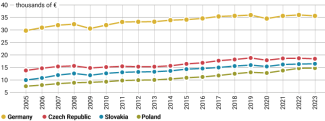
Source: Eurostat.
Chart 7. GDP per capita by purchasing power parity in the Czech Republic and Slovakia (and, for comparison, in Poland and Germany), 2012–2023
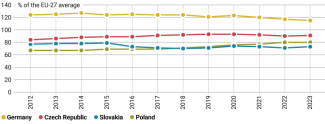
Source: Eurostat.
For Slovak companies, the Czech Republic often serves as the first testing ground for ambitions in foreign expansion – and vice versa. This is partly due to the cultural and linguistic affinity between the two nations, which enables communication without the need for interpreters. However, this does not imply that their business cultures are identical. The CzechTrade portal, operated by the Czech government agency for supporting exporters, observes, for example, that ‘while a certain social and commercial distance is typical in the Czech Republic when initiating contact, Slovaks tend to prefer informal or even cordial relations’.[72] In business negotiations, Slovaks are said to prioritise ‘intuition, spur-of-the-moment inspiration, and common sense’. This approach fosters a belief that any problem can be solved. They also tend to move more swiftly through the formal stages of business discussions in order to spend more time on the informal component. Overall, they are described as more emotional than Czechs and more sensitive to certain topics considered ‘taboo’ (such as abortion, LGBT issues, religion, the wartime Slovak state, or salaries).
Conversely, in matters concerning the Czech market, Slovaks emphasise building trust through positive experience and maintaining a reasonable pricing policy as the fundamental conditions for successful business relationships.[73] Regular contact and flexibility are also regarded as essential. While Czechs list topics they would rather avoid when speaking with Slovaks, the latter indicate subjects a Prague or Ostrava native is likely to enjoy discussing when establishing a business relationship – namely sports, art, Czech history, food, and holidays.
Asymmetry is the primary characteristic of Czech–Slovak relations at the interpersonal level. This is reflected in the uneven pattern of migration and, more broadly, in cultural influence. The Czech Republic exerts a far stronger pull than Slovakia, which is why the movement of Slovak citizens into the Czech Republic significantly outweighs that in the opposite direction. As a result, many more Slovaks live in the Czech Republic than Czechs in Slovakia (see Charts 8 and 9). A large number of Slovaks remain in the Czech Republic after completing their studies, drawn by the higher quality of education at Czech universities (as well as favourable admission criteria for Slovak applicants) and, more generally, by a higher standard of living – including better wages, public services such as healthcare, and lower levels of corruption (see table). Generations of Czechs and Slovaks who remember the common state are gradually passing away and, as a result, the bonds between the two nations are becoming more impersonal, or at least losing their aura of uniqueness.
Table. Condition of state institutions and standard of living in V4 countries based on selected indicators
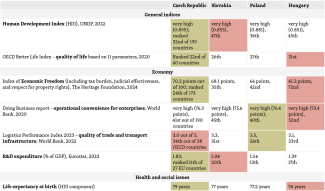
Source: author’s own work, based on various sources as stated in the table.
Slovaks in the Czech Republic
According to Slovak estimates,[74] around 200,000 Slovaks live in the Czech Republic, making it home to the world’s second-largest Slovak diaspora after the United States (750,000) and ahead of Canada (100,000). The latest Czech data, as at the end of 2023, indicate that over 119,000 Slovak citizens reside in the Czech Republic.[75] This places them second among foreign nationalities, between Ukrainians (574,000) and Vietnamese (68,000).[76] They account for 1.1% of the population and 11.2% of the foreign-born population. The largest share of this group – 44% – lives in Prague and the surrounding Central Bohemian Region, while a combined 25% resides in three border regions: South Moravia (with Brno), Zlín and Moravian-Silesia (with Ostrava).
The most recent census (based on persons ‘usually’ resident in the Czech Republic) showed that 0.9% of respondents identified solely with Slovak ethnicity (a further 0.6% combined it with Czech ethnicity), while over 1.4% declared Slovak as their mother tongue (with a further 0.6% declaring both Slovak and Czech equally) – see Chart 8. These figures suggest that the total number of Slovaks may range from approximately 163,000 (declared ethnicity, including dual) to 225,000 (declared mother tongue, including bilingual declarations).
Data from job centres suggest that the number of Slovaks living in the Czech Republic exceeds 200,000. In 2022, over 213,000 Slovak citizens were employed in the country, which placed them second among foreign workers, behind only Ukrainian nationals (270,000). Their number is now more than three times higher than at the end of 2003, shortly before both countries joined the EU in 2004. When Slovak President Andrej Kiska visited Prague in 2019, he referred to the city, unofficially, as ‘the third largest Slovak city’ – based on estimates suggesting that around 100,000 Slovaks reside there. This would place Prague behind only Bratislava and Košice, and ahead of Prešov, which officially ranks third with just under 90,000 residents.
Chart 8. Ethnic composition of the Czech lands and Slovakia in 1950 and 2021
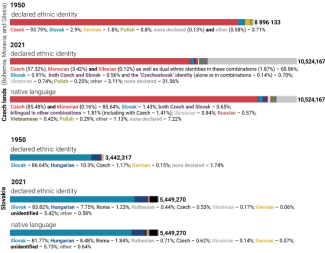
Source: based on data from national statistical offices from the 1950 and 2021 population censuses. Due to the high percentage of undeclared ethnic identity in the latest Czech census (almost 32%), the table also includes an approximation based on native language (alongside similar data for Slovakia). In the 1950 census, ethnic identity was recorded based on self-declaration.
Czechs in Slovakia
According to the latest population census (2021), 29,000 Czechs live in Slovakia – the lowest figure recorded since surveys began in 1921, both in terms of absolute numbers and as a share of the population (0.53%) – see Chart 9. These figures reflect a long-term trend observed since the post-war peak in 1980 (57,000 people, or 1.15% of the population).[77] Interestingly, even then, the numbers did not approach those recorded in the interwar censuses. From 1918 onwards, Czechs began replacing Hungarians en masse in state administration, and by 1930 as many as 122,000 Czechs (3.7% of the population) were living in Slovakia.
Estimates from the Czech side suggest that around 52,000 Czechs currently reside in Slovakia.[78] This figure is expected to decline, partly due to the population’s age structure – Slovak-based Czechs belonging to formal Czech associations have an average age of 80. Overall, according to the latest census, 34% of those declaring Czech ethnic identity in Slovakia are aged 65 or older, compared with 17% for the total Slovak population. By contrast, among Slovaks living in the Czech Republic, the proportion of over-65s is significantly lower (24%).
Chart 9. Population of Slovaks in the Czech Republic and Czechs in Slovakia, 1921–2021
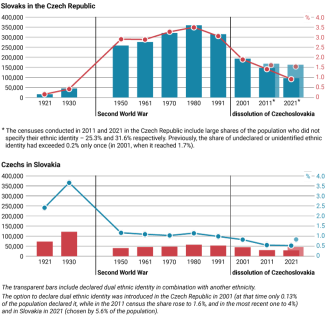
Source: based on data from national statistical offices – population censuses (ethnic identity declarations).
Mixed families and complex identity
Mixed families are one of the factors that strengthen interpersonal ties between residents of both countries. Their exact number is difficult to estimate, not least due to the fragmentary nature of the available data. Between 1980 and 1989, 4.9% of all marriages in Czechoslovakia involved an ethnic Czech and an ethnic Slovak, while 3.7% of all children born within marriages came from Czech–Slovak mixed families.[79] One of the greatest tennis players in history – Martina Hingis – came from a mixed family. She was born in 1980 in Košice. Her mother is a Czech from Moravia, and her father a Slovak. At the age of six, Martina emigrated with her mother to Switzerland, which she later represented in tennis, although she still speaks fluent Czech. According to the Czech Statistical Office, the number of Czech–Slovak couples living in the Czech Republic fell from over 130,000 in 1991 to just over 80,000 in 2001.
Marriages with Slovak men and women clearly predominate among new Czech marriages involving foreign nationals. In 2022, they accounted for nearly one-third of such cases, while marriages between Czech citizens and foreigners altogether represented over 12% of all new marriages.[80] The number of marriages with Slovak men and women steadily increased between 1995 and 2022.[81] In the case of marriages between Slovak men and Czech women, the number rose from 474 in 1995 to 574 in 2005, 773 in 2015, and 1,031 in 2022. Slovak women marrying Czech men numbered 274 in 1995, 677 in 2005, 807 in 2015, and 1,058 in 2022. However, this growth corresponds with a broader trend of rising divorce rates in these groups. Between 1995 and 2022, divorces involving a Slovak woman and a Czech man increased from 112 to 239, and those involving a Czech woman and a Slovak man rose from 186 to 239.
Longer periods spent in a culturally close environment – particularly within mixed families – contribute to assimilation or the emergence of more complex identities. In the most recent Czech census, 1.5% of residents declared Slovak ethnicity, with as many as 41% of them opting for dual ethnicity. Around 90% of the latter group identified simultaneously as both Slovak and Czech (see Chart 8). In the same census, over 225,000 respondents declared Slovak as their mother tongue (2.1%), although one in three of them listed it as one of two native languages, most often in combination with Czech. As a result, 69,000 people (0.65% of the total population) consider both languages to be their mother tongues. Similarly, 37% of Czechs living in Slovakia also identify themselves as Slovaks.
Assimilation is also reflected in the number of foreign residents applying for citizenship in the country where they live. According to data from the Czech Statistical Office on the naturalisation of foreign nationals, Slovaks were the group most frequently acquiring Czech citizenship between 2001 and 2008 (from 2009 onwards, Ukrainians became the most numerous). In the record year of 2001, 3,400 Slovaks were granted Czech passports. Over the past decade, this number has remained relatively high, ranging from 350 to almost 700 approved applications annually. Regardless, 14,500 people identified as Czechoslovak in the Czech census (just over half of them selecting only this identity, and the rest combining it with another). While still a small share of the overall population (0.14%), this figure is twice as high as a decade earlier.
Among leading figures in Czech media, politics and business, many have Slovak partners. On the Slovak side – where far fewer Czechs reside – such cases are markedly rarer. Former president and prime minister Václav Klaus met his Slovak-born wife Livia while studying in Prague. After his presidency, she served as the Czech ambassador to Slovakia (2013–2018). The current Speaker of the Chamber of Deputies, Markéta Pekarová Adamová, is married to a Slovak and adopted the first part of his surname. The most prominent Slovak in Czech politics, Andrej Babiš, symbolically ‘swapped’ his Slovak wife for a Czech partner in the 1990s after shifting his professional focus to Prague; the two later married. Another example is Michal Kubal, one of the Czech Republic’s most recognisable television presenters, who is married to a Slovak.
Students
The imbalance in appeal is also evident when looking at student numbers. More than 20,000 Slovaks study at Czech universities (the most recent comprehensive data from 2021 shows nearly 22,000, of whom only 0.7% pay tuition fees), whereas just around 100 Czechs attend universities in Slovakia.[82] Slovaks form the largest group of foreign students in the Czech Republic (according to the Czech Statistical Office, 38% in 2022), ahead of Russians (14%) and Ukrainians (11%). Brno, located just 130 km from Bratislava, holds a special place in Slovak perception and is sometimes – albeit somewhat inaccurately – described as ‘the largest Slovak university city’ (see box ‘Brno – the Czech capital of Slovak students’).
Slovaks typically benefit from free tuition in programmes taught in Czech, and most universities accept academic work submitted in Slovak (although this is not mandatory and some courses apply different rules). Tuition fees are generally not required from any foreign nationals enrolling in full-time programmes in Czech, which also attracts many Russian students. This has sparked public debate about whether taxpayers should fund the education of foreign students, especially if it reduces opportunities for domestic applicants – particularly as many foreigners do not remain in the country but instead pursue better-paid jobs in Germany or Austria. One of the reasons for maintaining free Czech-language tuition for foreigners is the wish to preserve the unique nature of Czech–Slovak relations and to meet the needs of a domestic labour market long affected with workforce shortages. On the other hand, residents of Slovakia increasingly view the current situation as part of the wider issue of talent outflow (the so-called ‘brain drain’). According to the OECD, 17% of Slovak students study abroad (compared with an EU average of 4%), and two-thirds of them choose the Czech Republic – where many remain afterwards.
Brno – the Czech capital of Slovak students
Slovak students have taken a particular liking to Brno – the second largest city in the Czech Republic (around 400,000 residents), the capital of South Moravia and its main exhibition and trade fair centre. The city’s appeal is undoubtedly strengthened by its proximity to Bratislava (the two cities are only 130 km apart), by Moravia’s greater cultural affinity with Slovakia compared with the rest of the Czech Republic, and the high quality of its universities. These institutions actively recruit students from Slovakia by participating in meetings for final-year secondary school pupils and by tailoring scholarship offers. Brno’s two largest universities (see below) are ranked in the fifth and eighth hundred of the Shanghai Ranking (ARWU) respectively, whereas Slovakia’s top institution – Comenius University in Bratislava – appears in the tenth hundred. Slovak students themselves cite the strong reputation of Czech higher education institutions as their main reason for studying abroad.
The most popular choice is Masaryk University (MUNI) in Brno – the second largest university in the country after Charles University in Prague. Of its nearly 33,000 students, more than 8,000 are international, including 5,400 Slovak nationals. The university’s website features a dedicated ‘For Applicants from Slovakia’ section, encouraging them to apply. It explains that the rules are ‘almost the same’ as for Czech peers and that living expenses are comparable with those in Slovakia. Slovak students can apply for accommodation scholarships or student housing, and they are usually permitted – except in translation-related programmes – to submit academic work in Slovak.
The second most popular choice among Slovak students is Charles University, followed by the Brno University of Technology (VUT). Of the latter’s 17,000 students, 4,400 are international, including 3,200 from neighbouring Slovakia. Other Brno-based institutions popular with Slovaks include Mendel University, specialising in agriculture and forestry, the University of Veterinary Sciences (the only one of its kind in the country), and the Janáček Academy of Performing Arts (JAMU). Largely due to the strong Slovak presence, Brno in 2022 narrowly overtook Prague in the national ranking of Czech cities with the highest share of international students – 24% compared with 23%.
Altogether, around 10,000 Slovak students are enrolled in Brno, representing 17% of the city’s student population. Certain faculties have an even higher proportion: at Masaryk University’s Faculty of Informatics, Slovaks account for half of all students (around 1,000); at the Brno University of Technology’s Faculty of Information, they account for more than one third (approximately 800); and at Masaryk’s Faculty of Medicine, one quarter (1,100 – the highest number at any single faculty). Although significant, these figures do not justify calling Brno ‘the largest Slovak university city’, as the press in both countries occasionally claims, often with deliberate exaggeration. For comparison, Slovakia’s largest university – Comenius University in Bratislava – has more than 22,000 domestic students (and 2,500 international ones). Other higher education institutions in Bratislava are also mostly attended by Slovak nationals: the Slovak University of Technology (STU) has over 7,000 students, the Slovak Medical University around 6,000, and the University of Economics approximately 5,000.
After completing their studies, Slovaks often choose to remain in the Czech Republic. Their education – particularly in fields such as IT or medicine – frequently leads to above-average earnings. This is reflected in the fact that Slovak citizens living in the Czech Republic recorded the highest median salary among all foreign nationals. According to data from the Czech Statistical Office, the median monthly wage for all employees in 2022 was CZK 36,104 (approximately €1,470). For Slovak citizens, it was 13% higher. By contrast, Polish citizens (typically employed in mining or automotive assembly) earned 4% less, while the earnings of Czech nationals were close to the overall national median.
Mutual perception
The excellent state of Czech-Slovak interpersonal relations, and their potential for further development, is well illustrated by various surveys showing instinctively positive associations with the neighbouring ‘brotherly nation’. According to a poll conducted in Visegrád countries, Czech respondents showed the highest level of trust (and the lowest level of distrust) towards Slovaks out of 14 nationalities – 78% expressed trust and only 4% distrust. Austrians (67% positive opinions) and Poles (53%) followed in the ranking.[83] Similarly, Slovaks identified Czechs as the most trustworthy group (84%, with 5% expressing distrust), followed by Poles (65%) and Austrians (62%).
Other regular sociological surveys conducted in the Czech Republic confirm this favourable perception of Slovaks and Slovakia. The latest survey by the CVVM agency (2023) revealed that 79% of Czechs view their eastern neighbours as ‘likeable’ – a result second only to their self-perception (80%). Slovaks ranked above the Vietnamese (50%), Poles (47%) and 10 other national groups living in the Czech Republic included in the poll, while Roma and Arabs typically received the least favourable responses.[84] In another survey measuring perception of specific countries, Slovakia received the highest rating on a five-point scale from the greatest number of respondents: 43% awarded it the top score, and a further 39% gave it the second highest. It achieved an average rating of 1.8 (where 1 is the highest), ahead of Austria (2.07) and Poland (2.27).[85]
It is worth noting that this strong Czech sentiment towards Slovakia is by no means a given: it has remained strong since the beginning of the 21st century, but in the years immediately following the dissolution of the common state it was significantly weaker. In 1993, for example, France, Austria, the United States, and the United Kingdom all ranked ahead of Slovakia in terms of Czech public sentiment. A public opinion survey conducted shortly before the split of Czechoslovakia revealed that Czechs viewed Slovaks as aggressive, pompous, and insecure, while Slovaks perceived Czechs as lazy, cunning, and condescending (though also well-mannered and well educated).[86] These stereotypes have not disappeared entirely – they persist in jokes (see box ‘Czech and Slovak jokes about each other’) and tend to resurface in more serious contexts, particularly at times of crisis.
Czech and Slovak jokes about each other
Some insight into how a nation is perceived may be gleaned from the jokes popular in a given country. Numerous examples can be found in Slovak jokes about Czechs and Czech jokes about Slovaks. Slovak jokes often play on stereotypes of alleged stinginess or incompetence during trips to the Slovak Tatras, with an implicit jab at the modest size of Czech mountains – the country’s highest peak, Sněžka, stands at just 1,603 metres, while Slovakia boasts 50 peaks exceeding 2,000 metres. One joke contrasts a Czech and a Slovak sitting in a pub: ‘The Czech has a thousand crowns in his pocket but acts as if he has ten. The Slovak has five, but behaves as if he has a thousand’. The supposed stinginess of Czech tourists in Slovakia is captured in an exchange between a father and son, where the latter exclaims: ‘Dad, we’ve only been here a week, and we’re already down a hundred!’ (100 crowns is about €4). Another category of jokes targets the alleged gluttony and obesity of Czechs – for example, the one about a shark devouring representatives of various nationalities, only to end up being eaten by a Czech.
By contrast, Czech jokes mock stereotypical Slovak traits such as recklessness, carelessness, primitiveness, or an irrational aversion to Hungarians. The latter is illustrated in a joke where a Hungarian driver is stopped and fined for lacking a motorway vignette. He protests and insults the police, and the case ends up in court. The judge issues a fine of €5,550: €50 for the missing vignette, €500 for insulting the officer, and €5,000 for doing it in Hungarian. Another joke has Czechs recommending travelling to Slovakia once the date of the end of the world is announced, because ‘everything there happens 30 years later’. The large number of Slovak students in Czech universities is sometimes referenced, as in the gag about a survey asking students if the presence of Slovaks bothered them: 20% allegedly said ‘Ano’ (yes, in Czech), and 80% said ‘Nie’ (no, in Slovak – a Czech would say ‘Ne’; the Slovak word for ‘yes’ is ‘áno’, with an accent on the ‘a’).
When the Czech Republic assumed the presidency of the EU Council, the renowned provocateur and sculptor David Černý created a controversial artwork titled Entropa, unveiled in 2009 in the Council building. The piece depicted various European nations through stereotypes, portraying Slovaks as a salami tightly wrapped in a Hungarian flag. In response, one of Slovakia’s best-known cartoonists, Martin Šútovec (known as Shooty), took up the challenge of drawing a stereotypical image of a Czech. His caricature featured the character Pytlík (literally ‘the Bagger’), a chubby bug from popular Czechoslovak children’s books, known for boastfully parading shallow knowledge of various subjects – a trait the name has come to denote in everyday speech. Shooty depicted Pytlík wearing sandals over white socks, ironically remarking that this was ‘part of the Czech national costume of the 20th and 21st centuries’. In the drawing, the character holds a beer in one hand and a shopping bag in the other, the latter bearing the slogan: ‘It’s cheap, so how could you not buy it?’.
The ongoing breakdown in political relations – symbolised by the suspension of regular intergovernmental consultations – and widespread criticism of Fico’s camp in the Czech media have brought to the surface more deeply rooted associations, in which the ‘Germanic Czechs’ are contrasted with the ‘Slavic Slovaks’. Daniel Šitera, an analyst at the Prague-based Institute of International Relations (ÚMV), highlights what he regards as a new incarnation of a phenomenon identified almost 30 years ago by the world-renowned Czech anthropologist (and Africanist) Ladislav Holý.[87] In his last major work, The Little Czech and the Great Czech Nation (1996), Holý points to a perhaps subconscious tendency in national tradition to emphasise the Czech Republic’s (supposedly high) level of democracy and culture by underlining similarities with Germany on the one hand, and differences – real or perceived – with Slovakia on the other.
This theme also appears in comments by some Slovak elites, such as anthropologist Juraj Buzalka. His popular 2023 book Postsedliaci (Post-peasants) depicts Slovaks as farmers transplanted into the modern world, along with the mentalities typically associated with that background – albeit within a stereotypical framing. Not long ago, however, Prague elites envied Slovakia its cultured President Čaputová, who stood in stark contrast to the frequently vulgar and alcohol-prone Zeman. Slovakia has also had a female prime minister, whereas in the Czech Republic both the office of prime ministers and the presidency have always been held by men.[88] Meanwhile, Czech business circles admired Bratislava’s determination in adopting the euro – a move that, by contrast, continues to lack public support in the Czech Republic.
A glimpse into the present and the past
Mutual overall positive perceptions between the two societies do not imply that they are aligned in their views on contemporary challenges or interpretations of the past (see Chart 10). More Slovaks than Czechs tend to view ‘Western societies’ (56% vs 38%) and the United States (62% vs 44%) as a potential threat to their identity and values, while they are less likely to see such threats in Russia (56% vs 72%) and China (46% vs 62%).[89] Both nations identify similar levels of perceived risk in relation to the EU (50–52%) and migrants (68–73%). When it comes to historical attitudes, Slovaks express significantly more nostalgia for communism. Around 27% of them regard the ‘political system before 1989’ as good or very good, compared to just 13% of Czechs, while 33% of Slovaks and 55% of Czechs consider it bad or very bad.[90] It is therefore not surprising that Czechs view the Velvet Revolution more positively (67% vs 53%). At the same time, it is Slovaks who express warmer feelings about re-anchoring in a broader entity – the European Union (53% vs 44%).[91]
Chart 10. Attitudes of Czechs and Slovaks towards selected issues
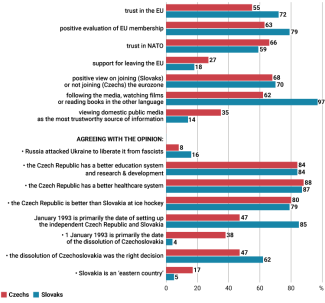
Source: based on a 2022 survey by Median SK.
1 January 1993 is seen by Slovaks primarily as the day of the establishment of the independent Slovak Republic (85%), while for Czechs it signifies both the birth of the Czech Republic (47%) and the dissolution of Czechoslovakia (38%), with which they had a stronger sense of identification. Since 2017, the proportion of Czechs choosing the latter option has fallen from 53%, suggesting a gradual fading of the memory of the shared state.[92] In line with stronger identification with the common state, Czechs more often than Slovaks regard the dissolution of Czechoslovakia as the wrong decision (48% vs 33%). In this context, it is somewhat surprising that the prevailing opinion in Slovakia is that their western neighbours benefited more from the split (a view held by 66% of Slovaks and 37% of Czechs, among whom the dominant perception is that the gains were evenly distributed).
Both nations agree (90–93%) that the state of bilateral relations after the dissolution of Czechoslovakia is good or very good. Their respective attitudes towards the former state are also reflected in the way they mark particular anniversaries: 28 October (the founding date of Czechoslovakia in 1918) is a public holiday only in the Czech Republic. Meanwhile, 1 January, as the ‘Day of the Establishment of the Slovak Republic’, was enshrined in Slovak legislation as early as 1993. In the Czech Republic, it was initially celebrated solely as New Year’s Day and was officially designated as the ‘Day of Renewal of the Independent Czech State’ only from 2001.
Culture, media and language legislation
Culture is another area where the mutual influence of Czech and Slovak traditions is apparent, but also where a clear disparity exists in terms of the strength of that influence. This is well illustrated by a survey that asked whether residents of a Visegrád Group country had recently watched a film, attended a play, or read a book by an author from another member state. As many as 83% of Slovaks reported recent contact with Czech art or literature (and 36–39% with Polish or Hungarian works).[93] Czechs most frequently chose Slovak authors from that group, though far less often than vice versa (50%, compared with 26% for Polish and 9% for Hungarian authors). Another poll found that 62% of Czechs follow Slovak media, read books in Slovak, or watch Slovak films, although only 10% do so very frequently. On the Slovak side, this pattern is much more pronounced, with 97% reporting similar engagement, and 57% doing so very frequently.[94]
This asymmetry also characterises the book market. In Slovakia, purchasing books in Czech is considered common. In many cases, books – especially works of world literature – are not translated into Slovak at all. The reverse is much less common in the Czech Republic. This disparity is evident in the offerings of major bookstore chains. The Czech chain Luxor lists 119,000 titles in Czech but fewer than 5,000 in Slovak – a smaller number than its selection in German. Interestingly, even in the large Slovak chain Panta Rhei, the sections for fiction and academic or popular science literature contain more Czech than Slovak titles (62,000 vs 19,000 for fiction, and 42,000 vs 17,000 for academic/popular science).
Slovaks are also more frequently exposed to the Czech language in the media than Czechs are to Slovak. This is partly due to recent changes in the media market, where international streaming platforms – less constrained by local language legislation – play an increasingly prominent role. Another factor is the close integration of both media markets. Czech content is more extensive, and the practice of broadcasting films and series in the local language is more strictly observed than in Slovakia. Appearances by politicians, experts, or public figures from one of the two countries are usually not translated when broadcast in the other, except for quotations in written news reports. However, newer Slovak films and programmes are often given a second version (dubbed or subtitled) when aired in the Czech Republic – something that rarely happens in reverse, except in the case of children’s content. This stands in contrast to practices during the Czechoslovak era, when mutual comprehension of both languages was actively encouraged. For instance, the evening news or major sports events were typically co-hosted by a Czech and a Slovak, who alternated in order to familiarise viewers and listeners with both languages. Between 1959 and 1989, Monday afternoon and evening television programming was produced by the Slovak studio – a tradition referred to as ‘Bratislava Mondays’.
Slovakia’s Act on the State Language,[95] permits the use of Czech on national channels, provided that the content is comprehensible to Slovak audiences. This requirement applies to audiovisual works in their original language, as well as to dubbing of content produced before 1 January 2008 (when stricter regulations were introduced by legal amendment) and already aired before that date. It also covers the original speech of individuals in news, commentary, and entertainment programmes, which allows Czech experts, for instance, to speak without being interpreted. There is, however, a clear and significant exception: programmes in foreign languages intended for children under the age of 12 must be dubbed into Slovak, unless aired during segments explicitly designated for national minorities. As a result, issues arise in Slovakia when broadcasting foreign entertainment shows– if produced after 2008 and dubbed in Czech – when they lack Slovak subtitles.
The first case in Slovakia of a fine imposed on a nationwide broadcaster related to language regulations concerned the airing of an American show dubbed in Czech. TV JOJ was fined in 2013 (having already been issued a warning in 2011 for a similar offence), although the €200 fine was largely symbolic.[96] Around that time, the Slovak media regulator repeatedly confirmed – in response to complaints from viewers who felt overwhelmed by Czech-language content – that Czech met the legal requirement of being ‘understandable’.[97] While experts from across the border are frequently invited to comment in both countries, relatively few popular Czech–Slovak television co-productions have emerged since 1993. The first major example was a local version of the musical talent show Pop Idol, broadcast between 2009 and 2021 (see box ‘Czech–Slovak SuperStar’). Other examples include Česko Slovensko má talent (since 2010, by TV Prima and JOJ), Talentmania (2010, by TV Nova in the Czech Republic and Markíza in Slovakia), and Česko Slovenský X Factor (2014, by Prima and JOJ).
Bratislava’s tightening of language legislation in 2007–2008 was, in fact, a response to measures taken in Prague. A key turning point came in 2005, when Czech public television (ČT) dubbed Slovak dialogue in the primetime series Záchranáři (Záchranári in Slovak), a Slovak–Czech co-production about mountain rescue workers in the Tatras. This decision, taken by ČT’s programming management, sparked intense debate. ČT argued that younger audiences struggled to understand Slovak. It was the second time Slovak dialogue was dubbed in a programme not intended for children, the first being when ČT aired a Czech-language version of the 1987 Slovak series Teta in 2003. Slovak children’s programmes had already been dubbed in the Czech Republic prior to that.
Czech–Slovak SuperStar
In 2009, Česko Slovenská SuperStar premiered – a musical talent show that was the local version of the British Pop Idol. To date, it has run for seven seasons, the most recent of which aired in 2021. The show was broadcast by two popular private TV channels belonging to the same media group: TV Nova in the Czech Republic and TV Markíza in Slovakia. Both the jury (initially split 2:2, later varied) and the pool of contestants were Czech–Slovak, as were the presenters for the first five seasons. The final two editions were presented solely in Czech, with the last hosted by Ewa Farna, a member of the Polish minority in the Czech Republic and a former judge on the show. The competition was won four times by amateur (sometimes semi-professional) singers from Slovakia and three times by Czech contestants, although representatives from both nations appeared on the podium each season. Before this joint version, both countries had held three independent seasons under the same franchise: Česko hledá SuperStar and Slovensko hľadá Superstar.
The final of the first edition, held under the slogan ‘Two languages, one voice’, achieved record viewership, drawing 3.89 million viewers from both countries combined (65% from the Czech Republic and 35% from Slovakia). This was only slightly below the peak audience for the final of the first Polish Idol in 2002, which attracted 4.37 million viewers – in a significantly larger market. The 2009 grand finale in Bratislava was won by 19-year-old Martin Chodúr from Ostrava, who triumphed over 20-year-old Miro Šmajda from Košice. Both went on to launch enduring musical careers as a result.
Nevertheless, fewer Slovaks watched that final than the conclusion of the first edition of the purely Slovak version in 2005 (1.35 million compared with 1.8 million), which had benefited from the novelty of the format at the time. Subsequent editions of the Czech–Slovak show also failed to match the popularity of the first, and after the seventh season – which had the lowest viewership, with the final attracting almost three and a half times fewer viewers than the debut season – the show was suspended.
Even before this, media debates had questioned whether the competition format genuinely fostered unity between the two nations or, instead, encouraged rivalry.[98] The issue of the Czech side producing twice as many contestants (and attracting more viewers) also resurfaced frequently. Organisers addressed this by ensuring that the same number of participants from each country were eliminated during the semi-finals.
The special relationship between Czechs and Slovaks is reflected in the facilitation of using one’s native language when dealing with public authorities and other formal matters. The Slovak Act on the State Language allows a specific exception requiring certain foreign documents to be treated on a par with domestic ones – this applies specifically to documents written in Czech. As a result, state institutions, public administration bodies and their legal entities are obliged to accept a document written in ‘a language that meets the requirement of basic comprehensibility from the perspective of the state language, provided that the document was issued or verified by the competent authorities of the Czech Republic’. The Czech Administrative Procedure Code, on the other hand, stipulates that administrative proceedings ‘shall be conducted, and documents drawn up, in the Czech language’, but adds that ‘participants in the proceedings may act and submit documents in the Slovak language’.[99] Similar exceptions can be found in a number of other Czech laws, including those on tax administration (No. 337/1997), the Constitutional Court (No. 182/1993; Slovak-language statements are accepted without an interpreter if participants agree), notaries (No. 358/1992) and business activity (No. 455/1991).
Sport
Sport remains a field still imbued with the spirit of Czechoslovakia. Some disciplines – often more niche – still feature joint competitions, at least up to a certain stage. Since 2002, the Czech–Slovak women’s handball interleague has referenced this shared tradition. It replaces the regular season in both countries (of the 22 editions, Slovak teams have won the majority – 14 – although they currently make up only 3 of the 12 participating clubs). The top teams then compete – from the semi-final stage onwards – for their respective national titles. A bowling interleague has also operated since 2016. In men’s handball, four joint seasons were held from 2001 to 2005, and in the 2022/23 season the Slovak champion was again included in the regular season. In 2017, there were plans to revive the joint competition, but most Czech clubs boycotted the idea.
From time to time, the idea of establishing joint leagues in more popular sports resurfaces, but such plans have never materialised. In football, the situation mirrors that between the English and Scottish leagues, where top Scottish clubs (Rangers and Celtic) seek entry into the more lucrative English competitions but face resistance from English teams. In the Czech–Slovak context, Slovak clubs tend to be more proactive – in 2010 they reportedly secured preliminary approval from UEFA, which typically resists such initiatives, to launch a joint league. Statements by key figures – such as Miroslav Pelta, then President of the Czech Football Association, in 2013 – occasionally reignite debate, but rarely lead to concrete steps.
A similar debate surrounds the idea of a joint ice hockey league. This, too, has been blocked by the Czech side, which sees little added value in including top Slovak clubs and anticipates numerous complications such a move could bring. Polish officials attempted to capitalise on this stance by proposing a Slovak–Polish hockey league, but those talks likewise failed to reach any formal agreement. However, individual ice hockey teams from both the Czech Republic and Slovakia have occasionally taken part as guest participants in the Russian and Austrian leagues, for one or several seasons.
Between 2007 and 2010, Czech and Slovak media discussed the idea of ‘reviving Czechoslovakia through football’ in the context of the two football associations considering a potential joint bid to host the UEFA European Championship in 2020. Ultimately, no such proposal was submitted for that or any subsequent tournament, with hosts already selected through to 2032. Local journalists argued that the two countries’ strong sporting traditions merited hosting rights – after all, Czechoslovakia was the European champion (1976), Olympic champion (1980), and twice a World Cup runner-up (1934 and 1962). The main obstacles, however, remain the insufficient number of large, modern stadiums and the reluctance of successive governments to finance such infrastructure with public funds.
National teams of the former common state were not immediately separated after 1 January 1993. In the case of the most closely followed team – the men’s national football team – it was decided to complete the qualification rounds for the 1994 World Cup under the name ‘Representation of Czechs and Slovaks’ (RČS). The final match under this name was played on 17 November 1993– the anniversary of the Velvet Revolution – and ended in a goalless draw against Belgium in Brussels, ending the team’s hopes of qualification. Three weeks earlier, the side had recorded its last victory – a 3–0 win over Cyprus – with the final goal for the joint team scored by Czech forward Tomáš Skuhravý. The 1992/1993 domestic football league season was also completed after the formal split. Sparta Prague were crowned the last champions, while the highest-ranked Slovak side – defending champions Slovan Bratislava – finished third. No team was relegated. Ten Czech clubs were joined by six promoted teams to form the new Czech football league. A similar format was used to establish a smaller (6+6) Slovak league.
Another issue linked to the dissolution concerned the succession of records and historical achievements. These should, in principle, be attributed to both successor states. In practice, however, they are almost always credited to Czech athletes and only occasionally to Slovaks.
The final ice hockey match played by the joint national team took place three days before Christmas Eve in 1992, in Moscow. The team was then split into two, with the Czech Republic inheriting the spot in the top tier (Group A of the World Championships), while Slovakia had to begin in Group C. In 1994, Slovakia comfortably won that tier, and in 1995 it also won the Group B tournament (which included a 10–0 win over Poland). By 1996, Slovakia had joined the Czech Republic in Group A, although they competed in separate groups. Their first direct encounter at the tournament came the following year and ended in a 3–1 Czech victory.
Conclusion: a model divorce and close, though no longer strategic, relations
Czechoslovakia ceased to exist just under 75 years after its founding. In that time, it arguably fulfilled its historical mission. For Slovakia, it enabled the emergence of new, more numerous elites and allowed for more autonomous development, which later opened the path towards aspirations for independence. A shared state with the Czechs was a necessary intermediate stage on that journey and, after the Second World War, shielded Slovakia from the uncertain fate of a defeated ally of Nazi Germany. For the Czechs – who have continued to identify more strongly with Czechoslovakia than their neighbours across the Morava – the state remained a source of pride. In particular, the interwar First Republic is still remembered as one of the most developed and democratic countries in the world at the time, and as a regional beacon of democracy. After leaving the Austro-Hungarian Empire, the republic offered the Czech economy – previously geared towards the broader Habsburg market – new opportunities, making it easier to detach from Vienna. For both nations, Czechoslovakia provided a sense of security in a difficult international environment. For over a decade, it eased fears of German–Austrian or Hungarian revisionism.
However, decades of coexistence did not produce either a ‘Czechoslovak nation’ or even a relatively unified Czechoslovak society. Cultural and linguistic proximity was insufficient to overcome the differences rooted in centuries of separate history, and declared goodwill could not bridge the gap in potential between the two sides. The divergence of historical processes and the asymmetry in size and wealth between the two ‘founding nations’ of Czechoslovakia, as well as the deep structural differences between them, proved obstacles too substantial – perhaps underestimated by the ‘founding fathers’.
Czechoslovakia left behind a legacy of an almost exemplary dissolution, which laid the foundations for the friendly contemporary relations between the two nations and, for most of the period since 1993, between their states. Today, there is no indication that it could be revived in any form – partly because, following Slovakia’s emancipation, relations between Czechs and Slovaks are regarded by both sides as, in many respects, a model. Moreover, the reasons for any such revival are diminishing: the two countries are both members of the European Union and, as such, part of the single European market. With the exception of temporary disruptions due to extraordinary circumstances, there are no border controls – both the Czech Republic and Slovakia belong to the Schengen Area. They are also united militarily through NATO membership. Language regulations in both countries are flexible enough to allow their respective nationals to feel at ease and use their own language in official contexts or at universities in the other country. One important element is still missing for Slovaks to feel the relationship is complete – a shared currency with their neighbour. Yet there is no indication that Prague intends to abandon the koruna in favour of the euro in the foreseeable future.
Nonetheless, in the words of both Czechs and Slovaks about the dissolution of their shared state, one can sometimes sense a feeling of unfulfilled hope and a view that it left both of its successors culturally poorer, more inward-looking and, when apart, less significant. Combining these elements, they also appear more peripheral. Czechoslovakia was a recognised name in international forums – one that the Czechs now struggle to live up to, with mixed results, and which the Slovaks no longer attempt to invoke. If it still existed today, it could arguably exert greater influence in European debates than either of its successors and, among the 13 Three Seas countries, would be surpassed in population only by Poland and Romania, while possessing a far stronger economy than the latter. These are, of course, purely theoretical reflections – ongoing internal disputes might just as easily have paralysed the state and hindered its Euro-Atlantic integration or reforms.
Czechs and Slovaks will remain close, yet distinct. As they continue to live in separate states, social differences are likely to grow, as evidenced by younger generations increasingly struggling to understand the other nation’s language. Their relationship still exhibits a degree of asymmetry. The Czech Republic attracts significantly more Slovak students, and it is far harder to find Slovak-language titles in Czech bookshops than the other way round. In European politics too, Prague long appeared more intent on asserting its distinctiveness, while Bratislava’s actions were more closely aligned with the visions of Paris and Berlin. Slovakia adopted the euro and the Fiscal Compact, and avoided disputes before the Court of Justice of the EU over refugee quotas. The Czech Republic, by contrast, played the role of a state sceptical of the EU mainstream for many years. This critical stance shifted only after the Fiala government came to power in late 2021, while in Bratislava the change went in the opposite direction with Fico’s return as Prime Minister in autumn 2023.
At the political level, the depth of relations between the two neighbours largely depends on the outlook of those in power. As a result, bilateral ties and coordination of regional, European, or foreign policy tend to tighten when the offices of Prime Ministers or Presidents are held by ideologically aligned figures. This was the case when both countries were governed by social democrats or, more recently, by centre-right parties, and when the heads of state were the pro-Atlantic, pro-European duo Čaputová and Pavel.
The perspectives of the two countries diverged, and their governments ceased to closely coordinate their moves and share positions following Slovakia’s 2023 parliamentary elections. Alongside Bratislava’s geopolitical alignment with Budapest on key issues, the vote resulted in breaches – on both sides – of long-standing norms underpinning the uniqueness of their bilateral relations. Among these principles was a mutual refrain from publicly criticising one another. Regular intergovernmental consultations were suspended, and the traditional diplomatic custom whereby a new prime minister selects the other country for their first foreign visit was nearly broken. The crisis in the political dimension of Visegrád cooperation means that the V4 is no longer a tool for mitigating bilateral disputes.
Despite changes in the domestic political landscape, Czech–Slovak relations remain, and are likely to continue to be, exceptional in many ways. Even now, at a time of political strain, the relationship is far from indifferent – both countries still serve as important reference points for one another. The expected victory of ANO in the Czech elections in autumn 2025 could improve the quality of political contacts, with a potential Babiš–Fico tandem likely to resume intergovernmental consultations. However, the current rift between the Prague and Bratislava leaderships – along with the gradual societal drift, Fico’s government’s retreat from rule-of-law norms, the unreserved disapproval voiced by Czech media and political elites, and the growing polarisation within both societies – may complicate any return to the status quo ante. This is particularly true as both countries increasingly cease to view one another as strategic partners.
[1] The name derives from the relatively small river Leitha, a right-bank tributary of the Danube, with the prefixes cis- and trans- referring to the perspective from Vienna. The Leitha marked the Austro-Hungarian border from the 12th century until the Treaty of Trianon in 1920, which awarded the territory on both sides of the river to Austria (today, this area forms its youngest federal state – Burgenland).
[2] ‘Dobrý den, Československo’, a Czech Television documentary, 2017, ceskatelevize.cz.
[3] This is the commonly cited version of a quotation from an open letter written by Palacký on 11 April 1848. The original passage read: ‘Indeed, if the Austrian state had not existed for some time already, we would, in the interest of Europe – indeed, of humanity itself – have to do everything in our power to bring it into existence as soon as possible’. The context was his rejection of an invitation to participate in the all-German parliament. Palacký justified his refusal not only by reference to his ethnic background (he was Czech) but also by his desire to affirm his commitment to the integrity of the Austrian monarchy, which he believed could be threatened by German unification efforts.
[4] This well-known sentence comes from his 1865 work The Idea of the Austrian State, in which he proposed dividing the monarchy into several constituent parts (federal states) and opposed the concept of dualism. The creation of Austria–Hungary in 1867 became a source of his opposition and disappointment, marking the beginning of a strategy of passive resistance – namely, a boycott of regional parliaments. In protest against dualism and Vienna’s policies, Palacký travelled to Russia in 1867 with two other leading Czech activists. Although the move did not prompt a change of course by the authorities, the warm reception he received from Tsar Alexander II triggered a wave of Russophilia in the Czech lands.
[5] The Habsburgs ruled in Bohemia almost continuously from 1526 to 1918. Initially, successors were crowned during the lifetime of their predecessors to secure the succession within the dynasty. From 1627 onwards, the throne became formally hereditary, meaning that rulers were no longer required to hasten their coronations – for example, Joseph I, who reigned from 1705 to 1711, never held one. Following the Pragmatic Sanction of 1713, each new Habsburg monarch automatically became king upon the death of his predecessor, thereby removing the need for a formal coronation. These ceremonies thus took on a more symbolic character. Joseph II, who ruled from 1780 to 1790, for instance, dispensed with coronations both as King of Bohemia and as King of Hungary.
[6] According to various estimates, GDP per capita in the Czech lands (the three so-called crown lands: Bohemia, Moravia and Silesia) rose by 59–65% between 1870 and 1910. In Galicia, by 1910, it had reached only 50–60% of the level recorded in the Czech lands. Two clusters of Hungarian counties (first-level administrative units) with the highest proportion of Slovaks – the ‘left bank of the Danube’ (59%, including present-day Bratislava and Nitra) and the ‘right bank of the Tisza’ (25%, including Košice and Prešov) – had similar GDP per capita levels at that time, ranging from 67% to 73% of the Czech figure. See M.S. Schulze, ‘Regional Income Dispersion and Market Potential in the Late Nineteenth Century Hapsburg Empire’, Working Papers no. 106/07, London School of Economics, November 2007, eprints.lse.ac.uk.
[7] In 1907, it secured three seats in the Austrian Imperial Council out of 108 held by Czech representatives, and after a name change in 1911, it held four. In the Czech Parliament, it won four seats out of 242 in the 1908 election.
[8] Years later, as president, he admitted in conversations with Karel Čapek that his earlier views had been unfair to those young politicians, and that he had not imagined he would later ‘set out on the path of revolution’ himself.
[9] The party currently co-governing Slovakia under the same name draws on its historical tradition but is not a direct successor of the organisation that was dissolved in 1938.
[10] In the Hungarian parliamentary elections of 1906 – the most successful for the SNS – it won seven of the 413 seats (1.7%). By comparison, in the 1907 elections to the Austrian Imperial Council, 108 Czechs secured mandates out of a total of 516 deputies (20.9%).
[11] Masaryk also secured an audience with the US President, Woodrow Wilson. His meeting with the American leader on 9 June 1918, towards the end of the First World War, contributed to a shift in Wilson’s stance regarding the preservation of Austria-Hungary. The meeting was the result of Masaryk’s growing international stature and the valuable information he possessed (having arrived in the US from Siberia), as well as the connections of his wife’s family. Charlotte Garrigue Masaryk came from a wealthy New York family. According to contemporary accounts, Wilson and Masaryk quickly found common ground, united not only by broadly similar worldviews but also by their shared background as university professors.
[12] ‘Bylo Československo smysluplný projekt? Pro a Proti’, Český rozhlas Plus, 29 October 2019, youtube.com.
[13] H. Svobodová, ‘100 let průmyslu: Proměny českého průmyslu v minulém století’, e15, 31 October 2018, e15.cz.
[14] According to the 1910 census, Pressburg (Bratislava) was the city within the territory of present-day Slovakia with the largest number of Slovaks (just under 12,000, based on mother tongue and according to the then-official administrative structure). Across the entire area corresponding to today’s Slovak state, there were 1,688,000 Slovaks. At the same time, approximately 40,000 Slovaks lived in Cleveland alone, and around 550,000 in the United States overall. Although the latter figures are sometimes disputed, the vitality of Slovak communities in the US is evidenced by the numerous Slovak-language newspapers regularly published there, as well as the work of many Slovak parishes and related organisations. See ‘Historicko – demografický lexikón obcí Slovenska 1880 – 1910’, Statistical Office of the Slovak Republic, 2012, slovak.statistics.sk, as well as V. Jancura, ‘Slovákov dala dokopy s Čechmi Amerika’, Pravda, 4 November 2015, pravda.sk.
[15] V. Kučera, J. Rychlík, Historie, mýty, jízdní řády, Praha 2015.
[16] From the regional elections in 1923 until the parliamentary elections in 1938, it remained the strongest party in every election held in Slovakia (in the 1938 vote, there were no other Slovak lists, apart from those of national minority parties). From 1925 onwards, the party’s name included Hlinka’s surname.
[17] ‘Rozpad Česko-Slovenska začala pomlčková vojna’, TASR, 23 November 2012, teraz.sk.
[18] O. Bláha, Jazyky střední Evropy, Olomouc 2015.
[19] P. Kosatík, ‘„Slováci jsou vlastně Češi”. Na počátku Československa byl mýtus o jednom národě’, Česká televize, 27 October 2018, ct24.ceskatelevize.cz.
[20] The assumption that the territory inhabited by the Vistulan tribe formed part of Great Moravia rests on an excerpt from the Life of Saint Methodius, written in the late 9th century, and on specific archaeological evidence. Historians – particularly in Poland – remain divided on this issue. See P. Boroń, E. Foltyn, ‘Na północ od państwa (wielko)morawskiego. Z problematyki badań Górnego Śląska i zachodnich krańców Małopolski w dobie karolińskiej’ [in:] Karolínska doba a Slovensko. Štúdie, Slovak National Museum, Bratislava 2011, pp. 5–37, snm.sk.
[21] In a survey conducted by the popular news portal Novinky.cz, involving more than 2,600 internet users, 73% of respondents stated that they understand Slovak very well, 22% said they occasionally struggle only with individual words, and only around 5% indicated that they experience various degrees of difficulty. While the survey may not be fully representative, it provides a sense of the extent of passive bilingualism. See J. Sotona, ‘Slovensky už mladší generace Čechů nerozumí. 25 let po rozdělení’, Novinky.cz, 17 November 2017.
[22] The author’s interview with Professor Jan Rychlík (Prague, 11 July 2023).
[23] ‘Jaký byl začátek konce Československa’, a Czech Television documentary, 2012, ceskatelevize.cz.
[24] ‘Bylo to fér?’, a Czech Television documentary, 2018, ceskatelevize.cz.
[25] The author’s interview with Professor Jan Rychlík (Prague, 11 July 2023).
[26] In the Czech Republic, Hus currently lends his name to over 400 streets and squares, while in Slovakia – only six. For comparison, at the time of writing, two streets named after Hus exist in Poland – in Warsaw and Gdańsk.
[27] Among the most common patrons of Roman Catholic churches in Slovakia, St Stephen ranks ninth (75 churches), whereas in Moravia alone – which is culturally closer to Slovakia than the rest of the Czech Republic – he ranks only 58th (four churches). Conversely, in Slovakia there is only one church dedicated to St Wenceslas (in the municipality of Jesenské near Levice, in the Diocese of Nitra, built during the Czechoslovak era in the 1930s), whereas in Moravia alone there are 59 such churches, and in Prague there are eight (he is, among others, co-patron of Prague Cathedral). Interestingly, the most common church dedication in both Slovakia and Moravia is the Assumption of the Blessed Virgin Mary (Slovakia – 144 churches; Moravia – 112).
[28] J. Červenka, ‘Citizens on Personalities, Eras, and Events of Czechoslovak History from the Founding of Czechoslovakia to Present Day - March 2018’, Centrum pro výzkum veřejného mínění, 9 May 2018, cvvm.soc.cas.cz.
[29] Issues relating to differing perceptions of the past and present are discussed in greater detail in subsection II.5, which is dedicated to this topic, and illustrated in Chart 10.
[30] The court decree issued by Empress Maria Theresa on 21 November 1771 defined the feast days of the patron saints of the various lands comprising the monarchy, in addition to the 17 holy days from the papal calendar that applied throughout Austria. For the Czech lands (excluding Moravia), these included the feast days of St John of Nepomuk and St Wenceslas, whereas for Moravia it was the joint commemoration of Saints Cyril and Methodius. As a result, residents of the latter region had one fewer day off.
[31] The Czech lands accounted for 90% of the national income, while Slovakia contributed 9% and Carpathian Ruthenia 1%; based on the author’s interview with Professor Jan Rychlík (Prague, 11 July 2023).
[32] In the first half of the 1950s, under the Five-Year Plan, 29% of its budget was allocated to investments in Slovakia, of which 31% was earmarked for industry. At that time, Slovaks constituted 18% of the country’s population, and their share of the national income accounted for 20%. M. Londák, Otázky industrializácie Slovenska 1945 – 1960, Bratislava 1999, as cited in: T. Dvořáčková, Současné dopady socialistické industrializace v České republice, Brno 2016, is.muni.cz.
[33] D. Popjaková, T. Mintálová, ‘Priemysel 4.0, čo mu predchádzalo a čo ho charakterizuje – geografické súvislosti’, Acta Geographica Universitatis Comenianae 2019, no. 2 (63), p. 175, as cited in: journals.indexcopernicus.com.
[34] M. Londák, S. Michálek, P. Weiss et al., Slovensko – evropský příběh, Praha 2018, p. 61.
[35] Calculations based on data from the Maddison Project (University of Groningen).
[36] Ibidem. Nevertheless, Slovakia’s real GDP in 1992 was, for instance, 25% higher than that of Poland.
[37] Tiso did not respond immediately, as he was more inclined towards declaring independence at an unspecified later date. Within the ruling party in Slovakia, there were differing views on the matter. One of the leading proponents of formally proclaiming independence in cooperation with Nazi Germany was Vojtech Tuka. To strengthen his position, he founded the Slovak–German Society in January 1939 and, in February, without any official authorisation, he held talks with Berlin that bore the hallmarks of treason. He served as Prime Minister for most of the period from 1939 to 1945. By contrast, Karol Sidor, as head of the autonomous Slovak government, rejected German demands and advocated political rapprochement with Poland. However, over time, he was marginalised within the party and stripped of influence through his appointment as Ambassador to the Holy See.
[38] P. Tabery, ‘Fateful Eights in Historical Consciousness Czech and Slovak Public: Events, Eras, Personalities’, Centrum pro výzkum veřejného mínění, 12 June 2018, cvvm.soc.cas.cz.
[39] ‘Tézy volebného programu HZDS’ [in:] Hnutie za demokratické Slovensko, Politický program, 1992, p. 1.
[40] Volební program ODS. Svoboda a prosperita. Volby do PSP ČR 1992, 30 March 1992, ods.cz.
[41] ‘Jaký byl začátek konce Československa’, op. cit.
[42] Deklarácia Slovenskej národnej rady o zvrchovanosti Slovenskej republiky, 17 July 1992, nrsr.sk.
[43] ‘Sbohem Slovensko’, a Czech Television documentary, 2007, ceskatelevize.cz.
[44] The protests against the dam in Hungary in 1989 were among the largest demonstrations against the socialist authorities during the 1980s, and some of their leaders later joined the government formed after the first democratic elections in 1990. By May 1989, over 140,000 people had signed a petition calling for the suspension of the Hungarian section of the project, and in 1988–1989 several thousand Hungarians participated in street demonstrations opposing it.
[45] J. Skalický, ‘Evropa se před 25 lety bála války v Československu. Vystrašil ji i problém s přehradou Gabčíkovo’, iROZHLAS, 19 July 2017, iRozhlas.cz.
[46] ‘V. MEČIAR: Osobne som rozhodol o prehradení Dunaja v Gabčíkove’, TASR, 25 November 2012, teraz.sk.
[47] ‘Spor o Vodné dielo Gabčíkovo priniesol precedens v dejinách dyplomacie’, TASR, 20 October 2012, teraz.sk.
[48] ‘Gabčíkovo–Nagymaros Project (Hungary/Slovakia)’, a ruling of 25 September 1997, International Court of Justice, icj-cij.org.
[49] Interestingly, when referring to the Velvet Revolution, this adjective is used almost exclusively by Czechs (sametová revoluce), while Slovaks refer to it literally as the Gentle Revolution (nežná revolúcia). However, when it comes to describing the separation of the two countries, both nations use the phrase Velvet Divorce (zamatový rozvod in Slovak).
[50] For example, in 1997, at Slovakia’s initiative, the two countries agreed to a territorial exchange. In line with the outcome of a local referendum, the settlement of U Sabotů (Javorník municipality) in the Czech Republic was transferred to Slovakia – where it was renamed Šance in 1998 – along with a railway station used mainly by residents of the Slovak village of Vrbovce, whose centre lies 4.5 km from the station bearing its name. In return, part of the Slovak settlement of Sidonie, now part of the Zlín District, was incorporated into the Czech Republic. Several minor adjustments were also made at that time, reducing the length of the border from 285 km to 252 km.
[51] I. Chmel Denčevová, ‘Kdo na koho v Československu doplácel? Jsou to hloupé diskuse a nikam nevedou, tvrdí historik’, Czech Radio Plus, 31 December 2024, plus.rozhlas.cz.
[52] Most of them were expelled in 1946.
[53] In the ensuing decades, the situation almost completely reversed: since 2014, the Czech Republic has allowed dual citizenship, while Slovakia tightened its rules in 2010 in response to measures introduced by Budapest to facilitate the acquisition of Hungarian citizenship by ethnic Hungarians living abroad. The Slovak regulations were slightly relaxed in 2022.
[54] M. Ivantyšyn, G. Mesežnikov (editor), Slovensko 1998–1999: Súhrnná správa o stave spoločnosti, Bratislava 1999.
[55] ‘Pro Havla jsem byl malý Napoleon, vzpomíná po dvaceti letech Mečiar’, iDNES.cz, 28 December 2012.
[56] ‘Podľa Ananicza Poľsko nemá byť prečo sprostredkovateľom medzi SR a ČR’, SME, 29 July 1998, sme.sk.
[57] In 2003, the legislation was extended to allow Czechs living in Slovakia to hold dual citizenship. A general liberalisation of the rules regarding dual nationality followed in 2014.
[58] The brigade was disbanded just over a year after Slovakia joined NATO, which is often cited as evidence supporting the view that the formation of the unit was primarily intended to assist Bratislava in securing accession to the Alliance.
[59] ‘Radičová: "Česko znovu dostane po nose!" Nečas: Nestojíme o radu!’, EuroZpravy.cz, 2 March 2012.
[60] ‘Projev prezidenta ČSSR Václava Havla v polském Sejmu a Senátu (Varšava, 25. ledna 1990)’, as cited in: old.hrad.cz.
[61] Deklaracja o współpracy Czeskiej i Słowackiej Republiki Federacyjnej, Rzeczypospolitej Polskiej i Republiki Węgierskiej w dążeniu do integracji europejskiej, 15 February 1991, as cited in: gov.pl.
[62] K. Dębiec, ‘'Dr Fico and Mr Hyde': Slovakia's game with Ukraine and Russia’, OSW, 8 October 2024, osw.waw.pl.
[63] See idem, K. Nieczypor, ‘Fico meets Shmyhal: Slovakia's two-track Ukraine policy’, OSW, 26 January 2024, osw.waw.pl.
[64] See K. Dębiec, ‘Slovakia: controversial changes to the criminal law, and a dispute with Brussels on the horizon’, OSW, 12 February 2024, osw.waw.pl.
[65] South Korea ranks third on this list with 76 vehicles per 1,000 inhabitants, followed by Japan with 63. Within the EU, Hungary (53), Germany (48), and Spain (39) follow the Czech Republic and Slovakia. The ratio for China stands at 18, and for Poland at 8 (based on estimates from the International Organisation of Motor Vehicle Manufacturers – OICA).
[66] Although, for example, the United States is far ahead of them in the production of commercial vehicles (OICA data).
[67] Discrepancies between data published by central banks or statistical offices of different countries are common and partly stem from insufficient coordination between them. In the case of investment data, both central banks adhere to the same guidelines set by the International Monetary Fund – the sixth edition of the Balance of Payments and International Investment Positions Manual, 2009, imf.org.
[68] M. Kláseková, ‘Slováci majú najnižšie čisté platy vo V4, štát im berie na odvodoch a daniach najviac’, Denník N, 12 August 2024, e.dennikn.sk.
[69] Eurostat data.
[70] See, for example, R. Chovanculiak, ‘Parita kúpnej sily nemá analytickú silu’, Denník N, 19 March 2021, e.dennikn.sk.
[71] R. Tomek, ‘Slovensko nie je chudobnejšie než Rumunsko – problém je v metodike, hovorí vládny analityk’, Denník N, 12 April 2023, e.dennikn.sk.
[72] ‘Slovensko. Kultura obchodního jednání’, BusinessInfo.cz, 20 September 2024.
[73] Ekonomická informácia o teritóriu – Česká republika, Ministry of Foreign and European Affairs of the Slovak Republic, 31 May 2024, mzv.sk.
[74] ‘Aktuálny počet Slovákov žijúcich v zahraničí’, Office for Slovaks Living Abroad, uszz.sk; as of 1 August 2023.
[75] ‘Počet cizinců, demografické události’, Czech Statistical Office, csu.gov.cz.
[76] The most recent census showed that 95,600 Slovak citizens reside in the Czech Republic, accounting for 0.9% of the country’s population.
[77] ‘Počet obyvateľov podľa národnosti v SR v rokoch 1921 – 2021’, Statistical Office of the Slovak Republic, scitanie.sk.
[78] The author’s interview with Rudolf Jindrák, Czech Ambassador to Slovakia (Bratislava, 14 March 2024).
[79] V. Srb, ‘Česko – slovenské sňatky a reprodukce česko – slovenských manželství 1980 – 1989’, Český lid 1991, no. 2 (78), Institute of Ethnology, Czech Academy of Sciences, pp. 89–92.
[80] P. Hortig, ‘Národnostně smíšená manželství nebyla populární’, Czech Statistical Office, 12 August 2024, statistikaamy.csu.gov.cz.
[81] ‘Cizinci v ČR – 2023’, Czech Statistical Office, 12 December 2023, csu.gov.cz.
[82] Data from the Czech Statistical Office and an interview conducted by the author with Rudolf Jindrák, Ambassador of the Czech Republic to Slovakia (Bratislava, 14 March 2024).
[83] O. Gyárfášová, G. Mesežnikov, Visegrad Four as Viewed by the Public – Past Experience and Future Challenges, Inštitút pre verejné otázky, Bratislava 2021, ivo.sk.
[84] M. Tuček, ‘Vztah české veřejnosti k národnostním skupinám žijícím v ČR – únor/březen 2023’, Centrum pro výzkum veřejného mínění, 2 May 2023, cvvm.soc.cas.cz.
[85] J. Červenka, ‘Czech Public's Attitudes to Foreign countries – Autumn 2023’, Centrum pro výzkum veřejného mínění, 21 December 2023, cvvm.soc.cas.cz.
[86] J. Burda, ‘Historik Michal Stehlík: Slováci měli Čechy za vychytralé a lenivé. A Češi? Ti si ukradli i vlajku’, Czech Radio, 30 December 2022, dvojka.rozhlas.cz.
[87] D. Šitera, ‘Skvělý český národ a volební zrada nevyzrálých Slováků’, Alarm, 11 April 2024, denikalarm.cz.
[88] The highest formal offices held by women in the Czech Republic to date have been the presidencies of the Senate (Libuše Benešová from the right-wing ODS, 1998–2000) and the Chamber of Deputies (Markéta Pekarová Adamová from the liberal TOP 09, 2021–2025, as well as Miroslava Němcová from ODS, 2010–2013).
[89] I. Brezina et al., ‘Democratic Trends in Central Europe’, Centre for Social and Psychological Sciences, Slovak Academy of Sciences, 2023, psychologia.sav.sk.
[90] Z. Bútorová, R. Klobucký, P. Tabery, ‘Nežná revolúcia a ponovembrový vývoj očami občanov SR a ČR’, Bratislava, 30 October 2019, sav.sk.
[91] P. Tabery, ‘Dissolution of Czechoslovakia: 25 Years since the Establishment of the Independent Czech and Slovak Republics’, Centrum pro výzkum veřejného mínění, 5 December 2017, cvvm.soc.cas.cz.
[92] ‘Postoje k rozdeleniu Československa a hodnoteniu súčasných vzťahov Česka a Slovenska’, Median SK, 19 December 2022, median.sk.
[93] O. Gyárfášová, G. Mesežnikov, Visegrad Four as Viewed by the Public…, op. cit.
[94] Postoje k rozdeleniu Československa…, op. cit.
[95] Act no. 270/1995.
[96] Previously, a small fine of €165 was imposed on a municipal television station in Komárno – where the population is predominantly Hungarian – for broadcasting advertisements in Hungarian.
[97] See ‘Slovenské úřady potvrdily, že čeština v místních médiích je srozumitelná’, Novinky.cz, 15 December 2018.
[98] Z. Komárová, ‘Je Superstar len ďalšia bitka národov?’, SME, 30 October 2009, kultura.sme.sk.
[99] Act no. 500/2004.