Security cooperation formats in the Baltic Sea Region
Contents
I. Security-related cooperation platforms in the Baltic Sea region
1. Defence, security and foreign policy
1.4 Exclusive Nordic and Baltic cooperation formats
2.1 Protection of critical maritime infrastructure
2.2 Countering the shadow fleet
2.4 Civil protection and civil defence
2.5 Cooperation in the field of internal security
2.6 Hazardous materials on the Baltic Sea seabed
2.7 Safety of air and maritime navigation
II. Conclusions and Recommendations
3. Medium- and long-term recommendations
Appendix: Table. Key security-related cooperation formats in the Baltic Sea region
INTRODUCTION
At the ministerial session of 16 May 2025, the foreign ministers of the Council of the Baltic Sea States (CBSS) gathered in Vihula and endorsed the idea of reforming the organisation into a format more geared towards addressing security challenges, in line with the recommendations of the Ilves–Landsbergis report (The Future of the Council of the Baltic Sea States). The Vihula Declaration, as well as the shared security interests of the CBSS member states in strengthening resilience against threats to societies, critical infrastructure, and maritime and air navigation, became guiding principles for the Polish Presidency of the organisation which began on 1 July 2025.
This report was compiled at the initiative of the Ministry of Foreign Affairs of the Republic of Poland, with the support of the Committee of Senior Officials of the CBSS, and constitutes a contribution to the process of reflection on changes within the organisation. The aim of this report is to review Baltic Sea cooperation formats in the broad field of regional security. There are dozens of such platforms in total. The report analyses not only their mandates, scope of competences, and structures, but also their actual activities. In addition, it examines the complementary sectoral role of NATO and the EU.
The mapping exercise was intended to identify unaddressed areas in which the CBSS could provide added value. During this exercise, we examined how to optimise the use of the CBSS for building crisis resilience and ensuring a unified and effective response to threats. In which areas would it be worth considering strengthening the CBSS role as a hub for cooperation and the coordination of activities? How can the CBSS be institutionally adapted to these new tasks?
The report was compiled using open sources, including the websites of governments and international organisations, as well as sector-specific reports and publications concerning regional, Nordic, Baltic, and Nordic-Baltic cooperation. Additionally, the guiding documents of the CBSS were analysed. Concurrently, structured interviews were conducted with all members of the Committee of Senior Officials. These consultations facilitated a deeper understanding of how the organisation is perceived in individual capitals, as well as the specific interests of the member states regarding the further evolution of the CBSS. Furthermore, the authors had the opportunity to exchange views with staff of the CBSS Secretariat. In addition, the authors conducted interviews with several Polish stakeholders involved in security-related cooperation within the CBSS framework or regional crisis preparedness efforts. The authors emphasise that the recommendations derived from the mapping exercise are the result of their own independent analysis.
The report is divided into two parts – the first analyses regional security-related cooperation formats, while the second presents conclusions and recommendations for the CBSS.
SUMMARY
- Since Russia’s full-scale invasion of Ukraine in 2022 the Baltic Sea region has been facing an increasingly unpredictable security environment. While deterrence and defence have been ensured by NATO, the escalation of Russian active measures against the Baltic Sea states has created a pressing need for better coordination in the field of broader security.
- On political level, since Russia’s withdrawal in 2022, the CBSS has constituted the only high-level forum bringing together all like-minded countries of the region, along with Norway, Iceland, and the EU, and has increasingly focused on security issues. The CBSS is also the only regional framework for political dialogue that includes two largest countries in the Baltic Sea region – Poland and Germany. Currently, the region stands out as the most cohesive in Europe in terms of perceptions of threats and challenges.
- Given these developments, the CBSS (Denmark, Estonia, Finland, Germany, Iceland, Latvia, Lithuania, Norway, Poland, Sweden and the EU) should continue its transformation into a forum for consultation on regional security. Its member states should maintain a flexible model of political cooperation without establishing new permanent structures. The CBSS strength lies in its agility and responsiveness. Since the regional decision-makers remain in constant direct contact, the CBSS is well positioned for swift decision-making, efficient crisis response, and adaptation to the evolving security environment.
- With regard to practical collaboration in the field of comprehensive security, the Baltic Sea region is highly networked, with numerous cooperation formats of varied membership. Most of them address different aspects of civil protection and civil defence, the protection of critical infrastructure, the shadow fleet, and migration pressure. This multiplicity of structures constitutes the region’s strength and reflects shared identities and interests. However, maintaining multiple formats of cooperation is demanding and resource-intensive for stakeholders and requires better coordination and the channelling of efforts. Cooperation faces persistent challenges regarding information exchange, situational awareness, and the clear division of responsibilities.
- The CBSS could serve as an institution that coordinates practical cooperation in enhancing resilience in the region. Given the dense network of cooperation platforms in the Baltic Sea region, avoiding the proliferation of additional formats is essential, combined with their systematic consolidation, streamlining, and optimisation. In this process, the CBSS could play a leading role as a coordinating actor, ensuring coherence and clarity of action.
- In the short term, the practical revitalisation of the CBSS could include bringing under its umbrella various formats of cooperation in which all member states participate. The main issues that could be incorporated into the work of the CBSS are the shadow fleet and irregular migration. The CBSS is also well suited to coordinating contacts between institutions and stakeholders responsible for safeguarding maritime areas, and to organising exercises in civil protection and civil defence. The CBSS could also take action to strengthen public-private partnerships in selected areas.
- Changes within the CBSS should also encompass a medium- to long-term recalibration. These may include revising the CBSS’s guiding documents; supporting cooperation on resilient satellite navigation systems; accelerating efforts to mitigate risks associated with hazardous submerged objects; facilitating interactions between agencies responsible for security of supply and strategic reserves; bolstering regional cooperation in the area of response and recovery capabilities for subsea cable incidents; coordinating collaboration on radiation-related threats; and supporting cooperation in the field of civil protection and civil defence.
- To chart a way forward, CBSS members should focus on "low-hanging fruits" in terms of strengthening security policy and practical cooperation, so as to give it new impetus. These could include organising a leaders’ summit and a meeting of interior ministers; mapping out cooperation formats that could be quickly brought under the umbrella of the CBSS; strengthening the CBSS role as a coordination platform ahead of relevant EU meetings; and inviting a NATO representative to meetings within the framework of the CBSS.
- The political and practical adaptation of the CBSS should not be interpreted as a signal suggesting the regionalisation within the European security architecture, which remains anchored in allied deterrence and defence within NATO. Enhanced cooperation within the CBSS should aim to ensure that the regions’ perspective on military threats and challenges is heard and to increase regional resilience by coordinating and interlinking national responses.
I. SECURITY-RELATED COOPERATION PLATFORMS IN THE BALTIC SEA REGION
1. Defence, security and foreign policy
1.1. Defence
The North Atlantic Treaty Organization. The primary organisation guaranteeing the security of the Baltic Sea region is NATO. It has been reinforced not only by allied measures and activities since 2014, but also by the accession of Finland and Sweden to the alliance in 2023 and 2024 respectively, which changed the region’s geostrategic landscape. However, in practice, following the approval at the 2023 Vilnius NATO Summit of the regional defence plans, which constitute the basis for the development of forces, capabilities, military exercises and the assignment of military formations to their implementation, the responsibility for the Baltic Sea region is divided within NATO’s Command Structure. Operational responsibility for Northern Europe lies with the Joint Force Command Norfolk. Central Europe falls under the responsibility of the Joint Force Command Brunssum, to which, among the Baltic Sea NATO member states, Estonia, Germany, Latvia, Lithuania and Poland are assigned. NATO is also adapting its Force Structure in the Baltic Sea region to the requirements of collective defence.[1]
In the land domain, the key structures are the Multi-Corps Land Component Command – North (MCLCC-N) in Mikkeli, the Headquarters of the Multinational Corps Northeast in Szczecin, as well as the Headquarters of the Multinational Division North East in Elbląg and the Headquarters Multinational Division North in Ādaži. NATO Forward Land Forces are deployed in Estonia, Latvia, Lithuania and Poland. They are also being established in northern Finland.
In the air domain, the Nordic Combined Air Operations Centre (CAOC) for the northern flank has been established in Bodø. The creation of the Nordic CAOC is intended to relieve the CAOC in Uedem, which is responsible for Allied airspace north of the Alps.
Since 2004, NATO’s Baltic Air Policing (BAP) mission has operated in the region, carried out by the air forces of NATO member states. It responds to violations of airspace and to flights of Russian military aircraft that may pose a threat to civil aviation (with no flight plan or radio communication and the transponder switched off). The mission was initially conducted from Lithuania (Šiauliai), but was gradually reinforced following the annexation of Crimea, with bases in Estonia (Ämari), Poland (Malbork), and Latvia (Lielvārde) incorporated into BAP. After Russian unmanned aerial vehicles entered Polish airspace in September 2025, the Supreme Allied Commander Europe activated NATO’s enhanced Vigilance Activity (eVA) Eastern Sentry, aimed at coordinating and reinforcing airspace protection on the eastern flank. As a result, BAP is currently augmented by additional British, Danish and German quick reaction alert aircraft operating from their home bases in Coningsby, Skrydstrup and Laage, respectively.
The maritime domain is integrated by the multinational headquarters Commander Task Force Baltic (CTF Baltic) in Rostock, formed in October 2024 within NATO Force Structure on the basis of the German Navy’s command in Rostock. In peacetime, this staff element comprises up to 180 officers seconded from the Baltic and Nordic states (excluding Iceland), France, Germany, Italy, the Netherlands, Poland and the United Kingdom. CTF Baltic will rotate. From 2028, it will relocate to Gdynia and will be embedded within the emerging POLMARFOR headquarters as part of the Polish Maritime Operations Centre – Maritime Component Command (four years later it will move to Sweden). CTF Baltic commands the maritime component of NATO’s enhanced Vigilance Activity in the Baltic Sea – Baltic Sentry. The eVA, launched in January 2025, is aimed at protecting critical undersea infrastructure.
Baltic Commanders Conference. Dialogue between representatives of region's naval forces is facilitated by the Baltic Commanders Conference, an annual event initiated by Germany in 2015. The most recent conference, held in March 2026 in Turku, was attended by naval commanders from Denmark, Estonia, Finland, Germany, Latvia, Lithuania, Norway, Poland, and Sweden, as well as the Commander of the NATO Maritime Command and the Commander of the CTF Baltic.
3+3 format. In 2023, at Germany’s initiative, a consultation format was established bringing together the framework and host nations of NATO Forward Land Forces in the Baltic states. It includes the ministers of defence of Estonia, Latvia and Lithuania, as well as those of United Kingdom, Canada and Germany, respectively. Meetings are also held at the level of representatives of the armed forces. The 3+3 format is aimed at synchronising military exercises and training, as well as at improving logistics and the exchange of information on activities on NATO’s eastern flank.
Northern Group. This was established in 2010 under the leadership of the United Kingdom. It serves as a forum for informal consultations among the ministers of defence and chiefs of defence of the Baltic and Nordic states, Germany, the Netherlands, Poland and the United Kingdom on security and defence in Northern Europe (including the Baltic Sea region, but also the High North). These meetings also facilitate the coordination of positions within NATO. In the past, discussions at the level of ministers of defence were correlated with meetings of the defence ministries of the NB8 states. The most recent meeting of the Northern Group took place at the level of deputy chiefs of defence in Greenland in September 2025. Separate regular consultations are also held between the ministers of defence of the Nordic and Baltic states.
Central Northern European Military Mobility Area (CNE MMA). Initially, trilateral cooperation on military mobility was established between Germany, the Netherlands and Poland on the basis of a letter of intent of January 2024. Within this framework, legal changes were developed to facilitate the movement of troops along a military mobility corridor running from the ports of the North Sea to the eastern flank. In November 2025, Belgium, the Czech Republic, Lithuania, Luxembourg and Slovakia joined this format. This led to the establishment of the CNE MMA. The new members committed themselves to implementing the solutions previously introduced by Germany, the Netherlands and Poland. The aim is to harmonise and simplify border procedures, align the development of critical infrastructure, strengthen information exchange and to promote closer cooperation among national authorities, the EU and NATO. Similar initiatives are also being undertaken by the Baltic states (Letter of Intent concerning cooperation in the establishment of a Baltic Regional Military Mobility Area of January 2026) and the Nordic states (Letter of Intent concerning the Establishment of harmonised Military Mobility Corridors of November 2024).
Joint Expeditionary Force (JEF). The JEF is a multidomain rapid reaction force of “like-minded” nations, developed since 2014 under the leadership of the United Kingdom. In addition to the UK, the JEF includes the Baltic and Nordic states as well as the Netherlands. The United Kingdom provides the command element – the Standing Joint Force Headquarters. The JEF is a cooperation format at the political level (annual leaders’ summits), the military level (meetings of representatives of the ministries of defence and armed forces), and the operational level – complementary to, but not within, NATO. The Baltic Sea region, the North Atlantic and the European High North are the geographical centres of gravity of the JEF. To date, the maritime domain has been prioritised. The possible expansion of the JEF to the Arctic is currently being discussed in the context of NATO’s enhanced Vigilance Activity Arctic Sentry in that region.
The visibility of the JEF increased markedly after Russia’s full-scale invasion of Ukraine. Activities included the periodic deployment of a staff element to Iceland and the Baltic states, the intensification of exercises, and tasks related to the protection of undersea infrastructure. Damage to the Finnish–Estonian Balticconnector gas pipeline (October 2023) led to the deployment of a naval task group to the Baltic Sea and the first ever activation of the JEF’s Joint Response Option (November 2023).
Nordic Defence Cooperation (NORDEFCO). Initiated in 2009, NORDEFCO was initially intended as a response to low defence spending by Denmark, Finland, Norway and Sweden (Iceland, which does not possess armed forces, also participates) through interoperability combined with cooperation in military modernisation and the resulting cost savings. It also served as a platform for states with similar perceptions of threats and challenges and as a link between NATO members (Denmark, Iceland and Norway,) and the then militarily non-aligned Finland and Sweden. Under the NORDEFCO framework, the coordination of Nordic military exercises was launched and interoperability was strengthened, particularly among the air forces (including mutual use of air bases and airspace). However, no joint procurement of arms materialised. In April 2024 – following the accession of Finland and Sweden to the NATO – the NORDEFCO ministers of defence signed a document setting out a common vision for the development of Nordic defence cooperation (Vision for Nordic Defence Cooperation) by the end of the decade. It envisages embedding NORDEFCO within NATO processes. The Nordic states seek to achieve this by intensifying strategic dialogue (shared situational awareness and escalation management), attaining the capability to command joint and combined operations, cooperating in the areas of host nation and logistical support and improving military mobility. In order to increase interoperability and secure supply chains, they also intend to extend cooperation in the development of their armed forces, including joint procurement and the strengthening of the Nordic defence industrial base.
Cooperation within NORDEFCO takes place at the level of ministers of defence and chiefs of defence (in both cases, two meetings per year). Day-to-day cooperation is overseen by two committees – the Policy Steering Committee and the Military Coordination Committee. NORDEFCO’s structure provides for cooperation in five areas (COPAs): capabilities, armaments, human resources and education, training and exercises, and operations. NORDEFCO is not closed to external cooperation – this has taken place with the Baltic states. In 2026, Norway holds the chairmanship of NORDEFCO.
1.2. Security
Bucharest Nine (B9). The B9 group is a consultation format of the heads of state of NATO’s eastern flank held prior to alliance summits. It was established at the initiative of Poland and Romania in 2015. In addition to these two states, its members are Bulgaria, the Czech Republic, Estonia, Hungary, Latvia, Lithuania and Slovakia. The NATO Secretary General also participates in B9 summits. Other guests have been invited as well, including the President of the European Commission, the Presidents of Ukraine and the United States, and the United Kingdom’s defence minister. In the past, the Bucharest Nine has met in configurations of ministers of foreign affairs, defence or transport. Until 2024, B9 summits adopted joint declarations expressing the shared interests of the eastern flank countries within NATO. Divergences regarding the policy which Hungary, Slovakia and to some extent Bulgaria and the other members of the group have had on Ukraine resulted in the last two summits (Riga 2024, Vilnius 2025) being limited to a Chairs' Statement (the so-called “troika”), adopted by the Presidents of Poland and Romania (the format’s leaders) and the head of state of the host country. Over the past two years, B9 meetings have been expanded to include the Nordic states, underscoring the importance of the Baltic Sea region for NATO. In 2024, Finland and Sweden participated at the Riga B9 summit for the first time. In 2025, representatives of the entire “Nordic Five” were present in Vilnius.
Eastern Flank Group. A summit of the leaders of the EU’s eastern flank states (excluding the Visegrad Group states, with the exception of Poland) took place in December 2025 in Helsinki at the initiative of the Finnish government. It was attended by the prime ministers of Bulgaria, Estonia, Finland, Latvia, Lithuania, Poland, Romania and Sweden. Initiatives aimed at strengthening the security and defence of the states most exposed to threats from Russia were discussed. The Joint Declaration of the Heads of State or Government of Eight EU Member States highlighted the need to implement the multi-domain Eastern Flank Watch (one of the flagship defence projects proposed by the European Commission) complementary to NATO activities. It aims at a comprehensive strengthening of security along the EU’s eastern border, including against drone threats. The talks were held immediately prior to the meeting of the European Council. Poland accepted a proposal to co-chair the work of the Eastern Flank Group together with Finland.
1.3. Foreign policy
Nordic–Baltic Eight (NB8). The NB8 is an informal and flexible coordination format comprising the three Baltic and five Nordic states. It is a convenient framework for the small and like-minded states of the region which demonstrates common positions on key foreign policy issues. In 2026, the NB8 is chaired by Estonia.
Since the 1990s, Nordic–Baltic cooperation has evolved from an instrument supporting the Euro-Atlantic integration of Estonia, Latvia and Lithuania into a platform for coordinating activities and pursuing common interests, mainly in foreign and security policy. In recent years, shared priorities have included support for Ukraine (e.g. training Ukrainian soldiers at the Nowa Dęba–Lipa training range in Poland), sanctions against Russia, strengthening regional security, energy cooperation.
Within the NB8 framework, summits of the heads of government, ministerial meetings (including of foreign and defence ministers), meetings of state secretaries and parliamentarians, as well as joint visits to third countries (India, Moldova, Ukraine) have been held. For 2026, visits by NB8 foreign ministries to the United States, Ukraine, and South Africa are planned. The NB8 has also presented joint statements at the United Nations General Assembly and the Human Rights Council. Additionally, the NB8 has developed ad hoc cooperation with other states or groups of states – including Germany, the Netherlands, Poland, the United Kingdom and the United States (NB8+ and NB8++). In 2025, the NB8 group met for the first time with representatives of the Weimar Triangle at the level of ministers of foreign affairs. Until 2021, annual meetings were held between the Nordic–Baltic Eight and the Visegrad Group (NB8+V4).
Nordic–Baltic Six (NB6). The NB6 is an informal group comprising Denmark, Estonia, Finland, Latvia, Lithuania and Sweden within the EU. It has operated since the Baltic states joined the EU in 2004. Consultations take place prior to meetings of the European Council (prime ministers) and the Foreign Affairs Council (foreign ministers). The NB6 has met in various extended configurations – including with Ireland and the Netherlands, as well as with Ireland and Poland. The NB6 group is associated with the club of EU member states that advocate greater budgetary discipline.
Enhanced Partnership in Northern Europe (E-PINE). Since 2003, the E-PINE format has served as a platform for consultations between the United States, the Nordic states (Denmark, Finland, Iceland, Norway, Sweden) and the Baltic states (Estonia, Latvia, Lithuania) in foreign and security policy. Meetings in the 8+1 format are held regularly at the level of the political directors of the ministries of foreign affairs and at the expert level.
Baltic Sea Parliamentary Conference. Since 1991, a forum for political interparliamentary dialogue in the Baltic Sea region has also been in operation. This parliamentary conference is composed of the representatives of the national parliaments of the Baltic and Nordic states, Germany and Poland; the regional parliaments of Åland, Bremen, the Faroe Islands, Greenland, Hamburg, Mecklenburg-Vorpommern, and Schleswig-Holstein; as well as the Baltic Assembly, the Nordic Council, and the European Parliament. The conference takes place once a year. Between conferences, the Standing Committee serves as the highest decision-making body. The platform has a rotating presidency (currently held by the Parliament of Schleswig-Holstein) and a secretariat. In 2023–2025, a Working Group on Energy Security, Self-sustainability, Resilience and Connectivity was active. At present, a Working Group on Strengthening Cyber and Information Resilience to Promote Democracy is in place. Security issues are playing an increasingly important role in the work of the Conference, for example in the context of crisis resilience, infrastructure protection, energy systems and cybersecurity.
Council of the Baltic Sea States (CBSS). The CBSS has been an important forum for consultations in foreign and security policy since 2022. These take place at the level of the political directors of the ministries of foreign affairs and the ministers themselves (on an ad hoc basis or within the framework of the CBSS’s annual Ministerial Session). Ongoing contact among the ministries of foreign affairs is maintained through the Committee of Senior Officials (composed of senior representatives from the foreign ministries of each CBSS member state and the European External Action Service). Continuity is further ensured by the Permanent International Secretariat of the CBSS in Stockholm and the rotating annual presidency.
Established in 1992, the CBSS constitutes the only high-level political dialogue forum for all the countries of the region (together with Norway, Iceland and the EU, excluding Russia since its withdrawal in 2022), increasingly focused on security issues. The three long-term priorities of the CBSS are: regional identity, a sustainable and prosperous region, and a safe and secure region. At present, four working groups operate within the CBSS structure: an Expert Group on Sustainable Maritime Economy, an Expert Group on Children at Risk, a Civil Protection Network, and a Task Force Against Trafficking in Human Beings.
1.4. Exclusive Nordic and Baltic cooperation formats
The Nordic Council of Ministers was established as a body for intergovernmental cooperation in 1971. Ministerial meetings are held in 14 different configurations: for labour; for digitalisation; for energy; for fisheries, aquaculture, agriculture, food and forestry; for justice affairs; for culture; for gender equality and LGBTI; for the environment and climate; for business; for regional development and planning; for health and social affairs; for education and research; for finance; and for Nordic cooperation. Decisions are taken unanimously. The prime ministers of the Nordic states meet once a year.
Nordic Council. Established in 1952, the Nordic Council is an organisation of Nordic interparliamentary cooperation, focusing on four areas – knowledge and culture; sustainable development; economy and labour market; and the welfare state. The Nordic Council meets twice a year. The plenary session is the council’s highest decision-making body and is held in the country holding the annual rotating presidency (in 2026 Finland). The Presidium operates between council’s sessions. The Secretariat of the council is based in Copenhagen. The Nordic Council is currently engaged in a process of reflection on its future, seeking to redefine its role in light of Russia’s invasion of Ukraine, the accession of Finland and Sweden to NATO, and the aspirations of autonomous territories (Åland, Faroe Islands, Greenland) for full membership. Since 2023, work has been underway to expand the council’s competences to include issues such as security and defence (primarily in the context of cyberspace and hybrid threats), crisis preparedness and resilience, and public security.
Similar cooperation formats were developed by the Baltic states following the restoration of their independence. The intergovernmental forum, the Baltic Council of Ministers, has operated since 1994. The highest decision-making body is the annual summit of heads of government. Meetings are also held in the format of the ministers of foreign affairs. Decisions are taken unanimously. The Baltic Council of Ministers has a Secretariat. It may establish task forces to address matters beyond the competences of the Committees of Senior Officials (on defence, energy, environment, home affairs, and transport and communications). A joint meeting of the Baltic Council of Ministers and the Baltic Assembly is referred to as the Baltic Council.
The Baltic Assembly is a forum for interparliamentary cooperation that has operated since 1991. Delegates from the three parliaments meet once a year at the session. Between sessions, the main body is the Presidium. Support is provided by a Secretariat. There are six standing committees within the Assembly, including the Committee on Security and Defence. This area occupies an important place in the format’s activities. The most recent resolution of the Assembly, adopted in November 2025, referred to defence cooperation, cybersecurity in the maritime domain, and the defence industry (including research and development). A summit of the Baltic Assembly and the Nordic Council is held annually. Estonia holds the annual Presidency of both the Baltic Assembly and the Baltic Council of Ministers in 2026. The priorities are food security and supply chain resilience, connectivity and support for Ukraine.
1.5. Other
EU Strategy for the Baltic Sea Region (EUSBSR). The EUSBSR was launched in 2009 as the first of the current four EU macro-regional strategies. It covers Denmark, Estonia Finland, Latvia, Lithuania, Poland, Sweden and the northern federal states of Germany (Norway also cooperates increasingly closely with the EUSBSR). Cooperation is characterised by a multi-level approach – the EUSBSR is implemented at governmental, regional, and local levels, with the participation of research and academic centres, regional cooperation structures, non-governmental organisations, and business actors. The main decision-making body is the National Coordinators Group (one from each member state). Each of the fourteen Policy Areas of the EUSBSR (termed: Bioeconomy, Culture, Education, Energy, Hazards, Health, Innovation, Nutri, Safe, Secure, Ship, Spatial Planning, Tourism, Transport) is managed by coordinators from two to three member states and a Steering Group (representatives of the ministries responsible for the given area, meeting twice a year). Within individual Policy Areas, international consortia implement projects financed primarily from EU programmes and instruments. Since 2022, the Baltic Sea Strategy Point (co-hosted by Centrum Balticum in Turku and Hamburg) has supported the EUSBSR.
2. Sectoral cooperation
2.1. Protection of critical maritime infrastructure
The protection of critical maritime infrastructure, with an emphasis on its undersea component, constitutes a vital area of NATO cooperation. A series of incidents in the Baltic Sea basin in 2022–2024, which resulted in damage to undersea gas pipelines and cables (telecommunications and one power cable), mainly in the Gulf of Finland, led to increased NATO engagement. NATO is currently conducting a range of activities in the Baltic Sea region in this field.
2.1.1. Activities within NATO
Baltic Sentry. In January 2025, the launch of NATO’s enhanced Vigilance Activity (eVA) – Baltic Sentry – aimed at protecting critical undersea infrastructure in the Baltic Sea basin through improved situational awareness and deterring hostile actions was announced. Maritime surface, subsurface and air assets (including unmanned systems) have been deployed to patrol the waters. In addition to the states of the region, vessels from the NATO Standing Naval Forces and assets from non-Baltic allies – including France, the United Kingdom and the United States – participate in Baltic Sentry. Support is also provided by the Joint Expeditionary Force (JEF) through assistance in identifying vessels of the shadow fleet using artificial intelligence (operation Nordic Warden). NATO has also introduced a similar advanced system, Mainsail, which uses artificial intelligence algorithms to process datasets from distributed sources, including satellite imagery, sonar systems, and undersea sensor networks.
Task Force X-Baltic (TFX-Baltic). TFX-Baltic, launched by NATO Allied Command Transformation in January 2025 as part of the broader Task Force X initiative, is intended to accelerate the development and deployment of unmanned maritime technologies and artificial intelligence solutions for naval operations. The ultimate objective is the introduction of vessels able to operate autonomously, conducting persistent surveillance, and respond rapidly to threats to critical maritime infrastructure. Eight NATO member states from the Baltic Sea region participate in the project, along with allies from outside the region (including France, the Netherlands, and the United States). In February 2026, Denmark, Estonia, Finland, Germany, Latvia, Lithuania, Poland, and Sweden signed a letter of intent to carry Task Force X-Baltic into the second phase of the project, transitioning from experimental fleets to nationally owned capabilities that can support the eVA Baltic Sentry.
NATO Maritime Centre for the Security of Critical Undersea Infrastructure. Even before the launch of Baltic Sentry, NATO decided to strengthen its capabilities in the protection of critical undersea infrastructure (CUI). At the NATO Summit in Vilnius (2023), the allies agreed to establish the Maritime Centre for the Security of CUI, which was set up a year later. The centre – located within Allied Maritime Command (MARCOM) in Northwood – serves as a hub for expertise and coordination, supporting decision-making and force deployment. Denmark, Germany, Greece, Norway, Poland, Portugal, Sweden, Turkey, the United Kingdom and the United States participate in its work. Complementing the centre’s activities is the NATO Critical Undersea Infrastructure Network, which provides a forum for expert cooperation, including for the Baltic Sea region. In 2025, work was underway on developing a concept for regional NATO hubs for CUI, in line with proposals put forward by Germany and Norway (for the Baltic Sea, the North Sea, the Atlantic, the Mediterranean and the Black Sea).
2.1.2. Activities within the European Union
The European Union has also undertaken comprehensive measures with regard to critical undersea infrastructure (CUI). Its two 2022 directives – NIS2 (on measures for a high common level of cybersecurity) and CER (on the resilience of critical entities) – were already intended to motivate member states to strengthen the protection of key elements of infrastructure.
The 2023 Revised EU Maritime Security Strategy (EUMSS) and its Action Plan highlight the protection of critical infrastructure in maritime areas (e.g. gas pipelines, undersea internet cables, offshore wind farms), announcing support for the development of innovative technologies (including monitoring unmanned systems) and the preparation of regional surveillance plans. CUI is also addressed in the 2025 European Internal Security Strategy (ProtectEU), which provides for cooperation between the European Commission (EC) and the High Representative with member states, EU agencies, and partners (including NATO) to prevent, detect, and respond to threats to undersea cables. It also envisages cooperation between the EC and member states to develop and implement an integrated mechanism for the monitoring of undersea cables in each sea basin, starting with the Nordic–Baltic region.
In 2024, the EC issued the Recommendation on Secure and Resilient Submarine Cable Infrastructures, providing for: the establishment of improved coordination in the governance and protection of these critical assets; the strengthening of structures responsible for their security and resilience; and the allocation of adequate financial resources to support the protection of submarine cable systems. A further step was represented by the adoption of the EU Action Plan on Cable Security (2025). It sets out a catalogue of key actions, including: tightening security requirements and risk assessments for submarine cables and prioritising the deployment of new and smart cables; enhancing threat monitoring capabilities in order to create a comprehensive situational picture and enable earlier warning and response; improving the effectiveness of incident response within the EU and establishing an EU emergency stockpiles for cable-laying vessels to reduce repair times for damaged cables; and enforcing sanctions and diplomatic measures against hostile actors and the shadow fleet. Finally, in January 2026, an expert group – established on the basis of the 2024 Recommendation – presented a comprehensive set of risk mitigation measures, namely the Submarine Cable Security Toolbox. One of its recommendations is to lay a new pan-Baltic submarine telecommunications cable connecting Denmark, Estonia, Finland, Germany, Latvia, Lithuania, Poland and Sweden.
Critical Seabed Infrastructure Protection, established in May 2023 as a PESCO project, is led by Italy, with Belgium, France, Germany, Ireland, Portugal, Spain and Sweden participating (Bulgaria, Denmark and Finland are observers). Its objective is to develop capabilities for subsurface patrolling and monitoring, building situational awareness, early warning, command and control, and protecting infrastructure using various effectors.
Regional Cable Hub. In January 2026, the Finnish Border Guard announced that, in cooperation with the Baltic Sea states and the European Commission, it would launch a centre for monitoring undersea cables. The EU Action Plan on Cable Security provides for the establishment of these hubs for each EU sea basin (Cable Integrated Surveillance Mechanisms). The objective is to create a real-time cable security monitoring system enabling the effective detection and assessment of threats, as well as information sharing and an alert system. The centres will be capable of aggregating and automatically analysing cable security data from multiple sources (including in cooperation with the private sector). If the states participating in a given Regional Cable Hub agree, these centres may also assume a coordinating role in cable repair and in securing the necessary capabilities, services, materials and equipment. The EU provides funding for up to 70% of the resources required for their establishment under the Digital Europe Programme. In April 2026, Finland announced that it is seeking EU funding to reinforce subsea cable repair capacity. The project – involving partners from Estonia, Finland and Sweden – is coordinated by the Finnish National Emergency Supply Agency. The aim is to ensure the continuous availability of at least one cable repair vessel in the Baltic Sea.
2.1.3. Regional initiatives
Measures undertaken within NATO and the EU are complemented by several initiatives at the regional level.
In the Joint Declaration concerning Baltic Sea security, signed on 5 June 2025 in Brussels, the states of the region committed themselves to keeping Baltic Sea security high on the NATO, the EU’s and other organisations’ agenda. The document – adopted by the ministries of defence of Denmark, Estonia, Finland, Germany, Latvia, Lithuania, Norway (which joined in November 2025), Poland and Sweden – was initiated by the Polish government. The Joint Declaration provides for: closer NATO–EU cooperation for regional security; supporting the Commander Task Force Baltic mission; supporting NATO initiatives aimed at improving situational awareness and deterring hostile activity in the Baltic Sea; the establishment of a regional hub for the protection of CUI (complementing the NATO Maritime Centre for the Security of Critical Undersea Infrastructure at MARCOM and the NATO CUI Network); and discussions aimed at developing further measures for the protection of CUI in the Baltic Sea.
The Memorandum of Understanding on the Protection of Critical Undersea Infrastructure in the Baltic Sea was signed by the members of the Council of the Baltic Sea States (Denmark, Estonia, Finland, Germany, Iceland, Latvia, Lithuania, Norway, Poland, Sweden and the EU) in May 2025. The memorandum was signed at the intergovernmental level, rather than within the framework of the CBSS. Its signatories have set themselves the following objectives: protecting and strengthening the resilience of critical undersea infrastructure in the Baltic Sea (primarily cables and pipelines); enhancing the security of supply chains as well as physical and cyber protection measures; developing subsurface capabilities within the EU for monitoring such infrastructure and ensuring its rapid repair; and engaging the private sector. The three main areas of cooperation envisaged by the document are: ensuring situational awareness through regular information exchange; sharing experiences in the protection of CUI; and cooperation and coordination with the EU, NATO and other organisations. The collaboration of the parties is to take the form of: an expert group (Joint Baltic Sea Expert Group), which will establish a network of contact points (with the option of involving transmission system operators as well as energy and telecom service providers); the exchange of information and best practices and a review of the measures taken; the development of know-how and technological solutions (in cooperation with business) for the improved protection, monitoring and repair of undersea infrastructure, as well as monitoring maritime traffic; the analysis of possibilities for new projects with EU funding; and the adoption of a joint work plan.
The Memorandum of Understanding on the cooperation on the protection and resilience of critical energy infrastructure was signed in June 2025 between Estonia, Latvia, Lithuania and Poland. Its purpose is to strengthen cooperation in the protection of energy infrastructure, with a particular emphasis on undersea infrastructure. This is to be achieved through: joint preventative measures; the detection of threats (both physical and cyber); response to incidents (concerning both land and maritime infrastructure); and the deterrence of potential adversaries. The key actions envisaged in the document include the development of mechanisms for the rapid exchange of information, the organisation of joint exercises and the coordination of crisis response. An intergovernmental and interinstitutional working group was established upon the signing of the memorandum. The memorandum also includes plans to develop a joint pilot project – the Flagship Model of Excellence in Infrastructure Protection and Resilience.
Baltic Ports Organization. In recent years, issues related to the security of port infrastructure in the context of sabotage and cyberattacks, as well as maritime navigation safety, have become the subject of dialogue within the Baltic Ports Organization, established in 1991 (bringing together Danish, Estonian, Finnish, German, Latvian, Lithuanian, Polish and Swedish ports).
2.2. Countering the shadow fleet
Measures taken against the activities of Russia’s shadow fleet, which is composed of dilapidated tankers transporting Russian oil in circumvention of the G7 price cap and the sanctions regime, are coordinated in multiple formats involving the states of the Baltic Sea region. The European Union, which adopts successive sanctions packages covering vessels transporting Russian oil and Russian companies providing services to the shadow fleet, is an important actor in this endeavour.
The Shadow Fleet Expert Group was initiated by Copenhagen in 2024.[2] This group brings together the coastal states of the Baltic Sea and the North Sea – Belgium, Denmark, Estonia, Finland, France, Germany, Iceland, Latvia, Lithuania, the Netherlands, Norway, Poland, Sweden and the United Kingdom. The Expert Group has met four times to date. The most recent meeting was held in February 2025 in Stockholm. The first three meetings were hosted by Denmark, Norway and Finland/Estonia. Attended by experts in maritime affairs and sanctions, the group serves to develop common measures to counter the activities of the shadow fleet within the framework of international law.
NB8++. The expanded Nordic–Baltic Eight format serves as a platform for countering the shadow fleet. In addition to the five Nordic and three Baltic states, the participants include Belgium, France, Germany, the Netherlands, Poland and the United Kingdom. The first joint statement on taking action against the shadow fleet in the NB8++ format was issued in December 2024 during the JEF summit in Tallinn (at that time without Belgium and France). The most recent NB8++ statement of June 2025 was agreed by the ministers of foreign affairs and government representatives. In January 2026, the NB8++ states sent a joint letter to the International Maritime Organization regarding Russia jamming GNSS signals and spoofing of the Automatic Identification System, as well as maritime safety in the context of the shadow fleet.
The Shadow Fleet Task Force expands the NB8++ format to include representatives of the G7 states, namely Canada, Italy, Japan, the United States and the EU. The group was established in response to Resolution A.1192(33) of the International Maritime Organization of December 2023, which calls for action against the unlawful operation of shadow fleets, and a commitment made by G7 Foreign Ministers in March 2025. The first meeting of the Shadow Fleet Task Force took place in October 2025 and was convened at the initiative of Canada and Denmark.
In the past, discussions on the shadow fleet have demonstrated considerable flexibility regarding the configuration of participants. For example, on 10 January 2025, experts from Denmark, Estonia, Finland, Poland, Sweden, the United Kingdom and the United States met. In June 2025, Poland’s ministry of foreign affairs, within the framework of the Polish Presidency of the Council of the EU, organised a meeting devoted to the threats posed by the shadow fleet, with the participation of experts from EU member states and the NB8++ format.
Energy security is of interest to NATO (the NATO Energy Security Centre of Excellence operates in Vilnius) and, in particular, to the European Union, which has undertaken ambitious measures in this field. Strengthening the security of critical energy infrastructure is an important element of the European Internal Security Strategy (ProtectEU). This has been supported by NIS2 and CER directives being implemented in the member states, as well as the EU–NATO Task Force on the Resilience of Critical Infrastructure focused on the exchange of best practices and increasing the resilience of selected sectors, including energy. The EU’s activity in the field of energy security also has a regional dimension in the form of the Baltic Energy Market Interconnection Plan.
Baltic Energy Market Interconnection Plan (BEMIP) is an EU initiative launched in 2008, aimed at integrating electricity and gas markets in the Baltic Sea region and ending their energy isolation. The participants are: the European Commission, Denmark, Estonia, Finland, Germany, Latvia, Lithuania, Poland and Sweden. Norway holds observer status. BEMIP meets in three configurations: at the ministerial level (ministers responsible for energy), senior officials, and the technical level. BEMIP is embedded in the EU Strategy for the Baltic Sea Region (EUSBSR). Since 2015, it has been merged with the Policy Area “Energy” Action Plan of the EUSBSR.
Cooperation within BEMIP is based on three memoranda. The first (2009) one focused on electricity and gas markets, infrastructure and energy generation. The second (2015) memorandum expanded the scope to include security of supply, energy efficiency, renewable energy and the integration of the Baltic states’ electricity grids with the continental European network. The third (2025) one added the decarbonisation of gas networks, the development of offshore wind energy, the protection of critical infrastructure (including in the context of cybersecurity), as well as cooperation in the field of carbon capture and storage/utilisation technologies. Governance structures were also strengthened, and a mechanism for the regular updating of the action plan was introduced.
Regional energy cooperation also takes place among the eight national transmission system operators of Denmark, Estonia, Finland, Germany, Latvia, Lithuania, Poland and Sweden. It concerns, for example, planning investments in offshore wind energy and hydrogen corridors, the development of interconnection networks, and the security and resilience of infrastructure. In 2004, the Nordic states signed an agreement on crisis preparedness in electricity transmission systems (NordBER). It provides for the exchange of experience and information, as well as joint crisis planning for the Nordic energy system.
2.4. Civil protection and civil defence
In recent years, cooperation in civil protection and defence has gained in importance, including at the regional level. States have begun to invest more in that field in response to the experience of Russia’s invasion of Ukraine, placing greater emphasis on wartime preparedness.
Civil preparedness is one of the 14 domains of NATO’s Defence Planning Process (NDPP), conducted in four-year cycles. NATO’s main civil planning body is the Resilience Committee, subordinate to the North Atlantic Council. It oversees six planning groups: civil protection; transport; civil communications; energy; health; and food and agriculture. Member states are required to implement seven baseline requirements for national resilience in the areas of: the continuity of government and essential government services; energy supplies; the ability to deal effectively with the uncontrolled movement of people; food and water resources; the ability to deal with mass casualties; civil communications systems; and civil transportation systems. NATO also operates the Euro-Atlantic Disaster Response Coordination Centre (EADRCC).
2.4.2. Activities within the European Union
In the EU, the Union Civil Protection Mechanism has been in operation since 2001. In October 2024, the European Commission published the report Safer Together: Strengthening Europe’s Civilian and Military Preparedness and Readiness, prepared under the leadership of former President of Finland Sauli Niinistö. This report served as a basis for the European Commission’s (EC) adoption of the European Preparedness Union Strategy of March 2025. The main objectives and actions set out in this strategy include: protecting essential societal functions in Europe; supporting population preparedness; improving crisis response coordination; deepening civil–military and public–private cooperation; and strengthening cooperation with external partners. Since 2013, the EC has operated the Emergency Response Coordination Centre (ERCC).
Policy Area Secure (EUSBSR). Within the framework of the EU Strategy for the Baltic Sea Region (EUSBSR), the Council of the Baltic Sea States, together with the Swedish Civil Defence and Resilience Agency, acts as coordinator of Policy Area (PA) Secure. In practice, it is closely linked to the CBSS’s Civil Protection Network. The priorities of PA Secure are: improving risk assessment and crisis management capabilities; strengthening resilience to crises and threats and the capacity to prevent them at the local level; and enhancing cooperation in protecting society from criminal threats and preventing serious crime through cooperation among the law enforcement authorities. Recent meetings of this PA have focused mainly on host nation support (HNS), mass evacuations, urban resilience and preparedness, and psychological resilience. Currently, three projects are being implemented within PA Secure – CREWS (engaging civil society in crisis response), as well as MUNIMAP and MUNI-RISK (providing administrative, planning, and technical support in the removal of munitions and explosives lying on the Baltic Sea seabed and in managing the associated risks).
European Coalition for Civil Preparedness and Resilience. In May 2025, under Sweden’s leadership, the European Coalition for Civil Preparedness and Resilience was established. The original signatories of the memorandum are Belgium, Estonia, Finland, Latvia, Lithuania, Luxembourg, the Netherlands and Sweden. Denmark, Poland and Germany subsequently joined the format. The cooperation brings together ministers responsible for internal security, preparedness and resilience. The coalition declares its intention to enhance cooperation in implementing the European Preparedness Union Strategy of March 2025.
The group aims to strengthen societal preparedness and resilience, develop an integrated assessment of risks and threats as a contribution to the preparation of a comprehensive EU risk and threat assessment, support improvements in situational awareness, reinforce the protection of critical infrastructure, develop civil–military cooperation, and to seek NATO-EU synergy. At the coalition’s meeting in November 2025, a Joint Coalition Agenda was adopted, and Sweden presented a non-paper on the establishment of a platform for cooperation among ministers responsible for civil defence within NATO. The Coalition’s third meeting took place in April 2026 in Helsinki.
2.4.3. Regional activities
Civil Protection Network (CBSS). This network was established in 2002 as one of the working groups of the Council of the Baltic Sea States. Cooperation here aims to enhance the security of the region through engaging public institutions (rescue services, crisis management and civil protection agencies), academic entities and local authorities. Activities cover a broad thematic scope: identifying challenges for rescue services and civil protection administrations, aligning research, education and technological solutions with these challenges, and fostering societal engagement in building resilience to everyday incidents and major disasters. The Civil Protection Network gained new momentum following the suspension of cooperation with Russia within the CBSS and its subsequent withdrawal from the organisation in May 2022.
Within this format, Denmark is represented by the Danish Resilience Agency; Estonia by the Estonian Rescue Services Agency; Finland by the Ministry of the Interior; Germany by the Federal Office of Civil Protection and Disaster Assistance and the Hamburg Fire and Rescue Service; Iceland by the National Commissioner of the Icelandic Police (Civil Protection Unit); Latvia by the State Fire and Rescue Service; Lithuania by the Ministry of the Interior (Fire and Rescue Department); Norway by the Norwegian Directorate for Civil Protection; Poland by the National Headquarters of the State Fire Service; and Sweden by the Swedish Civil Defense and Resilience Agency. During each Presidency, a Meeting of Directors General for Civil Protection of the CBSS is held, along with various thematic expert-level meetings. The Civil Protection Network made it possible to develop a pioneering macro-regional risk assessment. Additionally, the Baltic Excellence Programme also serves as a forum for experts from rescue services, law enforcement agencies and ministries.
Haga is a cooperation format established in 2009 for Nordic ministers responsible for civil defence and specialised government agencies. Its name derives from the palace outside Stockholm where the founding declaration was signed. Ministerial meetings and meetings at the level of directors of rescue services are held once a year, while day-to-day cooperation is overseen by a group of senior officials. Iceland and Norway are represented by their ministries of justice, Sweden by the ministry of defence, Denmark by the ministry of resilience and preparedness, and Finland by the ministry of the interior.
The original objectives focused on achieving synergy in peacetime crisis response to natural disasters and accidents. The second declaration (2013) introduced multiannual cooperation goals. For 2022–2024, these included drawing lessons from the COVID-19 pandemic in the field of civil preparedness and strengthening cooperation; addressing climate change through preventative measures and civil preparedness; and enhancing the capacity to perform the role of host nation in crisis situations (HNS). In the latter area, the most intensive exchange of information, practices and experience took place. A network of civil HNS experts was established.
The third declaration (2024) was signed in connection with the accession of Finland and Sweden to NATO and under the impact of Russia’s full-scale invasion of Ukraine and the intensification of hybrid attacks in the region, recognising the need to also prepare for crisis management under wartime conditions. This declaration set out the following cooperation priorities: joint planning and exercises in the fields of preparedness, civil protection and resilience; joint initiatives aligned with NATO and EU activities; strengthening civil–military cooperation through NORDEFCO; supporting private sector engagement in HNS; developing civil–military synergies in exercises, civil protection and critical public services; and improving Nordic information exchange regarding engagement in international civil protection initiatives and missions. In 2026, Denmark holds the chairmanship of the Haga format. The Nordic states have also declared they are open to expanding Haga to include the Baltic states and “other democratic Baltic Sea states” in areas of regional relevance.
NORDRED. Cooperation among the rescue and fire services of the Nordic states began in 1989 with a framework agreement between Denmark and Norway. Finland and Sweden joined in 1992, followed by Iceland in 2001. The NORDRED format focuses on mutual cross-border assistance in peacetime. Within the framework of the agreement, various types of arrangements have been concluded between Danish, Norwegian, Swedish and Finnish regions and local authorities. NORDRED has made it possible to determine operational and legal responsibility in the event of cross-border operations, to eliminate import and export restrictions on equipment (as well as its use), and to settle the costs of assistance. A contact group composed of representatives of the respective rescue services meets regularly within the format. Every three years, the contact group organises the NORDRED conference.
NORDHELS. Nordic cooperation in the field of health emergency preparedness has been carried out since 2002 under the auspices of the Nordic Council of Ministers and the Nordic Council. It also operates under the name of the Svalbard Group. It comprises the five Nordic states and three autonomous territories (Åland, the Faroe Islands and Greenland). Meetings of representatives of the health services are held annually.
Nordic Mutual Emergency Assistance Agreement in Connection with Radiation Accidents. Nordic cooperation in the field of radiological incidents was initiated in 1963. It includes annual meetings of the heads of the nuclear safety authorities from the five Nordic states (Denmark's SIS, Finland's STUK, Iceland's GR, Norway's DSA and Sweden's SSM) – the Nordic Chiefs Meeting. In 1993, the heads of these authorities established the Nordic Working Group on Emergency Preparedness (NEP) to strengthen cooperation, the coordination of activities, crisis communication, exchange of information and best practices, and mutual assistance. Cooperation includes exercises, with unannounced crisis communication tests (NEPEX). The group meets twice a year, with the possibility of convening extraordinary consultations. Its work is led by a rotating presidency and supported by a secretariat. In addition, a Nordic Public Communication group (NPC) operates, focusing on crisis communication with the public. Like the NEP, it meets twice a year.
In 2023, the heads of the Nordic nuclear safety authorities established an ad hoc working group – the Nordic Strategy Group. Its task was to develop recommendations for future Nordic cooperation in light of the growing demand for nuclear energy in the region, changes in the security environment, and the dynamic development of nuclear technologies. This group presented its report (Enhancing Nordic cooperation in Nuclear and Radiation Safety) containing 13 recommendations, in May 2025. They included a call for providing assistance and responding to nuclear incidents (including prevention) at the regional level. In this context, the regional Agreement on the Exchange of Radiation Monitoring Data, signed in 2001 within the framework of the CBSS, is noteworthy.
Within the framework of the Barents Euro-Arctic Council,[3] the Agreement on Cooperation within the Field of Emergency Prevention, Preparedness and Response has been in operation since 2008 between Finland, Norway, Russia and Sweden. Russia withdrew from the Agreement in November 2025. Nevertheless, the Joint Committee – bringing together the Finnish, Norwegian and Swedish ministries of the interior and rescue services – continues to operate. Crisis response exercises under the auspices of the Barents Euro-Arctic Council are also being continued in a modified form. The most recent – Rescue Borealis – took place at the turn of September and October 2025 in Oulu, Finland. They focused on how to respond to the use of weapons of mass destruction (CBRN). Hundreds of participants from Finland, Germany, Norway and Sweden took part (with observers from Poland). Exercises of this kind will be held every three years. As part of Rescue Borealis, the transport of EU-funded emergency medical stockpiles from Finland to Norway (RescEU Medical Livex) was tested.
In June 2025, the ministries of the interior of Estonia, Latvia and Lithuania signed a Memorandum of Understanding on cooperation in the strengthening of regional civil protection. The three Baltic states are aiming to synchronise the management of mass population movements in crisis situations, including scenarios involving large-scale evacuation. The memorandum is intended to facilitate the exchange of information on evacuation – regarding challenges, national plans, resources, corridors, border crossing points and vulnerable groups. Ultimately, it will lead to the adoption of a joint cross-border mass evacuation plan for the Baltic states. Poland (Ministry of the Interior) acceded to this memorandum in October 2025.
March 2026 marked yet another significant regional development in the field of civil protection with the release of the Memorandum of Understanding on cooperation on the protection of the civilian population. The document was signed by the ministry for resilience and preparedness of Denmark, the ministries of justice of Iceland and Norway, the ministry of defence of Sweden, and the ministries of interior of Estonia, Finland, Germany, Latvia, Lithuania and Poland. It envisages collaboration regarding cross-border evacuations and the management of uncontrolled movement of people – reception, registration, and onward flow – in the region based on common planning principles, coordinated procedures and the exchange of information. That includes the joint assessment of transport capacity, the identification of evacuation corridors, border crossings and potential transit and accommodation points, as well as promotion of the civil-miliary and public-private partnerships. In addition, the MoU encourages the establishment of cooperation mechanisms for public information, warning and alerting, and envisages the appointment of national points of contact.
The Baltic states are also developing trilateral cooperation in the field of the joint response to challenges facing the healthcare system, such as pandemics. In 2024, the ministries of health and social policy of Estonia, Latvia and Lithuania signed a Memorandum of Understanding on cooperation and mutual assistance in health-related crisis management. In the same year, they also established the High-level Baltic Working Group on Critical Medicines.
2.5. Cooperation in the field of internal security
Ongoing law enforcement cooperation within the European Union is carried out through the European Union Agency for Law Enforcement Cooperation (Europol), the European Union Agency for Criminal Justice Cooperation (Eurojust), and the European Border and Coast Guard Agency (Frontex). In April 2025, the European Commission adopted the European Internal Security Strategy (ProtectEU). The main objectives of the strategy include: developing new methods for managing internal security in Europe; improving the anticipation of threats through new ways of sharing intelligence; introducing more effective tools for the law enforcement authorities and strengthening European Justice and Home Affairs agencies; increasing resilience to hybrid threats; combating serious organised crime; and developing international partnerships. In parallel, two regional cooperation formats operate – in the field of border services and in combating human trafficking.
At the regional level, the Baltic Sea Region Border Control Cooperation (BSRBCC) has operated since 1997. The BSRBCC is a platform for cooperation among the police, border and customs services of Denmark, Estonia, Finland, Germany, Latvia, Lithuania, Norway, Poland and Sweden (Iceland holds observer status). The BSRBCC focuses on borders and maritime areas. The state holding the annual rotating presidency (currently Latvia) prepares an action plan for the given calendar year. Permanent elements of cooperation include meetings of: the Secretariat; the Baltic Border Committee, an expert platform tasked with developing practical implementing solutions; risk analysis experts; and cruise ship experts. A conference of heads of the border and police services is also organised. During meetings, which may be attended by representatives of other states and organisations (e.g. Frontex), the parties exchange experiences of cooperation in the Baltic Sea region and address current challenges. In recent years, these have included the activities of the shadow fleet and GNSS interference by Russia. Within the BSRBCC framework, National Coordination Centres operate within the respective services. They are responsible for the exchange of information regarding the participation of representatives of member states’ border and police services in activities carried out under the Presidency’s Action Plan (seminars, workshops, expert meetings).
Task Force against Trafficking in Human Beings (TF-THB) within the Council of the Baltic Sea States. For many years, the CBSS has been engaged in combating cross-border trafficking in human beings through the TF-THB. This cooperation enables the exchange of information and best practices among the countries of the region, strengthening the institutional and operational capacities of the various actors involved in this process. The CBSS also hosts the Expert Group on Children at Risk.
The regional dialogue among ministries of the interior, initiated by Poland in 2023, focuses on migration pressure and the protection of the EU’s external border with Russia and Belarus. The meetings are attended by Denmark, Estonia, Finland, Germany, Latvia, Lithuania, Norway, Poland, Sweden and the European Commission. The most recent conference was held in October 2025 in Gdańsk and focused on the instrumentalisation of migration, the threats posed by Russian drones, and the protection of maritime critical infrastructure.
2.6. Hazardous materials on the Baltic Sea seabed
NATO conducts regular activities aimed at clearing the Baltic Sea seabed of unexploded ordnance from the First and Second World Wars. These tasks are carried out by Standing NATO Mine Countermeasures Group One (SNMCMG1). The annual Open Spirit naval exercise, organised since 1997 in the waters of the Baltic states, is an example of these activities. Lithuania hosted the exercise in 2025.
Hazardous materials on the Baltic Sea seabed are also a matter of concern for the European Union. The Council conclusions on the Revised EU Maritime Security Strategy (2023) provide for the implementation of an action plan to eliminate unexploded ordnance, chemical munitions, and potential oil leaks from shipwrecks in the Baltic Sea. The document envisages the establishment of a mechanism involving the European Commission, the CBSS and HELCOM to coordinate scientific activities, operations, and data exchange in this field. The development, alongside regional organisations, of a coherent framework including concrete actions and financing to address threats related to unexploded ordnance and chemical weapons at sea (as well as their efficient monitoring and removal using innovative technologies) is one of the priorities of the strategy. Following the revision of the EU maritime security strategy, the first projects have already been launched, including the above-mentioned MUNIMAP and MUNI-RISK (EU-funded). In addition, under the EU Framework Programme Horizon Europe, the project MMinE-SwEEPER (Marine Munition in Europe – Solutions with Economic and Ecological Profits for Efficient Remediation) will be implemented until 2028, focusing on technological innovation in the detection of unexploded ordnance and the monitoring of related pollution and corrosion.
In September 2023 in Palanga, the European Commission along with Denmark, Estonia, Finland, Germany, Latvia, Lithuania, Poland and Sweden adopted the Commitments on Unexploded Ordnance by the Baltic Sea Member States. These commitments provide for cooperation within the CBSS and HELCOM frameworks; cooperation in the fields of technology, the exchange of experience and legal issues; a comprehensive mapping of hazardous materials and the preparation of a risk analysis; the designation of priority maritime areas for action; and the search for funding sources for response measures, including from EU funds.
HELCOM. The Helsinki Commission (HELCOM, Baltic Marine Environment Protection Commission) is a key format engaged in efforts to clear the Baltic seabed of hazardous materials. It is an intergovernmental organisation with a secretariat in Helsinki, operating on the basis of the updated Convention on the Protection of the Marine Environment of the Baltic Sea Area (1992). HELCOM brings together Denmark, Estonia, Finland, Germany, Latvia, Lithuania, Poland, Russia (cooperation with Russia within the organisation has been suspended since March 2022), Sweden and the EU. Lithuania currently holds the chairmanship (2024–2026).
HELCOM has been working to address the problem of Second World War hazardous materials dumped on the Baltic Sea seabed. To this end, it established the HELCOM Working Group on Dumped Chemical Munitions (HELCOM CHEMU), which prepared a report on chemical weapons dumping sites in the marine environment and developed HELCOM Guidelines for the development of national guidelines for fishermen on how to handle recovered chemical munitions. The 2010 creation of an ad hoc expert group (HELCOM MUNI), tasked with collecting and reviewing existing information on dumped munitions, was a subsequent step. In 2013, HELCOM established the Expert Group on the Environmental Risks of Hazardous Submerged Objects (EG SUBMERGED, under the Working Group on Reduction of Pressures from the Sea-Based Sources), which compiled and assessed data on submerged hazardous materials – including wrecks contaminated with oil substances – and evaluated the associated risks (2025). In 2021, an updated HELCOM Baltic Sea Action Plan was adopted, identifying measures aimed at neutralising submerged hazardous materials. HELCOM’s work thus includes developing an integrated regional approach to challenges related to hazardous materials on the seabed, conducting comprehensive risk assessments, and updating the relevant databases. In this field, the organisation cooperates with the CBSS and the EU.
2.7. Safety of air and maritime navigation
Sea Surveillance Cooperation Baltic Sea (SUCBAS). Building on the experience of bilateral Swedish–Finnish cooperation in the monitoring of maritime areas, Denmark, Estonia, Finland, Germany, Lithuania and Sweden signed a Letter of Intent in 2009 on Sea Surveillance Cooperation Baltic Sea (SUCBAS). Poland and Latvia subsequently joined the initiative, followed by the United Kingdom. A technical arrangement between the ministries of defence, armed forces and navies of the participating states (2012) established automated information exchange between national systems and the development of a common maritime situational awareness picture, with the aim of enhancing the safety and security of Baltic Sea shipping routes.
Since 2002, the European Maritime Safety Agency (EMSA) has operated in Lisbon. The agency provides technical expertise and operational support to enhance maritime safety, the preparedness for and response to marine pollution, and maritime security. The EMSA supplies governments and the competent authorities with accurate and reliable real-time information on the maritime domain, including vessel reporting, satellite surveillance and integrated maritime data services.
The European Border and Coast Guard Agency (Frontex) also shares its expertise and experience in maritime security with the countries of the region. In 2024, for nearly three months, Frontex provided operational and technical support to the coast guard authorities and maritime search and rescue services of Estonia, Finland, Latvia, Lithuania and Poland under the framework of the Multipurpose Maritime Operation Baltic Sea. The operation covered maritime surveillance, assistance to ships, search and rescue, combating illegal fishing and countering smuggling activities.
EU Strategy for the Baltic Sea Region (EUSBSR). Within the framework of this strategy, activities are not only undertaken to protect the waters of the Baltic Sea (Policy Area Hazards, implemented in cooperation with HELCOM) and to promote sustainable maritime transport (Policy Area Ship), but also to enhance maritime safety (Policy Area Safe). In this field, the EUSBSR focuses on safe navigation (including innovations related to alternatives to satellite navigation systems), winter navigation, vessel traffic management systems, as well as search and rescue (SAR) and the response to marine pollution incidents. One of the financial instruments supporting investments in maritime safety is the Interreg Baltic Sea Region Programme 2021–2027.
HELCOM. Issues related to maritime safety are also partly addressed by two working groups of the Helsinki Commission: the Maritime Working Group and the Response Working Group. The competences of their expert networks include matters related to automatic identification systems (AIS) in maritime traffic and safe navigation.
European Centre of Excellence for Countering Hybrid Threats (Hybrid CoE). Located in Helsinki, the Hybrid CoE was established in 2017. It brings together 35 states, including all CBSS members. The EU and NATO also participate in its work. The Hybrid CoE is an autonomous international expert organisation operating within a network-based framework, aimed at strengthening members’ resilience to hybrid threats. It facilitates the exchange of experience, the dissemination of best practices and the development of policy recommendations. It conducts exercises, training sessions and workshops, and publishes analyses and reports (including on Russian hybrid operations in the Baltic Sea region). Its target audiences include not only public institutions and decision-makers, but also the private sector. Hybrid CoE focuses on three main Communities of Interest: hybrid influencing, strategy and defence, and vulnerabilities and resilience.
II. CONCLUSIONS AND RECOMMENDATIONS
In the Baltic Sea region, several dozen organisations, formats, and platforms for international cooperation operate in the broadly defined field of security. Beyond deterrence and defence, most of them cover civil protection and civil defence, the protection of critical infrastructure (including undersea infrastructure), the shadow fleet, and migration pressure.
Yet their competences often overlap. There are also challenges related to information exchange, situational awareness, communication, and coordination, as well as the division of responsibilities. Some cooperation formats are affected by stagnation and a lack of substantive activity; others have been discontinued (e.g. the Northern Dimension, the Baltic Sea Task Force on Organised Crime) or remain to some extent suspended owing to Russia’s aggression against Ukraine (e.g. the Barents Euro-Arctic Council).
In this context, the network of regional cooperation requires streamlining and discussion of priority areas of engagement. The international organisation that could serve as a vehicle for integrating and coordinating various formats and activities in the field of security is the Council of the Baltic Sea States, which brings together all the democratic states of the Baltic Sea region.
- Quality rather than quantity. The vast majority of key issues related to regional security are, to a significant extent, already addressed through dialogue and cooperation within existing formats, as well as at the level of NATO and the EU. In the Baltic Sea region, a dense network of cooperation platforms has emerged, covering a broad spectrum of thematic areas. However, maintaining these formats is demanding and resource-intensive for stakeholders, including ministries of foreign affairs. Therefore, avoiding the proliferation of additional formats – combined with the systematic consolidation, streamlining, and optimisation of those already in place – is essential. In this process, the CBSS could play a leading role as a coordinating actor, ensuring coherence and clarity of action.
- Maintaining flexible cooperation at the political level without creating new permanent structures. The strength of the CBSS should lie in its agile responsiveness at the ministerial level, as it brings together a group of like-minded states with convergent security interests. As political decision-makers in the region remain de facto in constant, direct contact, this facilitates swift decision-making and efficient crisis response. In this context, a positive role is played not only by the ongoing interactions of the Committee of Senior Officials, but also by meetings of the political directors of the ministries of foreign affairs.
- Strengthening the CBSS’s role in practical regional security cooperation. Within the CBSS, the establishment of ad hoc working groups tasked with specific assignments should be considered. This should not come at the expense of the CBSS’s long-standing priorities (Regional Identity, Sustainable and Prosperous Region, Safe and Secure Region), the ongoing activities of the working groups, or synergies with the EU Strategy for the Baltic Sea Region.
- Adapting the roles of the rotating Presidency, the Secretariat, and the Committee of Senior Officials. Further consideration should also be given to streamlining the division of labour and enhancing coordination between the rotating Presidency, the Secretariat, and the Committee of Senior Officials with regard to the CBSS’s potential new security-related activities. A stronger role for the Presidency should be envisaged, particularly in initiating and facilitating cooperation. The Secretariat should focus on supporting the process of reorienting the organisation towards security-related cooperation.
-
- Summit of the leaders of the CBSS. It appears justified to reinstate meetings of the heads of government of the CBSS member states. This would strengthen the CBSS standing and visibility, providing strategic direction for cooperation, reforms, and the long-term vision of how it functions. In view of the considerable number of other formats engaging heads of government, summits of the leaders of the CBSS could be held irregularly, but at least once every two years.
- Meetings of the ministers responsible for internal affairs. Regular meetings of ministers of internal affairs (once a year) would add value to the CBSS. This kind of top-down political anchoring of cooperation in selected areas – such as civil protection, civil defence and strategic reserves – could provide fresh impetus to cooperation, including within the CBSS Civil Protection Network. Where appropriate, representatives of other ministries, such as infrastructure or energy, could meet under the auspices of the CBSS. Expanding its activities to include regular sectoral ministerial formats could enhance its effectiveness and translate into concrete actions and decisions. The main coordinating role would remain with the ministries of foreign affairs and the rotating Presidency, but the Committee of Senior Officials could expand its composition to include representatives of other ministries.
- Integration of dispersed cooperation. If ministries of internal affairs and other ministries are to be involved in the activities of the CBSS, consideration should be given to bringing some cooperation formats under the CBSS’s umbrella. It appears to be realistic to embed the Nordic Haga format into cooperation within the CBSS expanding meetings of ministers responsible for civil defence as part of strengthening the Civil Protection Network (especially as the Nordic states have signalled they are open to regional cooperation in this area). There is also the possibility of implementing and managing (within the framework of the CBSS) the Memorandum of Understanding on the Protection of Critical Undersea Infrastructure in the Baltic Sea of May 2025, particularly as all CBSS member states and the EU are its signatories.
- The shadow fleet and the law of the sea. Consideration should be given to establishing an ad hoc team of experts on the law of the sea and the protection of the marine environment within the CBSS framework, for example building on the Expert Group on Sustainable Maritime Economy, tasked with developing the provisions of a new regional convention concerning maritime areas. A potential international agreement of this kind would be designed to introduce restrictions on the freedom of navigation in the exclusive economic zones of the Baltic Sea in cases where vessels fail to meet environmental standards.
- Irregular migration. An involvement of the ministries of internal affairs in CBSS activities could facilitate the establishment of a dialogue on migration challenges in the region within the organisation. This relates in particular to the instrumentalisation of migration pressure by Belarus and Russia, as well as to the security of the external borders of the Schengen area. Integrated into CBSS, Polish-led meetings of representatives of the region's interior ministries, which have been held since 2023, could be continued.
- Security of maritime areas. Within the CBSS framework, consideration could be given to assessing the feasibility of networking specialised bodies responsible for the maritime security, including exclusive economic zones (EEZ). In recent years, the states of the region have undertaken extensive measures to strengthen the monitoring and protection of their maritime areas in response to the threats posed by the shadow fleet and incidents concerning critical undersea infrastructure. For instance, in Poland, a Maritime Security Centre is being established within the Maritime Border Guard Unit.
In view of the ongoing efforts of adapting relevant legislation in the region, as well as investments in incident response capabilities, a continuous exchange of information and experience would add value. One objective could be the development of a common model for responding to threats, including protocols and standards, as well as mechanisms for mutual assistance in exclusive economic zones, alongside the harmonisation of legal solutions. This form of cooperation could also include maritime administrations responsible for managing Vessel Traffic Services and the Automatic Identification Systems, while avoiding the duplication of the competences of HELCOM and the EU Strategy for the Baltic Sea Region.
-
- Undersea cables. Ensuring the capacity for the rapid repair and recovery of critical undersea infrastructure remains a key challenge. It is therefore worth considering the establishment of regional emergency stockpiles under the auspices of the CBSS, for example by increasing the involvement of the ministries responsible for infrastructure and energy in its activities. This would align with the recommendations of the EU Action Plan on Cable Security and could open up opportunities for European funding. Stockpiles of energy and telecommunication cables as well as other spare parts and components with long delivery times could be established at various locations across the region. Shared resources would reduce the unit costs of maintaining reserves and enable more efficient management and logistics, particularly in the event of simultaneous incidents in several states in the region.
- Involving NATO. The members of the CBSS could consider inviting representatives of NATO Headquarters to selected CBSS meetings. Bringing the NATO perspective would constitute a valuable complement to the EU’s membership in the organisation. It would also foster a better understanding of ongoing activities and the exchange of information between the CBSS and NATO in regarding regional security.
The CBSS could also cooperate more closely with and draw on the expertise of allied centres of excellence operating in the region. Of particular relevance in this context are cybersecurity (the NATO Cooperative Cyber Defence Centre of Excellence in Tallinn), energy security (the NATO Energy Security Centre of Excellence in Vilnius), strategic communications (the NATO Strategic Communications Centre of Excellence in Riga), and countering hybrid threats (the European Centre of Excellence for Countering Hybrid Threats in Helsinki).
-
- A consultation mechanism ahead of meetings in the EU. The member states of the CBSS could consider the feasibility of holding consultations prior to relevant meetings in the EU, for example on issues of foreign and security policy, infrastructure and transport, or internal affairs. One option would be consultations among ministries of foreign affairs ahead of meetings of the Foreign Affairs Council. In this way, the CBSS could serve as a platform for developing shared priorities, discussing divergencies, and enhancing the coherence of the region’s messaging in the EU decision-making processes. At the political level, the CBSS could also formulate recommendations for the EU, but also for NATO, on countering Russian hybrid operations and strengthening resilience in the Baltic Sea region.
- Exercises. The Secretariat and the members of the CBSS could initiate annual decision-making (tabletop) crisis-response exercises based on realistic scenarios. This would enhance understanding of national decision-making processes among the participants. There are also no obstacles for the CBSS’s Civil Protection Network to coordinate larger-scale civil defence and civil protection exercises (live exercises, LIVEX), for instance by expanding the Nordic Rescue Borealis exercises to the entire region. Added value would lie in involving institutions responsible for mass evacuations (including at the local government level and from the private sector) and for the management of strategic reserves.
- Public-private partnership. Consideration should be given to strengthening the role the CBSS plays as a regional hub for cooperation with the private sector and public-private partnership initiatives. Including businesses, operators of critical infrastructure, and technology manufacturers in the dialogue within the framework of the CBSS could enable adopting more realistic plans in the sphere of resilience and crisis response, as well as increasing regional self-sufficiency while shortening supply chains. The CBSS could also play a greater role as a forum for electricity grid and gas transmission network operators, as well as telecom service providers (the 2025 MoU on the Protection of Critical Undersea Infrastructure in the Baltic Sea envisages this kind of involvement).
- Cooperation among think tanks. The establishment of a consortium of think tanks under the aegis of the CBSS would contribute not only to a deeper understanding of the security challenges in the region, but also to building a “Baltic identity” based on shared analyses and assessments. It would be possible to launch a fellowship-type programme within the framework of the CBSS. Conferences, seminars, and workshops would create a space for systematic dialogue, knowledge sharing, and the development of joint recommendations for the further advancement of regional cooperation. In the initial phase, this collaboration among analytical centres could be partially financed by the CBSS in order to lower the entry threshold for smaller institutions.
3. Medium- and long-term recommendations
-
- Revision of the guiding documents. In light of Russia’s withdrawal from the CBSS and the organisation’s subsequent shift towards security-related cooperation, its members should consider initiating discussions on revising the 1992 Copenhagen Declaration (the Founding Document) as well as the scope of competences (CBSS Terms of Reference, CBSS long term priorities), so that they reflect the evolving international environment. Experience from other organisations shows, however, that this may be a time-consuming and laborious process, and securing the EU’s endorsement may entail objections from some EU member states.
- Satellite communications. An important area of potential cooperation within the CBSS framework – addressing a gap in regional collaboration – could be the coordination of activities related to the protection and strengthening of GNSS signals. At present, there is no regional cooperation format that effectively addresses the problem of Russia jamming and spoofing satellite communications, which poses a threat to maritime and air navigation. One possible scenario would be to expand the “Polish PNT Shield” project regionally; its objective is to increase the resilience of positioning, navigation and timing systems (PNT) through the development of alternative and complementary navigation techniques. The exchange of experience and know how, the development of common resilience standards against interference, and the coordination of efforts by the states in the region could significantly enhance the level of maritime and air navigation safety across the entire Baltic Sea region.
- Hazardous submerged objects. The CBSS member states could coordinate their efforts to advocate for an ambitious fund to be established within the EU for the removal of chemical weapons, conventional munitions, and other hazardous materials from the Baltic Sea seabed. Such actions could be undertaken on the basis of the revised EU’s maritime security strategy (2023), which provides for an action plan to eliminate unexploded ordnance in the Baltic Sea. The process of neutralising these remnants is highly complex and costly. However, it would significantly enhance ecological, economic and military security both in the region and across Europe, not least given the potential for chemical weapons or fuels on the seabed to be used in hostile operations.
- Strategic reserves. Strengthening cooperation among the agencies responsible for strategic reserves and emergency supplies in the member states of the CBSS would constitute an important element in building regional crisis resilience. It would be advisable to organise joint exercises based on scenarios involving the activation of emergency stockpiles, which would allow for the identification of gaps and bottlenecks. This cooperation could also envisage the exchange of information among the relevant agencies.
The CBSS – through the Civil Protection Mechanism or a new working group – would offer a suitable platform for negotiating a joint memorandum in this area, drawing on solutions and good practices from existing bilateral agreements (e.g. regarding the provision of assistance and its reimbursement). Regional cooperation may also be bolstered by EU initiatives aimed at strengthening the preparedness for health crises and the use of weapons of mass destruction, such as JA STOCKPILE (Joint Action on Comprehensive and Sustainable Strategic Stockpiles of Medical Countermeasures Used in Crisis) under the EU4Health Programme. The Finnish Institute for Health and Welfare is the coordinating institution for this project, which focuses on the efficient storage and distribution of reserves of medicines and medical equipment.
-
- Radiological threats. In the context of planned investments in nuclear energy in several states of the region (both large and small modular reactors), as well as risks to critical infrastructure, the member states of the CBSS could consider extending the Nordic Mutual Emergency Assistance Agreement in Connection with Radiation Accidents – including its working groups on emergency preparedness (NEP) and public communication (NPC) – to the remaining states of the region. This would be in line with the spirit of the recommendations of the Nordic Strategic Group report of May 2025, that involved all Nordic nuclear and radiation safety authorities. Raising the region’s preparedness for radiological threats would not constitute a new area of engagement for the CBSS, within which the Agreement on the Exchange of Radiation Monitoring Data was concluded in 2001.
- Mass evacuation of the population. The development of a common regional evacuation plan could be pursued under the auspices of the Civil Protection Network (CPN) of the CBSS, constituting an important element of strengthening civil defence. Given the cross-border nature of threats, ensuring the interoperability of national evacuation plans and international cooperation in this area is essential. For the CPN, the 2025 Memorandum of Understanding on co-operation in the strengthening of regional civil protection between the Baltic states and Poland, as well as the 2026 regional Memorandum of Understanding on cooperation on the protection of the civilian population, could serve as a starting point for a coordination effort, particularly as the latter provides for the possibility of political cooperation “within the framework of established regional formats”.
- Alarm signals. The harmonisation of alarm signals within the population warning systems across the region appears to be a promising area of cooperation within the CBSS. Within the organisation it would be possible to develop a memorandum standardising the guidelines for informing the public, as well as the formats of signs and notifications used in crisis situations. The harmonisation of these elements would enhance the effectiveness of the emergency response and improve the safety of the region’s residents by enabling them to better understand the warnings issued, regardless of their location.
APPENDIX
Table. Key security-related cooperation formats in the Baltic Sea region
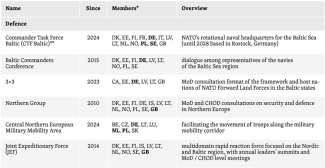
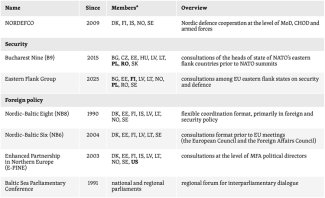
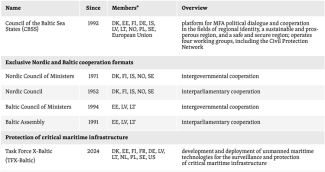
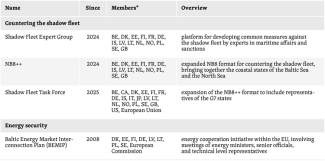
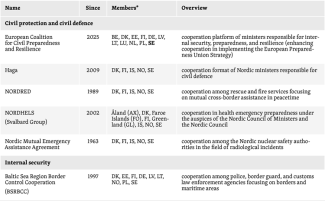
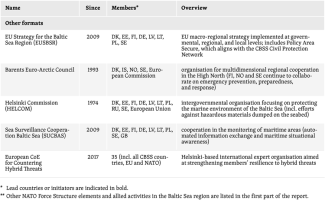
[1] Regional allied cooperation also includes the acquisition of military capabilities (although formally this is not a NATO process). Naval Mines Cooperation is a good example. In July 2024, a relevant letter of intent was signed, and in October 2025 the ministers of defence of Denmark, Estonia, Finland, Germany, Latvia, Lithuania, Norway, Poland and Sweden concluded a framework agreement setting out the principles for the joint procurement, logistics and maintenance of naval mine systems. Finland plays a leading role in the project and, together with Denmark, Germany, Lithuania and Norway, is preparing the implementing agreement.
[2] In its activities, it refers to the actions of the Price Cap Coalition on Russian oil and petroleum products under the auspices of the G7; Resolution A.1192(33) of the International Maritime Organization of December 2023; the Council of the Baltic Sea States Porvoo Declaration of June 2024; the ‘Call to Action’ on the shadow fleet issued by the European Political Community in July 2024; the joint statement of the Nordic–Ukraine Summit of October 2024; the activities of the NB8++ format; and the joint statement of the Helsinki Summit of Baltic Sea NATO Allies of January 2025.
[3] Established in 1993 as an intergovernmental organisation with a Secretariat in Kirkenes, it currently brings together four Nordic states (Denmark, Iceland, Norway and Sweden) and the European Commission. For three decades, the council served as a vehicle for multidimensional regional cooperation with Russia in the High North. It is a structure similar to the CBSS – with a presidency (lasting two years, currently held jointly by Norway and Sweden), sessions of the ministers of foreign affairs (every two years), the Committee of Senior Officials, and 12 working groups, including one dedicated to cooperation among rescue services. The Barents Regional Council also operates, with the participation of the northern regions of Finland, Norway and Sweden, as well as representatives of indigenous peoples. The Barents Euro-Arctic Council is today, to a certain extent, in a state of suspension. Contacts with Russia were halted in March 2022, and Russia withdrew from the council in September 2023. Finland announced its decision to withdraw in 2024, which entered into force at the end of 2025.