Europe’s diesel market under pressure: implications for Central Europe
Since the outbreak of war in the Persian Gulf, Europe has faced growing difficulties in its market for refined petroleum products. Although the Strait of Hormuz has been gradually reopening since the second half of September, allowing crude oil exports to increase, fuel production and exports from the region have not recovered at the same pace. War-related damage in the Middle East has further exacerbated the global shortage of spare refining capacity. Supply shortages have also been compounded by restrictions or bans on exports of certain fuels, including those imposed by Russia, where production infrastructure has suffered war-related damage, and China. The EU faces additional challenges as its own refining capacity has declined in recent years, partly due to the pursuit of climate policy objectives and economic difficulties.
In recent weeks, the most acute problems have concerned the market for middle distillates, particularly diesel. Diesel prices in the EU are now almost twice as high as at the beginning of the year, with little prospect of a significant decline. Moreover, Europe lacks both adequate buffers – such as spare domestic production capacity and substantial fuel stocks – to ease the pressure and a coherent, effective EU policy on liquid fuels. These problems also affect Central Europe, whose countries depend heavily on crude oil imports and, in some cases, on imports of diesel itself.
The G7 agreement of 2 October to release 100 million barrels from petroleum reserves, including substantial quantities of diesel on an urgent basis, could temporarily stabilise the market. However, unless the structural causes of the shortages – insufficient refining capacity and inadequate global fuel supply – are addressed, drawing down reserves will offer only temporary relief. It will merely postpone the need to address these challenges while generating additional demand in the future, partly due to the need to replenish stocks. In this scenario, EU member states, including those in Central Europe, could be forced to introduce measures to curb demand in the coming weeks or months.
The situation in the European market
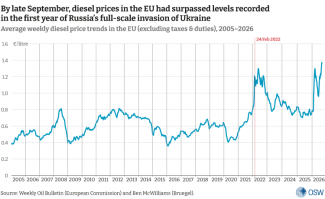
In the first months following the outbreak of the US–Iran war, the main challenges facing the EU oil market concerned the availability and price of jet fuel. Since August, however, problems in the diesel market have become increasingly acute. This is reflected in the rise in diesel prices, with the EU average surpassing levels recorded in 2022, the first year of Russia’s full-scale invasion of Ukraine. By late September, average prices were 82% higher than at the beginning of 2026.
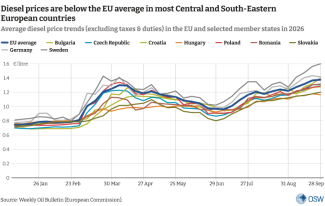
The highest average diesel prices in the EU (excluding taxes and duties) are recorded in the Nordic countries, particularly Sweden, as well as in the Netherlands and Germany. The situation is somewhat more favourable in Central and South-Eastern Europe, where prices in most countries remain below the EU average. Hungary and Slovakia have the lowest prices in the bloc, while Croatia is the only country in the region to exceed the EU average, albeit slightly. Nevertheless, the increases are placing considerable pressure on consumers, as fuel accounts for a larger share of household expenditure in Central Europe than in Western Europe.[1] Rising costs have become a major issue in public debate across the region, prompting governments to introduce measures to cushion their impact. Bulgaria has recorded the sharpest year-on-year increase in diesel prices in the region, at around 60%, while Hungary has seen the smallest rise, at 20%.
Although most EU countries have so far felt the effects of disruptions in the diesel market mainly through higher prices, some have also occasionally struggled to meet demand in full. In France, temporary shortages affected an estimated 10–15% of filling stations in the second half of September, primarily those operated by TotalEnergies, which had introduced a price cap.[2] Concerns over potential supply shortages have also been raised in Ireland and the UK, which is not an EU member, given both countries’ heavy dependence on imports. Similar risks have emerged in parts of Germany due to logistical difficulties caused by low water levels on the Rhine, a key waterway normally used for some fuel deliveries. These problems could intensify in the coming weeks as refineries worldwide enter their maintenance season, leading to temporary production shutdowns, and as demand traditionally rises in autumn, including in the agricultural sector.
Central and South-Eastern Europe has not yet experienced comparable disruptions, but the risk could grow if problems in global markets intensify. Seven countries in the region depend heavily on crude oil imports, with reliance on foreign supplies ranging from 78% in Romania to near-total or total dependence in the Czech Republic, Slovakia, Slovenia and Bulgaria. Some also rely on imports to meet domestic diesel demand. These include Slovenia, where the last refinery closed in 1998, and Hungary, where imports account for 74% of consumption, with deliveries from Slovakia within the MOL Group representing one-third of those imports. Although countries in the region meet, or are close to meeting, the requirement to maintain crude oil and petroleum product stocks sufficient to cover 90 days of average net imports,[3] this is an aggregate target that does not specify minimum stock levels for individual fuel types.
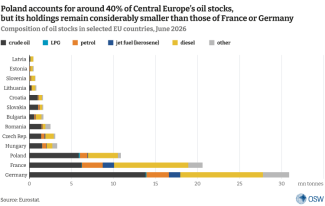
Oil reserves vary in composition across the region, with Poland and the Czech Republic holding the largest diesel stocks by volume. Some countries have already begun releasing reserves under the agreed arrangements, and others are likely to follow soon, reducing their buffers against potential disruptions. Combined with likely difficulties in securing imports, this makes fuel shortages a realistic possibility.
Factors behind the decline in diesel supply
The war in the Persian Gulf has severely disrupted regional and global markets for crude oil and refined petroleum products. Damage to production and refining facilities in the Middle East has reduced crude oil output and refining activity. Since late February 2026, partial or complete blockades, disruptions to transport infrastructure and heightened risks have also significantly curtailed exports along key routes, including through the Strait of Hormuz and the Red Sea.[4]
Despite the gradual reopening of export routes from the Middle East, facilitated by US escorts for tankers passing through the Strait of Hormuz and repairs to SaudiArabia’s East–West oil pipeline, exports of petroleum products from the region remain 40–50% below pre-war levels.[5] Persistent uncertainty, disruptions to transport and logistics networks and elevated risks in the Gulf are also keeping crude oil prices high. Monthly Brent crude futures contracts, for example, were trading at prices 40–45% higher at the end of September than in February 2026.[6]
Global market conditions have deteriorated further due to damage to Russia’s oil sector, including its refining infrastructure, and Moscow’s ban on diesel exports introduced in August 2026. The crisis is affecting countries worldwide, prompting a growing number of governments to impose restrictions. China,[7] Thailand, Kazakhstan and India are among those that have introduced temporary bans or taxes on fuel exports. These measures are further constraining global supplies and pushing up prices. In the second half of September, wholesale diesel prices at the Amsterdam–Rotterdam–Antwerp (ARA) hub were more than double their pre-war levels.[8] In Singapore, they were almost 100% higher, while prices for ultra-low-sulphur diesel (ULSD) on the US Gulf Coast had risen by around 77%.[9]
The complexities of Europe’s dependence on imports
Europe’s refining capacity has been shrinking amid the ongoing energy transition, climate policy requirements and rising operating costs. Since 2009, around 30 of the continent’s 100 refineries have closed, while total processing capacity has fallen by approximately 21%.[10] This has reduced Europe’s ability to increase fuel production in response to market pressures. At the same time, replacing Russian crude oil with different grades sourced from elsewhere has altered both the economics of EU refining and the mix of refined products. This shift has favoured lighter fuels at the expense of middle distillates, particularly jet fuel and diesel. Yet diesel accounts for the largest share of petroleum product consumption in the EU, at over 40%.
Nevertheless, the EU as a whole remains a net exporter of petrol, while its refineries can meet around 90–95% of domestic diesel demand. However, imports exceed the gap between consumption and domestic production. In the first half of 2026, diesel imports from outside the bloc were equivalent to around 18% of EU consumption. As the EU has moved away from Russian petroleum products, partly due to sanctions, suppliers from the Middle East and the US have gained importance. In the first half of 2026, Persian Gulf countries accounted for around 40% of the EU’s diesel imports from non-EU countries, with Saudi Arabia alone supplying more than a third. The US was the second-largest supplier during this period.
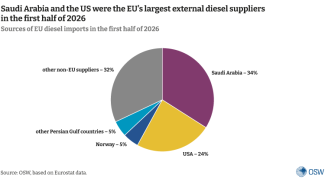
In September 2026, further damage to oil infrastructure in the Persian Gulf, including Saudi Arabia’s East–West pipeline, refineries and fuel storage facilities, led to a drop of more than 40% in Saudi diesel shipments to Europe compared with the previous month. Meanwhile, deliveries from the US rose sharply and, according to media reports, accounted for as much as half of European diesel imports.[11] The Netherlands, Ireland and the UK were reportedly the most reliant on US supplies.
Disruptions to crude oil shipments from the Persian Gulf are also affecting oil and fuel markets in Central and South-Eastern Europe. Saudi crude is processed mainly at Orlen Group refineries in Poland, the Czech Republic and Lithuania, as well as at MOL’s refinery in Slovakia. Other major sources of crude include Russia (for Slovakia and Hungary), Kazakhstan (for Romania and Bulgaria) and Azerbaijan (for the Czech Republic and Croatia). Slovakia and Hungary also face the challenge of the EU’s planned phase-out of Russian crude by the end of 2027, a move strongly opposed by the government in Bratislava. Other countries in the region have ended their dependence on Russian crude in recent years. Croatia has even banned its transit through the country’s infrastructure. However, indirect reliance on Russia persists in some cases. Romania, for example, imports some diesel refined from Russian crude in Turkey or India.
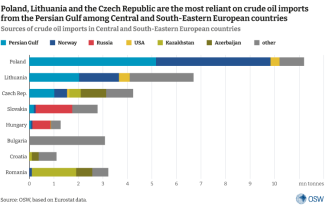
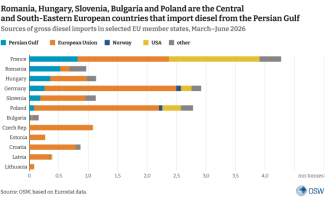
With the exception of Slovenia, countries in the region have retained substantial refining capacity, with scope for further expansion. Capacity increases are already under way in some cases, including Croatia. Slovakia is a net exporter of diesel, supplying around a third of Hungary’s imports and meeting approximately a quarter of its total demand for the fuel. At the same time, Bulgaria, Poland, Romania, Slovenia and Hungary all imported diesel from the Persian Gulf in the first half of 2026, primarily from Saudi Arabia. Between March and June, these deliveries accounted for around 70% of Hungary’s diesel imports from outside the EU, 65% of Romania’s and 52% of Slovenia’s.
Responses and measures taken
Disruptions in fuel markets, including rising prices for diesel, petrol and other fuels, are affecting public sentiment and weighing on EU economies. Their impact is particularly acute as they coincide with further increases in electricity and gas prices, which have long been among the most contentious and sensitive issues in energy policy debates in Brussels and national capitals. The strongest reactions so far have been in France, where fuel shortages have already emerged. Motorists have cut back on fuel purchases and car use, while incidents of vandalism, including damage to filling stations, have also been reported. Some stations in Corsica have closed, and the prospect of protests similar to the 2018 ‘yellow vest’ movement, sparked by an increase in fuel taxes, has also been raised. In response, the French government has announced plans to increase financial support for motorists.[12] The effects of the diesel market crisis have also been evident in Italy, where some transport companies have scaled back operations and industry representatives have threatened nationwide strikes. ENI was the first to introduce price caps at filling stations, followed by Socar and Q8.
Sharp rises in fuel prices pose a major political challenge for governments across Central and South-Eastern Europe. In some countries, the pressure to introduce measures to cushion their impact is compounded by the need to reduce budget deficits. Keeping the cost of living down has been a key pledge made to voters by the governments in Prague, Bratislava and Budapest. Yet Romania, Hungary, Slovakia and Bulgaria are all subject to the EU’s excessive deficit procedure. Slovakia and Bulgaria are also members of the eurozone, exposing them to the risk of direct financial sanctions if they persistently fail to comply with the relevant recommendations.
Measures to ease the burden of higher prices therefore generally reflect a compromise between voter expectations and fiscal constraints, with concerns about rising inflation also playing a role. Common responses include caps on retail fuel prices and margins, reductions in excise duty on diesel and targeted assistance for farmers. Hungary, Romania, Bulgaria and Croatia have all introduced various forms of support for the agricultural sector. Meanwhile, countries across the region are implementing or planning investments to strengthen their resilience in the near future. The Czech Republic is expected to significantly expand its crude oil and fuel storage capacity in 2027, while Slovakia plans to complete work to adapt its Bratislava refinery to process non-Russian crude that year. Bulgaria aims to increase diesel production to cover all domestic demand, while Croatia is expected to produce 30% more diesel in 2026 than in the previous year.
Some governments are also seeking to raise additional revenue to offset the costs of measures aimed at cushioning the impact of higher prices. Romania has introduced a windfall profits tax on the fuel sector, while the Czech government has submitted a similar proposal to parliament. Hungary already has such a levy in place until 2027, and the option is also under discussion in Slovakia.
Meanwhile, despite repeated calls, including from Central European countries, the European Commission has yet to introduce or oversee any broader short-term measures that could meaningfully reduce the scale and impact of the crisis in the EU. The main response has been the release of strategic oil reserves by member countries of the International Energy Agency (IEA), including EU member states, which began in March 2026. Although the IEA oversees the process, individual national governments retain the authority to make binding decisions on the volume and pace of releases. The Commission plays a secondary role, focusing on coordinating national efforts and facilitating information-sharing within the EU.
The Oil Coordination Group and, more recently, the Energy Union Task Force – Security have also been holding regular meetings in response to the severity of the crisis. However, beyond reassuring statements, their efforts have yet to yield tangible results. In particular, the seven months since the outbreak of the crisis in the Middle East appear not to have been used to develop a contingency plan or introduce concrete measures. This likely reflects, above all, the EU’s limited experience and lack of effective policy instruments in the oil and fuel sector. Meanwhile, European countries seeking closer coordination and joint solutions are holding consultations at various levels.
The Commission, for its part, is pursuing longer-term structural measures, primarily aimed at accelerating electrification and the energy transition in sectors such as transport, as proposed in the EU’s AccelerateEU plan of April 2026.[13] This stands in sharp contrast to the approach of most member states, which have so far concentrated on shielding consumers from rising diesel prices. At the same time, there has been a marked increase in the share of electric and hybrid vehicles in the EU during the first eight months of 2026.[14] This market trend is likely to have eased the impact of the current fuel market disruptions on some European consumers.
Uncertain outlook
The ongoing conflict in the Middle East and persistent strains on the global diesel market are also causing problems elsewhere, including rising prices at filling stations in the US. This is fuelling public discontent and poses a particular challenge ahead of the US midterm elections. Against this backdrop, media reports have suggested in recent weeks that Washington may impose a temporary ban on diesel exports. According to reports published on 1 October, the US administration urged EU countries to release diesel from their reserves to avert an embargo. The appeal was reportedly directed primarily at France and Germany, which hold the largest fuel stocks, and reflected the slower pace of reserve releases in Europe than in the US and Asian countries under the coordinated action by IEA members that began in March.[15]
At an emergency meeting of G7 leaders convened by the French president on 2 October, the countries agreed to release 100 million barrels from reserves over the following four months, including substantial volumes of diesel within the first 20 days. They also agreed to coordinate seasonal refinery maintenance across the G7 to avoid simultaneous shutdowns affecting an excessive proportion of refining capacity, and pledged to refrain from imposing export restrictions on energy commodities and fuels. Most of the diesel brought onto the market under the agreement is likely to come from European reserves. On the same day, Donald Trump withdrew his threat to ban US diesel exports. The agreement and additional releases of stored fuel are expected to ease price pressures temporarily. The mere prospect of such measures prompted a fall in fuel prices on commodity exchanges on 2 October, although prices rebounded a few days later.
However, it remains unclear how the agreement will be implemented and the release of oil reserves carried out. The IEA has clarified that the latest G7 arrangements do not entail additional commitments beyond those agreed in March but merely specify how they will be implemented. There are also suggestions that diesel releases from European reserves will not only be temporary but will also amount to no more than half of Russia’s diesel exports to global markets last year. This indicates that they will be insufficient to cover most of the supply shortfall.
Moreover, these releases will not address the main underlying causes of the current shortages. Apart from Russia’s export ban, these include substantially reduced fuel exports from the Middle East and temporary export restrictions imposed by numerous countries, including China. Unless these constraints are eased on a lasting basis or additional sources of supply emerge, such as a significant increase in exports from Indian refineries, markets for diesel and other petroleum products could remain under pressure in the coming months. The situation is likely to be exacerbated by the seasonal increase in winter demand, compounded this year by the need to replenish strategic and commercial reserves.
Europe is therefore highly likely to pursue several measures simultaneously to mitigate the impact of market disruptions, including efforts to maximise fuel production on the continent. This would probably require relaxing EU fuel-quality standards, an option already suggested by French President Emmanuel Macron, which could allow refineries to increase output to some extent. Adjusting the production mix in favour of diesel is another possibility, although this could come at the expense of jet fuel, another important middle distillate. However, such measures would probably not be sufficient to fully offset the shortfall in imports, making steps to curb demand potentially necessary. It remains unclear whether and how these efforts would be coordinated, whether all member states would adopt similar measures given their differing consumption levels, domestic production capacities and reserves, and to what extent the European Commission would be involved in managing the process.
Finally, if market pressures persist, calls to increase imports of Russian crude oil and possibly diesel could gain wider support across the EU. In Central Europe, Bratislava has been the most vocal advocate of such a move, and Budapest also supports this position in practice. A further potential vulnerability stems from the reliance of many EU countries, including those in Central Europe, on Kazakh crude oil. Its main supply route passes through Russia and could be disrupted by the ongoing war.
[1] Study on energy prices and costs – evaluating impacts on households and industry’s costs – 2024 edition. Final report, European Commission, Trinomics, 20 September 2024, enerdata.net.
[2] A. Woodward, ‘France runs short of diesel as Europe faces fuel supply warning’, Euro Weekly News, 22 September 2026, euroweeklynews.com.
[3] Data as of July 2026. Comparable figures for all countries in the region and the EU are unavailable for subsequent months. See Emergency oil stocks in days equivalent – monthly data, Eurostat, updated 5 October 2026, ec.europa.eu.
[4] For more information see A. Łoskot-Strachota, ‘Further disruption to Middle Eastern oil supplies’, OSW, 17 September 2026, osw.waw.pl.
[5] Oil Market Report – September 2026, IEA, 11 September 2026, iea.org.
[6] Brent Crude Futures, ICE, ice.com.
[7] ‘VIEW Chinese refiners suspend October fuel exports, sources say’, Reuters, 1 October 2026, reuters.com.
[8] C. Carpenter, ‘Middle East diesel exports to Europe head for six-year low in September’, S&P Global Energy, 21 September 2026, spglobal.com.
[9] A. Hernandez, C. Castillo, ‘Global diesel disruptions ripple through US refining, biofuel markets’, S&P Global Energy, 21 September 2026, spglobal.com.
[10] See Statistical Report 2026, FuelsEurope, 2026, fuelseurope.eu.
[11] L. Pazderkova, ‘Trump’s midterm fears put Europe’s diesel reserves in firing line’, EU Perspectives, 1 October 2026, euperspectives.eu.
[12] D. Cosnard, ‘French government doubles aid to drivers to head off fuel price crisis’, Le Monde, 23 September 2026, lemonde.fr.
[13] See A. Łoskot-Strachota, ‘The war in the Gulf and the challenges facing EU energy policy’, OSW Commentary, no. 728, 7 May 2026, osw.waw.pl.
[14] ‘New car registrations: +5.3% in August 2026 year-to-date; battery-electric 21.7% market share’, ACEA, 24 September 2026, acea.auto.
[15] IEA member countries are required to maintain stocks of crude oil and/or petroleum products equivalent to at least 90 days of average imports or 61 days of consumption, while EU countries generally maintain larger fuel reserves.