North Sea ports: caught in a stagnation trap
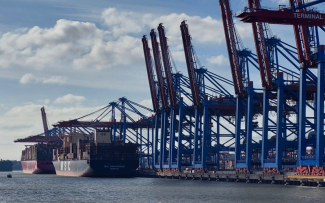
For more than half a century, Rotterdam, Antwerp and Hamburg have remained Europe’s largest seaports. In recent years, however, their growth has slowed considerably, while cargo throughput has remained virtually unchanged. Although they are still crucial to the European economy, ports in the Mediterranean, Adriatic and Baltic are steadily emerging as serious competitors. Their rapid development, combined with structural changes in global trade, is gradually bringing to an end the era in which cargo flows were concentrated in the continent’s three largest ports. The numerous geopolitical tensions and disruptions to global logistics in recent years, together with the stagnation of the European economy, have adversely affected the performance of Rotterdam, Antwerp and Hamburg. At the same time, these ports are also facing growing structural constraints. In response to the risk of declining cargo volumes, they are developing into energy hubs and seeking to build a competitive advantage on this basis.
European leaders outside the global top tier
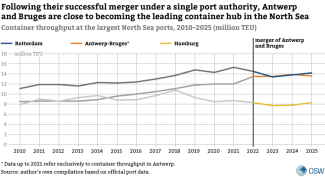
For many years, the North Sea ports have remained the largest in Europe, both in terms of container throughput, which underpins modern international trade, and total cargo throughput (measured in tonnes). Together, Rotterdam, Antwerp-Bruges,[1] and Hamburg handled more than 36 million TEU,[2] in 2025 (14.2 million TEU, 13.6 million TEU and 8.3 million TEU respectively), accounting for more than half of the combined throughput of the continent’s ten largest ports. Although Rotterdam remains Europe’s leading port, its heyday lasted from the 1960s to the early 2000s, when it ranked first in the world. It was subsequently overtaken by Singapore and Chinese ports as Asian economies expanded rapidly, and now ranks outside the world’s ten largest ports.
In previous decades, the North Sea ports reached high levels of capacity, so their subsequent growth naturally slowed. In recent years, however, Antwerp and Bruges have strengthened their position following their successful merger under a single port authority, ending competition between them. Over the past two years, their container throughput has at times even exceeded that of Rotterdam. Hamburg, by contrast, has stagnated for years due to past underinvestment and growing pressure from its main rivals, as well as from Polish ports. Over the past year, however, its container throughput has increased (+7.3% year on year), driven by congestion,[3] at other ports, including Rotterdam, and changes made by shipping lines to their service networks.
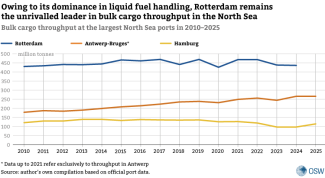
Rotterdam, however, remains the undisputed European leader in total cargo throughput, measured in tonnes. In 2025, it handled 428.4 million tonnes of cargo,[4] while second-placed Antwerp-Bruges handled 266 million tonnes.[5] The next two positions were held by Russian ports: Novorossiysk (168 million tonnes) and Ust-Luga (130 million tonnes). Hamburg ranked fifth (114.8 million tonnes), followed closely by Gdańsk (80.4 million tonnes). Rotterdam’s dominant position is underpinned by its handling of liquid fuels (197 million tonnes), primarily crude oil (100 million tonnes). Antwerp, in turn, is Europe’s largest port specialising in chemicals and perishable goods (such as fruit and vegetables), while Bruges is the leading port for vehicle handling. The latter is home to one of the world’s largest LNG terminals, which has operated since 1987 and is of key importance to the Belgian economy and those of other countries in the region. Hamburg does not enjoy a dominant advantage over its competitors in any cargo category, with container handling for the domestic and Central European markets being of greatest importance to the port.
What continues to underpin the strength of the North Sea ports?
The advantage enjoyed by the North Sea ports over other European ports rests on their favourable geographical location and well-developed, integrated logistics network, which enable them to serve the EU’s largest economies. They also have extensive port infrastructure comprising numerous terminals for containers, dry and liquid bulk cargo, LNG and vehicles. They offer a wide range of ocean, feeder and short-sea services. Rotterdam provides more than 500 shipping services a week, connecting it with over 1,000 ports worldwide. This represents a significant advantage over its competitors, as customers using the port have a wider choice of convenient connections and often benefit from faster cargo transport. Rotterdam is also Europe’s largest transhipment port.[6] Transhipment accounts for more than 30% of the port’s total cargo throughput.[7] Consequently, many shipping lines regard Rotterdam as their main European hub. Antwerp-Bruges collectively handles more than 300 services a week, connecting it with 800 ports. Antwerp specialises in handling ocean-going vessels, while Bruges focuses on short-sea connections, mainly with the United Kingdom. By comparison, Hamburg handles more than 100 services a week.
The competitive advantage of the ports of Rotterdam and, to a lesser extent, Antwerp-Bruges also stems from favourable hydrographic conditions, which allow them to accommodate the world’s largest container ships (with a capacity of 24,000 TEU). Although Antwerp lies approximately 80 km from the sea, its access channel is regularly dredged in cooperation with the Dutch authorities, as it partly runs through Dutch waters. Hamburg, which faces similar geographical constraints, has struggled to finance the dredging of both the navigation channel along the Elbe to the North Sea and the Kiel Canal, which shortens the route to the Baltic Sea. This prevents it from accommodating the largest vessels.
In recent years, however, these ports have developed into energy hubs where both conventional marine fuels and alternative fuels, such as ammonia, methanol and hydrogen, are produced. They also have extensive bunkering infrastructure,[8], which, among other factors, helps ensure their inclusion in the service rotations of the largest shipping lines. Rotterdam is Europe’s largest bunkering port and the second largest in the world, behind Singapore. Each year, it supplies ships with approximately 9.5 million tonnes of bunker fuel. Antwerp-Bruges, in turn, is the second-largest bunkering port in Europe and the fifth-largest globally. Approximately 6 million tonnes of conventional fuels are bunkered there annually.[9]
Rotterdam, Antwerp-Bruges and Hamburg also have the most developed onshore power supply (OPS) infrastructure for ships in Europe. Until recently, this was a niche solution, but under EU requirements, container and passenger terminals will be required to provide it from 2030. Such infrastructure is costly to build, meaning that ports in EU countries that do not yet have it may be less competitive than the North Sea ports.
Another significant advantage over other European ports is their extensive know-how and the consultancy services they provide through subsidiaries to terminals both at home and around the world. Hamburg Port Consulting (HPC), established in 1976, has completed more than 1,800 projects in 130 countries, including Kenya, Lebanon, India and the United States. Port of Antwerp-Bruges International, a company established in 2010, provides consultancy services and also invests abroad. It holds stakes in the ports of Duqm in Oman, Açu in Brazil and San Pedro Manutention in Côte d’Ivoire, and has managed the Port of Cotonou on behalf of the government of Benin since 2018. Rotterdam undertakes similar activities, providing advice on, among other things, the construction of ports and terminals, the implementation of digital solutions and measures to support the energy transition, mainly in Africa, South America and Asia. It also holds stakes in the ports of Sohar in Oman and Pecém in Brazil.
The competitive advantage of Rotterdam, Antwerp-Bruges and Hamburg is also reflected in their advanced digital Port Community Systems (PCS), which have yet to become standard across Europe. These systems streamline information flows and port operations. They are used by port authorities, terminal operators, shipping lines, freight forwarders, rail and road carriers, customs and tax authorities, border inspection services and customs agencies.
Hubs for the largest shipping lines
The world’s largest shipping lines have made the North Sea ports their hubs, helping them retain their leading position in container throughput. Carriers prefer to call at ports where they hold stakes, thereby maximising their profits. They regard capital investment in container terminals as a means of strengthening their position in the shipping sector. By acquiring stakes in terminals not only in Europe but around the world, and by taking over companies in the transport, freight forwarding and logistics (TFL) sector, they are seeking to control the entire logistics chain.
Map. The world’s leading shipping lines have a presence at the largest container terminals in the North Sea ports
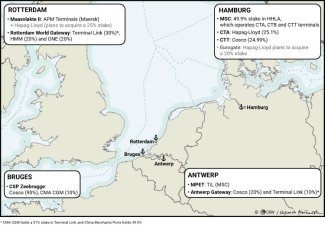
Antwerp, Rotterdam and Hamburg have adopted different strategies for developing their container terminals. Antwerp focuses on a single shipping line – the Swiss-Italian MSC, the world’s largest – and serves as its main European hub. Together with Singapore-based PSA,[10] (a leading global port operator and, among other investments, a shareholder in the Baltic Hub in Gdańsk), MSC’s subsidiary Terminal Investment Limited (TiL) operates the largest container terminal on the continent – the MSC PSA European Terminal (MPET). Another major terminal at the port is Antwerp Gateway, operated by the UAE-based DP World together with the French shipping line CMA CGM (the world’s third largest) and China’s COSCO (the fourth largest).
Rotterdam stands out for its diversified terminal operator structure. Almost all of the market’s largest players have a presence at the port. Denmark’s Maersk, the world’s second-largest shipping line, has its main European hub there. Through its subsidiary APM Terminals, it owns 100% of the Maasvlakte II terminal. In August this year, the German shipping line Hapag-Lloyd, the world’s fifth largest, which cooperates with Maersk as part of the Gemini Cooperation,[11] announced plans to acquire a 25% stake in the terminal.[12] The terminal is currently being expanded, which is expected to more than double its capacity to 5.4 million TEU annually and make it one of the most advanced in the world. Rotterdam World Gateway is currently regarded as one of the world’s most advanced terminals. It is operated by shipping lines including France’s CMA CGM (the main competitor to MSC and Maersk), South Korea’s HMM and Japan’s ONE, as well as DP World.
In Hamburg, meanwhile, the German logistics operator Hamburger Hafen und Logistik AG (HHLA) has dominated for many years. It operates three terminals at the port (CTA, CTB and CTT)[13] and its majority shareholder is the Free and Hanseatic City of Hamburg. In the early 2000s, Hapag-Lloyd, which has strong ties to Hamburg, acquired a 25.1% stake in CTA. However, amid stagnating cargo throughput, the port began looking for other shipping lines that could drive its growth. In 2023, COSCO acquired a 24.99% stake in the CTT (Tollerort) terminal.[14] The German port also attracted the interest of shipping line MSC, which acquired a 49.9% stake in HHLA in 2024, while the city retained the remaining 50.1%.[15] As part of the transaction, MSC had to guarantee that it would provide HHLA’s terminals with throughput of at least 1 million TEU from 2031. One of the main reasons for MSC’s investment in HHLA was that the German company owns Metrans, the largest intermodal operator in Central Europe. MSC sought to strengthen its position in this sector, as none of its competitors has a comparable carrier in its portfolio, and to integrate the entire logistics chain in this part of Europe.
Recently, shipping lines have shown growing interest in acquiring stakes in terminals in Hamburg, where none of them holds a majority stake. In November 2025, CMA CGM announced its intention to invest in the Eurogate terminal.[16] The transaction ultimately did not go ahead, and in June this year Hapag-Lloyd announced plans to acquire a 20% stake in the terminal.[17] Recent growth in container throughput in Hamburg has been concentrated mainly at Eurogate, where some shipping lines shifted their operations after MSC acquired a stake in HHLA. Interest in the terminal has also increased due to plans to build a new terminal as part of the ‘Eurogate Western Expansion 2030–2035’ project.
Beijing’s growing interest in the North Sea ports
What Rotterdam, Antwerp-Bruges and Hamburg have in common is the increasingly visible presence of Chinese capital in recent years, through investments by the shipping line COSCO, China Merchants Group (a Chinese state-owned conglomerate operating in sectors including transport, logistics and ports) and Hong Kong-based port operator Hutchison Ports. All three companies have invested in Rotterdam and Antwerp. COSCO has also invested in Hamburg and, since 2017, has had a presence at Bruges’ only container terminal (CSP Zeebrugge).[18]
The growing Chinese presence in these ports poses a risk of further deepening the European Union’s strategic dependence on China.[19] The associated risks include economic espionage, competition with other terminals for cargo volumes, particularly amid growing imports from Asia, and the strengthening of Chinese companies’ position in the TFL sector at the expense of European firms. There are also direct security concerns. Ports constitute critical infrastructure and play an important role in military mobility. China remains a strategic partner of Russia, raising questions about infrastructure security and the protection of data processed at these ports.
The proposed sale of CK Hutchison’s stakes in 43 terminals worldwide, including 14 in Europe, to the US-Swiss-Italian BlackRock–TiL consortium could have provided an opportunity to reduce the presence of Chinese capital in European ports. The transaction, announced in March 2025, has yet to be completed. It resulted from pressure by President Donald Trump to curb China’s influence in ports, particularly around the Panama Canal.[20] China opposed the transaction, proposing instead that COSCO become the majority shareholder. The acquisition of the terminals by BlackRock–TiL would not only deprive China of control over strategic terminals in various parts of the world, but would also strengthen the shipping line MSC, which, through TiL, would become the world’s largest port operator.
Rivals in the contested hinterland
For Rotterdam and Antwerp-Bruges, the most important markets, apart from the Benelux countries, are France and Germany. For Rotterdam, the nearby German state of North Rhine-Westphalia is particularly important. The United Kingdom also plays a key role for the Belgian ports. In recent years, Brexit has been one of their greatest challenges, prompting them to develop plans to diversify the markets they serve.
Hamburg, by contrast, predominantly serves the domestic market (approximately 4.2 million TEU in 2024).[21] Rotterdam’s estimated throughput for the German market stands at 1.7 million TEU, compared with 1.3 million TEU for Antwerp. Central European markets are not particularly important for either port, although regular intermodal services connect them with terminals in Austria, the Czech Republic, Poland and Slovakia. For Hamburg, by contrast, these markets are of key importance. It remains the largest port serving the Czech market (approximately 379,000 TEU handled in 2024).
In its new strategy, the Antwerp-Bruges port is focusing on expanding its presence in the German, French and Austrian markets. It also has high hopes for the launch of new intermodal connections to south-western Poland and the Czech Republic. This is primarily aimed at capturing export cargo bound for the United Kingdom that is currently transported by road. These efforts may be facilitated by the influence MSC exerts over Metrans through HHLA. Since October 2025, Metrans has been authorised to operate rail freight services in Belgium, enabling Antwerp to serve Central European markets on a broader scale.
To expand their presence in the so-called contested hinterland (markets for which ports compete), Rotterdam, Antwerp-Bruges and Hamburg have appointed representatives responsible for attracting customers and developing commercial relations with local logistics operators and cargo owners. Rotterdam has offices in Germany, Austria, Switzerland and China. Antwerp-Bruges has a presence in markets including the United States, France, Germany, Poland, the Czech Republic and Slovakia, as well as India, China and Japan. Hamburg, meanwhile, has representative offices in countries including China and the UAE and, in Central Europe, in Poland, the Czech Republic, Hungary and Austria.
Intermodal transport: the key to success
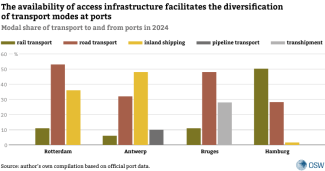
The success of the North Sea ports is also underpinned by efficient cargo transport, made possible by an extensive network of regular intermodal connections.[22] Rotterdam offers more than 400 international rail services to and from the port each week and provides competitive transit times: cargo can reach the German border within three hours and many other destinations in Europe within 24 hours. This is also made possible by an extensive network of intermodal terminals in the Netherlands, Belgium and Germany, particularly around Duisburg and Cologne. Rotterdam also benefits from the dedicated Betuweroute railway line, in operation since 2007, which is used exclusively for freight transport and connects the port with the German border.
The geographical location of these ports is another advantage, making it possible to deliver goods for the same customer to different European markets, a capability used by global companies. However, Rotterdam and Antwerp-Bruges regard inadequate rail infrastructure on the German side as their most serious bottleneck. Germany has little incentive to modernise it, as the current situation favours Hamburg. This is hampering Rotterdam’s and Antwerp-Bruges’ plans to expand into Central and Eastern European markets. The situation may change once the modernisation of 40 rail corridors is completed, which is scheduled for 2036.[23] These investments are to cover only sections along the north–south axis (including routes from Bremerhaven and Hamburg towards Hanover and onwards to Frankfurt am Main) and the north-west–south-east axis (from the Ruhr and Rhineland towards Hesse and Bavaria), which could improve rail freight connections from Rotterdam and Antwerp to southern Germany.
Hamburg, however, remains the European leader in rail freight with more than 200 freight trains operating there every day. Although official figures indicate that more than 90% of cargo between the port and the Czech Republic, Austria and Hungary is transported by rail, these data most likely predate the modernisation works that have caused numerous delays to rail services. Nevertheless, Hamburg retains a strong position in this area thanks to Metrans, which provides regular intermodal connections from the port to destinations across Germany and to its terminals in Central Europe. Its most frequent service is between Hamburg and Prague, with more than 40 pairs of trains (in both directions) per week, helping the port retain its leading position in the Czech market. The share of rail freight in Rotterdam and Antwerp-Bruges remains relatively low. In addition to problems with German infrastructure, this is also due to the highly developed inland waterway network. However, water levels on the German section of the Rhine have recently fallen, which could adversely affect freight transport from the Dutch port over the longer term. A relatively large volume of cargo is also transported by lorry to and from nearby intermodal terminals.
Outlook
The North Sea ports face numerous structural constraints and challenges. Their cargo throughput has remained broadly unchanged for years and is no longer growing as rapidly as that of other European ports in the top ten. This is due, among other factors, to shifts in global trade, geopolitical tensions and crises, such as the COVID-19 pandemic and the Red Sea crisis, which have weakened their position and led to temporary declines in throughput. These developments have clearly demonstrated the extent of their dependence on their main trading partners, the United States and China, the state of the EU’s relations with these countries, and the performance of the European economy. For years, the ports have also faced labour shortages and frequent strikes that have disrupted terminal operations. At the same time, other European ports have actively expanded their infrastructure in recent years and are becoming increasingly serious competitors to the North Sea ports. The latter currently have limited scope to expand their hinterland, partly because of delayed investment in rail infrastructure, particularly in Germany. At the same time, they have become dependent on shipping lines which, by investing in their terminals, provide them with stable cargo volumes but can also play the ports off against one another to maximise their profits. Consequently, Rotterdam, Antwerp-Bruges and Hamburg compete largely for the same markets, with limited opportunities to expand into new ones. This may reinforce the trend towards increasing transhipment volumes.
What continues to distinguish them from other European ports are their highly digitalised port management systems, which significantly accelerate cargo handling, as well as customs, tax and border control systems that are competitive with those in other countries, allowing goods to be cleared relatively quickly and delivered to their final recipients. There is, however, another side to this: these systems are perceived as less rigorous in their inspection of goods entering the EU market from third countries. Consequently, some importers choose these ports to avoid lengthier inspections or even the risk of their goods being denied access to the EU market. The ports are also regarded as the main gateways into Europe for South American drug cartels.[24] In the coming years, unless the ownership structure of container terminals at these ports changes, the presence of Chinese operators may also pose a growing risk to the security of terminals and supply chains.
One of the challenges, shared by other European ports, is the energy transition. The use of renewable fuels in shipping may create market opportunities but also carries the risk of overinvestment and wasted financial resources. Although Rotterdam and Antwerp are at the forefront of developments in this area, unsuccessful projects could adversely affect their future operations.
It will take other European ports a long time to catch up with Rotterdam, Antwerp-Bruges and Hamburg, given the investments made there by shipping lines, their extensive networks of shipping services and logistics chains, as well as their access infrastructure, despite delays in investment. At the same time, there is little prospect of rapid growth at the North Sea ports.
[1] The two ports merged in 2022.
[2] A unit of cargo capacity equivalent to one 20-foot container.
[3] Port congestion causing delays in cargo handling.
[4] ‘Throughput in the port of Rotterdam shows a slight decline’, Port of Rotterdam, 26 February 2026, portofrotterdam.com.
[5] ‘Port of Antwerp-Bruges ends 2025 with resilience’, Port of Antwerp-Bruges, 27 January 2026, portofantwerpbruges.com.
[6] Transhipment is the transfer of cargo from one vessel to another without the goods leaving the port by land.
[7] ‘Between growth and pressure: Rotterdam’s 2025 container year under review’, Port of Rotterdam, 10 March 2026, portofrotterdam.com.
[8] The process of refuelling ships.
[9] ‘Antwerp-Bruges’ LNG bunker sales hit record highs in 2025’, Engine Online, 13 February 2026, engine.online.
[10] PSA also independently operates two other container terminals at the port: PSA Antwerp Europa Terminal and PSA Antwerp Noordzee Terminal.
[11] Gemini Cooperation is a partnership between Maersk and Hapag-Lloyd, launched on 1 February 2025.
[12] ‘APM Terminals and Hapag-Lloyd partner to drive future growth at Maasvlakte’, Hapag-Lloyd, 19 August 2026, hapag-lloyd.com.
[13] HHLA also operates terminals at the ports of Tallinn, Trieste and Odesa.
[14] ‘Inwestycja COSCO w terminal w Hamburgu sfinalizowana’, Gospodarka Morska, 20 June 2023, gospodarkamorska.pl.
[15] ‘MSC Acquires Minority Stake in HHLA’, MSC, 27 November 2024, msc.com.
[16] ‘CMA CGM to acquire a 20% stake in Eurogate Hamburg terminal’, CMA CGM, 12 November 2025, cmacgm-group.com.
[17] ‘Hanseatic Global Terminals plans to acquire 20% stake in Eurogate Container Terminal Hamburg’, Hapag-Lloyd, 29 June 2026, hapag-lloyd.com.
[18] ‘COSCO Shipping Ports extends contract with Port of Zeebrugge’, Container News, 27 January 2022, container-news.com.
[19] K. Popławski, ‘Turning the tide: the US pushes back against Chinese influence in European ports’, OSW Commentary, no. 651, 17 March 2025, osw.waw.pl.
[20] See S. Baniak-Stachowiak, ‘A major reshuffle in ports: China sells its terminals to the US’, OSW, 11 March 2025, osw.waw.pl.
[21] Figures compiled by the Institute of Shipping Economics and Logistics (ISL) for 2024.
[22] The transport of goods using different modes of transport (e.g. rail, ship and lorry) while retaining the same loading unit (e.g. a container, semi-trailer or swap body). Rail transport plays a key role in this field.
[23] R. Connor, T. Jones, ‘Germany updates: Railroad operator seeks modernization delay’, Deutsche Welle, 7 October 2025, dw.com.
[24] See ‘Criminal Networks in EU Ports: Risks and challenges for Law Enforcement – Focus on the misappropriation of container reference codes in the ports of Antwerp, Hamburg and Rotterdam’, Europol, 25 November 2025, europol.europa.eu.