The East–West transport axis: between Georgia’s dominance and Armenia’s ambitions
Amid the war in Ukraine and instability in the Middle East, the South Caucasus is gaining importance as a transit region linking Europe and Asia. This is particularly true of Georgia, which serves as the central hub of the Middle Corridor, owing to regional political conditions and existing infrastructure. In the longer term, however, this situation may change. On the one hand, Tbilisi’s rapprochement with Russia and the deterioration of Georgia–EU relations could undermine the political and investment stability of the Georgian section of the route. On the other hand, the ongoing normalisation of Armenia’s relations with Azerbaijan and Turkey has created conditions conducive to the development of new transit links running through Armenia, although this remains dependent both on political developments in the region and on the outcome of the Armenian parliamentary elections scheduled for this June.
The Eurasian Silk Road
The Trans-Caspian International Transport Route (TITR), also known as the Middle Corridor, connects China and Central Asia with the South Caucasus, Turkey, and Europe, providing an alternative to the Northern Corridor running through Russia (see Map 1). Its importance has increased since 2022 as a result of Russia’s invasion of Ukraine, which has heightened demand for alternative trade routes. The corridor has become particularly important for the Central Asian states, which are seeking to reduce their transport dependence on Russia (see: ‘A safer alternative: growing interest in the Middle Corridor in Central Asia’).
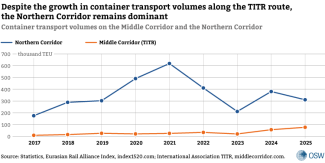
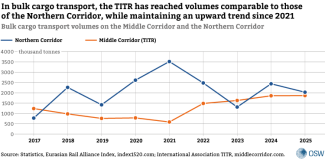
Although the importance of the TITR is growing, it remains significantly less developed than the Northern Corridor, particularly in the container transport sector. While the volume of goods transported via this route through Russia fell from 410,500 TEU in 2022 to 310,600 TEU in 2025, it still handles around four times more container traffic than the TITR (see Chart 1). However, the gap is considerably smaller when measured by weight, particularly in the case of raw materials and bulk cargoes (see Chart 2). This indicates that, since the start of Russia’s invasion of Ukraine, the growing importance of the TITR has primarily concerned the transport of lower value-added goods and, to a lesser extent, container shipments, which usually involve higher-value goods.
Despite its growing capacity, the route continues to face transport constraints, stemming from factors such as the need for multiple cargo transshipments, insufficient transport infrastructure capacity – particularly across the Caspian Sea, the Bosporus and Black Sea ports – and the lack of full standardisation of customs and logistics procedures among the countries of the region.
The South Caucasus within the Middle Corridor
In the South Caucasus, the current route of the TITR follows the Azerbaijan–Georgia–Turkey/Black Sea axis (see Map 2). Azerbaijan serves as the main entry point for goods arriving from the Caspian Sea: it links Central Asia – via maritime routes across the Caspian – with Georgia through the port of Alat and the country’s rail and road infrastructure. Azerbaijan has spent years developing this potential by integrating its port, rail and logistics infrastructure into an integrated transport system.
The onward transit of goods from Azerbaijan takes place through the territory of Georgia, whose importance has increased in recent years as its transport infrastructure has expanded. A key project was the Baku–Tbilisi–Kars (BTK) railway, linking Azerbaijan, Georgia and Turkey. In 2024, the modernisation of its Georgian section was completed, increasing the annual capacity of the entire route from 1 million tonnes to 5 million tonnes. The growing importance of this route is also evident in container transport: in the first half of 2025, the BTK carried 9,400 TEU, compared with just 200 TEU a year earlier. Georgia’s rail network is complemented by the Black Sea ports of Poti and Batumi, as well as by the east–west road corridor being developed with EU support, including the East–West Highway. The European Investment Bank (EIB) has invested a total of nearly €1 billion in Georgia’s road infrastructure, approximately €250 million of which has been allocated to developing this corridor.
At present, Armenia is not a transit country within the Caucasus section of the TITR. Its transport infrastructure remains less developed than that of the neighbouring countries, partly due to the closure of its borders with Azerbaijan and Turkey. Nevertheless, the EU has pledged financial support under the Resilience and Growth Plan for Armenia, which allocates €270 million for 2024–27, including funding for the development of transport infrastructure.
Georgia as a problematic hub
Alongside Azerbaijan, Georgia is a transit state on the Caucasus section of the TITR without which the corridor would be unable to function. In the future, however, the main challenge may lie not in the operational viability of the trade routes running through Georgia, but in Tbilisi’s political unpredictability. This stems from the country’s growing authoritarianism and the resulting deterioration in its relations with the EU. These factors undermine the long-standing assumption that Georgia remains a stable political partner in the region, while also weakening the trust of Turkey and Azerbaijan in Georgia as a transit partner. As a result, Georgia’s attractiveness as a destination for further infrastructure investment may decline.
The EU’s position may also prove significant, as it has been an important source of funding for the development of Georgia’s transport infrastructure, notably through the EIB. In the future, Georgia’s continued drift away from the West could make it more difficult to secure funding for new infrastructure projects, while also increasing the EU’s willingness to use financial assistance as a means of exerting pressure on the government in Tbilisi. This may not undermine Georgia’s current role within the TITR, but in the longer term it could slow the modernisation of the routes running through the country, thereby reducing transport efficiency along the corridor.
The shifting political landscape in Tbilisi could also affect the strategic calculations of Turkey and Azerbaijan. Both countries have an interest in maintaining an efficient east–west land connection, which may encourage them to reduce their dependence on the Georgian section of the corridor. In such a scenario, demand for unblocking routes through Armenia could grow. At present, these do not constitute a viable alternative to the existing route running through Georgia, but they may be viewed in Ankara – and potentially also in Baku – as a means of diversifying transit routes in the region.
The Armenian alternative
The growing importance of Armenia as an alternative transit route in the South Caucasus stems from two main factors. First, the country’s role in the regional transport landscape increased after the Second Nagorno-Karabakh War in 2020, when it began moving away from its previous model of economic cooperation with Russia in favour of normalising relations with neighbouring countries and diversifying its economic ties. This shift has created a new dynamic in the South Caucasus and increased the likelihood of normalisation with Azerbaijan and Turkey. Second, Armenia is now positioning itself as a potential linchpin of the regional transport network by promoting projects aimed at developing routes running through its territory.
Central to this approach is Armenia’s Crossroads of Peace (CoP) project, which aims to develop and unblock regional transport links across the country. These efforts are complemented by the TRIPP (Trump Route for International Peace and Prosperity) initiative, which envisages the creation of a transport corridor in southern Armenia linking Azerbaijan with its exclave of Nakhchivan. At the same time, Armenia has been modernising selected elements of its border infrastructure, including the Margara border crossing on the Turkish border, which is largely prepared for opening from a technical perspective. Implementing these initiatives could reshape the regional transport landscape, particularly in the road transport sector, potentially reducing Georgia’s importance while increasing the capacity of the TITR.
However, Armenia’s transport projects remain dependent on the opening of the country’s borders with Azerbaijan and Turkey. So far, neither the TRIPP nor the CoP has progressed beyond the conceptual phase. For logistics operators, concrete investments – such as the modernisation of roads and railways – as well as legal arrangements, including the establishment of durable and conflict-resilient mechanisms for transit operations, will be of key importance. Armenia’s parliamentary elections scheduled for this June could also pose a serious challenge. Should Prime Minister Nikol Pashinyan lose the upcoming vote, projects such as the CoP and the TRIPP could lose momentum or even be abandoned, particularly if relations with Azerbaijan deteriorate.
War as a driver of development?
Recent tensions in the Middle East, triggered by the confrontation between Israel and the United States on one side and Iran on the other, are shaping the debate on the need to further develop the TITR. The importance of trade routes linking Asia and Europe – as well as alternatives to land routes running through Iran and Russia – is once again increasing, thereby enhancing the role of the South Caucasus as an operational logistics hub and potentially supporting the further development of the TITR.
In the short term, the current configuration of transport routes in the South Caucasus is unlikely to change significantly, with the route through Azerbaijan and Georgia remaining the primary corridor for the movement of goods. In the longer term, however, should Armenia make further progress in normalising its relations with Azerbaijan and Turkey and succeed in opening its borders, the country’s infrastructure could begin to gain importance as a complement to the existing network, provided that this process results in concrete investments. Efforts to modernise Armenian infrastructure would receive financial support from the EU, notably under the Global Gateway programme, which envisages investments in Armenia totalling approximately €2.5 billion, including in connectivity and transport infrastructure. This means that, should the political situation in the region improve, Armenia could gain access to substantial funding for the development of transport routes.
Map 1. Land transport corridors between Europe and China
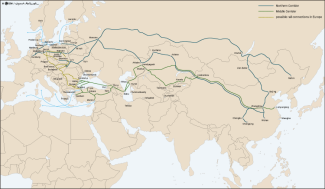
Source: the author’s own compilation.
Map 2. Transport routes in the South Caucasus
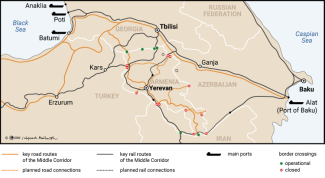
Source: the author’s own compilation.