Anything is possible: AfD sets its sights on power in Saxony-Anhalt
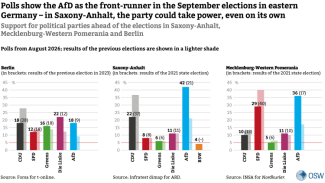
The elections scheduled for 6 September in Saxony-Anhalt will be crucial for Germany’s political system. For the first time in the history of the Federal Republic of Germany, the Alternative for Germany (AfD) has a real chance of taking power in one of the country’s federal states. An AfD-led government would enable the party to implement parts of its far-reaching programme, appoint its candidates to positions in the state administration and expand its institutional base ahead of the 2029 Bundestag elections. The party leads the polls both nationwide, with around 30% support, and in Saxony-Anhalt, where it is polling above 40%. Its support cuts across social, occupational and age groups.
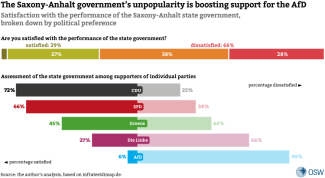
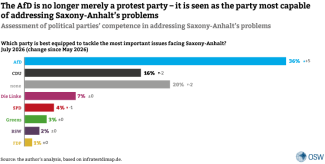
The AfD’s success is primarily due to its strong and lasting local roots, its appeal to East German identity and its highly effective online communication. The party also benefits from a growing perception among voters that it is particularly competent on political and economic issues, as well as from dissatisfaction with the policies of the federal government and its constituent parties. Only 13% of respondents view Chancellor Friedrich Merz’s government positively. The AfD’s strength in eastern Germany also demonstrates the failure of the strategy pursued by other parties and the media to isolate it. Attempts to keep the party isolated will become increasingly difficult. In practice, either post-election scenario in Saxony-Anhalt – the formation of the first AfD government with an outright majority or a minority coalition centred on the CDU – would strengthen the AfD ahead of the next Bundestag elections.
The AfD: a party for everyone
The September elections in Germany’s three eastern states will be the country’s most important political event this year. In Saxony-Anhalt and Mecklenburg-Western Pomerania (MVP), with elections scheduled for 6 and 20 September respectively, the campaigns are dominated by migration policy, access to public services in rural areas and the deteriorating economic situation. In Berlin, where elections will also take place on 20 September, the campaign focuses on housing availability, internal security and economic conditions.
Public sentiment across these states shares several features: dissatisfaction with both state and federal governments and a widespread belief that the AfD is highly competent to govern. The party is seen as offering better solutions than its rivals on migration, energy and climate policy as well as foreign affairs. The prospect of improved relations with Russia is particularly important to people in eastern Germany.[1] AfD politicians also dominate social media, helping the party reach the youngest voters.[2] Politicians from Merz’s governing CDU/CSU–SPD coalition have remained largely on the sidelines of the campaigns in all three states. At the state level, the coalition parties are widely blamed for the prevailing negative mood among voters.
In Saxony-Anhalt – a small, largely rural state with a population of two million and no major industrial or academic centres – the factors behind the AfD’s electoral success in eastern Germany are particularly evident. The party owes its success to its activists’ long-standing local roots and its emphasis on East German identity.[3] In the region, the AfD is a mass-membership party whose political agenda appeals to all social, age and occupational groups.[4] Its members often include people holding positions of public trust. At the same time, other parties have steadily lost voters because they lack charismatic leaders, their local structures are weak and their senior politicians have long avoided visiting smaller towns. This trend is compounded by deteriorating access to public services, which the demographic crisis is exacerbating.[5]
Against this backdrop, the AfD’s main campaign slogan, ‘Anything is possible’, signals its readiness to take power and form its first state government without coalition partners. For this scenario to materialise, the party would need to win more than 45% of the vote. AfD politicians argue that only a result above this threshold would enable the party to implement its ambitious and far-reaching election programme (see Appendix and the section Saxony-Anhalt: a model for Germany).
The salesman and the architect: campaign roles
The AfD’s success in Saxony-Anhalt would not have been possible without its charismatic 35-year-old regional leader, Ulrich Siegmund. He is co-chair of the AfD parliamentary group in the Saxony-Anhalt state parliament and has built political support by presenting himself as a representative of the local community. In the eyes of many voters, his cheerful manner and communication skills make him appear more like an accomplished salesman than a radical politician. Yet he leads a party monitored by the State Office for the Protection of the Constitution (LfV), which classifies the AfD as a far-right extremist organisation whose activities are directed against the democratic constitutional order (gesichert rechtsextremistische Bestrebung).[6] Siegmund began his political career as a local CDU politician. He joined the AfD in 2014 amid opposition to Berlin’s efforts to bail out indebted countries during the eurozone crisis.
Siegmund primarily seeks to mobilise undecided and younger voters without alienating other groups. His messaging is generally positive and relies on broad statements (‘We want a safe, free Germany, like it used to be’) rather than firm commitments. One of the most recognisable features of his current campaign has been a series of popular rides by enthusiasts of Simson motorcycles, an iconic brand from the East German era, combined with demonstrations of support for the AfD.
If the AfD secures an absolute majority, Siegmund could become the minister-president of Saxony-Anhalt. However, given his lack of experience, the people in his inner circle who exert the greatest influence over him would play a crucial role. These include Patrick Harr, the AfD parliamentary group’s press spokesman and Siegmund’s right-hand man, and Laurens Nothdurft, the group’s legal adviser and Siegmund’s personal lawyer. Both previously served in the leadership of Heimattreue Deutsche Jugend (HDJ), a neo-Nazi organisation that advocated revising Germany’s borders and was banned in 2009.[7]
Hans-Thomas Tillschneider plays a key role in the campaign. He drafted the party’s election programme and is regarded as one of the AfD’s leading ideologues. Born in Romania and raised in Baden-Württemberg, he has only lived in eastern Germany since 2020. He holds a doctorate and a habilitation (a postdoctoral academic qualification) in Islamic studies. In the AfD parliamentary group in Saxony-Anhalt, he is responsible for education and culture, and he serves as deputy leader of the party’s state organisation. Tillschneider belongs to the AfD’s radical wing centred on Björn Höcke, the party’s leader in Thuringia.[8]
There is speculation that Tillschneider could head a combined ministry overseeing policy areas central to the AfD’s planned overhaul of identity policy. For example, in the party’s state election programme, he has proposed making public funding for arts and culture conditional on recipients declaring their commitment to ‘the state, democracy and German culture’.[9]
Tillschneider makes no secret of his fascination with Prussia.[10] He is also one of the AfD’s most pro-Russian politicians. He visited Russia in September 2022, six months after the country launched its full-scale invasion of Ukraine. He abandoned plans to travel to the occupied Donbas only after pressure from the party leadership. In columns for the Moscow daily Vedomosti, he praised Putin for bringing stability to Russia.
Post-election scenarios
If the AfD secures an absolute majority in the Saxony-Anhalt Landtag, forming Germany’s first AfD-led state government, headed by Siegmund, should be relatively straightforward. All parliamentary groups can nominate candidates for state minister-president. Without an absolute majority, however, the AfD would need to seek support from outside its own parliamentary group. So far, only the BSW, Sahra Wagenknecht’s party, has signalled that it might cooperate with the AfD. This would not involve a formal coalition but rather support for an AfD minority government.
Another realistic scenario would see a CDU minister-president remain in office at the head of a minority government. Similar arrangements are already in place in Saxony, which has a CDU–SPD minority government, and Thuringia, which is governed by the CDU, SPD and BSW. In both states, the governments rely on support from Die Linke. A formal CDU–Die Linke coalition is ruled out by an internal CDU resolution adopted in 2018, which prohibits cooperation with both Die Linke and the AfD.
If the AfD fails to win an absolute majority, incumbent minister-president Sven Schulze (CDU) is expected to delay the transfer of power. The state constitution allows for this following a 2020 reform, as it sets no deadline for appointing a new government. The removal of the requirement to swear in a cabinet within 14 days of the new state parliament convening was part of preparations for the possibility of the AfD taking power (see below for more on such changes).
Saxony-Anhalt: a model for Germany
The influence of the AfD’s Saxony-Anhalt organisation within the party extends far beyond what its membership figures alone would suggest. It has around 3,500 members, up 35% year on year, compared with 73,000 across Germany. Its importance stems primarily from the AfD’s higher level of support in Saxony-Anhalt than in any other German state and its realistic prospect of taking power there.[11] At the same time, the AfD’s organisation in Saxony-Anhalt is regarded as one of the party’s most ideologically radical. It is dominated by figures associated with the former Flügel, a faction that brought together party radicals and was formally dissolved in 2020.
Saxony-Anhalt is also home to one of the most important intellectual centres of the so-called New Right (Neue Rechte).[12] The Antaios publishing house, run by Götz Kubitschek, one of the movement’s leading figures, is based in Schnellroda. It provides an important intellectual base for the AfD’s radical wing. This makes the party’s state election programme particularly significant. Compared with its programmes in Berlin and Mecklenburg-Western Pomerania, it sets out the most far-reaching plans to reshape the existing system across Germany. The party assumes that successfully implementing some of these proposals in Saxony-Anhalt could set a precedent and facilitate their subsequent adoption in other states or at the federal level.
The party’s vision rests on three main pillars: identity, internal security and institutional reform.[13] Economic and social policy are lower priorities (see Appendix). A significant share of its proposals would require changes to federal legislation and, in some cases, EU law, making them impossible to implement quickly. At the same time, the AfD is seeking to manage expectations by stressing that many of its proposals would require the party to remain in power for more than one term. It presents its programme as a long-term vision for the state’s development.
The central element of the programme is a package of reforms covering public media, education and culture. Measures in these areas could be implemented relatively quickly without seriously straining the state budget. They are also important to a large section of the party’s electorate. Among other measures, the AfD proposes terminating agreements on the funding of public media, separating refugees and German pupils into different school classes and promoting a positive portrayal of Prussia in culture and education.
As far as internal security is concerned, the party advocates a radical tightening of migration policy. Its proposals include a deportation drive, ending integration courses for refugees, increasing capacity at detention centres for people awaiting deportation and launching a Bundesrat initiative to maintain and strengthen border controls. The tougher migration policy would also apply to Ukrainians living in Germany. The AfD wants to restrict benefits for this group and argues that Ukraine has ‘large safe areas’ to which refugees should return. At the same time, the party wants to restore Russian lessons in schools and resume regular pupil exchanges with Russian educational institutions.
The programme also calls for an overhaul of state-level institutions, arguing that some of them have become politicised and act against the AfD. Its proposals include abolishing the State Office for the Protection of the Constitution (LfV), restricting postal voting and strengthening direct democracy through online petitions and opportunities for residents to address the Landtag. In the area of judicial reform, the AfD proposes replacing the current system, under which the ministry is responsible for judicial appointments, with a selection commission on which judges would hold a majority. It also calls for amendments to the criminal code, the decriminalisation of certain forms of speech and a lower age of criminal responsibility. However, the programme does not propose changing the composition of the State Constitutional Court or removing serving judges.
A training ground for future leaders
Personnel is as important to the AfD’s strategy as its political programme, as the party has so far lacked enough qualified staff. In preparation for a possible election victory, it established the Black-Red-Gold Academy, named after the colours of the German flag. Based in Berlin, the Academy has been operating since April 2025. Participants are trained in areas such as public administration management, speechwriting, media relations and preparing local government budgets. Its graduates are expected eventually to take up key positions in the administration. According to internal party estimates, the AfD would need around 150 trusted officials to ensure a smooth transition to power in Saxony-Anhalt[14].
Alongside the Academy, the AfD’s federal headquarters is developing a strategy for governing. Within a group called ‘Regierungsbeteiligung’, party lawyers are examining potential legislative obstacles to implementing its plans, including in the area of migration policy. They are also considering possible disputes with the federal administration and other states, including over cooperation between security services and information-sharing. Austria’s FPÖ (Freiheitliche Partei Österreichs – Freedom Party of Austria) is also helping the AfD prepare specific measures. In January, an AfD delegation led by Siegmund met FPÖ representatives in Salzburg. The talks focused on the FPÖ’s experience of governing, coalition negotiations, staff training and implementing its programme in the face of resistance from the administration. The FPÖ’s experience plays a particularly important role in these preparations because its ideological profile is similar to that of the AfD. It is also one of the few European parties of this kind with experience in government, including at the federal level in Austria in 2000–03 and 2017–19.
A ‘soft ban’ rather than a cordon sanitaire
The realistic prospect of the AfD taking power has revived the debate over banning the party at the federal level. Politicians remain divided on the issue, with differences cutting across party lines, and a ban is unlikely in the near future.[15] Efforts to contain the AfD have therefore focused on two other strategies. The first seeks to limit the party’s ability to operate institutionally and politically. The second aims to strengthen the resilience of state institutions in the event of the AfD taking power at the state level.
The reforms adopted by the Saxony-Anhalt state parliament in Magdeburg in April 2026 are a prime example of the latter strategy.[16] The package, known as the 2026 parliamentary reform (Parlamentsreform 2026), amended the state constitution, the Landtag rules of procedure and several laws. It strengthened the independence of the State Constitutional Court, including by enshrining the rules for electing judges in the constitution rather than, as previously, in ordinary legislation. It also changed the procedure for electing the president of the state parliament. If the candidate put forward by the largest parliamentary group fails to secure a majority, other groups can nominate their own candidates. The package also guaranteed by law the continued operation of the State Agency for Civic Education (Landeszentrale für politische Bildung) and restricted the government’s ability to terminate agreements between Germany’s federal states unilaterally, including those concerning public media. Other public institutions, as well as civil society and educational organisations, are taking similar measures.
The cordon sanitaire (Brandmauer) was intended to be the most effective political means of keeping the AfD out of power. It rules out any formal cooperation between the AfD and other parties. However, the strategy has failed to halt the party’s rise in support, particularly in eastern Germany. In 2023, Robert Sesselmann became the first AfD district administrator, in Sonneberg district in Thuringia, while Hannes Loth became the party’s first town mayor, in Raguhn-Jeßnitz in Saxony-Anhalt. Despite formal bans – including the CDU’s ban on cooperation with the AfD, in place since 2018 – and informal pressure from politicians in Berlin, cooperation between the AfD and other parties has taken place on numerous occasions.[17] Critics of the cordon sanitaire argue that it began to erode early on, with cooperation occurring particularly at lower levels of government. At the same time, much of the public does not understand either these arguments or the rationale behind the Brandmauer. In Mecklenburg-Western Pomerania, around 60% of respondents consider cooperation with the AfD acceptable.[18] In practice, this works to the AfD’s advantage.
With the Brandmauer strategy failing, an increasingly common approach has been to prevent AfD politicians from standing for executive posts in local elections. Candidates require approval from the local electoral committee, usually chaired by the mayor, which assesses whether they ‘guarantee loyalty to the free democratic basic order’.[19] Since 2025, this mechanism has been applied to several individuals, including in Rhineland-Palatinate, North Rhine-Westphalia and Lower Saxony. It had previously been used against more than a dozen politicians from the neo-Nazi NPD. Courts upheld the exclusion of NPD candidates, while some cases involving AfD politicians are still pending. Critics argue that broader use of this mechanism could amount to a de facto ban on a legal party contesting elections, particularly because a full judicial review takes place only many months after the vote.[20]
The limits of federalism
The AfD’s participation in government would require new forms of cooperation between federal and state institutions, as well as among the states themselves, which have so far taken many decisions by consensus. Scenarios currently under discussion include far-reaching proposals such as restricting some financial transfers to AfD-governed states. Saxony-Anhalt finances one-fifth of its budget through the Finanzkraftausgleich, Germany’s system of fiscal equalisation between the states. Another proposal is to lower the electoral threshold to 3%. This would fragment Germany’s political landscape but make it more difficult for the AfD to secure an outright majority.
Article 37 of Germany’s Constitution provides a theoretical mechanism for federal intervention in a state through the Bundeszwang procedure. With the consent of a majority in the Bundesrat, the federal government can compel a state to fulfil its obligations under federal law. Possible measures include issuing instructions, having federal authorities perform the state’s obligations on its behalf, appointing a federal commissioner and, in extreme cases, temporarily assuming specific powers. These measures cannot, however, extend to dissolving the state parliament or removing the state government.
A more direct instrument is the so-called federal intervention provided for under Article 91(2) of the Constitution. In the event of a specific threat to the existence of the state or the free democratic basic order, the federal government may act if the state authorities are unwilling or unable to do so. Without their consent or prior approval from the Bundesrat, it can place the state police under its orders and deploy the Federal Police. The decision must be taken collectively by the federal government. The Bundesrat can at any time require the federal government, by majority vote, to end the intervention.[21] Like with Article 91(2), this provision has never been invoked, and its use currently appears unlikely.
Every scenario strengthens the AfD
An AfD government in Saxony-Anhalt would deepen the already pronounced social polarisation in Germany. Mass protests across the country and even unrest could not be ruled out. At the same time, if a significant share of voters viewed the AfD’s performance in government positively, the party could secure further electoral victories, particularly in eastern Germany. This would further entrench what are effectively two distinct political systems in eastern and western Germany. Over time, this could also influence decisions about where people choose to live and work and where businesses invest in the two parts of the country. This could include migration from AfD-governed states to western states governed by the CDU, SPD or Greens.
At the federal level, an AfD victory in Saxony-Anhalt would increase pressure on the CDU/CSU–SPD coalition. Merz’s priority is already to keep the coalition together and ensure its survival until the 2029 elections. To achieve this, he will seek to implement social and economic reforms quickly, hoping that economic conditions will improve.[22] This would help ease tensions both between the coalition partners and within the parties themselves.
The debate over which is the lesser evil for the CDU – cooperation with Die Linke or with the AfD – will become an increasingly serious source of conflict among the Christian Democrats. Paradoxically, a relatively narrow AfD victory could create a major problem for the CDU if it forced the party to work with Die Linke in forming a minority government. This would reinforce the AfD’s argument that the Christian Democrats have abandoned their conservative profile and are clinging to power, even at the cost of circumventing their own restrictions on cooperation with the left. It would also strengthen the AfD’s claim that it alone can guarantee conservative policies and that voting for the CDU ultimately helps bring the left to power. The AfD would make this narrative a central theme of its campaign ahead of the next federal elections. It could also avoid having to defend its record in state government. Given the party’s shortage of experienced personnel and Saxony-Anhalt’s difficult financial situation, avoiding such scrutiny would benefit the AfD.
The consequences of a possible AfD victory in Saxony-Anhalt would extend beyond Germany. For its international partners, this would mean dealing with an even more inward-looking Germany, increasingly focused on domestic issues. At the same time, an AfD-governed federal entity could be expected to pursue an active foreign policy, for example by developing contacts with Russia. This could complicate the coordination of Germany’s foreign and security policy, as well as the implementation of some NATO logistical operations and intelligence-sharing. Saxony-Anhalt’s location in central Germany makes it crucial in this respect.
Appendix. Key elements of the AfD’s programme in Saxony-Anhalt
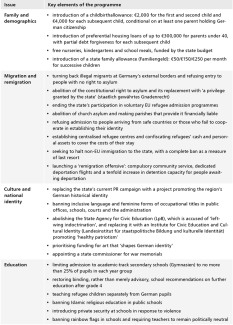
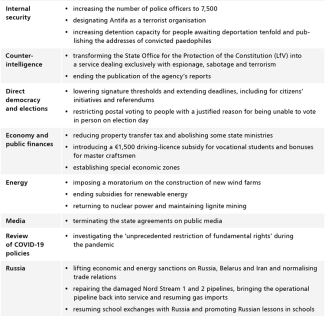
Source: the author’s analysis based on Regierungsprogramm der AfD Sachsen-Anhalt 2026.
[1] See K. Frymark, Too green, too fast, too dear. The AfD is gaining popularity in Germany, OSW Commentary, no. 518, 20 June 2023, osw.waw.pl.
[2] Ulrich Siegmund has 433,000 followers on Facebook, 524,000 on Instagram and 763,700 on TikTok, as well as 145,000 YouTube subscribers. By comparison, incumbent state minister-president Sven Schulze of the CDU has just 5,600 followers on Facebook and 11,100 on Instagram. Moreover, he has no comparable presence on TikTok or YouTube.
[3] The AfD has emphasised the importance of East German identity since its inception. See K. Frymark, Alternatywa dla wschodnich Niemiec. Saksonia i Brandenburgia przed wyborami landowymi, OSW Commentary, no. 307, 28 August 2019, osw.waw.pl.
[4] Volkspartei (partia masowa), Leksykon Niemiecki, OSW, osw.waw.pl and K. Frymark, Fear of change. The social costs of the Zeitenwende, [in:] A. Kwiatkowska (ed.), Making up for lost time. Germany in the era of the Zeitenwende, OSW, Warsaw 2023, osw.waw.pl.
[5] Between 1990 and 2024, the population of eastern Germany, excluding Berlin, fell by 16%, from around 15 million to 12.4 million. Saxony-Anhalt recorded the largest decline, at 26%. Over the same period, the population of western Germany grew by 10%. See K. Frymark, A republic of seniors. Germany's demographic challenges, OSW Commentary, no. 663, 25 April 2025, osw.waw.pl.
[6] At the federal level, the AfD remains classified as a suspected extremist organisation(Verdachtsfall). On 26 February 2026, the Cologne Administrative Court temporarily barred the BfV from classifying, treating or monitoring the party as a confirmed far-right extremist organisation (gesichert rechtsextremistische Bestrebung) pending a ruling in the main proceedings.
[7] A. Geisler, F. Hillebrand, P. Maxwill, Rechts, extrem, freundlich, Der Spiegel, no. 34, 14 August 2026; Senatsverwaltung für Inneres Berlin, Verfassungsschutzbericht 2005, Berlin 2006, p. 233, pardok.parlament-berlin.de
[8] For more on B. Höcke’s views and political profile, see A. Kwiatkowska, M. Cichocki, Jakie będą Niemcy pod władzą AfD?, Niemcy w ruinie?, 25 June 2026, youtube.com and K. Frymark, A. Kwiatkowska, AfD w marszu po władzę? Partia po ważnym zjeździe, an OSW podcast, 6 July 2026, youtube.com
[9] AfD parliamentary group motion, Recognition of the state, democracy and German culture as a condition for state funding of culture, Parliamentary Paper No. 8/7118, Saxony-Anhalt Landtag, 16 June 2026, landtag.sachsen-anhalt.de.
[10] N. Giwerzew, F. Adler, Der Mann, der die «patriotische Wende» einleiten will: zu Besuch beim AfD-Vordenker Hans-Thomas Tillschneider, Neue Zürcher Zeitung, 17 August 2026, nzz.ch.
[11] The AfD has a highly uneven regional structure. Its three largest western state organisations – in North Rhine-Westphalia, Bavaria and Baden-Württemberg – account for around 43% of the party’s membership, compared with around 24% in the five eastern states. Despite their smaller membership base, however, the AfD’s eastern state organisations wield disproportionate influence within the party. Their influence derives from the AfD’s much stronger electoral performance in eastern Germany, its deeper roots in local communities there and the leading role that eastern German politicians and party structures play in shaping its political agenda. See Parteimitglieder in Deutschland: Version 2025, Berlin 2025, fu-berlin.de.
[12] The term ‘New Right’ (Neue Rechte) refers to an intellectual and political current whose proponents seek to bring about a long-term shift in public debate and political culture. Its defining features include drawing upon the ideas of the so-called Conservative Revolution of the Weimar Republic, criticism of liberal universalism, an emphasis on national identity and an ethnocultural understanding of community. See B. Fischer, Was die Neue Rechte ist – und was nicht, Federal Agency for Civic Education, Bonn 2019, bpb.de.
[13] Das Land zuerst. Regierungsprogramm der AfD Sachsen-Anhalt zur Landtagswahl 2026, Magdeburg 2026, afd-lsa.de.
[14] F. Klemenz, Strategie und Personal: Wie sich die AfD aufs Regieren vorbereitet, Table Media, 29 June 2026, table.media.de.
[15] See K. Frymark, A general rehearsal: strategies to contain the AfD, OSW Commentary, no. 598, 27 May 2024, osw.waw.pl.
[16] Motion by the CDU, Die Linke, SPD, FDP and Greens parliamentary groups: Parliamentary Reform Bill 2026, Parliamentary Paper No. 8/6871, Saxony-Anhalt Landtag, 20 April 2026, landtag.sachsen-anhalt.de.
[17] Between 2019 and 2024, the AfD cooperated with other parties on hundreds of local resolutions across the five eastern German states, with the largest share occurring in Saxony-Anhalt (27%). See W. Schroeder, D. Ziblatt, F. Bochert, Brandmauer – is still alive! Empirische Ergebnisse zur Unterstützung der AfD in den ostdeutschen Kommunen durch etablierte Parteien (2019–2024), Wissenschaftszentrum Berlin für Sozialforschung, September 2024, pp. 13–15, wzb.eu.
[18] Mecklenburg-VorpommernTREND Juli 2026, Infratest dimap, July 2026, infratest-dimap.de.
[19] Article 53(3) of the Rhineland-Palatinate Municipal Code (Gemeindeordnung Rheinland-Pfalz), which was applied to AfD politicians in 2025, stipulates that a candidate must ‘guarantee that they will at all times uphold the free democratic basic order within the meaning of the Basic Law’. See Ausschluss von AfD-Kandidaten im Spannungsverhältnis zwischen Wahlrecht und Verfassungstreue, Wissenschaftlicher Dienst des Landtags Rheinland-Pfalz, 18 September 2025, landtag-rlp.de.
[20] R. Breyton, U. Exner, „Was hier passiert, ist ein Entzug des passiven Wahlrechts durch die Hintertür“, Die Welt, 22 July 2026, welt.de.
[21] Voraussetzungen und Grenzen von Bundeszwang und Bundesintervention, WD 3 – 3000 – 101/25, Wissenschaftliche Dienste des Deutschen Bundestages, Berlin, 13 January 2026, bundestag.de.
[22] K. Frymark, A. Kozaczyńska, Waiting for reforms: the future of the German welfare state, OSW Commentary, no. 737, 15 June 2026, osw.waw.pl.