Germany: AfD scores landslide victory in Saxony-Anhalt
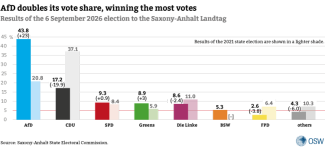
The AfD won the parliamentary election in Saxony-Anhalt on 6 September, securing 43.8% of the vote – 23 percentage points more than in 2021. This gave the party 39 seats in the 83-seat Landtag. The CDU, which had previously led the state government, won just 17.2% (down 19.9 pp) and 15 seats. Its coalition partner, the SPD, came third with 9.3% (up 0.9 pp), securing eight seats. The Greens also secured eight seats with 8.9% (up 3 pp), while Die Linke won the same number with 8.6% (down 2.4 pp). The Sahra Wagenknecht Alliance (BSW) entered the Landtag with 5.3% of the vote and five seats. The FDP, another member of the outgoing governing coalition, failed to clear the electoral threshold. Turnout reached 77.8% (up 17.5 pp from 2021), the highest level recorded in the state since 1989.
The result will not alter the balance of power in the Bundesrat, where Saxony-Anhalt holds four of the 69 votes. The state constitution sets no specific deadline for electing a new minister-president. If the process reaches a third round of voting, a simple majority will suffice. The new Landtag must convene by 6 October at the latest (see Anything is possible: AfD sets its sights on power in Saxony-Anhalt).
The AfD leadership will seek to form a government, most likely with the support of the BSW, the only party to have declared before the election that it was willing to cooperate with the AfD. Following its crushing defeat, the CDU will focus on maintaining the stability of the federal government, particularly as it faces the prospect of further electoral setbacks. The next test will come in Mecklenburg-Western Pomerania on 20 September, where the AfD leads the polls, followed by Berlin.
Commentary
- The AfD achieved the best result in its history but fell short of an absolute majority. Unless it can attract MPs from other parties, including the CDU – which it intends to try to do – it will need a partner to govern. The BSW is the only party willing to cooperate with the AfD. Wagenknecht’s party has ruled out a formal coalition, instead favouring support for a minority government on specific legislative initiatives. The two parties share common ground on a range of issues, particularly cooperation with Russia, tighter migration policy and institutional changes in the state, including the abolition of regional counter-intelligence structures and reforms to public-service media. Their main differences concern economic policy – the BSW has a strong social-policy profile – and education, including their approaches to history. Unlike the AfD, the BSW is not a revisionist party (see An alternative alliance).
- The AfD owes its success primarily to the popularity of its charismatic lead candidate, disappointment with the CDU government and a widespread desire for change. Ulrich Siegmund, the AfD’s candidate for minister-president, ran a highly active and personalised campaign that also won over undecided voters. Some 37% of respondents viewed his performance positively, compared with 30% for Minister-President Sven Schulze. The AfD also mobilised 170,000 previous non-voters – more than any other party – and gained 82,000 votes from the CDU. The party doubled its vote share from the previous election partly by significantly broadening its electorate, including in large university cities, where it had previously struggled to attract support. Perceptions of the AfD’s ability to govern also played an important role: 35% of respondents considered it the party best equipped to tackle the state’s most pressing problems, up from 9% in 2021. Support for the AfD was higher among men than women (51% compared with 40%) and peaked at around 52% among voters aged 35–59. The party performed particularly strongly among blue-collar workers, winning 61% of the vote in this group. By comparison, the SPD, traditionally associated with working-class voters, received just 6%.
- The CDU’s defeat reflects deep dissatisfaction with Chancellor Friedrich Merz’s government, voter fatigue after 24 years of uninterrupted CDU rule in Saxony-Anhalt and mistakes made during the election campaign. Despite a The CDU’s defeat reflects deep dissatisfaction with Chancellor Friedrich Merz’s government, voter fatigue after 24 years of uninterrupted CDU rule in Saxony-Anhalt and mistakes made during the election campaign. Despite efforts to keep state and federal politics separate – Merz effectively stayed out of the campaign – federal issues featured prominently and worked against the CDU. As many as 87% of respondents were dissatisfied with the federal government’s performance, while 84% said the CDU had made many promises ahead of the Bundestag election but delivered on few of them. Disputes over pension reform, the state of the economy and high prices, including energy costs, were particularly significant. The CDU also failed to establish Schulze as a strong successor to the popular CDU Minister-President Reiner Haseloff. Having taken office only in January, Schulze had little time to build sufficient name recognition. Regional CDU structures are now calling for his resignation, while some party members are pushing for an end to the party’s policy of ostracising the AfD.
- The SPD and the Greens performed relatively well thanks to tactical voting by some opponents of the AfD. Some voters, including CDU supporters, backed the two parties to help them clear the electoral threshold and thus reduce the AfD’s chances of securing an absolute majority. The SPD and the Greens gained 19,000 and 18,000 votes from the CDU respectively. Die Linke, meanwhile, recorded its worst result in the state’s history, losing voters primarily to the BSW (15,000) and the AfD (12,000).
- The AfD’s victory will increase pressure on the CDU/CSU–SPD coalition in Berlin, with the election result weakening Chancellor Merz in particular. Calls for Merz to resign have already emerged within the CDU, including from the leadership of the party’s youth wing in Brandenburg, although they remain marginal. The SPD’s relatively strong result will ease pressure on its leaders and may encourage them to seek to renegotiate some reforms, particularly pension reform. Within the CDU, debate over its strategy towards the AfD and whether to maintain the existing cordon sanitaire will intensify, fuelling tensions within the party. These tensions will grow if the CDU suffers significant defeats in Mecklenburg-Western Pomerania and Berlin. If Merz withstands this pressure, his key medium-term test will be the election in North Rhine-Westphalia in April next year. Both a poor result for the CDU and a strong showing by Minister-President Hendrik Wüst, an informal contender for the chancellorship, would accelerate the debate over a change in the CDU leadership ahead of the next federal election.