Waiting for reforms: the future of the German welfare state

Friedrich Merz won the 2025 election on a promise to rebuild the capacity of the state. He pledged to curb illegal migration, take the initiative in European policy and deliver far-reaching economic and social reforms. While a shift in direction is evident in the first two areas, the CDU/CSU–SPD government’s record on social policy has fallen short of expectations. One year after Merz took office, public disappointment is widespread, with 84% of Germans expressing a negative view of the government’s performance.
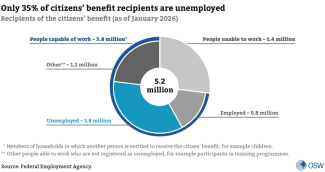
One of the clearest examples of this unfulfilled promise is the reform of the citizens’ benefit (Bürgergeld). During the election campaign, the Christian Democrats portrayed the scheme as evidence of the shortcomings of the German welfare state: costly, overly lenient and insufficiently effective in encouraging people into work. Annual expenditure on the Bürgergeld system amounts to €52 billion, and 5.2 million people receive the benefit, around half of whom are not German citizens. The Christian Democrats promised reforms that would save several billion euros and encourage some unemployed people to return to the labour market. However, the reform adopted in March, which enters into force on 1 July, is unlikely to achieve these aims. Actual savings in 2026 are expected to amount to only €86 million.
Germany’s difficult economic situation is placing growing pressure on the government, which plans to implement a reform of the statutory health insurance system and a package of budgetary reforms before the summer recess. Reaching a compromise has proven difficult because the coalition partners hold differing views on the direction of the reforms. Nevertheless, failure to act will deepen public dissatisfaction with the government and could lead to a crisis within the governing coalition. The main beneficiary would be the opposition AfD, which leads in the polls and is attracting support from both the Christian Democrats and the Social Democrats.
Bürgergeld: a symbol of the problem
The German welfare state has a long history and a strong constitutional foundation. Its origins lie in Bismarck’s reforms of the 1880s and, following 1949, the principle of the welfare state was incorporated into the Basic Law of the Federal Republic of Germany (Article 20(1)). The aim of the welfare state is to protect citizens from the risks associated with a market economy by preventing poverty, reducing inequality and promoting social justice.[1] Consequently, in addition to pension and health insurance, Germans have access to a broad range of benefits, including child allowances, housing support and parental benefits. This extensive system of state support sets Germany apart from many other countries. More than 500 different benefits are available,[2] although the complexity of the system makes it difficult to determine its full scope and assess its impact.[3] In 2024, Germany redistributed around 31% of GDP through its social welfare system, including pensions and healthcare, amounting to €1.3 trillion.[4]
Reforming such a complex system is extremely challenging. The last major attempt at comprehensive reform was Gerhard Schröder’s (SPD) Agenda 2010.[5] The measures introduced at the time faced widespread public criticism because they involved substantial cuts to social benefits, a greater reliance on flexible forms of employment and stricter sanctions for those refusing work. Although Agenda 2010 later contributed to improvements in the labour market, it also became a key factor in the SPD’s electoral defeat in 2005. Many Social Democratic voters and party members viewed the reforms as a departure from the principle of protecting the most vulnerable, resulting in a loss of public trust. Agenda 2010 prompted a split within the SPD, with some members viewing the reforms as a betrayal of left-wing ideals and leaving to establish what later became The Left (Die Linke).
The introduction of the citizens’ benefit (Bürgergeld) by Olaf Scholz’s (SPD) government in 2023 was intended to mark a symbolic break with this period. The scheme replaced the controversial Hartz IV benefit, one of the key pillars of Agenda 2010. Its main purpose was to guarantee a minimum standard of living for people who are unable to support themselves financially (see Appendix). As a result, it covered not only the unemployed but also those in work whose incomes were insufficient to meet their basic living needs. Compared with the previous system, the citizens’ benefit provided higher payments, imposed less severe sanctions for failing to cooperate with the employment office and offered recipients longer protection periods. The new framework also placed greater emphasis on developing professional skills and strengthening cooperation with employment services. At the same time, the term ‘citizens’ benefit’ was intended to shift public perceptions of recipients away from dependence on state support and towards recognition of their status as equal citizens.
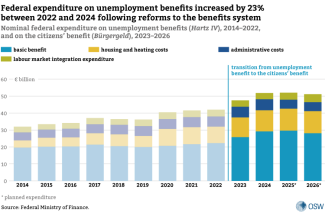
Federal spending on social benefits increased by around 23% between 2022 and 2024 following the introduction of the citizens’ benefit (see Chart 1). The Bürgergeld system currently costs the public purse around €52 billion per year.[6]
Shortcomings of the system
Contrary to its intended purpose, Bürgergeld quickly became a symbol of a state perceived as both too expensive and too lenient towards those regarded as taking advantage of the system, including recipients without German citizenship. According to a survey conducted in November 2022, 58% of respondents considered the introduction of the new benefit to be a ‘rather bad’ idea, compared with 35% who regarded it as ‘rather good’. In addition, 68% supported the Christian Democrats’ criticism that the scheme did not provide sufficient incentives for unemployed people to seek employment.
Friedrich Merz highlighted all of these issues during the 2025 election campaign, portraying the citizens’ benefit as a flawed policy whose abolition would generate savings of several billion euros.[7] Beyond the fiscal dimension, criticism of the scheme centred on several key concerns raised by both politicians and experts.
First, the rules governing the benefit do not encourage unemployed people or those working part-time to become more active in the labour market. As recipients earn more, the benefit is gradually reduced, which undermines the financial incentive to work additional hours. This problem is particularly evident among those employed in so-called minijobs – a flexible form of employment introduced in 2003 under the Agenda 2010 reforms to help reduce unemployment, partly by lowering labour costs for employers.[8] These jobs were intended to serve as a temporary stepping stone to full-time employment for unemployed people. In practice, however, the structure of the citizens’ benefit has contributed to their persistence as a long-term form of employment for a relatively small group of individuals.
The second criticism concerns the limited effectiveness of measures designed to help people find employment, a challenge that is largely linked to the structural characteristics of the German labour market and the broader economy. Economic slowdown and structural transformation, together with a mismatch between jobseekers’ qualifications and labour market needs, have contributed to a gradual increase in unemployment, which stood at 6.3% in May 2026, while demand for highly skilled workers has continued to rise. In 2025, Germany faced a shortage of around 164,000 specialists in science and technology-related fields, and in some federal states, such as Bavaria, the available workforce was sufficient to fill only around half of all vacancies.[9]
Despite strong demand for labour, several factors continue to hinder jobseekers’ ability to find employment. These include low levels of vocational qualifications, poor German-language skills, health problems – particularly mental health issues – low motivation and childcare responsibilities.[10] Analyses by the Federal Employment Agency support this assessment, showing that more than 52% of people who found work in 2024 returned to receiving benefits within three months.[11] This pattern is particularly common among people under the age of 25 and those who are not German citizens.
The third problem is the limited effectiveness of employment offices, resulting from an expanding bureaucratic burden. Between 2014 and 2024, federal spending on administering the citizens’ benefit increased by 38% to €6.5 billion (see Chart 1), while expenditure on career guidance and labour market integration rose by only 8%. The growing cost and complexity of administration have reduced the effectiveness of job placement services. This problem is also reflected in the views of Bürgergeld recipients, more than half of whom do not actively seek work and cite the lack of job opportunities and training programmes as the main reason.[12]
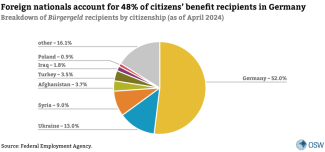
Criticism of Bürgergeld also centres on its widespread use by foreign nationals who have not contributed to the system over an extended period. Almost half of all recipients (48%) are not German citizens.[13] At the end of last year, the CDU/CSU–SPD government excluded certain Ukrainian refugees from the scheme. This measure formed part of broader welfare spending cuts and also reflected a desire to tighten Germany’s migration policy.[14]
Yes to benefits, no to work disincentives
There is broad public support in Germany for welfare system reform. Surveys show that 62% of respondents believe they live in a socially unjust state (ARD Infratest dimap, February 2026). Many respondents cited, above all, high levels of social inequality – Germany scores 30.1 points on the Gini coefficient, compared with 24.9 for Poland and an EU average of 29.2, with lower values indicating lower levels of inequality – and social contributions and taxes that are viewed as both unfair and excessively high. In 2025, the combined tax and social contribution burden for a single person without children earning the average wage reached 49.3% of income in Germany, up from 47.9% in 2024. By comparison, the figure stood at 35.0% in Poland in 2025, while the OECD average was 35.1%.
Other concerns include the exemption of certain professional groups, such as civil servants, from paying contributions; the perceived preferential treatment of foreign nationals within the German welfare system; and the relatively small gap between the financial benefits of employment and those of receiving welfare payments.[15] Among the reform proposals discussed in Germany, the most widely supported is limiting benefits for EU citizens residing in Germany who have previously worked full-time in the country for an extended period. Other popular proposals include digitalising and simplifying the welfare system, for example through a single portal for benefit applications or the introduction of automatic child benefit payments. Respondents are, however, opposed to flat-rate benefit payments and reduced oversight, with 71% rejecting such measures.
Germans expect their welfare state to be preserved, but they are unwilling to accept distortions in the system. Lower social spending does not enjoy strong public support, with the notable exception of spending on the citizens’ benefit. Respondents see raising taxes on the highest earners as the most effective way to improve the public finances, a measure supported by 69% of those surveyed. At the same time, confidence in the Merz government’s ability to deliver welfare reform remains limited, even among supporters of the Christian Democrats and the Social Democrats. According to an ARD Infratest dimap survey conducted in April this year, 54% of CDU/CSU supporters and 58% of SPD supporters believe that the CDU/CSU–SPD government will not succeed in introducing fundamental changes to the system.
Political deadlock within the government
Against the backdrop of prolonged economic stagnation and rising welfare costs, the CDU/CSU–SPD government announced a package of reforms aimed at strengthening economic competitiveness and improving the long-term sustainability of public finances. The proposed measures were to cover social insurance and welfare programmes, as well as the tax system and efforts to reduce bureaucracy. However, the much-publicised ‘autumn of reforms’,[16] repeatedly promised by Chancellor Merz, has yet to materialise. This reflects both disagreements between the coalition partners over the scope, depth and pace of reform and divisions within the governing parties.
Germany’s difficult fiscal situation is an additional challenge. The federal budget is already projected to face a shortfall of €34 billion in 2027, rising to a cumulative €140 billion by 2030,[17] thereby increasing the pressure to implement reforms quickly. Reform of the citizens’ benefit therefore forms part of a broader effort to reduce public spending. This includes measures such as the requirement introduced by Vice-Chancellor and Finance Minister Lars Klingbeil (SPD) for every ministry to cut expenditure by 1%, as well as ongoing discussions on potentially increasing VAT and inheritance tax rates and reducing subsidies and tax relief for businesses.
Reforming the welfare state has, however, proved politically challenging from the outset due to significant differences between the Social Democrats and the Christian Democrats. The SPD argues that reform can be achieved without cutting benefits, primarily by improving the efficiency of the system and curbing bureaucracy. The CDU, by contrast, maintains that meaningful reform requires reducing both the number and scope of benefits.
The SPD opposes deep cuts to welfare spending and stricter conditions for benefit recipients, fearing further losses of support among this group of voters. Within the party, one of the most prominent opponents of far-reaching reforms is Deputy Chairwoman and Federal Minister of Labour and Social Affairs Bärbel Bas. She holds a strong position within the SPD and is widely regarded as the informal leader of its left wing. Her popularity has also been strengthened by her criticism of Chancellor Merz.[18] Additional pressure on the party, particularly in the form of opposition to greater labour market flexibility, comes from trade unions, which have traditionally maintained close ties with the SPD.
The Christian Democrats, by contrast, favour far-reaching reform, although the scope and pace of implementation remain the subject of internal debate. The strongest advocates of extensive reform are the youngest MPs in the so-called Junge Gruppe, who accuse Chancellor Merz of being more responsive to the SPD’s social policy demands than to proposals put forward by his own party. Without the support of the 18 members of the Junge Gruppe, the coalition would lack a parliamentary majority, as its advantage over the opposition amounts to only 12 seats. The group’s influence became apparent during the debate on pension reform in autumn last year, when its members blocked what they regarded as an overly diluted package of measures.[19] Pressure for a tougher reform agenda also comes from MPs associated with the party’s traditionally influential pro-business wing, organised within the Parlamentskreis Mittelstand (Parliamentary Group for Small and Medium-Sized Businesses), which comprises 80% of CDU/CSU MPs (166 of the alliance’s 208 members).
Renaming rather than reforming
Given the sharply differing positions of the two parties, a special commission on welfare reform was established under the Ministry of Labour and Social Affairs. This made it possible to develop a reform proposal limited to measures acceptable to both sides, significantly narrowing the scope for far-reaching reform. The commission began its work in September 2025 and published its recommendations in January 2026. The proposals focus on modernising welfare administration, curbing bureaucracy and strengthening incentives to take up employment. They do not include reductions in benefit levels,[20] with savings expected to result solely from improving the system’s efficiency. As a result, the recommendations amount, in practice, to a technocratic refinement of the existing arrangements rather than a structural reform of the welfare system.
The new regulations will enter into force in July this year and include stricter sanctions for failing to cooperate with employment offices, such as benefit reductions or suspension for missing appointments with employment advisers, penalties for refusing job offers and tighter scrutiny of recipients’ assets. According to estimates included in the draft legislation, the reform is expected to generate savings of €86 million in 2026 and €69 million in 2027, far below the previously promised savings of several billion to several tens of billions of euros. The reform has therefore not only been introduced later than expected but has also proved far less ambitious than earlier political pledges had suggested.
Despite its limited budgetary impact, the overall direction of the reform – focusing on changes to the system without reducing benefit levels – has been received positively by the public. According to a Politbarometer survey conducted for ZDF television in November 2025, 74% of Germans support stricter conditions for receiving welfare benefits. The measures are most popular among supporters of the Christian Democrats (96%) and the AfD (90%), while 74% of Social Democratic voters also view them favourably. In addition, 96% of CDU/CSU supporters, 92% of AfD supporters and 88% of SPD supporters (ARD Infratest dimap, September 2025) back the introduction of far-reaching sanctions against people who repeatedly reject job offers or fail to attend appointments arranged by employment offices. Support for such restrictive measures is notably lower among the electorates of the Greens (64%) and Die Linke (65%).
Prospects
German society would like reforms that improve the efficiency of the welfare system without reducing benefits or requiring significant sacrifices from citizens. This preference is difficult to reconcile with mounting pressure on public finances and the need for substantial savings, which are pushing the government towards more far-reaching measures and politically unpopular decisions. The debate is also shaped by Germany’s traditionally cautious approach to fiscal policy and its strong aversion to public debt. In the short term, this is likely to benefit the AfD, which currently leads opinion polls with 28% support, while the CDU stands at 22% and the SPD at 12%.
The flow of voters from both governing parties to the AfD is becoming increasingly apparent. In the case of the SPD, this trend is reinforced by strong support for the AfD among blue collar workers. In the Bundestag elections, 38% of voters in this group, traditionally a core part of the Social Democratic electorate, voted for the AfD. A similar pattern can be seen in state and local elections, where AfD candidates are increasingly successful in traditional SPD strongholds, including the Ruhr region. This reflects a perception among part of the SPD electorate that the party is more focused on representing the interests of welfare recipients than those of workers. At the same time, the SPD’s positions on identity politics contribute to this trend, as the party is seen as prioritising the interests of minorities and support for a liberal migration policy over the concerns of its traditional electorate.
State elections in September could shape the future of welfare reform in Germany. With the CDU in Saxony-Anhalt and the SPD in Mecklenburg-Western Pomerania both expected to lose ground to the AfD, two scenarios appear particularly plausible. The less likely scenario involves closer cooperation within the coalition, an end to disputes both between the parties and within their parliamentary groups, agreement on a comprehensive reform package and its implementation before the end of the legislative term. The ongoing work on healthcare reform suggests that such an outcome is possible. Reform proposals presented by the coalition in April this year, including annual savings of several billion euros, were received relatively positively by experts, the public and both governing parties.[21]
The second, and more likely, scenario involves escalating disagreements within the coalition over reform. Each party is likely to focus on securing the greatest possible benefits for its own voters, leaving only limited scope for compromise. This would further exacerbate the federal budget’s problems, which are already driven by high welfare spending and the costs of the healthcare and pension systems. The absence of reform, and therefore of savings, would undermine the government’s ability to finance growth-oriented reforms and investment, potentially paving the way for an AfD victory in the 2029 Bundestag elections.
Appendix. The Bürgergeld benefit
The primary purpose of the citizens’ benefit is to guarantee a minimum standard of living for people who are unable to support themselves financially. It is available to individuals aged 15 and over who reside permanently in Germany, are capable of working at least three hours per day and are below retirement age. The scheme therefore covers both unemployed people and those in work whose earnings are too low to meet their basic living needs. There is no statutory limit on the length of time for which the benefit can be received.
Bürgergeld consists of a flat-rate basic payment (for example, €563 per month for a single person in 2025) and, where necessary, an additional allowance for housing and heating costs, the amount of which depends on the rent payable. During the first year, however, a so-called grace period applies, under which housing costs are generally covered in full. After this period, recipients may be required to reduce their housing costs, for example by moving to less expensive accommodation. The final amount of the citizens’ benefit is calculated as the difference between the level of need determined by the employment office and the recipient’s income.
The basic payment may be reduced by up to 30% if the recipient fails to cooperate with the employment office, for example by refusing a job offer.
A central element of the system is the activation of recipients in the labour market through career guidance, training and support in finding employment, with the aim of helping them gradually become independent of state assistance.
[1] See the entry Soziale Marktwirtschaft (social market economy) [in:] Kultura polityczna Niemiec. Krótki kurs, OSW, osw.waw.pl.
[2] Alongside the citizens’ benefit (Bürgergeld), some of the costliest welfare programmes include child benefit (Kindergeld) and the child supplement (Kinderzuschlag), which together cost the federal budget €58.6 billion in 2025, housing benefit (Wohngeld), which amounted to €4.7 billion in 2023, and basic social assistance benefits (Sozialhilfe – Sozialbuch XII), which cost €20.2 billion in 2025.
[3] ‘Over 500 Different Social Benefits in Germany’, Ifo Insitut, 15 October 2025, ifo.de.
[4] Sozialbudget 2024, Bundesministerium für Arbeit und Soziales, July 2025, bmas.de.
[5] A. Kwiatkowska, Cinderella became the Empress. How Merkel has changed Germany, OSW, Warsaw 2021, osw.waw.pl, pp. 10–12.
[6] ‘Mehr als ein Drittel des gesamten Haushalts für Arbeits- und Sozialetat’, Deutscher Bundestag, 11 July 2025, bundestag.de.
[7] ‘Merz will Entlastungen mit Einsparungen beim Bürgergeld finanzieren’, Handelsblatt, 17 December 2024, handelsblatt.com.
[8] A form of employment in which monthly earnings do not exceed €603 or the number of working days does not exceed 70 per calendar year. Under so-called minijobs, no social security contributions are payable.
[9] Ch. Anger et al., MINT-Frühjahrsreport 2025: Arbeitsmarktbericht – Gute Gründe für MINT, Institut der deutschen Wirtschaft, Köln, 21 May 2025, iwkoeln.de.
[10] In March 2025, the proportion of children under the age of three receiving formal childcare stood at 37.8%. Across Germany, there is a shortage of around 300,000 childcare places for children in this age group. See N.T. Hinsberger, ‘Jobcenter in der Krise? Die Rückfallquoten ins Bürgergeld steigen dramatisch’, Merkur.de, 9 November 2025.
[11] R. Becker, ‘Bürgergeld-Realität: Jede zweite Vermittlung der Jobcenter läuft ins Leere’, Fachverlag für Sozial- und Rechtsjournalismus, 7 November 2025, buergergeld.org.
[12] B. Boockmann et al., Bürgergeldempfänger: Viele sind krank, die Hälfte sucht keinen Job – und Jobcenter bieten zu wenig Stellen an, Bertelsmann Stiftung, 4 December 2025, bertelsmann-stiftung.de.
[13] R. Bocksch, ‘Hälfte der Bürgergeldempfänger:innen sind Deutsche’, Statista, 7 August 2025, de.statista.com.
[14] K. Frymark, ‘Germany is cutting benefits for refugees from Ukraine’, OSW, 20 November 2025, osw.waw.pl.
[15] Die Welt journalist Fatina Keilani calculated how much state support she could receive as a single mother of four children if she were not working. Assuming a monthly rent of €1,800, her state-recognised needs would amount to €4,517 per month. Including additional support for schooling, school trips and meals, the total value of state assistance could reach around €70,000 per year. See F. Keilani, ‘Ich habe mir ausgerechnet, was ich mit Bürgergeld bekäme, und bin schockiert’, Die Welt, 8 June 2026, welt.de.
[16] F. Merz, ‘“The autumn of reforms has long since begun”’, The Federal Government, 17 September 2025, bundesregierung.de.
[17] ‘Klingbeils Haushaltsplan mit Lücken – als «Aufwärmübung»’, Die Zeit, 29 April 2026, zeit.de.
[18] ‘„Menschenverachtend“, kritisiert Bas die Politik des Koalitionspartners’, Die Welt, 2 May 2026, welt.de.
[19] R. Roßmann, ‘Die Machtmaschine stottert’, Süddeutsche Zeitung, 26 November 2025, sueddeutsche.de.
[20] The proposals concerned not only the citizens’ benefit but also the housing benefit (Wohngeld) and the child supplement (Kinderzuschlag).
[21] B. Brinkmann, ‘Von Patienten bis Kliniken: Wie Nina Warken 20 Milliarden einsparen will’, Süddeutsche Zeitung, 14 April 2026, sueddeutsche.de.