Deeper reconciliation or reopening old wounds? Controversy over the gathering of the German expellee association in the Czech Republic
The annual gathering of the Sudeten German Homeland Association – the largest organisation representing Germans expelled from Czechoslovakia and their descendants – has sparked considerable political controversy and media debate in the Czech Republic. For the first time in its history, the event was held outside Germany and Austria after a Brno-based association engaged in Czech–German reconciliation invited the organisers to hold it in the Czech Republic. The association, which has ties to Germany’s Christian Democratic movement, does not pursue legal or financial claims. Instead, it focuses on the historical and moral aspects of the expulsions. Public reactions to hosting the gathering largely reflected broader political and social divisions in the Czech Republic. Government representatives boycotted the event and successfully advocated the adoption of a resolution in the Chamber of Deputies stating that the gathering should not be held in the country. Members of the governing coalition criticised the initiative as an attempt to “reopen old wounds” and described it as a betrayal. The opposition took a markedly different view. Most opposition parties supported hosting the event as a gesture of reconciliation. Markus Söder, Bavaria’s Minister-President, participated in the gathering. He was received in Prague by President Petr Pavel, whose relationship with the government has recently become increasingly strained.
Good intentions…
The five-day gathering of the Sudeten German Homeland Association (Sudetendeutsche Landsmannschaft, SdL), held from 21 to 25 May, was incorporated into the wider Meeting Brno festival, an initiative dedicated to promoting Czech–German reconciliation. The festival, which has been held annually for the past decade, emerged from a major civic initiative launched in 2015 to mark the 70th anniversary of the end of the Second World War. Under the banner of the ‘Year of Reconciliation’, the city of Brno organised a series of events addressing the difficult legacy of both the occupation by Nazi Germany and the forced expulsion of the city’s large German population after the war (see Appendix: The complex history of Czech–German coexistence). The festival was founded by the well-known Brno-born writer Kateřina Tučková, who also served as its inaugural programme director.
Most of the festival’s funding is provided by municipal and regional authorities, although they do not formally influence its programme. The SdL gathering itself received substantial financial support from the Bavarian parliament. For the third consecutive year, Meeting Brno was held under the honorary patronage of President Petr Pavel. This year, the festival also received the patronage of Senate Speaker Miloš Vystrčil of the opposition Civic Democratic Party (ODS). Vystrčil played an active role in the event, participating in the festival’s ‘Pilgrimage of Reconciliation’ and delivering a speech. In his remarks, he suggested that attempts to sow division between Czechs and Germans were being encouraged by countries “to our east”.
Among opposition parties and mainstream media outlets, support for hosting the SdL gathering in the Czech Republic outweighed criticism of the event. Proponents framed their arguments in moral, political and economic terms, emphasising the value of dialogue, reconciliation and stronger cross-border ties. Many criticised the government for its opposition to the gathering, arguing that it was seeking to divert public attention from more immediate challenges, including disputes over public media governance and criticism from international partners regarding reductions in defence spending. Supporters also highlighted Germany’s pivotal role in the Czech economy. Germany is the country’s most important trading partner, accounting for roughly one-third of Czech exports. Given all this, efforts to ease historical tensions and strengthen bilateral relations were presented as serving Czech national interests.
A particularly important factor shaping Czech relations with German expellee organisations is their prominent role in Bavaria, the federal state bordering the Czech Republic and its most important economic partner within Germany. Although Bavaria accounts for around 16% of Germany’s population, it generates approximately a quarter of Czech–German trade. Bavarian firms are among the largest foreign investors in the Czech Republic, particularly in the automotive and electrical engineering industries. Major companies such as Siemens, BMW and Brose have established a significant presence in the country. Bavaria’s political significance extends beyond economics. It is often emphasised in the Czech public debate that Bavarian governments have traditionally held positions closer to those of successive administrations in Prague than many other German federal states. This convergence is particularly evident in their scepticism towards immigration and ambitious climate and energy policies, including concerns about an excessive reliance on renewable energy sources.
From a Bavarian perspective, the importance of the Czech Republic and the broader issue of reconciliation is closely linked to the post-war arrival of around 1.9 million displaced persons, including approximately one million Germans expelled from Czechoslovakia. The influx increased Bavaria’s population by roughly 25% in the years following the Second World War. Over time, Sudeten Germans came to be recognised as Bavaria’s ‘fourth tribe’, alongside Old Bavarians, Franconians and Swabians. They continue to play a prominent role in regional politics, with politicians of Sudeten German background regularly holding around a quarter of the seats in the Bavarian parliament. Sudeten German organisations have also developed unusually close ties with the Bavarian state administration. Over the decades, both sides have established a dense network of long-standing formal links unmatched elsewhere in Germany. In 1954, Bavaria granted Sudeten Germans official state patronage, paving the way for dedicated institutions and stable public funding. This framework was further strengthened in 1970 with the creation of the Sudeten German Foundation, tasked with preserving the community’s cultural heritage and historical legacy.
Against this backdrop, bringing the SdL gathering to the Czech Republic represents a major symbolic success for the Sudeten German community. It also forms part of a broader trend towards extending the commemorative activities of German expellee communities beyond Germany’s borders. Comparable initiatives include Hungary’s introduction in 2012 of the Memorial Day for the Forced Expulsion of Hungarian Germans, observed annually on 19 January, and the Grand Meetings of the Transylvanian Saxons (Großes Sachsentreffen) which have been held regularly in Romania since 2017.
…but poor timing
The SdL gathering – the first in its history to take place outside the German-speaking countries – was held in a politically challenging environment. Since December 2025, the Czech Republic has been governed by a coalition led by Andrej Babiš, bringing together three parties that, to varying degrees, advocate a sovereigntist agenda.[1] Opposition to the event was particularly strong among representatives of the far-right Freedom and Direct Democracy (SPD) party and the Eurosceptic Motorists for Themselves (Motoristé sobě). Petr Macinka, the foreign minister from the latter party, argued that the gathering had come too soon. He suggested that an event of this kind would be viewed more neutrally by the Czech public only “in 10 to 20 years”. Prime Minister Babiš (ANO) adopted a similar position, noting that many people who personally remember the post-war period are still alive. One ANO MP described the gathering as an unnecessary attempt to “reopen old wounds”.
Given the political profile of the Czech government, the organisers of the gathering were unlikely to have anticipated a warm reception. The sports minister from Motorists for Themselves described the gathering as a “political provocation”. Meanwhile, SPD leader and Speaker of the Chamber of Deputies Tomio Okamura organised a protest in Brno less than a month before the event, condemning the decision to host the SdL gathering in the Czech Republic as “unacceptable” and “an immense disgrace” to the country.
Opposition to the SdL gathering took a formal shape on 14 May, when the Chamber of Deputies adopted a resolution calling on the organisers to cancel the event. Opposition parties boycotted the vote. The resolution argued that elements within the Sudeten German community continue to promote views that challenge the post-war settlement. The controversy also exposed tensions within the European Parliament’s Europe of Sovereign Nations group, of which both the Czech SPD and Germany’s Alternative for Germany (AfD) are members. AfD politicians have repeatedly criticised the continued existence of the Beneš Decrees as part of the Czech legal order, the measures that sanctioned the confiscation of property or the revocation of Czechoslovak citizenship of Sudeten Germans in 1945.
The SdL, however, differs significantly from the AfD and other far-right movements. Closely associated with Bavaria’s Christian Social Union (CSU), it has adopted a substantially more moderate position over the past decade. While the organisation still formally supports the repeal of the Beneš Decrees, it removed demands for property restitution from its statutes in 2015. Members who opposed the change were expelled and barred from attending future gatherings. According to Bernd Posselt, the long-serving chairman of the SdL, this exclusion applies to all AfD members, including Erika Steinbach, the former CDU politician who later joined the AfD. Posselt has said that some within these circles regard him as a “traitor serving Czech interests”. Yet Posselt himself remains a divisive figure in the Czech Republic. The son of a Sudeten German father from Jablonec nad Nisou, he voted, as a CSU member of the European Parliament, against Czech accession to the EU in 2003, arguing that Prague should first remove the Beneš Decrees from its legal order. Together with similar objections raised by politicians in Germany and Austria, his stance contributed to the Czech Republic receiving the lowest level of support in the European Parliament among the ten states that joined the EU in 2004. His criticism of the Beneš Decrees continues to attract controversy in the Czech Republic. More recently, some commentators have argued that his interventions in Czech domestic politics have gone too far. Posselt described the parliamentary debate on the resolution condemning the SdL gathering as a “caricature of parliamentarianism” and referred to Czech nationalists as “mentally and intellectually backward”.
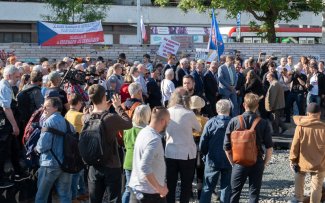
The Czech government's opposition to the SdL gathering culminated in an official boycott of the event, while protests in Brno highlighted the broader societal divisions surrounding the issue. In the absence of government representatives, the most senior CSU politicians attending the gathering – German Interior Minister Alexander Dobrindt and Bavarian Minister-President Markus Söder – were welcomed by Jan Grolich, governor of the South Moravian Region and leader of the Czech Christian Democrats (KDU-ČSL). The meeting was facilitated by the fact that KDU-ČSL and the CSU belong to the same European political family. Söder was also received in Prague by President Petr Pavel. The president, however, chose not to attend the event in Brno. This was likely an attempt to avoid further escalating tensions, as the presence of the country’s highest-ranking constitutional official could have been interpreted as an endorsement of a highly contentious gathering. The controversy surrounding the event was also evident on the streets. Around 3,000 people participated in activities associated with the SdL gathering. Approximately half were German participants, representing only a small proportion of the organisation’s estimated 250,000 members. At the same time, a similarly sized crowd gathered elsewhere in Brno to protest against the event. The demonstrations were led primarily by extra-parliamentary communist groups and former president Miloš Zeman. Addressing the protesters, Zeman argued that “the Sudeten Germans were a fanatical part of the Nazi movement”.
Uncertain prospects
The Czech government insists that strong relations with Germany remain a priority. Its preferred approach is to separate disputes over historical memory from contemporary political and economic cooperation. Three months before the event, Bavarian Minister-President Markus Söder hosted Prime Minister Andrej Babiš in Munich, describing Bavaria as a prospective “VIP partner” of the Czech Republic. A month later, Babiš travelled to Berlin for talks with German Chancellor Friedrich Merz. The meeting stood in contrast to the unsuccessful efforts of Slovak Prime Minister Robert Fico, despite his longer tenure in office, to secure a similar audience with the German leader. Following both visits, Babiš emphasised the positive aspects of Czech–German relations, stressing the need for pragmatic cooperation and close coordination within the EU. Although differences emerged during the Berlin talks, particularly over energy and climate policy, they did not fundamentally alter the constructive tone of the relationship. It is noteworthy that the SPD shifted its attention soon after the SdL gathering, returning to its more familiar anti-Ukrainian rhetoric.
Babiš is generally regarded as one of the more pragmatic figures within the governing coalition. Germany is also a key market for Agrofert, the conglomerate he founded. Nevertheless, pressure from coalition partners competing for political visibility, combined with domestic challenges, may encourage the government to continue employing sovereigntist rhetoric. For Germany, the central question is whether such rhetoric and symbolic gestures, aimed primarily at domestic audiences, will have any tangible effect on economic relations or cooperation within the EU. At present, this appears unlikely, particularly in the economic sphere. At the same time, plans to hold future SdL gatherings alternately in Germany and the Czech Republic may ensure that the issue remains politically sensitive. In a society that remains deeply polarised, and in which attitudes towards the gathering closely reflected party-political loyalties, such events could either provide a platform for dialogue and reconciliation or continue to serve as a focal point for lingering grievances and mutual mistrust.
APPENDIX
The complex history of Czech–German coexistence
Germans had lived in the Czech lands with significant concentrations in towns and border regions, since the thirteenth century. For much of that period, relations between Czechs and Germans were relatively peaceful. Apart from the Hussite Wars, serious conflicts between the two communities were rare until the nineteenth century. Tensions began to emerge in the second half of the nineteenth century as Czech and German political aspirations increasingly diverged. The Czech national revival movement sought greater recognition of the historical and political rights of the Czech nation within the Habsburg monarchy. Czech leaders, in turn, emphasised the historical borders of the Kingdom of Bohemia. By contrast, many Germans living in the Czech lands favoured reorganising the empire along ethnic lines.[2]
The creation of Czechoslovakia in 1918 brought these competing visions into a new political framework. Germans constituted roughly a quarter of the population of the new state, yet many did not identify with it and felt marginalised within its political system. They were underrepresented in public administration, education and other state institutions, and often regarded policies such as land reform as favouring the Czech and Slovak majority populations. The political structure of interwar Czechoslovakia did little to foster a common sense of belonging. In practice, power rested largely on agreements between the five main Czech political parties, rather than on a genuinely inclusive system reflecting the country’s ethnic diversity. Nevertheless, German parties were not entirely excluded from political life. From 1926 onwards, they periodically participated in governing coalitions, giving them at least some influence over the direction of state policy.
The Great Depression marked a turning point in Czech–German relations. The economic crisis hit the industrial border regions, where a large portion of the German population lived, particularly hard. This created favourable conditions for the emergence of the Sudeten German Party in 1933 and its rapid ascent to prominence. Closely aligned with Germany’s Nazi Party, it soon became a key instrument in Adolf Hitler’s efforts to undermine and destabilise Czechoslovakia. The crisis culminated in the Munich Agreement of 1938, which transferred the predominantly German-speaking border regions to the Third Reich. Six months later, in March 1939, Germany occupied the remaining Czech lands, including Prague and Brno, and established the Protectorate of Bohemia and Moravia. During the war, the Czechoslovak government-in-exile, led by President Edvard Beneš, argued that the post-war expulsion of the German population was necessary to prevent future ethnic conflicts. Between 1942 and 1943, it secured the support of the major Allied powers for this policy.
The expulsion of most of Czechoslovakia’s approximately three million Germans took place in two phases. The first, known as the ‘wild expulsions’, took place between May and September 1945. The second, an organised transfer process, took place between January and October 1946. According to the findings of a joint Czech–German commission of historians, between 15,000 and 30,000 people died during the expulsions. Among the most tragic incidents was the Brno Death March of late May 1945. By comparison, between 320,000 and 350,000 residents of Czechoslovakia died during the German occupation, around two-thirds of them victims of the Holocaust. A significant step towards reconciliation came on 21 January 1997, when both heads of governments signed the Czech–German Declaration on Mutual Relations and Their Future Development.
[1] K. Dębiec, ‘Babiš’s new government: Czechia first’, OSW, 18 December 2025, osw.waw.pl.
[2] Idem, To už se nevrátí. Czechoslovakia and contemporary Czech–Slovak relations, OSW, Warsaw 2025, osw.waw.pl.