Trump’s deportation policy: electoral consequences and social tensions
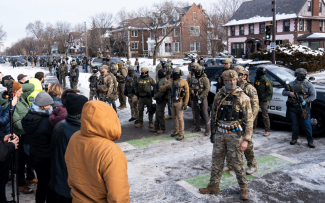
Internal tensions have been rising in the United States over the strategy to combat illegal immigration adopted by the Donald Trump administration. Several factors have contributed to this situation, including intensified deportations among populations living deep inside the country, an increase in the number of officers responsible for these operations, and an authorisation for them to take more radical action. The deaths of two US citizens in Minneapolis, Minnesota, have further fuelled the tensions. These dramatic events, alongside political pressure, including from Republican politicians, compelled the president to scale back the deportation campaign in Minnesota. However, this short-term de-escalation does not mean that further disputes regarding the immigration issue will not arise in the near future, particularly between the federal government and state or local authorities. Any new efforts to advance the president’s objective of expelling all undocumented migrants residing in the United States will inevitably generate social tensions. This could also affect the Republicans’ electoral performance in the November midterm elections, held halfway through the presidential term, which will determine the composition of the House of Representatives, one third of the Senate, and various other state and local offices.
A radical deportation campaign
During the election campaign, Trump pledged to deport all individuals residing in the United States unlawfully – a population estimated at around 14 million. Around 70% of them have lived in the country for more than five years, with the largest concentrations found in the most populous states: California, Texas, New York, and Florida. The administration has faced a number of challenges in identifying, detaining, and deporting these individuals. The campaign has required expanding the existing immigration enforcement agencies, increasing the federal government’s capacity to hold larger numbers of people awaiting removal, and intensifying efforts to identify suspected undocumented migrants.
In response to these needs, the budgets of Customs and Border Protection (CBP) and Immigration and Customs Enforcement (ICE) were significantly increased. Trump’s ‘big, beautiful bill’[1] allocated $165 billion to these agencies, with the funds to be spent by 2029. Their combined budgets for 2025 amount to approximately $30 billion. The additional funding is intended to enable them to hire more personnel (ICE increased its workforce by more than 100% within a year, reaching 22,000 employees) and to provide space in detention centres for those apprehended.
The government has also intensified the use of advanced technologies to identify illegal immigrants. These include AI-assisted facial recognition systems, software for analysing data held by the federal administration (including medical records), and tools for monitoring social media as well as tracking and inspecting mobile phones. Immigration authorities have also commenced talks with commercial entities that collect data on internet users for marketing purposes.
As part of the new policy, the government has also ramped up detentions of individuals suspected of residing unlawfully deep inside the country, rather than only in the immediate vicinity of the border. The number of such detentions soared from around 50,000 in 2024 to approximately 230,000 last year. They have been typically carried out by masked officers using unmarked vehicles in public places, an approach that deviates from the operational methods of other US law enforcement agencies and has not been used on such a scale previously. From the government’s perspective, this is intended to create a deterrent effect for potential illegal immigrants and to prompt those already residing in the country unlawfully to leave.
The strategy adopted by the Trump administration has met with growing public resistance and heightened the risk of miscalculation. US citizens and individuals residing in the country legally have been mistakenly detained. Newly recruited officers, as well as those not prepared to operate in urban environments (such as CBP officers deployed to major US cities), have faced pressure both from their superiors and from protesters, heightening the risk of misjudging situations and using measures disproportionate to the threat. This is illustrated by the cases of two US citizens shot dead in January by immigration officers in Minneapolis.
Targeting the ‘Democratic’ states
The intensified efforts to detain as many illegal immigrants as possible, together with the deployments of federalised National Guard units (referring to situations in which the president takes control of a state’s National Guard, placing it outside the governor’s jurisdiction), have frequently targeted cities and states governed by the Democrats, sparking opposition and protests. This, in turn, has allowed Trump to portray his political opponents as supporters of illegal immigration.
However, the strength of this message has been weakened by widespread opposition to the tactics employed by ICE and CBP officers. According to a recent NBC poll, 67% of respondents oppose the operational methods currently used by the immigration agencies. Their actions also constitute a form of pressure aimed at sanctuary cities, counties, and states, that have adopted regulations limiting cooperation with the federal administration in the enforcement of immigration laws. They neither report detentions of individuals with irregular status to federal authorities, nor detain people residing in the United States illegally, nor make their prisons or means of transport available to federal services. In such situations, the role of local police departments is usually limited to assisting federal agents in the event of confrontations with protesters.
The practice of adopting regulations concerning non-cooperation in combating illegal immigration began during the presidency of Barack Obama, when the number of deportations rose significantly. It has now spread to 12 states (including the most populous – New York and California), the District of Columbia, and many cities, such as Los Angeles, Chicago, New Orleans, and Minneapolis. During his first term, Trump sought to cut federal funding for states, counties, and cities that had adopted such legal arrangements, but his executive order was ruled unconstitutional. He has now pledged to renew these efforts, urging Congress to pass legislation preventing state and local authorities from refusing to cooperate in immigration enforcement.
Using the US armed forces domestically
The Trump administration has been using its deportation campaign to test the limits of employing the US armed forces to resolve domestic issues. Some of the president’s remarks – for example those made during a meeting with senior US military commanders in Quantico last September – suggest that he intends to prepare for a crackdown on what he has described as the ‘enemy within’. In this context, major US metropolitan areas may serve as a testing ground for such operations. During the election campaign, Trump repeatedly identified representatives of the radical left as this ‘enemy within’. It is difficult to determine whether these remarks are merely part of campaign rhetoric or reflect the president’s actual plans. The actions taken so far appear to indicate an effort to strengthen measures targeting illegal immigrants and to introduce a deterrent effect for protesters.
In the face of the challenges encountered by ICE and CBP agents, Trump on several occasions decided to deploy federalised National Guard units to individual cities, such as Los Angeles, Chicago, and Washington. These officers could only perform support roles, as US law does not permit the armed forces to be used for policing activities on US territory. The president also deployed 700 US Marine Corps troops to Los Angeles. Moreover, escalating protests in Minneapolis prompted him to place 1,500 soldiers from the 11th Airborne Division on standby and to announce that they could be deployed to restore order on the city’s streets.
Trump has also repeatedly suggested that he could invoke the Insurrection Act of 1807, enabling him to deploy a state’s National Guard or regular armed forces against citizens if a rebellion breaks out against the government or if the law cannot be enforced by ordinary means. This power was last exercised in 1992 by President George H.W. Bush during racial unrest in Los Angeles.
Softening the approach ahead of the elections
Trump’s decision to de-escalate tensions surrounding the deportation campaign in Minneapolis following the deaths of US citizens – by intensifying cooperation with local authorities and subsequently withdrawing nearly one third of the federal agents involved in the operation – highlights the growing importance of pre-election considerations and pressure from Republican politicians in shaping the president’s approach to this issue. His immigration policy may affect the Republican Party’s electoral performance this year. The administration’s success in curbing illegal immigration to the United States could become a major asset in the forthcoming campaign, but controversies surrounding the actions of ICE and CBP have blunted this potential advantage.
A number of recent polls indicate that US voters hold a negative view of the practices employed by the immigration services. The events in Minneapolis have further worsened this perception. Although most self-identified Republican voters continue to support President Trump’s immigration policy, those identifying as independents – whose votes may also prove important in the autumn elections – express serious doubts. According to an NBC poll, 81% of respondents oppose the practices employed by the immigration services.
The effectiveness of the deportation campaign may also be limited by a partial government shutdown (a situation in which a budget bill or a continuing resolution has not been adopted, forcing the federal administration to reduce its operations to an essential minimum) affecting the Department of Homeland Security. The Democrats, whose votes in the Senate are required to pass a budget bill, have made further funding for the department – which oversees agencies such as ICE and CBP – conditional on significant changes to the way federal agents operate, including a ban on face masks and a requirement to wear body cameras recording their actions.
The dispute over these issues led to a brief, partial shutdown from 31 January to 3 February this year. As a result, funding for the Department of Homeland Security was excluded from the broader budget bill that was ultimately passed; instead, the department was placed under a two-week continuing resolution, which expired on 13 February. It remains unclear how long the next shutdown may last, though it could negatively affect the department’s operations. Funding for the immigration services will be secured through resources allocated under the ‘big, beautiful bill’.
There is also a real risk of internal destabilisation. The large-scale deportation campaign is one of the key elements of Trump’s political programme, and advocates of a radical approach to this issue – most notably Stephen Miller, the president’s adviser on homeland security – continue to wield considerable influence within his inner circle.
Further actions by federal agents under the adopted strategy to combat illegal immigration will increase the risk of further miscalculations and a consequent escalation of protests across the country. These could be accompanied by riots or acts of vandalism and looting, similar to those seen in 2020, when a wave of demonstrations triggered by racial tensions swept across the United States. In such a scenario, Trump could choose to deploy the armed forces to restore internal order. However, this would expose him to a strong electoral backlash, owing to increased mobilisation among opposition voters.
[1] A. Kohut, J. Tarociński, ‘Trump’s One Big Beautiful Bill Act: lower taxes and greater focus on border protection and confrontation with China’, OSW, 10 July 2025, osw.waw.pl.