OSW Monitor. Hungary election, no. 1
- The parliamentary election scheduled for 12 April in Hungary is set to take place within a wholly new configuration of the political landscape.
- Fidesz, led by Viktor Orbán and the clear victor in the past four elections, will face a new challenger: the TISZA party of Péter Magyar.
- Over the past two years, TISZA has brought about a profound transformation in Hungarian politics. In October 2024, it became the first political force in eighteen years to surpass the Fidesz–KDNP coalition in the opinion polls.
- This shift reflects deeper transformations within the party system: the disintegration of the former opposition, the transfer of its electorate to TISZA, and the progressive erosion of the governing camp’s dominance.
- As a consequence of these developments, a near two-party configuration has emerged, and there is now a genuine risk that Fidesz could lose power.
THE POLLS
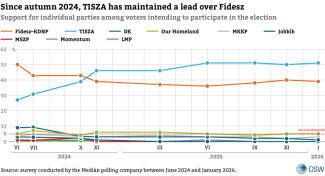
- Regarded as the most reliable polling institute, Medián indicates in its early January survey that support for the TISZA party stands at 51%, compared with 39% for the Fidesz–KDNP coalition (see Chart 1). This represents a slight increase in TISZA’s lead compared with the November survey last year, when the gap amounted to 10 percentage points. Among the electorate as a whole, Magyar’s party enjoys a lead of 7 percentage points (40% to 33%). At the same time, Fidesz’s ratings in January – as measured by Medián in the election years 2014, 2018, and 2022 – have never been as low as they are at present (although in each of those years support for the governing camp increased in the subsequent months).
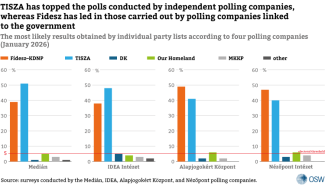
- Since the European Parliament elections in June 2024, all major polling companies – irrespective of the extent of their links to the authorities – have recorded a systematic improvement in TISZA’s ratings. Independent polling organisations (including Medián and IDEA) indicate a lead for Magyar’s party over Fidesz ranging from a few to more than a dozen percentage points. By contrast, in surveys conducted by research centres linked to the authorities (Nézőpont and Alapjogokért Központ), Fidesz remains in the lead, owing to methodologies more favourable to the governing camp (see Chart 2).
- TISZA’s standing in the polls is to a large extent the result of its absorption of the electorate of the former opposition. Of those parties – the liberal-left Democratic Coalition (DK), the centrist Momentum, the satirical Hungarian Two-Tailed Dog Party (MKKP), the right-wing Jobbik, and the far-right Our Homeland – only the latter surpasses the 5% electoral threshold in the polls (see Chart 1) and may therefore assume the role of kingmaker. Meanwhile, Hungary’s Green Party (LMP) and Momentum have announced that they will not field either party lists or individual candidates in the April election, justifying this decision on the grounds of a desire to prevent the fragmentation of the opposition vote.
- The transfer of voters from the formerly fragmented opposition to TISZA has largely run its course. At the present stage of the campaign, the party’s principal challenge is to attract supporters of the governing party and to mobilise undecided voters. However, the experience of the 2022 parliamentary election indicates that Fidesz possesses greater reserves among the latter group. This group’s significance remains considerable: according to the latest survey by Medián, undecided voters still account for approximately 19% of the electorate.
- Support for the principal political parties varies markedly according to age, educational attainment, and place of residence. TISZA clearly dominates among younger voters, particularly those under 40, whereas support for the Fidesz–KDNP coalition increases with age, with its strongest position among those aged 60 and above. A similar polarisation is evident by educational level: the higher the level of education, the greater the propensity to support TISZA, while Fidesz achieves its best results among voters with no more than primary education. TISZA enjoys an advantage in major urban centres, whereas Fidesz remains the dominant force in rural areas and small towns.
FIDESZ VERSUS TISZA
Fidesz’s assets:
- Control of media and communication resources: approximately 78% of the media market remains under the control of entities linked to Fidesz, enabling the party to shape the pre-election narrative and public discourse freely. The politicisation of state media, ongoing for more than a decade, has in recent years been accompanied by an expansion of the governing camp’s dominance within commercial media outlets.
- A network of local structures and clientelist linkages: this encompasses local authorities, political and economic elites, as well as public institutions dependent on the state or local government. The redistribution of public funds, infrastructure investment, and social welfare programmes reinforces relations of loyalty between the centre and the periphery, particularly in smaller towns and rural areas. Consequently, this network facilitates the mobilisation of the electorate and constrains the opposition’s room for manoeuvre at the local level.
- A favourable electoral system: in 2024, the boundaries of single-member constituencies were redrawn, and their current configuration benefits Fidesz. The number of constituencies in the opposition’s traditional strongholds (including Budapest) was reduced, thereby increasing the relative representation of more pro-government areas. A further factor strengthening Fidesz’s position is the vote of Hungarians residing abroad. The overwhelming majority of them support Fidesz–KDNP (in 2022, over 90% did so), which translates into approximately one to two additional seats – a margin that may prove significant in the event of a closely contested election.
- Financial advantage in the campaign and pre-electoral incentives: Fidesz makes extensive use during the campaign of state resources and business networks linked to the governing camp. This enables the party to conduct a prolonged and intensive campaign, as well as to finance wide-ranging mobilisation efforts targeting specific social groups. In the pre-election period, the government also deploys fiscal and social policy instruments (including transfers, tax relief, and one-off benefits).
- The position and charisma of Viktor Orbán: the Hungarian prime minister has framed the contest as a plebiscite ‘for or against him’. Fidesz benefits from Orbán’s experience, his ability to impose a dominant narrative, and his image as a strong leader capable of ensuring stability in a tense international environment.
- The mobilisation of the conservative and nationalist electorate: Fidesz effectively mobilises its core supporters by presenting itself as the guarantor of security (through a ‘pro-peace’ narrative), the defender of state sovereignty in the face of pressure from EU institutions, and a force sceptical of immigration.
- Fear of the ‘new and unknown’: Fidesz emphasises the virtues of stability, predictability, and continuity in government, contrasting these with its opponents’ lack of political experience. For part of society, Orbán is a politician ‘tested in times of crisis’, having led the state through periods of significant external and internal shocks (including the 2015 migration crisis, the COVID-19 pandemic, and the war in Ukraine).
- International support: Orbán has used declaratory backing from selected right-wing politicians – including Donald Trump – as an instrument for reinforcing his domestic political legitimacy. At the same time, the authorities in Budapest emphasise that the incumbent prime minister remains a guarantor of low energy prices, owing to his personal relations with both Putin and Trump (the latter having secured a temporary exemption from US sanctions on Russian oil).
TISZA’s assets:
- The effect of novelty and anti-establishment appeal: the party’s image as a formation operating outside the existing power structure enables it to channel growing public fatigue with Fidesz’s prolonged dominance. For part of the electorate, Péter Magyar represents the first recognisable and credible alternative to Viktor Orbán in many years. The party has succeeded in mobilising the protest vote, for which issues such as abuses of power, corruption, and the quality of governance are more salient than traditional ideological cleavages.
- Strong consolidation of the former opposition electorate: TISZA has absorbed voters disillusioned with the ineffectiveness and fragmentation of the previous opposition parties. The party operates as a ‘new opposition’, unencumbered by associations with earlier electoral defeats, personal rivalries, or the period in government prior to 2010. This reduces the dispersion of votes on the opposition side and reinforces the perception of TISZA as the sole credible challenger to Fidesz.
- A clean slate and a narrative of ‘moral renewal’: a central element of TISZA’s message is its critique of clientelism, corruption, and the oligarchisation of the state. This narrative gains credibility in the context of successive scandals and controversies affecting the governing camp. Such themes resonate particularly strongly among urban, younger, and middle-class voters.
- Reform without revolution: TISZA effectively emphasises the need for a change in the style of governance and for political renewal, rather than a radical ideological shift. This message appeals to voters fatigued by the concentration of power, persistent polarisation, and the repetitiveness of the government’s narrative, while simultaneously wary of the potential costs of abrupt change.
- A programme aimed at improving the economic situation and relations with the EU: persistently high inflation, cost-of-living pressures, and limited growth in real household incomes have increased the electorate’s receptiveness to the opposition’s message. TISZA underscores the costs of the government’s policies – including conflicts with the EU and the freezing of EU funds – and pledges to secure their release, presenting this as a precondition for accelerating economic growth. This message resonates both with voters sensitive to living costs and with the middle classes and entrepreneurs, for whom relations with Brussels are primarily of economic rather than identity-based significance.
- Ideological flexibility: TISZA deliberately avoids firm alignment with traditional ideological cleavages, enabling it to appeal to centrist as well as moderately conservative and liberal voters. Such a strategy facilitates the mitigation of the pronounced polarisation characteristic of the Hungarian political scene and enhances its capacity to attract undecided voters and even segments of the Fidesz electorate.
- An advantage in large cities and among younger voters: TISZA performs comparatively better in major urban centres and among younger segments of the electorate, for whom the quality of public institutions, economic prospects, and the style of governance are of particular importance. These groups tend to be more critical of the centralisation of power, the politicisation of institutions, and the narrowing of media pluralism, while also more acutely affected by economic stagnation and limited opportunities for social mobility.
- An effective presence on social media: TISZA offsets its limited access to nationwide traditional media through its effectiveness on social media platforms. These channels facilitate direct communication with voters, enable rapid responses to current developments, and allow the party to circumvent editorial filters and narrative frameworks imposed by pro-government media.
MAJOR DEVELOPMENTS
Lists of candidates endorsed by TISZA and Fidesz
In November last year, Péter Magyar presented 106 candidates representing his party in single-member constituencies (the remaining 93 MPs are elected from party lists). He opted for individuals from outside politics, predominantly local activists, entrepreneurs, doctors, and teachers. In January, Fidesz likewise unveiled its candidates. The party introduced new contenders in 41 of the 106 constituencies; however, in contrast to TISZA’s nominees, these are largely individuals associated with the governing apparatus and public administration (including government commissioners, mayors and their deputies, as well as heads of district offices). Personnel changes were particularly evident in constituencies where opinion polls indicate a weakening of Fidesz’s position and rising support for TISZA. A notably low proportion of women remains characteristic: despite a doubling in the number of female candidates compared with 2022, there are only 14 women among the 106 nominees. By comparison, women occupy approximately one third of the places on TISZA’s lists. This disparity reflects a broader feature of Hungarian politics: there is currently not a single woman serving as a minister in the government.
Tensions surrounding the Slovak amendment concerning the Beneš Decrees
An amendment to Slovak law introducing the possibility of imprisonment for publicly challenging the post-war expropriation decrees (directed, among other groups, against the Hungarian minority) has become a feature of the electoral campaign. Although the ‘defence’ of Hungarian minorities represents one of the government’s principal slogans, Orbán has refrained from criticising the legislation, owing to his close relations with Slovak Prime Minister Robert Fico and their strategic alliance within the European Council. Magyar has accused the prime minister of betraying Hungarians in Slovakia. He has also drafted an open letter to Fico, called upon Orbán to co-sign it, and announced that, should Slovakia threaten Hungarians with imprisonment for expressing their views, a future TISZA government would expel the Slovak ambassador.
Further child-protection scandals weigh on Fidesz
The Hungarian government has closed the juvenile correctional facility in Szőlő Street in Budapest following revelations of abuse and the arrest of the institution’s former director. The authorities have announced the establishment of a new nationwide institution as part of a reform of the correctional system. This step forms part of a broader crisis surrounding Hungary’s child protection services, which has undermined the credibility of the cabinet’s pro-family narrative. A similar scandal in 2024 – linked to the pardon of an individual convicted in a paedophilia case – triggered the most serious political crisis for Fidesz in recent years, leading to the resignation of President Katalin Novák and the former Minister of Justice, Judit Varga. It was in the wake of the ensuing public outrage that Magyar first emerged as a political actor, cultivating his image as a critic of systemic pathologies within the governing camp. In recent weeks, TISZA has organised protests, accusing the government of negligence in the field of child protection.
TISZA strengthens its expert base in the fields of economic and diplomatic policy
In January, Magyar announced the recruitment of two prominent experts as part of the party’s preparations for assuming power. István Kapitány – a long-standing senior executive at Shell who served for a decade as the company’s global executive vice-president – has been appointed chief adviser on economic and energy policy. His nomination has drawn criticism from pro-government media on account of his corporate background; for TISZA, however, it signals an emphasis on managerial competence and a more technocratic approach to energy policy. Magyar has also indicated Anita Orbán as a prospective future head of diplomacy. She has experience in government administration (between 2010 and 2015 she served as Ambassador-at-Large for Energy Security in the Orbán government) and subsequently held senior positions in international companies in the energy and telecommunications sectors. In her publications, she has advocated the diversification of energy supplies and a reduction of dependence on Russia (in 2008 she published a book on Moscow’s energy imperialism). These nominations may help to counter Fidesz’s claims that TISZA lacks the expertise required to govern. They also signal the possibility of a recalibration of Budapest’s existing energy policy towards Russia in the event of a change of government.
A hierarchy of electoral issues favourable to TISZA
Medián’s January survey confirms not only TISZA’s sustained lead over Fidesz, but also the greater credibility of the opposition’s message in addressing the country’s key problems. Voters identify the crisis in healthcare and education – a central theme of TISZA’s campaign – as the most important issue, followed by corruption and the deteriorating economic situation, which they associate with abuses of power. These are followed by concerns relating to child protection and fears of a potential withdrawal of Hungary from the EU. Only in fifth place do respondents cite the principal motif of Fidesz’s campaign, namely the risk of the country being drawn into a war in Europe. Government narratives concerning possible tax increases under a change of administration or alleged interference by Brussels in the election process are of marginal significance. At the same time, 62% of respondents believe that the country is heading in the wrong direction, and 54% take the view that Orbán seeks to weaken the EU. Regarding the war in Ukraine, 54% consider Russia’s actions to constitute unjustified aggression, whereas 35% regard them as an attempt to defend its interests and security. This suggests a continued, though not universal, susceptibility within the electorate to pro-Russian narratives.