Latvian parliamentary election: Prime Minister seeks re-election
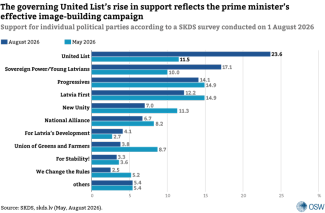
The United List (Latvian: Apvienotais saraksts, AS), led by incumbent Prime Minister Andris Kulbergs, is likely to win the 3 October election to the Saeima, Latvia’s 100-seat unicameral parliament. His appointment in May this year, which brought a series of coalition crises to an end, shifted voter preferences and prompted a sudden surge in support for AS in the polls. Previously, when Evika Siliņa of New Unity (Jaunā Vienotība, JV) headed the government, opinion polls had indicated growing support for Latvia First (Latvian: Latvija pirmajā vietā, LPV), a populist party led by oligarch Ainārs Šlesers, which has centred its campaign on criticism of JV.
The shift in voter preferences this summer largely reflects Prime Minister Kulbergs’s effective management of his public image and political messaging. He has not only successfully distanced himself from his predecessors’ mistakes but has also appropriated the populist opposition’s key message: the promise of effective government. Socio-economic issues have dominated this year’s election campaign, while regional security has remained a secondary concern.
Commentary
- The threat level in Latvia has not changed ahead of the election and the situation remains stable, albeit tense. According to Latvia’s intelligence services and armed forces, the key challenge this autumn is the intensification of hostile activities by Russia and Belarus, including migration pressure, disinformation, sabotage (including arson) and airspace violations. Since the beginning of 2026, around 11,500 attempts to cross the border illegally from Belarus have been thwarted, compared with 12,000 throughout 2025. Incursions into Latvian airspace by Russian and Ukrainian unmanned aerial systems are another challenge. At Latvia’s request, NATO has deployed two pairs of German Eurofighter jets to Lielvārde Air Base for the duration of the election period.
- The election campaign focused on socio-economic issues. Domestic social and economic policy featured particularly prominently, with debate centred on the difficulties facing the near-bankrupt national carrier airBaltic, delays in the implementation of Rail Baltica and the use of state funding for non-governmental organisations. During the campaign, Interior Minister Jānis Dombrava (National Alliance, Nacionālā apvienība, NA) unsuccessfully sought to undermine the prime minister’s political standing. His aim was to broaden his electoral base by cultivating an image of himself as the leading figure of the nationalist camp, an authority on security policy, and an advocate of a hard line towards Russia and Belarus.
- The issues that have dominated the election campaign indicate that, although ethnic polarisation remains the principal dividing line in Latvian politics, social conflicts are increasingly cutting across linguistic divisions. The party system remains divided along linguistic and ethnic lines into two main blocs: the ‘Latvian’ and ‘Russian’ blocs. The former comprises primarily right-wing political parties – the National Alliance, the United List and the Union of Greens and Farmers (Zaļo un Zemnieku savienība, ZZS) – as well as the centre-right New Unity. These parties form the current governing coalition. The Latvian bloc also includes the opposition left-wing party the Progressives (Progresīvie, P). The Russian-speaking electorate, meanwhile, is represented primarily by the populist Sovereign Power/Young Latvians Alliance (Suverēnā vara / Apvienība „Jaunlatvieši”, SV/AJ) and Latvia First (Latvija pirmajā vietā, LPV), which together command around 20% support.
- The Russian-speaking electorate remains divided, while the intensity of Russian and Belarusian disinformation during the election campaign has remained broadly consistent with that recorded in previous electoral cycles. Of the four political parties seeking to represent this segment of the electorate, only two have secured significant support: LPV and SV/AJ. Both parties are seeking to mobilise their core electorates while simultaneously appealing to ethnic Latvian voters, relying primarily on the charisma of their leaders, rhetoric centred on dignity and populist policy platforms. Ainārs Šlesers, the leader of LPV, appeals to a more moderate electorate, particularly middle-aged men who prioritise economic development and regard language issues as secondary. Jūlija Stepaņenko of SV/AJ, by contrast, draws support primarily from older, economically disadvantaged voters who favour improved relations with Latvia’s eastern neighbours. Harmony Centre and For Stability are likely to remain outside parliament, with polling support of no more than 2.5% and 3% respectively. Aleksejs Rosļikovs, the leader of For Stability, fled to Belarus in the spring of this year in connection with criminal proceedings initiated against him in Latvia. From Belarus, he has been conducting an aggressive election campaign that relies heavily on disinformation.
- Following the election, parties from the Latvian bloc are expected to form a pragmatic coalition. The result of coalition negotiations will depend to a considerable extent on how many electoral lists clear the 5% threshold for parliamentary representation. The overriding objective of Latvia’s right-wing parties will be to prevent the formation of a government that includes parties representing the Russian-speaking electorate – LPV and SV/AJ – which currently poll at 12% and, depending on the survey, 10–17% respectively (see Appendix). A government headed by incumbent Prime Minister Kulbergs is the most likely outcome. Its core could comprise AS, NA and ZZS, provided that the latter clears the electoral threshold. The selection of additional coalition partners, such as JV and P, would be more complex, as their ideological positions and the expectations of their electorates differ considerably from the values of this three-party grouping.
APPENDIX