Latvia’s bitter success: a state locked in a cycle of polarisation
Since the early 1990s, Latvia has undergone a successful transformation, becoming a democratic, free-market state and joining both the EU and NATO. Today, it ranks among highly developed countries. However, despite these achievements, it requires decisive reforms to overcome its current political and economic stagnation. The logic of Latvian polarisation, which has kept pro-Russian parties away from central power over the past 15 years, has led to the emergence of a system of technocratic coalition governments lacking a clear vision for development. This political cordon sanitaire has protected the state from Russian influence, but it has also constrained further modernisation. Without comprehensive reform, Latvia risks prolonged socio-economic stagnation.
The era of Harmony and Unity
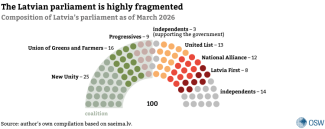
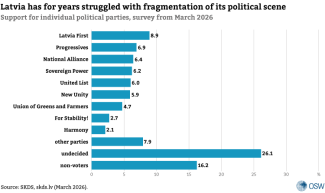
Latvia’s political system is centred on a unicameral parliament (Latvian: Saeima) with relatively broad powers. Alongside its legislative and oversight functions, it also holds constitutional authority to appoint officials and develop international cooperation. This gives it a strong institutional position relative to both the executive and the judiciary. It independently elects the head of state, as well as key officials and judges. However, the parliament’s strong position is weakened by the fragmentation of the domestic political scene. Despite a 5% electoral threshold, the parliament remains highly divided: between 13 and 19 electoral blocs typically contest elections, of which around 8–10 usually win seats. Most of these are alliances, often comprising small regional parties. In practice, this means that as many as a dozen or more parties can be represented in parliament.[1]
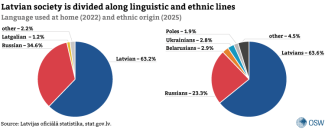
In addition to this fragmentation, another issue is the logic of political polarisation. The country has two distinct electorates: Latvian and Russian-speaking. This has resulted in a tradition of forming cordon sanitaire coalitions consisting of centre-right Latvian parties whose primary objective is to prevent parties supported by the Russian-speaking electorate from entering government.
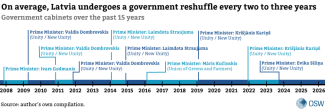
Centre-right governments led by Unity, known since 2018 as New Unity (Latvian: Jaunā Vienotība, hereafter: JV), have dominated Latvian politics over the past 15 years. Successive cabinets headed by this party were typically formed in coalition with the nationalist National Alliance (Latvian: Nacionālā apvienība, hereafter: NA),[2] the oligarchic Union of Greens and Farmers (Latvian: Zaļo un Zemnieku savienība, hereafter: ZZS) and smaller parties. The period from 2016 to 2019, when a prime minister from ZZS rather than JV led a coalition of these three parties, was an exception. The aim and the key unifying factor of these coalitions was to prevent the formation of a government involving the Social Democratic Party ‘Harmony’ (Latvian: Sociāldemokrātiskā partija “Saskaņa”),[3] which won successive elections in 2011, 2014, and 2018, and is regarded as pro-Russian.
During the current political era, spanning a decade and a half, successive cabinets have been formed on the basis of pragmatism rather than ideological alignment or the electoral interests of individual coalition partners. This arrangement has resulted in unstable cabinets and the need to carry out reshuffles every two to three years.
Coalition parties often agreed only on a political minimum, namely maintaining a pro-Western course in foreign and security policy, including strengthening relations with the EU and NATO, supporting Ukraine and attracting an allied presence on Latvian territory. The continuity of this course is personified by Edgars Rinkēvičs, who has served as president since 2023 and previously headed the Latvian foreign ministry for nearly 12 years, beginning in 2011.
However, the defeat of the moderately pro-Russian Harmony in the 2022 parliamentary elections, driven by shifts in attitudes (polarisation) among the Russian-speaking electorate,[4] did not alter the logic underpinning the formation of cordon sanitaire coalitions. On the contrary, social polarisation has intensified and the government led by New Unity continues to position itself as a defender of the country’s pro-Western course and as a safeguard against pro-Russian parties and populism. The latter has found a new embodiment in Latvia First (Latvian: Latvija pirmajā vietā, LPV), the party of former oligarch Ainārs Šlesers, who styles himself as a local version of Donald Trump.
The weakness and strength of executive power
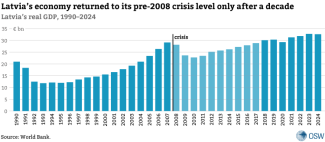
Limited programme coherence in domestic policy, particularly on economic issues, has exacerbated Latvia’s structural problems, including some of the most pressing challenges, such as the economic underdevelopment of the south-eastern regions and the continued reliance on the transit of goods between east and west as the primary driver of growth. Divergences between party platforms have also constrained the ability to make long-term investments, implement state reforms, and reorganise the economy.
Stagnation is evident in investments in rail,[5] and road infrastructure. Major EU-funded projects – Rail Baltica and Via Baltica – have been scaled down and have encountered significant delays. Another issue is the underfunding of the state-owned airline AirBaltic,[6] which has faced repeated crises. The construction of barriers along the borders with Russia and Belarus after 2021 provides an emblematic example of the difficulties involved in delivering infrastructure projects. Latvia took much longer to complete its project than Lithuania, a delay that resulted from the challenges of working in difficult terrain, including forest clearance in border areas, and from internal problems such as irregularities in public procurement procedures.[7]
The deficiencies of central-level politics are compounded by a distinctive system of local governance. Local governments often operate as ‘semi-autonomous fiefdoms’, where local leaders are sufficiently powerful to pursue quasi-independent foreign or economic policies, thereby exerting an influence on state policy that is disproportionate to their mandate.
A typical example of this phenomenon,[8] is the position of mayors in the cities of Courland. From 1988 to 2021, the Russia-linked oligarch Aivars Lembergs served as mayor of Ventspils and, at the same time, as leader of For Latvia and Ventspils (Latvian: Latvijai un Ventspilij), which continues to govern the city. His party is a key component of the Union of Greens and Farmers, represented in parliament. Since the late 1990s, Liepāja has been governed by the Liepāja Party (Latvian: Liepājas partija), which until 2022 was also part of ZZS. Māris Kučinskis, Latvia’s prime minister from 2016 to 2019, emerged from its ranks. During the rule of Harmony and Nils Ušakovs, who served as mayor from 2009 to 2019, Riga pursued its own policy in the areas of memory (the celebration of 9 May) and international relations (a partnership with Moscow), in defiance of the line set by the pro-Western central government. Aleksandrs Bartaševičs, the mayor of Rēzekne in Latgale from 2009 to 2026, remained in dispute with the central government from at least 2022 over issues such as memory and cultural policy.[9]
A state of bureaucrats?
The low quality of politics and the stagnation of economic life have resulted in persistently low levels of public trust in Latvian institutions. Trust indicators are, on average, 10 to 20 percentage points lower than the OECD average,[10] with the exception of trust in local government. According to OECD surveys conducted in 2023, only 12% of respondents believed that the political system allows ordinary people to influence government actions, a figure 18 percentage points lower than the OECD average.[11] In 2023, the least trusted Latvian institutions included political parties, at only 12.51%, or about half the OECD average.[12]
While available domestic opinion surveys have produced varying results, they confirm a significant decline in Latvians’ trust in politicians and in their confidence in government effectiveness. The main causes include unmet public expectations that emerged after Russia’s invasion of Ukraine and the radicalisation of political discourse in Latvia in recent years, both of which have reduced the effectiveness of parliament and government. The cabinet formed in 2022 by Krišjānis Kariņš (with Evika Siliņa serving as prime minister since 2023) planned reforms in the areas of energy, security, and education to strengthen the competitiveness of the Latvian economy, but had to confront a prolonged economic slowdown and persistent issues in the healthcare sector. Consequently, some of these planned reforms stalled, while others were abandoned; in recent years, the government has faced criticism from both the opposition and the public for inefficiency. Responding to accusations of low effectiveness, in early 2025 Prime Minister Siliņa announced a government ‘reset’ and a new programme. However, as of early 2026, the results remain limited, largely owing to internal disputes between coalition partners from ZZS and the left-wing Progressives party. According to surveys conducted last autumn, only 27.9% of respondents believed that the current cabinet should remain in office until the parliamentary elections, while more than half (56%) expected it to resign. The government has also faced pressure from the opposition, which has submitted formal motions of no confidence in the prime minister on six occasions since early 2025.[13]
Over the past four years, Latvia has experienced two highly polarising public debates. The first occurred after Russia’s invasion of Ukraine, when the Latvian state belatedly decided to implement de-Sovietisation measures. Some of these were high-profile acts, such as the removal of the ‘Monument to the Liberators of Soviet Latvia and Riga from the German Fascist Invaders’. Most of the changes encountered difficulties in implementation, particularly those aimed at introducing legislation enabling the government to revoke citizenship from individuals openly supporting the regime in Moscow. In practice, these provisions have proved to be either ineffective or extremely difficult to enforce.[14]
Legislation drafted under the influence of ‘patriotic fervour’ has deepened distrust between the Latvian majority and the Russian-speaking minority. As a result, political participation among the Russian-speaking segment of society has declined.[15]
The second shock came in the autumn of 2025, when, after hours of debate, parliament adopted a law on withdrawing from the so-called Istanbul Convention. In response, several thousand people took part in a demonstration in central Riga to protest against the Saeima’s decision.[16]
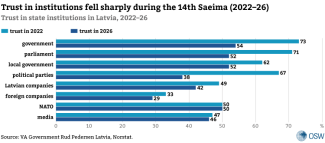
Low levels of public trust and the inability of state institutions to respond swiftly to societal needs,[17] are partly reflected in the protracted debate over ‘bloated bureaucracy’ in the country,[18] which gained renewed momentum when Donald Trump began his second presidential term in the United States and Elon Musk unveiled plans to establish the Department of Government Efficiency (DOGE). In the autumn of 2024, Latvian President Edgars Rinkēvičs identified the ‘super-normativism’ of the bureaucracy as the country’s main problem, arguing that its excessive growth was a factor constraining development.[19] Consequently, in the spring of 2025, Prime Minister Siliņa established a special body tasked with reducing bureaucracy.[20]
Paradoxically, Latvia’s public administration is not excessively large. The number of people employed in this sector is comparable to that in other Baltic (and Nordic) countries, although it is higher than the EU and OECD averages.[21] A far more significant issue is inefficiency, which stems from an operational logic that places primary emphasis on the legal correctness of processes, favouring formal compliance over substantive outcomes.[22] As a result, some reforms and modernisation plans remain in limbo, while most of those that are necessary and publicly supported have not been implemented consistently. This fuels a media narrative about an overgrown bureaucracy and reinforces corresponding public perceptions.
The problems of the Latvian state have been exploited by Russian propaganda disseminated through the media,[23] which has exaggerated real challenges to the point of absurdity, thereby creating a false image of a failed state dependent on the EU and contrasting it with the ‘wonderful years of Soviet prosperity’. The sustained promotion of the ‘failed state’ narrative[24] aims to discredit Latvia both internationally and domestically, thereby reinforcing persistently low levels of public trust.[25] At the same time, this has led to an extreme politicisation of the debate on state reform: even well-founded criticism of inefficiency or socio-economic problems is dismissed by the governing side as an attack on the state and as succumbing to Russian propaganda.[26]
Outlook: no breakthrough on the horizon
The Latvian state should move beyond the logic of cordon sanitaire coalitions, as the increasingly unsustainable model of isolating Russian-speaking parties is blocking vital reforms and coherent policymaking. Governments that have so far relied on a minimal political consensus and ‘marriages of convenience’, with narrow political interests and divergent regional interests hampering reform and development, should become a thing of the past. The key lies in at least partial depolarisation and the future formation of a governing coalition based on a shared ideological and programmatic foundation, offering a credible prospect of implementing the strategic changes needed for the country’s further development.
Structural reforms of the administrative apparatus that go beyond slogans about ‘cutting red tape’, are crucial for increasing its effectiveness. Their aim should be to accelerate decision-making and implementation, although this cannot be pursued in isolation from the quality of legislation adopted by the legislature. In the longer term, such reforms would enhance the efficiency of the state and also help to overcome the crisis of public trust.
The absence of necessary reforms has reduced the country’s resilience to external threats. As it borders Russia and Belarus, Latvia must contend with actions aimed at weakening social cohesion and further undermining trust in state institutions. Its priority should be both to preserve the existing capacity to mitigate the effects of political and economic pressure from neighbouring states and, in the longer term, to carry out reforms that strengthen societal resilience.
Despite growing dissatisfaction with the performance of the current governing coalition, the parliamentary elections scheduled for the autumn of 2026 are unlikely to bring about a radical change in Latvia’s political landscape. The course towards a centre-right cordon sanitaire coalition is likely to be maintained. Protests against the country’s withdrawal from the Istanbul Convention have revealed scope for cooperation between the nationalist right and populist forces, suggesting a gradual erosion of ethno-polarisation.
In the run-up to the elections, the increasingly liberal New Unity will seek to dissuade the nationalist right and its electorate from forming an alliance with the ‘Latvian Trumpists’, fearing a loss of influence over the composition of the future coalition. Most likely, New Unity will push for the creation of a new cordon sanitaire around Šlesers, as he continues to gain support among Russian-speaking voters and politicians. After the upcoming elections, parliamentary divisions are likely to re-emerge in a modified form, thereby prolonging the current impasse.
[1] The parties forming Prime Minister Evika Siliņa’s current three-party government are, for the most part, alliances of regional groupings. The centre-right New Unity, from which the prime minister hails, is in fact a coalition of four groupings, while the Union of Greens and Farmers is an alliance of three regional parties. Only the left-wing Progressives operate as a single, independent party.
[2] The National Alliance ‘All for Latvia!’ – ‘For Fatherland and Freedom/LNNK’ (Latvian: Nacionālā apvienība “Visu Latvijai!” – “Tēvzemei un Brīvībai/LNNK”).
[3] Until 2014, the party operated under the name Harmony Centre. In the 2026 elections, the Social Democratic Party ‘Harmony’ is once again running under that banner.
[4] In the 2022 parliamentary elections, Harmony’s conciliatory stance towards Russia’s invasion of Ukraine resulted in the party failing to cross the electoral threshold. For the Russian-speaking electorate, Harmony was too critical of Russia, while for Latvian voters it was not sufficiently firm in its criticism.
[5] V. Demidovs, ‘Eight out of 17 new trains are carrying passengers at present’, LSM, 22 February 2024, eng.lsm.lv.
[6] K. Arājs, ‘How important is air Baltic to the Latvian economy’, LSM, 21 November 2025, eng.lsm.lv.
[7] B. Chmielewski, J. Tarociński, ‘The Baltic states and Finland: fencing themselves off from Russia and Belarus’, OSW Commentary, no. 539, 15 September 2023, osw.waw.pl.
[8] B. Chmielewski, ‘Far behind Riga: Latvia’s problems with uneven development’, OSW Commentary, no. 498, 15 March 2023, osw.waw.pl.
[9] Until 2023, Bartaševičs was one of the more prominent members of the Social Democratic Harmony party. Following its electoral defeat in 2022, he founded his own local party – Together for Latvia (Latvian: Kopā Latvijai). At the national level, it forms part of the oligarchic Latvia First party.
[10] ‘OECD Survey on Drivers of Trust in Public Institutions. 2024 Results – Country Notes: Latvia’, OECD, 10 July 2024, oecd.org.
[11] Ibid.
[12] E. Brikmane, A. Nulle, ‘Uzticēšanās pētījums: cilvēkus uzrunā saprotami, pierādījumos balstīti lēmumi un cieņpilna komunikācija’, LV Portāls, 19 August 2024, lvportals.lv.
[13] B. Ozoliņa, A. Lazdiņa, ‘Premjere Silina iztur sesto neuzticības balsojumu’, LSM, 12 February 2026, lsm.lv.
[14] B. Chmielewski, ‘A lot of effort, not many results. Latvia’s belated de-Sovietisation’, OSW Commentary, no. 569, 6 February 2024, osw.waw.pl.
[15] M. Hiršs, ‘Řuņas neliks krieviem mīlēt Latviju’, Satori, 14 October 2025, satori.lv.
[16] A. Lazdiņa, V. Anstrate, ‘Pie Saeimas tūkstoši protestē pret Latvijas izstāšanos no Stambulas konvencijas’, LSM, 29 October 2025, lsm.lv.
[17] J. Plauka, ‘No padomju laikiem mantotais kūtrums. Saruna ar pētnieci Līgu Stafecku par cilvēku iesaisti lielās un mazās lietās’, LSM, 1 November 2024, lsm.lv.
[18] ‘Valsts prezidents: birokrātija Latvijā bremzē daudzus procesus’, ReTV, 4 August 2023, retv.lv.
[19] ‘Latvian president: We are stuck in ‘super-normativism’’, LSM, 22 October 2024, eng.lsm.lv.
[20] ‘Birokrātijas mazināšanai veidos darba grupu’, LSM, 10 March 2025, lsm.lv.
[21] Government at a Glance 2025: Employment in general government, OECD, 19 June 2025, oecd.org.
[22] I. Reinholde, M. Stučka, No disruption, no progress: Reforming Latvia’s public administration, LaSER, December 2024, domnicalaser.lv.
[23] The narrative portraying Latvia as a failed state periodically appears in online and social media.
[24] I. Siliņa, ‘Kremļa propagandā galvenais ir iestāstīt, ka citur ir sliktāk. Saruna ar ārpolitikas pētnieku Hiršu’, LSM, 8 February 2026, lsm.lv.
[25] M. Balodis, ‘Why is Latvia called a failed state?’, Centre for East European Policy Studies, 22 May 2020, appc.lv.
[26] L. Ozoliņa, ‘Latviešu emociju likumi: nevienlīdzības kurss’, Satori, 28 January 2026, satori.lv.