Latvia: Andris Kulbergs’ caretaker government
On 18 May, the Latvian parliament (Saeima) approved the government of Prime Minister Andris Kulbergs (see the Appendix for his biography) in a confidence vote. The new cabinet secured the support of 66 of the 100 MPs, while 25 voted against. This concluded the process of forming a new governing coalition, which had been under way since 14 May, following the collapse of the previous cabinet. The coalition comprises four parties: the centre-right New Unity (Latvian: Jaunā Vienotība, JV), the party of former Prime Minister Evika Siliņa; the nationalist National Alliance (Nacionālā apvienība, NA), the moderately conservative United List (Apvienotais saraksts, AS), represented by Kulbergs, and the Union of Greens and Farmers (Zaļo un Zemnieku savienība, ZZS). The left-wing Progressives (Progresīvie) moved into opposition.
The collapse of Siliņa’s government resulted from months of disagreements within the coalition. The process began in autumn 2025, when public protests broke out over a parliamentary debate on Latvia’s withdrawal from the provisions of the Istanbul Convention (see ‘Latvia’s governing coalition is falling apart: a dispute over the Istanbul Convention’). The crash of a Ukrainian drone, reportedly jammed by Russian forces, into fuel storage facilities near Rēzekne in eastern Latvia on 7 May served merely as a catalyst, accelerating the coalition’s final breakdown.
The new government is provisional and will remain in office for just under five months, until the swearing-in of the new parliament following elections scheduled for 3 October this year. The new prime minister’s priorities will be to ensure the country’s stability until the elections and to advance a limited number of key policy measures, including strengthening Latvia’s air-defence capabilities.
Commentary
- The government’s main aim is to maintain political stability in the run-up to the elections. Kulbergs’ cabinet (see Appendix) will focus on a small number of the country’s most pressing challenges. Political activity in the coming months is likely to be limited by the summer parliamentary recess and the campaign ahead of the autumn election. As a result, the prime minister’s key priorities will be to strengthen Latvia’s airspace security, stabilise the state-owned airline airBaltic and accelerate progress on the Rail Baltica project.
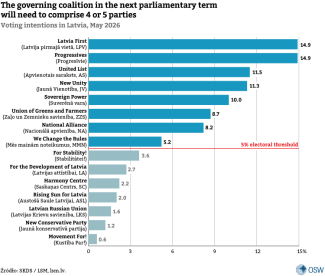
- The new prime minister’s political ambitions extend beyond the lifespan of the current caretaker government. His ability to build a coalition, secure an agreement relatively quickly and reach compromises, together with the strong support of President Edgars Rinkēvičs and favourable polling trends (see Appendix), has strengthened his position as a leading contender for the premiership after the autumn elections. However, in addition to the election result, his prospects will depend on whether he can manage tensions within the coalition and preserve its cohesion.
- Latvia’s pro-European and pro-Atlantic foreign and security policy is expected to remain unchanged. A key indicator of continuity is the retention of Foreign Minister Baiba Braže (New Unity). Politicians from her party have led the ministry without interruption since 2011. New Unity has also appointed Colonel Raivis Melnis, an active-duty officer in the Latvian armed forces, as defence minister. He previously served as a liaison officer at Latvia’s embassy in Kyiv and later as an adviser to Prime Minister Siliņa.
- Security is likely to be the dominant theme of the election campaign. The drone incidents in May have shifted public attention decisively towards defence and national security, sidelining earlier ideological debates concerning a possible withdrawal from the Istanbul Convention.
APPENDIX
Profile of the Prime Minister
Andris Kulbergs (born 26 May 1979) is a Latvian politician, entrepreneur and business executive. He entered parliamentary politics in 2022, winning a seat in the Saeima as a representative of the United List. He chaired the parliamentary committee investigating irregularities in the implementation of the Rail Baltica project and has been a vocal critic of excessive bureaucracy in the Latvian state administration. Before entering politics, he worked in the private sector, holding a number of senior management positions, including in companies involved in motor vehicle distribution. He studied in Riga and Tallinn.
Composition of the new government
- Prime Minister – Andris Kulbergs (United List)
- Minister of Finance – Māris Kučinskis (United List)
- Minister of Justice – Edvards Smiltēns (United List)
- Minister for Smart Administration and Regional Development – Edgars Tavars (United List)
- Minister of Foreign Affairs – Baiba Braže (New Unity)
- Minister of Defence – Raivis Melnis (independent; nominated by New Unity)
- Minister of Transport – Rihards Kozlovskis (New Unity)
- Minister of Health – Hosams Abu Meri (New Unity)
- Minister of Education and Science – Ilze Indriksone (National Alliance)
- Minister of Culture – Nauris Puntulis (National Alliance)
- Minister of the Interior – Jānis Dombrava (National Alliance)
- Minister of Climate and Energy – Jānis Vitenbergs (National Alliance)
- Minister of Economics – Viktors Valainis (Union of Greens and Farmers)
- Minister of Welfare – Reinis Uzulnieks (Union of Greens and Farmers)
- Minister of Agriculture – Uldis Augulis (Union of Greens and Farmers)