Ukrainian attacks on Russian logistics hubs. Day 1616 of the war

The change of Commander-in-Chief of the Armed Forces of Ukraine came at a time of intense Russian military pressure on several fronts (see: ‘Change of commander-in-chief of the Armed Forces of Ukraine’). Russian forces continued their operations near Dobropillia, Kostiantynivka and Lyman, while Ukrainian troops counterattacked in the Novopavlivka and Novooleksandrivka directions.
The situation is most difficult in and around Kostiantynivka. Fighting continues in the northern part of the urban area, where isolated pockets of Ukrainian resistance reportedly remain. Meanwhile, Russian assault groups are becoming increasingly active in Oleksiievo-Druzhkivka, north-west of the city. The position of Ukrainian forces across this entire sector continues to deteriorate, particularly as Russian troops are seeking to sever logistics routes north of Kostiantynivka.
Ukrainian counterattacks in the Novopavlivka and Novooleksandrivka directions have produced some local gains, but have failed to break through the Russian force grouping. According to Ukrainian sources, Russian troops have been pushed back near the village of Filiia and Ukrainian units have been advancing slowly in sectors between the Yanchur, Vorona and Vovcha rivers, reportedly aiming to move closer to the Huliaipole–Velyka Novosilka road. These operations have forced Russian units to undertake stabilisation efforts, but Ukrainian troops have yet to achieve their objective of directly threatening Russia’s supply system.

According to statements by Ukraine’s Air Force Command, between the evening of 21 July and the morning of 28 July, Russia launched 1,225 attack drones and decoys, 11 Iskander ballistic missiles, 16 cruise missiles and three anti-ship missiles. Ukrainian forces claimed to have destroyed or neutralised 1,060 drones, 13 cruise and anti-ship missiles and six ballistic missiles.
The deadliest air attack occurred on 24 July. It targeted a drone technology presentation organised by Armada, a Ukrainian association of unmanned systems manufacturers. The event, held in Kapitanivka near Kyiv, was reportedly attended by more than 300 military personnel, officials and representatives of foreign defence companies. A coordinated missile strike involving three ballistic missiles killed 11 people and injured more than 100. The Prosecutor General’s Office of Ukraine announced that it had opened an investigation, detained the event’s organiser and charged him with illegally arranging the gathering without adequate security measures. An employee of a Polish company operating in Ukraine’s defence sector, who was not a Polish citizen, was reportedly among those killed in the attack.
Russian forces continued to strike port infrastructure in Odesa, Chornomorsk and Mykolaiv, as well as vessels off the Black Sea coast. On 22 July, Ukraine’s State Border Guard Service reported that a Russian drone had struck the stern of the bulk carrier Golden Rose in the Black Sea, causing a major fire; all 16 crew members were evacuated. On 25 July, a civilian vessel sailing under the flag of Palau was attacked while leaving a port in Odesa Oblast. On 27 July, the state-run Ukrainian Sea Ports Authority reported overnight attacks on civilian merchant vessels in the port of Mykolaiv, which killed one person and injured several others. On 26 July, Oleh Kiper, head of the Odesa Oblast Military Administration, announced that the merchant vessel Golden Leo had sunk off the coast of Odesa after being struck near Chornomorsk on 19 July. Nine crew members and a Ukrainian harbour pilot were killed in the attack (see: ‘Russian strike on Ukrainian maritime transport. Day 1609 of the war’).
Russia also continued its air attacks on energy infrastructure in the Dnipropetrovsk, Kharkiv and Chernihiv oblasts. Zaporizhzhia remains a daily target for attacks, primarily involving aerial glide bombs. Ivan Fedorov, head of the Zaporizhzhia Oblast Military Administration, stated that air raid alerts remain active in Zaporizhzhia Oblast for around 90% of the time and in some districts continue uninterrupted around the clock. On 25 July, the Italian Embassy in Kyiv reported that Russian shelling of Kherson earlier that day had destroyed a historic building that housed the Italian consular mission between 1906 and 1918. One person was killed and two were seriously injured in the attack. On 26 July, a Russian drone strike on a supermarket killed two people, including a young girl, and injured 25 others.
The Romanian government reported that its F-16 fighters jets shot down three drones that had violated the country’s airspace over a three-day period from 24 to 26 July. The incidents resulted in no casualties or material damage. An investigation established that the drone shot down on 24 July was a Russian Shahed. Examination of the other two aircraft is ongoing. Romanian President Nicușor Dan said that he would lodge a diplomatic protest with Russia. According to Romania’s Ministry of National Defence, Russian drones have violated Romanian airspace on 33 occasions since the start of Russia’s full-scale war, with fragments or complete drones recovered from around 50 locations across the country. During the same period, more than 100 Russian attacks on Ukraine have taken place near the Romanian-Ukrainian border. 18 drone incursions have been recorded in 2026 alone.

On 21 July, Bloomberg reported that the Kazakh government had announced a suspension of oil shipments to the main export terminal on the Black Sea following a series of Ukrainian attacks on tankers. The Caspian Pipeline Consortium terminal near Novorossiysk had reportedly stopped accepting crude because shipowners were concerned about the safety of their vessels. According to Bloomberg, if the disruption had continued until the end of the week, Kazakh companies would have been forced to reduce production, as around 80% of the country’s oil exports pass through the terminal (see: ‘Ukrainian attacks on the CPC oil pipeline: outlook for Kazakhstan’s oil sector’). On 27 July, the Kazakh government announced that the terminal had resumed operations.
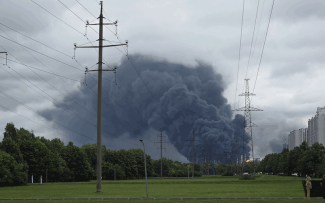
On 22 July, the Russian daily Kommersant reported that Ukrainian drone attacks carried out that day had damaged four Wildberries logistics centres – in Elektrostal, Kotovsk, Krasnodar and Nevinnomyssk – with a combined area of 552,000 square metres, equivalent to around 10% of the company’s warehousing infrastructure. According to OSINT sources, Wildberries facilities in Shushary and Novosaratovka in Leningrad Oblast were struck on 24 July. On the same day, the company’s management reported an attack on its logistics centre in Simferopol. On 25 July, Russian sources reported an apparent attempted drone attack on Wildberries’ largest warehouse in Yekaterinburg. However, there were no reports on the effects of these strikes.
On 25 July, the Security Service of Ukraine (SBU) announced that it had carried out a drone attack on an oil platform at the Filanovsky field and on two sanctioned cargo vessels, the Port Olya 2 and the Begey. According to the SBU, the ships were used to transport military cargo between Iran and Russia. On the same day, the Iranian Ministry of Foreign Affairs accused Ukraine of attacking an Iranian merchant vessel. An explosion reportedly occurred on board, killing one sailor and injuring another. Iran described the strike as an act of aggression and a violation of the United Nations Charter. In an interview with Sky News on 27 July, Ukrainian President Volodymyr Zelensky stated that Iran is, in effect, participating in the war against Ukraine because it has supplied Russia with thousands of Shahed drones, production technology and other weapons since the start of the full-scale invasion.
On 23 July, agents of Ukraine’s HUR military intelligence service reportedly carried out an operation targeting the elite Russian drone unit ‘Rubikon’. Three drone operators were reportedly killed and one injured when an explosive device was detonated remotely in the occupied town of Dniprorudne.

The SBU uncovered two Russian agent networks in Kyiv and Dnipro that had allegedly activated more than 1,000 Starlink terminals for Russian forces. On 24 July, two FSB agents were detained in the Ukrainian capital after they had registered 76 devices using forged Ukrainian passports and the assistance of a postal worker. The following day, a suspect was arrested in Dnipro for activating more than 1,000 terminals using other people’s personal details. The SBU stated that it had blocked all devices linked to the two investigations.
On 27 July, the SBU announced that it had detained two FSB agents in Kharkiv Oblast who were preparing to assassinate dozens of Ukrainian military personnel. According to investigators, the suspects, who had been recruited via the Telegram messaging app, rented a house and circulated invitations to a charity event where they planned to lace drinks with poisonous substances.
On 21 July, the SBU prevented a double explosion in the car park of a residential estate in Ivano-Frankivsk. The plot reportedly involved detonating the first device remotely among parked cars, followed by a second explosion after residents, police officers, paramedics and rescue workers had arrived. A local unemployed man recruited by Russian intelligence services had allegedly hidden the devices in cooking pots. Each contained 6 kg of explosives and hundreds of metal bolts to increase their destructive impact.
The following day, the SBU detained two suspects who were allegedly preparing an act of sabotage on a railway line in Chernihiv Oblast. They were found in possession of two improvised explosive devices that they intended to plant under the tracks. According to the investigation, the principal operative was a mobilised resident of Kyiv who had left his military unit without authorisation.

On 21 July, Britain’s BAE Systems announced that it had signed a licensing agreement with an undisclosed Ukrainian company for the production of L119 105mm light towed howitzers for the Armed Forces of Ukraine.
On 22 July, the European Council announced that EU member states had approved the United Kingdom’s participation in a loan facility to support Ukraine. As a result, Kyiv will be able to use loan financing to procure key defence-related products from the United Kingdom.
On 23 July, during a visit to Kyiv, Irish Prime Minister Micheál Martin announced €125 million in support for Ukraine, including €100 million for the delivery of priority non-lethal military equipment and €25 million to support the reconstruction and protection of critical infrastructure.
On 24 July, the Ukrainian defence news outlet Defense Express reported that Poland’s WB Group had supplied the Armed Forces of Ukraine with the Warmate 5 weapons system. It is likely operated by the Main Directorate of Intelligence of the Ministry of Defence of Ukraine.
On 27 July, during President Zelensky’s visit to London for talks with the new British Prime Minister, Andy Burnham, officials announced that an undisclosed Ukrainian company would receive licences to produce the Stone Cloak electronic warfare system.
According to Reuters, the Trump administration has informed members of Congress that it will not complete the disbursement of $400 million allocated for military assistance to Ukraine in the 2026 fiscal year until the 2029 fiscal year. This would indicate that the United States is reluctant to provide Ukraine with any form of material support for the remainder of President Donald Trump’s term.

On 21 July, the SBU, the State Bureau of Investigation (SBI) and the National Police announced the detention of 15 organisers of draft evasion schemes operating across several oblasts. The schemes involved providing fictitious employment, falsifying medical records, fraudulently obtaining carer status, facilitating illegal border crossings and disclosing the locations of mobilisation teams. For example, in Sumy Oblast, men liable for military service were employed as ‘lecturers’ at a fictitious educational institution, a scheme that reportedly benefited more than 200 people.
On 28 July, the SBI announced that it had charged two soldiers from the 425th Separate Assault Regiment “Skelya” in connection with the brutal treatment of fellow servicemen. According to investigators, last May the suspects decided to take it upon themselves to punish two soldiers for disciplinary breaches. They repeatedly struck the victims before locking them in an outbuilding, where the abuse continued. Both victims were admitted to hospital with traumatic brain injuries and other injuries. This is another example of serious dysfunction within the unit (for more, see: ‘A crack in the “Skelya”: disciplinary and reputational damage in the so-called Syrskyi regiments’).
Dmytro Lubinets, the Ukrainian Parliament Commissioner for Human Rights, reported four cases of murder at territorial recruitment centres in the Kyiv and Dnipropetrovsk oblasts. He identified Zakarpattia as the oblast with the most widespread human rights violations and reported numerous irregularities in the Odesa and Dnipropetrovsk oblasts, with particularly egregious cases in Lviv Oblast. By contrast, he offered a positive assessment of the Kirovohrad and Khmelnytskyi oblasts, noting that they rank among the leading regions in terms of mobilisation rates relative to population size while recording relatively few violations.

On 25 July, President Zelensky stated that, according to intelligence reports, Russia plans to expand mobilisation by a further 300,000–500,000 people after the State Duma elections on 21 September. The Ukrainian government estimates that 221,000 people joined the Russian armed forces in the first seven months of this year, against estimated losses of 225,500. On 27 July, the Russian government published a presidential decree increasing the strength of the Russian armed forces to 2.43 million personnel from 1 August, including 1.535 million service members. This marks the third increase in military personnel numbers in 2026.