Ukraine: suspension of shipping to Black Sea ports and the associated risks
On 22 July, Ukraine’s Minister of Agrarian Policy, Taras Vysotskyi, announced that no commercial vessel had entered Ukraine’s Black Sea ports that day. Shipowners suspended sailings over concerns about the safety of their vessels following an intensification of Russian strikes. On 19 July, an attack on the Golden Leo killed nine people and the vessel sank on 26 July. Foreign Minister Andrii Sybiha described the Russian attacks as “deliberate economic and humanitarian terror.” Earlier, media reports informed that insurers had stopped issuing new policies for vessels bound for Ukrainian ports. The Black Sea ports are Ukraine’s main export gateway, handling around 95% of the country’s grain exports as well as significant volumes of iron ore.
It remains unclear how long the suspension will last. Shipping could resume once insurers raise premiums to reflect the increased risk. In that case, the disruption is unlikely to have a significant impact on Ukraine’s annual export volumes, although it would reduce the profitability of agricultural production. A prolonged suspension, however, would create a major challenge for Ukraine. The alternative route through the Danube ports lacks sufficient capacity and involves higher transport costs. If this scenario materialises, Ukraine would likely seek to redirect exports through Polish and other Baltic ports. This would most likely create congestion at the Polish-Ukrainian border and prompt renewed efforts to persuade neighbouring countries to lift their embargoes on Ukrainian agricultural products.
Commentary
- In the short term (over the coming few months), the suspension of shipping to Odesa is likely to have only a limited impact on Ukraine. The wheat, barley and rapeseed harvest is currently under way, while the maize and sunflower harvest, which totalled 41 million tonnes last year, will begin in the autumn. Ukraine also has substantial grain storage capacity. According to Elevatorist, the country has around 1,200 grain elevators with a combined capacity of nearly 53 million tonnes. The actual capacity is likely to be higher, as this figure does not include smaller silos. According to estimates by the USDA Foreign Agricultural Service (FAS), grain and oilseed stocks stood at 6.6 million tonnes at the beginning of July. This means there is considerable capacity to accommodate the new harvest. At the same time, reduced export capacity will put downward pressure on farmgate prices, negatively affecting agricultural producers, particularly smaller farms that lack storage facilities.
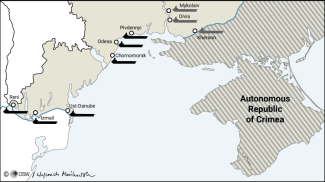
- In the longer term, Ukraine has no viable substitute for its Black Sea ports. Cargo flows through the Danube ports, primarily Izmail and Reni, would almost certainly increase, although their capacity is limited. At their peak in 2023, they handled nearly 3 million tonnes of cargo per month, around 80% of which consisted of agricultural products. Most of the grain was transported by barge to the Romanian port of Constanța, where it was transhipped onto larger vessels. Additional deliveries from southern Ukraine reached Constanța by rail and road, allowing the port to handle a record 14 million tonnes of Ukrainian grain in 2023. The launch of the Black Sea corridor later that year (see ‘Ukraine: the new Black Sea corridor is a success’) significantly reduced the role of the Danube ports because their logistics are more expensive and more complex than those of the Greater Odesa ports (Odesa, Pivdennyi and Chornomorsk; see map). Overall, Ukraine’s Black Sea ports handled 73.3 million tonnes of cargo in 2025, compared with just 8.9 million tonnes at the Danube ports. The situation is further complicated by the Danube’s record low water level, which has reduced barge carrying capacity by up to 60%.
- Redirecting exports through Baltic ports in Poland, Lithuania and Germany would also pose significant logistical challenges. Transporting grain by road over longer distances is uneconomic and would create severe congestion on roads and at border crossings. Rail capacity is also limited on both sides of the Polish-Ukrainian border. Although new transhipment terminals linking the standard- and broad-gauge rail networks have been built in recent years, and major global shipping companies such as Maersk and MSC have expanded their presence in western Ukraine, these improvements have not fundamentally altered the situation. A more significant breakthrough is expected only after the planned extension of the standard-gauge (1,435 mm) railway from Mostyska to Sknyliv, near Lviv, which is scheduled for completion in 2027, although delays appear likely. Rail transport also continues to face operational difficulties stemming from cooperation with Ukraine’s state railway monopoly, Ukrzaliznytsia (UZ), particularly in the allocation of transport slots. In addition, Poland’s PKP LHS (PKP Broad Gauge Metallurgy Line), which operates the broad-gauge railway linking Hrubieszów on the Ukrainian border with Sławków in southern Poland, has encountered repeated difficulties in negotiations with its Ukrainian counterpart in recent years, complicating the stable operation of the route.
- Agricultural and food exports are critical to Ukraine’s economy. In the first half of 2026, they were worth $12.5 billion, accounting for nearly 60% of the country’s total exports. In 2025, maritime transport handled more than 85% of food exports by volume, while the share for grain reached 95%. Beyond agriculture, any prolonged disruption would also affect iron ore exports. In 2025, Ukraine exported more than 16 million tonnes of iron ore to China, worth $1 billion. Black Sea ports play a less important role in imports, although they remain a key entry point for fertilisers, with China being a major supplier.
- If shipping is not resumed in the near future, Kyiv is likely to renew its efforts in Brussels to secure the removal of the import embargoes imposed by Poland and Hungary, as well as the licensing requirements applied by Romania, Bulgaria and Slovakia to Ukrainian agricultural products. The restrictions on grain and oilseed imports introduced in 2023 had only a limited impact on Ukraine because they coincided with the reopening of three Black Sea ports. Any decision to lift the embargoes could once again result in large volumes of Ukrainian agricultural products entering neighbouring countries, as happened in 2022–2023, when Poland, Hungary, Slovakia and Romania imported a combined 8.5 million tonnes of Ukrainian grain.
Map. Ukraine’s Black Sea ports