Ukraine: new government overshadowed by a controversial dismissal
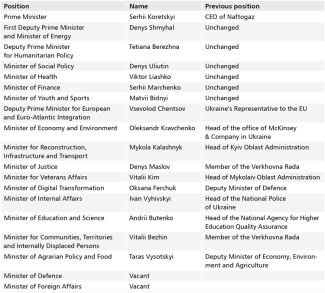
On 16 July, the Verkhovna Rada approved Serhii Koretskyi as prime minister by a majority of 289 votes and confirmed the composition of his cabinet. The new government reversed the merger of two ‘super-ministries’. The Ministry of Economy, Environment and Agricultural Policy was split into the Ministry of Economy, headed by Oleksandr Kravchenko, and the Ministry of Agrarian Policy, led by Taras Vysotskyi. The outgoing minister, Oleksii Soboliev, is expected to become deputy head of the Presidential Office for Economic Affairs. The Ministry for Development of Communities and Territories was also divided into two separate ministries: the Ministry of Reconstruction, Infrastructure and Transport, headed by Mykola Kalashnyk, and the Ministry of Communities, Territories, and Internally Displaced Persons, led by Vitalii Bezhin. Other notable changes include Vsevolod Chentsov replacing Taras Kachka as Deputy Prime Minister for European and Euro-Atlantic Integration, and Ivan Vyhivskyi succeeding Ihor Klymenko as Minister of Internal Affairs (see Appendices 1 and 2).
Several senior ministers retained their positions, including First Deputy Prime Minister and Minister of Energy Denys Shmyhal and Finance Minister Serhii Marchenko. The defence and foreign affairs portfolios remain vacant. Under the constitution, the president nominates candidates for both posts separately, but he has yet to do so. On the evening of 16 July, Volodymyr Zelensky announced that Yevhenii Khmara, the acting head of the Security Service of Ukraine (SBU), would serve as acting minister of defence. Andrii Sybiha, minister of foreign affairs in Yuliia Svyrydenko’s government, remains the most likely candidate for the post.
The government’s new line-up failed to generate the positive media coverage the president had hoped for, as the reshuffle was overshadowed by his decision not to offer a cabinet post to Mykhailo Fedorov, the outgoing minister of defence and the most popular politician in the previous cabinet (see: ‘Zelensky vs Fedorov: Ukraine’s Defence Minister dismissed’). This move drew widespread media criticism and sparked protests attended by thousands of demonstrators in the country’s largest cities. Koretskyi enjoys a well-deserved reputation as an effective manager, having demonstrated his abilities while leading the state energy companies Ukrnafta and Naftogaz.
Commentary
- The new prime minister’s professional achievements are beyond dispute. In particular, as head of Ukrnafta, he increased the company’s revenues by a factor of 2.5 through reforms that curtailed corrupt rent-seeking. Whether he will prove equally successful as prime minister remains an open question. He has never held a position in public administration, which may prove a serious handicap. The same applies to the new minister of economy, Oleksandr Kravchenko, who previously headed the office of McKinsey & Company in Ukraine and likewise has no experience in public administration.
- The failure to nominate Mykhailo Fedorov undermined the impression that the cabinet reshuffle marked a political turning point. Instead, it drew widespread media criticism, sparked protests in the country’s major cities and caused turmoil in the Verkhovna Rada, preventing the confirmation of Koretskyi’s full cabinet. Contrary to Zelensky’s earlier announcements, he ultimately decided not to submit the nominations of Ihor Klymenko, the outgoing minister of internal affairs, for minister of defence and Andrii Sybiha for minister of foreign affairs, out of concern that Klymenko lacked sufficient parliamentary support. This indicates that the government reshuffle has slipped beyond Zelensky’s control, with even senior and loyal members of his team, such as Klymenko, caught up in the fallout. As a result, two key cabinet posts remain vacant, while the Verkhovna Rada is not scheduled to sit again until 18 August.
- The dismissal of Svyrydenko, who held office for less than a year, had been widely expected, although its timing came as a surprise (see: ‘Ukraine: new government led by Yuliia Svyrydenko’). Her departure, along with that of Deputy Prime Minister and Minister for Reconstruction Oleksii Kuleba, marks the latest stage in the removal of officials associated with former head of the Presidential Office Andrii Yermak. The appointment of Koretskyi as the new prime minister can be seen as part of preparations for what is likely to be the most challenging winter of the war to date, during which the resilience of Ukraine’s energy sector will be of critical importance.
- The existing model of governance is unlikely to change, with the president and the Presidential Office remaining the principal decision-making authority and the government’s role limited to carrying out their decisions. However, Koretskyi may enjoy greater autonomy than his predecessor. The main criticism levelled at Svyrydenko was that she lacked a reputation for devising innovative and effective policy solutions. Unlike the government she formed a year ago, when the reshuffle was largely limited to ministers exchanging portfolios or the promotion of deputy ministers, the new cabinet includes several new faces.
Appendix 1. Composition of Serhii Koretskyi’s government
Appendix 2. Biographies of the Prime Minister and the Deputy Prime Minister for European and Euro-Atlantic Integration
Serhii Koretskyi – born in Lutsk in 1978. He graduated from Lutsk Technical University in 2001 and from Ivano-Frankivsk National Technical University of Oil and Gas in 2005. In 2019, he completed the Executive MBA programme at the Kyiv-Mohyla Business School. From 1997 to 2018, he worked for the oil trading company Kontynium, steadily rising through the ranks to become chairman of the management board in 2007. In 2013, he was appointed chief executive officer of WOG Group, part of Kontynium and the owner of one of Ukraine’s largest petrol station chains. Between 2019 and 2022, he ran his own business, a chain of coffee bars. In 2022, he took over as CEO of the state-owned oil company Ukrnafta, steering it to record financial results. In April 2025, he became CEO of the state-owned Naftogaz conglomerate, which includes Ukrnafta. Under his leadership, the company accumulated sufficient gas reserves ahead of the 2025/26 heating season, enabling Ukraine to get through last winter without major disruption despite regular Russian attacks on its gas infrastructure. He has no political base of his own. He is married, has an adult daughter and speaks English.
Vsevolod Chentsov – Deputy Prime Minister for European and Euro-Atlantic Integration – born in Drohobych in 1974. He graduated in law from Ivan Franko National University of Lviv in 1996 and joined the Ministry of Foreign Affairs. He held secretarial posts at the Ukrainian Embassy in Turkey between 1997 and 2002 before taking up a series of senior legal posts at the ministry’s headquarters. Between 2002 and 2005, he headed the Treaties Unit and served as Deputy Director of the Legal Department. Between 2005 and 2006, he was Deputy Director of the Legal Department, Head of the Unit of Special Legal Issues and Deputy Director of the Legal Division at the Ministry of Foreign Affairs. In subsequent years, he held a number of diplomatic postings abroad, serving as Minister-Counsellor at the Ukrainian Embassy in Poland (2006–07) and Deputy Head of Ukraine’s Mission to the European Union (2007–11). From 2011 to 2017, he was Director of the European Union Department at the Ministry of Foreign Affairs. In 2017, he became head of a diplomatic mission for the first time, taking up the post of ambassador to the Netherlands while concurrently serving as Ukraine’s Permanent Representative to the Organisation for the Prohibition of Chemical Weapons (OPCW). Since August 2021, he has headed Ukraine’s Mission to the European Union and the European Atomic Energy Community. He is regarded as a leading specialist in European integration, with nearly two decades of experience in the field. He has no political base of his own. He is married, has a daughter and speaks English.