An intensification of air strikes instead of an offensive. Day 1553 of the war

Russian forces are making slight gains around Kostiantynivka: they have advanced, most likely capturing Illinivka and Berestok, situated to the south and south-west of the town, as well as Novodmytrivka to its north-east. Russian forces are continuing operations aimed at encircling Kostiantynivka, attempting to cut off Ukrainian supply routes.
The Russians also continued their advance in the Huliaipole direction, reaching Verkhnya Tersa and Vozdvyzhivka, where they encountered resistance from the defenders. These advances are most likely the result of small groups of Russian soldiers infiltrating the front line; however, they do not (contrary to statements published by the Russian Ministry of Defence) indicate that full control of the area has been achieved.
Despite the Russian forces maintaining the initiative, their current advances are significantly smaller than in the corresponding periods of previous years. Whilst one cannot speak of a breakthrough or of Ukraine seizing the initiative (see ‘Mutual escalation of air strikes. Day 1546 of the war’), the pace of the Russian offensive has slowed significantly, a fact also noted by Russian sources. In previous seasonal cycles, the onset of spring marked a period of increased activity by Russian forces, which took advantage of favourable weather and terrain conditions. The lack of any visible acceleration in the pace of advances on the front may indicate a deterioration in Russian offensive capabilities due to the growing number of successful attacks on its rear areas. In recent weeks, Ukrainian forces have significantly intensified attacks by medium-range unmanned aerial vehicles (approx. 50–250 km) on Russian logistics hubs, troop concentrations, air defence systems, ammunition depots and command posts. These attacks pose a threat to the Russian military’s operational rear and enable the creation of ‘corridors’ for missile and drone strikes deep into Russian territory.

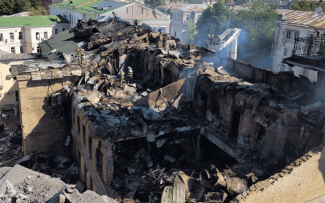
On the night of 23–24 May, Russia carried out one of the largest concentrated and combined missile and drone attacks on Ukraine, with Kyiv and Kyiv Oblast as the main targets. According to the Ukrainian Air Force Command, Russia used 90 missiles and 600 drones, whilst the attack itself comprised several waves of strikes involving unmanned aerial vehicles, ballistic missiles and cruise missiles. According to a statement by the authorities in Moscow, the strike was in retaliation for the attack on a student dormitory in Starobilsk (see below). As a result of the Russian strike, four people were killed and nearly 100 injured across the country, whilst in Kyiv alone over 80 people were injured, including three children, and two people were killed. Around 30 residential buildings were damaged or destroyed. Cultural and administrative buildings in the capital were also hit, including the Art Museum, the Kyiv Opera House, the Valeriy Lobanovskyi Dynamo Stadium, the Chernobyl Museum, the Ministry of Foreign Affairs building, and the premises of the Security Service of Ukraine and the Ukrainian Army’s Land Forces Command. One of the strikes damaged the residence of the Albanian ambassador, posing a direct threat to his life. Industrial facilities were also targeted, including the Artem electronics plant. During the attack, Russia used an Oreshnik ballistic missile, which was most likely aimed at the disused airport in Bila Tserkva. Some sources reported a second Oreshnik strike, which quickly became part of the information war. Initial reports claimed that it had struck Druzhkivka, from where the defence south of the Sloviansk and Kramatorsk conurbation is directly coordinated. The following day, some Ukrainian sources began to deny that a second attack using the Oreshnik had taken place and/or to place the missile’s impact on the Russian side of the front line – in Donetsk or its outskirts.
Over the past week, there was also a massive attack during the night of 20–21 May and throughout the following day. Russia carried out strikes in several regions of Ukraine, hitting, among other things, residential buildings, businesses and other civilian facilities. The most serious consequences were reported in Konotop in Sumy Oblast, where a Russian drone struck a multi-storey residential building. One woman was killed and at least 11 people were injured. Casualties were also reported in the Donetsk, Zaporizhzhia and Chernihiv oblasts. In total, according to the Ukrainian Air Force Command, between the evening of 19 May and the morning of 26 May, Russia used 1,586 Shahed-type drones and 91 cruise and ballistic missiles. Ukraine claimed to have neutralised 1,438 drones and 55 missiles.

During the night of 21–22 May, the Ukrainian Armed Forces carried out a strike on the town of Starobilsk in annexed Luhansk Oblast. As a result of the attack, which involved the use of drones, the buildings of a local vocational training centre and, most likely, an adjacent student hall of residence were destroyed. According to Russian reports, 21 people aged between 18 and 21 were killed under the rubble of the second building. The Ukrainian side stated that the target of the strike was “one of the headquarters of the Rubicon unit” – the main structure within the Russian Ministry of Defence responsible for the adaptation and use of various types of drones. In response to the attack, Vladimir Putin ordered the Russian Armed Forces to prepare a retaliatory strike against Ukraine, which was carried out on 24 May. Furthermore, on 25 May, the Russian Foreign Ministry stated that, in response to the “terrorist act in Starobilsk”, the Russian army was launching “consistent, systematic strikes” against enterprises of the Ukrainian military-industrial complex in Kyiv and against “decision-making centres”. On the same day, in a conversation with US Secretary of State Marco Rubio, Russian Foreign Minister Sergey Lavrov reportedly warned the American side about strikes on decision-making centres in Ukraine and called for the “evacuation of diplomatic personnel”.
On 20 May, the Ukrainian General Staff reported a successful drone strike on the Lukoil-Nizhegorodnefteorgsintez refinery near Kstovo in Nizhny Novgorod Oblast. A fire reportedly broke out at the facility, which had been targeted for the second time in recent days. Russian Telegram channels also reported an attack on the same day on the Nevinnomyssk Azot plant in Stavropol Krai, which is one of the largest producers of fertilisers and chemicals used in the manufacture of explosives. The local authorities denied the strikes, stating that air defences had repelled the air raid and that the damage was caused by falling debris. A day later, Ukrainian forces struck an oil refinery in Syzran in Samara Oblast, over 800 km from the border with Ukraine. According to the Ukrainian side, the strike caused a fire at the facility. The governor of Samara Oblast confirmed the attack but denied that the refinery had been damaged.
On 23 May, Ukrainian forces carried out night-time drone strikes on the Metafrax Chemicals plant in Perm Krai and oil infrastructure in Novorossiysk on the Black Sea. Extensive fires reportedly broke out at both sites. Metafrax is a key player in the Russian chemicals industry, and it supplies companies involved in the manufacture of aviation equipment, drones, rocket engines and explosives. Following the strike, production at the plant was reportedly suspended.
On 24 May, Kyiv reported a strike on the oil transhipment point at the Tamanneftegaz oil terminal in Volna, Krasnodar Krai. According to the defenders, the patrol vessel “Pytlivy” in Novorossiysk was also hit, but there has been no confirmation of these reports so far. On the same day, the “Alpha” Special Operations Centre of the Security Service of Ukraine (SBU) reportedly attacked the Vtorovo production and dispatch station in Vladimir Oblast. This facility, owned by the state-run pipeline operator Transneft, is a key hub in the main pipeline system for petroleum products, supplying fuel to large fuel depots around Moscow and to Sheremetyevo, Domodedovo and Vnukovo airports.
According to an analysis published on 21 May by the Russian-language website Vot Tak, Ukraine has carried out at least 158 strikes on Russian refineries since the start of the full-scale war. The attacks targeted 24 of the 33 facilities with a processing capacity of over 1 million tonnes of crude oil per year. No such strikes were recorded in the first year of the war; there were four in 2023, 34 in 2024, 88 in 2025, and already 33 before the end of May this year. The refineries in Ryazan and Saratov were the most frequently targeted – 15 times each. Refineries in Krasnodar Krai also remained regular targets: Afipsky, Ilsky and Tuapse, which were struck 12 times each. According to Vot Tak, there are practically no large refineries left in the European part of Russia – i.e. facilities with a capacity exceeding 10 million tonnes – that have not previously been attacked by Ukraine. The only large facilities of this class not affected by attacks are those beyond the Urals: Omsk and Angarsk.

In an interview published on 19 May, the Commander-in-Chief of the Armed Forces of Ukraine, General Oleksandr Syrskyi, reported that the number of offensive operations and counterattacks carried out by the Defence Forces had begun to exceed the corresponding activity of Russian troops. Syrskyi attributes this both to a decline in the intensity of Russia’s operations and to the increased activity of Ukrainian units implementing the principle of ‘active defence’, i.e. counterattacking where necessary and launching offensives where possible. He emphasised that, during the earlier operation in the Oleksandrivka sector, which concluded at the end of April, the Ukrainians were said to have liberated approximately 500 km² of territory and 12 settlements, a claim not even corroborated by Ukrainian OSINT sources. He noted, however, that this did not signify an operational breakthrough, but rather a change in the format of operations.
On 19 May, the Commander-in-Chief of the Armed Forces of Ukraine, General Oleksandr Syrskyi, announced that the Ukrainian army has sufficient manpower to implement regular rotations every two months. He emphasised that analyses had been carried out regarding the number of soldiers in combat positions and personnel deployed in operational areas. The rotation process will be subject to regular monitoring. To this end, it has been agreed that the 15th day of each month will be the date for monitoring the implementation of rotations in military units. The issue of service conditions and troop rotations became the subject of public debate following reports concerning soldiers of the 14th Brigade fighting on the Kharkiv front. According to accounts from their families, the soldiers had been struggling with serious logistical problems for eight months, including shortages of food and drinking water. Following this information, the General Staff of Ukraine announced the dismissal of the commanders of the 14th Brigade and the 10th Corps. The reasons cited were irregularities in reporting the situation on the front line, the loss of positions, and errors in the organisation of supplies for the soldiers.
Ukraine is continuing to expand its defence infrastructure along the entire border with Belarus, even though – as the Ukrainian authorities emphasise – there is currently no direct military threat from that country. The measures were announced on 20 May by Andriy Demchenko, spokesperson for the State Border Guard Service of Ukraine. The work involves the expansion of defensive fortifications, the creation of new minefields and the modernisation of existing security measures. Demchenko noted that Ukraine continues to view the Belarusian border as a potential threat due to Minsk’s close cooperation with Moscow. On 21 May, the Security Service of Ukraine (SBU) launched large-scale counter-intelligence operations in the northern regions of Ukraine (Chernihiv, Kyiv, Zhytomyr, Volyn and Rivne oblasts). The aims of the operation are to counteract subversive, sabotage and terrorist activities and to prevent the enemy from infiltrating border areas. Officers will carry out increased checks on citizens, inspect vehicles and search selected premises for materials that may pose a security threat. Temporary restrictions on traffic and movement may also be imposed in certain places.
Tensions were heightened by Russian-Belarusian exercises involving the use of tactical nuclear weapons, which took place between 18 and 21 May (see ‘Nuclear force exercises in Russia and Belarus’). Previously, President Zelensky had warned that Russia might be preparing attacks on Ukrainian ‘decision-making centres’, as well as potential offensive operations from Belarusian territory targeting Kyiv or NATO countries. Kyiv’s emphasis on the threat from Belarus is intended to undermine Lukashenka’s attempts to break out of international political and economic isolation.

General Syrskyi reported on 20 May during a meeting of the Ukraine–NATO Council in Brussels that since the start of 2026, total Russian losses had exceeded 141,500 soldiers, of whom over 83,000 were said to have been “eliminated permanently”. According to him, the Russian army is losing at least a thousand soldiers every day. Syrskyi highlighted the role of Ukrainian unmanned systems units, which are said to be contributing significantly to a situation where Russia is losing more men than it is able to mobilise. He also pointed to the rapid increase in the number of strikes on Russian rear areas thanks to the deployment of medium-range drones, and also to the weakening of Russian air defences closer to the front line. This is intended to enable more effective attacks on logistics hubs, refineries and Russian defence industry facilities. It should be noted that the casualty ratios reported by the Ukrainian side are atypical compared to most modern wars: Syrskyi’s estimates suggest a ratio of approximately 58% killed to 42% wounded, whilst earlier data cited by President Volodymyr Zelensky in March this year indicated a similar ratio of 62% to 38%. It is a fundamental characteristic of conflicts that there is a significantly higher proportion of wounded compared to killed. However, the high proportion of fatalities may reflect the specific nature of the ongoing war: the mass use of attack drones and the Russian army’s difficulties in evacuating the wounded.
According to a 19 May report by Reuters, citing three European intelligence agencies, by the end of 2025 China trained around 200 Russian soldiers, some of whom were subsequently deployed to the Ukrainian front. The Russian soldiers were reportedly undergoing training at Chinese military facilities, including in Beijing and Nanjing. The programme included training in drone operation, electronic warfare, air defence and infantry operations. In response to the Reuters report, the Chinese Ministry of Foreign Affairs emphasised that China’s stance on the war remains “objective and impartial”, and that Beijing continues to advocate for a resolution of the conflict through peaceful negotiations. According to intelligence sources, the trained Russians included experienced military instructors who, upon their return, took part in drone operations in occupied Crimea and Zaporizhzhia Oblast.
According to information from the Ukrainian Ministry of Foreign Affairs released on 25 May, the Russian army has recruited over 2,900 citizens from 36 African countries this year to take part in the war against Ukraine. The largest numbers of recruits are said to come from Kenya, Egypt, Cameroon, Ghana, Nigeria and Uganda. According to the Ukraine, Russia plans to recruit as many as 18,500 foreigners by 2026. The Ukrainian Ministry of Foreign Affairs also announced that it is cooperating with selected African countries (including Ghana) to counter the recruitment of their citizens into the Russian army. On the same day, the Coordination Headquarters for the Treatment of Prisoners of War announced the launch of the StopRussianRecruiter.org website, which aims to expose the Russian system for recruiting foreigners into the Russian Federation’s army. The website will publish information on the recruitment methods used by Russia, the scale of the practice, the geographical scope of the Russian recruiters’ activities, and the individuals collaborating with the Russian Federation in various countries.

On 21 May, the New Zealand government announced its participation in the international Legio mission, which aims to train Ukrainian soldiers on Polish territory. It was not specified how many instructor soldiers New Zealand would send to the Norwegian-run Camp Jomsborg, nor what its financial contribution would be. At the same time, it was noted that New Zealand has been actively supporting the training of Ukrainians under the British INTERFLEX initiative since 2022.
On 21 May, the US Department of State approved the potential sale to Ukraine of services related to the maintenance and modification of HAWK short-range air defence systems worth up to $108 million under the FrankenSAM initiative.
On 24 May, the British daily The Telegraph reported that the UK, France, Spain, Italy and Canada had blocked an initiative by the NATO Secretary General that would have committed European Alliance member states to allocating the equivalent of at least 0.25% of their GDP annually to military aid for Ukraine. Mark Rutte would like to see this commitment adopted at the NATO summit in Ankara in July. At the NATO summit in The Hague in 2025, NATO member states committed to providing long-term financial support to Kyiv of at least €40 billion a year.