The unobserved Easter truce. Day 1511 of the war
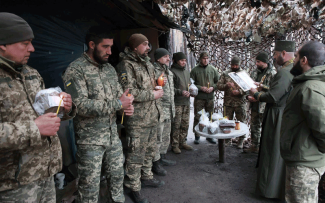

On 9 April, Vladimir Putin announced an Easter truce from 4:00 pm on 11 April until midnight the following day. Representatives of the Ukrainian authorities had previously signalled their readiness for a halt in the hostilities during the holiday period (on 30 March, President Volodymyr Zelensky), and the Russian decision met with conditional acceptance from Kyiv. Both sides made the continuation of the truce contingent on the other side’s compliance. Representatives of the Russian authorities emphasised that it was temporary, and that on 13 April the so-called special military operation would resume.
The Easter ceasefire did not lead to a halt in hostilities on the front line, but it was observed by both sides with regard to air strikes on targets deep within the territories. According to data from the General Staff of the Armed Forces of Ukraine (GSAU), Russia violated its own commitments 10,721 times, with the vast majority of violations in the frontline zone being drone attacks (9,035). However, no use of missiles, attack drones (‘Shaheds’) or air strikes was recorded. Some Ukrainian sources also reported a war crime committed during the ceasefire – near the border town of Veterynarne in Kharkiv Oblast, when the Russians allegedly shot four prisoners of war. Meanwhile, the Russian General Staff recorded 6,558 ceasefire violations by Ukrainian forces.
Russia continued its offensive on several fronts in Donetsk Oblast. Particularly fierce fighting took place on the southern and north-eastern outskirts of Rai-Oleksandrivka, where the defenders are still preventing the local Ukrainian force from being surrounded. The Russians made slight advances south and east of Dobropillia, and also entered further neighbourhoods in the centre of Kostiantynivka, thereby expanding the grey zone there. In Kharkiv Oblast, further areas on the eastern bank of the Oskil River in the Kupiansk area have fallen under Russian control.
Ukrainian forces retain the initiative in the western part of Zaporizhzhia Oblast. According to some sources, they have regained control of Novoyakovlivka, a development not reported by Ukraine, which denies it previously lost the village. Fighting continues for Stepnohirsk and the settlements lying between it and Novoyakovlivka. However, the situation has calmed down to a degree and the front line has stabilised in the eastern part of Zaporizhzhia Oblast and in Dnipropetrovsk Oblast.
The Russians have entered further border towns in Sumy Oblast. The Ukrainian 14th Army Corps, responsible for its defence, reported the necessity of withdrawing from positions in the Myropilske area in the face of overwhelming enemy forces. This is the third border bridgehead established by Russian forces in Sumy Oblast. Most of the border areas to the north, east and south-east of Sumy are now under their control or in a grey zone.

The rear bases of the defenders in Odesa Oblast remain a constant target for Russian strike drones. Damage to energy infrastructure occurred on the evening of 8 April and during the night of 10 April (among others, the Vilkovo substation on the border with Romania was hit). On 10 April, fuel depots in Odesa and the port of Pivdennyi were attacked (resulting in fuel leaks from the tanks), and a day later, facilities in the regional capital. Further strikes on port infrastructure took place in Odesa on 13 April and in Izmail and Chornomorsk on 14 April. In addition to the quay facilities, two ships flying the flags of Panama and Liberia were damaged.
The Russians continued to destroy infrastructure behind the front lines and in border regions. Damage to energy facilities, mainly substations, occurred in Zaporizhzhia, as well as in the Kharkiv and Chernihiv oblasts (9 and 13 April), the Dnipropetrovsk, Kirovohrad and Sumy oblasts (11 April) and Mykolaiv Oblast (14 April). Industrial facilities in Pavlohrad (9 April) and Zaporizhzhia (13 April) were also hit, as were a fuel depot and railway infrastructure in Dnipro (13 April). In Kharkiv and Sumy, residential buildings were damaged (in Sumy, 17 people were injured on 10 April), as well as an administrative building in the centre of Chernihiv (14 April). On the morning of 14 April, Kryvyi Rih was attacked twice. According to Ukrainian data, from the evening of 8 April to the morning of 14 April, Russia deployed a total of 634 unmanned aerial vehicles (including 410 ‘Shahed’ strike drones) and seven missiles. Ukraine reported that it had neutralised 546 drones and one missile.

On 9 April, Ukrainian drones damaged a substation at the Krymskaya oil pumping station in Krasnodar Krai, and on 13 April, they caused a fire at a chemical plant in Cherepovets in Vologda Oblast. A further attack on the Krymskaya pumping station took place on 11 April, though there were no reports of damage. On 10 April, the General Staff of the Armed Forces of Ukraine reported that two drilling platforms in the Caspian Sea had been hit, and a day later – a fuel depot in Hvardiiske in occupied Crimea.
The Ukrainians also attacked energy infrastructure in the occupied parts of the Kherson and Zaporizhzhia oblasts, causing local blackouts. The facilities were damaged on 9, 10 and 14 April (a substation near Melitopol was hit twice). On 14 April, Ukrainian drones also targeted energy infrastructure on the Crimean Peninsula.

On 8 April, the Security Service of Ukraine (SBU) reported that it had prevented a terrorist attack in Kharkiv, which had been planned by a local couple recruited by the Russian services via the Telegram messaging app. Those arrested intended to detonate an improvised explosive device in the city centre to cause panic. A day later, officers reported that a terrorist attack had been prevented in Khmelnytskyi. A local collaborator of the Russian services, who was preparing an attack at a location where Ukrainian soldiers were stationed, was arrested. The attacker planned to detonate an improvised explosive device remotely and, in order to increase the number of victims, he intended to lure a police patrol to the scene by making an anonymous report.
On 9 April, the SBU reported that preparations for a series of contract killings commissioned by Russia’s Federal Security Service (FSB) in Odesa had been prevented. A collaborator of the Russian services, who was to assemble weapons and ammunition in the city for use in the attacks, was detained. A day later, the SBU announced they had caught and arrested ‘red-handed’ of a professional hitman in Odesa who was planning to assassinate a high-ranking officer of the Ukrainian Navy. According to investigators, the hitman was a citizen of one of the Balkan states and had been recruited by Russia.
On 13 April, the SBU detained a local collaborator of the Russian services in Kharkiv who was coordinating strikes by attack drones on the city. The woman was reportedly broadcasting the results of these attacks in real time, helping to assess their effectiveness and identify the positions of Ukrainian air defence.

On 9 April, the Commander-in-Chief of the Armed Forces of Ukraine, Oleksandr Syrskyi, reported that Russia plans to increase the strength of its Unmanned Systems Forces to 165,500 troops by the end of 2026, an increase of approximately 60% on current levels. According to Ukrainian intelligence, this formation, established in November 2025 (see ‘Russian advances in Zaporizhzhia Oblast. Day 1364 of the war’), currently numbers 101,000 personnel. Syrskyi highlighted the growing role of drones on the battlefield and the ongoing rivalry between both sides for dominance in the unmanned domain. According to him, between December 2025 and March 2026, Ukrainian unmanned forces inflicted greater personnel losses on the Russians than Moscow was able to replenish through new conscription during that period.

On 8 April, Norwegian media reported that, despite the government’s earlier declarations regarding the transfer of F-16AM/BM fighter jets to Kyiv, none of the aircraft had arrived in Ukraine. Oslo had originally announced its intention to donate six operational aircraft and – as a source of spare parts – six non-operational aircraft. However, it was discovered that, due to their poor technical condition, the F-16 fighter jets intended for operational use had been undergoing repairs at the Sabena facilities in Belgium for over a year. Meanwhile, in June 2025, as part of its annual report to the UN, the Norwegian government declared that it would transfer a total of 14 F-16AM/BMs to Ukraine, a transfer scheduled to take place in 2024.
On the same day, the US Department of Defence signed a contract for the production of spare barrels for M777 howitzers worth $146 million. Some of the purchased barrels are to be transferred to Ukraine as part of the military aid packages announced during Joe Biden’s presidency. The entire contract is scheduled for completion by 31 March 2031.
On 10 April, the German Embassy in Ukraine announced the delivery of five MEDIGUARD armoured medical vehicles. This is the result of cooperation between three companies from Ukraine and Germany, with financial support from the government in Berlin – the medical equipment and protective gear are manufactured in Germany, whilst assembly takes place in Ukraine.

On 8 April, Sergiy Tomilenko, chairman of the National Union of Journalists of Ukraine, said that since the start of the full-scale invasion, 147 media workers had been killed, including at least 21 whilst carrying out their professional duties, and 28 Ukrainian journalists remain in captivity. According to him, Russia treats independent media as direct targets of attacks, and ‘Press’ markings on journalists’ clothing and vehicles may increase the risk of death.
On 10 April, the Office of the UN High Commissioner for Human Rights noted that in March the number of civilian casualties in Ukraine rose by 49% compared to the previous month. According to their data, at least 211 people were killed and 1,206 were injured. The UN identified short-range drones as the greatest direct threat to the civilian population. In March, they were responsible for the deaths of 66 civilians – more than any other weapon. Frontline areas are particularly dangerous, where – as highlighted – the victims are often elderly people, attacked whilst they are going about their daily activities. In total, since 24 February 2022, the UN has confirmed the deaths of at least 15,578 civilians, including 784 children, and injuries to 43,352 people, including 2,668 children.
On 11 April, the 72nd prisoner exchange between Ukraine and Russia took place, resulting in the return of 175 Ukrainian military personnel and seven civilians to the country. Almost all of the released Ukrainians had been held captive since 2022. Among them were 25 officers, including defenders of Mariupol, as well as National Guard officers captured during the seizure of the Chernobyl Nuclear Power Plant in the early days of the invasion. The condition of a significant number of those released is described as serious, indicating the long-term effects of torture and inhuman treatment. The exchange was organised with the support of the US and the United Arab Emirates. Two days earlier, as part of another exchange, Ukraine recovered the bodies of a thousand fallen soldiers. According to the Ukrainian coordination headquarters, this was one of the largest exchange of bodies operations since the start of the full-scale war. In return, the Russian side is thought to have received the bodies of 41 of its own fallen soldiers.
On 13 April, the Ukrainian Ministry of Foreign Affairs established the post of Ambassador for Prisoners of War, Civilians Deprived of Liberty and Missing Persons. Dmytro Ponomarenko, former Ukrainian ambassador to the Republic of Korea and Mongolia, was appointed to the new post. The position was created on the initiative of Foreign Minister Andrii Sybiha within the Department of International Law and Countering Aggression. The new representative will coordinate the Ministry of Foreign Affairs’ efforts to develop more effective mechanisms for exerting pressure on Russia regarding the treatment of Ukrainian prisoners of war and missing persons.