Devastating Russian attacks on the capital’s energy infrastructure. Day 1427 of the war

Russian troops are continuing their attempts to break through the lines of defence in the southern suburbs of Kostiantynivka. Small groups of enemy soldiers are trying to take up favourable positions on the hills northeast of Yablunivka, in order to then attempt to capture the western part of Kostiantynivka along the western bank of the Kryvyi Torets River. At the same time, they are conducting an offensive on the eastern side of the city – from the direction of Chasiv Yar and the village of Oleksandro-Shultyne. The primary objective is to take control of the area stretching from Kostiantynivka to Druzhkivka, which would enable an attack from the south and south-east on Kramatorsk and Sloviansk – the most important cities in Donetsk Oblast remaining in Ukrainian hands.
The Russians have managed to gain control of the entire Huliaipole area, and fighting is currently ongoing for the village of Zaliznychne, located to the west of it. Russia has also most likely taken over Pryluky, to the northwest of the city. The situation is also becoming increasingly difficult south of Zaporizhzhia, where the Russians are trying to dislodge the defenders from Stepnohirsk, gaining a foothold in the villages of Plavni and Prymorske, located on the dry Kakhovka Reservoir. The capture of Stepnohirsk will result in the southern part of the Zaporizhzhia conurbation coming under artillery fire and within the range of drones and aerial bombs. In the longer term, attempts to cut off logistics routes from Zaporizhzhia to the east – to Huliaipole and Orikhiv – are to be expected.

On the night of 13–14 January, Russian troops carried out a massive attack on infrastructure in the Zaporizhzhia and Dnipropetrovsk oblasts, cutting off electricity to over 45,000 consumers in Kryvyi Rih. Meanwhile, the Polish consulate building was damaged in a night bombing of Odesa (no one was injured).
The Ukrainian capital has been subjected to particularly intense attacks. On 20 January, there was a massive strike on Kyiv, during which a Zircon missile, 18 Iskander-M/S-300 ballistic missiles, 15 Kh-101 missiles and 339 strike drones were used. More than 5,500 multi-storey residential buildings were left without heating, and almost the entire left bank of the city was cut off from water supplies, while in the rest of the city the water pressure was reduced (there is also no water in some government buildings, including the Verkhovna Rada). In total, more than 335,000 residents of Kyiv were left without electricity as a result of the attack.
On 15 January, Russian drones struck the centre of Lviv, damaging an Orthodox church and a playground. On the same day, attacks on energy infrastructure in the Kharkiv, Zhytomyr and Odesa oblasts resulted in power outages. Particularly intense strikes were reported in Kharkiv (repeated on 17, 19 and 20 January), Zaporizhzhia (18 and 19 January), Odesa (19 January) and Dnipro (20 January).
Over the past week, the Russian army has continued its attacks on critical infrastructure in many oblasts. Several fatalities were reported in Kharkiv and Kherson, while residents of the Chernihiv, Dnipropetrovsk, Sumy, Donetsk and Zaporizhzhia oblasts were injured. According to estimates by the Air Force Command, between 13 and 20 January, Russian forces used 1,017 drones (including 715 Shaheds), 36 ballistic and cruise missiles, and one Zircon anti-ship missile. Ukraine declared it had destroyed 807 unmanned aerial vehicles and 18 missiles.
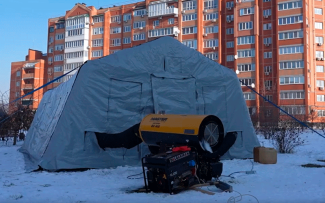
As a result of the attacks, on 15 January, the Ministry of Energy introduced scheduled power outages in all regions of Ukraine for all categories of consumers. It was emphasised that the most difficult situation was in Kyiv, where residents were allowed to move during the curfew to so-called resilience centres – special places where emergency heating and power supply (generators) are provided, as are internet access and water.

On the night of 13–14 January, the Alpha Special Operations Centre of the Security Service of Ukraine and units of the Ukrainian Navy carried out a coordinated drone attack on Russia’s Atlant Aero military plant in Taganrog, Rostov Oblast. The company manufactures unmanned aerial vehicles, electronic warfare systems, and digital integration systems for FPV strike drones and loitering munitions. The attack was confirmed by satellite images documenting the destruction of several buildings in the complex.
On 13 January, in the area of the Caspian Pipeline Consortium (CPC) terminal on the Black Sea, Ukrainian drones most likely attacked at least two tankers. Fires broke out on the vessels, which were waiting to be loaded. The CPC is a key infrastructure project transporting oil from Kazakhstan through Russia to the terminal in Novorossiysk, which is an important export route for this raw material. At the end of November 2025, Ukrainian maritime drones had already attacked the CPC terminal, resulting in part of the infrastructure being temporarily taken out of service.

Poland is preparing a 47th military aid package for Ukraine worth €220–230 million, including ammunition and spare parts. This was announced on 19 January by Vasyl Bodnar, Ukraine’s ambassador to Warsaw, in an interview with the Ukrinform agency. He stated that, in the first quarter of 2026, the Ukrainian army will receive four MiG-29 fighter jets out of a total of the “nearly ten” which Poland promised last year. On 15 January, Deputy Minister of National Defence Paweł Zalewski announced that there is a plan to transfer “up to nine” aircraft of this type. Furthermore, according to Bodnar, an agreement for Poland to grant a €120 million loan will be signed in the first half of 2026, facilitating Ukraine’s purchase of Polish weapons.
On 16 January, the General Staff of the Polish Armed Forces announced the start of the first training courses for Ukrainian soldiers in 2026. These are being carried out on Polish territory as part of the EUMAM UA mission (EU Military Assistance Mission Ukraine). One of the key courses is the training of combat medics. The training mission command stationed in Żagań is responsible for their implementation.
Finland has decided to provide Ukraine with a 31st military aid package worth €98 million, as announced by the Finnish Ministry of Defence on 16 January. As in previous cases, its contents have not been disclosed for security reasons. Spain will supply Kyiv with an LTR-25 tactical early warning radar worth €37 million. The Spanish government announced the signing of the contract with the manufacturer, Indra Sistemas SA, on 14 January. The radar will be part of another support package being prepared by Madrid, along with anti-aircraft missiles and armoured weapons.
On 16 January, Czech President Petr Pavel announced in Kyiv that his country plans to soon transfer to Ukraine combat aircraft capable of shooting down enemy drones. He did not specify the type, but this was interpreted as an announcement of the transfer or sale of L-159 light combat jets. In recent months, Kyiv and Prague have been in talks about four of these aircraft. On 19 January, however, the Czech government decided not to sell these aircraft to Ukraine. The most likely immediate reason for this decision was that Pavel had not consulted the government beforehand about the promises made in Kyiv.
On 14 January, the European Commission adopted a legislative package to support Ukraine in 2026 and 2027, which includes a €90 billion aid loan. Commission President Ursula von der Leyen announced that two-thirds of this amount would be allocated to military support. In December 2025, the European Council agreed to grant this loan. Once the proposals have been approved by the European Council and the European Parliament in the second quarter of this year, the transfer of funds should begin.
Ukraine has suspended further orders for German HX-2 ammunition due to serious defects revealed during its use, as reported by Bloomberg on 19 January. This is probably the first decision of this kind taken by Kyiv (previously, the Ukrainians had refused to accept old and not fully functional equipment or ammunition). Ukraine has so far received half of the 4,000 HX-2 and older HX-1 drones signed for in 2024 at the expense of Germany. The HX-2, which was supposed to be a breakthrough solution due to its operation based on artificial intelligence algorithms, turned out to be mechanically underdeveloped. During their use to date, only one in four has successfully taken off. The HX-2 also proved vulnerable to Russian electronic warfare systems (their resistance was supposed to be guaranteed by artificial intelligence), and after being jammed, they lost communication with their operators. What is more, some of the delivered units lacked the components responsible for the operation of artificial intelligence altogether.

On 19 January, President Volodymyr Zelensky announced that Pavlo Yelizarov, alias Lazar, would become the new deputy commander of the Ukrainian Air Force at the request of Defence Minister Mykhailo Fedorov. He will be responsible, among other things, for changes in the country’s air defence, involving the greater use of mobile fire groups, interceptor drones and other means of so-called small air defence. According to Fedorov, he will be primarily responsible for creating an “anti-drone dome” over Ukraine. Yelizarov is an Air Force officer and the current commander of Lazar Group, which specialises in the use of drones on the battlefield. He enjoys great authority in the army and is considered a pioneer in the use of unmanned aerial vehicles on the front line.
In an interview on 18 January, Commander-in-Chief of the Armed Forces of Ukraine Oleksandr Syrskyi announced that the first stage of the transition of the Armed Forces of Ukraine to a corps system was completed at the end of 2025. In his opinion, the reform has streamlined and relieved the command system, as well as increased the efficiency of the use and supply of military personnel and staff. “Previously, the command system was based on temporarily created operational and tactical groups, in which officers were appointed on a rotational basis and relocated from their positions, which had a negative impact on the quality of management”, Syrskyi emphasised. The army is currently moving into the second stage of the reform, which will be completed by the end of this year and will involve transferring brigades to the appropriate corps.
According to journalists from the investigative portal Slidstvo.Info, over the past two years, there has been an increase in the number of Ukrainians of conscription age detained during illegal attempts to cross the border with Belarus. According to data from the State Border Service of Ukraine (SBSU), 1,424 men were detained at this border in 2025, 326 in 2024, and only four in 2023. The Belarusian route was among the top five routes in terms of the number of conscripts detained, ahead of Poland, among others. The highest number of detentions was recorded at the borders with Romania (10,066), Moldova (4,937), Slovakia (2,265) and Hungary (1,841). The fewest cases were recorded at the borders with Russia (1 person) and Poland (511 people). According to the investigation, smuggling into the EU via Belarus costs approximately $8,000 per person.
Speaking in parliament on 14 January, the newly appointed Ukrainian Defence Minister Mykhailo Fedorov emphasised that the main objectives of the ministry would be to reform the army, improve infrastructure on the front line and to decisively fight corruption . He announced a comprehensive audit of the Armed Forces of Ukraine, which would be used as a basis for specific systemic solutions. Fedorov revealed that approximately 2 million Ukrainians are evading military service and approximately 200,000 have left military units without permission.
In 2026, Ukraine plans to launch a Register of Arms Manufacturers under the Ministry of Defence. The new defence procurement system will function as a military, non-public version of a digital public procurement platform, intended exclusively for state-verified arms manufacturers. This was announced on 15 January by Arsen Zhumadilov, director of the Defence Procurement Agency (AZO). Once the new system is launched, information on demand will automatically be sent to a wide range of manufacturers responsible for supplying a given category of weapons. Currently, there are approximately 1,300 companies on the list of suppliers.

On 14 January, Ukrainian military intelligence (HUR) published information on foreign equipment used by Russian military-industrial complex companies. This includes 50 types of equipment, such as water jet cutting machines from the Czech company PTV, used by companies producing ship and coastal radar stations, equipment for strategic missile forces and military facility protection systems, milling machines from the American company JET Tools, used by a manufacturer of components for Russian Kh-101 cruise missiles, and Chinese TAYU TY-200S thermoplastic machines, operated by a company producing guidance systems, sights and reconnaissance complexes. HUR points out that Russian defence companies lease equipment, which allows them to conceal the actual end user and is one of the mechanisms for circumventing sanctions.
In the aforementioned interview, Syrskyi said that in 2026, the Russians plan to create at least 11 new divisions and recruit another 409,000 people into the army. He stated that Russia’s total mobilisation potential exceeds 20 million people, of whom approximately 4.5 million are trained reserves who can be directly involved in replenishing combat units. He added that this gives the enemy an advantage in recruiting troops and maintaining the size of offensive groups. He also stated that, despite implementing mobilisation plans in 2025 at over 100% and engaging approximately 406,000 people, the Russians failed to increase the size of their offensive group – for almost six months, it remained at around 711,000 soldiers. According to Syrsky, the Russian authorities were unable to increase the size of their army on Ukrainian territory due to human losses, which he estimated at around 419,000 soldiers in 2025.