Ukraine: a New Year’s reset of the state security management system
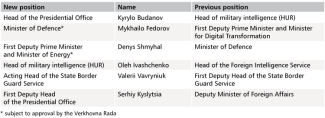
On 2 January, President Volodymyr Zelensky carried out a reshuffle within the structures responsible for the state’s security policy. Among the key personnel changes, he appointed Kyrylo Budanov, who formerly led Ukrainian military intelligence (HUR), as the new Head of the Presidential Office (PO); dismissed Vasyl Malyuk, the head of the Security Service of Ukraine (SBU); and appointed Mykhailo Fedorov, First Deputy Prime Minister and Minister for Digital Transformation, as the new Minister of Defence. His predecessor, Denys Shmyhal, has taken over the Ministry of Energy (see table below). The President justified the shake-up by emphasising the need to transform the PO into the state’s central decision-making body tasked with addressing strategic issues, including the future development of the defence forces. Additional responsibilities assigned to the PO include leading peace negotiations and overseeing the security and defence sector. Further personnel changes were announced to support this shift: Serhiy Kyslytsia, a seasoned diplomat, was appointed Budanov’s first deputy; Oleh Ivashchenko, Budanov’s former deputy, was appointed as the new head of HUR; the head of the State Border Guard Service was also replaced.
Zelensky’s personnel reset signals that Ukraine is determined to end the war, but remains prepared to continue armed resistance should international peace talks fail to yield results. It also reflects an intention to restore the PO’s authority and transform it into a centre for coordinating security policy and diplomatic efforts, possibly positioning Budanov as the President’s de facto chief national security adviser. Domestically, the appointment of the popular head of HUR is designed to repair the President’s image following a major corruption scandal; in the longer term, it may also diminish Budanov’s electoral prospects should Zelensky decide to seek re-election.
Commentary
- Budanov’s appointment marks the end of the transitional period at the PO that began in November with the dismissal of Andriy Yermak (see: ‘Hell has frozen over: Head of the Office of the President of Ukraine Andriy Yermak resigns’). The choice of the highly popular HUR chief, who is associated with successful offensive special operations against Russia, can be interpreted as an attempt to restore the PO’s authority. Budanov had previously been in conflict with Yermak, who reportedly sought to limit his direct access to the president. Implementing personnel changes within the PO, which still employs associates of his predecessor, will serve as an early test of Budanov’s effectiveness. In the domestic political context, the appointment of Budanov – who, according to opinion polls, would defeat Zelensky in a future presidential election – can be seen as an effort to curb his independent political standing and to expose him to greater scrutiny from the media and the public.
- The scope of the responsibilities assigned to Budanov suggests that he could become Zelensky’s de facto chief national security adviser. He is expected to strengthen Ukraine’s negotiating team by operating with a stronger mandate than his predecessor, who faced criticism in the West, and to represent the head of state in talks with his US and European counterparts on ending the war. More broadly, the appointment of Budanov, an officer known for bold and effective operations on Russia’s territory, sends a clear message that, should peace negotiations fail, Ukraine remains determined to continue its war effort and will not accept concessions on fundamental issues.
- Fedorov’s task is to accelerate the technological breakthrough in the field of national defence. As the chief architect of the country’s digital transformation and a figure who enjoys Zelensky’s trust, he had previously been considered for the role of head of the Presidential Office. He has not faced any allegations of financial misconduct. His appointment is intended to signal a commitment to curbing corruption and overhauling defence procurement, including through further digitalisation. His predecessor, Denys Shmyhal, began implementing such measures during his brief tenure, which began in July 2025. He is now expected to introduce similar reforms at the Ministry of Energy, which is in urgent need of comprehensive restructuring following a major corruption scandal (see: ‘Operation Midas: the largest corruption scandal within Zelensky’s inner circle’), amid intensified efforts to rebuild national infrastructure damaged by Russian attacks.
- Budanov faces a key challenge in establishing a working relationship with the new head of the Security Service of Ukraine (SBU). Zelensky decided to dismiss Vasyl Malyuk despite opposition from large segments of the military, including Andriy Biletsky, commander of the Third Army Corps, and Mykhailo Drapatyi, Commander of the Joint Forces of the Armed Forces of Ukraine. These officers highlighted the contributions of Malyuk and the SBU to the fight against the Russian invasion. However, Malyuk also faced allegations of involvement in efforts to undermine the independence of Ukraine’s anti-corruption institutions (see: ‘Rivalry between state services: the fight for control over combating corruption in Ukraine’).
- The position and operational approach of military intelligence are expected to remain unchanged. Budanov has been succeeded by Oleh Ivashchenko, a seasoned HUR officer who previously served as deputy head of the agency and led the Foreign Intelligence Service. His appointment signals continuity in leadership and a commitment to carry out further offensive special operations on Russia’s territory.
Table. Key personnel changes in Ukraine’s leadership