Severe Russian attacks on Ukrainian power plants. Day 1385 of the war

The Russians continue their attempts to completely take over the Pokrovsk conurbation, intensifying their activities in the area of Rivne and Svitle (according to Russian sources, the former is already under Russian control of the occupiers) along the road connecting Pokrovsk and Myrnohrad. Russia has made progress in Rodynske, north of Pokrovsk, reaching the road to Dobropillia, which runs north of the city, and in Hryshyne, seeking to cut Ukraine off from the last transport artery connecting Pokrovsk with Pavlohrad. The Ukrainian military leadership also admitted that soldiers had left Lysivka and Sukhyi Yar south of Myrnohrad, thus avoiding complete encirclement in the area.
The situation is also difficult for Ukraine in Siversk, where the Russians have taken over most of the town. Intense fighting is taking place for Sviato-Pokrovske, Zvanivka and Vyimka, located south of the town. Northwest of Siversk, the Russians have managed to make progress in the vicinity of Yampil. Their actions in this area have been aided in recent days by bad weather conditions, which have made it difficult for the defenders to use drones. According to the Chief of the General Staff of the Russian Army, General Valery Gerasimov, the Russians also made a “breakthrough” in Lyman, but this was denied by General Andriy Biletskyi, commander of the 3rd Army Corps of the Armed Forces of Ukraine, who stated that enemy troops had been stopped before reaching the town.
Russian sources also report the capture of Kucheriivka and the village of Pishchane east of Kupiansk, but these reports have not yet been reliably confirmed – the southern part of the city is said to remain under Ukrainian control, with some sources reporting effective counterattacks in the central district. The Russians, though, are pushing the Ukrainians out of the southern areas of Vovchansk.
On 7 December, Russian forces destroyed a bridge over the Donets River in Staryi Saltiv (east of Kharkiv) and a dam in Pechenihy, which led to the closure of roads connecting Chuhunivka and Vovchansk with Kharkiv, as well as Chuhuiv and Velykyi Burluk. The attacks are aimed at blocking Ukrainian military supply lines in the Vovchansk and Kupiansk directions, indicating Moscow’s further offensive plans in Kharkiv Oblast.
The situation is also difficult for defenders in the vicinity of Huliaipole, where Russia has made progress north of the city, occupying Solodke and approaching Dobropillia. Russian troops have also advanced in the Stepnohirsk area in Zaporizhzhia Oblast, which is a consequence of the transfer of part of Ukraine’s forces to Huliaipole in order to maintain the line of defence there.

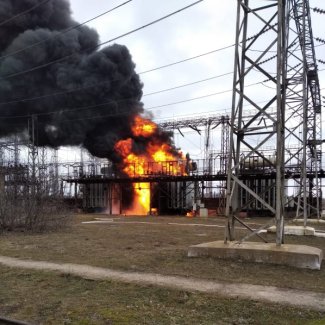
The Russian military once again carried out a massive, combined air strike on energy infrastructure facilities. Across Ukraine, hourly power outages and restrictions on electricity consumption for industrial consumers and businesses were introduced. In just two days – on the nights of 5 to 6 and 6 to 7 December – Russia used 894 strike drones of various types (450 of which were Shaheds), six Kinzhal missiles, 34 Kalibr cruise missiles and 16 Iskander-M ballistic missiles. The targets were primarily electricity generation and distribution facilities and transmission lines in the Volyn, Vinnytsia, Kyiv, Chernihiv, Lviv, Odesa, Zaporizhzhia, Dnipropetrovsk, Mykolaiv, Poltava, Sumy, Kirovohrad and Kharkiv oblasts. Among others, Kyiv, Dnipro, Lutsk, Chernihiv, Sumy, and Kremenchuk were hit.
As a result of the attack on the energy infrastructure, nuclear power plants were forced to reduce their production capacity, as reported on 6 December by Anatoliy Zamulko, head of the State Energy Supervision Inspectorate. Due to strikes on transmission lines, the nuclear power plant in Zaporizhzhia completely lost its external power supply. This is the 11th such incident since the start of the full-scale conflict.
On the night of 3 to 4 December, Russia attacked a power plant in Odesa Oblast. On 4 December, the Kherson Thermal Power Plant was completely destroyed, leaving more than 40,000 customers without electricity. Stanislav Ihnatiev, chairman of the Ukrainian Renewable Energy Association, said that power outages will continue throughout the winter and may only be lifted in early April, provided that repairs to the damaged facilities proceed without hindrance.
Civilian and residential buildings were also targeted by drone and missile attacks. On the night of 5–6 December, Russian drones completely destroyed the railway station building in Fastiv (the city was also attacked on 8 December). On 3 December, the Russians attacked Kharkiv and Kryvyi Rih (damaging, among others, 15 residential high-rise buildings, 29 private houses and a school), and on 4 December – Odesa and Kherson. As a result of the strike carried out on 5 December on Dnipro, a warehouse belonging to one of the two largest pharmaceuticals distributors, BaDM, was hit. The company reported that stocks of medicines and medical supplies worth over 5 billion hryvnias were destroyed. This is yet another Russian attack on pharmaceutical warehouses this year – in August, October and November, pharmaceutical storage facilities in Dnipro and Kyiv were also attacked. The Ministry of Health and Social Welfare stated that these strikes pose a serious threat to the stability of pharmaceuticals supplies in Ukraine.

On the night of 3 to 4 December, Ukrainian drones attacked the Dmitrievskaya oil depot in Tambov Oblast in Russia. According to the Ukrainian General Staff, several oil tanks were burned down. On the same day, a Lukoil fuel depot near Voronezh was also reportedly hit.
On the night of 4–5 December, Ukrainian drones carried out an attack on the facilities of the Nevinnomyssk Azot company in Stavropol Krai, which is a key element of the Russian military-industrial complex. The company’s production capacity is over 1 million tonnes of ammonia and 1.4 million tonnes of ammonium nitrate per year, making it one of the most important suppliers of components for the production of explosives and ammunition.
On the same night, the Ukrainians struck the port infrastructure in the city of Temryuk, located on the right bank of the delta of the Kuban River, at the mouth of the Sea of Azov. The attack caused a fire in the port. The port is the main transhipment point for coal and agricultural products from the occupied part of Ukrainian territory. This summer, the Russian media reported on the opening of an oil export terminal at the port, thanks to which Russian fuels are transported from there.
On the night of 5 to 6 December, hackers from Ukraine’s military intelligence service (HUR) carried out an operation targeting the IT and communications infrastructure of the Russian group of companies Eltrans+. Over 700 computers and servers were deactivated, over 1,000 company user accounts were deleted, and 165 terabytes of data were destroyed or encrypted. Key infrastructure elements were also targeted in the attack – access control systems, video surveillance systems, and platforms responsible for data storage and archiving were compromised. Eltrans+ is one of the top ten largest Russian companies providing customs and freight forwarding services. The company plays a significant role in the delivery of sanctioned goods and electronic components imported from China, which are used by the Russian military-industrial complex.
On the night of 8–9 December, Russian air defences allegedly shot down more than 120 Ukrainian drones in various regions, including Crimea, Belgorod and Ryazan. On the morning of 9 December, the Energozapchast plant in Cheboksary (Chuvash Republic) was reportedly attacked.

On 2 December, the Ukrainian Ministry of Defence announced the results of the DOT-Chain Defence digital defence procurement system. According to official data, since August this year, the Ukrainian army has received equipment worth over 6.15 billion hryvnia (147.6 million dollars). In total, almost 144,000 pieces of equipment were delivered to the armed forces, including FPV drones and electronic warfare systems. According to the ministry, the digital supply system has already been implemented in 184 brigades of the Armed Forces of Ukraine (AFU) and in two corps of the National Guard.
On 3 December, the Verkhovna Rada of Ukraine adopted the budget for 2026. The act does not provide for salary increases for soldiers. Instead, the government plans to introduce new rules for signing military contracts, which will include more favourable terms of service for soldiers. On 5 December, the Cabinet of Ministers approved and submitted to the Verkhovna Rada a draft law introducing incentive contracts in the AFU. It is intended to guarantee more transparent terms of service and simplified rules for salary increases for military personnel. The draft law provides, among other things, for flexible contract terms, enabling soldiers to take advantage of leave, convalescence and medical rehabilitation.
According to government estimates, Ukrainian arms exports could bring Kyiv up to 100 billion hryvnia in additional revenue, Finance Minister Serhiy Marchenko said on 3 December. In his opinion, there is a high probability that a decision will soon be made to expand foreign sales to include other types of weapons. After the start of the full-scale Russian invasion, Ukraine introduced a total ban on the export of military goods. In November this year, however, President Volodymyr Zelensky allowed for the possibility of a partial lifting of the ban, announcing that Ukraine would open two arms export offices – in Berlin and Copenhagen – and was preparing an agreement on the sale of drones.
On 4 December, military rights spokeswoman Olha Reshetylova pointed to a number of irregularities that make the mobilisation system inefficient and costly, and that the current method of recruiting soldiers is causing the state to suffer losses, both financial and human. Recruitment centres (TCR) often conscript people who should not be in the army. These include, for example, people who are ill, carers of disabled people or people who are physically unfit for service. Improper mobilisation generates further costs; after a few months, poorly selected recruits end up in state-funded treatment or rehabilitation or are discharged. Medical commissions do not operate objectively and are overburdened. In Reshetylova’s opinion, it is the police, not the military, that should take over some of the functions of the TCR – especially those related to document verification and recruitment.
On 5 December, Prime Minister Yulia Svyrydenko announced the establishment of the Ukrainian Armed Forces Support Research Centre, which will work on modernising the army, drawing on the experience gained on the battlefield. She also announced the addition of special military training to the curriculum of selected fields of study. The aim is to create a reserve of specialists who are crucial to the combat potential of the Armed Forces of Ukraine, particularly in the field of military medicine. Svyrydenko announced that the government would soon update the list of universities offering this training.
On 5 December, Deputy Head of the Presidential Office Pavlo Palisa revealed details of a new personnel management mechanism in the Armed Forces of Ukraine. The new approach assumes that mobilised soldiers will be assigned to units before basic training begins. Recruits will be trained in conditions as close as possible to those specific to a given brigade. Currently, 37 brigades can conduct basic military training independently. If a brigade does not have the appropriate infrastructure, training will take place at the training centres or training battalions of army corps, but with the full support of instructors from the brigade in question.
On 8 December, the Commander-in-Chief of the Armed Forces of Ukraine, General Oleksandr Syrskyi, announced the continuation of the process of moving training centres deeper into the country to minimise the risk of losses during air strikes. He admitted that the security situation in some facilities is unsatisfactory and requires urgent action, especially in terms of the construction and retrofitting of shelters.

On 8 December, Ukrainian Human Rights Ombudsman Dmytro Lubinets warned that Russian intelligence services were preparing an operation aimed at destabilising the internal situation in Ukraine by organising “peaceful protests”. Such attempts are to take place in Odesa, Dnipro, Kharkiv, Mykolaiv and Kyiv. The Russian services will supposedly exploit the difficult situation and emotional vulnerability of citizens, trying to win over women in particular – especially mothers of soldiers who are prisoners of war or missing persons.

General Syrskyi said in an interview with Sky News on 5 December that Russia launches between 4,000 and 5,000 suicide drones per day at Ukrainian positions along the front line, as well as between 1,500 and 2,000 bomb-dropping drones. However, he stressed that the Ukrainian army responds with the same number of attacks – and even more. Syrskyi added that the Russian armed forces still have twice as many artillery shells as Ukraine, but the range and destructive power of Ukrainian drones make it difficult for Russia to use artillery effectively. According to Syrskyi’s estimates, more than 700,000 soldiers are fighting on the Russian side of the front line. The Russian army’s losses are estimated at between 1,000 and 1,100 soldiers killed or wounded per day, most of whom die as a result of their injuries.

On 2 December, during Zelensky’s visit to Ireland, the country’s Prime Minister Micheál Martin announced the transfer of non-lethal military equipment worth €100 million to Kyiv.
On 3 December, Canada announced that it would allocate $145 million for the purchase of American weapons under the Prioritised Ukraine Requirements List (PURL) mechanism. It was also announced that the Canadian company Roshel had delivered over 2,000 Senator MRAP vehicles.
On the same day, Norway announced that it would contribute $500 million under the PURL, thus becoming the second largest contributor to this mechanism after the Netherlands, with a total contribution of $850 million.
On 4 December, Australia announced that it would allocate $95 million in military aid to Ukraine, including $50 million under the PURL, $43 million worth of weapons and military equipment from the Australian Defence Force’s stocks, and $2 million for the Drone Capability Coalition. On the same day, New Zealand announced that it would contribute $15 million under the PURL.