The Kremlin’s Loyal Praetorians
Contents
I. THE BALANCE OF POWER WITHIN THE RUSSIAN RULING ELITE
2. The group of ‘independent Putinists’
II. THE KREMLIN’S CADRE MANAGEMENT
1. Closing ranks: a conservative personnel policy
2. Disciplining the nomenklatura: ‘anti-corruption’ purges
5. The ‘new elite’: more propaganda than a personnel revolution
III. REACTIONS AND ATTITUDES OF THE PUTINIST NOMENKLATURA
1. Adapting to the new reality
2. Ideological zeal as a strategy for survival and career advancement
IV. FORECAST: TENSIONS SIMMERING BENEATH A VENEER OF STABILITY
MAIN POINTS
- The current phase in the evolution of the Putin regime shows a clear intensification of trends visible since 2012, when Vladimir Putin returned to the presidency after Dmitry Medvedev’s four-year term. The personalistic nature of rule has become more pronounced, and patron-client networks continue to play a dominant role in the system. State institutions serve largely as a façade for the real mechanisms of governance and the ruling elite’s parasitic exploitation of state resources. These mechanisms are based on personal ties. Since the start of the full-scale invasion of Ukraine, the role of repression, censorship and indoctrination in state management has steadily increased.
- Despite its negative impact on the Russian economy, the war with Ukraine allows the main interest groups – clans clustered around the Kremlin (the presidential centre of power) – to continue to enrich themselves. In the period of ‘wartime Putinism’, the following groups are strengthening their influence: the group gathered around the Rostec state corporation led by Sergei Chemezov; the families of Putin’s friends, the Rotenbergs and the Kovalchuks; the family of Nikolai Patrushev, Putin’s aide (adviser)[1] for maritime policy as well as the milieu linked to Moscow mayor Sergei Sobyanin. The special position of the clans in the system is determined by both formal and informal factors, including their control over strategic economic assets (state or private) and informal control over the so-called administrative resource. The latter is achieved through the use of loyal figures in influential positions in the federal government and a network of clients in the public administration, who serve the particular interests of their patrons. However, the key resource that determines the real weight of players in the system is their ability to lobby Putin himself for their interests, including influencing the Kremlin’s personnel policy.
- Clan leaders enjoy Putin’s trust, but he strictly regulates the scope of autonomy of the groups they lead. Putin tries to prevent any of them from becoming too powerful, as this could generate unwanted political ambitions. His priorities include maintaining the stability of the system, guaranteeing indefinite rule for himself, and ensuring his personal safety. To maintain a balance of power, Putin fills key positions with trusted individuals who are not directly affiliated with any of the main influential groups and who therefore owe their careers directly to him. This is intended to eliminate the phenomenon of ‘dual loyalty’ and serve as an additional instrument for maintaining a dynamic balance within the ruling elite.
- The emergence from the shadows and consolidation of positions within the system of individuals related to Putin is a new and significant trend. As in the case of filling important positions with members of his confidants’ families, this is intended to strengthen the personal and ‘family’ motivations in perpetuating the current model of government. This is calculated to guarantee the stability and continuity of the regime not only during Putin’s lifetime, but also after his death. Maintaining intergenerational control over lucrative income from systemic corruption matters just as much.
- The Kremlin’s personnel policy is conservative. It consists of: limited reshuffling at the federal level; keeping Putin’s long-standing, trusted associates in key positions within the system; keeping many people dismissed from high positions within the Kremlin’s orbit; limited opportunities for advancement for representatives of the younger elite cohorts (except for those whose candidacies are lobbied for by the most important clans and members of Putin’s family). A side effect has seen this state of affairs lead to gerontocracy: the average age of key figures in the system is rising.
- Under wartime conditions, the traditional Russian method of disciplining the elite, known as the ‘fight against corruption’, has gained momentum. This bolsters the role of the security services in the system (primarily the FSB, but also the Prosecutor’s General Office and the Investigative Committee). Although these bodies are constantly seeking to expand their sphere of influence, they are not independent players and merely serve the Kremlin’s interests.
- The deteriorating economic situation and the Kremlin’s desire to punish members of the business elite for displaying insufficient loyalty (including having ties to the West) are resulting in an unprecedented scale of the redistribution of shrinking assets, including the nationalisation of profitable enterprises, in violation of the previously applicable rules of the game. Systemic competition for sources of income is increasing, and only the strongest players can enjoy relative security for their holdings.
- Since 2024, the Kremlin has been implementing an ideological project to create a ‘new elite’ composed of veterans of the invasion of Ukraine. Although these people do not yet hold positions of real power or significant income, they are potentially important in two ways. Firstly, as a propaganda counterweight and (though the extent of this is difficult to assess) an alternative to the ‘old’ elites. Secondly, as a hard-core war-supporting electorate interested in maintaining a long-term confrontational foreign policy based on militarism and geopolitical revanchism.
- Since 2022, the methods of disciplining the elites have also included the requirement to publicly demonstrate pro-war and anti-Western attitudes. Putin has revoked his earlier consent to a limited pluralism of opinion within the establishment. Even a silent distancing from Kremlin ideology is being increasingly treated as disloyalty. At the same time, demonstrating allegiance to militaristic ‘patriotism’ is seen as beneficial to one’s career progression. As a result, the ideologisation of the Russian ruling elite and administrative apparatus is growing, and it is often difficult to draw a clear line between top-down requirements and the grassroots zeal of officials.
- The ideological fervour of the nomenklatura is one of the signs of its widespread adaptation to changing conditions, despite the dissatisfaction of some of these circles with the political and economic consequences of the war and sanctions. The key reasons for their obedience and loyalty to the leader include: fear of losing their status, property or even their life if they are suspected of disloyalty; belief that there is no alternative to Putin; the opportunity to profit from the war and war-induced structural changes in the Russian economic model; faith in Russia’s ultimate victory over Ukraine and the West; pro-war and anti-Western views.
- There is no indication that Putin intends to choose a successor and voluntarily relinquish power. The transfer of power would involve too high a risk, and the rivalry among the elite triggered by this decision could destabilise a system already weakened by the effects of the full-scale war. In the foreseeable future, therefore, there is little likelihood of a change in the Kremlin’s domestic and foreign policy or of radical shifts in the attitudes of the ruling elite. However, the situation may change should Russia suffer military defeat in Ukraine, a deep economic crisis or if Putin became physically unable to rule the country.
INTRODUCTION
During the full-scale war against Ukraine, which began in February 2022, Russia saw the consolidation of Putin’s dictatorial rule. Its personalistic nature became more pronounced, as clearly demonstrated by the decision to invade a neighbouring state against the wishes and interests of the majority of the ruling elite. The dominant role of patron-client networks in the system continues, with the head of state as the ‘super-patron’. State institutions are merely a façade masking the real, informal mechanisms of governance and exploitation of state resources, based on personal connections.
Unlike Western concepts of a modern state, the ruling elite perceives Russia as the patrimony of the ruler, who is the actual owner of the territory, population and resources.[2] One’s position in the Russian system of power is determined less by the formal office one holds and much more by informal influence, including the key factor: access to Putin.[3]
The neo-totalitarian course in domestic policy is growing stronger.[4] It is marked by increasing state interference in the private lives of citizens, as well as mass censorship and the indoctrination of society (especially children and young people) in the spirit of anti-Western militarism, geopolitical revanchism and imperialism. The Kremlin is aggressively promoting a pseudo-conservative ideology hostile to democratic values and is punishing dissent with increasing severity. The government’s totalitarian ambitions are manifested in forcing citizens, mainly members of the ruling elite, to actively support the Kremlin’s policies, including the war. Unlike the period before the full-scale invasion, which was characterised by a certain degree of pluralism, it is now insufficient to display an “apolitical” stance, silent consent and lack of opposition to prove one’s loyalty.
War has become the primary tool for stabilising Putin’s system, despite the rising costs it imposes on the state and society. This highlights a paradox characteristic of Russia, resulting from the patrimonial logic of governance. From the Kremlin’s perspective, anything that enables the ruling elite to tighten its control over the country is beneficial and legitimate. The effectiveness of patrimonial management is not measured by improvements in the society’s standard of living or macroeconomic indicators, but by the concentration of as many assets as possible in the hands of key interest groups. These, in turn, allow for the autocratic imposition of the rules of the game on both the entire administrative apparatus and the Russian population. War enables an unprecedented redistribution of resources within the system, as well as an indefinite suspension of discussions about the succession of power, structural dysfunctions of the economy, and the regime’s inability to generate a vision of the future that is attractive to the establishment and society. In order to mobilise Russians and neutralise resistance, the regime resorts to pseudo-patriotic slogans, using invented (or self-provoked) threats, including ones allegedly originating from the West, which it falsely claims are existential in nature. Patriotic mobilisation helps to justify growing repression, the elimination of political opponents and the isolation of Russians from hostile ideological influence, while preventing social and elite protest.
The logic of the personnel policy in Putin’s system is governed by the principle of top-down appointments. Representative bodies serve largely as a façade and regularly rigged ‘elections’ serve only to formally approve the personnel decisions which the Kremlin makes in advance. The only sovereign voter is Vladimir Putin: he and his administrative staff (the Presidential Administration – PA) decide on appointments to the most important offices in the federal and regional authorities and to management positions in state-owned enterprises. This is reminiscent of the Soviet nomenklatura system, except that in Putin’s personalistic dictatorship, promotions are the result of lobbying through informal networks, rather than the result of recommendations from collectively managed formal institutions (as was previously the case with the Communist Party of the Soviet Union).
It should be assumed that Putin intends to maintain his dictatorial power for life, unless circumstances arise that thwart these plans, such as the war in Ukraine taking an unfavourable course, economic collapse or his poor health. This assumption reflects the main objective of the Russian model of government: to reproduce the existing mechanisms of power without rotation at the highest position in the state. In this system, all means of consolidating the leader’s power are acceptable and legitimate by default.
Given the scale of the challenges to international security posed by Putin’s regime, as well as the lack of political agency among Russian society, it is crucial to examine the mood and balance of power within the Russian ruling elite in order to assess the Kremlin’s potential to cause harm on the international stage and to forecast further developments. At the same time, analysing this matter is fraught with considerable uncertainty, especially in the context of the ongoing war. The reasons for this include:
- the closed-off nature of the regime;
- the opacity of political and business decisions resulting from the personalistic model of government, in which only a small group of people have direct access to the leader;
- the fact that a significant amount of information concerning regime officials is classified to circumvent sanctions;
- restrictions on obtaining information from representatives of various levels of government (widespread surveillance by the security services creates the fear of being accused of disloyalty or treason);
- the high probability of deliberate disinformation and restrictions on access to data imposed by the Russian intelligence services.
Nevertheless, it is possible to identify the most important trends in Russian power circles and attempt to make cautious predictions.
In this text, the ruling elite (a term used interchangeably with the ‘power elite’) is defined as the set of political, administrative and business figures who genuinely influence Kremlin decisions. Given the system’s dominant principle of nomenklatura-style appointments and the strictly limited autonomy granted to individual players, both terms are treated as synonyms of ‘nomenklatura’. This is all the more justified because those labelled as the elite do not stand out for exceptional competence, qualities or service to the country. Their main function is to serve Putin’s interests and those of the key beneficiaries of Putin’s kleptocracy. Members of the nomenklatura have the influence and assets necessary to control significant financial flows or parts of the bureaucratic apparatus. Their ambition is to expand their possessions further, whether in the economic-financial or administrative sphere. It is important to stress, however, that their position depends above all on the leader’s favour. In a personalist dictatorship there are no centres of power or influence independent of the Kremlin.
In the realities of the Putin system, one must understand politics and political influence in a particular way that has little to do with how the term is defined in democratic systems. Because the model is personalist and neo-patrimonial, society lacks agency and elections are a fiction. The only autonomous politician in Russia, who determines the course of foreign and domestic policy, is Vladimir Putin. For everyone else, ‘politics’ relates rather to their ability to shape Putin’s decisions and to use bureaucratic resources to fight for influence within the administrative apparatus and to compete for corruption revenues. The most important political objective is to preserve the current model of rule.
The text divides Russia’s ruling elite according to two criteria. The first is the type of resources they possess (clans vs. independent Putinists), and the second is the function they perform within the system (technocrats vs. ideologues). Clans are key groups of influence whose patrons have direct access to Putin (in some cases, clan leaders enjoy long-standing friendly relations with him), which enables them to lobby for their own interests effectively. Clans also have economic resources of strategic importance to the state and extensive networks of clients in the economic and administrative sectors. The so-called independent Putinists, on the other hand, are members of the elite who are not affiliated with key groups and owe their position solely to Putin’s trust and favour. They can influence state policy in selected areas, but as a rule they lack their own economic support base and do not head patronage networks that could significantly bolster their impact on decision-making processes.
The distinction between technocrats and ideologues attempts to capture the specific division of roles that developed in the system after 2012. This was the turning point between Dmitry Medvedev’s ‘liberal’ presidency and the pseudo-conservative shift that took place in Russia’s domestic and foreign policy after Putin’s return to the Kremlin. Technocrats – professional managers, operating primarily in the broadly understood economic sphere – are responsible for macroeconomic performance, financial stability, and the declared modernisation and innovation in the economy and how the state is managed. The role of ideologues is to legitimise autocratic power through neo-Soviet politics of history, the promotion of ‘traditional moral and spiritual values’, and the idea of geopolitical revanchism. The full-scale invasion of Ukraine, for which all representatives of the Russian authorities are accountable (albeit to varying degrees), is blurring the distinction between ideologues and ‘apolitical’ managers. However, it still serves as a useful reference point for studying the ideological transformation of the Russian ruling elite.
This text focuses on analysing key trends and developments in the Russian ruling elite in the second half of 2025. It mainly addresses the nomenklatura at the federal level, since the situation at lower levels of government is, with few exceptions, a result of top-down signals and decisions.[5]
The first chapter presents the current balance of power within the elite, including the main political and business clans, the role of figures not directly associated with them, as well as Putin’s relatives. It also briefly analyses the current position of the security apparatus in Putin’s model of governance.
The second chapter discusses the Kremlin’s most important methods of managing cadres. These include: a conservative personnel policy, the alleged fight against corruption, the redistribution of assets on an unprecedented scale, and the formation of a so-called new elite from among veterans of the invasion of Ukraine (so far this latter has mainly been taking place at the declarative level). Since 2022, there has also been an increase in the top-down ideological mobilisation of Putin’s officials.
The third chapter analyses the reactions and attitudes of members of the elite towards the Kremlin’s increasingly harsh domestic and foreign policy, as well as towards the state leadership’s arbitrary changes to the existing rules of the game.
The text concludes with a forecast of how the situation is likely to develop over the next two to three years. It presents the most important factors for the continuation or change of the Kremlin’s current policy.
I. THE BALANCE OF POWER WITHIN THE RUSSIAN RULING ELITE
As Russia increasingly shifts its economy and state budget onto a war footing,[6] most Kremlin-linked ‘clans’ have consolidated their influence. These are interest groups whose most important representatives wield informal influence over state policy because they have direct access to Putin. They can shape his decisions and control selected parts of the state administration and key economic sectors. In effect, the clans are the state’s most important shareholders, in line with the idea of patrimony, under which the ruler, as the owner of the territory, population and resources, leases them for use to chosen vassals. He is also the real beneficiary of a significant share of the profits and illegal transactions they generate. Figures such as Yuri Kovalchuk and Arkady Rotenberg, who formally hold part of Putin’s wealth, are referred to as his ‘wallets’.[7]
Political influence allows clans to reap lucrative profits from state procurement and related corrupt income, which in turn enables them to buy the loyalty of their clients. The leading cliques consolidate or expand their control over sectors considered strategically important for the stability of the regime, and in turn generously finance the war, demonstrating their complete loyalty to Russia’s leader. These groups have representatives in key state offices (federal and regional)[8], including the intelligence services, and thus benefit from the political, administrative and coercive resources offered by these institutions. They also use their influence in the media to promote their own interests and fight their competitors. So far, there have been no signs of direct competition between the main clans for power and assets.
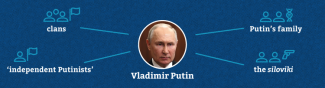
Key clans emerged during Putin’s rule, i.e. after 2000. This happened to the detriment of Boris Yeltsin’s oligarchy, which had been enriched by the privatisation of the 1990s but which was stripped of its influence on politics under Putin. Businessmen belonging to this group, such as Roman Abramovich, Oleg Deripaska and Vladimir Potanin, once had a say in Russia’s political course (the latter as one of the ‘seven bankers’ who financed Yeltsin’s election campaign, saving him from defeat in 1996). Today, they still occupy top positions on the lists of the richest Russians and have remained in the orbit of power, demonstrating their loyalty in every way possible (without which they could lose their fortunes or their lives). Their role includes administering Putin’s hidden assets, but their influence on the Kremlin’s decisions is minimal. The wealth of these ‘old oligarchs’ has its roots in Russia’s raw material deposits, which means that their property rights and future financial status are entirely dependent on the whims of the patrimonial ruler.
The leaders of the pro-Putin clans come from two key environments, and their position in the system stems from their long-standing, close ties with Putin. Some, such as his aide Nikolai Patrushev or the head of the state corporation Rostec, Sergei Chemezov, served with him in the KGB in the 1980s. Others, such as businessmen Arkady Rotenberg and Yuri Kovalchuk, are Putin’s friends from his youth or his business partners from the early 1990s.
Another figure worth mentioning as a patron of the influence group is a member of the regional elite, Moscow Mayor Sergei Sobyanin, who has been working directly with Putin only since 2005 (when he was appointed head of the Presidential Administration). Sobyanin and his clan’s position in the system is weaker than that of the players mentioned above, but given the political, financial and demographic importance of the city he governs, he is de facto a member of the federal power elite and has managed to build an influential administrative and business base around himself.
Below is a brief description of the most important political and business interest groups in Russia.
The Kovalchuk clan
The key figure in the group, Yuri Kovalchuk, has worked with Putin since 1991. He is the main shareholder of Bank Rossiya, which for decades has invested in numerous profitable assets and has handled the illegal financial interests of the dictator and his cronies.[9] He is also considered to be Putin’s ideological adviser[10] (on Putinist ideology see below: Ideological pressure).
The group wields extensive influence in the media and propaganda spheres, as well as in science and research, and in Rosatom[11] – a state-owned corporation with its own transport and logistics facilities, which is one of the key tools of Russian influence abroad (especially in view of the weakening position of Gazprom and Rosneft due to sanctions). The clan controls Russia’s largest private media holding, National Media Group (its president is Kirill Kovalchuk, Yuri’s nephew), which brings together a number of popular Russian media outlets, as well as VK, the most widespread social media platform (approx. 92 million monthly users). Boris Kovalchuk, Yuri’s son, has been head of the Accounts Chamber, the audit body for government spending, since May 2024. This is not a significant political position, but it offers insight into the finances of the entire state apparatus and the tools to bring it to heel. However, according to some opinions, Boris’s ambition is to assume the leadership of one of the major energy companies: Rosneft or Gazprom.[12]
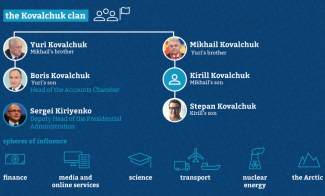
Yuri’s brother, Mikhail Kovalchuk, has been consolidating his control over the sphere of science for years. He is president of the Kurchatov Institute, which works closely with Rosatom on nuclear energy research. One of the phases of his rise in the system was his takeover of the Russian Academy of Sciences (its current president, Gennady Krasnikov, has close ties to Kovalchuk). He is also seeking to expand his influence in Roscosmos (among other things, he has become an advisor to the head of the corporation).[13] He is also involved in genetic research and bioengineering – projects in which Putin himself has a personal interest. In addition, the Kovalchuks are contributing to the expansion of Russia’s presence in the Arctic, a region of strategic importance for the development of the country’s offensive military and economic-commercial potential. In this area, they are building an alliance, at least a tactical one, with the Patrushev family (see below). At the same time, according to media reports, the Kovalchuks are interested in the agri-food sector,[14] which could lead to a conflict of interest with the Patrushevs. They are also investing in the development of cryptocurrencies – a convenient instrument for circumventing sanctions.[15]
Sergey Kiriyenko, the Deputy Head of the Presidential Administration since 2016 and in charge of domestic policy is an important figure in the Kovalchuk clan. He is a former Prime Minister (1998) and former Director General of Rosatom (currently he is the head of the corporation’s supervisory board). He stands out from the other members of the clan due to his ambition to expand his own sphere of influence (see below: Ideological zeal as a strategy for survival and career advancement), which indicates he is striving for independence from his patrons.
The Chemezov clan (the Rostec clan)
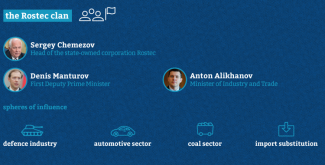
Sergey Chemezov, head of the state-owned Rostec corporation, controls financial flows and state procurement that allow the company to profit from the war and acquire further assets. The corporation controls the vast majority (officially around 80%) of the arms industry and is also present in the coal and automotive industries (the Kamaz and AvtoVAZ plants), among others. Furthermore, it profits from the import substitution programme in a number of strategic industries. Chemezov’s position is determined both by his long-standing close relationship with Putin and by the fact that he has trusted people in the highest positions in the government (these include First Deputy Prime Minister Denis Manturov, who oversees industry and trade, and Minister of Industry and Trade Anton Alikhanov). Rostec also controls elite groups in regions where Rostec’s most important assets are located, including the Nizhny Novgorod, Kaliningrad and Rostov oblasts.[16]
The Rotenberg clan
This clan is centred around the brothers Arkady and Boris Rotenberg, businessmen and billionaires who have been friends with Putin since their early youth (they practised martial arts together in Leningrad in the 1960s). The most important person in the group is Arkady Rotenberg, followed by: his brother Boris, Boris’s sons Roman and Boris Rotenberg (both are sports activists: entrepreneur Roman Rotenberg is the first vice-president of the Russian Ice Hockey Federation, and Boris is the general director of the Lokomotiv Moscow football club), as well as Arkady’s sons: entrepreneur Igor and ice hockey player Pavel Rotenberg. Unlike the Kovalchuk clan, the members of the Rotenberg family are not involved in political activities, focusing instead on increasing their wealth due to Putin’s protection. Among other things, the group controls large swathes of infrastructure, transport, construction and real estate (including in the EU, mainly in Germany), and the chemical industry. For years, it has been profiting from lucrative state contracts, including for Gazprom and Rosatom. Despite growing budgetary difficulties, the Kremlin does not intend to abandon its ambitious railway and road infrastructure development projects, which fall within the domain of the Rotenbergs, and suggests that they will continue to profit from state contracts in this area.[17] Some sources speculate that the Rotenbergs may have been behind the launch of the nationalisation of assets, which has been gathering pace since the start of the full-scale invasion (see below: Redistribution of assets), in order to expand their already impressive holdings.[18] Their backers in the government include Vitaly Savelyev, Deputy Prime Minister overseeing transport issues, and Andrey Nikitin, Minister of Transport.
The Patrushev clan
Former long-time Secretary of the Security Council (an advisory body to the President of the Russian Federation, currently consisting of 13 permanent members and 22 ordinary members) Nikolai Patrushev retained extensive informal influence in the system despite his official demotion to become Putin’s aide for maritime policy in May 2024. This influence is based on his close contacts with the security forces, direct access to the leader, and oversight of the aforementioned project to strengthen Russia’s presence in the Arctic, which is crucial for Putin. Patrushev is also embedded in formal administrative structures as head of the Russian Maritime College,[19] where the reorganisation of this body has meant he has marginalised the influence of Dmitry Medvedev (Security Council Deputy Chairman) and Denis Manturov (First Deputy Prime Minister). The college is responsible for coordinating the state’s maritime policy and its military dimension between executive authorities at various levels. Patrushev’s deputy in this institution is Mikhail Kovalchuk, who also chairs the college’s scientific council (this body includes other representatives of the Kurchatov Institute too). Patrushev also has ambitions to participate in building Russia’s ‘technological sovereignty’, which involves enhancing technological espionage.
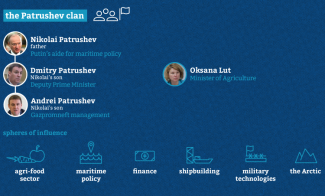
The clan’s position was bolstered by the promotion of Dmitry Patrushev (Nikolai’s son) from Minister of Agriculture to Deputy Prime Minister (May 2024). This is one of the few examples of a career in the state power structures pursued by the children of Putin’s confidants (this generation also includes Pavel Fradkov, Deputy Minister of Defence and son of the former head of the Foreign Intelligence Service). Most of them end up in private and state-owned businesses. Dmitry Patrushev is becoming an increasingly independent player, expanding his influence in the Russian agri-food sector, thanks in part to his control over Rosselkhozbank, state aid programmes and export revenues. Nikolai’s younger son, Andrei Patrushev, is involved in mining projects on the Arctic shelf and is a member of Gazpromneft’s management.
The Sobyanin clan
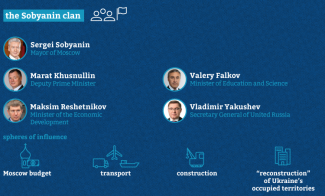
The mayor of Moscow, Sergei Sobyanin, who is highly regarded as an effective manager, manages to maintain his extensive influence in the system. The Moscow City Hall and the companies enjoying its patronage derive huge profits from siphoning funds from the wealthy capital’s budget and, among other things, from development projects. People associated with Sobyanin include Deputy Prime Minister Marat Khusnullin, who oversees transport, construction and the ‘reconstruction’ of the occupied territories of Ukraine (the businesses clustered around him are the beneficiaries of lucrative state contracts in this sector). Other figures include Maksim Reshetnikov, the Minister of Economic Development, Valery Falkov, the Minister of Education and Science, and Vladimir Yakushev, First Deputy Chairman of the Federation Council (the upper house of parliament) and Secretary General of the party of power, United Russia.[20] Yakushev is actively strengthening his position in the system by centralising and bureaucratising the party’s management and narrowing the circle of people who enjoy relative autonomy within its structures or who make important decisions.[21] Despite many years of ruling the capital, Sobyanin has managed to maintain his influence in the resource-rich Ural Federal District, where he held high positions in the regional authorities (including governor of Tyumen Oblast) from the 1990s to 2005. However, his importance in the region waned in 2025 after the dismissal of Yevgeny Kuyvashev from the post of governor of Sverdlovsk Oblast.
The Shoigu clan (in decline)
he only clan that has lost its position in recent years is the group[22] that was once gathered around Sergei Shoigu, the defence minister who was dismissed in May 2024. He was in conflict with Rostec CEO Chemezov, whom he criticised for the insufficient quantity and quality of weapons and military equipment which the corporation was supplying to the army. Due to his blatant disregard for the needs of the army and the rampant corruption in the Ministry of Defence, Shoigu himself was the target of relentless attacks by the now deceased rebel leader of the Wagner mercenary group, Yevgeny Prigozhin, the head of Rosgvardiya, Viktor Zolotov[23] and by ‘ultra-patriotic’ circles. Shoigu’s dismissal was accompanied by an unprecedented purge in the ministry (see further, Disciplining the nomenklatura: ‘anti-corruption’ purges). The repression also affected Moscow Oblast, which was linked to Shoigu, where several dozen officials were arrested – however, Governor Andrei Vorobyov has so far been spared.[24] This is the only case of a “shareholder of Russia” being stripped of his assets and clientelist network.
Shoigu himself, as a person who has been close to Putin for decades, formally retained his high position in the system of power due to his appointment as secretary of the Security Council (replacing Nikolai Patrushev). He also became head of the Federal Service for Military-Technical Cooperation, which means he is responsible for procuring sanctioned technologies and goods used by the arms industry from abroad. Hence his regular visits to ‘friendly’ countries (China, India, Syria, North Korea) to sign contracts for supplies. He also participates in military planning as deputy head of the Military-Industrial Commission (headed by Putin) which is responsible for overseeing the implementation of the tasks of the military-industrial complex. Although his position in the Security Council guarantees him immunity from the FSB, both he and his supporters have lost their control over the military budget managed by the Ministry of Defence and the associated corrupt income (‘corruption rent’).
It is also worth noting that although the Security Council (primarily its permanent members) has played a vital role in the system for decades as an advisory body to successive presidents on strategic issues, its position became weaker with the onset of the full-scale aggression against Ukraine. The Security Council meeting on 21 February 2022, where the planned recognition of the independence of the so-called Donetsk and Luhansk People’s Republics was discussed, opened a new phase in relations between the leader and the ruling elite. It turned into a spectacle of disciplining the members of the Security Council. They received a clear signal that Putin expects them to eagerly agree with even the most controversial decisions made without their participation, in secret from most of the formal leadership of the state. Putin likely consulted his subsequent plan to invade Ukraine only with then Security Council secretary Patrushev, Defence Minister Shoigu, Chief of the General Staff Valery Gerasimov and FSB head Aleksandr Bortnikov.
In this context, the question arises as to whether Shoigu’s promotion to Security Council secretary could result in a reassertion of his position within the system. Formally, he is in charge of the council’s administrative apparatus – its bureaucratic support wing. The secretary does not have the coercive, financial or administrative resources to call the shots in the nomenklatura. The role that Patrushev previously played in this position was unique due to his personal qualities, extensive connections in the security forces and close relations with Putin. Patrushev turned the Security Council apparatus into a powerful centre of influence, analysis of internal and international security, and coordination of the work of state bodies. It seems unlikely that Shoigu will be able to repeat his predecessor’s success.
2. The group of ‘independent Putinists’
To balance the influence of the most important clans and stabilise the system, and also to guarantee his own personal safety, Putin fills some key positions with trusted individuals who are not affiliated with any of the above-mentioned interest groups, and who therefore owe their careers directly to his patronage. This is intended to eliminate the “double loyalty” effect and serve as an additional instrument for maintaining a dynamic balance within the ruling elite. Although each of the individuals listed below has their own protégés in the administrative apparatus, there is no evidence to suggest that they are building up their own significant political support base.
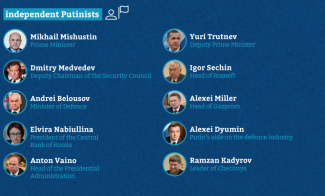
Many of these individuals are so-called technocrats – professional, “apolitical” top-level managers who are expected to effectively manage the areas they are entrusted with. Their main function in government is to serve the interests of Russia’s “shareholders”, led by Putin. Technocrats influence state policy in a narrow legislative and bureaucratic sense, benefiting from corruption, but lacking economic backing in the form of strategically important assets. The group of ‘independent Putinists’ also includes people who, due to their control over rich resources (e.g. the managers of state-owned energy companies), are ‘shareholders’ of the Russian state, but whose influence is generally limited to the economic sphere. This distinguishes this group from clans permanently anchored in the state administration.
Independent Putinists include:
- Prime Minister Mikhail Mishustin (formally the second person in the state, but with limited influence on government appointments),
- former President Dmitry Medvedev (currently Deputy Chairman of the Russian Security Council headed by Putin, and First Deputy Chairman of the Military-Industrial Commission responsible for securing the needs of the army),
- Defence Minister Andrei Belousov,
- Head of the Presidential Administration Anton Vaino,
- Deputy Prime Minister and Putin’s representative for the Far East Yuri Trutnev (whose ambitions and influence in the political and business sphere are limited to the territory under his control),
- Igor Sechin[25] (head of Rosneft and secretary of the Presidential Commission for Strategic Development of the Fuel and Energy Sector and Environmental Security),
- Gazprom CEO Alexei Miller,
- President of the Central Bank Elvira Nabiullina,
- Putin’s aide for the arms industry Alexei Dyumin.
Dyumin represents a group of Putin’s personal security officers promoted to senior state posts over the past decade. The group also includes the head of the Federal Customs Service Valery Pikalyov, Minister of Emergencies Aleksandr Kurenkov and Putin’s aide for personnel policy Dmitry Mironov.
Dyumin has long been floated as a likely successor to Putin, alongside Sergei Kiriyenko, Sergei Sobyanin and Dmitry Patrushev. For now, he has not gained a leading position within the state administration (in particular, he was not appointed to the post of defence minister, as many commentators had predicted). It remains to be seen whether his position as Secretary of the State Council (an advisory body coordinating cooperation between authorities at various levels, including heads of regions), which he has held since May 2024, will elevate him to the status of one of the main players. In this field, his interests clash with the ambitions of Kiriyenko as head of the PA’s domestic policy bloc, who is consistently strengthening his influence in the Russian regions (for more on Kiriyenko’s role and ambitions, see below: Ideological zeal as a strategy for survival and career advancement).
Another ‘independent Putinist’ deserves mention here: the leader of Chechnya, Ramzan Kadyrov. He rules his republic despotically and Chechnya is often referred to as the ‘internal abroad’ of the Russian Federation; it is unique in that it is de facto exempt from Russian law and connected to Russia by a kind of personal union, based on Kadyrov’s personal loyalty to Putin. At the same time, Kadyrov insists on the independence of his fief from federal state institutions, including law enforcement agencies. He has at his disposal a large (possibly around 20,000 strong) and loyal guard, composed of members of the local security forces. There are two reasons for Putin’s consent to Kadyrov’s displays of autonomy stems. On the one hand, he is helpless in the face of the Chechen problem and turning a blind eye, along with huge subsidies and grants from the federal budget, is the price for stability in the once rebellious republic). On the other hand, Kadyrov is a useful ally in foreign and domestic policy.[26]
The Chechen leader’s weakness, however, is his almost complete lack of allies at the federal level (instead, he has numerous adversaries, including the head of the Investigative Committee, Aleksandr Bastrykin, and the head of the FSB, Aleksandr Bortnikov). In light of regular reports of Kadyrov’s terminal illness,[27] the current balance of power between Grozny and Moscow and in the North Caucasus region is likely to be seriously redefined, although it is difficult to predict the direction of these changes at this stage.
In 2024, the trend of promoting members of Putin’s immediate and extended family in the public sphere became apparent. Some of them are holding positions seen as important for the stability of the system of power and its image in Russian society. The daughters of the Russian leader, Maria Vorontsova and Katerina Tikhonova, emerged from the shadows and became public figures.[28] In May 2024, the daughter of Putin’s cousin, Anna Tsivilyova, was appointed Deputy Minister of Defence in charge of social policy and aid to veterans of the invasion of Ukraine. She is also head of the “Defenders of the Fatherland” Foundation and owns shares in large companies in the coal and tourism industries.[29] In the same month, her husband, Sergei Tsivilyov, was appointed the new Minister of Energy. Both are Putin’s ‘eyes and ears’ in key areas of government.[30]
Putin’s eldest daughter, Maria Vorontsova, is a member of the management of the New Medical Company (NOMEKO), which develops innovative medicine. The company is involved in the implementation of new diagnostic and treatment methods, genetic research and personalised medicine. The SOGAZ Meditsina clinic in St. Petersburg, which belongs to NOMEKO, provides treatment to Putin’s closest friends and associates. Although Russian state propaganda presents genetic research as a countermeasure to ‘Western genetic weapons’ targeting Russians, there are strong indications that its primary goal is to prolong the lives of members of the ruling group, primarily Putin himself.
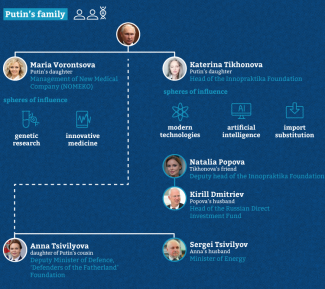
Katerina Tikhonova, head of Innopraktika foundation, focuses on advanced technologies, including artificial intelligence and the implementation of scientific solutions in business, including for the purposes of import substitution. The latter is considered a strategic sector in the context of Western sanctions. She is also involved in international cooperation, including with China and India.[31] As co-chair of the coordinating council for import substitution at the Russian Union of Industrialists and Entrepreneurs, she is likely to have a decisive say in the financing of projects in this area. A whole host of Russian state-owned and private companies, including Rosneft and Rostec, are engaged in sponsoring Innopraktika’s activities.[32] In addition, Mikhail Kovalchuk and his Kurchatov Institute cooperate closely with Tikhonova, including in the field of gathering genetic information and genetic research and biotechnology.[33] Tikhonova is a close friend of Natalia Popova, deputy director of the Innopraktika Foundation, whose husband Kirill Dmitriev, head of the Russian Direct Investment Fund, was appointed one of the main negotiators in Russia’s talks with the US that began in January 2025.
It is unclear how much of a role Putin himself has in promoting his daughters and to what extent it is the Kremlin clans doing this in an attempt to get closer to the leader and lobby more effectively for their interests. Combined with the promotion of the family members of the dictator’s confidants (the aforementioned nominations of Dmitry Patrushev and Boris Kovalchuk), this may indicate a search for an effective formula to solidify the regime’s stability. Apparently, the intention is to count on the loyalty of those who share an intergenerational interest in continuing the current model of government. One of the expected benefits of building this kind of ‘multi-family holding’ within the power structures may also be an increase in the efficacy of the system. One way to limit the scale of embezzlement in sectors important to the Kremlin is to centralise corruption, i.e. to redirect the main financial flows into the hands of selected families.
As Putin’s system became increasingly repressive and the ‘besieged fortress’ syndrome was fuelled by the war, Soviet-style spy mania and the hunt for ‘enemies of the motherland’ were revived on a large scale.[34] As a result of this policy, the already crucial role of the siloviki (the intelligence services and law enforcement bodies) as the Kremlin’s traditional tool for maintaining internal political stability has been further strengthened.
The atmosphere that there is a threat to state security from external enemies and a 'fifth column' is being constantly fomented. This creates the conditions to reinforce the position of agencies such as the Federal Security Service (FSB, the strongest of the services, with the broadest powers), the Federal Protection Service (FSO), the Foreign Intelligence Service (SVR), the Main Directorate of the General Staff (formerly GRU, military intelligence), the National Guard (Rosgvardiya), the Ministry of Internal Affairs, the Investigative Committee, the Prosecutor General’s Office, and others. These institutions compete for influence and resources, but they are united by a common strategic interest. This is the defence of the neo-totalitarian regime that provides them with significant and ever-expanding supervisory and repressive powers, as well as increasing transfers from the federal budget. Their representatives (the so-called siloviki) are also interested in maximising illegal income from corruption and extortion.
One important element of contemporary Russian economic reality is the widespread – formal and informal – supervision of private business by institutions responsible for domestic security. This serves two key functions: it is a tool for the authorities to exercise political control over a significant segment of society, and a channel for ‘feeding’ the siloviki and guaranteeing their loyalty to the system through a constant flow of corruption rent.[35] The siloviki also take advantage of the opportunity to benefit from wartime redistribution of assets and are increasingly expanding the scope of the so-called fight against corruption. This targets a growing number of officials and managers of state-owned and private enterprises (for more details, see Disciplining the nomenklatura: ‘anti-corruption’ purges).
The siloviki’s public activity consists in trumpeting their successes in the fight against ‘enemies of the state’ and corrupt officials, as well as in legitimising the neo-totalitarian regime, the war and the confrontation with the West. The frontrunners in this effort include Aleksandr Bortnikov, Aleksandr Bastrykin and Nikolai Patrushev, who can still be counted among the broadly defined siloviki milieu. The consistent expansion of the secret services’ powers is accompanied by a reinforcement of their symbolic position in the system, based on the myth of them being defenders of the fatherland and their unique professional ethos.[36] This translates into a specific culture-creating role: perpetuating the legitimacy of state terror and autocratic rule through the long-standing romanticisation of ‘good Chekists’ in popular culture and historiography.
Within the ecosystem of the security institutions, the position of the FSB has been growing stronger for years. It is the main advocate of state policy based on the logic of ‘special operations’ and the defence of a ‘besieged fortress’. This means striving to maximise control over social life, isolating Russia from external influences and keeping members of the elite in check. The FSB is largely behind anti-corruption campaigns, digging up dirt on officials and businesspeople, and vetting candidates for positions in the executive, legislative and judicial branches at various levels.
It is worth mentioning that a significant proportion of the alleged crimes detected by the apparatus of repression, classified as treason, terrorism or extremism, are the result of incitement and inspiration from the FSB, which fabricates detection statistics in selected areas.[37] This agency is most likely preparing for a significant increase in repression against the ‘enemies of the people’ in the context of the protracted war in Ukraine. This may be demonstrated by the adoption of a law allowing for the restoration of a system of prisons and detention centres directly subordinate to the FSB, as was once the case for the KGB (since the 1990s, the entire prison system has been formally under the authority of the Ministry of Justice, through the FSIN – Federal Penitentiary Service).[38]
The repressive function of the FSB often takes precedence over its counter-intelligence duties, and in recent years this has led to a series of spectacular failures, for which those responsible have not been punished (this indirectly points to the Kremlin’s real priorities). These include the misjudgement of the prospects for a full-scale invasion of Ukraine in early 2022, the failure to prevent Prigozhin’s rebellion in June 2023 and the terrorist attack in Krasnogorsk near Moscow in March 2024, and finally, the inability to prevent Ukrainian troops from entering Kursk Oblast in August 2024.
Although Putin’s system is based on the security structures, they do not play independent role in the Russian model of rule. There is no information about them successfully lobbying for their own candidates for high state positions (for instance, the long-standing efforts of the head of Rosgvardiya Viktor Zolotov to appoint Alexei Dyumin as defence minister ended in failure; Dyumin remains primarily Putin’s protégé, not Zolotov’s). The ambitions of figures such as Bortnikov, Bastrykin and Zolotov – long-time associates of the Russian leader – seem to focus on the institutions they head, as well as on consolidating their role in the system (as guardians of the ‘besieged fortress’ charged with fighting the state’s enemies), and competing for influence with other domestic security agencies.
Putin, who is keen to give the security agencies a free hand in escalating repression, carefully curbs their potential political ambitions. A similar mechanism is used in relation to the army. Despite its traditionally apolitical nature, maintained largely thanks to the FSB guarding the loyalty of the military, the Kremlin fears that the war will strengthen the political position of commanders. The Kremlin’s strategy is to ensure that no Russian general becomes a popular public figure. This is demonstrated in part by the removal of General Sergei Surovikin (a sympathiser of Wagner Group leader Prigozhin) from command of military operations in Ukraine, and the demotion and five-year prison sentence of General Ivan Popov. The latter was charged and convicted of embezzlement, but in reality he was most likely punished for criticising the leadership of the Ministry of Defence and the situation in the army, as well as for his excessive popularity inside the military. It is significant that he was denied the opportunity to rehabilitate himself by returning to the front, and Putin ignored Popov’s supplicatory letter asking for clemency.
II. THE KREMLIN’S CADRE MANAGEMENT
1. Closing ranks: a conservative personnel policy
Putin’s wartime personnel policy is conservative. It consists of limited reshuffles at the federal level (the regional level is much more dynamic)[39] and the consolidation (with a few exceptions) of the positions of the most important players and influential groups in the system. Even falling out of favour with Putin does not necessarily mean the immediate loss of position. This is demonstrated by the case of the deputy head of the Presidential Administration, Dmitry Kozak, once his trusted associate for ‘special tasks’ in foreign policy (Kozak was involved, among other things, in destabilising the political situation in Ukraine, Georgia and Moldova). The leader’s dissatisfaction was reportedly caused by a difference of opinion on the invasion of Ukraine in 2022: Kozak was allegedly the only person in the elite who openly criticised this decision. However, Putin did not dismiss him immediately, waiting until September 2025, after Sergei Kiriyenko had effectively taken over Kozak’s duties (see below, Ideological zeal as a strategy for survival and career advancement). Kozak was offered the position of Putin’s representative in the Northwestern Federal District, but he refused and, according to available information, he now travels freely abroad,[40] which may indicate that he has been assigned unofficial tasks.
Some of the figures who lost their high government positions were assigned new roles and have remained within the Kremlin’s orbit. In many cases, however, their status has become much weaker. Apart from Patrushev, Medvedev and Shoigu, mentioned in the text, these include: Sergei Ivanov, dismissed in 2016 from his post of head of the Presidential Administration (for the next decade he served as Putin’s special representative for environmental protection, ecology and transport, and retained his seat on the Security Council – he was only relieved of both posts in February 2026); Rashid Nurgaliyev, former Minister of Internal Affairs, since 2012 Deputy and then First Deputy Secretary of the Security Council; Yuri Chaika, until 2020 Prosecutor General, currently Putin’s representative in the North Caucasus Federal District. The current chairman of the State Duma, Vyacheslav Volodin, lost his previous influence after his dismissal from the post of deputy head of the Presidential Administration in charge of domestic policy in 2016 (among other things, he lost control of the party of power, United Russia)[41]. In turn, Igor Krasnov, a 49-year-old former Prosecutor General responsible for the mass nationalisation of assets, was appointed President of the Supreme Court in September 2025, which is effectively a face-saving demotion.
Putin’s traditional conservatism in personnel matters is compounded here by his desire for domestic political stability in a state of war mobilisation, as well as a clear wish to surround himself with people who are well-known, proven and whom he trusts. As a result, as the dictator consolidates his power, the average age of key figures in the system is rising, with many of them having held their positions for over a decade. The gradual introduction of the children of some of these people into state positions has not yet reached a scale that would allow us to speak of a generational change in the highest echelons of power.
The oldest generation (aged around 70 and above) controls key assets and groups of influence and enjoys high status. Special laws and presidential decrees allow for the extension of the terms in office of, among others, the head of the Investigative Committee, Aleksandr Bastrykin (73, who took up the post in 2011), the head of the Federal Security Service, Aleksandr Bortnikov (75, head of the institution since 2008), the head of the Foreign Intelligence Service, Sergey Naryshkin (72, in office since 2016), the chair of the Federation Council, Valentina Matviyenko (77, in office since 2011), Foreign Minister Sergey Lavrov (76, in office since 2004). 75-year-old Nikolay Patrushev remains an important figure, although, as mentioned, his influence has waned as a result of his unexpected dismissal in May 2024. The 83-year-old president of the Constitutional Court, Valery Zorkin, has held his position since 2003, and Putin’s foreign policy aide, 79-year-old Yuri Ushakov, since 2012. Alexei Miller (64) has been the CEO of Gazprom since 2001, and Igor Sechin (66) has been at the helm of Rosneft since 2012. In the coming years, therefore, we can expect Putin’s ‘elder statespeople’ to leave the system due to natural causes (the president of the Supreme Court, 81-year-old Vyacheslav Lebedev, died in early 2024).
The conservative personnel policy is also reflected in the lack of reshuffles among the so-called technocrats, who are striving to ensure that the Russian war machine can function without disruption and that the population does not feel the effects of the war on a larger scale. Minimising the negative consequences which the armed aggression and sanctions have on the Russian economy and population requires the competent management of state resources, which in turn demands professionalism and an efficient bureaucracy. This leads to people who have held key positions in economic management for years maintaining a relatively stable position in the system. These include: the head of the Central Bank, Elvira Nabiullina, who has been in office since 2013 (she is the architect of Russia’s successes in stabilising the currency market after 24 February 2022), Finance Minister Anton Siluanov (in office since 2011), Prime Minister Mikhail Mishustin (in office since 2020), First Deputy Prime Minister Denis Manturov (a member of the government since 2012 – first as a minister and then as a deputy prime minister), Economy Minister Maksim Reshetnikov (in office since 2020). These people are fully loyal to Putin and focused on ensuring the socio-political legitimacy of Putinism in the eyes of the citizens. Their position seems secure as long as they manage to guarantee the necessary budget revenues to fuel the war machine.
At the same time, a gradual generational change is taking place at the lower levels of the public administration, which do not have real political influence but are still important from the point of view of the efficient day-to-day state management (this applies, among others, to the positions of federal deputy ministers)[42]. This indicates that the system’s capacity for personnel renewal is being maintained, albeit to a limited extent, conditional on the political interests of the oldest cohorts.
The conservative personnel policy and short ‘reserve bench’ are demonstrated, among other things, by the limited government reconstruction that took place after the rigged presidential election of 2024. Its main purpose was essentially to improve the mobilisation of state resources so that the war can continue for at least several years. The only significant change in the government at that time was in the position of defence minister, when Sergei Shoigu, criticised for his incompetence and corruption scandals, was replaced by economist Andrei Belousov, former first deputy prime minister.[43] More surprising at the time was the dismissal of Patrushev from the post of Security Council Secretary.[44] Apart from that, the changes in the government confirm the consolidation of the main interest groups in Putin’s system.[45]
In this context, the technocratisation of the management of the defence ministry is noteworthy (one of its latest manifestations was Deputy Defence Minister General Aleksandr Fomin being replaced by the former First Deputy Minister of Industry and Trade, Vasily Osmakov in October 2025). The task of its leadership is to efficiently meet the financial and material needs of the Russian army in order to continue the war of destruction against Ukraine, including by curbing corruption in the ministry. Belousov is assisted in these efforts by, among others, Deputy Minister and Head of the Ministry’s Apparatus Oleg Savelyev, who is regarded as an extremely efficient bureaucrat. Previously, he controlled financial flows in the armed forces as an auditor of the Accounts Chamber and, after the annexation of Crimea, he successfully carried out the process of integrating the occupied peninsula with Russia.
2. Disciplining the nomenklatura: ‘anti-corruption’ purges
Corruption remains one of the pillars of Putin’s system (in line with the idea of the state as the property of those in power) and remains at a very high level.[46] The ongoing ‘fight’ against it is merely a pretence and serves not to eradicate the phenomenon, but rather to use it as an instrument for managing the state and the elites.
The current anti-corruption crusade is being waged for the following purposes:
- propaganda (demonstrating the state’s alleged rule of law and determination to prosecute those responsible for embezzlement),
- the redistribution of shrinking assets in conditions of war and sanctions,
- settling scores within the ruling group and at the regional and local levels,
- disciplining members of the nomenklatura,
- reducing mismanagement in arms production and supplies to the military.
The scale of corruption is not adequately illustrated by official data, according to which tens of thousands of corruption offences are detected annually (most of them, however, involve small sums). Their number is growing, as is the number of officials dismissed for bribery (reaching several hundred per year).[47] The real appetites of the nomenklatura can be gauged by examining the assets confiscated in the summer of 2025 at the regional level: the former president of the regional court in Krasnodar Krai, Aleksandr Chernov, lost 87 properties and 3 billion roubles (almost $36 million), and the former mayor of Vladivostok, Vladimir Nikolayev, lost over 800 properties and approximately 600 million roubles (over $7 million).[48] At the same time, there is no data on the enormous scale of corruption at the highest levels of power, where the culprits are above the law and the level of embezzlement exceeds that reported in official statistics many times over. Punishing those without strong protection allows the real scale of bribery practised by Putin’s cronies to be covered up.
Criminal proceedings related to corruption in Russia
In 2023, the public prosecutor’s office initiated more than 530 criminal proceedings for violations of the law in the arms sector,[49] and in 2024, approximately 30,000 officials were subjected to disciplinary measures for violating anti-corruption regulations.[50] In the first eight months of 2025, a record number of criminal cases involving offences in the area of military procurement were brought before the courts since the start of the full-scale war.[51]
During the first three quarters of 2025, 155 high-ranking officials were arrested, including members of regional governments and parliaments (i.e. three times more than in the pre-war year 2021 and over a quarter more than in 2024). The main defendants in criminal cases were law enforcement officers (32%), but the construction, housing and transport sectors also came under scrutiny.[52]
Inthe Russian context, it is impossible to determine in how many cases the law enforcement agencies intended to punish the corrupt, and when they aimed to remove inconvenient individuals from the sources of corrupt income, and redirect financial flows into the hands of more powerful players. With the full-scale invasion of Ukraine and the deteriorating economic situation, there have been changes in the previous rules on which the informal agreement between the Kremlin and the elite was based. Before, loyalty and moderate theft from the state coffers (proportional to a person’s status in the system) allowed members of the elite to enjoy relative impunity and a sense of security. Currently, the number of people who can steal from the state treasury with impunity is noticeably shrinking. Corruption is becoming more centralised. In times of forced budget cuts and uncertainty about the evolution of public sentiment, demonstrating a harsh policy towards corrupt officials is necessary on a much larger scale than before. In particular, this refers to those cases where embezzlement weakens the combat capabilities of the army and undermines Putin’s flagship geopolitical and ideological project of subjugating Ukraine.
As a result of the so-called fight against corruption, personnel changes have become more frequent in recent years, mainly at the lower levels of state management. These have mainly affected regional and local officials, managers in state-owned and private companies, including those linked to the military-industrial sector, but have also included the management of some federal state institutions. [53] Those arrested included two deputy energy ministers, a former deputy transport minister, a former deputy commander of the Rosgvardiya, the head of the Deposit Insurance Agency, a former governor of Kursk Oblast, the head of the culture department in the Moscow city government, the deputy governors of Krasnodar Krai and Altai Krai, officers of the Federal Penitentiary Service, the vice-president of Bank Rossiya, a member of Rosatom’s management and the deputy head of the Federal Customs Service. In 2024, arrests began at the state-owned corporation Rusnano, responsible for the development of nano-technologies.[54] The most high-profile case of this type to date was the purge in the Ministry of Defence, which began in the spring of 2024.
The purge in the Ministry of Defence: dismissals and arrests
On 25 April 2024, Deputy Minister of Defence Timur Ivanov was detained by the FSB military counterintelligence service on charges of accepting a particularly large amount of bribes scale between 2018 and 2023. Ivanov’s arrest, which was widely publicised in the state media, directly undermined the position of the incumbent Defence Minister Sergei Shoigu. The FSB military counterintelligence, undoubtedly acting in coordination with the Kremlin, demonstrated its control of the ministry and proved that Shoigu, although he belongs to Putin’s circle of trusted associates, was unable to protect his subordinates. By the end of 2024, several dozen ministry officials were dismissed or arrested – on charges of corruption and the embezzlement of budget funds. Some of them have already been sentenced to imprisonment, including Ivanov himself who, unusually for an official of his rank, received a very heavy sentence of 13 years in prison.
The case had several dimensions. The conduct of high-profile purges among corrupt ministry officials, who owed their careers to the dismissed minister Shoigu, served to point out who was to blame for the army’s supply shortages and held them accountable for failures on the front line. Apart from political and institutional rivalry, another reason for the purge may have been the desire to remove companies subordinate to the Ministry of Defence from lucrative construction projects in the occupied territories of Ukraine. The government’s programme for the socio-economic development of the ‘new territories’ envisaged spending 4.4 trillion roubles (over $50 billion). The biggest beneficiaries of the Ministry of Defence being sidelined from these contracts are most likely companies linked to Deputy Prime Minister Marat Khusnullin, the supervisor of the Southern Federal District (which includes the annexed territories of the Donetsk, Luhansk, Zaporizhzhia and Kherson oblasts). It cannot be ruled out that the actions against Shoigu were orchestrated by National Guard commander Viktor Zolotov, who in 2022–2023 lobbied the Kremlin to appoint his former subordinate from Putin’s personal security detail – the then governor of Tula Oblast, Alexei Dyumin – as defence minister.
Under the new circumstances, those who do not have particularly strong patrons cannot be certain of their future, even if they remain loyal and adopt a pro-war stance. Paradoxically, this does not lead to greater integrity among the ruling elite, but rather to fiercer competition for assets at the middle and lower levels, involving security forces and smear campaigns in the media. Uncertain prospects and the scrapping of the previous rules of the game result in a drive to get rich quickly and a growing penchant for risk-taking.
Members of the elite suspected or accused of corruption offences avoid further investigation or punishment by volunteering for the front line (during the first three years of the invasion, at least 100 former regional and local officials, MPs and security service officers chose to do so).[55] In this way, they hope not only to have their past abuses erased from their records, but also to continue their careers within the structures of power. Not a single federal-level figure is among them, which may indicate an unofficial ban on allowing this kind of rehabilitation for people who know too much about the system’s pathologies. Decisions in these cases are made in a non-transparent and arbitrary manner.
At least in some instances, the unexplained deaths of members of the political and business elite may be linked to corruption issues (or disputes over the redistribution of corrupt earnings) From the beginning of 2022 to the end of 2025, at least around 40 people (representatives of the political elite at various levels, senior managers of state-owned and private companies, including Gazprom and Lukoil) died or were killed in suspicious or unexplained circumstances. In 2025, the deaths of, among others, Transneft Vice-President Andrei Badalov (who fell from a window)[56] and Transport Minister Roman Starovoyt, who was dismissed in July 2025 (the official was said to have shot himself),[57] were classified as suicides.
The neo-totalitarian phase of the evolution of Putinism, and the accompanying war – which requires the mobilisation of cadre, economic and social resources on an unprecedented scale – must be given the appropriate ideological legitimacy. Following failed searches for a ‘national idea’ in the 1990s, Putin’s rule has seen a gradual rehabilitation of the imperial idea, inspired and sponsored by the Kremlin, largely drawing on well-known archetypes from the Soviet era. This process has clearly gathered momentum since the start of Putin’s third presidential term (from 2012). The regime not only utilised and expanded Soviet historical mythology and revived imperial nostalgia, it has also deliberately fostered a kind of ‘Weimar syndrome’ within society – a sense of resentment over the USSR’s defeat in the Cold War.
In response to calls for a political liberalisation and modernisation along Western lines, emanating from the new Russian middle class and parts of the Russian administrative and business elites in 2011–2012, a decision was taken to construct a new ideological foundation for the regime – a pseudo-conservative ideology. This served to brand the liberal Russian opposition as a Western fifth column, alien to the traditional values supposedly held by the nation. It was also intended to act as a counterweight to Western democratic ideas, which Putin’s team regarded as an existential threat to the Russian system of power. However, it offered no positive programme for the reconstruction of the socio-political order, but only progressive self-isolation and identification through negative points of reference. This, in turn, required the development of a fluid and malleable image of the enemy. The actual actions of representatives of the ruling camp, particularly their extreme materialism and ostentatious consumerism, from the outset stood in stark contradiction to their declared values.[58]
The ideological canon of wartime Putinism
During the full-scale invasion of Ukraine, the government stepped up its efforts to definitively construct an ideological canon that is binding both de jure (at the level of statutory law) and de facto (regarding practices that go beyond the letter of the law) and to impose this upon the elite and the public. It is worth noting, however, that the Russian Constitution prohibits the establishment of an official state ideology. Consequently, the authorities present it not as a construct enforced from above, but – in line with the idea of fundamental harmony between the interests of the state and society – merely as an expression of the traditional, organic Russian identity and patriotism (traditional moral and spiritual values). The Kremlin’s ideology is intended to legitimise the personalist model of government as the only one suited to Russia, as well as to justify the regime’s short- and long-term goals and the means chosen to achieve them.
Although this canon does not constitute a coherent scientific or philosophical system, unlike, for example, Soviet Marxism-Leninism (and is therefore not an ideology in the classical sense of the term), it nevertheless manifests ambitions to provide a comprehensive explanation of the logic of reality. It is a collection of often inconsistent narratives drawing on beliefs entrenched in the political and popular culture of the Soviet era and Putinism. Narratives from the perestroika period and the 1990s, on the other hand, are dismissed as unpatriotic. The new ideology is, moreover, presented as having no alternative. During the full-scale war, censorship and surveillance in Russia have taken on a mass character, and the dissemination of ideas inconsistent with the canon is in many cases considered a crime and severely punished. The most common formal charges include: ‘discrediting the Russian army’, ‘the deliberate dissemination of false information’, ‘extremism’, ‘the justification of terrorism’ and ‘the rehabilitation of Nazism’. At the same time, at least some of the ideas spread by propaganda find fertile ground both within the nomenklatura and in society, as they appeal to ingrained notions about the functioning of the international order and Russian political and social reality.
The essence of Putin’s ideology boils down to a few basic tenets. These are:
- The fundamental civilisational difference between Russia and the West
Allegedly, Russians possess a unique cultural DNA that drives their attachment to so-called traditional moral and spiritual values (a catalogue of these values is contained in the Fundamentals of State Policy in the Sphere of Preserving and Strengthening Traditional Russian Moral and Spiritual Values, a document adopted in November 2022).[59] The concept itself is vague and is used in a highly manipulative manner to appeal to Western conservative circles. Generally, it refers to so-called family and religious values in an ultra-conservative sense, including an obscurantist concept of ‘morality’ and the supremacy of the state’s interests over the needs of the individual. It also cherishes the cult of violence and toxic masculinity. Adherence to these values supposedly distinguishes Russia positively from the degenerate, declining civilisation of the West (liberal democracies).
- Russian messianism (missionism)[60] and supremacism
The war against Nazi aggression between 1941 and 1945, the victory and the ‘liberation’ of Europe supposedly give Russia a special mandate to have a say in the future of the continent and the world. According to this narrative, Russian tradition, history and culture are more valuable and held in higher regard than the traditions, histories and cultures of other nations, to whom Moscow simultaneously denies the right to full sovereignty. Furthermore, due to its unique historical experiences and exceptional bond with the divine (“We are Russians, God is with us”), the Russian nation has a special, redemptive mission to fulfil in world history.
- A cyclical view of history
Russia is once again waging a ‘Great Patriotic War’ for the survival of the state and the nation in the face of an existential enemy: Western-backed Ukrainian Nazism (Nazism, referred to as fascism prior to 2022, is perceived in the historical memory of Russians as synonymous with absolute evil).
- Mysticism
The Kremlin’s geopolitical revanchism is presented as an eschatological struggle between good and evil. Western democratic values are increasingly referred to as a Satanism aimed at destroying Russia’s national and cultural identity.
- The cult of militarism
Russia’s greatness has always been determined by the strength of its arms and imperial conquests. Militarism and a confrontational model of relations with the West are seen as the path to regaining that greatness.
- The cult of strong leadership and a powerful state
The most important element of Russian identity is the special relationship between the citizen on the one hand and state power and the imperial idea on the other. The individual is fully subordinate to the state and must look to it for a point of reference for the individual and collective identity. The interests of the state (read: the government) always take precedence over the needs and rights of citizens.
- Discrediting democratic values
Liberal democracy is an idea fundamentally alien to Russians, impossible to transplant onto Russian soil without risking the collapse of the state. The rights of women, LGBTQ people and national minorities are manifestations of extremism threatening the biological survival of the Russian nation and its system of values.
These narratives clearly convey the Kremlin’s intentions, both those that favour the elites and those that do not, and they also force them to adapt to changing conditions. They set out the criteria for assessing the loyalty of the state apparatus and the red lines that the elites must not cross in their attitudes towards the government, the war and Russia’s international relations. These intentions can be summarised as follows:
- the desire to wage a permanent war against existential threats emanating from an inherently hostile West,
- the ambition to redefine the world order in accordance with the interests of the Kremlin leadership,
- a firm political course aimed at maintaining a hierarchical social order, state paternalism, centralised state governance, the elimination of the remnants of pluralism, and the steady increase in control over the elite and society,
- the exclusion of any possibility of Russia adopting Western political models; the Kremlin will remain the sole centre distributing political influence and wealth amongst the representatives of the elites,
- signalling that relations between the government and society and between the Kremlin and the elites will be increasingly based on arbitrary changes to the rules of the game by the state’s top leadership. These changes will be accompanied by punishing those deemed insufficiently loyal,
- promises of continued enrichment through corruption and parasitism on state resources, albeit with a change in the rules governing access to sources of wealth; the economic sphere will be subordinated to the needs of war and the militarisation of the state, with wartime mobilisation remaining a priority; at the same time, the Kremlin will provide the nomenklatura with protection against the consequences of any potential social protests on political and economic grounds.
In this context, it is legitimate to ask what the West represents as a negative point of reference for Kremlin ideology, in light of a possible reset with the US under Donald Trump. The opening of negotiations with Russia regarding Ukraine sparked temporary euphoria in the Kremlin, and state propaganda began to portray the United States as the ‘good’ West. However, despite certain parallels between Russian imperial obscurantism and the so-called traditional values and foreign policy under the MAGA banner, any normalisation of relations with Washington would be strictly tactical on Moscow’s part. It would be calculated to weaken Europe (the ‘bad’ West) as much as possible and to regain influence in Russia’s ‘sphere of privileged interests’ (the so-called post-Soviet area). At the same time, sooner or later the Kremlin would return to the strategic confrontation with the US—both because of its ambition to fundamentally reshape the global security order and because of its own domestic political interests.
The practical implementation of the wartime ideology
It is generally difficult to draw precise lines between the top-down ideological guidelines being formulated by Putin and his inner circle (including informal advisers such as, for example, Yuri Kovalchuk, as well as Presidential Administration structures) and initiatives originating from members of the nomenklatura who are attempting to adapt as best they can to the new situation. The general ideological climate, shaped by years of escalating confrontation with the West and successive wars (in Chechnya, Georgia, Syria and Ukraine), the leader’s increasingly militaristic and pseudo-conservative rhetoric, and the zeal of nomenklatura representatives and pseudo-scientists seeking to please the Kremlin all create a self-perpetuating machine (on the elite’s reactions, see below: Ideological zeal as a strategy for survival and career advancement).
Among the most zealous and radical public promoters of Putin’s ideology are – apart from the dictator himself – Nikolai Patrushev, Deputy Chairman of the Security Council Dmitry Medvedev, Putin’s aide and head of the Russian Military-Historical Society Vladimir Medinsky, State Duma Chairman Vyacheslav Volodin and Sergei Kiriyenko. They are supported by a number of deputies to the Duma and the Federation Council, as well as a host of pro-Kremlin ideologues and propagandists such as Alexander Dugin, Sergei Karaganov and Konstantin Malofeyev; however, the role of many of these figures is often overestimated. At the regional level, Georgy Filimonov, governor of Vologda Oblast, has recently stood out. The activity of ideological hawks (led by Medvedev, who regularly engages in hate speech and calls for the genocide of Ukrainians), apart from setting the tone for the rest of the state apparatus, allows Putin to be portrayed as a relatively moderate politician. This, in turn, is designed to manipulate public opinion both within Russia itself and in the West.
The entities involved in shaping ideology include: the Presidential Administration, the research and analytical apparatus of the Security Council (including the Security Council’s Scientific and Expert Council), and think tanks working on behalf of the state administration (such as the Russian Institute for Strategic Studies (RISI), which has links to foreign intelligence), the ministries of culture, education and science (which, together with the Presidential Administration, develop ‘patriotic education’ programmes for children and young people), the secret services (primarily the FSB), the Ministry of Defence, the Russian Orthodox Church, state media, state-created youth organisations, as well as a whole host of government-organised NGOs generously funded from the state budget and the coffers of state and private enterprises. The lack of resistance from the elite and the zealous fulfilment of the leader’s expectations serve as proof to the Kremlin of the wisdom and effectiveness of its neo-totalitarian course.
One manifestation of this course is a return to the Soviet model of direct ideological control over the state apparatus. Under Putin’s decree of February 2023, the posts of deputy heads for political affairs have been officially established in state institutions and state-owned companies, with candidates for these posts being agreed with the Presidential Administration and the FSB. This expands on the earlier practice, well-established in the Russian system, of seconding active-duty FSB officers to civilian institutions. These ‘political officers’ are tasked with spreading the narratives created by the Presidential Administration throughout society, ensuring the ‘political correctness’ of employees and officials, brainwashing them with so-called traditional values and ‘historical truths’, ensuring employees vote as desired in various levels of sham elections, and recruiting informants.
The coordination of activities takes place, but so does ideological rivalry between different parts of the system (the secret services and the apparatus of repression, the Presidential Administration, and individual ministries and government agencies). The display of zeal in proving one’s correctness and usefulness to the Kremlin manifests itself, amongst other things, in inciting hatred against so-called foreign agents, enemies of the nation and traitors, in hate speech and genocidal rhetoric directed at the West and Ukraine, in incitement to war crimes, and also in misogynistic, xenophobic and homophobic statements and actions that refer to the defence of so-called traditional values.[61] These attitudes of the nomenklatura in the public sphere set the standards to which Russian society is expected to conform. Combined with increasing, totalitarian censorship, this creates favourable conditions for the mass indoctrination of Russian citizens.
Interesting ideological work is also taking place in a less public sphere and takes the form of pseudo-scientific publications authored by mid-level officials of the Presidential Administration, university staff, and historians affiliated with the Ministry of Defence or the FSB. The latter, taking advantage of their privileged access to closed archives, create a manipulated vision of Russian history based on distorted facts. This is intended to justify the special position of the repressive apparatus within the political system and to shape the attitudes of future generations of officials. Less concrete ideas are presented in the writings of Aleksandr Kharichev, head of the Department for the Monitoring and Analysis of Social Processes at the Presidential Administration, and Andrei Polosin – Vice-Rector for Ideological Affairs at the Presidential Academy of Public Administration (RANEPA)[62]. The latter is the author of the university indoctrination programme ‘Fundamentals of Russian Statehood’, and was previously a close associate of Kiriyenko at Rosatom. In publications controlled by the Kremlin, they expound on the distinctiveness of ‘Russian civilisation’, the unique Russian DNA[63] and the foundations of the Russian value system (‘pentabasis’)[64], regularly referring to Putin’s own theses in the process. More down-to-earth sections of their work concern justifying the dictatorial system of government (praising paternalism in state–citizen relations or attributing to Russians a natural inclination to sacralise power).[65] These same individuals, as officials, carry out practical, day-to-day activities in the field of domestic political management, which contributes to the consolidation of the regime at various levels of the socio-political situation.
Krugovaya poruka
Under the Kremlin’s imposed principle of krugovaya poruka,[66] active public support for the regime’s ideological foundations – including aggressive militarism – is increasingly seen as the duty of all members of the ruling elite, particularly high-ranking officials. In Russia, the boundaries are blurring between technocrats (apolitical managers) and ‘ideologues’. Technocratic figures such as Prime Minister Mishustin and Moscow Mayor Sobyanin sought to distance themselves from the topic of war during the initial phase of the full-scale invasion. Sobyanin’s trip to the occupied Donbas in December 2022, which was exploited for propaganda purposes, was most likely the result of pressure from Putin rather than his own initiative. In May 2025, however, a kind of ideological manifesto of Putinism was published: a collection of articles, presumably prepared by a team of historians loyal to the regime, whose formal authors are members of the Security Council (including the two officials mentioned above). It was dedicated to the 80th anniversary of the victory in the ‘Great Patriotic War’, but the commemoration of this milestone served as a pretext for the collective justification of the invasion of Ukraine and the accompanying changes in Russia’s domestic and foreign policy.[67]
Krugovaya poruka is not limited solely to the symbolic and rhetorical sphere. It also implicates the ruling elite in direct participation in war crimes. The federal and regional nomenklatura, government bodies, and state and private businesses are involved in the invasion and occupation of Ukrainian territories in various ways. This takes place, for example, through the imposition of quotas on state institutions and companies for the recruitment of soldiers, as well as the curatorship of Russian regions over selected occupied territories (aimed at their so-called ‘reconstruction’[68]). In certain cases, this activity is rewarded. For example, Valery Pikalyov, Deputy Governor of St Petersburg and former head of security at Putin’s residence on Lake Valdai, was promoted to head of the Federal Customs Service – most likely in connection with his oversight of the ‘reconstruction’ of occupied Mariupol.
A new trend in managing the ruling elite and the balance of power within the system has been observed in the Kremlin-inspired redistribution of assets on a scale unseen since the 1990s. It takes the form of nationalisation, reprivatisation, hostile takeovers and the so-called ‘fight against corruption’.[69] The redistribution of wealth began in late 2021, but gained momentum during the full-scale invasion of Ukraine and accelerated significantly in 2025.
Actual control over the seized assets is generally exerted by the state-owned or private businesses that instigated the takeovers. Although it is often unclear who stands behind their formal beneficiaries, at least in some cases the expropriations serve to expand the holdings of the major clans (e.g. the Rotenbergs – chemical industry assets, the Patrushev family – the agri-food sector, Chemezov – the defence sector)[70] and are most likely the result of mutual agreements between them and with Putin’s knowledge. This would explain the lack of friction over this issue between the key interest groups (though conflicts are noticeable at lower levels of the system). So far, these groups have not been seeking monopolies in specific sectors (on the contrary, they strive to diversify their ‘investment portfolios’), but they do have areas of particular interest, chosen partly on the basis of assets they have previously accumulated. At the same time, the role of security forces representatives in organising expropriations is noticeably growing: they are both the direct beneficiaries of this process (when they themselves take over assets) and a tool used by the leading players (when they act in the interests of the latter).[71]
The process of redistribution has four main objectives.
The first is the consolidation and reinforcement of the position of pro-Kremlin clans in key sectors of the economy in exchange for loyalty. This is designed to stabilise the system, streamline the mobilisation of the economy for the war effort, and to concentrate as many resources as possible in the hands of trusted individuals. The beneficiaries take over profitable enterprises, aspiring to a quasi-monopolistic position in individual sectors, which in the long term will allow them to dictate the rules of the game to other market participants. The even enrichment of the clans ensures stability and a balance of power, but in the long term the only guarantee of maintaining the status quo will be the Kremlin’s favour, Putin’s willingness to act as an arbiter in the event of conflicts, and a smooth succession of power. The latter is not an obvious scenario for how events might unfold following Putin’s death (or, less likely, if he steps down whilst still alive).
The second objective is to punish and discipline insufficiently loyal members of the elite by seizing their assets (this is often accompanied by criminal sanctions – see below). The criteria for loyalty have changed compared to the period before February 2022, and the rules of the game have become far less transparent. There is a clear state drive towards the so-called nationalisation of the Russian political and business elite – isolating it from foreign influence, forcing its representatives to repatriate capital from abroad (for example, Mikhail Fridman, founder of Alpha Group, has returned to Moscow) and punishing those with ‘dual loyalties’ who wish to continue making money in Russia whilst protecting their assets in safer jurisdictions.
Businesses are being expropriated from owners who reside permanently abroad, hold foreign citizenship or have permanent residence permits outside Russia (this is the motive behind around one-third of the takeovers carried out since the outbreak of the full-scale war)[72]. In sectors deemed strategic, the expropriation of individuals with foreign ties is justified on grounds of national security. Examples include the prosecutor’s office’s motion to nationalise the Chelyabinsk Electrometallurgical Plant and the nationalisation (in June 2025) of one of Russia’s largest airports – Moscow’s Domodedovo. According to the prosecutor’s office, the airport’s owners, who held dual citizenship, had allegedly been pursuing an aggressive Western policy aimed at Russia’s strategic defeat by inflicting economic losses.[73] Ultimately, Domodedovo was sold off in early 2026 (at a significantly undervalued price) to entities controlled by Arkady Rotenberg, which have been managing Moscow’s main Sheremetyevo Airport for nearly a decade.[74]
Thirdly, nationalisation and the reprivatisation of nationalised assets are a source of additional revenue for the state budget amid growing financial problems and a rising deficit caused by war expenditure.[75] In 2024, privatisation proceeds brought in nearly $1.5 billion to the budget, more than twenty times the original target.[76] In the spring of 2025, Finance Minister Anton Siluanov highlighted the need for a ‘major privatisation drive’ in Russia and announced that it would include the energy, transport and financial sectors. Although these plans have not yet materialised, the budget gained almost as much from privatisation in 2025 as it had the previous year (112 billion roubles, or over $1.4 billion)[77]. In November 2025, the new Prosecutor General, Aleksandr Gutsan, called on his subordinates to use asset confiscation as a tool in the fight against crime more frequently (confiscation is increasingly being applied not only in cases of alleged economic crimes, but also political ones).[78]
Finally, the creation of groups of beneficiaries whose ownership is easily contestable by law and which rests solely on arbitrary guarantees from Putin appears to be an important aim of the process. The assets serve as a reward for their loyalty and a guarantee of continued unconditional obedience to the regime.
By all accounts, the decision to seize attractive assets is first taken at the political level, and the prosecutor’s office then finds legal pretexts to legitimise it. The most common official reasons for expropriation are ‘illegal property management’, corruption, the acquisition of property with illegally obtained funds, and involvement in so-called extremist activities (this is a frequent pretext for the seizure of Ukrainian entrepreneurs’ assets)[79]. Assets are also nationalised as a result of forced bankruptcies. The prosecutor’s office is also increasingly challenging privatisation transactions from the 1990s, manipulating the statute of limitations (in these cases, it brings charges of illegal privatisation). This is a manifestation of the final dismantling of the legal guarantees of property rights in Russia. After 2022, the arbitrary changing of the rules of the game became one of the key attributes of the leader’s sovereign power.
The redistribution process first impacted (in 2022) foreign entities that decided to leave the Russian market following the start of the invasion. Subsequently, from 2023, Russian companies lacking sufficiently strong protection from powerful players began to be taken over, including enterprises controlled by regional elites.[80]
According to estimates, between February 2022 and June 2025, at the request of the public prosecutor’s office, the state seized assets worth approximately 3.9 trillion roubles (around 50 billion dollars at the June 2025 exchange rate, i.e. approximately 2% of the Russian Federation’s GDP), of which over 1.5 trillion roubles were assets of foreign companies.[81] A significant proportion of nationalisation orders are classified: in 2024, these accounted for almost two-thirds.[82] The figures regarding actual hostile takeovers of property by influential figures, not confirmed by court rulings, remain unknown.
The new distribution of wealth primarily benefits individuals linked to the major clans, security agencies and “independent Putinists”.[83] The first significant manifestation of the redistribution process was the nationalisation of a number of assets in the chemical sector in 2023, which were subsequently transferred to Ruschem plants controlled by the Rotenberg clan. Other assets nationalised or taken over by private entities included Russia’s largest car dealer Rolf (now controlled by Umar Kremlov, who holds a stake in a significant portion of Russia’s betting market and is linked to the head of the Presidential Security Service, Alexei Rubezhny)[84], one of the largest oil producers, Blago (after a series of suspicious deaths of people linked to the company, including its main owner Arkady Fosman, control of this company was most likely taken over by the former head of the FSB’s ‘K’ department, Viktor Voronin)[85], as well as the pasta manufacturer Makfa. In March 2025, the Forbes billionaire Vadim Moshkovich – head of one of Russia’s largest agricultural holdings, Rusagro – was arrested on charges of embezzlement. Both the takeover of Makfa and the likely seizure of Rusagro from Moshkovich fall within the interests of Deputy Prime Minister Dmitry Patrushev, who is in control of the agri-food sector, including through Rosselkhozbank, a state-owned bank he supervises. Moshkovich's position within the system may have been weakened prior to this by business conflicts with the entourage of Medvedev and Volodin.[86]
In 2024, the prosecutor’s office frequently requested that the state treasury take over real estate and land. A new trend involves the revocation of patents (intellectual property rights) in the arms industry and the takeover of assets in the oil sector, including companies controlled by former senior managers of Rosneft and Gazprom. The latter may indicate a review of the informal immunities previously enjoyed by the state business elite.[87] According to available information, the Kremlin may also be considering the creation of state-owned mega-holdings: one for metallurgy and another for energy, which would bring all assets in these sectors under state control (with minority stakes held by the current owners).
It is believed that the lobbyist for this latter idea is Igor Sechin – head of state-owned Rosneft and a longtime close associate of Putin, who has for many years aspired to take control of the assets of Gazpromneft and the private Lukoil.[88] Currently, Rosneft, which once aggressively expanded its holdings in the energy sector, has been forced, at least temporarily, to revise its plans for further expansion – as a result of the war and sanctions. The corporation is focusing on maintaining production and providing the state with essential export revenues. The imposition of US sanctions on Rosneft and Lukoil in October 2025 was a particularly painful blow to Sechin’s ambitions as these affect not only the financial health of both companies but also their importance to the state budget’s revenue from raw material exports.[89]
It remains unknown how far the competition for assets might, over time, take on a more brutal form and lead to the public exposure of potential conflicts within the elite. Not only could this hinder the consolidation of the system of power, but it might even destabilise it by suggesting the Kremlin’s weakness. So far, the only example of a public conflict has been the dispute over the Wildberries e-commerce platform, in which – at the federal level – a tangle of business interests and political rivalry among North Caucasus elites, pursued through criminal means, came to light. At the current stage of the evolution of the Putin system, this was merely an anomaly and a temporary image problem for the Kremlin, but further tensions of this kind cannot be ruled out in the coming years.
Wildberries: a jolt in a well-oiled machine
Wildberries, Russia’s largest e-commerce platform, founded in 2004 by the husband-and-wife team of Tatiana Kim and Vladislav Bakalchuk, began to face difficulties in 2024, stemming in part from poor management. Following a fire at Wildberries’ warehouses in St Petersburg in January 2024, the company came under scrutiny from the relevant authorities (the Investigative Committee launched an investigation into breaches of fire safety regulations).
At that time, Kim (who owned 99% of the company’s shares) reached an agreement with the Mirzoyan brothers, businessmen who controlled Russia’s largest outdoor advertising operator, Russ Outdoor. They are protégés of Suleiman Kerimov, a senator from Dagestan and a dollar billionaire (ranked 130th on the 2025 Forbes global list). Kerimov is said to have persuaded Kim to merge with Russ Outdoor (everything suggests this was a form of protection money in exchange for immunity from the security services and the Investigative Committee). Kerimov is also credited with securing the necessary backing for the deal from Anton Vaino, head of the Presidential Administration, and subsequently from Putin himself. According to available information, the merger was overseen by Maksim Oreshkin, deputy head of the Presidential Administration. It was announced in mid-2024 and a joint venture between Wildberries and Russ Outdoor – called RWB – was established in order to implement it. Wildberries contributed 65% of the shares and Russ Outdoor 35% (given the glaring disparity in the assets actually contributed, the transaction was clearly disadvantageous to Wildberries).
Although contracts of this type, approved at the highest political level, are not subject to appeal, Vladislav Bakalchuk (co-founder of Wildberries and formally the holder of 1% of the company’s shares) considered himself an aggrieved party and sought help from the head of Chechnya, Ramzan Kadyrov, who publicly promised him support. Both portrayed Bakalchuk’s wife’s decision as the result of an affair with the co-owner of Russ Outdoor, and after Tatiana Kim announced her intention to divorce her husband, the case took on the tone of a tabloid scandal. Furthermore, the marital and business conflict escalated into a public exchange of accusations and threats between Kadyrov and Kerimov’s associates. Emotions reached fever pitch in September 2024, when Bakalchuk’s attempt to storm the Wildberries headquarters ended in a street shootout, killing two of the company’s security guards. The decisions taken in the Kremlin regarding Wildberries’ fate were ultimately, as expected, sealed by the court, and Bakalchuk (due to his insubordination) was stripped of his previous shares in the company. Surprisingly, however, he continues to conduct business unhindered, which may indicate the relative effectiveness of Kadyrov’s protection.
Unexpected in the Wildberries case was the Kremlin’s lack of reaction to the escalating conflict and the fact that one of the disputing parties used business methods straight out of the ‘wild’ 1990s. Equally intriguing is the question of who will become the ultimate beneficiary of the newly formed enterprise. According to available reports, Yuri Kovalchuk is aspiring to control the Russian e-commerce market, seeking to take over the assets of both Wildberries and Ozon, as well as several other platforms (totalling approximately two-thirds of the market share).[90]
5. The ‘new elite’: more propaganda than a personnel revolution
In parallel with the ‘patriotic’ mobilisation of the nomenklatura, the Kremlin is promoting a plan for a sweeping reshuffle in the state apparatus, based on veterans of the aggression against Ukraine (this also includes collaborators from the time of the first invasion in 2014). According to the Russian authorities, it is the “heroes of the special military operation in Ukraine” (who, incidentally, receive generous social benefits linked to their veteran status) who should occupy the leading positions in the education and youth training system, in social movements, state-owned companies and the public administration. As announced by Valentina Matviyenko, Speaker of the Federation Council, those who fought in the war should not only participate in the state governance, but also become a new, “patriotic” cultural elite – a bulwark against war critics.[91] So far, this narrative has not taken hold in Russian society. Although most Russians believe that veterans enjoy social respect, and although there is a social demand for the renewal of the state elite, only a negligible percentage are willing to recognise precisely those who fought in Ukraine as the “elite”.[92] The opening of formal career paths for war participants serves several purposes.
Firstly, it is intended to symbolise the renewal of the state and society in the crucible of the so-called war against Nazism, and to justify the aggressive ideology of militarism and imperialism. The aggression against Ukraine is presented in propaganda as a new Great Patriotic War, modelled on the defensive war of 1941–1945. Veterans are elevated as a new elite – the embodiment of the ideals of patriotism and self-sacrifice, and of traditional moral and spiritual values – in opposition to the ‘old’, cosmopolitan elite that emerged from the transformation of the 1990s. The latter considers itself – in Putin’s own words – a ‘caste with special rights and privileges’ that sought to ‘sit on two chairs’, earning money in Russia whilst safeguarding its capital in the West.[93] The discrediting of the ‘old elite’ is expressed not only in verbal criticism, but also in the revocation of the benefits of the 1990s privatisation detailed above.
Secondly, opening up career paths for veterans is intended to solidify the electorate interested in the continuation of the war and the consolidation of the regime. Both are presented as an opportunity for ‘everyone’ to achieve unprecedented social advancement, whilst also motivating Russians to contribute to the invasion. This provides an additional incentive (alongside generous social transfers and preferential access for combatants to public goods and services) to align one’s personal interests with those of the Kremlin – even though a significant portion of society is unable to define the war’s objectives.[94] Killing and risking one’s life as an effective career path also fits into the totalitarian logic of the cult of war and death on the battlefield.
Thirdly, the creation of a new class of beneficiaries within Putin’s system encourages ambition among those whose social advancement is not due to clan-patronage ties with the ‘old’ elite. Their advancement is linked directly to Putin’s favour, which is meant to strengthen their personal loyalty to the leader.
Due to its involvement in war crimes, the new elite would likely be less inclined than the old one towards any future rapprochement with the West. It appears, however, that the Kremlin intends for the newcomers to counterbalance not only the ‘liberals’, but also the ‘ultra-patriots’ (the so-called Z-patriots[95] with radically pro-war, though not necessarily pro-regime, views), who regularly accuse the ruling elite of incompetence.
Fourthly, the promotion of veterans as rivals to the old elites is intended to serve as a further disciplinary tool against the nomenklatura at various levels, which is judged on the basis of its ideological orthodoxy and ability to mobilise state resources for the war effort. At the same time, it is a refutation to accusations that the ossified Putinist system closes off career paths to outsiders.
Finally, social reintegration programmes for veterans returning from war (training for public administration staff, assistance with occupational retraining or support in setting up their own businesses) are intended to neutralise the threats to socio-political stability. These threats stem from the return from the battlefield of people with inflated financial expectations, accustomed to violence and capable of organising themselves against the authorities.[96]
The main vehicle for promoting the new elite is the ‘Time of Heroes’ project, run by the Presidential Administration under Kiriyenko’s supervision since March 2024. It has its equivalents in almost all the Russian regions.[97] During the first year, 43 participants received appointments to various positions within the state apparatus. Among them were at least 13 people suspected of war crimes in Ukraine.[98] Furthermore, many state institutions and government-funded foundations (including ‘Defenders of the Fatherland’, led by Deputy Defence Minister Anna Tsivilyova) also provide assistance for veterans of the invasion.[99]
To date, the most prestigious appointment (though not one involving access to real power) has been the nomination of Artyom Zhoga (former head of the so-called parliament of the Donetsk People’s Republic, DPR) as Putin’s representative in the Ural Federal District. Moreover, three other veterans (Alexei Kondratyev, Amyr Argamakov, Yuri Nimchenko) were appointed senators. Among the other significant promotions, the following stand out: the appointment of Colonel Aleksandr Tikhonov as deputy to Putin’s representative in the Volga Federal District, Yevgeny Pervyshev as governor of Tambov Oblast, as well as appointments to civil service posts in federal ministries and regional authorities (deputy governors, ministers in regional governments, advisers to authorities at various levels, as well as the heads of youth paramilitary organisations: Yunarmiya and the Movement of the First)[100]. The latter seem particularly significant as an indication of the growing involvement of war veterans in the ‘patriotic education’ of children and youth. It boils down to widespread indoctrination in the spirit of militarism and Russian supremacism, to which the government is devoting increasing attention.
Furthermore, there is a growing trend of promotions to high-level posts in the Russian regions for individuals who previously served in the occupation administrations of the seized territories of Ukraine. For example, Yevgeny Solntsev, the so-called ‘Prime Minister of the DPR’, has served as acting governor of Orenburg Oblast since March 2025, whilst Irina Gekht, who held a similar position in the occupation authorities of Zaporizhzhia Oblast, was appointed acting governor of the Nenets Autonomous Okrug at the same time (both officially ‘won’ the gubernatorial ‘elections’ in September 2025). Earlier, in 2023, two others were promoted to governors: (of Omsk Oblast) Vitaly Khotsenko, the former so-called Prime Minister of the DPR, and (of Chukotka) Vladislav Kuznetsov, the former so-called Deputy Prime Minister of the Luhansk People’s Republic. However, the regions to which they were assigned offer neither the opportunity to showcase their achievements to the Kremlin nor to gain control over significant financial flows. The appointment of these individuals as governors, proof of the career paths opened up by involvement in the occupation, is intended to encourage Russian officials to serve in the annexed territories. This service is not particularly popular within the administrative apparatus, which forces frequent rotations. Since the start of the full-scale war, hundreds of officials at various levels have worked in the territories occupied by Russia. They are sent there by their superiors (often forcibly) or volunteer themselves – to avoid punishment for corruption offences. Some of them hope that this service will serve as a springboard to a career (though this motivation is undermined by dangerous working conditions).
To date, the appointments of war veterans suggest that they are not being granted access to real power or money, including the spoils of corruption. As a rule, those fighting on the front line have no patrons within the system, whilst entrenched patronage networks, based on widespread nepotism, defend themselves against outsiders with whom they would have to share power and assets.[101] The veterans’ appointments serve mainly to advertise war as a path to upward social mobility. Promoting veterans is also a means of legitimising the extensive networks of GONGOs, focused on providing aid to the Russian army. They live off state funds and are driving out the remnants of the anti-regime civil society.
The situation is different for ‘nomenklatura soldiers’:[102] those who, already part of the administrative apparatus, lend themselves credibility through participation in the war which is generally brief and of a token nature. Among the significant group of officials who voluntarily went ‘to the front’ (and boasted about it, harnessing the local media for their self-promotion), only a small proportion actually found themselves in the combat zone.[103] Some officials combined their so-called front-line service with their regular duties, whilst others serve for a few weeks or months before returning to their normal lives. Most officials end up in special units stationed far from the combat zones (mainly BARS volunteer units tasked with ‘maintaining public order’ to the rear of Russian forces). This demonstrates particular cynicism given the lack of troop rotation for ordinary citizens, who have been forcibly mobilised since September 2022. For officials avoiding dangerous military service, self-promotion is intended to facilitate career advancement or simply to maintain their position within the system.
So far, the rise of real veterans, especially professional soldiers, has been held back by the Kremlin’s fears of strengthening the political capital of the army – an institution that consistently enjoys the public’s trust and esteem as one of the cornerstones of Russian identity.[104] Available information suggests that the Time of Heroes programme deliberately selects mediocre people with no ambition, but who are willing to show absolute loyalty and obedience.[105] These concerns are also illustrated by the mechanism for selecting candidates in ‘elections’. In the 2024 regional and local polls, only 0.5% of all veterans running as candidates for the United Russia party (380 in total) held the status of active military personnel.[106] In the similar ballots of 2025, almost three times as many veterans won seats (mainly at the municipal level), which is still insufficient to allow us to speak of a large-scale trend, even though in some regions their share in regional parliaments reached 10–12% (the Ryazan and Chelyabinsk oblasts and the Komi Republic).[107] As usual, the largest group of candidates was made up of public sector employees, who are entirely dependent on the state and known for their high level of loyalty. Caution should therefore be used when approaching the much-hyped announcements of the co-opting of around 100 veterans into the State Duma (almost a quarter of its membership) through the September 2026 sham parliamentary elections.[108]
The ‘elite renewal’ programme also poses other risks to the system. Veterans unfamiliar with the intricacies of the nomenklatura may be a source of problems, insubordination and disruptions to the functioning of the patrimonial state apparatus. In regional administrations, there is also growing concern regarding the attitude of officials who worked in the occupied territories (they are accused of a penchant for corruption, a sense of impunity and arrogance exceeding the level accepted in Russia)[109].
III. REACTIONS AND ATTITUDES OF THE PUTINIST NOMENKLATURA
1. Adapting to the new reality
According to available information, a significant portion of the Russian ruling elite reacted negatively to Putin’s decision to launch the full-scale invasion of Ukraine. This was partly because sanctions disrupted a convenient scheme whereby money earned in Russia could be safely invested in the West. However, none of the high-ranking members of the nomenklatura broke with the regime, despite its war crimes and the murders of political opponents. There were occasional cases of emigration for political reasons, and these were generally not publicised. The only departure to attract attention was that of Anatoly Chubais,[110] the former head of the Rusnano corporation, in 2022. He has extensive knowledge of how the regime operates (it is worth noting that Chubais has never condemned the war). The alleged attempt to poison him abroad (2022), followed by a propaganda smear campaign and a wave of arrests among those linked to Rusnano in connection with probable embezzlement, may serve as a warning to other members of the elite against attempts to distance themselves from the Kremlin.
The Russian ruling class, despite the initial shock, discontent and fear for the future, has adapted in organisational and mental terms to the new wartime situation, including the confrontation with the West. They have got to grips with the fact that this situation is likely to persist for a very long time. As yet, there are no signs of rebellion against this ‘game without rules’ involving the large-scale redistribution of assets, nor any significant resistance to the ideology imposed from above.
The reasons for mass loyalty to the regime include both positive motivations (the hope of reaping benefits from demonstrating loyalty or individual views aligning with the Kremlin’s official propaganda narrative) and negative ones (fear of repression).
The key motivations of the state apparatus and big business can be summarised as follows:
- fear of losing status, wealth or even one’s life if accused of disloyalty (the nomenklatura is well aware it is under constant surveillance by the security services);
- the conviction that the regime is stable and that Putin is an effective leader; even Yevgeny Prigozhin’s military mutiny in June 2023 only temporarily shook this certainty. The warlord’s imminent death only strengthened the system in the eyes of the nomenklatura, and served as another lesson to them about the price of breaking the rules of the game;
- the Kremlin’s ability to maintain domestic political stability and legitimacy despite growing macroeconomic problems, heavy war losses and intensifying social issues (alcoholism, drug addiction, rising levels of violence); from the perspective of broad sections of Putin’s nomenklatura, nothing threatens the kleptocratic quasi-feudalism on which the entire Russian ruling elite has been enriching itself for decades;
- attachment to the social and material status associated with numerous privileges in Russia;
- the conviction that there is no alternative to Putin, whether within the ruling class itself or among the opposition (all significant opposition figures have been imprisoned, forced into exile or murdered);
- The lack of prospects in exile (fear of a significant decline in living standards and social status, as well as of prosecution for complicity in the regime’s crimes; the lack of credible security guarantees from foreign governments; the threat of assassination by the Russian intelligence services; resentment and distrust of the West);
- the opportunity to profit from the war and structural changes in the economic model (the conversion of a significant part of the economy to a war footing) amid persistently high levels of corruption (see box below).
Even when taking into account the uneven distribution of increased wealth among the nomenklatura, as well as inflation-induced losses,[111] the pessimistic forecasts of substantial financial distress, typical for the early stages of the full-scale war, have not materialised. Three years after the war began, the number of Russian dollar billionaires had returned to pre-invasion levels. In 2024, Russia ranked fourth in the world in terms of the size of this group (128 individuals), surpassing the United Kingdom in terms of the value of their assets; this trend continued into 2025,[112] with those subject to sanctions being the main beneficiaries of this wealth accumulation. This was mainly due to the rise in commodity prices on global markets. Only a handful of dollar billionaires renounced their Russian citizenship,[113] whilst many others returned to Russia, bringing their wealth back with them and thereby abandoning their long-standing ‘dual loyalty’ (the latter involved transferring capital accumulated in Russia to foreign territories). It should be borne in mind, however, that they are merely the nominal owners of the assets; in the Russian context, as I have mentioned, the use of assets and the accumulation of wealth through business activities do not stem from ownership rights, but from a form of lease – assets that generate income are part of Putin’s ‘patrimony’, as they remain under his full control, and the law enforcement agencies can seize them from the formal owners at any time.
Further motivations include:
- a belief in Russia’s ultimate victory in Ukraine and in its confrontation with the West; regardless of the intentions and actions of the Trump administration and European states, Washington’s pursuit of a reset with Russia and Europe’s inconsistent policy towards it are seen as signs of naivety and weakness;[114]
- continuing opportunities to invest and earn money in Europe and to travel to European countries despite sanctions (see box below).
Numerous loopholes in the Western sanctions regime mean that Putin’s leading ‘oligarchs’, including those subject to sanctions, continue to profit from trade with Europe and invest the money they earn in the war. These include, among others, the Rotenberg brothers and Oleg Deripaska, who co-finance mercenary (“volunteer”) units fighting in Ukraine and encourage their companies’ employees to sign contracts with the army.[115] According to reports by independent media, companies linked to Deripaska are also profiting from arms production in Russia.[116] The issue also concerns high-ranking officials. The European Union has still not imposed sanctions on, for example, Andrei Patrushev, the younger son of Putin’s aide, who is enriching himself through state contracts and uses a diplomatic passport to travel to Europe.[117] In July 2025, Valentina Matviyenko, Speaker of the Federation Council, attended the World Conference of Speakers of Parliament at the UN headquarters in Geneva, despite being subject to sanctions imposed by the US, the EU, Canada and Switzerland itself. This allowed her to publicly spread lies about the war. Her wealth, amassed through her complete loyalty to Putin, is meanwhile safe in San Marino, managed by her son Sergei Matvienko (subject to US, Canadian and Japanese sanctions, but exempt from EU sanctions).[118] Furthermore, family members of many officials (federal, regional and municipal) are still able to live or study in the West.[119]
Other factors include:
- anti-Western resentment due to financial losses caused by sanctions (felt by a large section of the nomenklatura);
- pro-war views (likely held by only a small section of the nomenklatura).
Despite widespread adaptation and ostentatiously displayed loyalty, in 2025 public signs of discontent and tensions among the ruling elite began to appear, which can be regarded as veiled criticism of the war. These became apparent, among other things, during the St Petersburg International Economic Forum (June 2025).[120] The main target of criticism is, formally, the high interest rate policy pursued by the Central Bank of Russia (CBR) to curb inflation. Those complaining about this situation include Sergei Chemezov, Arkady Rotenberg and Igor Sechin, as well as Finance Minister Anton Siluanov. The reasons for the dissatisfaction are: high interest rates on loans, which are stifling business activity (as Economy Minister Maxim Reshetnikov stated, Russia “is on the brink of recession”)[121], and the relatively strong rouble, which is reducing the rouble-denominated export revenues of businesses and the state budget. CBR President Elvira Nabiullina has been repeating since mid-2024 that the country has already exhausted its resources for economic development, so easing monetary policy would only lead to stagflation. However, no one doubts that the real source of the problems is the war, the legitimacy of which cannot be questioned without incurring Putin’s wrath.
2. Ideological zeal as a strategy for survival and career advancement
As mentioned above, it is often difficult to draw a line between the top-down ideologisation of the elite as a method of managing the system and their (self-)ideologisation as a reaction to the Kremlin’s expectations and directives. In fact, these two vectors reinforce each other: the nomenklatura receives clear signals as to what behaviour is desired, and the lack of resistance on its part reassures the Kremlin of the effectiveness of the measures chosen.
The increasingly radical attitudes of members of the state apparatus only to a limited extent stem from genuine ideological motives. Most representatives of the regime are extremely cynical and opportunistic, ready to mimic others, whilst also displaying a high degree of flexibility in adapting to new conditions. This takes the form of espousing militaristic and obscurantist rhetoric. Many of these individuals, including the leading anti-Western hawk Dmitry Medvedev, were once regarded as pro-Western liberals. Views that are 100 per cent in line with the propaganda narrative can – apart from Putin – certainly be attributed to current and former heads of the security agencies who were shaped by Soviet security structures, including the KGB (Patrushev, Bortnikov, Bastrykin). Putin’s aide Vladimir Medinsky, who is particularly active in the field of historical propaganda, also belongs to this group.[122] Even the hawks, however, can make a 180-degree turn in the tone and content of their statements as long as it serves their current interests, including the manipulation of their opponents. The April 2025 interview with the anti-American Patrushev is an example of the latter; he argued for the need to rebuild trust in relations with Washington in the name of sharing responsibility for the world’s future.[123] Regardless of the motivations of individual people, however, it remains true that mass adherence to the Kremlin’s ideology strengthens the system and entrenches its aggressive foreign policy.
A demonstrative renunciation of ties with the West and involvement in promoting ‘patriotic’ ideology to show loyalty to the Kremlin translate into concrete benefits. This primarily means the opportunity to embezzle budget funds through participation in ventures that are a priority for the country’s leader and linked to the continuation of the war. Desirable attitudes are dictated not only by the Kremlin’s official rhetoric and the informal levies for the war imposed on big business, but also by the structure of the federal budget. State expenditure on armaments, the army, propaganda and domestic political repression is rising steadily. In 2025, total expenditure on the war machine exceeded funding for social purposes for the first time since 1991. For instance, ideological radicalisation has paid off handsomely for Medvedev and his entourage. Whilst in the years 2015–2023 the ‘charitable’ organisations linked to him received several billion roubles annually, their budgets skyrocketed in 2023–2024 (since at least some of them began supporting the war and the occupation of Ukraine). In this period, payments from various entities, including big business and state-owned banks, totalled 120 billion roubles (over 1.2 billion dollars).[124]
It is intriguing to observe the trend in how some elite members use language, clothes and other external attributes to display allegiance to the Kremlin’s military agenda and ‘traditional values’. This is reflected in the increasingly frequent use of military jargon by civil servants and MPs, and in their appearance, styled in a military or folk-Orthodox manner (lush facial hair, khaki clothing and Stalinesque military jackets for men; long skirts or traditional headwear – kokoshniks – in the case of women).[125] In turn, the ‘pivot to the East’, towards China, which is set to replace the West as the main reference point in the economy, geopolitics and cultural cooperation, translates into an increased interest in learning Chinese (a trend inspired by Putin himself, who boasted of his granddaughter’s successes in this field).[126]
This proving of one’s ideological correctness is not limited solely to the realm of rhetoric, propaganda and symbolism, but manifests itself in practical actions amounting to complicity in war crimes. These include administrative apparatus and private and state-owned businesses financing military units fighting on the front line. One such unit is Soyuz, organised by Sergei Kiriyenko and Yuri Trutnev, Putin’s representative in the Far Eastern Federal District. Its recruitment base is the Russian Martial Arts Union, led by both officials.[127] The unit is funded by Rosatom, Sberbank, Lukoil and companies from the Far East. Both political sponsors have personally travelled to the Donbas to provide aid to the unit. Another example is the Española brigade (sponsored by the Rotenberg family), known for the neo-Nazi views of its members.[128]
Furthermore, it is becoming an increasingly widespread practice among large state-owned and private companies to recruit mercenaries for the war in Ukraine and to pay their salaries or generous incentive bonuses based on fictitious employment with the company (this practice is carried out by, among others, Rusal and Novatek, Gazprom, Roscosmos, and Russian Railways).[129]
As noted above, it is often difficult to draw a clear line between the use of these practices to obey specific Kremlin directives and a grassroots zeal to curry favour with the authorities. Ultimately, however, the entire Russian state apparatus bears responsibility, in one form or another, for war crimes.
Standing out from the rest of the apparatus – in terms of the ambition and the scale of his activities – is one of the leading architects of domestic policy, Sergei Kiriyenko. In recent years, he has been consolidating his position within the system by assuming control over successive areas and playing a role in the ideologisation of public life.
Ideology in the service of a career: the case of Sergei Kiriyenko
Many have found that zeal in promoting Kremlin ideology serves as a springboard to a career in politics and the administration. The deputy head of the Presidential Administration serves as a prime example of this. He is responsible for domestic policy, including the control and shaping of public opinion, and the supervision of online propaganda (propaganda in the traditional media is overseen by another deputy head of the PA, Alexei Gromov)[130] and political parties. He is also in charge of organising pseudo-elections at various levels. Apart from the domestic agenda, Kiriyenko bears co-responsibility for the integration of the occupied Ukrainian territories into Russia. His subordinates, together with the secret services and Rosgvardiya, were in charge of organising the annexation ‘referendums’ in autumn 2022 and they are careful to ensure that subsequent ‘elections’ in these regions go the Kremlin’s way; they also recruit Russian occupation staff and pursue a policy of Russification of the local population.
Kiriyenko is regarded as a follower of the ‘methodological school’ of the Russian philosopher Georgy Shchedrovitsky: a concept of social engineering based on the assumption that society is malleable and can be programmed to fulfil specific functions. Ethical considerations are secondary to the principle of effectiveness: the most important thing is the selection of appropriate goals and the means to achieve them. Committed to a technocratic vision of state governance, Kiriyenko regards ideology and propaganda as effective tools for managing society at a given stage.[131] His tasks include preparing public opinion for any decision Putin may make regarding war and peace, and ensuring domestic political stability amid the invasion of Ukraine, sanctions and a lack of vision for the future.
At the same time, Kiriyenko is pursuing his own personal ambitions. He is actively expanding the organisational infrastructure of the PA’s domestic political bloc and broadening his own networks of influence within the system by placing loyalists at various echelons of the state apparatus. He is establishing new organisations and initiatives that promote anti-Western ideas and support the war. He is also strengthening his control over recruitment procedures for federal and regional administrations and state-owned corporations through contests and training programmes. These include: the School of Governors (50 of its graduates currently head Russian regions)[132], the School of Mayors, Leaders of Russia and Time of Heroes, dedicated to veterans of the invasion of Ukraine. The PA’s domestic policy bloc subordinated to Kiriyenko also monitors the work of regional authorities, coordinates election and propaganda campaigns in the regions, and taps into the potential of leading Russian universities to promote the official domestic policy line.
In early 2025, Kiriyenko launched another training programme (Social Architects), aimed primarily at political consultants and spin doctors who had previously been involved in preparing ‘elections’ at various levels. They are tasked with shaping public opinion on social issues deemed particularly important (including the assistance provided to war veterans), feigning dialogue between the government and society, and organising ‘grassroots social activism’ – with the aim of steering public sentiment in the desired direction.
Kiriyenko is also expanding into the field of historical propaganda, which until recently was dominated by Vladimir Medinsky. He supervises the National Centre for Historical Memory under the President of the Russian Federation, established in late 2023, that promotes a propagandistic narrative about the genocide of the Soviet people between 1941 and 1945, and Western fascism.[133] This perpetuates the myth of Russia’s exceptional suffering and mission, both past and present, which is used to justify the invasion of Ukraine.[134]
Kiriyenko’s ambitions, however, extend further. He is aggressively expanding his influence over foreign policy. He has taken over from Dmitry Kozak, who has fallen out of favour, the task of cementing Moscow’s control in Abkhazia and South Ossetia (through the ‘elections’ of pro-Russian candidates) and destabilising the political situation in Moldova, Transnistria and Armenia. Furthermore, he works to increase Russian influence in African states friendly to Russia (including Mali and the Central African Republic) through political “consultancy”.[135] Kiriyenko’s significant promotion involves his formal supervision of the newly established Presidential Administration department for strategic partnership and cooperation, which is headed by his former subordinate at Rosatom, Vadim Titov. This new organisational unit has replaced the two departments previously managed by Kozak. Its remit includes cooperation with the “near abroad” (the so-called post-Soviet space) and certain aspects of relations with the so-called Global South. In practice it means spreading Kremlin propaganda and disinformation in selected countries, as well as interfering in their internal affairs.[136]
Both the scope of Kiriyenko’s ambitions and his track record in achieving them set him apart as a member of the Kovalchuk clan. This raises the question of his future status within the system. It is too early to regard him as an independent player with his own network of vassals, though. The Kovalchuk clan’s patronage shields him from rivals, but excessive ambition could prove fatal if he overestimates his value to Putin or upsets the fragile balance of power within the system. The logic of Putinism, where the leader’s absolute priority is his own, autocratic (most likely lifelong) power, precludes the excessive strengthening of certain players at the expense of others.
IV. FORECAST: TENSIONS SIMMERING BENEATH A VENEER OF STABILITY
The task of predicting how the situation will develop within Russia’s political-business establishment is fraught with a high risk of error and, given the pace of events in the context of the ongoing war, no such forecasts should extend beyond a two- to three-year horizon. So far, there are no indications that Putin is preparing for a succession whilst he is still alive, and therefore significant changes to the system may only occur after his death. Given the Russian leader’s obsession with his own health[137] and his ambition to go down in history as the architect of Russia’s return to great power status, it can be assumed that he plans to rule for a long time and carefully eliminate potential rivals. The fundamental question in this context, however, is his actual physical capacity to manage a complex system and the conflicts of political and business interests that may arise within the state apparatus over the next few or several years. Both the stability of the system and the attitudes and positions of individual players will depend largely on this capacity.
Several factors support the assumption that Putin has no plans to step down voluntarily. Firstly, as the repressive course in domestic policy, the creeping nationalisation of the economy and the systemic confrontation with the West have escalated, the stakes in the political game have risen, and only absolute power can guarantee the leader’s personal and financial security.
Secondly, a legal framework has been created for Putin’s lifelong rule. The 2020 constitutional reform allows him to stay in power until 2036,[138] but further manipulations of the constitution to extend this period cannot be ruled out.
Thirdly, the full-scale invasion of Ukraine requires a propaganda-driven image of the leader as an irreplaceable figure, a new Stalin – the saviour of the nation and the guarantor of superpower status during a new ‘Great Patriotic War’. Putin’s system currently features elements of a cult of personality, based on the premise that his rule is the sole guarantee of the state’s survival and the integrity of the Russian nation.
Finally, the lack of succession plans is reflected in a careful balancing of the positions of individual players within the system, so that no single figure (even the most trusted individuals) rises above the rest. This is intended to curb speculation about successors since this could potentially weaken Putin’s position as the sole guarantor of the elite’s influence, wealth and personal security. The intractable dilemma facing the Kremlin is, on the one hand, the need to prepare a succession plan in advance to ensure the long-term stability of the system after the dictator and, on the other, the fear of a successor becoming too firmly established within the system too soon, which could lead to a ‘palace coup’. This dilemma largely determines the logic of the relationship between the Kremlin (the leader) and the ruling elite in Russia.
Unless Russia suffers a military defeat in Ukraine or an economic collapse in the foreseeable future (which is highly unlikely today), no domestic political turbulence is to be expected that could lead to a shift in the balance of power within the ruling elite. Even an escalation of repression targeting its members is not expected to result in a rebellion. Putin’s nomenklatura realises that a sudden change of leader could severely destabilise a system already weakened by the effects of a full-scale war. As long as the system (and its leader) is perceived as strong and stable, and the benefits of loyalty outweigh the gains from a potential elite revolt, then any such revolt remains highly unlikely. The absence of public conflicts over assets between the most powerful clans (behind-the-scenes negotiations do not necessarily proceed so peacefully) and the firm position of these groups in the system appear to be stabilising Putinism. At present, Putin’s role as arbiter seems secure.
At the same time, a number of aspects of US, NATO and EU policy fill the Russian nomenklatura with cautious optimism regarding the final outcome of the current phase of the war. They raise hopes that serious macroeconomic turbulence will be avoided and point to the West’s weakness and the efficacy of Putin’s revanchist policy. Signals from Washington since the start of Trump’s presidency (his animosity towards Ukraine, the suspension of US military supplies to Kyiv, and negotiations with Moscow despite the increased shelling of Ukrainian civilian infrastructure), the sluggishness of the US and the European Union in tightening and stepping up sanctions, as well as the lack of support for Ukraine’s membership of NATO, all effectively boost Putin’s position as an effective leader.
For the Russian power elite, the war created a window of opportunity for careers, promotions and profits from war-linked economic sectors. Some members of the nomenklatura would like to see an end to the war and a normalisation of relations with the West, which would mean a return to ‘business as usual’, allowing them to secure their corrupt earnings beyond the reach of the Russian siloviki. However, many others are not interested in relinquishing the privileges and income associated with shifting the economy, propaganda and society onto a war footing. These include the most influential figures, who control the state’s financial assets and administrative and security resources.
This means that the Kremlin will continue to organise the state around a military agenda. Should Russia avoid the negative consequences of its aggression against Ukraine, the current trends within the nomenklatura will become more pronounced (‘rallying around the flag’, complete loyalty to the leader, deepening anti-Western attitudes). This will create fertile ground for the continuation of a foreign policy based on militarism and revisionism towards the European security order.
However, in 2024–2025, trends emerged that could weaken the elites’ loyalty to the Kremlin in the long term.
The large-scale unlawful redistribution of assets, in the absence of clear rules of the game, threatens to trigger acute conflicts the moment the Kremlin’s control over interest groups weakens or when Putin is no longer there to act as the main guarantor of transactions. In such a scenario, asset disputes could spiral out of control, leading to a brutalisation of political and business life. This would significantly undermine the political legitimacy of Putinism.
The negative impact which mass nationalisation (and the transfer of seized assets into the hands of unqualified people) is having on long-term economic stability is a separate issue. The Russian economy has successfully adapted to the realities of war and sanctions largely due to market-based sectors run by professional managers. Thus, the continuation of an unpredictable, arbitrary redistribution of resources, intended to consolidate Putin’s power base and discipline the nomenklatura, may in the long term weaken Russia’s ability to wage war.
The traditional ‘divide and rule’ method may also be a source of conflict. Creating conditions conducive to rivalry in many spheres, including the duplication of the competences of various individuals and institutions, increases the desire to keep a close eye on one another and – to some extent – may enhance the nomenklatura’s ability to perpetuate Putin’s war-time regime. The prerequisite is keeping rival factions in check, which may become increasingly difficult over time. For example, at least five people are currently involved in overseeing the defence sector: Minister Belousov, Deputy Prime Minister Manturov, Security Council Secretary Shoigu, Security Council Deputy Chairman Medvedev (as First Deputy Chairman of the Military-Industrial Commission) and Putin’s aide Dyumin. Deputy Chief of the Presidential Administration Kiriyenko is expanding his influence in the ideological sphere, which creates a potential area of conflict with Medinsky. Simultaneously, as Secretary of the State Council, Dyumin is encroaching on Kiriyenko’s traditional sphere of influence: control over regional authorities.
Given the secretive nature of the Kremlin’s personnel policy, the degree to which reshuffles in the highest state offices are being considered in the foreseeable future is difficult to predict. So far, conservatism in personnel appointments has effectively stabilised the situation within the ruling elite, although at the same time the lack of regular rotation is causing frustration among younger generations due to the lack of prospects for career advancement. Undoubtedly, personnel rotation will eventually become necessary – given the advanced age of some decision-makers – but it will most likely be selective in nature. According to some commentators, Patrushev’s dismissal from the post of Secretary of the Security Council in May 2024 marked the start of a generational change at the highest echelons of power; however, the absence of other such decisions means that it is too early to speak of a trend.
It cannot be ruled out that personnel reshuffles will take place after the hot phase of the war against Ukraine is over. They would serve to hold those responsible for errors and negligence to account, as well as to regroup forces ahead of the next stage of the confrontation with Ukraine and the West. The ‘new elite’ (veterans of the invasion) is unlikely to play a significant role in this process, although its representatives may become increasingly involved in reinforcing the regime’s ideology, including the ‘patriotic education’ of children and young people, and may be recruited into the apparatus of repression.
The activities of the elite in the coming years will likely focus on both short-term and long-term objectives. The former include the search for effective ways to maintain their position within the system in the face of the growing competition for assets and political influence, triggered by the negative effects of the war and sanctions. They will strive to retain their posts, as well as to avoid the loss of their wealth and personal freedom. This may lead to the formation of coalitions involving players with direct access to the leader. It cannot be ruled out that the ‘Arctic alliance’ between the Patrushev and Kovalchuk factions could be both a sign of mutual checkmating in a strategic area of state policy and a harbinger of a broader trend towards coalition-building. Alliances, however, can change rapidly depending on the dynamics of the situation, and an alliance formed in one area does not mean there is no rivalry in another. Furthermore, players will always be driven by self-serving motives, which may lead to the betrayal of one’s tactical allies. The long-term goals of the elite include building the strongest possible position vis-à-vis their rivals in order to secure a suitably influential place in the system on the cusp of a new, post-Putin political configuration. Sergei Kiriyenko’s expansionist stance appears to fit this pattern. However, forecasting possible scenarios for the ‘post-Putin’ era goes beyond the scope of this text.
[1] In Russian: помощник. Unlike an adviser (советник), the role of an aide involves being assigned specific tasks and, in some cases, having their own bureaucratic apparatus to carry them out.
[2] For more information, see: M. Domańska, Putinism after Putin. The deep structures of Russian authoritarianism, OSW, Warsaw 2019, osw.waw.pl.
[3] It is difficult to overestimate, for example, the Night Hockey League as an informal channel of contacts between Putin and his cronies, including Alexei Dumin, Sergei Shoigu, the Rotenberg brothers, Moscow Oblast Governor Andrei Vorobyov, businessmen Vladimir Potanin and Gennady Timchenko. Ю. Александрова, ‘Ночная хоккейная лига на Красной площади: Сколько шайб забил Владимир Путин в ворота Алексея Дюмина?’, Myslo Новости, 26 December 2019, myslo.ru; ‘Составы команд Гала-матча с участием Владимира Путина’, Ночная хоккейная лига, 10 May 2016, nhliga.org.
[4] M. Domańska, ‘Putin’s neo-totalitarian project: the current political situation in Russia’, OSW Commentary, no. 489, 17 February 2023, osw.waw.pl; eadem, ‘Russia 2021: consolidation of the dictatorship’, OSW Commentary, no. 419, 8 December 2021, osw.waw.pl; eadem, ‘Tightening the screws. Putin’s repressive laws’, OSW Commentary, no. 380, 18 February 2021, osw.waw.pl.
[5] In an expert ranking of the 100 leading Russian ‘politicians’, only seven positions are occupied by representatives of regional elites. For more, see Power and Society in Russia. The Political Transformation Index, New Eurasian Strategies Centre, June 2025, p. 16.
[6] For details, see I. Wiśniewska, ‘The costs of war are driving the economy: Russia’s economic situation in 2024’, OSW, 28 February 2025, osw.waw.pl.
[7] M. Domańska, Putinism after Putin…, op. cit.
[8] For more, see M. Bartosiewicz, ‘Regional elites in wartime Russia’, OSW Commentary, no. 648, 10 March 2025, osw.waw.pl.
[9] I. Wiśniewska, Priceless friendship. The Kremlin’s support for Vladimir Putin’s cronies, OSW, Warsaw 2018, osw.waw.pl.
[10] Yuri Kovalchuk is believed to have been one of the few people who had access to Putin during the COVID-19 pandemic and to have supported the idea of a full-scale invasion of Ukraine.
[11] ‘Ресурсы, которые Путин предложил США, после начала войны перешли под контроль его друга Ковальчука’, Система, 25 February 2025, t.me; for more on the clan’s assets, see М. Рубин et el., ‘Портрет Юрия Ковальчука, второго человека в стране’, Проект, 9 December 2020, proekt.media.
[12] M. Zygar, The next generation: Russia’s future rulers, Atlantic Council Eurasia Center, July 2025, atlanticcouncil.org.
[13] ‘Михаил Ковальчук станет советником главы Роскосмоса по "Космическому атому"’, TACC, 11 June 2025, tass.ru; ‘Росатом и Курчатовский институт создали объединённый Совет по совместному стратегическому развитию’, Атомная энергия 2.0, 11 February 2025, atomic-energy.ru.
[14] ‘Зерно – новая нефть. За него воюют кланы Патрушевых и Ковальчуков’, Новая газета – Европа, 28 July 2025, novayagazeta.eu.
[15] Н. Коротоножкина, А. Затирко, ‘Менеджеры ближайшего друга Путина зашли в бизнес по майнингу криптовалюты’, Агентство, 29 August 2025, agents.media.
[16] A. Pertsev, ‘Расшатывая вертикаль. Как элиты приспосабливаются к эпохе «дикого путинизма»’, Carnegie Endowment for International Peace, 17 April 2025, carnegieendowment.org.
[17] A. Pertsev, ‘A patchwork quilt’, Riddle, 17 June 2024, ridl.io.
[18] M. Fedotov, ‘FT назвала Ротенбергов инициаторами национализации в России’, Deutsche Welle, 10 April 2025, dw.com/ru.
[19] As Putin’s aide, Patrushev also oversees the newly created AP department for maritime policy, which is headed by his former deputy in the Security Council, Sergei Vakrukhov (the fact that he has his own administrative apparatus distinguishes Patrushev from most of Putin’s other aides). ‘История создания Морской коллегии’, Морская коллегия Российской Федерации, marine.org.ru. Composition of the Collegium: Персональный состав Морской коллегии, marine.org.ru. For more information, see: И. Шуманов, Н. Фархатдинов, ‘«Мрачнейший». Почему Николай Патрушев стал новым хозяином российской Арктики’, Republic, 17 October 2024, republic.mag.io.
[20] А. Перцев, ‘Ремонт кабинета для нового президента. Почему в новом правительстве столько соратников Собянина’, Carnegie Endowment for International Peace, 22 January 2020, carnegieendowment.org.
[21] A. Pertsev, ‘Mutation of the «Bears»’, Riddle, 20 December 2024, ridl.io.
[22] Shoigu’s group included: the dismissed Deputy Ministers of Defence Timur Ivanov, Ruslan Tsalikov and Pavel Popov, the dismissed Deputy Minister of the Environment Pavel Barishev (previously, like Popov, a long-time close associate of Shoigu in the Ministry of Emergency Situations) and a number of other high-ranking officials in the ministry who owed their careers to Shoigu. At the regional level, this group included the authorities of his native Tuva and the governor of Moscow Oblast, Andrei Vorobyov.
[23] Zolotov unsuccessfully lobbied for the appointment of his former subordinate, Alexei Dyumin, then governor of Tula Oblast, to the post of defence minister.
[24] Т. Юрасова, ‘Зачистка клана. За два года в Подмосковье арестованы каждый десятый мэр и десятки чиновников. Что происходит и почему’, Новая газета, 15 January 2025, novayagazeta.ru.
[25] Sechin stands out in this group due to his status bridging big state business and the security apparatus. In the 1980s, he was officially a military interpreter in Angola and Mozambique, but he was most likely working in those countries as an intelligence agent. During his time as deputy prime minister and then head of Rosneft, he maintained close relations with the FSB’s internal security department, whose officers were referred to as ‘Sechin’s spetsnaz’. Among other things, Sechin used them in 2016 to settle scores with the then Minister of Economy Alexei Ulyukayev, who was subsequently sentenced to prison for corruption. One of the representatives of ‘Sechin’s Spetsnaz’, General Ivan Tkachev, was appointed head of the FSB’s military counterintelligence department in 2025. The extent to which Sechin has retained his influence in the security apparatus after the outbreak of full-scale war is unclear. The suspicious circumstances surrounding the death of his son, Ivan, in February 2024 are worth noting. А. Волошинов, ‘Умер сын главы ‘Роснефти’ Игоря Сечина Иван’, Deutsche Welle, 20 February 2024, dw.com/ru.
[26] For details, see M. Domańska, Putinism after Putin…, op. cit.
[27] ‘Преемник падишаха’, Новая газета Европа, 22 April 2024, novayagazeta.eu.
[28] Tikhonova had previously appeared sporadically in the media and at public events affiliated with the Kremlin, while Vorontsova only began to appear in public in 2024 (including at the International Economic Forum in St Petersburg, a prestigious event bringing together the cream of the Russian ruling elite). In early 2025, she was invited to a school in Yaroslavl Oblast as ‘one of the country’s best scholars’ despite her lack of significant academic achievements.
[29] State institutions are increasingly implementing support programmes for war veterans. In addition to the Ministry of Defence, special committees and working groups have been set up for this purpose, including in the State Council and the Federation Council, and the United Russia party is also implementing a programme in this area. This is in line with the ‘patriotic’ pro-war stance, but it is also intended to stabilise the social situation: with the return of soldiers from the front, the level of violence in everyday life in Russia has risen sharply.
[30] As a result of a journalistic investigation into the scale of nepotism among the Russian elite, a total of 27 people identified as Putin’s relatives were found to hold positions in the state administration and state-affiliated businesses. However, only a few of them, mentioned in this text, have real influence. Among the rest, it is worth mentioning Alina Kabaeva, Putin’s long-time partner and mother of his two sons (since 2014, she has been chair of the board of directors of the National Media Group), and his cousin Mikhail Putin, brother of Anna Tsiviliova (deputy chair of the board at Gazprom). For details, see ‘Отцы и деды. Генеалогическое исследование российской власти’, Проект, 10 November 2025, proekt.media.
[31] ‘Дочь Путина решила переманить российские IT-компании в Индию’, The Moscow Times, 18 April 2025, ru.themoscowtimes.com.
[32] ‘State Corporation “Unified Perimeter”. How Putin’s daughter and her photomodel friend decided to make Innopraktika an integrator of all high-tech companies’, T-Invariant, 15 January 2025, t-invariant.org.
[33] Ibid.
[34] ‘Репрессии в новом качестве: как менялся профиль репрессивности режима на третьем году войны’, Re: Russia, 24 December 2024, re-russia.net.
[35] For more details, see M. Domańska, P. Żochowski, ‘Business under supervision – pathologies serving the system of power in Russia’, OSW Commentary, no. 212, 1 June 2016, osw.waw.pl.
[36] J. Darczewska, Defenders of the besieged fortress. On the historical legitimisation of Russia’s special service, OSW, Warsaw 2018, osw.waw.pl.
[37] Н. Лукина, ‘Театр одного агента. Как ФСБ организует постановочные «теракты» и дает за них реальные сроки’, The Insider, 3 July 2025, theins.ru.
[38] А. Солдатов, И. Бороган, ‘ФСБ строит свою тюремную империю’, 25 June 2025, agentura.ru.
[39] On personnel policy at the regional level, see А. Кынев, ‘Новый старт: региональная политика и региональная номенклатура в России на четвертом году «СВО»’, Re: Russia, 9 July 2025, re-russia.net.
[40] ‘Дмитрий Козак написал Путину письмо с критикой войны, а после отставки уехал за границу’, Агентство, 28 November 2025, agents.media.
[41] Unlike the ‘ruling party’ in democratic countries, which is elected in free and competitive elections and then forms the government, United Russia is a tool and extension of the executive branch (the Presidential Administration). Its programme is dictated by the Kremlin’s current needs, and party positions are filled in accordance with the Presidential Administration’s guidelines. The struggle of the party’s members for formally elected offices is not so much about interacting with voters and gaining a real social mandate, but rather about behind-the-scenes games and intrigues aimed at gaining the Kremlin’s approval and administrative support for a given candidate. Membership in the party of power is often a prerequisite for a career in the state administration.
[42] Power and Society in Russia…, op. cit.
[43] This appointment weakened Belousov’s position in the nomenklatura, as he had much greater control over the economy as deputy prime minister.
[44] The reasons for this dismissal remain unclear. Among the speculations on this subject is the idea that Putin decided to weaken the position of the overly ambitious Patrushev, who had extensive influence in the security forces.
[45] M. Domańska, I. Wiśniewska, P. Żochowski, M. Bartosiewicz, Russia’s new government: the Kremlin is preparing for a long war, OSW, 13 May 2024, osw.waw.pl.
[46] According to Transparency International, Russia ranks an inglorious 154th out of 180 countries included in the 2024 Corruption Perceptions Index (it was noted that the situation has worsened in recent years). ‘Corruption Perceptions Index 2024’, Transparency International, transparency.org.
[47] ‘Коррупция в России’, TAdviser, tadviser.ru; ‘Генпрокуратура раскрыла данные о коррупции в России’, РБК, 16 June 2025, rbc.ru; ‘В Главном следственном управлении проанализирована работа по расследованию преступлений коррупционной направленности за истекший период 2024 года’, СК Подмосковья, 9 December 2024, t.me.
[48] ‘У судьи, 25 лет возглавлявшего Краснодарский суд, конфисковали 87 объектов недвижимости и 3 миллиарда рублей’, The Moscow Times, 19 August 2025, ru.themoscowtimes.com.
[49] И. Краснов, ‘В РФ в 2023 году было возбуждено 531 уголовное дело по нарушениям в сфере ОПК’, Интерфакс, 26 March 2024, interfax.ru.
[50] Idem, ‘В 2024 году около 30 тыс. чиновников привлекли к ответственности за коррупцию,’ Коммерсантъ, 9 December 2024, kommersant.ru.
[51] ‘В суды поступило рекордное количество уголовных дел, связанных с оборонзаказом’, The Moscow Times, 9 September 2025, ru.themoscowtimes.com.
[52] М. Эрлих, ‘В 2025 году в России арестовано 155 высокопоставленных чиновников’, Новая газета Европа, 16 October 2025, novayagazeta.eu.
[53] In 2025, a further increase in the number of arrests was recorded: eadem, ‘Посадочный сезон’, Новая газета Европа, 4 August 2025, novayagazeta.eu.
[54] Chubais headed Rusnano from 2008 to 2020. Despite the state budget investing over 400 billion roubles in the development of nanotechnology, the corporation generated losses and was on the verge of bankruptcy, and the promised technologies were never developed. In March 2022, Chubais left Russia. In September 2023, Putin suggested that his departure was related to embezzlement at the corporation and maliciously linked it to his Jewish origins. In December 2025, a court decision seized Chubais’s assets in Russia in connection with a lawsuit filed by Rusnano against its former management for embezzling nearly 12 billion roubles (over $156 million).
[55] An amendment to the law introduced in 2024 allows for exemption from criminal liability for those who sign a contract with the army. It is possible to volunteer for the front line to avoid punishment at any stage of criminal proceedings – with the consent of the Ministry of Defence and the investigating authorities – provided that the person in question is not charged with terrorism, extremism or treason.
[56] ‘Погиб вице-президент «Транснефти» Андрей Бадалов. Он выпал из окна в Москве’, Meduza, 4 July 2025, meduza.io.
[57] His death, not necessarily by his own hand, was linked to the arrest he was facing for embezzlement of funds intended for the construction of defensive fortifications in Kursk Oblast. For more on the case, see ‘Роман Старовойт был ставленником Ротенбергов, главой приграничной Курской области и министром с большими перспективами’, Meduza, 8 July 2025, meduza.io.
[58] W. Rodkiewicz, J. Rogoża, Potemkin conservatism. An ideological tool of the Kremlin, OSW, Warsaw 2015, osw.waw.pl.
[59] Основы государственной политики по сохранению и укреплению традиционных российских духовно-нравственных ценностей, Президент России, 9 November 2022, kremlin.ru.
[60] Both concepts are semantically similar and relate to a specific Russian mission. The first has connotations of a specific religious (Orthodox) mission, whilst the second relates to ‘secular’ contexts. O. Nadskakuła, ‘Misjonizm i krytyka Zachodu jako istotne elementy tożsamości Rosji’, Studia Sandomierskie 18 (2011), no. 1.
[61] Leading the way here is the Deputy Chairman of the Security Council and former President of Russia, Dmitry Medvedev. See Medvedev’s channel on the Telegram platform: t.me/medvedev_telegram.
[62] The rector of RANEPA, which trains staff for the administration, is Alexei Komissarov, a close associate of Kiriyenko.
[63] А.Д. Харичев, А.В. Полосин, ‘ДНК России’, Взгляд, 8 February 2023, vz.ru.
[64] According to this model, the value system is based on five foundations: the individual, the family, society, the state and the nation. Each of these is associated with one dominant value – respectively: creativity, traditions, harmony, trust in institutions and patriotism. А.Д. Харичев, А.Ю. Полосин, А.В. Полосин, Е.Н. Соколова, Восприятие базовых ценностей, факторов и структур социально-исторического развития России (по материалам исследований и апробации), Журнал политических исследований, Том 6 № 3, 2022, naukaru.ru.
[65] A. Pertsev, ‘Manifesto of the Builder of Putinism’, Riddle, 18 April 2025, ridl.io.
[66] Krugovaya poruka refers to mutual guarantees of loyalty binding members of a closed group, enforced by their shared involvement in illegal or compromising activities. In this mechanism, collective responsibility ensures that no member of the group will betray the others.
[67] К 80-летию Великой Победы. Сборник статей членов Совета Безопасности Российской Федерации. Москва, Издательство «Известия», 2025.
[68] А. Перцев, ‘Путин и Кириенко заставили российские регионы взять «шефство» над городами и районами Донбасса’, Meduza, 8 July 2022, meduza.io.
[69] For details, see I. Wiśniewska, ‘Putin’s elite divides the spoils in Russia: large-scale nationalisation and re-privatisation of assets’, OSW Commentary, no. 685, 1 September 2025, osw.waw.pl.
[70] Д. Морохин, ‘Ротенберги, Ковальчуки, Патрушевы: главные бенефициары военной национализации’, Новая газета Европа, 28 October 2025, novayagazeta.eu.
[71] Idem, ‘Военное поглощение’, Новая газета Европа, 25 March 2025, novayagazeta.eu.
[72] Ibid.
[73] Ibid.; ‘Вчера ваши, а теперь наши’, Коммерсантъ, 13 February 2024, kommersant.ru.
[74] Д. Морохин, ‘Окрыленный Ротенберг’, Новая газета Европа, 3 February 2026, novayagazeta.eu
[75] ‘Кремль подключил силовиков к поиску денег для бюджета’, The Moscow Times, 20 March 2025, ru.themoscowtimes.com.
[76] ‘Приватизация в РФ в 2024 году принесла бюджету 132 млрд руб. при плане в 6 млрд’, Интерфакс, 18 March 2025, interfax.ru.
[77] ‘Минфин получил от приватизации в 2025 году 112 млрд рублей доходов’, TACC, 30 December 2025, tass.ru.
[78] ‘Под председательством Александра Гуцана состоялось заседание коллегии, посвященное практике применения конфискации имущества в уголовном судопроизводстве’, Генеральная прокуратура Российской Федерации, 20 November 2025, genproc.gov.ru; ‘Глава Генпрокуратуры потребовал конфисковать больше имущества у россиян’, The Moscow Times, 20 November 2025, ru.themoscowtimes.com.
[79] Power and Society in Russia…, op. cit.
[80] As in the case of Dalpolimetall in the Far East, which produces for the defence industry. ‘Военное поглощение’, op. cit.
[81] Estimates by the NSP law firm ‘Список имущества, изъятого в пользу Российской Федерации в последние годы’, 27 June 2025, nsplaw.com. For more on the nationalisation and redistribution of assets since 2022, see I. Wiśniewska, ‘Putin’s elite divides the spoils in Russia…’, op. cit.
[82] ‘«Передел собственности группировок». На третий год войны Россия поставила рекорд по национализации’, The Moscow Times, 9 December 2024, ru.themoscowtimes.com.
[83] Businessmen close to Putin, such as Gennady Timchenko (ranked sixth on the list of Russia’s richest people according to ‘Forbes’), also benefit from it. In December 2024, he bought the Baltika brewery from Carlsberg. See ‘«Балтику» купили на деньги компании друга Путина Геннадия Тимченко. Эта же фирма платит зарплаты учителям предполагаемых сыновей президента и Алины Кабаевой, утверждается в расследовании ФБК’, Meduza, 14 August 2025, meduza.io.
[84] Р. Романовский, Р. Баданин, ‘Быт и нравы эпохи П., Часть 4’, Проект, 23 July 2024, proekt.media.
[85] ‘Серия странных смертей произошла в одном из крупнейших производителей растительного масла в России. С компанией связан экс-глава управления «К» ФСБ’, Агентство. Новости, 18 January 2025, t.me.
[86] D. Morokhin, ‘Farming magnate detained in Moscow on fraud charges after moving business to Russia’, Novaya Gazeta Europe, 27 March 2025, novayagazeta.eu; С. Ежов, ‘Агробарон против «кошелька» Медведева. Аресту миллиардера Мошковича предшествовал его конфликт с семьей Юсуфова’, The Insider, 25 April 2025, theins.ru.
[87] ‘Военное поглощение’, op. cit.
[88] Р. Катин, ‘Раскулачат ли олигархов’, Важные истории, 3 February 2025, istories.media.
[89] I. Wiśniewska, F. Rudnik, ‘Trump’s first sanctions, the EU’s 19th sanctions package: the West increases the pressure on Russia’, OSW, 24 October 2025, osw.waw.pl.
[90] ‘Chaebols or zaibatsu? How industry-specific family holding companies are created and what they look like in Russia’s wartime economy’, Re: Russia, 28 May 2025, re-russia.net.
[91] ‘Матвиенко призвала создать новую культурную элиту из участников войны’, The Moscow Times, 24 February 2025, ru.themoscowtimes.com.
[92] In a March 2025 poll by the state-run VCIOM, only 2% of respondents considered veterans of the ongoing war to be an ‘elite’. ‘Россияне отказались верить словам Путина о превращении участников войны в Украине в новую российскую элиту’, Агентство. Новости, 18 March 2025, t.me; ‘Конфликт с Украиной в апреле 2025 года: внимание, поддержка, отношение к переговорам, плюсы и минусы спецоперации, отношение к участникам СВО’, Левада-Центр, 6 May 2025, levada.ru.
[93] ‘Участников СВО Путин назвал подлинной элитой’, Интерфакс, 29 February 2024, interfax.ru.
[94] ‘Два года «военной операции» в Украине: отношение россиян’, Russian Field, February 2024, russianfield.com.
[95] So named after the letter Z – one of the symbols of the Russian invasion of Ukraine in February 2022.
[96] By mid-2025, around 137,000 people had returned from the front.
[97] Graduates of the programme are to be appointed to senior government posts. Over 20% of those accepted into its first intake had previously worked in state bodies, and nearly 80% are career military personnel. By contrast, there are almost no civilians without experience in state administration who, due to their participation in the war, would be advancing their careers within the structures of power. ‘Герои своего времени’, Новая газета Европа, 5 December 2024, novayagazeta.eu.
[98] Ibid; ‘За год обучения по программе "Время героев" назначение получили 43 участника’, TACC, 26 May 2025, tass.ru.
[99] For more on support mechanisms, see ‘После фронта – в школы и на госслужбу’, Новая Газета Европа, 26 July 2025, novayagazeta.eu.
[100] The Young Army (Yunarmiya) was established in 2016 on the initiative of the then Minister of Defence, Sergei Shoigu. The Movement of the First was founded on Putin’s initiative in 2023 and openly draws on the traditions of the Soviet Pioneer movement. They are led by Vladislav Golovin, a veteran of the battle of Mariupol (one of Russia’s greatest war crimes), and Artur Orlov, respectively.
[101] On the mechanisms for promoting veterans and the reactions of the ‘old’ elites in Russian regions – see M. Bartosiewicz, ‘Regional elites...’, op. cit.
[102] Ibid.
[103] М. Эрлих, ‘VIP-фронт’, Новая газета Европа, 17 January 2025, novayagazeta.eu. As of early 2025, at least 30 officials and deputies at various levels had been killed at the front. Among them were both volunteers and individuals seeking to avoid punishment for crimes. ‘На войне против Украины погибло больше 30 российских представителей власти’, Север.Реалии, 24 February 2025, severreal.org.
[104] ‘Институциональное доверие: сентябрь 2023’, Левада-Центр, 12 October 2023, levada.ru.
[105] ‘«Не время для героев»: как Кремль делает вид, что выращивает новых лидеров из ветеранов, но боится действительно популярных военных’, Вёрстка, 18 November 2025, verstka.media.
[106] Е. Алексеева, ‘«Новая элита» не выдвигается’, Важные истории, 6 September 2024, istories.media.
[107] According to the Central Election Commission (CEC), 1,663 participants and veterans of the invasion stood in the elections, and 1,035 won seats, which accounted for approximately 2% of the total number of seats. It cannot be ruled out, however, that the CEC’s figures were inflated for propaganda purposes. А. Соколова, К. Орлова, ‘1,5% кандидатов от «СВО»’, Новая газета Европа, 10 September 2025, novayagazeta.eu.
[108] ‘Faridaily: Кремль планирует набрать в новый состав Госдумы 100 участников войны’, Meduza, 6 March 2025, meduza.io.
[109] ‘«Я не начальник, а командир. А вы – никто. Падайте в ноги»’, Meduza, 2 February 2024, meduza.io.
[110] At the time of his emigration, he held the post of the President’s Special Representative for contacts with international organisations in the sphere of development.
[111] В. Белкин, ‘Zолотой миллиард. В российской экономике разгорается битва за сокращающийся ресурс’, The Insider, 29 April 2025, theins.ru.
[112] П. Харчевникова, ‘Россия догнала Великобританию по числу долларовых миллиардеров’, РБК, 29 October 2025, rbc.ru. The top spot on Forbes’ list of Russian billionaires is held by Lukoil’s main shareholder, Vagit Alekperov. He is followed by Alexei Mordashov, owner of the Severstal metallurgical holding, and Leonid Michelson, co-owner of the energy companies Novatek and Sibur. ‘Cостояние российских миллиардеров почти сравнялось с резервами ЦБ РФ’, The Moscow Times, 17 April 2025, ru.themoscowtimes.com.
[113] Г. Смирнов, ‘Двое российских бизнесменов из списка Forbes отказались от гражданства’, РБК, 29 February 2024, rbc.ru.
[114] This refers both to the inability to effectively enforce sanctions (trade with Europe continues to support the Russian war machine) and to the self-restraint regarding military aid to Ukraine.
[115] С. Ежов, ‘Миноритарии режима. Ключевые путинские олигархи, попавшие под санкции, продолжают зарабатывать миллиарды на торговле с Европой’, The Insider, 22 December 2024, theins.ru; М. Жолобова, А. Короткова, ‘«Нас называли “их там нет”». Как российские миллиардеры поставляют российской армии наемников’, Важные истории, 1 August 2023, storage.googleapis.com; ‘Центр «Досье» рассказал, кто финансирует ЧВК «Конвой»’, OCCRP, 14 August 2023, occrp.org.
[116] С. Ежов, ‘Бронеэкспортер: как компании Дерипаски зарабатывают на войне и почему он это скрывает’, The Insider, 11 June 2025, theins.ru.
[117] ‘Сын Николая Патрушева зарабатывает на субсидируемых государством перевозках и летает за границу по диппаспорту – «Сирена»’, The Insider, 21 April 2025, theins.ru.
[118] ‘Сын Матвиенко во время войны живет на вилле в Италии’, Важные истории, 1 August 2025, istories.media.
[119] S. Berkhead, P. Kozlov, ‘Why the Families of Russia’s Regional Elites Still Covet Life in the West’, The Moscow Times, 11 June 2025, themoscowtimes.com.
[120] For more on the disputes surrounding the state of the Russian economy, see F. Rudnik, ‘Signs of rising tensions within the Russian elite’, OSW, 25 June 2025, osw.waw.pl.
[121] According to Rosstat data for the first quarter of 2025, taking seasonal factors into account, Russia found itself on the brink of a technical recession (a situation in which GDP falls for two consecutive quarters).
[122] In February, Medinsky became president of the Union of Russian Writers (URW) – an organisation that is currently being transformed into yet another instrument of censorship. Following his appointment, a sevenfold increase in the URW’s budget was announced. А. Басманов, ‘Боджет Союза писателей России вырастет в семь раз за счет госфинансирования после того, как его возглавил Мединский’, Новая газета Европа, 22 October 2025, novayagazeta.eu.
[123] ‘«Вызовы и угрозы на морях для России во многом усиливаются»’, Коммерсантъ, 21 April 2025, kommersant.ru.
[124] С. Титов, ‘Кэш и политический трэш. Фонды, близкие к Дмитрию Медведеву, получили рекордные пожертвования во время войны – мы узнали, на что их тратят’, Настоящее время, 10 June 2025, currenttime.tv.
[125] A. Pertsev, ‘Barracks Management’, Riddle, 30 June 2025, ridl.io; ‘Dressing the part. In wartime Russia, political elites are literally wearing their patriotism on their sleeves’, Meduza, 22 July 2025, meduza.io.
[126] ‘Российские элиты начали нанимать китайских нянь для своих детей’, The Moscow Times, 30 June 2025, ru.themoscowtimes.com.
[127] Р. Романовский, ‘Кириенко и Трутнев создали для войны отряд из спортсменов «Союз». «Важные истории» нашли его спонсоров’, Важные истории, 20 February 2024, istories.media.
[128] The brigade was disbanded in October 2025, and two months later its commander, Stanislav Orlov, was killed in occupied Sevastopol, allegedly during an attempt to arrest him for illegal arms trafficking. There are indications that his elimination by the security services was a consequence of the unit becoming too independent. P. Sauer, ‘‘Warning to others’: murky death of militia leader as Kremlin reasserts control’, The Guardian, 24 December 2025, theguardian.com.
[129] ‘«Нас называли “их там нет”»...’, op. cit.
[130] Among other things, through the Institute for Internet Development, which is generously funded from the state budget. А. Сапожников, ‘Не в «Знании» сила’, Новая газета Европа, 11 January 2024, novayagazeta.ru. Kiriyenko’s son, Vladimir, heads Russia’s most popular social network, VK.
[131] А. Перцев, ‘Щедровитяне: кто формировал мировоззрение Сергея Кириенко’, Meduza, 26 October 2016, meduza.io.
[132] Е. Мухаметшина, ‘С 15 октября стартует обучение на седьмом потоке школы губернаторов’, Ведомости, 14 October 2025, vedomosti.ru.
[133] К. Пахалюк, ‘«Лаборатория исторической безопасности»’, Новая газета Европа, 22 April 2025, novayagazeta.eu.
[134] K. Pakhaliuk, ‘Unpredictable past’, Novaya Gazeta Europe, 13 February 2024, novayagazeta.eu.
[135] A. Pertsev, ‘Kiriyenko and Prigozhin’s Legacy in Africa’, Riddle, 10 April 2025, riddle.io.
[136] ‘Путин упразднил управления Кремля, которые курирует Дмитрий Козак – единственный противник войны в его окружении’, Агентство, 29 August 2025, agents.media.
[137] М. Рубин et al., ‘Расследование к 70-летию Владимира Путина’, Проект, 1 April 2022, proekt.media.
[138] Since May 2024, he has been in power illegally. M. Domańska, ‘“Everlasting Putin” and the reform of the Russian Constitution’, OSW Commentary, no. 322, 13 March 2020, osw.waw.pl.