


Iraqi oil: sector crisis and the search for solutions
Iraq holds some of the world’s largest oil reserves and, until the outbreak of the US-Israeli war with Iran in February 2026, was the Middle East’s second-largest oil producer and exporter after Saudi Arabia. The conflict involving Iran, particularly the blockade of the Strait of Hormuz, has triggered a crisis in the global oil market. Iraq’s oil sector has been among the hardest hit, with exports from the country virtually grinding to a halt between March and June. Exports began to recover in the following months, approaching pre-war levels in October.
However, the situation remains unstable. Given the unresolved status of the Strait of Hormuz, the continuing conflict between the US and Israel on one side and Iran on the other, and the profound destabilisation of the region, levels of Iraqi oil exports through the strait remain uncertain amid higher costs and a volatile political and economic environment.
Because of Iraq’s heavy reliance on oil shipments through the Strait of Hormuz the conflict has intensified debate over the need to diversify export routes and destinations. Baghdad is seeking to reduce its dependence on the strait by expanding pipeline capacity and infrastructure through Turkey and Syria to the Mediterranean, potentially extending its export routes to the Red Sea.
These plans have attracted considerable interest from neighbouring countries, as well as the United States, American energy companies and EU member states. Some progress has been made in developing more concrete proposals: a consortium has been established to assess the feasibility of an export route through Syria, and various options for expanding the route through Turkey are under consideration. These initiatives are also intended to strengthen Iraq’s domestic pipeline network. However, the projects would be costly, require binding investment commitments and take many years to complete.
Obstacles to sustained foreign investment and the development of new export routes include Iraq’s domestic political conditions, particularly the weakness of the central government and state institutions, intense political disputes (including between the federal government and the autonomous Kurdistan Region) and a challenging investment climate. Security remains a persistent concern, given the unresolved conflict involving Iran and the high level of activity by non-state actors, including pro-Iranian militias, which have targeted energy infrastructure across the region in recent months. The stability and development of Iraq’s energy sector remain closely tied to the political situation both within the country and in its neighbourhood.
Iraq’s oil sector before the war
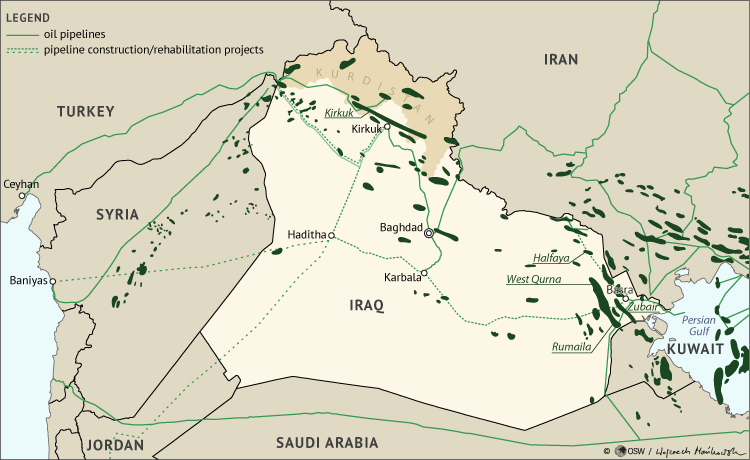
Iraq holds approximately 9% of the world’s proven oil reserves, while its production costs are among the lowest globally. The country’s largest and most important oilfields are located near the Persian Gulf, in the Basra region. Before the outbreak of the war, the giant Rumaila, West Qurna 1, West Qurna 2 and Zubair oilfields accounted for approximately 70% of Iraq’s total oil production, rising to 90% when smaller fields in the south are included. Approximately 7% of Iraq’s pre-war oil production came from Iraqi Kurdistan and/or northern Iraq, only part of this oil was exported (see map).
Iraq’s oil production has remained stable in recent years, reaching almost 4.4 million barrels per day (b/d) in 2025. Exports that year were at their highest level since 2019, at 3.7 million b/d. Asian countries are the main markets for Iraqi oil, accounting for more than 76% of total exports in 2025. China (35% of the total) and India (27%) were the largest buyers, while Europe accounted for approximately 17% of exports.
Before the outbreak of the war in the Gulf, the government in Baghdad and foreign energy companies operating in Iraq planned to increase exports by expanding oil production by approximately 60%, to 7 million b/d by 2030. This was to be achieved by boosting output from existing fields and blocks, including West Qurna 1, West Qurna 2 and Zubair, and bringing new oilfields in southern Iraq into production. However, the implementation of some of these plans was complicated in 2025 by US sanctions against Russia’s Lukoil, the operator and majority shareholder of one of Iraq’s largest oil production projects, West Qurna 2, as well as the new Eridu field. US energy company Chevron is in advanced talks to take over operations at West Qurna 2 following Lukoil’s withdrawal, while ExxonMobil is seeking to invest in another Iraqi oilfield, Majnoon. Both companies have shown markedly greater interest in investing not only in oilfields but also in oil transport infrastructure since the outbreak of the war with Iran on 28 February this year.
Meanwhile, Chinese companies remain the largest foreign investors in Iraq’s oil sector, particularly PetroChina, which operates or jointly operates key oilfields, including Rumaila, West Qurna 1 and Halfaya.
The impact of the war on the oil sector
The outbreak of the war severely disrupted Iraq’s oil production and exports, primarily due to the country’s heavy reliance on seaborne oil shipments.
Before the war, 97% of Iraq’s oil exports, originating from fields around Basra, passed through the Strait of Hormuz. At the same time, Iraq’s oil storage capacity is among the lowest in the region, sufficient to cover approximately six days of normal production and exports.[1] The closure of the strait forced Iraq to make rapid and drastic cuts to oil production – the steepest among Gulf states, amounting to approximately 3 million b/d – and led to a collapse in exports, which fell by 90–97% between March and May 2026 compared with January. Oil production from fields in southern Iraq was the hardest hit.
Small volumes of oil (approximately 3–5% of total exports) have been and continue to be transported from Iraqi Kurdistan and/or northern Iraq to Turkey via the Kirkuk–Ceyhan pipeline. Before the war, approximately 200,000 b/d were transported along this route. In March 2026, production from Kurdish oilfields was effectively suspended over fears of Iranian attacks, temporarily reducing exports via this route as well.
Iraq’s near-total dependence on shipments through the Strait of Hormuz and the lack of viable alternatives that could be deployed quickly forced Baghdad to seek urgent, unconventional solutions. These included the launch of small-scale oil exports to Syria by road tanker (see below). Nevertheless, Iraq’s immediate priority has been to restore and maintain seaborne oil exports, made possible primarily by the gradual resumption of shipping through the strait with US military support from July 2026.
Amid the conflict and disruptions to transit through the Strait of Hormuz, Baghdad changed its export logistics. With importers and oil traders unwilling to risk entering the Gulf to collect Iraqi crude from Basra, as they had done previously, Iraq became one of the first countries in the region to transport its own oil through the strait, often with vessels’ tracking systems switched off. It then offloaded the crude onto buyers’ tankers during ship-to-ship transfers in Omani waters. In some cases, Iraqi tankers sailed directly to nearby destination ports.
Baghdad also used shipping corridors designated by Iran and obtained the necessary permits from Tehran to transport its cargoes. In August, Iraq became the only Gulf oil producer to receive formal Iranian authorisation to export some of its crude, prompting allegations that it was acting as an intermediary in the trade of Iranian oil. Over time, Iraq also began offering substantial discounts on its crude to make it commercially viable for some traders to bear some of the risks and higher costs associated with transit through the Strait of Hormuz.
Since late September, the Strait of Hormuz has remained largely open in practice, despite the absence of a formal agreement and ongoing attacks. This has been facilitated in part by US naval escorts, allowing Iraq to increase its oil exports further, gradually bringing them close to pre-war levels. However, these arrangements offer only a temporary solution to the challenges facing Iraqi oil exports, and the recovery to near-normal export volumes remains neither secure nor sustainable.
Seeking alternatives to the Strait of Hormuz
Following the outbreak of the war, Baghdad intensified efforts to reduce its structural dependence on the Strait of Hormuz by expanding the capacity of existing oil pipelines, restoring those that are not fully operational and constructing new ones. The latter are also intended to facilitate the strategic diversification of export markets by increasing oil shipments to Europe and other Western markets, while deepening economic and political cooperation with new partners, including US energy companies.
The main projects currently under discussion involve either expanding the capacity of the existing pipeline to Turkey's Mediterranean oil terminal and connecting it to production facilities in southern Iraq, or constructing new export routes through Syria to the Mediterranean and/or to the Red Sea. Despite interest from neighbouring countries and international partners, none of these projects has progressed beyond the preliminary stage (the route through Turkey is operational but performing below expectations). Concrete cost estimates and binding commitments from potential investors are still lacking.
- The Turkish route (Kirkuk–Ceyhan)
The pipeline connects oilfields in northern Iraq to the Turkish oil terminal at Ceyhan on the Mediterranean coast. It crosses the border at Fishkhabur and has been operational since 1976. Its nominal capacity is 1.5 million b/d, although this has never been achieved. Since 2013, the export corridor has also included a Kurdish branch, which has been under Baghdad’s control since 2025 (see map). This branch currently carries Iraqi oil exports to Turkey (approximately 250,000 b/d in September), while work to restore operations along the original route is at an advanced stage. Its capacity on the Iraqi side is currently estimated at 350,000 b/d. In 2026, the northern export route was supplied by local oilfields in the Kurdistan Region and, in recent months, also by crude transported by road tanker from southern Iraq.
The operation and expansion of the route are constrained by technical challenges, including ageing and partially damaged infrastructure and the need to construct additional pumping stations to increase capacity. A more serious obstacle, however, is the lack of operational pipeline connections between the northern route and Iraq’s main oil-producing region in the south. The old Strategic Pipeline requires complete rehabilitation. The proposed construction of a new pipeline from Basra to Kirkuk via Haditha and domestic refineries (approximately 1,000 km) would be costly and time-consuming. According to available estimates, the section to Haditha alone would cost around $4.5 billion. Expanding Iraq’s domestic pipeline infrastructure is also essential for the implementation of any overland oil export projects.
Political disputes between Iraq, Turkey and Iraqi Kurdistan pose equally significant challenges. For roughly a decade, the route’s Kurdish branch was used by the Kurdistan Region and Turkey without Baghdad’s consent, ultimately resulting in arbitration rulings imposing financial liabilities on Ankara. Turkey refused to comply with the rulings and suspended oil flows through the Kurdish branch from March 2023 to September 2025. Deprived of oil revenues, Erbil was unable to meet its financial obligations to investors, while Baghdad simultaneously restricted funding for the autonomous region. The issue was partially resolved in 2025, notably through the transfer of control over the Kurdish branch to an Iraqi state-owned company. Further agreements were reached in July 2026, but these are temporary arrangements and remain entangled in broader political disputes between the parties.
Although Turkey is keen to increase the route’s capacity and oil exports and establish itself as an energy hub, it is treating the issue as part of a broader set of interrelated matters and seeking to push through a number of measures that it considers important. These include strengthening the position of Turkish oil companies in Iraq (their presence remains minimal, with little indication that they could compete with Chinese or US firms) and revisiting the financial claims against Ankara arising from the arbitration rulings.
Security issues are also under discussion, including the dismantling of Kurdish forces affiliated with the Kurdistan Workers’ Party (PKK) in Iraq and the conditions for closing Turkish military bases in the country. Finally, Turkey is linking the pipeline issue to the proposed transport corridor known as the Development Road Project, running from Basra through Turkey to Europe. The project, estimated to cost $17 billion, would include rail, road and fibre-optic connections, with Turkey expected to serve as its main contractor and beneficiary.
Despite the challenges and complexity involved, this appears to be the most promising of the projects under discussion, primarily because much of the infrastructure is already in place. However, given the current political complexities, progress is likely to be slow and fraught with risks. Any increase in exports along this route will depend on the construction of pipelines within Iraq connecting Kirkuk to Basra. Any progress in developing these solutions would represent a strategic breakthrough in efforts to expand the use of the route.
- The western/Syrian route (Haditha–Baniyas)
Syria is the second major option under active consideration for diversifying Iraq’s oil export routes. Following the outbreak of the war in the Gulf, Syria began importing Iraqi crude transported in road tankers and, for a time, also supplied Iraq with limited quantities of petroleum products. Discussions are also under way on constructing a pipeline with a capacity of approximately 1 million b/d to Syrian ports on the Mediterranean coast. It would follow the route of the former Kirkuk–Baniyas export pipeline, which has been out of operation since the 1980s and was damaged during regional conflicts. The project would also require the construction of a domestic pipeline section connecting Basra to Haditha. Depending on the final route of the pipeline, the project could cost approximately $15 billion.
Fundamental differences between Syria’s government, which emerged from the radical Sunni opposition, and Iraq’s Shia-led authorities remain a significant challenge. For the time being, several rounds of political talks have helped the two sides set aside these differences and cooperate.
US energy companies are among those currently interested in the proposed new pipeline, which would enable oil exports from southern Iraq. They are also in advanced talks over investments in Iraqi oil production (see above). In July 2026, during Prime Minister Ali al-Zaidi’s visit to the US, a consortium was established to explore the development of the route. Its founding members included Chevron, TI Capital and Qatar’s UCC Holding, with TotalEnergies joining a month later. Last summer, the Iraqi government and the state-owned Basra Oil Company also reached an agreement with the consortium to conduct a technical and financial feasibility study for a pipeline from Basra to Haditha, with branches extending to Mediterranean oil terminals in Syria (Baniyas) and Turkey (Ceyhan).
Both the Turkish and Syrian routes align with the interests of EU member states. The French president and German chancellor openly expressed interest in Iraqi oil when they hosted al-Zaidi in their respective capitals in September 2026. Both meetings also included discussions on enhancing existing cooperation with Iraq.[2]
- The southern routes (Red Sea)
Alongside plans to diversify Iraq’s oil export routes to the Mediterranean, Baghdad is considering various options for developing routes to the Red Sea. For some time, a route through Saudi Arabia was regarded as the most promising option, with efforts focused on restoring the Iraqi Pipeline in Saudi Arabia (IPSA)[3]. However, these talks were abandoned following further attacks by Iraqi militias on Saudi energy infrastructure, which Baghdad was unable to prevent. The option of a route through Jordan to the Red Sea port of Aqaba has also repeatedly resurfaced in discussions, but no agreement has been reached so far.
Political factors and challenges
The strong determination of the authorities in Baghdad remains the key domestic political factor driving efforts to restore Iraq’s oil production and exports and develop the oil sector. According to World Bank estimates, in 2025 the oil sector accounted for 53% of the country’s real GDP, 88% of government revenue and more than 90% of its export earnings.[4] The losses incurred this year could lead to a 16% contraction in Iraq’s GDP.[5] The current oil crisis has thus raised the prospect of economic collapse in Iraq and threatens to undermine the country’s fragile socio-political stability.
In October, the Iraqi authorities estimated losses at $60 billion, while government revenue fell by approximately 46% year-on-year in the first seven months of the year.[6] Ensuring financial liquidity, which depends on oil exports, became Baghdad’s top priority. This facilitated the formation of a government in May (six months after the elections), favoured the appointment of businessman Ali al-Zaidi as prime minister and shaped his political agenda, including more than a dozen foreign visits focused on economic issues.
At the same time, the political situation in Iraq and the wider region poses serious challenges, both immediate and structural, that directly affect the oil sector. Among the most significant are:
- Chronic instability in Iraq and the wider region. Iraq itself has been devastated by conflicts stemming from the US intervention and the war against Islamic State, while also suffering the consequences of other regional conflicts, including those in Syria and Iran. The activities of numerous non-state armed groups remain a major challenge. These range from militias (approximately 60 organisations with a combined strength of around 240,000 personnel, often only nominally under state control) and various Kurdish armed groups to Islamic State networks and other organisations. In recent years, Iraq has also been the scene of military operations conducted by Iran, the US, Turkey, Israel and Saudi Arabia, among others.
- Weak political structures and state institutions. Iraq’s political landscape is fragmented and deeply divided, with some political forces linked to and dependent on autonomous militias. Weak institutions, clientelism and corruption remain persistent problems. Relations between the federal government and the autonomous Kurdistan Region are another major source of tension. These difficulties have repeatedly hampered the operations of foreign investors, particularly Western companies, both in Iraq as a whole and in the Kurdistan Region. They now also severely constrain the government’s ability to act (the current prime minister’s young age and lack of an independent political base were reportedly regarded as advantages that facilitated his appointment).
Despite these complex circumstances, the government is taking steps both to bring the most problematic militias under control (under strong US pressure) and to curb corruption. One example was the wave of arrests in June and July 2026, unprecedented in Iraq in recent years, during which approximately 210 people were detained, mainly mid-ranking officials and politicians.
- Heavy dependence on both Iran and the US, and Iraq’s role as an arena of conflict between them. Iran’s influence rests on its ties with political parties and militias, as well as extensive economic links. Washington retains considerable influence over Iraq’s politics, security (a US military base remained operational in the country until September 2026) and economy. Notably, since 2003, all revenues from Iraqi oil sales have been deposited in the US, which has repeatedly suspended bank transfers and cash shipments to Iraq. Amid the war in 2026, Iraq faces intense pressure from both Washington and Tehran. This is reflected, among other things, in Baghdad’s ambiguous stance towards the economic blockade of Iran and in the appointment of Prime Minister al-Zaidi, who is acceptable to both sides.
Current security challenges
The principal challenge at present is the ongoing armed conflict between the US and Israel on one side and Iran on the other. The prospects for a lasting political settlement are minimal, while the risk of renewed escalation remains high. Such a scenario would almost certainly bring further restrictions on transit through the Strait of Hormuz and an escalation of hostilities, including attacks on energy infrastructure across the Persian Gulf region, both in Arab states and Iran. Although Iraq has not been a primary target of such attacks so far, renewed escalation would expose it not only to losses resulting from the closure of the strait but also to a likely intensification of the proxy war between Iran and the US being fought on Iraqi territory, potentially destabilising the country.
The risk posed to Iraq’s oil sector by pro-Iranian militias and, more broadly, terrorist organisations should also be considered high. Even after the end of the most intense phase of the conflict (March–April 2026), Iran-linked forces operating in Iraq repeatedly attacked energy infrastructure in Gulf states (including the Saudi East–West Pipeline, which they destroyed in September) and targets in Iraqi Kurdistan. The threat these groups pose to energy infrastructure and other targets persists despite US and Saudi air strikes and operations by Iraqi security forces.
Iraqi Kurdistan adds another layer of complexity to the already difficult situation, given its internal tensions, simmering conflict with Baghdad and friction with Iran and, to a lesser extent, Turkey (the region serves as a refuge for armed opposition groups). It should be emphasised, however, that the threat extends beyond the activities of Iran-linked forces. In September and October this year, a series of attacks on energy infrastructure in Syria, including pipelines and other facilities, were probably carried out by Islamic State. The organisation has also stepped up its activities in Iraq, launching attacks near Kirkuk, one of which killed an Iraqi general.
Outlook
Iraq is and will remain a major player in the Persian Gulf oil market. However, as with other countries in the region, its prosperity, including the condition and development of its oil sector, depends on political developments, the future of the conflict between the US and Israel on one side and Iran on the other, and the resolution of structural domestic problems, particularly those related to security. Despite the relatively rapid recovery of oil exports to pre-war levels after six months of conflict, this recovery remains precarious.
The crisis triggered by the war has exposed Iraq’s structural problems but has also provided a strong impetus to seek solutions. In the oil sector, Baghdad is seeking to diversify its partners and export destinations with the aim of creating stable conditions for the sector’s development. However, even if the most ambitious projects succeed, they would only partially reduce the dominance of Chinese investment in the sector, the importance of Asian export markets and Iraq’s dependence on the Strait of Hormuz.
As regards the diversification projects currently under consideration, the Turkish option (expanding the Kirkuk–Ceyhan route) appears the most promising, as the basic infrastructure is already in place and negotiations over its use are at an advanced stage. The main obstacles to its implementation remain political: reaching an agreement between Ankara, Baghdad and Erbil and ensuring stability.
The prospects for the Syrian project are less clear, although it benefits from the involvement of US companies and faces fewer political obstacles than the Turkish route. The main challenge is the need for more extensive and time-consuming investment than the Turkish option requires, the viability of which could be undermined in the short term by security concerns. For both projects, as well as Iraq’s oil sector as a whole, the costly construction of domestic pipeline connections linking the oilfields in the south to Haditha and, depending on external circumstances, to Syrian and/or Turkish terminals would be crucial. In the longer term, a lasting resolution of the problems affecting the Strait of Hormuz, ensuring reliable access to a low-cost export route, could reduce the prospects for securing financing and implementing all the proposed investments in new pipeline infrastructure.
Map. Iraq’s oil sector: major oilfields and existing and planned pipeline infrastructure
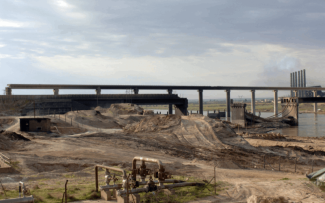
The Kirkuk–Ceyhan pipeline has been partially upgraded and is ready for use, but is not yet operational.
Source: R. Mansour, ‘New energy and trade routes could bypass Hormuz and change the Middle East. But major challenges remain’, Chatham House, 25 September 2026, chathamhouse.org; S&P Global Commodities Insights.
[1] ‘Iraq ranks lowest in Gulf oil storage capacity’, Shafaq News, 9 March 2026, shafaq.com.
[2] French energy company TotalEnergies is a major player in the gas sector, while Germany’s Siemens Energy is planning investments in the electricity sector.
[3] The route was closed following Iraq’s invasion of Kuwait in 1990.
[5] ‘Iraq and the IMF’, International Monetary Fund, imf.org.
[6] ‘Iraq oil revenues plunge 53% through July’, Shafaq News, 14 October 2026, shafaq.com.