Ukraine’s economy under growing strain amid Russia’s war of attrition
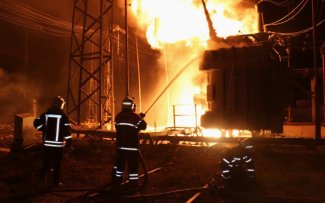
Ukraine’s economy is probably under greater strain than at any point since spring 2022, with overlapping crises across several sectors threatening to exacerbate the general situation. The de facto blockade of Ukraine’s Black Sea ports, which began in late July, has led to a collapse in agricultural exports, particularly grain. A new wave of Russian attacks, ongoing since late August and involving, among other weapons, jet-powered drones, has caused extensive damage. Meanwhile, a shortage of PAC-3 interceptors, which are capable of intercepting ballistic missiles, has enabled Russia to launch effective strikes against Ukraine’s main steel plants, forcing them to almost completely halt production. In early October, Russia launched a new campaign of large-scale strikes against Ukraine’s energy infrastructure, as it had in previous years. At the same time, a budget liquidity crisis caused by government failures is just one element of a much broader set of serious economic problems.
The impact of the blockade of the Black Sea ports
Ukraine’s agricultural production is largely export-orientated. Annual domestic consumption of wheat and maize is estimated at around 15 million tonnes, compared with a combined harvest of more than 54 million tonnes in 2025. The same applies to oilseeds, with the exception of sunflower seeds, most of which are processed domestically. The ports of Greater Odesa – Chornomorsk, Odesa and Pivdennyi – served as the main export gateway for most agricultural products. The ports played a particularly important role in grain exports, handling more than 95% of Ukraine’s total grain exports in 2025. Maritime transport also played a key role in exports of rapeseed (78%), soybeans (78%) and animal feed ingredients (76%).
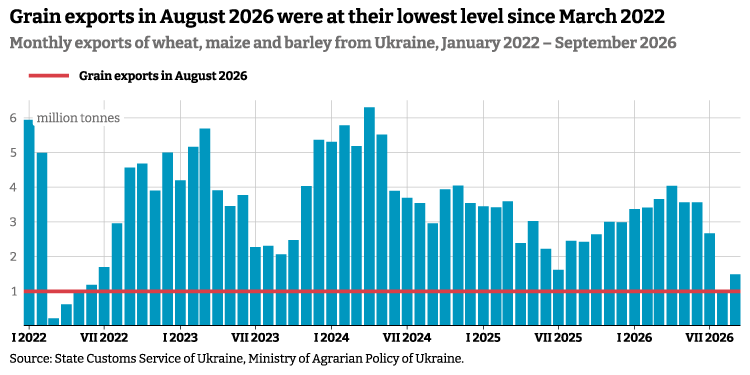
Shipping to all three ports has been suspended since 22 July due to intensified Russian attacks. The resulting de facto blockade has led to a sharp decline in Ukraine’s agricultural exports. Grain exports have been particularly badly affected, falling from 3.6 million tonnes in June to just under 1 million tonnes in August. Although they recovered to 1.5 million tonnes in September, this was still only around 40% of their pre-blockade level.
Alternative routes – via Ukraine’s Danube ports or by rail across its land border with EU member states to Baltic Sea ports and Romania’s Constanța – cannot handle the required export volumes. They involve significantly higher transport costs, face capacity constraints and may also cause political difficulties. Moreover, transporting bulk commodities such as grain by road is not economically viable over long distances. Russian attacks on the Danube ports and vessels departing from them pose a further obstacle to exports. Attacks of this kind have also occurred off the coasts of other countries. On 6 October, for example, drones struck two vessels in Bulgaria’s exclusive economic zone, sinking one of them.
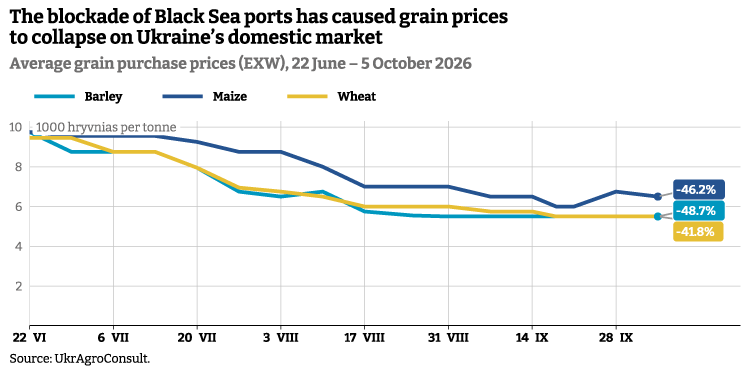
Severe restrictions on exports have caused domestic grain prices to collapse. Between June and October, average purchase prices for wheat and maize fell by around 40% to 5,500 hryvnias per tonne (approximately €110), leaving most agricultural enterprises with revenues below their production costs. By contrast, global grain prices have been rising in 2026. On the MATIF exchange, for example, wheat prices increased from €200 per tonne at the beginning of the year to €244 on 7 October. However, it is difficult to determine how far the decline in Ukrainian exports has contributed to this trend, as prices began to rise before the blockade. Nevertheless, current prices remain well below those recorded following the outbreak of the full-scale war, when wheat prices peaked at more than €400 per tonne.
With exports severely restricted, the availability of storage space for grain and oilseeds is becoming another major challenge. The harvesting of some crops is almost complete, with volumes exceeding last year’s levels. As of 1 September, Ukraine had harvested 25.8 million tonnes of wheat (up 2.5 million tonnes year on year), 6.05 million tonnes of barley (up 0.8 million tonnes) and 4 million tonnes of rapeseed (up 0.8 million tonnes). The maize harvest is expected to reach around 32 million tonnes, while the sunflower seed harvest is forecast to exceed 13 million tonnes. This raises the prospect of a serious shortage of storage capacity in the coming months. The total capacity of grain storage facilities is estimated at 50–60 million tonnes, of which 25 million tonnes was already filled by 1 September (10 million tonnes more than a year earlier). The sowing of winter crops has already begun, with no clear signs so far of a reduction in the area under cultivation, except in regions near the front line. However, if the port blockade persists, the area sown next spring is likely to shrink significantly. Low prices for agricultural produce could also trigger a wave of bankruptcies among agricultural enterprises, particularly small and medium-sized ones.
Steel industry – key plants suspend production
Initially, the maritime blockade also appeared likely to disrupt exports of steel products, which had been generating substantial revenues ($4.7 billion in 2025), with more than half of sales handled through the ports. Indeed, exports of iron and steel fell sharply between June and August, declining by 76% from 525,000 tonnes to 125,000 tonnes per month. However, the campaign of Russian air strikes against Ukraine’s largest steel plants, ongoing since August, has proved a far more serious problem. The attacks caused such extensive damage that the country’s three largest steelworks still in operation (Zaporizhstal and Kametstal, both owned by Rinat Akhmetov’s Metinvest, and ArcelorMittal’s plant in Kryvyi Rih) suspended production in September.
All three steelworks reportedly suffered extensive damage to their blast-furnace infrastructure as well as energy and logistics facilities. According to Metinvest, Zaporizhstal alone was struck by 17 ballistic missiles, killing eight employees and injuring 28 others.[1] Russian forces also targeted Interpipe’s facilities in Dnipro and the Dnipro Metallurgical Plant, although it remains unclear whether either of these sites suspended production. As a result, steel output fell by 57% year on year in August with pig iron output falling by 66%. The figures for September are likely to show declines exceeding 90%.

It remains unclear when, or even whether, the steelworks will resume production. This raises questions regarding whether a costly reconstruction makes sense, given that there is no guarantee that the repaired facilities will not be destroyed again.
A prolonged halt in production will have serious social consequences and place considerable strain on regional budgets. ArcelorMittal’s steelworks employed nearly 13,000 people and Zaporizhstal 8,000, but the number of people whose livelihoods depend on these plants is much higher. According to the industry association Ukrmetalurhprom, each job in the steel industry supports up to eight jobs in companies providing related services.[2] The governor of Zaporizhzhia Oblast estimated that 30,000 families depend directly or indirectly on Zaporizhstal for their livelihoods. The plant was also the region’s largest taxpayer.[3] Other industrial centres, notably Dnipro and Kamianske, face similar problems. The destruction of steelmaking capacity has also led to shutdowns or sharp reductions in iron ore production. In Kryvyi Rih, the shutdowns of major mining and metallurgical enterprises have forced subcontractors to scale back their operations and local authorities to cut spending.
Losses in other sectors
Intensified Russian attacks on infrastructure have extended well beyond the steel industry. Targets include industrial and commercial facilities, logistics centres, warehouses and sorting centres operated by Nova Poshta, Ukraine’s largest parcel delivery company, as well as markets and petrol stations. Between 1 August and 25 September alone, 20 facilities belonging to Fozzy Group, one of Ukraine’s largest supermarket chains, were damaged or destroyed. Data centres have also come under repeated attack since mid-September, although these Russian strikes on Ukraine’s technology companies has so far had a less severe impact than the Ukrainian strikes against targets in Russia.[4] Kyiv, Kyiv Oblast and Odesa have been the hardest hit.
Russia has also intensified its attacks on pharmaceutical facilities. These strikes have been occurring since the start of the full-scale invasion. However, their frequency has increased sharply since September, particularly in Kyiv and Kyiv Oblast.[5] On 4 October, Russian forces destroyed a KUSUM factory in Sumy, while on 7 October they attacked the BKhFZ plant in Kyiv. The Kyiv-based Darnytsia Pharmaceutical Company has also been struck several times. Pharmaceutical distribution centres have also come under attack. On 3 September, Russian strikes destroyed the Biokon complex in Kyiv Oblast, one of Ukraine’s largest pharmaceutical warehouses, which stored, for example, imported medicines. Three warehouses operated by the World Health Organization (WHO), which held medicines and medical supplies for people in frontline areas, have also been damaged or destroyed.[6] The attacks have not yet caused nationwide shortages of medicines and medical supplies, although certain medicines are in short supply in some regions.[7]
The situation at Ukraine’s state railway operator, Ukrainian Railways, is also deteriorating. Intensifying Russian strikes on railway infrastructure across the country are disrupting freight transport. Attacks on rolling stock have been particularly damaging: 521 locomotives have been damaged or destroyed since the start of the war, including 304 since the beginning of this year alone. According to Minister of Agrarian Policy Taras Vysotsky, Ukraine has virtually exhausted its reserve locomotive fleet.
Attacks on the railway’s power supply infrastructure pose a further challenge. Increasingly frequent strikes on overhead traction lines force the temporary closure of sections of the rail network, causing delays in freight deliveries. As a result, Ukrainian Railways’ financial losses are mounting. The company recorded losses of 7.8 billion hryvnias (approximately $173 million) in 2025, but in the first half of 2026 alone, these exceeded 10 billion hryvnias (approximately $222 million).[8] Its full-year results are likely to be even worse, as problems in the steel and agricultural sectors have led to a sharp decline in freight volumes in the railway’s most profitable segment, from 450,000 tonnes per day in July to less than 250,000 tonnes in September.
Russian attacks on logistics infrastructure are taking an increasing toll on Ukrainian businesses. A survey of 465 companies conducted by the Institute for Economic Research in the second half of August found that 7% had suffered the destruction of goods or damage to property, while a further 41% had been affected indirectly by delivery delays and rising prices.[9] The impact was most severe for businesses in southern Ukraine, while those in the less industrialised western part of the country fared relatively better.
According to Prime Minister Serhii Koretskyi, Russian attacks on businesses could reduce this year’s tax revenues by 70 billion hryvnias (approximately $1.6 billion). However, this estimate is likely to be too low. Opposition MP Yaroslav Zheleznyak puts the potential drop at 120–150 billion hryvnias.
Disruption caused by air raid alerts
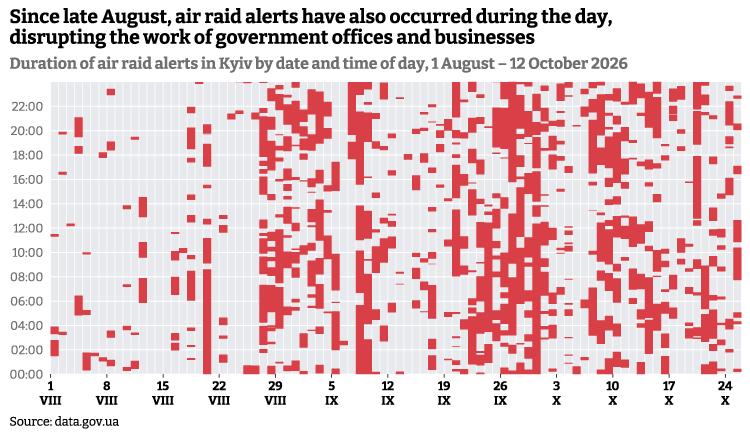
Russia has intensified its attacks on Kyiv in late August, increasing its use of jet-powered drones, which have proved difficult for Ukrainian air defences to intercept. The strikes have been so frequent that air raid alerts in the capital lasted a combined ten days in September, the highest monthly total since the start of the full-scale invasion. If attacks continue at their current intensity, October is likely to set a new record.
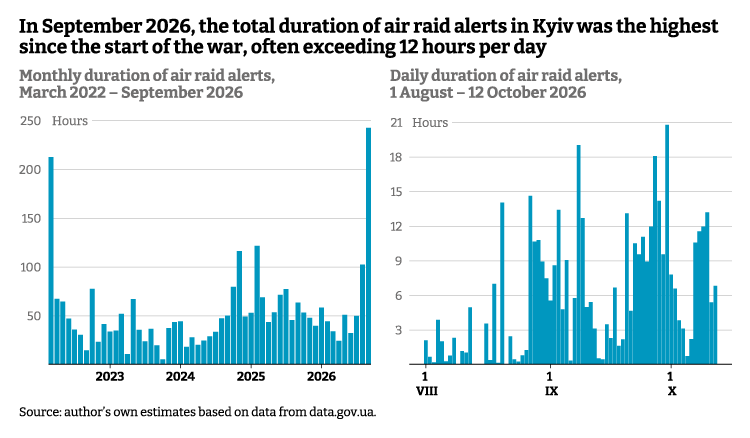
In previous years, air raid alerts were generally shorter and the vast majority occurred at night. Since late August, however, daytime attacks have become increasingly frequent, with alerts often lasting more than 12 hours a day. This has significantly disrupted business activity, particularly given Kyiv’s role as Ukraine’s main business centre. The situation also places a considerable burden on residents, making it difficult to plan even routine activities such as shopping or visiting government agencies.
Energy sector once again in the firing line
The situation in the energy sector remains relatively good. Until early October, households had experienced virtually no scheduled power cuts. According to the Ministry of Energy, Ukraine currently has 15 GW of available electricity supply capacity, including imports. This is expected to rise to 19.6 GW by November and 21.4 GW by the end of the year, compared with peak demand of 18 GW during the coldest periods of last winter.
Gas reserves are also higher than in the previous two years and should be sufficient to see the country through the heating season without disruption. Paradoxically, the successful Russian attacks on industrial facilities discussed above, particularly steelworks, will significantly reduce the consumption of both electricity and gas, thereby easing pressure on the energy system.

The relatively favourable situation could deteriorate rapidly, however, as Russia resumed large-scale attacks on electricity and heat generation infrastructure in October. According to Energy Minister Denys Shmyhal, Russia has developed a detailed strategy for targeting infrastructure during the winter of 2026–27. The plan reportedly envisages coordinated strikes on power generation facilities, district heating systems, water supply and sewage networks and electricity transmission infrastructure. It allegedly specifies the number and types of weapons required to destroy individual facilities. Separate scenarios have also reportedly been prepared for major cities, including Kyiv, Kharkiv and Odesa, with the aim of triggering localised humanitarian crises by simultaneously disrupting electricity, heating and water supplies. Russia also reportedly intends to destroy electricity transmission lines and to cut off left-bank Ukraine from right-bank Ukraine, where most of the country’s power generation capacity is located. While these plans may appear alarming, they largely reflect tactics that Russia has already employed in previous years, generally with limited success.
Kyiv in the crosshairs
Over recent months, Ukrainian regions and cities have stepped up preparations for Russian attacks on critical infrastructure. Working with the central government, regional authorities have drawn up so-called resilience plans, subsequently approved by the National Security and Defence Council. These outline not only measures to address power outages but also ways to maintain other services essential to the functioning of cities, particularly water and heating supplies and sewage systems. The plans have not been made public, and it is difficult to make a reliable assessment of any media reports on how their implementation is progressing. Nevertheless, it is reasonable to assume that much of the work has already been completed or is nearing completion.
The wave of Russian attacks on energy infrastructure in October has focused primarily on Kyiv and Kyiv Oblast. High-voltage substations supplying electricity to the capital have been the main targets. Kyiv is particularly vulnerable, as Russian strikes last winter destroyed virtually all of its electricity generation capacity, leaving it almost entirely dependent on supplies from elsewhere in the country. The so-called Kyiv Ring, a network of extra-high-voltage transmission lines and substations surrounding the capital, plays a crucial role in supplying the city with electricity. Exacerbating this is the fact that Kyiv remains one of Ukraine’s largest consumers of electricity, accounting for an estimated 15% of national consumption during periods of peak demand.
Repeated Russian strikes[10] have severely damaged the 750 kV Kyivska substation, which supplies the capital with electricity from the Rivne and Khmelnytskyi nuclear power plants.[11] This has led to intermittent power outages in Kyiv. The attacks demonstrate that even a protective concrete enclosure around a transformer cannot prevent a facility from being destroyed if it is subjected to a concentrated barrage of ballistic missiles. Rapid repairs are also hampered by the near-constant air raid alerts mentioned above, as the risk of further strikes on the same facility prevents repair work from taking place while alerts are in force.

Russian attacks have prompted the introduction of scheduled power cuts in Kyiv, which have been in place since 6 October. So far, these have generally lasted only a few hours and affected limited parts of the city. There have been exceptions, however. On 9 October, for example, north-western districts experienced severe disruptions throughout the day, according to SvitloBot, a website that monitors electricity supplies at more than 1,000 locations across Kyiv. It should be noted, however, that electricity consumption is typically at its lowest in October. If similar disruptions occur in winter, particularly during periods of low temperatures, power cuts are likely to be considerably longer and more severe. Outside the capital, electricity supplies remain much more stable, as evidenced by the fact that Ukraine is still, for the time being, a net exporter of electricity.

Disruptions to water supplies in parts of Kyiv have proved more serious than the power cuts themselves. This suggests that the authorities have failed to deliver on their promise to ensure that the water supply system can continue operating during power outages. The problem has sparked another dispute between President Volodymyr Zelensky and Kyiv Mayor Vitali Klitschko.[12] On 13 October, Zelensky accused the city authorities of making the slowest progress in the country on their resilience plan and announced changes to how the capital is being governed. Klitschko responded by accusing the central government of withholding the funds needed for winter preparations and failing to provide Kyiv with adequate air defences.
Attacks on substations supplying power to Kyiv’s metro have also caused outages, bringing trains to a halt and putting escalators out of service. The latter is particularly problematic because some stations in the city centre are more than 100 metres underground. The metro is both the capital’s main form of public transport and its largest network of shelters. Disruptions to its operation have therefore made it even harder for the city to function, compounding the problems caused by drone attacks on bridges across the Dnipro River.[13]
A bleak outlook for the coming winter
Russian attacks on infrastructure are unlikely to ease in the coming months or become less effective in the coming weeks. This is mainly due to Ukraine’s limited stock of interceptors capable of shooting down ballistic missiles and the lack of an effective means of countering jet-powered drones. Ukraine claims to intercept 55% of these drones, although the reliability of this figure is difficult to assess. Moreover, deploying measures to improve the interception rate will take at least several months. Russian attacks are therefore likely to cause increasing disruptions to Ukraine’s economy and further reduce tax revenues. This, in turn, will limit the government’s ability to support businesses and is likely to prompt Kyiv to step up its appeals for greater international assistance.
Despite initiatives put forward by Turkey and India, there is currently little prospect of a full resumption of shipping from Ukraine’s Black Sea ports. Russia remains unwilling to agree to a mutual halt to attacks on vessels and port infrastructure. Moscow sees the gaps in Ukraine’s air defences as a ‘window of opportunity’ to inflict further damage and force Kyiv to capitulate. As a result, Ukraine’s agricultural sector could face a deep crisis early next year. A wave of farm bankruptcies and a significant reduction in the area being sown are highly likely. Unless Ukraine finds an effective way to counter jet-powered drones, further destruction of logistics infrastructure serving businesses across different sectors of the economy is also likely. This will exacerbate existing problems and make it increasingly difficult for Ukrainian companies to operate.
Russian attacks on energy infrastructure are likely to continue throughout the heating season. However, experience from previous years suggests that Russia is unlikely to achieve its objectives, such as causing a nationwide blackout. A much more likely, and no less disruptive, scenario is the emergence of localised humanitarian crises in individual cities or districts of major urban centres. These could result from prolonged disruptions in the supply of electricity, heating and water, as well as to sewage systems. In some areas, the situation could approach the scale of a humanitarian catastrophe, particularly if the winter is harsh and prolonged.
These mounting problems will further undermine public morale, deepen war fatigue and weaken Ukrainians’ resolve to continue resisting. Nevertheless, they are unlikely to bring about a sufficiently dramatic shift in public opinion to increase support for any ceasefire terms that would de facto amount to Ukraine’s capitulation.
[1] О. Пикало, ‘Росія вчетверте за місяць вдарила по «Запоріжсталі»: дві балістичні ракети пошкодили цехи та інфраструктуру’, Forbes, 17 September 2026, forbes.ua.
[2] О. Пикало, ‘«Втрати до 7% ВВП». Удари РФ майже зупинили українську металургію. Чим це загрожує?’, Forbes, 2 October 2026, forbes.ua.
[3] О. Звонарьова, ‘Ми – одна з небагатьох областей, які на 100% забезпечені резервними дизельними генераторами’, Укрінформ, 15 August 2026, ukrinform.ua.
[4] I. Wiśniewska, ‘Data centres in Russia: the consequences of Ukrainian drone strikes’, OSW, 19 October 2026, osw.waw.pl.
[5] ‘Атаки на фармацевтику: хронологія ударів рф по складах з ліками та аптеках’, Слово і діло, 7 October 2026, slovoidilo.ua.
[6] Н. Боднар, ‘Дефіциту поки немає, а ціни щодня ростуть: що насправді відбувається з ліками після ударів по складах’, Українська правда, 12 September 2026, pravda.com.ua.
[7] В. Коломієць, ‘У МОЗ розповіли, що відбувається з наявністю ліків в Україні’, Громадське, 5 October 2026, hromadske.ua.
[8] О. Черкасець, ‘Потяги з трьох частин, дрова у вагонах і 10 мільярдів збитку. Як залізниця готується до чергової воєнної зими’, Економічна правда, 6 October 2026, epravda.com.ua.
[9] О. Кузяків, Є. Ангел, Звіт за результатами опитування. Підтримка бізнесом заходів політики стійкості логістики, Інститут економічних досліджень та політичних консультацій, August 2026, ier.com.ua.
[10] K. Nieczypor, M. Goliszewski, J. Tarociński, ‘A unilateral ‘energy truce’? Day 1693 of the war’, OSW, 13 October 2026, osw.waw.pl.
[11] Д. Бобрицький, ‘Відрізати столицю від АЕС. Чому Київ раптово залишився без світла і якими будуть відключення електроенергії взимку’, NV Бізнес, 10 October 2026, biz.nv.ua.
[12] M. Jędrysiak, ‘Between the hammer and the anvil: the challenges facing Ukraine’s local government in wartime’, OSW Commentary, no. 742, 20 July 2026, osw.waw.pl.
[13] K. Nieczypor, S. Matuszak, J. Tarociński, ‘Kyiv’s bridges in the crosshairs of Russian drones. Day 1686 of the war’, OSW, 6 October 2026, osw.waw.pl.