


Vučić or the students? Serbia ahead of the parliamentary elections
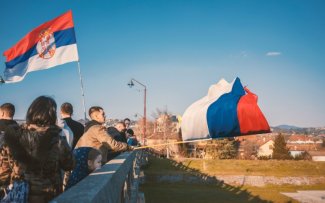
On 25 October, Serbia will hold its third snap parliamentary election in the last six years. The election was called following months of student demonstrations, which erupted after the collapse of a railway station canopy in Novi Sad in November 2024. Over time, the protest movement evolved into a political project – the Student List (SL). It is this party that will be the main challenger to the Serbian Progressive Party (SNS), which has been in power since 2012 and is led by the country’s former president, Aleksandar Vučić. The upcoming election represents the greatest challenge to Vučić’s camp during his 14 years in power. However, he still enjoys numerous systemic advantages which, combined with the tools at his disposal to influence the electoral process, could secure him victory. The student movement is hoping to spark mass social mobilisation and channel public disillusionment with the SNS’s long-standing rule. A scenario in which both sides declare victory cannot be ruled out, which could lead to an escalation of tensions.
From commemorating the victims to a political movement – 22 months of student protests
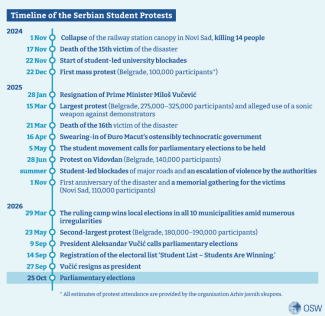
The disaster at the railway station in Novi Sad acted as a catalyst for the growing public dissatisfaction with the SNS government. In recent years, there have been numerous demonstrations targeting the authorities, including protests against the lithium mining project[1], electoral irregularities and the promotion of violence in pro-government media.[2] However, these did not result in any real political changes, as Vučić – seeking to defuse tensions and consolidate his position – readily called snap elections, in which the SNS achieved some victories. This was also the case in the most recent election, held in 2023, when the broadly defined ruling bloc (the governing party together with its satellite parties and the majority of national minorities) secured over 150 seats in the 250-seat parliament. The turning point came with the deaths of 16 people following the collapse of a canopy of the Novi Sad railway station, which was undergoing renovation between 2021 and 2024. The tragedy became a symbol of deep-rooted dysfunction under SNS rule – the renovation of this small building was extremely costly, raising suspicions of corruption. Furthermore, documentation concerning the implementation of the project by foreign partners (including those from China) was classified, making it difficult to identify those responsible. Despite the launch of an investigation, no one has yet been held to account.[3] The anti-government protests were led by groups that had previously been less politically active – students supported by academic staff, who have proved to be the driving force behind new forms of resistance.
Over the following months, the students employed various protest strategies, culminating in the formation of a political movement. The initial demonstrations were primarily intended to commemorate the victims of the disaster in Novi Sad, whilst the participants’ demands centred on holding those responsible to account and disclosing details of the station’s renovation. Subsequently, acts of civil disobedience intensified, taking the form of blockades of major roads, the public television building and university faculties, which led to the suspension of classes at universities for several months. A turning point in raising the profile of the student movement came with an initiative launched in early 2025 to organise protests in various parts of the country. These were accompanied by marches or organised cycle rides covering several kilometres, starting in the major university cities (Belgrade, Novi Sad, Niš, Kragujevac, Novi Pazar). This helped to foster contact with residents in the provinces and to break the authorities’ monopoly over news coverage, as they sought to discredit the emerging movement. Gradually, these activities evolved into a regular series of meetings with citizens to promote the students’ demands, under the banner of ‘A Student in Every Village’. Mass protests also took place regularly in the largest cities, the biggest of which occurred in Belgrade on 15 March 2025 and drew between 275,000 and 325,000 people.[4] On 5 May 2025, the student movement demanded early parliamentary elections for the first time, thereby signalling its entry into the contest for political power.
At the same time, the student movement faced repression from the authorities. Those in power systematically accused the protesters of acting on behalf of unspecified foreign states, engaging in terrorism, and attempting to overthrow the constitutional order and instigate a ‘colour revolution’ in the country. During the demonstrations, there were regular instances of unjustified use of force or arrests by the security forces, as well as physical clashes provoked by militias linked to the SNS (recruited from among party loyalists, football hooligans and criminal groups). Although the students took great care to ensure the movement remained decentralised and did not promote specific leaders, individual activists were targeted in pro-government media (e.g. Vladan Đokić, rector of the University of Belgrade) and subject to surveillance by the security services using spyware.[5] Meanwhile, lecturers, teachers and public-sector workers who supported the protests had their salaries cut or were dismissed. At the same time, the authorities tightened their grip on the security forces through staff purges and the appointment of individuals whose political loyalty to the authorities was assured.
However, the ruling camp failed to weaken the student movement. Initially, attempts to ‘defuse’ the protests by dismissing Prime Minister Miloš Vučević proved unsuccessful; in April 2025, he was replaced by Đuro Macut, a doctor who was independent but remained under the SNS’s full control. Subsequently, Vučić repeatedly postponed setting a date for the elections, hoping to wait out public frustration. He knew that, unlike in previous years, an early election might not ensure his camp’s continued hold on power. It was not until 9 September – following a summer mobilisation of party structures and a tour of the country – that he called the election, aware that further delay could only weaken support for the SNS. A few weeks later, having secured his party’s nomination as its candidate for Prime Minister, he resigned from his post in order to ‘establish his credibility’ in the eyes of his voters and the international community. In doing so, he sought to avoid accusations of abusing his position during the campaign, although in reality he had been running it for many months.[6]
An anti-corruption catch-all – a profile of the Student List
The student movement will be represented in the parliamentary elections by 250 independent candidates. The plenary assemblies of individual universities across Serbia were responsible for nominating candidates, with the proposed names then discussed at national level. The primary criterion for their selection was the absence of any previous high-level political involvement. As a result, candidates for parliament were selected from among university lecturers, activists, artists, doctors and athletes. The lead candidate on the Student List is cardiologist Ilija Srdanović, although he refuses to be described as its leader. The movement has also dispensed with the practice, typical of Serbian political tradition, of including the leader’s full name in the name of its electoral committee, a move intended to reflect its decentralised and democratic nature. The composition of the candidates suggests that, if it wins the election on 25 October, the SL will seek to form a government of experts, whose main task will be to tackle the country’s most pressing domestic issues.
The Student List is focusing on calls to remove the SNS from power, tackle corruption and restore the proper functioning of politicised state institutions. Another key objective is to guarantee fair electoral conditions. However, both the list’s candidates and the students themselves speak largely in general terms and focus on criticising the current government. In September this year, the movement drew up an 11-point framework programme reflecting a catch-all strategy. It contains very specific proposals, such as the establishment of a prosecution police force or the confiscation of illegally acquired assets, which will be extremely difficult to implement without systemic changes that the programme does not address. Social and populist promises are also being made (including a guarantee of free school textbooks and a drastic reduction in the price of medicines) to attract voters for whom strictly political demands are of less importance.
The student movement avoids taking clear positions on international issues. Its activists maintain that removing the SNS from power and tackling critical domestic challenges take precedence over foreign policy. The movement has not specified its stance on EU membership, although some of its 250 candidates are known to support European integration, while those favouring closer ties with Russia remain in a minority. The SL has announced that, once in power, it will not impose sanctions on Moscow, a stance that reflects public sentiment in Serbia (in 2023, 64% of those surveyed opposed such a decision).[7] At the same time, surveys show that 75% of its voters favour closer relations with the EU than with Russia.[8] On the issue of Kosovo, the SL invokes the Serbian constitution, which recognises the former province as an integral part of the country. This view is also shared by the majority of Serbs – in 2023, 83% of respondents who expressed a preference would have voted against recognising Kosovo’s independence in a referendum.[9] The student movement deliberately avoids other, more polarising foreign policy issues (such as EU integration) in order to unite as broad a group of voters as possible around the demand for a change of government.
Together or separately – the dilemmas facing opposition parties
The successes of the student movement have led to the marginalisation of the traditional opposition parties. In recent years, these groups have supported successive protests, but due to their fragmentation and internal conflicts, they have never seriously challenged the ruling camp’s hegemony. The peak of their success was securing 24% (around 900,000 votes) in the 2023 parliamentary elections as the ‘Serbia Against Violence’ bloc. However, the 65 seats won at that time were quickly split among numerous smaller parliamentary groups, preventing the creation of a consolidated centre of resistance against the ruling party. Following the outbreak of protests in 2024, most of the opposition backed the students’ demands, but the students rejected the possibility of cooperating with opposition politicians, viewing them as complicit in the country’s problems. Although some groups responded by criticising the SL – for instance, by pointing to its unclear foreign policy stance – they were unable to create a real alternative to the protest movement.
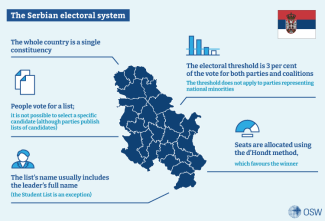
Ultimately, ahead of the snap election, the majority of opposition parties threw their support behind the Student List. This came from a wide range of political forces – from left-wing and pro-environmental groups, through liberal parties, to nationalist ones. As a result, on 25 October, only two significant opposition blocs comprising parties currently represented in parliament will stand for election – the pro-EU coalition European Serbia (ES) and the national-conservative alliance Authentic Right (AD). Their primary aim, however, will be to cross the 3% electoral threshold, potentially allowing them to act as ‘kingmakers’, by helping to secure a parliamentary majority for a Student List-led government. However, the AD has for years been accused of being a ‘phantom opposition’, raising the possibility that it could cooperate with the current ruling camp. Given the expected high turnout, however, neither coalition may secure parliamentary representation, in which case their votes – in accordance with the d’Hondt method in force in Serbia – will benefit the winner.
The ruling camp’s systemic advantages
Over 14 years in power, the SNS has developed a range of measures that will work in its favour in the upcoming elections. The party has around 700,000–800,000 members (11–12% of the population), who are linked to it through patronage networks. A condition for employment in the public sector – which is the main employer, particularly in the provinces – is SNS membership or, at the very least, cooperation with the party, for example by attending its rallies or securing a certain number of votes in elections from family and friends. In this way, the party can also keep potential dissidents in line by threatening them or their relatives with dismissal.
The SNS’s second key strength is its dominance of the media landscape. The ruling camp controls both the public media and a network of private television stations, tabloid newspapers and online portals owned by oligarchs close to it. At the centre of this media coverage is Vučić, who appears in public several times a day – according to figures compiled by the CRTA organisation, he made 371 public appearances in the first eight months of 2026 alone.[10] He has repeatedly abused his position as president in this way, using his role as head of state to engage in party campaigning on behalf of the SNS.
As a result of the takeover of the media market by Vučić’s camp, it is impossible to speak of a fair pre-election contest. A CRTA report covering the first three weeks of the campaign (9–30 September) shows that, across five national television channels, 69% of airtime was devoted to the ruling party, whilst 31% was devoted to the opposition. At the same time, the government was portrayed positively in 38% of the coverage analysed and neutrally in 61%, whilst its opponents were portrayed negatively in 42% and neutrally in 53%.[11] The few news outlets not controlled by the government do not hold licences to broadcast nationally and are available only on selected cable networks. In this year’s Reporters Without Borders ranking, Serbia ranks 104th worldwide (compared with 80th in 2012), and the organisation classifies the media situation in the country as ‘difficult’. Among the official candidate countries for EU membership, only Georgia and Turkey (ranked 135th and 163rd respectively), whose accession negotiations are on hold, fared worse.
There are strong indications that the authorities are implementing a plan to bring the last remaining influential independent media outlets under their control. In August 2025, investigative journalists published a recording of a conversation between the head of the Serbian state-owned telecoms operator and the director of United Group.[12] The group brought together the most important opposition media outlets, led by the television channels N1 and Nova S. The recording suggested that the Serbian authorities were pressing for changes in the management of media outlets critical of them, with Vučić himself proposing the changes. In August 2026, the protracted sale of United Group’s Serbian assets was completed, with the Portuguese investment fund Alpac Capital acquiring them. Since 2022, this entity has been the majority owner of the Euronews group, whose acquisition was reportedly co-financed by Viktor Orbán’s government through a Hungarian state-run foundation.[13] Moreover, the government in Budapest was among Vučić’s closest foreign partners. So far, N1 and Nova S have continued to provide coverage critical of the government, but the new owner has already made changes to the programming schedule (including taking a popular satirical programme off the air) and replaced some management staff with individuals who previously worked in pro-government media. There are therefore indications that the transaction will serve to bring the remaining opposition media under government control, and these efforts may intensify if the SNS wins the elections.
Electoral abuses
In addition to the advantages stemming from its control over institutions and the media, the ruling camp may also exploit irregularities on polling day itself. The OSCE Office for Democratic Institutions and Human Rights, in its report on the 2023 parliamentary election, noted, amongst other things, breaches of the secrecy of the ballot (in 24% of polling stations observed), the associated practice of ‘family voting’ (19%), and isolated cases of vote-buying, ballot box stuffing and attempts to influence voters’ decisions.[14] Another pressing issue is the outdated register of eligible voters, which contains 6.45 million people – only around 200,000 fewer than the total number of Serbian citizens according to the 2022 census. This opens the door to numerous irregularities, although these are more significant in local elections. In the past, the authorities have added their supporters to the registers to ensure victory in municipal council elections, whilst at national level each voter can cast only one vote. Hope for at least a partial reduction in electoral malpractice on polling day lies in the mobilisation of the student movement, which is organising training sessions for election committee members open to all interested citizens. The aim of the initiative is to ensure the presence of at least one SL representative at each of the more than 8,000 polling stations.
The ruling party is also attempting to limit the diaspora’s participation, as it is opposed to the ruling party. More than twice as many people as in the previous election – 102,000 – have registered to vote from abroad, with the highest numbers in Germany, Bosnia and Herzegovina (BiH) and Austria.[15] The student movement claims that there were nearly 10,000 additional applications, but that diplomatic missions rejected or ignored them. At the same time, the ruling party has influenced the number of overseas polling stations – there will be just four in the US and two in Canada. By contrast, Serbs in BiH – who are far more numerous but also traditionally closer to the authorities in Belgrade – will vote at 28 polling stations. The decision by the authorities to set polling station opening hours according to Serbian time (GMT+1) may also contribute to lower turnout among the diaspora outside Europe; this means, for example, that the polling station in Chicago will be open from 1.00 am to 2.00 pm, whilst the one in Sydney will be open from 5.00 pm to 6.00 am.
Post-election scenarios
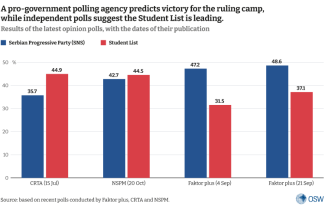
The limited number of reliable opinion polls makes it difficult to predict the outcome of the election. Polls published by agencies close to the government indicate a clear lead for Vučić’s bloc, known as United Serbia, which comprises the SNS and several of its satellite parties. By contrast, surveys by polling organisations considered independent suggest that the Student List has a better chance of victory (see Chart). The results of the local elections held in March 2026 across 10 local authorities serve as a supplementary indicator. In all 10 local authorities – thanks to the massive mobilisation of the SNS and its media and financial apparatus – the ruling camp emerged victorious. Nevertheless, the opposition (mostly local activists supported by students) significantly increased its presence on municipal councils, and on three of them secured just one seat fewer than the ruling party. This suggests that, with the support of residents in large cities (Belgrade, Novi Sad, Niš, Kragujevac), who are more sceptical of the government, the SL could pose a real threat to Vučić’s camp.
The 25 October election is the biggest test for the SNS since 2012, yet it remains the favourite to win. It is bolstered by its control of the media landscape and its patronage networks, which ensure it has a disciplined electorate. Furthermore, Vučić’s camp can draw on memories of a period of relative prosperity, particularly during the early years of its rule – since the SNS came to power, GDP per capita at purchasing power parity has more than doubled (from 14,500 to 34,000 dollars, according to the World Bank). In addition, a number of major infrastructure projects have been completed, such as the A1 motorway, opened in 2019, and the Belgrade–Subotica high-speed rail link, which opened in 2025. However, projects of this kind were carried out with disregard for local building and environmental standards and fostered corruption, the most tragic example of which was the disaster in Novi Sad.
A scenario in which both sides declare victory is possible. According to local analysts and commentators, the latest unpublished opinion polls show a slight lead for the Student List.[16] Combined with the expected electoral irregularities of the authorities, this raises the prospect of a closely contested result between the two largest blocs. This, in turn, could lead to both sides challenging the results, a resurgence of protests and even violent confrontation. In such a scenario, the ruling party, which controls the security forces and the military, holds the upper hand over its opponents. Furthermore, the SNS is capable of repeating a tactic used in the past – delaying the announcement of the final election results by ordering a recount in selected polling stations on the grounds of irregularities. This would help to quell any public discontent and slow down the process of forming a parliament. In a worst-case scenario, this obstruction could continue until the snap presidential election, which, following Vučić’s resignation, must take place by the end of the year.
The reaction of the international community could be a key factor in the post-election situation. Owing to months of protests and the erosion of democratic standards in Serbia, Vučić no longer enjoys the same level of support within the EU as he did previously. The SNS’s associate membership of the European People’s Party (EPP) has also been under review for over a year. These developments could enable EU member states and institutions to respond more firmly to electoral irregularities. The EU could also act as a mediator in the event of a dispute over the election result.
Given the balance of power between the two main blocs, it may turn out that smaller players on the political scene, particularly national minorities, will play a decisive role in forming the future government. Much depends on whether the two opposition coalitions, as well as the SNS’s long-standing partner – the post-Milošević Socialist Party of Serbia (SPS), which is grappling with a crisis within its own ranks – manage to clear the electoral threshold. The stance of parties representing national minorities may also prove crucial; thanks to liberal regulations (they are not subject to the 3% threshold, and their votes receive an additional multiplier when seats are allocated), they have won over a dozen seats in parliament in recent years, with most of them supporting the ruling parties. The Alliance of Vojvodina Hungarians (SVM), representing the largest minority, is likely to be of the greatest significance; following Orban’s loss of power in Budapest, it now finds itself at a political crossroads and may be inclined to support a Student List-led government.
A clear victory for the SNS or the SL would help to prevent tensions from escalating. The student movement is counting on a massive public mobilisation that could offset the ruling parties’ advantages. With an out-of-date electoral register, even a turnout of 65% would, in practice, mean that around 80% of eligible voters would go to the polls. Faced with the prospect of a decisive victory for the Student List, Vučić might be inclined to concede defeat and hand over power peacefully. Conversely, a clear victory for the former president’s camp could discourage citizens from protesting and weaken arguments about electoral irregularities, which – even if they inflated the SNS’s result – would not change the winner of the election.
[1] M. Szpala, ‘Serbia: protesty po przedterminowych wyborach parlamentarnych’, OSW, 29 December 2023, osw.waw.pl.
[2] M. Szpala, ‘Serbia: mass protests in the shadow of tragedies’, OSW, 25 May 2023, osw.waw.pl.
[3] An investigation into corruption is being conducted by the Organised Crime Prosecutor’s Office (TOK), whilst the regional prosecutor’s office in Novi Sad has brought criminal charges against three individuals (including a former infrastructure minister); however, these efforts are facing constant obstruction, including by courts controlled by the authorities. It is also unclear whether the accused were among those pardoned by Vučić in his final decision before resigning. The list of 49 people covered by the presidential pardon remains confidential.
[4] According to estimates by the organisation Arhiv javnih skupova.
[5] In total, 14 people – student movement activists (including rector Đokić) and members of the opposition – were allegedly spied on using Pegasus software, as confirmed by Amnesty International and the University of Toronto’s Citizen Lab – G. Andrić, T. Ćurčič, ‘Studenti u blokadi: Najmanje 14 ljudi špijunirano; ‘trivijalni senzacionalizam’, tvrdi BIA’, BBC News na srpskom, 2 September 2026, bbc.com.
[6] J. Nowinowski, ‘Serbia’s President Vučić resigns: a one-man show’, OSW, 28 September 2026, osw.waw.pl.
[7] ‘Stavovi građana Srbije prema Rusiji’, Institut za evropske poslove, 8 November 2023, iea.rs.
[8] New research: They believe in democracy, not in government, CRTA, Stanford, PULSR, June 2026, crta.rs.
[9] Percepcija građana prema Kosovu, Institut za evropske poslove, 11 October 2023, iea.rs.
[10] Campaigning without the paperwork; CRTA Election Observation Mission Report Election Year 2026/2027, CRTA, 8 September 2026, crta.rs.
[11] First interim report on long-term observation, CRTA, 8 October 2026, crta.rs.
[12] K. Sharife, V. Radojević, ‘Audio Recording Reveals United Group and Telekom Srbija CEOs Discussing Undermining Serbian Broadcaster’, OCCRP, 28 August 2025, occrp.org.
[13] A. Pethő et al., ‘Secret documents reveal that Orbán’s people were behind the purchase of one of Europe’s biggest TV channels’, Direkt36, 11 April 2024, direkt36.hu.
[14] Republic of Serbia. Early Parliamentary Elections 17 December 2023. ODIHR Election Observation Mission Final Report, ODIHR, 28 February 2024, odihr.osce.org.
[15] Calculations by the European Western Balkans portal based on data from the State Election Commission, the Ministry of Public Administration and Local Self-Government.
[16] This information was also confirmed in person during an OSW analyst’s study visit to Serbia in October 2026.