Negotiations on the EU’s Multiannual Financial Framework: towards greater centralisation
Negotiations on the EU’s Multiannual Financial Framework (MFF) for 2028–34 present a classic case of trying to square the circle. The EU faces a rapidly growing array of challenges, from reindustrialisation and investment in security to the energy and digital transitions, all of which require substantial funding. However, the deteriorating economic situation in the wealthiest member states, particularly Germany, makes it politically difficult for them to support an increase in the budget. The negotiations, which are even more complex than usual, will produce an inadequate budget that could weaken two pillars of European integration: cohesion policy and the Common Agricultural Policy (CAP). If adopted, the more centralised spending structure, which prioritises support for industry and innovation, will strengthen the political position of the European Commission while weakening that of beneficiary member states and regions. In the longer term, this risks slowing economic convergence and gradually exacerbating political tensions within the EU, at a time when the bloc is already grappling with challenges that threaten its cohesion.
The Multiannual Financial Framework (MFF) is a seven-year plan that sets ceilings for the EU’s annual budgets and determines the structure of the bloc’s revenue and expenditure. It is a long-established instrument for coordinating spending, as the complexity of EU programmes requires planning beyond a single financial year. The seven-year duration of the MFF was designed to ensure stable EU funding while avoiding recurrent political disputes. The European Commission aims to conclude the negotiations by the end of this year, but given the scale of the disagreements, the talks are likely to extend into the first quarter of 2027.
The 2021–2027 Multiannual Financial Framework: seven lean years
The assumptions underpinning the 2021–27 MFF did not – and could not – account for the shocks the EU would face during this period. These began with the COVID-19 pandemic and the resulting economic downturn and supply chain disruptions, followed in 2022 by Russia’s invasion of Ukraine, which triggered an energy crisis. In the following years, trade tensions also emerged with the United States and China, and the EU is now grappling with the consequences of the war in the Middle East, including rising energy and fertiliser prices. This increasingly unstable external environment has slowed the EU’s economic growth, driven up energy prices, hampered the energy transition and, ultimately, made it necessary to increase defence spending.
International instability is also affecting planning for the EU’s next budget. On the one hand, the EU is increasingly prioritising funding for security and resilience-building, as well as financial support for Ukraine. On the other, certain political processes are accelerating, and preparations for the EU’s enlargement to include Montenegro, Moldova and Ukraine are gaining prominence. Although accession negotiations with Ukraine are unlikely to conclude during the next budgetary period, the EU could still launch pre-accession support programmes.
The EU’s deteriorating competitiveness also forms part of the backdrop to the negotiations. Member states have been virtually absent from the race to develop advanced semiconductors and AI models. Hopes that the green transition would become a new driving force behind European industrialisation have not been realised. Instead, China, which controls over 90% of global rare earth processing, has come to dominate the production of photovoltaic panels, wind turbines and batteries, achieving near-monopoly status in many areas. Worse still, companies in sectors traditionally dominated by European companies are also struggling. The automotive industry is facing a deep structural crisis,[1] while the rapid development of AI threatens the position of other industries, including pharmaceuticals and specialised machinery.
The EU’s economic difficulties have soured the political climate for MFF negotiations. Germany, the largest net contributor to the EU budget, is particularly reluctant to increase its contributions and seeks to redirect EU funds towards new priorities. The German economy has stagnated since the pandemic, while defence spending is rising under pressure from the US and NATO. These economic difficulties are a major factor behind the exceptionally low approval ratings of Friedrich Merz’s government, which took office just over a year ago but may not survive the nearly three years remaining in its term. Other net contributors, including Austria and Finland, are also facing difficult economic conditions. Eurosceptic right-wing parties opposed to increasing the EU budget enjoy strong support in both countries, and their position in Finland could strengthen further following next year’s parliamentary elections. Moreover, the French presidential election scheduled for the spring of 2027 provides a particularly strong incentive for net contributors to reach an agreement as quickly as possible, as a potential victory by a more Eurosceptic candidate from the National Rally could lead to a substantial reduction in the EU budget.
Against this backdrop of widespread pessimism, reports by Enrico Letta and Mario Draghi, both commissioned by the European Commission and published in 2024, offered assessments that have shaped the debate on the future of the EU and MFF negotiations. Both authors agreed that Europe must achieve much deeper integration within its single market and treat it as a strategic asset in the pursuit of technological sovereignty. At the same time, the EU urgently needs to mobilise vast resources for an ambitious new industrial policy that would enable it to compete in the global innovation race, particularly in AI, advanced technologies and clean energy. From the perspective of net contributor countries, the most advantageous approach would be to finance such programmes from the EU budget, ideally by cutting existing expenditure, particularly on cohesion policy and the Common Agricultural Policy (CAP).
Financing the repayment of debt incurred under the Recovery and Resilience Facility (RRF),[2] through which member states receive funding as part of their National Recovery Plans, will be an equally important challenge in the MFF negotiations. The facility was approved in 2021 in response to the economic downturn caused by the COVID-19 pandemic, particularly in the EU’s southern members. Member states agreed to take on joint debt to finance €750 billion in expenditure, with the RRF accounting for €312.5 billion in grants and €360 billion in low-interest loans. So far, the EU budget has covered interest payments on this debt, but principal repayments will begin in 2028. Unless the EU budget is substantially increased, debt repayments will reduce the funding available under the MFF.
The European Commission’s proposal for 2028–2034: a modest, centralised budget
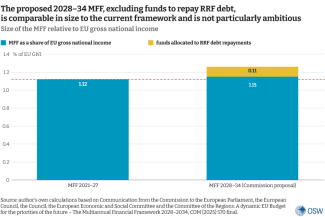
In July 2025, the European Commission presented its proposal for the 2028–34 MFF, amounting to €1,985 billion in nominal terms and €1,763 billion in 2025 prices. The Commission argued that this amount, if approved, would be the highest on record, 64% higher than under the previous MFF. However, given the relatively high inflation the EU has experienced in recent years, the ambition of the proposal should be assessed against the income of EU member states. The proposed budget amounts to 1.26% of the EU’s gross national income (GNI).[3] On paper, this represents a substantial increase from 1.12% of GNI under the 2021–27 MFF. However, this figure also includes the cost of servicing and repaying debt incurred under the RRF, estimated at a total of €149 billion in 2025 prices.[4] Excluding these costs, the Commission’s current proposal amounts to just 1.15% of the EU’s GNI, representing only a marginal increase over the previous MFF. It should therefore be regarded as an unambitious proposal resulting directly from exceptionally strong resistance from net contributors, particularly as further negotiations are certain to reduce its size.
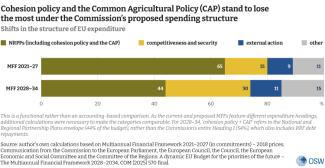
The European Commission has sought to resolve the dilemma of delivering on new MFF priorities with limited resources by consolidating programmes, aiming to improve spending efficiency and reduce bureaucracy. Its proposal envisages reducing the number of expenditure headings from seven to four, most notably by bringing spending across several areas, including the CAP and cohesion policy, under unified National and Regional Partnership Plans (NRPPs), drawn up separately for each member state. The Commission has earmarked €771 billion for implementing these plans. While this figure may appear substantial, representing the largest expenditure item in the MFF, the restructuring will reduce the combined share of spending on cohesion policy and the CAP in the seven-year budget from 65% to 44%.
The new competitiveness, prosperity and security heading is set to become the main beneficiary of the restructured MFF, with an allocation of €522 billion, raising its share of the budget from 15% to 30%. The €398 billion European Competitiveness Fund, to be created by consolidating 12 existing programmes, will be its largest component. The fund will support innovation across several areas including the clean transition and industrial decarbonisation, biotechnology, agriculture and the bioeconomy, defence, security and space, and digital technologies. Within the fund, defence and security will see the largest increase in funding, from €25 billion to €116 billion. The budget for Horizon Europe, the EU’s research and development programme, is also set to almost double to €155 billion. These changes are intended to address calls made in European policy debates in recent years to strengthen the industrial policy component of the EU budget and improve the bloc’s ability to compete effectively with China and the US.
The remaining 11% of the MFF will be allocated to EU external action. The largest component of this heading, the €190 billion Global Europe instrument, will finance development cooperation, humanitarian aid and pre-accession assistance. The European Commission has proposed allocating €100 billion from the MFF reserve to finance pre-accession assistance for Ukraine and its reconstruction. The model adopted by the Commission avoids creating the impression that support for Ukraine competes with other budgetary priorities. However, this comes at the cost of significantly reducing the EU’s overall flexibility buffer for responding to unforeseen crises.
This level of support will ensure that Ukraine, despite not yet being an EU member, can expect to receive nearly two-thirds of the amount allocated to Poland under the Commission’s proposal for the 2028–34 MFF. However, if the war continues, these funds will be used primarily for the country’s defence and financial stabilisation. It should also be noted that Ukraine will not be required to contribute to the EU budget. Even now, the EU disburses funds to Ukraine only if it meets specific requirements (conditionalities), giving the bloc considerably greater scope to exert pressure on Kyiv to meet member states’ demands.
The implications of the changes for Central Europe
The proposed restructuring of the MFF will cut funding for less prosperous regions by 15% and for agriculture by 10%,[5] reductions that risk significantly exacerbating Central Europe’s net budgetary position. Under the Commission’s proposal, Poland is set to receive €123.3 billion through the NRPPs, including approximately €112.5 billion allocated to agriculture and cohesion policy,[6] compared with €105.5 billion available under these headings in the current budgetary period.[7] This represents a nominal increase of 6.6%, although cumulative inflation over the period has been much higher, at 23%. Under the current rules, Poland would therefore receive nearly €130 billion from the CAP and cohesion policy in the next MFF. The effective shortfall stems not only from cuts to the budgets for these policies but also from the fact that several Polish regions, mainly in the west of the country,[8] will exceed the income threshold of 75% of the EU average per capita, placing them in the category of transition regions, which receive substantially less financial support. In addition to funding for cohesion policy and the CAP, Poland is set to receive €1.9 billion for migration, internal security and border protection, as well as €8.8 billion from the Social Climate Fund. In 2026 alone, Poland will contribute a total of PLN 41.5 billion (approximately €9.5 billion) to the EU budget.
Central Europe is unlikely to be among the main beneficiaries of the shift in MFF funding towards competitiveness. These funds are typically allocated through competitive calls for proposals, in which companies and research institutions from Western Europe tend to prevail. Under the current Horizon Europe programme, Poland has so far secured approximately €1 billion[9] (1.6% of the total funds disbursed), ranking only 16th among participating countries.[10] Assuming a similar share under the next MFF, Poland would receive an additional €1.6 billion, while the wealthiest EU member states are likely to be the main beneficiaries of the increased funding. It is difficult to assess how much Central Europe could receive from the European Competitiveness Fund. If its funding criteria are similar to those of Horizon Europe, Poland could expect to secure several billion euros in additional funding over the seven-year MFF period.
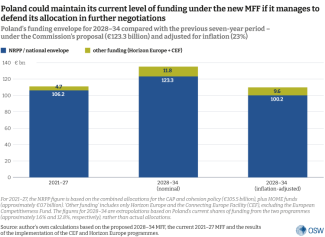
As a consolation prize for Central Europe, funding for the Connecting Europe Facility (CEF) is set to more than double to €72 billion. In recent years, the programme has been one of the EU’s most effective instruments for improving transregional connectivity and diversifying energy supplies. Poland has secured the largest share of CEF funding under the current MFF (approximately 12.8%), receiving €3.7 billion.[11] Repeating this success could help the country partially offset losses under other budget headings and secure an additional €5.5 billion in the next financial period.
Greater powers for the European Commission and the marginalisation of regions
One controversial proposal from the Commission is to significantly expand the application of the rule-of-law conditionality mechanism and milestone requirements to cover payments under the NRPPs. Combining funding for cohesion policy and the CAP into a single programme will give the Commission much greater control over the distribution of funds.
Under the proposed changes, the Commission will negotiate NRPPs with individual national governments, but the Council will have the final say on their approval. The Commission will then assess whether the agreed milestones have been met before releasing subsequent tranches of funding. Under the current cohesion policy framework, the Commission merely verifies invoices and assesses the eligibility of expenditure. Moreover, suspending NRPP funding in response to breaches of the rule of law will require a qualified majority in the Council,[12] while the Commission will be able to suspend payments unilaterally in cases of violations of the Charter of Fundamental Rights. The key innovation, therefore, is the extension of the rule-of-law conditionality mechanism beyond cohesion policy to include the CAP. Net contributors, particularly Austria, Finland, Germany, the Netherlands and Sweden, are the leading proponents of strengthening the rule-of-law conditionality. Estonia has also signed a non-paper supporting this approach.[13]
The Commission will gain its most far-reaching powers through the system of milestones, which will enable it to impose binding commitments on member states as a condition for releasing further funding. In this way, the Commission will be able to exert pressure on governments on matters such as implementing European Semester recommendations, effectively gaining greater influence over the direction of member states’ economic policies. For example, current recommendations for Poland include fiscal consolidation, raising the retirement age, reducing bureaucracy in public procurement, accelerating the energy transition and promoting inclusive education.[14] While country-specific recommendations under the European Semester were originally intended to improve economic competitiveness, they increasingly focus on advancing the ‘green transition’, which in practice could drive up energy costs and slow economic growth.
The proposed changes would significantly strengthen the Commission’s position, particularly vis-à-vis net beneficiary countries. It has much less leverage over net contributors, which could threaten to withhold their contributions in the event of a dispute with the Commission – a move that could even attract public support in those countries. EU funding remains an important source of investment for many net beneficiaries, especially as their fiscal positions are deteriorating, partly due to rising defence spending. A decision to suspend payments could undermine their credibility in financial markets and push up bond yields. Similar arrangements were first introduced through National Recovery Plans under the RRF, with milestones tied to the European Semester. This effectively attached strict financial sanctions to a mechanism originally designed to coordinate economic policy. Contrary to the Commission’s assurances at the time, this arrangement proved to be neither a one-off nor a temporary measure, but rather the first step towards a fundamental change in the logic of the system.
In many key EU debates, the European Commission has not been a neutral arbiter but an advocate of particular policies. For example, Brussels favours accelerating the energy and climate transition, which runs counter to the stance of most Central European countries. This raises concerns that conditionality could become a tool for exerting pressure on member states, as has been the case with the excessive deficit procedure. In the past, Brussels has repeatedly faced criticism for applying inconsistent standards and treating the largest member states, such as France and Germany, more leniently.[15]
In another significant shift, the consolidation of numerous MFF programmes into unified NRPPs is likely to substantially weaken the position of the regions. The EU has traditionally prided itself on its model of multi-level governance, in which virtually all levels of government share responsibility for decision-making, thereby putting the principle of subsidiarity into practice. Under the new MFF, the plans will largely be the product of negotiations between the European Commission and individual national governments, with regions playing at most a consultative role. National governments will therefore assume much greater responsibility for allocating funds, as money will no longer flow directly from the Commission to the regions. Consequently, the regions could be relegated to the role of mere project implementers rather than genuine partners in MFF programming.
The Commission’s centralisation proposals have drawn criticism primarily from net beneficiary countries in Central and Southern Europe, which are also pushing for the largest possible EU budget.[16] In a joint position presented to the Commission, these countries rejected proposals that would curtail their right to programme EU expenditure while strengthening the Commission’s role, although the proposed restrictions may still be softened during the negotiations. If the new MFF is modelled on the National Recovery Plans, the advantages of cohesion policy, such as long-term, structured planning, will be sidelined in favour of a system that may prove neither more flexible nor less bureaucratic, but will certainly be less structured. The Commission, which has long complained of staff shortages, lacks the capacity to monitor regional developments across member states in detail and assess the needs of individual regions. Worse still, a milestone-based system carries a greater risk of financial irregularities. In the name of strengthening oversight of member states’ adherence to the rule of law and their economic policies, the new system scales back traditional checks on invoices and actual expenditure.[17]
New sources of revenue: the EU’s formula for reconciling the opposing camps?
The European Commission hopes to overcome exceptionally strong resistance among net contributor countries to relatively modest increases in the EU budget by proposing new sources of revenue. These would finance a substantial share of the proposed MFF increase, providing €308 billion, or approximately €44 billion annually. This is not a new approach. For years, member states have transferred 75% of their customs revenue to the common budget. However, many of the revenue sources proposed by the Commission remain controversial, as they would involve the EU taking over a share of member states’ tax revenues. Formally, their contributions to the EU budget would remain unchanged, but in practice, many governments, particularly those of the most heavily indebted countries, would have to seek new sources of revenue for their national budgets.
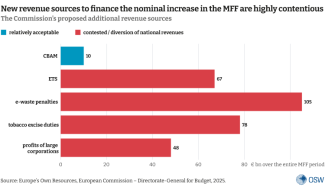
The European Commission expects additional revenue from the Carbon Border Adjustment Mechanism (CBAM; 75% of the proceeds would go the EU budget, generating approximately €10 billion over the seven-year MFF period), the Emissions Trading System (ETS; 30%, €67 billion), penalties for failing to meet e-waste collection targets (€105 billion), excise duties on tobacco consumption (15%, €78 billion) and a tax on the profits of corporations with annual revenues exceeding €100 million (€48 billion).[18] So far, most member states have been willing to accept only revenue from CBAM, a mechanism introduced this year that imposes additional carbon charges on imports of certain categories of goods into the EU from countries without carbon pricing systems comparable to the EU’s ETS.
The Commission’s other proposals have raised objections, as they would require member states to surrender a portion of their revenues to the EU budget. The idea of directly taxing the largest corporations has drawn even stronger criticism, particularly from net contributors, which regard it as an infringement of their tax sovereignty and an excessive expansion of the Commission’s powers. The Commission, for its part, argues that these companies benefit the most from the single market. Another contentious proposal involves raising revenue through penalties for failing to meet e-waste collection targets. This arrangement could create scope for abuses by the Commission, which would benefit financially when member states fail to implement EU regulations. Meanwhile, increasing the EU’s share of ETS revenues would disadvantage countries with a high proportion of coal in their energy mix, such as the Czech Republic and Poland. For these countries, revenue from ETS allowance auctions and special mechanisms, including free emission allowances for the power sector and the Modernisation Fund, serves as compensation for the high costs of their energy transition.
The European Parliament has also put forward its own proposals for new revenue sources, including taxes on online gambling, services provided by major digital platforms and capital gains from cryptocurrencies.[19] However, these measures will be difficult to implement. Malta, a major tax haven for online gambling operators, strongly opposes the first of these taxes. Meanwhile, introducing a digital tax would almost certainly create new tensions in relations with the US, something that many member states are keen to avoid in the current international climate.
An unsatisfactory proposal from Cyprus and the outlook for the negotiations
Cyprus, which held the presidency of the Council of the EU in the first half of 2026, sought to find a compromise by presenting its own revised proposal in June. From the outset, Germany had lobbied aggressively for a 20% reduction in the MFF, equivalent to €400 billion, through cuts across all expenditure headings.[20] However, the Cypriot presidency resisted this pressure, proposing cuts of just 2%, or €33 billion. To the further irritation of net contributors, even these modest reductions would come at the expense of external action and the European Competitiveness Fund, while leaving cohesion policy and the CAP largely untouched.[21] The Netherlands, Germany and Sweden, in particular, rejected the proposal outright as unacceptable.[22] The presidency made no fundamental changes in other areas. It retained a model similar to that of the National Recovery Plans, with a strong role for the Commission, and did not restore greater regional involvement in shaping the MFF.[23] It merely introduced the option of involving regions in MFF programming, which the Commission could subsequently take into account when assessing whether milestones have been met. Ultimately, however, the entire arrangement rests on the goodwill of national governments.
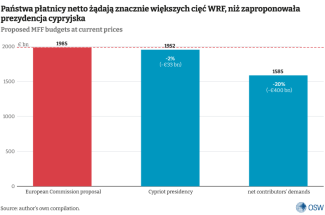
Even if the final size of the MFF is only slightly smaller than the Commission’s proposal and its funding structure remains largely unchanged, the Commission will gain much greater scope to advance the EU agenda through milestones and strengthened rule-of-law conditionality. Member states will still have substantial funds at their disposal (Poland is expected to remain the largest MFF beneficiary in absolute terms), but their autonomy over spending decisions will be significantly curtailed.
There is a serious risk that the 2028–34 Multiannual Financial Framework will trigger the erosion of cohesion policy as traditionally understood. It will lose its emphasis on long-term, carefully considered expenditure programming in cooperation with the regions, which requires a mature approach to planning and implementing projects and a focus on strategic objectives. Instead, this approach will give way to a more chaotic system of ad hoc planning, characterised by constant negotiations with the European Commission and short-term political deals, significantly increasing the risk of errors and distortions. Net beneficiary countries may also lose leverage in policy areas where their objectives conflict with the Commission’s agenda. After all, what difference will it make if Central European countries press for slower implementation of climate policy to avoid harming economic growth, when the Commission can impose similar objectives on them through milestones?
[1] K. Popławski, ‘Kryzys Volkswagena. Problemy firmy mówią coś bardzo ważnego o współczesnych Niemczech’, Klub Jagielloński, 7 August 2026, klubjagiellonski.pl.
[2] The facility formally constituted the largest part of NextGenerationEU. Its other components included REACT-EU, FAIR, EAFRD, rescEU and other funds. These were established to secure the political support needed to quickly push through the ambitious initiative.
[3] Although gross national income (GNI) is similar to gross domestic product (GDP), it measures the income earned by a country’s residents rather than the value of goods and services produced within its borders. In other words, it excludes income earned in a particular member state by foreign-owned companies and transferred abroad, while including income earned overseas by domestic companies and residents.
[4] A dynamic EU Budget for the priorities of the future – The Multiannual Financial Framework 2028–2034, The European Commission, COM(2025) 570 final, 16 July 2025, eur-lex.europa.eu.
[5] R. Hansum, J. Lindner, N. Redeker, E. Rubio, ‘Ripe for Reform – What’s in the EU Budget Proposal and What Should Come Next’, Jacques Delors Centre, 1 August 2025, delorscentre.eu.
[6] Europe’s budget. Member States allocation, Publications Office of the European Union, 9 December 2025, op.europa.eu.
[7] ‘Budget pre-allocations’, The European Commission, commission.europa.eu.
[8] Most likely Lower Silesia, Silesia and Greater Poland, and possibly also Pomerania and Mazovia, unless Warsaw is excluded.
[9] Narodowy Punkt Kontaktowy Programów Badawczych UE. Świat w PR UE, app.powerbi.com.
[10] The programme includes not only EU member states but also non-EU countries, such as Israel and the United Kingdom.
[11] Calculations based on data from CINEA Project Portfolio – Overview | Sheet – Qlik Sense for CEF Transport and CEF Energy projects in 2021–25.
[12] The Commission and some net contributors had sought to require a qualified majority to reject a Commission proposal to suspend NRPP payments.
[13] ‘Non-paper on behalf of Austria, Estonia, Finland, Germany, The Netherlands, and Sweden on the Rule of Law and the Charter of Fundamental Rights in the MFF proposal’, aeur.eu.
[14] ‘Recommendation for a Council Recommendation on the economic, social, employment, structural and budgetary policies of Poland’, The European Commission, COM(2026) 221 final, 3 June 2026, webgate.ec.europa.eu.
[15] T. Moller-Nielsen, ‘Deficit denial: Why the EU’s fiscal rules are problematic’, Rapporteur, 11 April 2026, rapporteur.com; A. Isaac, ‘Rome warns EU budget rules must be fair after Macron gives in to ‘yellow vest’ protestors’, The Telegraph, 12 December 2018, telegraph.co.uk.
[16] ‘Joint Declaration on the Multiannual Financial Framework 2028–2034 by The Friends of Cohesion’, 25 May 2026, at: gov.pl.
[17] RRF traceability and transparency – Gaps remain regarding the traceability and transparency of RRF funds, The European Court of Auditors, Special Report 14/2026, 6 May 2026, eca.europa.eu.
[18] Europe’s budget. Own resources, Publications Office of the European Union, July 2025, op.europa.eu.
[19] Interim report on the proposal for the multiannual financial framework for 2028–2034, The European Parliament, P10_TA(2026)0111, The European Parliament, 28 April 2026, europarl.europa.eu.
[20] A. Rinke, ‘Germany demands $450 billion cut to ‘unaffordable’ EU budget, document shows’, Reuters, 30 June 2026, reuters.com.
[21] V. Becker, ‘A ‘no-go box’: Frugals smash Cypriot EU budget proposal’, Rapporteur, 11 June 2026, rapporteur.com.
[22] E. du Chatinier, ‘North vs South: Cyprus budget compromise sparks clash over EU billions’, EUPerspectives, 14 June 2026, euperspectives.eu.
[23] Proposal for a Regulation of the European Parliament and of the Council establishing the European Fund for economic, social and territorial cohesion, agriculture and rural, fisheries and maritime, prosperity and security for the period 2028–2034 and amending Regulation (EU) 2023/955 and Regulation (EU, Euratom) 2024/2509 (‘NRPP Regulation’), Council of the European Union, document 10559/26, 16 June 2026, data.consilium.europa.eu.