Continuity or a change in tone? Israel ahead of the parliamentary elections
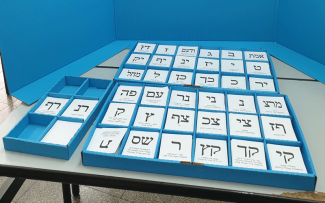
On 17 July, the Knesset voted to dissolve itself at the end of its term, paving the way for elections on 27 October. This was the first Israeli parliament since the 1980s to complete a full four-year term and the first Israeli government since the 1970s to remain in office for an entire term. However, this formal stability belied profound turmoil. During this period, Israel experienced mass protests, the Hamas attack and armed conflicts during which its territory came under fire, while its military committed war crimes on a large scale, primarily in the Gaza Strip but also in Lebanon. These developments deepened the polarisation and radicalisation of Israeli public life and reinforced an already evident ‘besieged fortress’ mentality, reflected, for example, in a tendency to instinctively deny crimes and label critics as antisemitic.
It is unclear whether the elections will produce a clear winner. A deadlock could leave Benjamin Netanyahu as prime minister in a caretaker capacity for the foreseeable future. However, given the current political landscape and public sentiment, even a change of government is unlikely to produce a major overhaul of state policy. Limited changes may be possible in domestic affairs, although any adjustments in foreign and security policy are likely to be modest and largely stylistic.
Israel before 7 October 2023
Israel began the current parliamentary term, which opened in November 2022 and is now drawing to a close, with the most extreme government in its history – a coalition of ultra-religious, nationalist and ultranationalist parties headed by a prime minister who had been standing trial since 2020 on charges of bribery and breach of trust.
Israel also entered this period amid deep polarisation, driven by disputes over the character of the state that had been intensifying for decades. While currently centred on the prime minister and his policies, these disputes are fundamentally systemic and extend beyond individual personalities. In essence, they reflect a clash between different versions of Jewish nationalism and competing visions of the role of religion in public life.
The occupation of the Palestinian territories, maintained since 1967 and marked by increasing brutality, has formed, and continues to form, a key context for Israeli social and political life and is closely linked to these disputes. At the start of the current parliamentary term, in 2022, the Israeli armed forces killed 146 Palestinians in the West Bank, the highest annual toll since 2004. Meanwhile, the Gaza Strip, under an Israeli blockade since 2007, had been repeatedly bombed in successive operations targeting Hamas, which governs the enclave, including in 2008–09, 2012, 2014 and 2021. At the same time, the process of Israeli colonisation continued to expand in East Jerusalem and the West Bank. More than 770,000 Jewish Israelis were already living there, accounting for 10% of the country’s Jewish population. The situation deteriorated further after extremist parties espousing Jewish racial supremacy and calling for territorial expansion joined the governing coalition.
The first major shock of the current term came in the form of mass protests triggered by the government’s plans to reform the judiciary, notably by weakening the constitutional position of the Supreme Court, which serves both as the country’s High Court of Justice and, in effect, its constitutional court.
Given the weakness of Israel’s institutional safeguards – including the absence of a single constitution, the president’s lack of veto power and an electoral system in which voters choose political parties rather than individual candidates – weakening the Supreme Court would have dismantled the country’s most important check on executive power and cleared the way for the governing majority to pursue a potentially far-reaching transformation of the country.
Between January and October 2023, the protests spread across most of Israel, drawing as many as 300,000 people and significantly slowing, or at least delaying, the government’s reform drive.
The Hamas attack and its aftermath
The Hamas attack on 7 October 2023 marked a turning point in the parliamentary term. The assailants killed more than 700 Israeli civilians and over 300 members of the security forces and abducted around 250 people.
The attack triggered a series of military operations over the next two and a half years, which successively targeted the Gaza Strip, the West Bank, Lebanon, Syria, Yemen and Iran. In Gaza alone, the Israeli military killed 73,000 people, according to official Palestinian figures (although the actual death toll is undoubtedly higher), and destroyed around 70% of the built environment.
At the same time, Israeli territory repeatedly came under fire from Lebanon, Yemen and eventually Iran. The effectiveness of Israeli and US air defence systems prevented these attacks from causing significant casualties. Nevertheless, they disrupted the functioning of the state and led to the temporary evacuation of tens of thousands of residents from northern Israel.
On most of these fronts, it was Israel that escalated the conflict or initiated direct confrontation. It also inflicted far greater losses and, according to reports by the UN and human rights organisations as well as numerous first-hand accounts, systematically committed war crimes and crimes against humanity, while its actions in the Gaza Strip exhibited characteristics of a genocide.
Available information indicates that the Israeli military deliberately destroyed civilian infrastructure in Gaza, partly in the course of military operations (often with questionable military justification) and partly through planned demolitions. The destruction affected residential buildings, hospitals, schools, universities, mosques, government offices, cemeteries, historic sites, water desalination facilities, farmland and orchards.
The Israeli military also regularly and knowingly carried out attacks that resulted in very high civilian casualties. Numerous accounts further indicate that Israeli forces repeatedly targeted civilians, including women and children, unarmed men, medical personnel, journalists and humanitarian workers. One such attack claimed the life of a Polish citizen.
In addition, Israel restricted or cut off deliveries of humanitarian aid to the Gaza Strip, deliberately causing starvation, and subjected detainees to torture. These actions were accompanied by rhetoric, notably from senior state officials, that dehumanised Palestinians and/or called for the complete destruction of Gaza.
Consequently, in November 2024 the International Criminal Court issued international arrest warrants for Prime Minister Benjamin Netanyahu and former Defence Minister Yoav Gallant.
The domestic consequences of the war
The Hamas attack left Israeli society traumatised, an effect compounded by months of anxiety over the fate of those abducted and by the experience of a protracted war.
Meanwhile, the conduct of the war in Gaza sparked mass protests in Israel. For the most part, these did not stem from concerns about the military’s actions, but from the belief that the prime minister was prolonging the conflict for political reasons and that securing the hostages’ release was not his priority. He was accused of seeking to delay the legal proceedings against him and to rebuild his political support. Demonstrations over these issues drew hundreds of thousands of participants.
The sequence of events set in motion by Hamas, in which Israelis were both victims and, on a far greater scale, perpetrators of war crimes, contributed to a deterioration in the mental health of Israeli society. According to a survey conducted in late 2025 by one of Israel’s health funds, 32% of respondents said they needed psychological or psychiatric support. The number of suicides also increased, particularly among soldiers,[1] as did cases of domestic violence.
In another significant development, public attitudes became increasingly radicalised. As noted above, statements dehumanising Palestinians and/or calling for their destruction routinely appeared in public debate – with little or no pushback. Moreover, strong support – often at 60–70% or higher – persisted for the views that Israel employed insufficient military force in the Gaza Strip, that there were no innocent people in the territory and that starvation was an acceptable method of warfare.
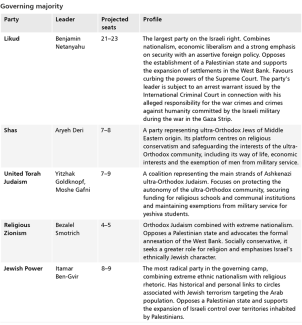
This radicalisation was accompanied by a rise in violence, most starkly illustrated by Israeli settlers carrying out systematic attacks on the Palestinian population in the West Bank with the acquiescence of the Israeli military and often under its protection. Police brutality against anti-government protesters and Arab residents of Israel, particularly in Jerusalem, also increased.[2] Attacks by radical Jewish groups on Palestinians, both Muslims and Christians, in Jerusalem’s Old City became more frequent, as did assaults on Christians of other nationalities, including clergy. The presence of Bezalel Smotrich of the Religious Zionism party and Itamar Ben-Gvir of the Jewish Power party in government fostered these trends, as both represent political currents combining extreme nationalism with religious fundamentalism.
The period after 7 October 2023 also deepened pre-existing social divisions. This was particularly evident in the exemption from military service of ultra-Orthodox men (currently numbering around 80,000), which became a source of escalating tension amid repeated call-ups of reservists.
Characteristics of the political spectrum
Israel’s political landscape is primarily defined by the notion of ‘Zionist parties’, which span most of the political spectrum, from the far right to the left. Despite profound differences, these parties share the belief that Israel should be the nation-state of the Jewish people, shaped primarily – and, in its more extreme variant, exclusively – by Jews and serving the interests of the Jewish nation, rather than a state of all its citizens with an identity defined in civic terms. Most also share the belief that the Jewish people have a unique historical and moral right to the land on which Israel was established, and reject external criticism of the state’s actions since 7 October 2023.
Despite this common core, these parties remain deeply divided over the desired model of the state. At one end of the spectrum is a radical ethno-nationalist, openly racist current closely tied to religious messianism, which advocates formally expanding Israeli territory and curbing judicial independence and other checks on executive power. Parties such as Religious Zionism and Jewish Power fall into this category. At the other end are parties that favour a more secular, pragmatic and liberal state – in the sense of liberal nationalism rather than European liberalism – underpinned by strong institutions that constrain executive power, though this does not mean that they are free from ethnic nationalism or aspirations to regional hegemony.
This dispute is reflected in differing positions on the role of Judaism in the state, the criteria for belonging to the Jewish nation, the desired extent of participation by national minorities in public life, and Israel’s territorial future. Differences over security policy, the Israeli-Palestinian conflict and foreign policy are considerably less significant. While discernible, they are not fundamental enough to define the main dividing lines of the political landscape. Moreover, these differences only become pronounced within Israel’s already narrow and right-leaning political spectrum.
It is crucial to distinguish between the deep ideological divide and the political conflict centred on Netanyahu, even if the two often overlap. In the opposition’s view, the prime minister has been compromised by his criminal trial, failures in relation to the 7 October attack, efforts to weaken judicial independence, his polarising style, prolonging the war in Gaza for his own political gain and his role in enabling ultra-Orthodox and religious-nationalist parties to gain influence. These issues have led representatives of the Zionist opposition to rule out cooperation with Netanyahu and to call for his removal from power as a prerequisite for improving the situation in the country. At the same time, however, all of them have worked with him in the past, some very closely, and raised no objections to the main thrust of his policies.
Ultra-Orthodox Jewish parties and, most notably, Arab parties fall outside the political spectrum outlined above. The former participate in political life and regularly join governing coalitions, despite their religious reservations about Zionism and secular Jewish statehood.
Arab parties, representing approximately one-fifth of Israeli citizens, stand apart in this respect. Although they do not challenge the existence of the Israeli state, they are still not widely regarded as fully legitimate participants in political life. The prospect of an Arab party joining a governing coalition remains controversial and generally unwelcome, even though, given the likely deadlock between the Zionist blocs, it is now being reluctantly considered as a possible post-election scenario. Consequently, unlike in most parliamentary democracies, Israel’s political landscape is not divided solely into government and opposition, but into government, opposition and Arab parties, which operate within the political system but have so far been largely excluded from the exercise of power, except for a brief and unusual episode in 2021–22.
The pre-election landscape
Even though Netanyahu’s position has clearly weakened, he remains the central figure in the Israeli political arena and is the preferred candidate for prime minister for 33–35% of voters. In head-to-head match-ups, he trails only Gadi Eisenkot (see Appendix). At the same time, no political bloc has commanded a clear majority in the polls for many months. Parties supporting Netanyahu are projected to win around 50 seats, the opposition around 60 (61 in some polls) and the Arab parties 10–11.[3] Netanyahu appears to have little chance of retaining a majority, but he may hope that his opponents will also fail to secure one, which would trigger another election, allow him to remain in office as caretaker prime minister and give him time to improve his poll ratings.
We should therefore expect Netanyahu to make concerted efforts to shape the political agenda, primarily through a strategy of ‘flight forward’: highlighting new threats (Turkey is increasingly being mentioned in this context) or, more likely, reigniting one of the armed conflicts. Renewing the confrontation with Iran would require a green light from Washington, which seems unlikely ahead of the US midterm elections on 3 November. Resuming the war in the Gaza Strip, however, appears more probable. The opposition is even concerned that the prime minister could exploit, or even engineer, a crisis to boost his poll ratings and potentially postpone the elections. Finally, Netanyahu can be expected to mount an intensive campaign against the Arab parties and any Zionist parties willing to engage with them.[4]
In light of recent political history and long-standing polling trends, four post-election scenarios appear most plausible, in descending order of probability:
- No majority and the need to hold another election. Netanyahu would remain caretaker prime minister until a new parliamentary majority emerges, which in practice could allow him to stay in office for a prolonged period of time without having to face a new confidence vote. A similar situation occurred in 2018–20, when he remained in office in this capacity for 16 months.
- A coalition between the Zionist opposition and an Arab party. The religious-conservative Ra’am party would be the most likely partner. Given the controversy surrounding cooperation with Arab parties, this would be a clearly less desirable option for the Zionist opposition than securing an outright majority. In this scenario, Ra’am would most likely not hold any ministerial posts, but would instead secure guarantees that several key demands of its electorate would be met; it might even choose to support the government from outside the coalition without formally joining it.
- An outright majority for the Zionist opposition. This scenario would entail the formation of a broad coalition of mostly right-wing and centre-right parties, united primarily by their opposition to Netanyahu. However, the national-conservative views of their leaders, the breadth of the Zionist political consensus, the rightward shift in public sentiment and the inevitable pressure from the nationalist opposition would significantly limit such a government’s room for manoeuvre.
- A split within one of the political blocs or the emergence of a new political force. The fact that particular social groups have consistently voted for the same parties over the years means that electoral preferences remain relatively stable and major electoral upsets are rare. At the same time, given the narrow gap in support between the two blocs (most polls currently show them securing around 50 and 59 seats), even a small shift in voter preferences could determine the outcome of the election. A similar effect could result from a split within one of the political blocs or the emergence of a new party willing to cooperate with both sides of the political divide, or capable of mobilising previously untapped niche groups of voters on either side of the spectrum. Such a development would not fundamentally alter the ideological and policy landscape of Israeli politics, but it could provide a way out of the current impasse and prevent another political deadlock.
Overall picture
The parliamentary term now drawing to a close has been marked by a profound political, social and security crisis in Israel. However, the protests against judicial reform, the Hamas attack of 7 October and the ensuing armed conflicts have not altered the fundamental fault lines of Israeli politics, but have instead further radicalised it. This radicalisation has extended to political life, public debate, the conduct of military operations and the functioning of state institutions.
The elections will primarily serve as a referendum on Netanyahu’s continued leadership. A political deadlock and difficulties in forming a stable majority remain a likely scenario. In that event, Netanyahu would remain in office until a new government was formed, while a prolonged crisis would encourage him to continue using security issues as the principal instrument of political mobilisation.
However, even if the opposition were to take power, this would amount to an adjustment rather than a fundamental change in state policy. A new government would bring greater pragmatism to domestic and foreign policy and could also curb unchecked settler violence in the West Bank. At the same time, a broad consensus spanning the vast majority of Israel’s political spectrum would persist on security, foreign policy and the approach to the Israeli-Palestinian conflict. If a coalition including an Arab party were formed, its room for manoeuvre would be further constrained by the right-wing opposition’s efforts to undermine its legitimacy.
Appendix. Overview of political parties
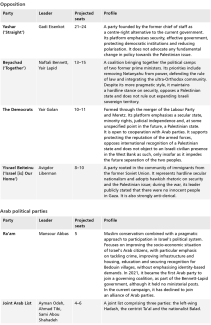
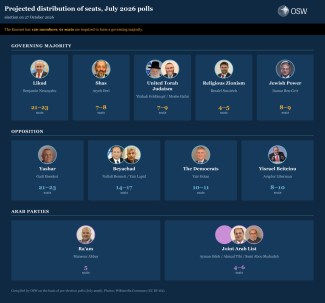
[1] T. Levinson, ‘IDF Reservist Dies by Suicide in Southern Israeli Forest, Marking Third Such Case in a Week’, Haaretz, 1 August 2026, haaretz.com.
[3] A situation in which neither side can secure a majority without Arab votes has characterised Israeli politics over the past decade, leading to five early elections between 2019 and 2022. The country’s main political forces made several attempts to overcome this problem: first through a grand coalition (2020–21, the Netanyahu-Gantz government), then by bringing one of the Arab parties into the governing coalition (2021–22, the Bennett-Lapid government) and finally, during the current term, by co-opting extremist parties (see Jewish Power). Only the last of these solutions has proved effective in the longer term.