


Catching the last train: Montenegro on the road to EU membership
Twenty years after declaring independence, Montenegro is the most advanced candidate currently in the EU accession process. Russia’s full-scale invasion of Ukraine has provided fresh impetus to EU enlargement, not only in the eastern neighbourhood but also in the Western Balkans. Since 2024, Montenegro’s accession negotiations have accelerated markedly. The country aims to conclude the talks in 2026 and join the EU by the end of 2028. Its accession would demonstrate that the EU’s enlargement policy has regained momentum and could help curb Russian and Chinese influence in the Western Balkans. However, the insufficient implementation of reforms, particularly in the area of the rule of law, disputes with Croatia and potential difficulties in securing the ratification of the accession treaty by EU member states could hinder this objective. There are also concerns over Belgrade’s influence, as Serbia seeks to preserve its longstanding leverage over Podgorica. In addition, the ongoing debate within the EU on alternative models of membership poses a risk for Montenegro, as it could lead to accession with limited competences.
Political momentum
Montenegro opened accession negotiations with the EU in 2012 but made little progress for over a decade. By 2024, it had provisionally closed only three of the 33 negotiating chapters. The slow pace reflected not only domestic shortcomings but also the reluctance of EU member states to pursue further enlargement. Croatia was the last country to join the European Union in 2013. Russia’s full-scale invasion of Ukraine marked a turning point, underscoring the role the EU could play in countering Moscow’s influence in Europe. The decision to grant candidate status to Ukraine and Moldova in 2022 also indirectly benefited the Western Balkans, where several countries had launched accession negotiations much earlier. Seeking to restore the credibility of the enlargement process, the EU adopted a more supportive approach towards their membership aspirations. At the same time, member states that have traditionally backed the region’s integration into the EU, including Austria, Italy, Croatia and Slovenia, stepped up their efforts within the EU institutions, for example through the ‘Friends of the Western Balkans’ coalition.
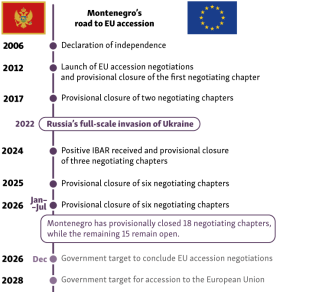
Montenegro has been the main beneficiary of the EU’s renewed focus on the region. The new momentum in enlargement coincided with greater political stability at home. After three years of political turbulence following the end of the Democratic Party of Socialists’ (DPS) nearly three decades in power, Milojko Spajić formed a government in Podgorica in 2023.[1] His cabinet made stepping up EU accession negotiations its top priority. A more active legislative agenda, combined with Brussels’ supportive stance, has since enabled Montenegro to provisionally close 15 negotiating chapters (see Figure: Milestones in Montenegro’s European integration). In 2024, Montenegro became the first current candidate country to receive a positive Interim Benchmark Assessment Report (IBAR), confirming that it had met the interim benchmarks in the fundamentals cluster, including the rule of law, judicial independence and combating corruption.[2] In April 2026, the Council of the EU decided to establish a dedicated working group to prepare Montenegro’s draft accession treaty. The EU’s readiness to admit the country is also reflected in its inclusion in the assumptions underpinning the 2028–2034 Multiannual Financial Framework.
Milestones in Montenegro’s European integration
Source: author’s own analysis.
The benefits of accelerated European integration…
The prospect of EU membership has partially helped to bridge divisions within Montenegro’s political elite. By prioritising the European agenda, Milojko Spajić’s ideologically diverse government has partially defused the ethnic tensions that have long dominated the country’s politics. The coalition is centred on the prime minister’s centrist Europe Now! Movement (Pokret Evropa sad! – PES), but also includes the traditionally anti-Western party representing the Serbian minority, alongside Albanian and Bosniak parties. Although they differ on many issues, all parliamentary parties officially support Montenegro’s accession to the EU. Many of the ‘blue flag laws’ required to close negotiating chapters have also been passed with opposition support.
Public support for EU membership remains high. In September 2025, 71% of Montenegrin citizens backed accession, seven percentage points fewer than a year earlier.[3] The decline may have reflected falling support for the government amid rising living costs. At the same time, the EU enjoys considerably higher levels of public trust in Montenegro than in many member states. It is trusted by 65% of citizens and viewed positively by 63%, compared with EU averages of 51% and 43% respectively.[4]
As Montenegro has progressed in its EU accession negotiations, its judiciary has become more active. The post-communist Democratic Party of Socialists (DPS), which governed the country from 1991 to 2020, was widely associated with organised crime, corruption, clientelism and the resulting capture of state institutions. At the same time, Montenegro maintained a Euro-Atlantic foreign policy course after the 2006 independence referendum and joined NATO in 2017. As a result, its Western partners were generally less inclined to respond robustly to the ruling party’s breaches of the rule of law. The DPS’s electoral defeat in 2020 created an opportunity for those responsible for numerous scandals to be held to account. Although the pace of prosecutions has fallen short of public expectations, the Special State Prosecutor’s Office (SDT) has launched numerous investigations into former DPS officials and their appointees. Some have resulted in convictions, albeit mostly at the first instance, including the sentencing of the president of the Supreme Court, who served from 2007 to 2020, to ten years’ imprisonment for participating in an organised criminal group. At the same time, many of the country’s highest-profile scandals remain unresolved, particularly those involving Milo Đukanović, who served several terms as both president and prime minister and who led the DPS until 2023.
…and its drawbacks
The rapid pace of legislative changes required for EU accession has drawn criticism from civil society. Critics argue that laws are often passed without adequate expert consultation, making the legislative process less transparent. In February 2026, for example, parliament passed 25 laws required to meet EU accession criteria in a single day, without the usual parliamentary debate. The government has also invoked the need to harmonise domestic legislation with EU law to justify politically contentious measures. One example is the amendment to the Law on the National Security Agency, which grants the intelligence services broad powers, including access to citizens’ personal data. Although the government argued that these changes were necessary to close Chapter 24 – a key chapter covering justice, freedom and security – the European Commission recommended amendments that will have to be adopted before the accession negotiations are concluded.
Many civil society organisations are concerned that Brussels may be overlooking shortcomings in the reform process in order to demonstrate its commitment to reviving enlargement policy.[5] After years of stagnation, Montenegro now has a credible prospect of EU membership. As a country with only 624,000 residents and the most advanced candidate in the accession process, it is widely regarded within the EU as the least problematic applicant.[6] Although the European Commission’s annual accession reports continue to identify shortcomings, these are often softened in the public messaging of EU officials, thus creating the impression that Montenegro’s progress has been largely unimpeded. Civil society organisations argue, for example, that the positive IBAR assessment reflected compliance with narrowly defined technical benchmarks in the field of the judiciary, combined with Brussels’ political will, but has so far failed to produce any significant improvement in the functioning of the justice system.[7]
Assessments by international organisations indicate that improvements in Montenegro’s democratic standards have been gradual. Freedom House continues to classify the country as ‘partly free’, with its score on the organisation’s 100-point scale slipping from 69 to 68 between 2024 and 2026. While Transparency International’s Corruption Perceptions Index has remained unchanged at 46 out of 100, this is still the highest score among the Western Balkan countries. The Bertelsmann Transformation Index, which assesses countries undergoing systemic transformation, recorded an improvement of 0.33 points in 2026, taking Montenegro’s score from 7.12 to 7.45 on a 10-point scale.[8] This placed the country ahead of several EU member states, including Bulgaria, Romania and Hungary, while it remained in the category of ‘defective democracies.’ The most favourable assessment comes from this year’s V-Dem Institute report, which classifies Montenegro as an ‘electoral democracy+’, alongside countries including the United States and the United Kingdom. It also identifies Montenegro as one of only two countries in the broadly defined Eastern European region where democratic standards are improving rather than declining.
Threats to accession: domestic factors…
The government’s target of concluding EU accession negotiations in 2026 may prove overly ambitious. With only under six months remaining before its self-imposed deadline, Montenegro still has to provisionally close half of the negotiating chapters. The European Commission’s main concerns relate to Chapters 23 and 24, which cover the rule of law. These chapters may be provisionally closed subject to post-accession monitoring mechanisms, to be lifted only once Montenegro has fully aligned its legislation with the EU acquis or met specific requirements.[9] The design of these mechanisms is likely to be determined by the working group responsible for drafting the accession treaty. According to media reports, they could include measures, such as reducing EU funding in the event of backsliding on the rule of law or temporarily restricting voting rights in EU institutions.
It may also prove difficult to close Chapter 27 (Environment and Climate Change). It is the most financially demanding chapter, with full implementation of EU requirements estimated to cost between €3-4 billion. Compliance will require substantial investment in infrastructure, including wastewater collectors, treatment plants and sewage networks. Concluding negotiations in this area in 2026 would therefore be driven more by political will than by actual progress. Here too, post-accession transitional arrangements are likely to be introduced, giving Montenegro additional time to meet specific requirements.[10]
The prospect of parliamentary elections, most likely to be held in June 2027, is also unlikely to make the accession negotiations are completed on time. As the vote approaches, political tensions are likely to intensify, and European integration may increasingly become a tool of domestic political competition. In protest against the adoption of the controversial law on the intelligence services, the DPS withdrew from key parliamentary committees. In July 2026, however, the government and part of the opposition, led by the DPS, reached an agreement on amendments to the legislation. They also agreed to adopt the constitutional amendments required to conclude the accession negotiations by a two-thirds majority; this requires the support of 54 of the 81 members of parliament, while the governing coalition controls only 47 seats. Even so, renewed political disputes cannot be ruled out and could undermine the cross-party cooperation that has characterised the accession process so far.
…EU factors…
Once all negotiating chapters have been provisionally closed, the next major hurdle will the ratification of Montenegro’s accession treaty by the EU member states. Depending on the country, ratification requires either a simple or a qualified parliamentary majority, while a nationwide referendum is generally optional. All EU member states officially support Montenegro’s accession, but their final decisions will also be shaped by domestic political considerations, particularly public opinion. Attitudes towards further enlargement remain divided across the European Union, with average support standing at 53%. Support is lowest in France (35%), Austria (38%), the Czech Republic (39%) and Germany (42%), and highest in Spain and Malta (71% each), Lithuania (70%) and Croatia (67%).[11] At the same time, Montenegro faces the lowest level of opposition among all EU candidate countries. On average, 38% of EU citizens oppose its accession, with the highest levels of scepticism recorded in Austria (55%), Italy (49%) and the Czech Republic (48%). Strongest support is found in Sweden (81%), Slovenia (70%) and Croatia and Denmark (68% each).[12]
France is likely to pose the greatest challenge to the ratification of Montenegro’s accession treaty. Paris has traditionally been sceptical of EU enlargement, as illustrated by its 2019 decision to block the opening of accession negotiations with Albania and North Macedonia while calling for a revision of the enlargement methodology. Although France softened its position following Russia’s full-scale invasion of Ukraine, in December 2025 it sought to veto the provisional closure of two of Montenegro’s negotiating chapters. This was ultimately averted through a diplomatic effort by Podgorica, supported by Germany.[13] In May 2026, President Emmanuel Macron pledged France’s full support for Montenegro’s EU membership. However, ratification of the accession treaty will still require either approval by a three-fifths majority in the French Parliament or endorsement in a nationwide referendum, although the latter remains highly unlikely.
France’s final position will also be influenced by the presidential election scheduled for April 2027. Until its outcome is known, the French Parliament is unlikely to approve the accession of a new EU member, as political parties will be reluctant to alienate their voters. Victory for a candidate from the far-right National Rally could also delay the enlargement process for a prolonged period, not only in Montenegro’s case.
Montenegro’s accession ambitions could also be affected by the ongoing debate over alternative models of EU membership. This discussion has been driven primarily by the question of Ukraine. Some member states favour its rapid accession, potentially as part of a future peace settlement with Russia, while Ukraine itself continues to press for swift membership. A full accession process, however, would take many years, prompting proposals for alternative paths to integration. One option under discussion would grant access to the single market and the four freedoms of the movement of goods, services, capital and people, while withholding veto rights in the EU’s foreign and security policy. The idea has been embraced by the leaders of those Western Balkan countries with little prospect of rapid accession, mainly because of rule of law concerns, including Serbian President Aleksandar Vučić and Albanian Prime Minister Edi Rama.[14] German Chancellor Friedrich Merz has proposed a different model, advocating associate membership for Ukraine and observer status for the Western Balkans. This concept was further developed in a Franco-German non-paper prepared ahead of the June EU–Western Balkans summit in Tivat, Montenegro. It envisages candidates gaining gradual access to the benefits of European integration, such as EU funding, roaming and the single market, in line with their progress in implementing reforms.[15]
Any redefinition of EU membership would also have implications for Montenegro. The most significant change could involve limiting voting rights in EU institutions, reflecting efforts to avoid a repeat of the ‘Hungarian scenario’. Under the unanimity rule governing the EU’s foreign and security policy, Viktor Orbán’s government was able to block sanctions against Russia and aid packages for Ukraine. Podgorica, however, is seeking full membership under the existing rules. It argues that its foreign policy has been fully aligned with the EU’s external positions for many years. However, given that it has no strong advocate within the European Union and wields limited political and economic weight, Montenegro has little influence over the debate. As a result, it may ultimately have to accept a form of membership without veto rights or with those rights subject to temporary restrictions.
…and regional factors
Serbia’s influence in Montenegro raises concerns that the EU could admit another potential ‘Trojan horse’. Belgrade has built an extensive network of influence in that country, including aligned political actors, a network of supportive media outlets and the institutions of the Serbian Orthodox Church. Through these channels, it can influence public opinion among part of the population, 33% of whom identify as Serb, thus undermining the government’s agenda.[16] Serbia also indirectly advances Russian interests in Montenegro. Media outlets aligned with Belgrade, along with senior clergy of the Serbian Orthodox Church, frequently echo Kremlin narratives, including those concerning the war in Ukraine.
Two parties represent the Serbian minority, one of which is part of Milojko Spajić’s governing coalition, remain an unpredictable element of Montenegro’s political landscape.[17] Officially, they support EU integration and have toned down their earlier anti-Western rhetoric, having previously opposed NATO membership. However, they continue to promote many of Belgrade’s narratives, including claims that the rights of Montenegro’s Serb community are under threat. If these parties were to join future governments and Montenegro subsequently became an EU member, they could potentially complicate decision-making within the European Union. Brussels may therefore seek to encourage the formation of governments without the participation of Serbian minority parties, either during the current parliamentary term or after the 2027 elections. At the same time, politicians with close ties to Belgrade can also be found in other governing parties, including the prime minister’s Europe Now! Movement (PES) and the centrist Democrats, who currently control the security ministries.
Belgrade may also seek to destabilise Montenegro before or after its accession for political reasons. For years, President Aleksandar Vučić has portrayed Serbia as the leader of the Western Balkans and argued that it should be the first country in the region to join the EU. However, his government has failed to implement the reforms required for accession, while democratic standards have continued to deteriorate. The resulting lack of progress towards EU membership has been attributed, not without some justification, to Brussels’ reluctance to pursue enlargement in the region. Montenegro’s tangible progress and credible membership perspective undermine this narrative and could further weaken support for Serbia’s political leadership, who have been facing mass anti-government protests since autumn 2024. Montenegro’s accession would also strengthen the role of EU institutions and member states in the country, reducing Belgrade’s ability to exert influence. Serbia, however, continues to view its south-eastern neighbour in paternalistic terms and seeks to preserve its leverage over both Montenegro’s political leadership and its society.
Montenegro’s dispute with Croatia could also delay the completion of the accession process. Since December 2024, Zagreb has opposed the provisional closure of Chapter 31 (Foreign, Security and Defence Policy) until Podgorica meets a number of specific demands.[18] This is another example in the Western Balkans (following the case of North Macedonia) of accession negotiations being used to address bilateral disputes. Croatia’s demands stem from tensions that emerged in 2024 over issues related to historical memory.[19] In addition to calling for the delimitation of the maritime border, Croatia is seeking the return of property dating back to the Yugoslav period, including a training sailing ship, as well as redress for victims of the Morinj camp, which operated during the wars of the 1990s. Most of these issues remain unresolved, and Podgorica has tended to downplay the significance of the dispute with Croatia. However, as accession draws closer, it may become more willing to make concessions.
Conclusions
Despite these challenges, Montenegro remains the undisputed frontrunner in the EU enlargement process. The acceleration of accession negotiations reflects not only Brussels’ renewed commitment to enlargement but also Podgorica’s genuine reform efforts. Although these reforms have so far served mainly to initiate improvements in democratic standards, and their implementation has at times lacked transparency, Montenegro continues to compare favourably with the other Western Balkan countries. This makes its accession a realistic prospect, provided it secures the approval of the EU member states. Even if membership is not achieved by the end of 2028, completion of the process by 2030 does appear likely. Any delay would probably reflect the electoral calendar in several member states in 2027, including France, Greece, Spain and Italy, where elections, combined with public scepticism towards enlargement, may discourage political leaders from taking key decisions related to accession.
Montenegro’s accession is also beneficial for the EU. Since 2022, Brussels has consistently declared its readiness to admit new members, with particular emphasis on Ukraine. However, the Western Balkans have often remained a secondary priority in statements by leading EU policymakers. This risks undermining the credibility of the EU’s renewed enlargement policy and could encourage countries in the region to turn away from the European path in favour of alternative partners. This trend is already visible in North Macedonia, which has been unable to open accession negotiations because of Bulgaria’s veto.[20] In recent years, this has prompted Skopje to increase its cooperation with Serbia, Viktor Orbán’s Hungary and, through them, with China.[21]
Montenegro’s accession would demonstrate that the EU’s enlargement policy has been genuinely revived and this would provide a strong incentive for reform across the rest of the Western Balkans. Over the longer term, the accession of the remaining countries in the region could help curb Russian influence, particularly in the fields of energy, disinformation and intelligence activities, as well as China’s growing role in the economic and intelligence domains.
Montenegro’s accession process is likely to serve as a test case for future EU enlargement. Although its accession treaty is expected to follow the model of Croatia’s 2011 treaty, statements by EU officials suggest that a new generation of safeguard clauses and transitional arrangements could be introduced. The debate already under way is likely to feed into a broader discussion about the future shape of the EU, with the solutions developed for Montenegro potentially serving as a model for the future accession of the remaining Western Balkan countries, and also Ukraine and Moldova.
Paradoxically, Montenegro’s prospects could also benefit from Iceland’s renewed interest in joining the EU. On 29 August 2026, Iceland is due to hold a nationwide referendum on whether to resume the accession negotiations it suspended in 2013. If the proposal is approved, negotiations are likely to progress relatively quickly, given the country’s high level of socio-economic development and the substantial part of the accession process it has already completed. A scenario in which Montenegro and Iceland join the EU simultaneously cannot therefore be ruled out. The accession of a well-established Nordic democracy could also lend greater legitimacy to Montenegro’s bid for full EU membership.
[1] Ł. Kobeszko, ‘Montenegro’s new government: the long-awaited stabilisation of the executive branch’, OSW, 6 November 2023, osw.waw.pl.
[2] Under the negotiation methodology adopted in 2020, a positive IBAR is a prerequisite for closing all negotiating chapters.
[3] Istraživanje – Političko javno mnjenje Crne Gore Septembar 2025, Centar za demokratiju i ljudska prava, 16 October 2025, cedem.me.
[4] Standard Eurobarometer 105 - Spring 2026, Eurostat, 11 May 2026, europa.eu.
[5] M. Bukovics, ‘Montenegro’s Rush to EU Accession Seen Containing Dangers’, Balkan Insight, 1 April 2026, balkaninsight.com.
[6] According to calculations by the Belgrade-based Centre for European Policies, Montenegro’s accession would cost the average EU citizen €0.27 per year during the first seven years of membership. See: S. Subotić, A. Milinković, Koliko me košta Zapadni Balkan?, Centar za evropske politike, November 2025, cep.org.rs.
[7] See I. Vukčević, State and development direction of the judiciary in Montenegro, Centre for Civic Education, 28 March 2026, cgo-cce.org.
[8] For the purposes of the study, the period from 1 February 2023 to 31 January 2025 was analysed.
[9] EU Enlargement Commissioner Marta Kos has indicated that Montenegro’s accession treaty will include monitoring mechanisms designed to safeguard democratic standards. See: ‘Montenegro Enters ‘Endgame’ to Join EU, But Must Face ‘Democratic Safeguards’’, Balkan Insight, 23 March 2026, balkaninsight.com.
[10] This could include, for example, the achievement of a specified recycling rate or the connection of a certain proportion of the population to the sewage network.
[11] Standard Eurobarometer 105 - Spring 2026, op. cit.
[12] EU citizens’ general view on EU enlargement, Special Eurobarometer 564, February–March 2025, europa.eu.
[13] France argued that Montenegro had not met the required benchmarks. The media in Montenegro speculated that Paris was considering a veto under pressure from Serbia.
[14] The call for a limited form of EU membership based on access to the single market and participation in the Schengen area was set out in a joint article by Rama and Vučić published in the Frankfurter Allgemeine Zeitung.
[15] ‘Franco-German non-paper call for new approach to EU enlargement’, European Western Balkans, 5 June 2026, europeanwesternbalkans.com.
[16] See J. Nowinowski, ‘The little ‘Big Brother’ is still watching. Montenegro’s response to Serbia’s influence’, OSW Commentary, no. 677, 1 July 2025, osw.waw.pl.
[17] Of the parties representing the Serbian minority, only New Serbian Democracy (NSD), led by Parliament Speaker Andrija Mandić, is currently part of the governing coalition. The other, the Democratic People’s Party (DNP), withdrew from the government in January 2026.
[18] P. Wankiewicz-Kłoczko, ‘Croatia sets conditions for Montenegro's accession to the EU’, OSW, 13 December 2024, osw.waw.pl.
[19] After the Montenegrin parliament adopted the UN resolution recognising the Srebrenica genocide, the parties representing the Serbian minority secured the passage of a similar domestic resolution on the Croatian Ustaše concentration camp at Jasenovac. In response, Zagreb declared three Montenegrin politicians, including the speaker of parliament and the deputy prime minister, personae non gratae.
[20] See J. Nowinowski, ‘Waiting for Godot: Prospects for resolving the Bulgaria-North Macedonia dispute’, OSW Commentary, no. 720, 26 March 2026, osw.waw.pl
[21] Idem, ‘North Macedonia: European integration at a crossroads’, OSW, 10 December 2025, osw.waw.pl.