High unemployment and labour shortages: paradoxes in Ukraine’s wartime labour market
Even before Russia’s full-scale invasion, the Ukrainian labour market lacked transparency due to the enormous shadow economy, involving as many as 3 million people and generating more than 30% of the country’s GDP. The war has acted as a catalyst for several important developments, including a significant rise in wages, particularly in both white-collar and blue-collar professions requiring specialist skills. Despite this, earnings remain far lower than those available in EU countries neighbouring Ukraine. A paradoxical situation has also emerged: although unemployment has reached double digits, businesses are finding it increasingly difficult to recruit staff. Employers now identify labour shortages as a more pressing issue than security concerns or disruptions to power and heating supplies. Fear of mobilisation appears to be the main reason for this situation. Many men subject to military service are unwilling to seek formal employment for fear that they could be conscripted into the armed forces. As long as the war continues, this trend is unlikely to change significantly.
Statistical and methodological challenges
Even before Russia’s invasion, it was difficult to obtain reliable statistics on Ukraine’s population and its regional distribution. The most recent census was conducted in 2001. In late 2019, an estimate based solely on mobile operator data indicated that 37.3 million people were residing in the country at the time. This figure differed significantly from the official data provided by the State Statistics Service of Ukraine (Ukrstat), according to which the population totalled 41.6 million. This discrepancy can only partly be explained by the fact that Ukrstat included residents of the occupied Donetsk and Luhansk oblasts, as population data for other regions also differed substantially. In every administrative unit except Kyiv city and Kyiv and Kharkiv oblasts, the population proved to be far lower than the official figures; in some cases, such as Ternopil and Zakarpattia oblasts, the discrepancy exceeded 25%. The outbreak of war, which triggered mass internal displacement and large-scale emigration, further complicated any assessment. Some estimates suggest that only 29 million people currently remain in the territory controlled by the government in Kyiv and that this number is steadily declining.[1]
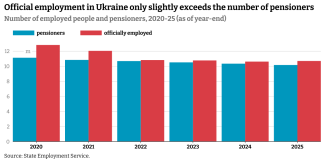
The lack of reliable data also extends to the labour market. The most recent detailed information on this subject published by Ukrstat dates from 2021. At that time, 15.6 million people were employed in Ukraine, including 15% who were self-employed. According to the State Employment Service, 12 million people paid social security contributions in the same year, indicating that more than 3.5 million were working in the shadow economy. Since the outbreak of the full-scale war, available data have covered only those officially employed. As of the end of 2025, this figure stood at 10.7 million, only slightly higher than the number of pensioners (10.2 million). Although the number of officially employed people has fallen by 1.3 million, it is difficult to determine conclusively whether this trend has also affected those working ‘off the books’. The government’s Employment Strategy 2030, adopted in January 2026, suggests that around 3 million people are working in the shadow economy.
Employment structure: the prominent role of the public sector
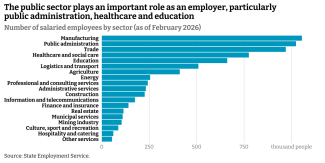
The State Employment Service publishes data on the sectoral distribution of salaried employees, amounting to 7.2 million people. However, these figures do not present a complete picture of the labour market, as they exclude the self-employed, members of the Ukrainian Defence Forces (comprising the Armed Forces, the National Guard and the State Border Guard Service, with an estimated combined strength of 1 million) and, for obvious reasons, those not officially employed. Although the manufacturing sector employs the largest number of workers, the public sector – particularly public administration, education and healthcare – accounts for a substantial share of total employment. At the same time, it is reasonable to assume that, in a number of sectors, the actual number of workers is far higher than official statistics indicate, given the widespread practice of ’off-the-books’ employment. In 2021, estimates suggested that this problem was most prevalent in agriculture, where as many as 45% of workers were believed to be employed informally, followed by construction (17%) and retail trade (16%).[2] In reality, however, this proportion may be even higher.
The structure of formal employment differs significantly across regions. In poorer and frontline oblasts, the public sector, particularly state administration, plays a much larger role as an employer, primarily due to the scarcity of alternative employment opportunities. Public administration accounts for 36% of employment in Donetsk Oblast and 32% in Kherson Oblast. By contrast, in Kyiv – although the city hosts central government institutions – the figure stands at only 7.5%. A similar pattern can be observed in education and healthcare.
Comprehensive data on formal employment across the regions for the entire period since the outbreak of the war are unavailable. However, the available figures indicate that between October 2023 and February 2026 the number of salaried employees fell in all oblasts except Kyiv, where it increased marginally by 1.7%. The steepest declines were recorded in frontline regions such as Donetsk (-47%), Kherson (-31.6%) and Zaporizhzhia (-24%) oblasts. However, the trend was also evident in western Ukraine, which lies far from the front line and is targeted less frequently than the eastern and central regions of the country: in Lviv Oblast, formal employment fell by 5.5%, in Ternopil Oblast by 14%, and in Ivano-Frankivsk Oblast by 16.7%.
Wages have risen, but remain very low
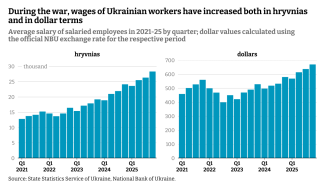
Ukrstat publishes wage statistics, but these should be treated with caution, as they cover only officially declared earnings and exclude the smallest companies, which often employ workers without formal contracts. Moreover, so-called ‘tax optimisation’ is widespread in Ukraine, particularly among small and medium-sized enterprises. This practice involves formally employing workers at the minimum wage while paying the remainder of their earnings unofficially – ‘in envelopes’. According to a survey by the Razumkov Centre, 12.6% of employees received such ‘supplements’ in 2024.[3] As a result, assessing the actual level of earnings, particularly in the non-public sector, remains difficult. Official data indicate that average gross wages almost doubled between the first quarter of 2022 and the fourth quarter of 2025, soaring from 14,600 to 28,300 hryvnias. This substantial increase was partly driven by high inflation,[4] but wages also rose in US dollar terms, from $500 in the first quarter of 2022 to $670 in the fourth quarter of 2025.
However, despite the wage growth recorded in recent years, pay levels in Ukraine remain far below those in neighbouring EU countries. In early 2026, the average wage in Ukraine was half the level of Poland’s statutory minimum wage and was nearly four times lower than the average wage in Poland.
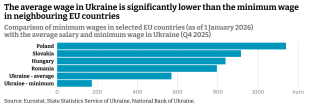
From a regional perspective, Kyiv clearly stands apart, with the average monthly salary reaching nearly 40,000 hryvnias (approximately €800). Earnings in other oblasts were significantly lower, ranging from 18,600 hryvnias in Chernivtsi Oblast to 27,000 hryvnias in Dnipropetrovsk Oblast.
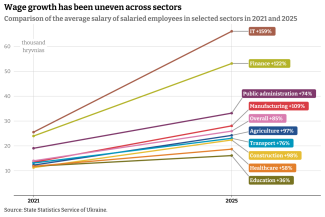
Wage growth between 2021 and 2025 was uneven across different sectors of the economy. The largest increases were recorded in highly specialised sectors such as IT (159%) and finance and banking (122%). Wages also doubled in labour-intensive sectors such as construction and agriculture, although the substantial level of informal activity in these sectors may distort assessments of actual earnings. The education sector recorded the weakest wage growth, with salaries rising by only 36%. However, once inflation is taken into account, real wages in the sector effectively declined compared with the pre-war period.
Paradoxes of unemployment in Ukraine
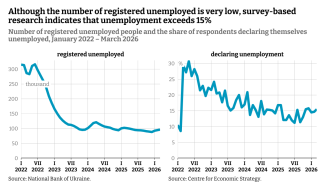
The number of officially registered unemployed people in Ukraine is low: according to data from the National Bank of Ukraine, it stood at only 96,000 in March 2026. This largely stems from the low level of unemployment benefits, which range from 3,900 to 8,650 hryvnias (approximately €80–170) and are paid for only 90 days from the date of registration. Once this period expires, an unemployed person usually loses any incentive to maintain official status, as doing so requires regular visits to the employment office while offering no tangible benefits, particularly given that access to healthcare remains free of charge. However, survey data indicate that the unemployment rate remains high: in March 2026, it stood at 15.5%, higher than for most of 2025, although significantly lower than immediately after the outbreak of the war, when it exceeded 30%.[5] These survey findings broadly correspond to unemployment figures contained in the government’s Employment Strategy 2030, according to which the unemployment rate reached 11.3% in October 2025. Detailed data on regional disparities are unavailable, but the problem most likely affects smaller towns and rural areas, while having a much more limited impact on large cities such as Kyiv and Lviv.
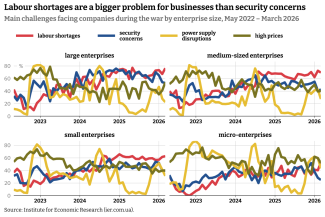
The situation looks completely different from the perspective of employers. Regular surveys among business representatives conducted by the Kyiv-based Institute for Economic Research show that labour shortages became the main challenge for companies in the second half of 2024 and that the problem has continued to intensify since then. By March 2026, 67% of enterprises reported experiencing labour shortages, significantly exceeding the share citing workplace security concerns (42%) or power and heating outages (30%).
The extent of difficulties in recruiting workers varies according to company size. Large firms reported the problem most frequently (76%), followed by medium-sized and small enterprises (70% and 63% respectively). Only micro-enterprises, employing up to 10 people, viewed staff shortages as a less serious challenge, most likely because they are able to rely more easily on informal employment.
Mobilisation as a labour-market challenge
Fear of mobilisation appears to be the main cause of labour shortages. Under current regulations, an employer who hires a man subject to military registration is required to notify the relevant military recruitment office. This naturally increases the likelihood that the individual will be called up for military service, unless they are entitled to a statutory exemption, for example because they are raising at least three minor children or caring for a person with a disability.
In order to retain key personnel, the government introduced a complex system of military service deferments for employees of critically important enterprises, allowing them to exempt up to 50% (in some cases 100%) of staff liable for military service.[6] The scheme, which covered 1.3 million people in 2025,[7] remains controversial in Ukraine. On the one hand, it helps protect essential specialists from military service. On the other, it has led to numerous abuses, with state-owned and municipal enterprises employing fictitious workers.[8] At the same time, according to Defence Minister Mykhailo Fedorov, military recruitment offices are seeking as many as 2 million people, thereby preventing them from taking up formal employment.[9] It is also difficult to estimate how many people, fearing detention by military recruitment patrols, are unwilling to seek employment – whether formally or in the shadow economy – if it involves regular travel or working outdoors.
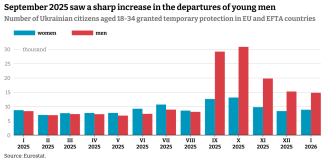
A government decree issued in August 2025 allowing men aged 18–22 to leave the country during martial law also created additional challenges for the labour market. The measure was intended to reduce the practice of sending sons abroad – often for wholly or partly fictitious studies – shortly before they turned 18. It was also likely aimed at improving the government’s image among the youngest generation, which only a month earlier had actively participated in protests against efforts to undermine the independence of the National Anti-Corruption Bureau.[10] As a result, large numbers of young men left Ukraine in September and October 2025. The government avoided providing information on this matter, but some estimates suggest that 78,000 men in this age group left the country during the first three months after the ban was lifted.[11] Eurostat data on Ukrainians granted temporary protection also indicate that nearly 80,000 additional young men departed between September 2025 and February 2026 compared with the January–August 2025 period. The actual figure is likely to be even higher, given that some legalised their stay through means other than temporary protection. It is worth noting that men under the age of 25 represent a particularly important segment of the labour market. Although they are not subject to mobilisation, they remain liable for military service and can therefore be counted among the 50% of a company’s workforce not covered by military service deferments, a factor that had previously helped ensure stable business operations.
Outlook
As long as the hostilities continue, the situation on the Ukrainian labour market is unlikely to improve, particularly with regard to labour shortages. Only a radical change in the rules governing mobilisation and military service deferments for employees could alter the situation. However, conditions are likely to improve significantly once the war ends. First and foremost, a large share of the roughly one million troops currently serving in the armed forces will be demobilised and able to return to the labour market, providing several hundred thousand additional workers, including technical specialists. In addition, many of those who have so far avoided mobilisation will ‘emerge from the shadows’. Furthermore, a certain number of refugees will undoubtedly return, although the scale of this movement is difficult to predict, as the number of those expressing such intentions has steadily declined as the war drags on.
The government is currently preparing a reintegration strategy that envisages the return of up to 2 million people.[12] At the same time, however, many men who were unable to join their families abroad during martial law for various reasons are likely to leave the country. The key factors determining whether individuals choose to return to their homeland or to emigrate will include the terms of any peace agreement or ceasefire, the country’s economic situation and the prospects for reconstruction in the years ahead. In the short term, however, Ukraine is unlikely to reverse its severe demographic decline, which could deepen further if a significant proportion of young people currently living abroad do not return to the country. Of the 4.3 million Ukrainians covered by temporary protection in the EU, 1.3 million are under the age of 18. In 2025, 169,000 children were born in Ukraine, compared with 485,000 deaths. The downward trend in births has continued for years, and the war has only intensified it. This inevitably means that fewer people will enter the Ukrainian labour market with each passing year.
[1] В. Мерещук, ‘Елла Лібанова: «За рік населення України зменшилося на мільйон»’, LB.ua, 25 April 2026.
[2] ‘Фактично кожен п’ятий працівник в Україні є неформально зайнятим та соціально незахищеним’, Головне управління ДПС в Івано-Франківській області, 7 July 2021, if.tax.gov.ua.
[3] ‘Трудові ресурси для повоєнного відновлення України (червень 2024р.)’, Разумков Центр, 7 August 2024, razumkow.org.ua.
[4] According to the National Bank of Ukraine, inflation stood at 26.6% in 2022, 5.1% in 2023, 12% in 2024 and 8% in 2025.
[5] М. Самойлюк, ‘Трекер економіки України під час війни’, Центр економічної стратегіі, ces.org.ua.
[6] S. Matuszak, P. Żochowski, ‘The Gordian knot of mobilisation: Ukraine balancing the needs of the military and business’, OSW Commentary, no. 632, 20 November 2024, osw.waw.pl.
[7] І. Лисогор, ‘Протягом року в Україні зросла кількість заброньованих’, LB.ua, 29 January 2026.
[8] ‘Бронювання на продаж: як держпідприємства стали ринком відстрочок’, Економічна правда, 22 April 2026, epravda.com.ua.
[9] K. Nieczypor, ‘Ukraine’s mobilisation crisis: a new minister, old challenges’, OSW, 3 April 2026, osw.waw.pl.
[10] M. Jędrysiak, ‘Ukraine: Verkhovna Rada restores independence of anti-corruption bodies’, OSW, 31 July 2025, osw.waw.pl.
[11] К. Родак, ‘Сотні тисяч, але не мільйони. Скільки чоловіків покинули Україну під час повномасштабної війни’, NGL.media, 16 January 2026.
[12] Л. Голуб, ‘Україна готується до повернення мільйонів громадян: уряд розробляє стратегію реінтеграції’, Главком, 24 April 2026, glavcom.ua.