Waiting for Godot: Prospects for resolving the Bulgaria–North Macedonia dispute
Since 2020, Bulgaria has blocked the start of EU accession negotiations with North Macedonia, arguing that Skopje has failed to implement certain provisions of bilateral agreements. Previously, other member states had taken similar steps. Greece’s long-standing veto ended in 2018 with the signing of the Prespa Agreement, which led to the country being renamed North Macedonia.[1] This, in turn, enabled the country to join NATO two years later. Although Athens lifted its blockade, the planned start of EU negotiations in 2019 was delayed by France, which questioned the methodology used to assess reforms in candidate countries.
Efforts to overcome Bulgarian opposition have so far proved unsuccessful. A decision adopted in 2022, with the support of Western partners, has yet to be implemented. North Macedonia refuses to meet its key requirement – to include the Bulgarian minority in its constitution – which is a condition for opening EU accession negotiations. Skopje fears that such a concession would merely prompt further demands from Sofia. The deadlock, now lasting more than five years, has adversely affected political relations and public sentiment. The chances of resolving the dispute without the involvement of external actors appear slim. Launching accession talks is in the EU’s interest, and overcoming the Bulgaria–North Macedonia conflict will be a test of the effectiveness of EU enlargement policy.
Background to the dispute
Bulgaria’s veto stems from its interpretation of the past, which differs significantly from the Macedonian perspective. Although Sofia has supported the independence and Euro-Atlantic course of its western neighbour since the fall of communism, it has at the same time contested its cultural, linguistic and historical distinctiveness. Many Bulgarians, including politicians, regard Macedonian identity as an artificial construct – a product of communist Yugoslav propaganda, which after the Second World War served to eradicate pre-existing Bulgarian influence in the territory. They therefore contend that Macedonian statehood rests on Bulgarian nation-building foundations, but that Macedonian elites remain unwilling to acknowledge this.
Macedonians, in turn, seek to emphasise their distinct identity. Given the relatively short tradition of their own statehood, they often lay claim to the heritage of peoples who have inhabited the territory of present-day North Macedonia over the centuries – Bulgarians, Greeks and, to a lesser extent, Serbs. This has led to disputes over historical policy. They also differ significantly from their eastern neighbours in their interpretation of the 1941–1944 period, when Tsarist Bulgaria, allied with Nazi Germany, occupied most of the areas now controlled by Skopje, contributing, among other things, to the extermination of the local Jewish population. Sofia opposes describing these actions as an occupation and seeks to remove negative portrayals of its policies at the time from Macedonian school textbooks, museums and memorial sites.
Agreements and problems with their implementation
The first attempt to regulate disputed issues between Bulgaria and North Macedonia was the Treaty on Friendship, Good Neighbourliness and Cooperation, signed in 2017 by the then prime ministers, Boyko Borissov and Zoran Zaev. Both parties committed, among other things, to “combating propaganda directed against each other”, refraining from interference in each other’s internal affairs and establishing a joint expert commission on historical and educational issues.[2] Initially, the treaty led to a revival of political and cultural relations. However, it did not explicitly confirm the distinctiveness of Macedonian identity or language, thereby leaving scope for Sofia to formulate further demands in subsequent years. The expert commission, operating under pressure from political decision-makers, has failed to develop comprehensive recommendations for the education system. It has held 38 meetings to date; however, for some time its work has been largely superficial and confined to the signing of protocols. Although historians have drawn up joint suggestions regarding curricula on ancient and early medieval history, they have been unable to progress further due to differing interpretations of the legacy of the Archbishopric of Ohrid, established in the eleventh century.[3]
The 2022 agreement, signed with the support of France during its presidency of the Council of the EU, was intended to bring an end to bilateral disputes. The proposal accepted by both sides was intended to lift Bulgaria’s veto on the commencement of EU accession negotiations with North Macedonia. Sofia made this conditional upon listing Bulgarians among the national minorities in the preamble to the constitution.[4] At the same time, a protocol was adopted, the implementation of which will determine the success of North Macedonia’s European integration. Bulgaria secured provisions linking its neighbour’s progress in negotiations to advances in the work of the historical commission, granting Skopje access to state archives (although these were already open), and countering ‘hate speech’ directed against Bulgarians. However, no clear methods were outlined for assessing the degree of implementation of these commitments. This creates scope for arbitrary interpretation, thereby raising concerns in North Macedonia that Bulgaria may put forward further objections.
The Social Democratic Union of Macedonia (SDSM), which was in power in 2022, accepted the ‘French proposal’ but failed to secure the required two-thirds majority in parliament needed to amend the constitution accordingly. Moreover, in 2024 it lost power to the right-wing Internal Macedonian Revolutionary Organisation – Democratic Party for Macedonian National Unity (VMRO–DPMNE), which owed its electoral success in part to its strong criticism of agreements concluded with neighbouring states. The incumbent government, led by Hristijan Mickoski, is reluctant to fulfil the requirements concerning the Bulgarian minority. At the same time, owing to the principle of unanimity in EU enlargement policy, Sofia is able to effectively block Skopje’s accession.
Perception of the dispute in both countries
Approaches to the ‘Macedonian question’ are largely the subject of consensus across the Bulgarian political landscape. All major parties expect Skopje to amend the constitution and oppose any renegotiating of the 2022 arrangements. This is evidenced by a unanimously adopted parliamentary resolution in May 2025. The main political forces formally declare that they have no additional claims towards their neighbour, however, they remain reluctant to undertake confidence-building measures in relations with North Macedonia, partly due to pressure,[5] from radical groups. The strongest of these, Revival, openly claims that it is a ‘second Bulgarian state’ that should ultimately be unified. Such rhetoric naturally increases mistrust on the other side.
In North Macedonia’s public debate, relations with its neighbour are a source of deep political polarisation. VMRO–DPMNE portrays the Social Democrats, now the largest opposition party, as chiefly responsible for the current situation, arguing that they yielded to Bulgarian pressure in 2017 and 2022. The right has also openly criticised the work of the Macedonian members of the joint historical commission. After coming to power, Mickoski’s government replaced its members, accusing previous experts of failing to adequately defend national interests, while the far-left Levica has called for its dissolution. The SDSM, in turn, accuses VMRO–DPMNE of deliberately impeding North Macedonia’s EU accession efforts. Parties representing the Albanian minority, which hold approximately 25% of parliamentary seats, distance themselves from the dispute with Bulgaria. They support an unconditional Euro-Atlantic trajectory and are therefore willing to introduce constitutional amendments.
Problematic minorities
In recent years, the treatment of national minorities in both countries has become a source of tension. According to the 2021 census, approximately 3,500 Bulgarians reside in North Macedonia, accounting for just 0.2% of the population. Macedonians argue that this number is too small to justify their inclusion in the preamble to the constitution as a constituent people. Moreover, such a provision would effectively mean that Skopje accepts Sofia’s narrative regarding the Bulgarian foundations of contemporary Macedonian identity. At the same time, Macedonians in Bulgaria, numbering around 1,100 people or 0.02% of the population, are not recognised as a national minority. This prevents them from establishing associations or engaging in organised cultural activities. On this basis, the European Court of Human Rights has repeatedly found that Bulgaria has violated international conventions, however, its recommendations have not been implemented. Mickoski’s government regards their implementation by Sofia as one of the conditions for introducing constitutional amendments.
Sofia does not classify people of Bulgarian origin living beyond its western border as a national minority; instead, it refers to them as “citizens of North Macedonia with Bulgarian self-awareness”. This framing suggests that their actual number may be higher than indicated by census data. These communities receive financial support from the Bulgarian government, as do Bulgarian organisations in Albania, Kosovo, Moldova, Serbia and Ukraine. Funding has increased in recent years, rising from 0.5 million leva (approximately €256,000) in 2020 to 2.1 million leva (approximately €1.1 million) in 2024, with the draft budget for the next four years projecting a further increase to €2.5 million by 2029.[6] Ethnic Bulgarians living in North Macedonia are treated as a priority group, receiving 34% of the allocated funds in 2024,[7] despite being the second smallest community covered by the programme,[8] North Macedonia is also among the largest beneficiaries of Bulgaria’s official development assistance.[9]
Against the backdrop of political and identity tensions, it may appear paradoxical that Macedonians apply for Bulgarian passports; however, their primary motivation is pragmatic: access to EU citizenship and its associated benefits, particularly the right to work in other member states. According to Bulgaria’s interior minister, more than 216,000 passports have been issued to citizens of North Macedonia since 2007, when Bulgaria joined the EU[10] – a figure equivalent to nearly 12% of the country’s current population. The process is facilitated by simplified procedures and the relative ease with which applicants are able to demonstrate Bulgarian ancestry. Although most applicants are likely motivated by practical considerations, this ‘passport paradox’ fuels identity debates and indirectly strengthens Sofia’s position, as it uses these figures to argue that Skopje underreports the number of ethnic Bulgarians in the country.
Impact of the dispute on political and economic relations
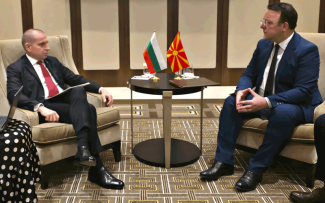
In the context of ongoing disputes, bilateral political relations have weakened in recent years. Prime Minister Mickoski has thus far met his Bulgarian counterpart only once. Efforts to open dialogue have been led by Macedonian President Gordana Siljanovska-Davkova, who was elected in 2024 with the backing of VMRO-DPMNE. She has adopted a more moderate approach, while also highlighting the asymmetrical nature of agreements with the eastern neighbour. Her meetings with President Rumen Radev and Prime Minister Rosen Zhelyazkov, who are no longer in office, took place on the margins of international summits and have not produced concrete results. They have led only to routine statements calling for de-escalation and to Bulgarian declarations that no further demands will be made.
Economic cooperation between the two countries has developed steadily; however, it remains constrained by political tensions and inadequate infrastructure. Since 2022, bilateral trade has consistently exceeded €1 billion, reaching €1.1 billion in 2024,[11] with Sofia now ranking as Skopje’s third-largest import partner.[12] However, further growth is limited, among other factors, by underdeveloped cross-border transport links. There is no direct air connection between the two capitals and, despite being only 175 km apart, they also lack a railway link, as well as a direct motorway or expressway.
Most progress in connectivity has taken place within broader international projects, likely influenced in part by external pressure. A key example is Pan-European Corridor VIII, which aims to connect Bulgaria’s Black Sea coast, including the ports of Burgas and Varna, with the Adriatic port of Durrës in Albania via North Macedonia. The expansion of road and rail networks along this route is strategically important not only for economic development but also for NATO military mobility. After years of deadlock, Sofia and Skopje reached an agreement in November 2025 to jointly construct a cross-border railway tunnel; both sides also committed to completing their respective rail sections in order to restore regular train services between the two capitals by 2030, following a hiatus of more than 80 years.
Consequences of the deadlock
Bilateral disputes with neighbouring countries, which have led to a freeze in North Macedonia’s EU integration process, have negatively affected perceptions of EU membership among the North Macedonian public. In 2014, 80% of citizens supported accession; however, this figure declined steadily in the following years, reaching a low of 60% in 2023 before recovering to 71% in 2025. At the same time, the proportion of respondents who consider membership ‘somewhat unimportant’ or ‘not important at all’ has increased from 15% in 2014 to 27%.[13] Despite this shift, EU integration remains the principal foreign policy priority for most respondents.[14]
Mickoski’s government formally maintains its objective of joining the EU, but has thus far failed to implement the required reforms in areas such as the rule of law and to intensify efforts to combat corruption. It has also expanded cooperation with Hungary and, outside the EU, with Serbia, particularly in the fields of the economy, infrastructure and energy. The leaders of these countries openly challenge a number of EU policies, and there are indications that closer ties with Budapest and Belgrade may also reflect China’s interests. At the same time, the government has sought to strengthen relations with the Trump administration.[15]
Political disputes are increasingly reflected in mutual hostility between the two societies. Despite close linguistic and cultural ties, as many as 78% of surveyed Macedonians view Bulgaria negatively, and 26% perceive it as the greatest threat to their country – the highest figures among all states included in the survey.[16] In recent years, the most extreme manifestations of this hostility have included physical attacks on members of the Bulgarian minority, as well as acts of vandalism against their cultural associations. These institutions often bear the names of historical figures whose legacies are interpreted very differently in the two countries, such as Tsar Boris III or Ivan Mihailov.[17] Macedonians argue that such choices are provocative, and some clubs have consequently been banned. Bulgarian media report extensively on each incident, while politicians use them to criticise the authorities in Skopje and present themselves as defenders of persecuted compatriots. This dynamic may also encourage increased financial support for these organisations and reinforce social prejudice. In Bulgaria, support for North Macedonia’s EU accession is the lowest in the EU, with 32% in favour and 58% opposed.[18]
The Bulgarian–Macedonian impasse, now in its sixth year, also undermines the EU’s image and its enlargement policy in the Western Balkans. The 2022 agreement, brokered under French auspices, not only failed to unblock Skopje’s integration but also incorporated bilateral issues directly into the negotiation process, thereby creating a potentially problematic precedent. This runs counter to EU declarations that accession depends on the fulfilment of clearly defined treaty-based criteria. North Macedonia was granted EU candidate status as early as 2005 and, alongside Croatia, was then the most advanced country in the region in this process. Greece’s veto at the time prevented further progress, while Zagreb went on to join the EU in 2013. According to the European Commission’s annual reports, only Montenegro and, to a lesser extent, Serbia are currently better prepared for membership than North Macedonia. Despite five years of Bulgarian obstruction, it continues to demonstrate a higher level of readiness than, for example, Albania, whose accession EU representatives expect in 2029 or 2030. Tirana has, in fact, benefited from the 2024 decision by member states to decouple its integration process from that of Skopje. Since then, it has succeeded in opening all six negotiation clusters.
Attempts to overcome the deadlock
Despite its polarising rhetoric, Mickoski’s government declares its willingness to introduce the required constitutional amendments, provided that Bulgaria refrains from making further demands. Distrusting assurances from decision-makers in Sofia, Skopje seeks an EU guarantee that amending the constitution would constitute the final condition prior to the opening of accession negotiations. These concerns appear justified, as Bulgaria retains the ability to impose further blockages on the basis of the provisions of the 2022 protocol. The credibility of Sofia’s declarations is further undermined by repeated instances of politicians publicly questioning the distinctiveness of Macedonian identity and language. In 2025, Bulgarian Members of the European Parliament, including those representing the then government coalition, succeeded in removing references to the Macedonian language and identity from the European Parliament’s annual report on Skopje’s progress in European integration. Earlier, they had proposed adding the qualifier ‘modern’ before these terms, thereby implying that Macedonian identity in the past was effectively synonymous with Bulgarian identity. Skopje’s calls for EU guarantees therefore appear rational; however, it remains unclear how such guarantees would function or what mechanisms Brussels could employ to enforce them.
The Macedonian government has sought to organise talks with Bulgaria involving representatives of EU member states, EU institutions, or the United States. Efforts to arrange such mediation, including on the margins of the NATO summit in The Hague in 2025, have thus far proved unsuccessful. The prime minister has announced plans to intensify these efforts in 2026 in order to lift the veto with the involvement of external actors; however, increased diplomatic activity has so far produced no tangible results. Skopje’s negotiating position is also weakened by the foreign policy of Mickoski’s government, which relies on cooperation with Europe’s enfants terribles – Hungary and Serbia.
Bulgaria remains focused on enforcing the 2022 agreement, which is favourable to it, and shows no willingness to renegotiate it. Prospects for compromise are further limited by ongoing political instability since 2021, characterised by frequent changes of government and an almost continuous electoral cycle. Another parliamentary election, the eighth within five years, took place in April 2026. Amid domestic challenges, foreign policy has taken a back seat. The current situation also allows Bulgaria to shift responsibility for the impasse onto North Macedonia, accusing it of lacking the political will to adopt the required constitutional amendments.
The EU is likewise reluctant to revise its approach or amend the 2022 ‘French proposal’. Representatives of EU institutions visiting North Macedonia have consistently stated that the failure to implement the constitutional amendments is the sole obstacle to opening accession negotiations. European Commission President Ursula von der Leyen has stated clearly that “the ball is in the Macedonian court”, thereby reinforcing the Bulgarian narrative and placing responsibility for the deadlock on Skopje alone. While European Council President António Costa and EU Commissioner for Enlargement Marta Kos have shown greater understanding of Macedonian concerns, they have also stressed the need to include Bulgarians in the constitution.
Resolving the Bulgarian–Macedonian dispute at the bilateral level, without external mediation, appears highly unlikely. Both sides remain firmly entrenched in their positions: Sofia expects full compliance with the agreed conditions, which are favourable to Bulgaria, while Skopje is reluctant to make further symbolic concessions. The political balance in both countries also works against a compromise. In North Macedonia, the more compromise-oriented Social Democrats are no longer in power, while in Bulgaria the reformers who led earlier bilateral negotiations are now in opposition. Meetings between representatives of the two states have yielded only limited progress, primarily in the area of joint infrastructure projects. The unfavourable political climate has also affected the historical commission, whose work has stalled. Proposals by international experts to place it under the auspices of UNESCO or to draw on the experience of similar Polish–German or Franco–German bodies have not been taken forward. The impasse, now lasting more than five years, has also strained societal relations and weakened confidence in EU integration within North Macedonia.
The only realistic prospect for Skopje to open accession negotiations lies in the involvement of external actors. A mediating role could again be played by an EU member state trusted by political elites in both countries. For other candidate states, North Macedonia’s dispute with Bulgaria serves as a warning against the formal bilateralisation of the negotiation framework.[19] Continued delays in opening accession talks may prompt Skopje to deepen cooperation with other partners, such as China, and, at the regional level, with Serbia, which pursues a multi-vector foreign policy. At the same time, it may show interest in ideas discussed in Brussels, such as forms of EU membership without veto rights or arrangements limited to access to the single market and the Schengen area. Although Ukraine would be the principal beneficiary of such arrangements, particularly following a potential peace settlement with Russia, some Western Balkan states without a near-term accession perspective, including North Macedonia, Serbia and, to a lesser extent, Albania, could also benefit indirectly. It remains unclear whether even this form of membership would require Skopje to amend its constitution.
[1] See M. Szpala, ‘A Greek-Macedonian compromise. Chances for ending the dispute’, OSW, 13 June 2018, osw.waw.pl.
[2] See M. Seroka, ‘Nowy rozdział w stosunkach macedońsko-bułgarskich’, OSW, 9 August 2017, osw.waw.pl.
[3] The Macedonian Orthodox Church – the Archbishopric of Ohrid – was recognised as canonical by the Patriarch of Constantinople only in 2022. In the same year, the Serbian Orthodox Church granted it autocephaly.
[4] See Ł. Kobeszko, M. Szpala, ‘Krucha ugoda Macedonii Północnej z Bułgarią’, OSW, 22 July 2022, osw.waw.pl.
[5] See J. Nowinowski, ‘A nationalist voice of protest: the resurgence of radical parties in Bulgaria’, OSW Commentary, no. 683, 27 August 2025, osw.waw.pl.
[6] За подкрепа на организации на български общности от Република Албания, Република Сърбия, Република Косово, Украйна и Република Молдова и на граждани от Република Северна Македония с българско самосъзнание, Council of Ministers of the Republic of Bulgaria, 30 October 2025, pris.government.bg.
[7] The support stood at 711,000 leva (approximately €363,000) – Относно средства за подкрепа на българската общност в чужбина, National Assembly of the Republic of Bulgaria, 13 June 2025, parliament.bg.
[8] The largest Bulgarian communities abroad are likely to be found in Ukraine (205,000 according to the 2001 census) and Moldova (38,000 according to the 2024 register).
[9] Republic of North Macedonia, information from the Ministry of Foreign Affairs of the Republic of Bulgaria, mfa.bg.
[10] ‘Митов отчете над 216 хиляди македонци с български паспорти’, Vesti, 24 June 2025, vesti.bg.
[11] Data from the National Statistical Institute of the Republic of Bulgaria – nsi.bg.
[12] Data from the State Statistical Office of North Macedonia – stat.mk.
[13] I. Damjanovski, Analysis of public opinion on North Macedonia’s accession to the European Union (2014–2025), Institute for Democracy “Societas Civilis” – Skopje, 20 January 2026, idscs.org.mk.
[14] A. Velinovska, A. Sofeska, EU Integration in 2024: From European dream to Macedonian reality, Public Opinion Analysis Paper No. 2/2025, 10 February 2025, idscs.org.mk.
[15] J. Nowinowski, ‘North Macedonia: European integration at a crossroads’, OSW, 10 December 2025, osw.waw.pl.
[16] Western Balkans Regional Poll | May–July 2025, International Republican Institute, 11 September 2025, iri.org.
[17] During the reign of Boris III, Bulgaria began its occupation of most of the territory of present-day North Macedonia in 1941. Mihailov, for his part, was a twentieth-century activist advocating an independent Macedonia, albeit one conceived as a state with a Bulgarian national character.
[18] Among candidate countries, only Ukraine recorded a lower result in Bulgaria (31% in favour, 59% against). See EU citizens’ general view on EU enlargement, Special Eurobarometer 564, February–March 2025, europa.eu.
[19] Bilateral disputes also arise in the context of the potential accession of Montenegro and Ukraine. See P. Wankiewicz-Kłoczko, Ł. Kobeszko, ‘Croatia sets condition for Montenegro’s accession to the EU’, OSW, 13 December 2024; I. Gizińska, A. Sadecki, K. Sienicki, ‘Hungary hardens its stance on Ukraine’, OSW, 28 March 2025, osw.waw.pl.