A grim reality and a brighter future: Ukrainian public sentiment in the fifth year of the war
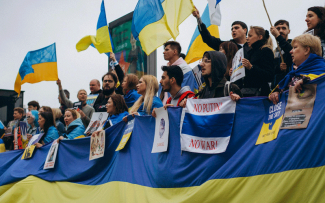
At the outset of the fifth year of the war, Ukrainian society continues to demonstrate resilience and a willingness to resist the aggressor. Russia’s initiative on the front line and the massive aerial attacks on cities and infrastructure have not broken the will of Ukrainians – the majority still oppose territorial or political concessions to Russia. At the same time, however, growing war fatigue is becoming increasingly evident. This is reflected in negative assessments of the current situation and in expectations of a renewal of the political class. The wartime environment also makes the conduct of sociological research more difficult and distorts its results. It may therefore be assumed that the country’s real problems and social divisions are likely to be deeper than those declared by respondents in opinion polls.
Public opinion in wartime
Although sociological surveys in Ukraine reveal important trends, their findings should be approached with caution. Owing to the ongoing war, fewer surveys are conducted through direct and/or field research, while a growing number rely on telephone interviews, which are associated with higher refusal rates. Internal migration also makes it more difficult to obtain a representative sample. Moreover, many respondents are reluctant to answer certain questions for fear that their responses might reveal views perceived as ‘unpatriotic’.[1]
For this reason, some sociological centres have modified their research methods: for example, instead of inquiring directly about trust in the president, they ask respondents to report not their own opinion but that of an acquaintance. In some cases, this leads to a noticeable adjustment in the results (for instance, in one survey conducted by the Kyiv International Institute of Sociology – KIIS – the level of trust in President Volodymyr Zelensky fell from 61% to 53%).[2] Surveys also fail to capture the views of certain segments of society: above all, this concerns soldiers fighting on the front line, many of whom oppose territorial concessions and strongly support the continuation of resistance. Residents of areas located close to the front line are likewise excluded; among them, war fatigue is likely to be much stronger, and consequently, in some regions, the willingness to accept concessions may be greater. Refugees are also not included, some of whom are likely to return to the country after the war. These groups may hold markedly different views on the issues discussed above.
Surveys are conducted among a society living under constant strain, which inevitably affects the rationality of responses. According to the World Health Organization, more than half of Ukrainians suffer from psychological problems related to war-induced trauma.[3] This may generate a tendency to present one’s own views as more optimistic than they truly are, as part of a mechanism of psychological compensation. In wartime conditions, citizens also seek to project an image of widespread solidarity to the outside world, which may conceal the country’s real problems, conflicts, and social tensions.
In Ukraine, certain issues are rarely raised in public. These include dissatisfaction with the arrival of approximately 4.6 million internally displaced persons[4] in western and central Ukraine (which has resulted in rising property prices and a greater presence of the Russian language in public spaces), resentment towards refugees who have left the country (some view them as traitors who have chosen a more comfortable life abroad; according to a survey by the Rating Group, 60% of Ukrainians believe that they should not have the right to stand as candidates in elections)[5], as well as divisions between those fighting at the front and their families, and those who have not taken part in the fighting. In such circumstances, opinion polls can become a self-fulfilling prophecy – not merely a reflection of reality, but also an instrument that helps to shape it.
Optimism and resilience
Despite four years of full-scale war, Ukrainians surveyed surprisingly often express optimism. According to research conducted by the Kyiv International Institute of Sociology (KIIS), two-thirds of citizens believe that in ten years’ time their country will be developing as a member state of the European Union (the proportion expressing this view has been increasing since August 2025). They also believe that society is on the path towards overcoming its ‘internal contradictions’ and becoming a political nation (before the war, only 35% of respondents held this view).[6]
According to sociologists, this optimism stems from a psychological mechanism whereby individuals and communities operating under conditions of prolonged and extreme stress tend to develop a subconscious belief in positive scenarios (even when there are no rational grounds for such expectations). This reinforces their willingness to resist and endure in difficult circumstances. Such an attitude helps to sustain internal cohesion in the face of an external threat, weakens capitulationist sentiments and the readiness to make concessions to Russia, and at the same time strengthens resilience to narratives aimed at undermining the country’s stability and society’s defensive effort.
At the same time, the declared optimism regarding the country’s future does not translate into a belief in a swift end to the war. In this respect, realism prevails, based on the conviction that Russia is not interested in peace. Only one fifth of Ukrainians believe that the war will end this year, while just under half think that it will end in 2027 or later. This outlook is reinforced by confidence in the potential of the Armed Forces of Ukraine and their effectiveness in resisting the aggressor’s advances (77% of respondents believe that Ukraine is capable of continuing to defend itself effectively).[7]
The existential nature of the confrontation with Russia and the fear of occupation mean that Ukrainians are prepared to endure the hardships associated with the war for as long as necessary. In January 2026, during the harshest cold spells and amid massive Russian aerial attacks, nearly two-thirds of respondents expressed this view, and this proportion has been increasing since the end of 2024.
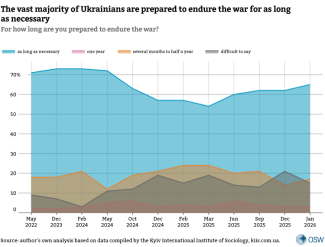
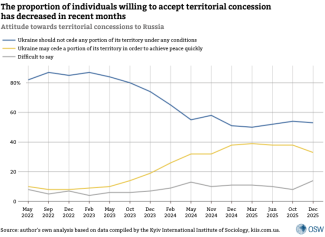
The readiness to continue resisting reduces support for territorial concessions to Russia (such as relinquishing the unoccupied part of the Donbas) – even in exchange for security guarantees from the West (especially the United States) that are currently being negotiated. Although the proportion of citizens prepared to relinquish part of Ukraine’s territory had been steadily increasing since the beginning of the invasion, this trend reversed last year. This shift may reflect the consolidation of society in response to pressure from the US and Russia to make concessions in this sphere.
Despite their hopes for a better future, Ukrainians are aware of the negative aspects of their current reality and believe that the country is moving in the wrong direction. The divergence between an optimistic vision of the future and a pessimistic assessment of the present stems from the negative perception of successive corruption scandals at the highest levels of power, the perceived unfairness of mobilisation rules, everyday threats to life, as well as shortages of electricity and heating and the deteriorating economic situation.
Fatigue with the authorities
An important component of the negative assessment of the present is the growing fatigue with the political camp that has been in power since 2019. Periodic changes at the highest levels – most often in response to corruption scandals (such as the cabinet reshuffle in July 2025 or the replacement of the head of the Presidential Office in January this year) – have not convinced the public that a genuine renewal of the governing elite has taken place.
The level of trust in Zelensky remains high; however, this stems largely from the need for institutional stability, the president’s effectiveness in mobilising political, military, and financial support abroad, and the rally-around-the-flag effect, which encourages Ukrainians to unite around the head of state as the embodiment of the country’s independence. This was particularly evident following a heated exchange between Zelensky and Donald Trump at the White House on 28 February 2025,[8] when the US President accused the Ukrainian leader of being a ‘dictator without elections’.[9] It is also significant that more than half of Ukrainians currently do not see any politician who could serve as an alternative to him (only one in three respondents expresses a different view).
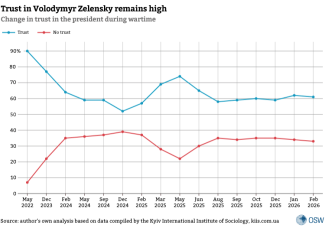
At the same time, society distinguishes between support for Zelensky’s actions on the international stage and criticism of his decisions in domestic affairs, while declared trust in him shows a predominance of responses of ‘rather trust’ over ‘trust completely’. The limited number of published polls on electoral support have produced results significantly lower than trust ratings, which reflects the separation of trust in the office of the president itself from the assessment of Zelensky as a politician. Ukrainians hold him responsible for domestic problems and also associate him with corruption within his inner circle,[10] and with an excessive concentration of power.
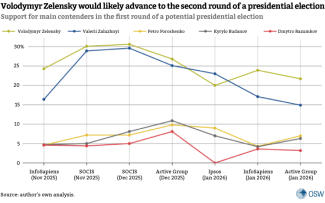
The Armed Forces of Ukraine enjoy almost universal public trust owing to their effective resistance to the aggressor. This creates expectations that veterans and individuals from groups directly involved in the war effort will assume greater responsibility for the state than before and will stand in elections when these become possible. Nearly two thirds of respondents declare potential support for a party hypothetically established by them. This does not, however, translate into expectations regarding the future president – Ukrainians would prefer the office to be held by a politician from the civilian sector rather than the military, which may be interpreted as an expression of concern about a military dictatorship, which they strongly oppose. This casts doubt on the prospects of a potential electoral victory by General Valerii Zaluzhnyi. It is certain, however, that after the war, veterans will be widely represented in Ukrainian political life, and political parties will seek their presence on electoral lists.
The renewal of the political scene, which more than 90% of society supports, is prevented by the law on the legal regime of martial law and by the constitutional ban on holding parliamentary and presidential elections while it remains in force. Ukrainians themselves are also not ready for this, and they treat external pressure as an attack on the state’s sovereignty – the demand to hold elections comes from abroad: notably Russia, but also the United States. Trump, who is widely criticised in Ukraine, has repeatedly questioned, as has Vladimir Putin, the democratic character of the Ukrainian authorities.[11]
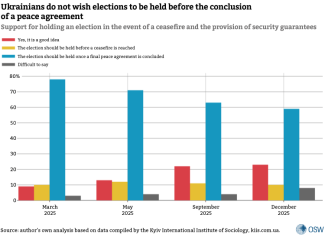
A clear majority of society does not wish to vote during the war, and almost 60% support holding elections only after the lifting of martial law, even in the event of a ceasefire and the provision of security guarantees. Ukrainians recognise that, given the lack of an up-to-date voter register, the large number of internally displaced persons, and the difficulty of ensuring voting opportunities for soldiers at the front line, elections would be only partially representative and that participation itself could be dangerous. At the same time, the number of undecided respondents, as well as those who believe that elections could be held even while martial law remains in force (but after a ceasefire), is increasing. Supporters of this approach are primarily opponents of Zelensky – as disappointment with his rule grows, so too does the desire among part of society to replace him with someone less burdened by scandals or more effective.
On the verge of division
Demonstrating resilience is an important element of resistance for Ukrainians: an intensification of pessimistic sentiment would lead to a weakening of social cohesion, an increase in apathy, and to defeatism. The optimism expressed in opinion polls indicates that they have become not only an instrument for analysing society, but also a tool of social self-regulation. The so-called herd effect is also at work here – individuals make decisions in line with the majority, which in difficult conditions seeks comfort in the vision of a better future.
This does not mean, however, that Ukrainians fail to recognise the internal problems of the state whose independence they are fighting for. This makes it possible to predict that a large proportion of today’s active politicians (both those linked to Zelensky and those from the opposition) will disappear from the political scene after the war and will likely be replaced by veterans and individuals from volunteer groups supporting the army and civilians. This will reflect the social divisions already visible between those who fought and those who did not, and between those who remained in the country and those who emigrated.
Those in the military and those involved in supporting the army will be seen as those entitled to a moral mandate to engage in political activity. At the same time, a large share of Ukrainians will likely be ready to deny such a mandate to refugees abroad, viewing them as individuals who did not directly experience the effects of the war and did not contribute to the war effort. Although a lasting peace remains distant, society’s assessment of the terms on which the war with Russia ends will be a key factor shaping the evolution of Ukraine’s political scene, the depth and nature of social divisions, and the dynamics of holding the current leadership to account.
[1] K. Rickard, G. Toal, K.M. Bakke, J. O’Loughlin, ‘The challenges of surveying in war zones: Lessons from Ukraine’, Journal of Peace Research 2025, vol. 62 (6), journals.sagepub.com; O. Bezrukova, O. Vilkova, A. Petrenko-Lysak, ‘Social perception of war: a study of Ukrainian society under Russia’s full-scale invasion’, Innovation: The European Journal of Social Science Research 2025, vol. 38 (1), after: tandfonline.com.
[2] ‘Dynamics of trust in President V. Zelenskyy, perception of the prospects of the Ukrainian government and the state of democracy: results of a survey conducted on January 23–29, 2026’, Kyiv International Institute of Sociology, 4 February 2026, kiis.com.ua.
[3] ‘Three years of war: rising demand for mental health support, trauma care and rehabilitation’, World Health Organisation, 24 February 2025, who.int.
[4] Д. Глушко, ‘В яких регіонах України найбільше внутрішньо переміщених осіб і як змінилася їхня кількість – інфографіка’, Апостроф, 5 January 2026, apostrophe.ua.
[5] ‘Public opinion in times of war: Political preferences, trust and ideological orientations of Ukrainians, 27–31 July 2025’, Westminster Foundation for Democracy, p. 28.
[6] ‘How Ukrainians see the future of Ukraine’, Kyiv International Institute of Sociology, 9 January 2026, kiis.com.ua.
[7] ‘Public opinion in the context of Russia's attempts to plunge Ukraine into darkness and cold: results of a survey conducted on January 23-29, 2026’, Kyiv International Institute of Sociology, 2 February 2026, kiis.com.ua.
[8] OSW team, ‘The failure of Zelensky’s US visit and Europe’s plan to end the war’, OSW, 3 March 2025, osw.waw.pl.
[9] See K. Sienicki, T. Iwański, ‘The Trump effect: anti-American sentiment rises in Ukraine’, OSW, 24 April 2025, osw.waw.pl.
[10] M. Jędrysiak, ‘Operation Midas: the largest corruption scandal within Zelensky’s inner circle’, OSW, 13 November 2025, osw.waw.pl.
[11] See idem, ‘President until the end of the war. Volodymyr Zelensky’s term of office is extended’, OSW, 20 May 2024, osw.waw.pl.