Year four of the war: the front stabilises, negotiations stall
Ukraine has survived the fourth, and arguably most difficult, year of the war. Russian forces maintained the initiative and made battlefield advances, but failed to achieve any significant operational gains or to secure a strategic breakthrough. The Ukrainian army has managed to hold a coherent defensive line and prevent a collapse of the front line. There is no indication that this could change over the coming year. In the winter of 2025/26, Russia launched unprecedented attacks on Ukraine’s energy system, aiming to trigger a humanitarian crisis in its largest cities and pushing the system to the brink of collapse.
As this war of attrition continued, talks on ending the conflict resumed at the initiative of President Donald Trump following a three-year hiatus. Russia hopes to use this diplomatic path to advance its political objectives in Ukraine, having failed to secure them by military means. The resumption of direct US-Russia talks, including the August 2025 meeting of leaders in Alaska, raised the Kremlin’s hopes of victory and bolstered the legitimacy of Vladimir Putin’s regime. So far, the negotiations have failed to produce any tangible results owing to Russia’s uncompromising stance: it treats the talks as a vehicle for pursuing its consistently maximalist demands.
Little change along the front line
For another year, Russian forces unsuccessfully sought to break through the 1,200-km front line. They made limited advances: in August north of the Pokrovsk, and in December in the eastern part of Zaporizhzhia Oblast. However, they failed to convert these tactical gains into operational success, as Ukrainian forces stabilised their defence along successive lines. The most intense fighting continues in the Donbas, Zaporizhzhia Oblast and the adjacent part of Dnipropetrovsk Oblast. Russian forces also retain the initiative in Kharkiv Oblast. Despite this, the Ukrainian army achieved significant success here by regaining control over most of Kupiansk, thereby contradicting the Kremlin’s claims that its forces had captured the city. Although military operations remain largely positional, during the fourth year of the war, Russia occupied between 4,300 and 4,800 square kilometres, or approximately 0.7% of Ukraine’s territory.
Russia’s most significant gains included the capture and subsequent expansion of bridgeheads in Dnipropetrovsk Oblast in the summer of 2025 (aimed at securing operations in Donetsk Oblast), the seizure of most of the Pokrovsk by December and the capture of Huliaipole in January this year, pushing the defending Ukrainian forces out of the north-eastern part of Zaporizhzhia Oblast. The offensive also accelerated south of Zaporizhzhia, with Russian forces now positioned 20 km from the city and separated by Ukraine’s main defensive line. It is also worth noting that in March they pushed Ukrainian troops out of Russia’s Kursk Oblast, parts of which had been occupied for eight months. Although the Ukrainian ‘Kursk operation’ had limited military significance, its symbolic and reputational impact was considerable.
Since the Russian advances can hardly be considered significant, they will have certainly disappointed the Kremlin, which had expected its forces to break through Ukrainian defences. The ground offensive has been accompanied by regular air strikes involving up to several hundred attack drones per day, targeting sites across Ukraine. This campaign includes large-scale assaults on Ukraine’s energy infrastructure. Russia is deliberately waging a war of attrition.
During the first three years of the full-scale conflict, the size of Russian forces increased steadily, from around 150,000 troops at the outset of the invasion to approximately 700,000 at present, including between 300,000 and 400,000 directly engaged on the battlefront. However, it appears that Russia can no longer afford to further expand these numbers. While the recruitment of contract soldiers remains effective (according to official data, 417,000 individuals enlisted throughout 2025, an average of 35,000 new recruits per month) estimates by the Ukrainian General Staff suggest that more than 90% of them merely replace those who had been killed or wounded.
The Kremlin has retained its capability to recruit personnel for military service, but the steadily rising signing-on bonus – ranging from 2 to 4 million roubles (roughly $26,000–52,000) depending on the region – suggests that this is becoming increasingly difficult. Enormous losses, estimated at a total of 1.2 million killed and wounded since 2022, combined with the large numbers of wounded soldiers and disabled veterans returning home, may eventually generate strains on the home front. One likely consequence could be a declining pool of volunteers willing to enlist for military service. This in turn raises the question of how long Russia can sustain its offensive operations at their current intensity.
Over the coming year, the nature of military operations is unlikely to change in any significant way. Russia will not be capable of breaking through the front line. Both sides possess the necessary reconnaissance capabilities to track their adversary’s movements, which greatly complicates any attempt to launch large-scale operations, as they are almost certain to fail. A collapse of Ukrainian defences due to the exhaustion of forces and materiel also appears unlikely. This development would create a new strategic situation and could adversely affect the ongoing Russia-Ukraine talks held under Washington’s auspices.
It is also reasonable to expect that Russia will fail to dislodge the defending Ukrainian forces from all of the Donbas, 20% of which remains under Ukrainian control. At a pace of advance comparable to that observed in recent months, it would take Russian forces approximately two to three years to occupy the whole of this region. In the fifth year of the war, Russia’s primary targets will be Kramatorsk and Sloviansk, the last major cities in the Donbas still under Ukrainian control.
Energy infrastructure under severe strain
Ukraine’s greatest achievement lies in maintaining an effective defence, which has performed better than most observers anticipated at the end of the third year of the war. Even in cases where Russian forces managed to breach the defensive lines locally, Ukrainian units mounted effective counterattacks, slowing Russian advances. More importantly, Ukraine has retained the capacity to sustain its defence, which is significantly reliable on the use of drones and artillery.
Ukrainian forces have also retained the capability of conducting operations inside Russia. This was demonstrated by Operation Spider’s Web, a coordinated drone strike on 1 June 2025 targeting airfields in several Russian regions where strategic bombers are stationed. At least seven Tu-95 aircraft were destroyed in this attack, representing a major success for Ukraine and dealing a heavy blow to Russia in terms of both material losses and prestige.
Ukraine has also carried out effective drone strikes against selected oil pipelines and more than a dozen refineries in the European part of Russia. These attacks have partially destroyed or damaged some facilities, triggering a fuel crisis and forcing the Russian government to introduce a temporary ban on fuel exports. It is impossible to put precise figures on Russia’s losses, as no relevant data have been released. However, estimates suggest that at the peak of Ukrainian strikes last summer, around 30% of Russia’s total refining capacity was taken offline, causing financial losses amounting to several billion dollars.
The lack of troop rotation continues to pose a challenge for Ukraine, although ongoing mobilisation efforts have yielded tangible results. Each month, the Armed Forces of Ukraine recruit approximately 27,000–30,000 new personnel, enabling the military to maintain a strength of around 800,000 troops. Nevertheless, in August 2025 the government decided to permit men aged 18–22 to leave the country; within a few months, more than 100,000 individuals exercised this right. This move came as a surprise, as many had expected the government to lower the minimum mobilisation age, which remains set at 25 despite persistent personnel shortages in the military.
Starting in the autumn of 2025, Russia stepped up the attacks on Ukraine’s energy infrastructure that it had first launched three years earlier. With each successive year of the war, Russian forces have escalated their strikes on Ukrainian power grids, power plants, combined heat and power plants and gas extraction facilities. The increasingly deliberate nature of these attacks stems from at least two factors. The first is Russia’s failure to deliver the expected breakthroughs on the battlefield and its assumption that the energy crisis will trigger a humanitarian emergency, undermine Ukrainian morale and reduce Ukraine’s capacity to sustain its defence. The second is the West’s limited response, which emboldened the Kremlin by dispelling its initial concerns that Russian attacks on energy infrastructure could prompt Western countries to supply Ukraine with long-range missiles capable of striking targets deep inside Russia. The Kremlin’s continued escalation indicates that it no longer sees this as a credible risk.
Russia has adjusted its tactics in targeting Ukraine’s energy system. Whereas its earlier strikes targeted locations across Ukraine, in recent months it has conducted large-scale attacks focused on infrastructure in selected major cities, particularly Kyiv, and on key transmission lines. Russia has also benefited from difficulties in Ukraine’s air defence. The increased effectiveness of Russian strikes stems both from improvements in Russian tactics and from reduced deliveries of air defence missiles, in particular of the most effective Patriot systems.
As a result of the attacks, millions of Ukrainian people were left without heating for many weeks. It is already clear that supplies to around 800 buildings in Kyiv will not be restored before the end of the current heating season. Compounding the crisis, Ukraine has experienced its coldest winter in many years, with temperatures plunging to -25°C. Electricity supplies lasting only a few hours per day have become the norm in parts of the largest cities, including the capital. In a particularly serious incident on the night of 2–3 February this year, a large-scale Russian attack destroyed the Darnytska combined heat and power plant, which had supplied heating to 300,000 residents of Kyiv.
The deteriorating condition of Ukraine’s energy infrastructure is increasingly pushing the country towards a humanitarian crisis. Extensive damage, compounded by repeated strikes on the same facilities, has shaken the stability of the energy system and it now stands on the brink of collapse. Despite intensive efforts from energy workers, restoring its full operational capacity will take at least a year and some of the damage will not be repaired before next winter. However, even the cumulative weight of these challenges has failed to weaken the determination of the Ukrainian people to defend their country.
Corruption persists despite the war
Recent months have demonstrated that, despite the ongoing war, political infighting has not abated in Ukraine. In July, the Verkhovna Rada unexpectedly stripped the National Anti-Corruption Bureau of Ukraine (NABU) and the Specialised Anti-Corruption Prosecutor’s Office (SAPO) of their independence, with President Volodymyr Zelensky swiftly signing the adopted amendments into law. Mass protests across Ukraine, along with a backlash from the country’s Western partners, prompted parliament to reverse the changes only a few days later. The failed attempt to undermine NABU and SAPO was orchestrated by the presidential office, which sought to obstruct investigations targeting individuals from the president’s inner circle.
A major corruption scandal erupted last November, implicating Timur Mindich, Zelensky’s friend and former business partner, Deputy Prime Minister Oleksiy Chernyshov and former energy minister Herman Halushchenko. They were accused of creating a corruption scheme that siphoned resources from the state-owned energy company Energoatom. Although the investigation is still underway, the case sparked public outrage and weakened the president’s authority, despite the absence of evidence linking him to the scheme. Responding to mounting controversy, in late November Zelensky secured the resignation of the head of the Presidential Office, Andriy Yermak, widely regarded as the second most influential person in the country.
In the following weeks, Zelensky made a series of personnel changes. He appointed Kyrylo Budanov, the popular head of military intelligence (HUR), as head of the Presidential Office, and Mykhailo Fedorov, Deputy Prime Minister and Minister of Digital Transformation, who is credited with the success of Ukraine’s digitalisation drive, as defence minister. At the same time, he dismissed Vasyl Maliuk, the discredited head of the Security Service of Ukraine (SBU). These changes were intended to help restore public trust in Zelensky.
The corruption scandal surrounding Energoatom may be seen as further confirmation that, even during armed conflict, corruption remains widespread in the country. At the same time, the decision to bring corruption charges against influential figures – an unprecedented move in the history of independent Ukraine – demonstrates that NABU and SAPO are effective in performing the roles for which they were established.
Trump’s shift
Unable to achieve its political objectives through military means, the Kremlin resorted to diplomatic efforts, following a shift in the US approach to the war and Russia under the Donald Trump administration. Russian diplomats were tasked with accelerating what the military had failed to accomplish, while maintaining maximalist demands. The Kremlin concluded that it would be a mistake not to exploit the new US president’s bold and arguably naive conviction that he could end the conflict swiftly. As early as 12 February last year, just three weeks after his inauguration, Trump held his first official telephone conversation with Vladimir Putin, thereby abandoning the previous policy of isolating Russia.
This was followed by the first meeting between the US and Russian foreign ministers, held in Riyadh on 18 February. Ten days later, Trump’s encounter with Zelensky in the Oval Office descended into an unprecedented public spat, after which the Ukrainian president was asked to leave the White House. Bilateral relations hit rock bottom and Ukraine’s key partner, and principal supplier of military assistance suddenly became a serious concern.
However, the shift in the US administration’s narrative towards Russia and Ukraine, as well as its diplomatic efforts, failed to produce any tangible results. During the NATO summit in The Hague on 25 June, Trump acknowledged for the first time that ending the war was “more difficult than people would have any idea. Vladimir Putin has been more difficult, frankly, I had some problems with Zelensky... It’s been more difficult than other wars”.
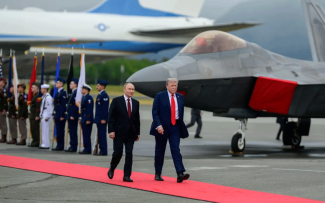
Nevertheless, the US president persisted in his efforts; most notably, he decided to hold direct talks with Putin on 15 August in Anchorage, Alaska. The meeting’s sole outcome was that the Russian leader bolstered his legitimacy, both at home and on the international stage. The Kremlin offered the United States nothing in return.
In the following months, the US continued its diplomatic efforts aimed at reaching an agreement to end the Russia-Ukraine war, led by the president’s special envoy Steve Witkoff. On 20 November, the US presented Ukraine with a 28-point draft peace plan providing for the withdrawal of the Armed Forces of Ukraine from all of the Donbas and a reduction of their strength to 600,000 troops. For Ukraine, voluntarily abandoning the positions it continues to hold, including key defensive lines, was and remains unacceptable. Trilateral US-Russian-Ukrainian negotiations, as well as bilateral talks between Russia and Ukraine, were held in subsequent months in Abu Dhabi (23–24 January and 4–5 February 2026) and in Geneva (17–18 February), but failed to produce any results. Meanwhile, a separate document on security guarantees for Ukraine was negotiated, though both its contents and the mechanism for its entry into force remain unknown.
Russia’s economic stagnation
One of Russia’s key objectives in its Trump policy is to persuade him to ease sanctions in order to trigger a process of dismantling the broader Western sanctions regime. This is becoming increasingly necessary, as Russia’s war-orientated economy is coming under mounting strain after four years of conflict. Consequently, in its bilateral agenda with the US, Russian diplomacy has sought to decouple the issue of Russia’s aggression against Ukraine from cooperation in other areas, tempting Trump and his business circle with purportedly vast economic opportunities.
The war remains the overriding priority of the Putin regime, shaping the organisation of the state’s economic activity. Nominal spending on security and national defence has risen from 23.8% of total budget expenditure in 2021 to around 45% in 2025, resulting in a proportional reduction in allocations to other areas, including social policy. Salaries for soldiers, social benefits for the wounded and payments to the families of those killed are estimated at around $52 billion – roughly 2% of Russia’s GDP. VAT accounts for more than one third of federal revenues and its increase from 20% to 22% from 1 January this year underscores the country’s shrinking fiscal space. The Kremlin opted for this socially unpopular measure in response to dwindling reserve funds, growing difficulties in financing the budget deficit and the high cost of borrowing on the domestic market.
The prioritisation of war-related spending has resulted in mounting economic stagnation and degradation, trends that are likely to become more serious in the coming years. At first glance, last year’s headline indicators – inflation (6.8%), the budget deficit (2.6%) and GDP growth (1%) – do not appear particularly alarming. However, any assessment of the real economic situation must take the use of ‘creative accounting’ into consideration. This applies in particular to inflation, which may in fact be twice as high as the official figure.
Despite mounting problems and the Kremlin’s efforts to conceal them, an economic collapse in Russia appears unlikely in the foreseeable future. The West has still done too little, and too late, as part of its sanctions policy – including through the continuous tightening of restrictions and the imposition of secondary sanctions – to generate an economic crisis severe enough to compel the Kremlin to seriously engage in talks on ending the war. The regime has therefore concluded that, despite there being warning signs, the risk of economic destabilisation remains distant. It is thus likely to continue pressing for a political resolution, hoping that Trump’s stance and Europe’s difficulties will translate into advantages on the battlefield. However, Russia does not have unlimited time. Pressure on the Kremlin will intensify, potentially pushing it towards riskier moves and increasing the likelihood of further miscalculations.
Ukraine’s ‘American front’
After initial difficulties in understanding President Trump’s methods and logic, Ukraine began to find its footing in the new reality of its relations with the United States. In May, the two countries signed an agreement on mineral resources that provides for US participation in the future extraction of rare earth metals in Ukraine. This represented a Ukrainian gesture towards the US president, and a step intended to deepen America’s economic involvement in the country.
The Ukrainian side also began to demonstrate a constructive approach to US-Russia talks on ending the war, signalling a willingness to adjust its negotiating position. Ukraine has learned to navigate these discussions in a manner that avoids provoking Trump’s ire. This is notably reflected in its indication that Ukrainian forces could withdraw from the Donbas and that a demilitarised zone could be established there, provided that Russian forces pull back by a comparable distance from the current front line and that the West agrees to provide Ukraine with security guarantees.
At the same time, the Ukrainian leadership is aware that a withdrawal from the Donbas carries the risk of falling into a Russian trap. Ceding control of the defensive lines there would pave the way for a new Russian offensive towards central Ukraine and would likely trigger an internal crisis. According to a KMIS poll conducted in January of this year, 52% of Ukrainian people oppose withdrawing from the part of the Donbas controlled by Ukraine, even in exchange for Western security guarantees, while 40% would be prepared to support this concession. This indicates that much of Ukrainian society remains unconvinced that Russia is genuinely interested in ending the war.
This perspective was also reflected in a mid-February poll conducted by the Razumkov Centre, which found that 75.2% of respondents believe that, even if a peace agreement were signed, Russia would violate it and launch another attack. At the same time, an increasing number of Ukrainian people are willing to accept the current front line as a line of demarcation, if Ukraine receives credible security guarantees.
In these exceptionally difficult conditions, Ukraine’s diplomatic activity deserves high praise. In its dealings with Trump, Kyiv has demonstrated good faith in pursuing a peaceful solution, while rightly remaining sceptical about whether a peace agreement acceptable to Ukraine can be negotiated with Russia. Ukraine’s participation in peace talks is therefore shaped by necessity and tactical calculation, a stance that appears rational in the current circumstances.
Europe – an ally in search of a vision
Europe remains Ukraine’s principal military and financial anchor. Throughout 2025, European leaders repeatedly acted as intermediaries between Washington and Kyiv, seeking to temper the impact of Trump’s negative actions. Given the Kremlin’s regular criticism of the European position, which it views as the main obstacle to its victory, this stance can be regarded as broadly effective. However, the EU has continued its protracted and so far ineffective discussions on post-war security guarantees for Ukraine.
As in the previous three years of the war, Europe lacks a strategic plan for bringing Russia’s invasion to an end and remains unable, whether through political measures or sanctions (which are still insufficiently robust), to convince Moscow that it cannot win. On a positive note, the pro-Ukrainian narrative and a realistic assessment of Russia’s objectives towards Ukraine and Europe continue to shape the mainstream European debate.
Ukraine remains critically dependent on European military and financial assistance, without which it would be unable to sustain its defence or ensure its relative fiscal and economic stability. In addition to the continued support provided by individual countries, NATO’s PURL (Prioritised Ukraine Requirements List) mechanism has been operational since August 2025, financing priority purchases of US-made equipment (such as air defence systems and ammunition) for Ukraine with European funds.
After protracted discussions, last December the EU decided to raise an interest-free loan of €90 billion for Ukraine, backed by the EU’s budget. However, it failed to reach an agreement to use the €210 billion in frozen Russian assets as collateral for the loan. Ukraine has even proposed confiscating all these funds, but its lobbying efforts have proven unsuccessful. The adopted solution reflects the growing burden that supporting Ukraine has placed on the EU’s member states, particularly amid rising budget deficits. While it can hardly be considered ideal, the €90 billion will undoubtedly provide a substantial boost to the Ukrainian budget over the next eighteen months.
Prospects for the fifth year of the war
Shortly after the summit in Alaska, President Trump stated: “I would have thought the Russia deal maybe would have been one of the easier ones”. However, this remark has not translated into any tangible shift in US policy towards Russia. That may appear surprising, particularly given that the Kremlin has remained consistent in its demands towards Ukraine and Europe since the outset of its full-scale war. There is little indication that Russia will alter its stance, at least over the coming year. Despite its failure to deliver the anticipated breakthroughs on the battlefield, the Kremlin believes it is on the path to victory. It will therefore press on with its offensive while maintaining dialogue with Trump, seeking to persuade him to exert pressure on Ukraine and ease sanctions – and enticing him with the prospect of business cooperation. How long the Trump will allow himself to be strung along by Russia remains an open question.
Ukraine will remain steadfast in resisting the pressure to withdraw its forces from the part of the Donbas it controls. The situation on the battlefield and its likely trajectory do not compel Ukraine to make any concessions to Russia, especially as the Ukrainian leadership is aware that Russia’s objective of depriving Ukraine of its sovereignty has not changed and that its determination to achieve this goal remains undiminished.
For this reason, Ukraine does not expect the war to end and, despite all the difficulties, sees the continuation of its defence as the only viable option. At the same time, it will continue to demonstrate good faith in pursuing peace talks under Washington’s auspices, maintaining the appearance of engagement while remaining sceptical about the outcome. Facing US pressure to organise presidential elections, the Ukrainian government will continue to reject these calls, arguing that to do so would contravene its constitution and that elections cannot be held under wartime conditions without risking internal destabilisation and weakening the cohesion of a state that has been focused on the defence effort for the past four years.
Ukraine’s key objective is to secure acceptable terms for ending the war – ones that preserve its sovereignty and its ability to develop and integrate with Western structures. Russia’s objectives remain the exact opposite. It will thus press on with its assault for as long as it believes it can win.
The hopes of Ukraine and the rest of Europe for ending the conflict are well captured by the words of Julian Klaczko, an eminent though now largely forgotten Polish political writer. In his 1876 book The Two Chancellors: Prince Gortchakof and Prince Bismarck, which was widely read in Europe at the time, he wrote that “Russia is never so far removed from the goal as when it undertakes to force the dénoûment”. This observation suggests that the Putin regime may commit strategic errors that could ultimately lead to its defeat.