Forging a nationalist model army. The political prospects of the Azov Movement
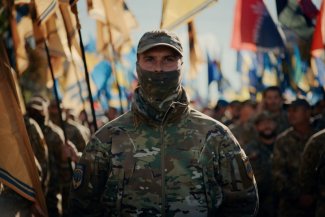
In September 2025, President Volodymyr Zelensky signed a decree awarding the rank of brigadier general to Andriy Biletskyi, one of the most influential and prominent leaders of the Ukrainian nationalist movement. The promotion followed his appointment as commander of the 3rd Army Corps. A month earlier, Zelensky decorated Colonel Denys Prokopenko, the newly appointed commander of the 1st Corps ‘Azov’ of the National Guard of Ukraine, with the Order of Bohdan Khmelnytsky, second class, awarded for personal courage. Both corps, which originate from the nationalist Azov movement and draw upon shared values and traditions, were established as part of the ongoing reorganisation of the Ukrainian armed forces and are intended to serve as a model for reforming other military formations.
The selection of these units reflects the recognition of their achievements and their prominent role on the battlefield and also underscores the growing importance of members of the Azov movement within the structures of Ukraine’s Defence Forces. In Biletskyi’s case in particular, this may facilitate his potential return to active politics after the war, amid a high public demand for strong leaders with explicitly nationalist views with military backgrounds. However, controversial beliefs and conflicts with other members of the nationalist movement could pose an obstacle to his ambitions.
A major reform during a major war
The structural reform of the Armed Forces of Ukraine, announced at the start of 2025, aims to transform its inefficient command structure which is ill-suited to current wartime conditions. The existing model is based on a system of temporary tactical groups, operational-tactical groupings and operational-strategic groupings of forces. It will be replaced by a system of new formations – army corps. General Valerii Zaluzhnyi, Oleksandr Syrskyi’s predecessor, was expected to launch the transformation as early as the summer of 2022, but it did not go ahead due to alleged resistance from the countrys leadership.[1]
Pressure to carry out the reform intensified in 2024, particularly within right-wing circles initially centred around Biletskyi. In November 2025, Denys Prokopenko, then commander of the 12th Special Purpose Brigade ‘Azov’ of the National Guard of Ukraine (12th SPB ‘Azov’), published a 12-point programme for transforming the army, arguing that the existing system of hands-on command over companies and battalions was “senseless and inefficient”.[2] Similar views were expressed by other prominent officers, including Bohdan Krotevych, the brigade’s chief of staff, and Dmytro Kukharchuk, commander of one of the battalions of the 3rd Separate Assault Brigade (3rd SAB) led by Biletskyi.
Owing to its reputation within the military and broader society, the 3rd SAB was selected as the foundation for forming the 3rd Army Corps. This formation was created by attaching four additional brigades to the 3rd SAB, establishing a unified command structure, standardising training levels and achieving interoperability; this was intended to serve as a model for broader change across the Ukrainian armed forces. The 12th SPB ‘Azov’ earned similar recognition after it was essentially destroyed during the fighting at the Azovstal plant in Mariupol in 2022 and its staff was taken prisoner by Russian forces. Following the release of its commanders – including Prokopenko, Sviatoslav Palamar and Bohdan Krotevych – and their return to active duty, the brigade was reconstituted and subsequently operated in parallel with the 3rd SAB under Biletskyi’s command.
In March 2025, Biletskyi announced that the formation of the 3rd Army Corps had been successfully completed, declaring that it would “change the course of the war in Ukraine’s favour”. A month later, Prokopenko announced the establishment of the 1st Corps of the National Guard of Ukraine and assumed its command.
Common roots
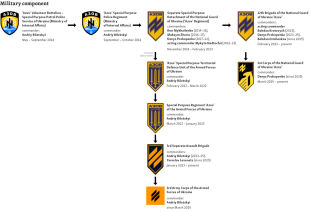
Both corps draw on the legacy of the Azov movement and are often conflated. Their common root is the ‘Azov’ Volunteer Battalion that Biletskyi formed in the spring of 2014 in Berdiansk. It was subsequently reorganised into a regiment and incorporated into the National Guard as a separate special purpose unit. During this early period, the core of the unit consisted of activists from the Patriot of Ukraine far-right organisation and football fans from the ‘ultras’ scene, including supporters of Metalist Kharkiv, based in Biletskyi’s home city, and Dynamo Kyiv, where Prokopenko was involved. The unit trained in Berdiansk on the coast of the Sea of Azov – hence its name – and later in Mariupol, where it gained prominence by repelling attempts by pro-Russian separatists to seize the city. In 2014 and 2015, the battalion participated in numerous engagements, including in Shyrokyne and near Ilovaisk.
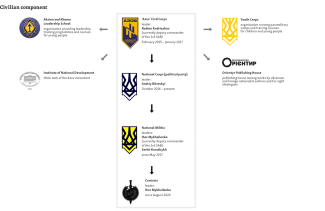
The group received substantial administrative and financial backing from Arsen Avakov – first as governor of Kharkiv Oblast and subsequently, from 2014 to 2021, as Ukraine’s longest-serving interior minister.[3] Within a short time-period, the battalion, later expanded into a regiment, evolved into a nationwide movement with an extensive structure comprising tens of thousands of active members. In 2015, its leaders established the ‘Azov’ Civil Corps, followed the next year by the National Corps political party. In 2018, they created a paramilitary structure known as the National Druzhyny, which effectively functioned as a street militia. In 2020, it was transformed into Centuria, a training and educational organisation that continues to operate within the 3rd SAB.
The movement’s organisational expansion was also facilitated by significant financial support from influential business figures. The battalion formed by Biletskyi was reportedly sponsored by the oligarchs Serhii Taruta, Ihor Kolomoisky and Rinat Akhmetov, who relied on its members to protect their business interests.[4] The lack of transparency surrounding donations made to the accounts of the National Corps was one indication of this support. Journalists revealed that significant sums from alleged supporters had been regularly transferred by almost the same group of individuals – identical amounts and at the same time – raising suspicions that these donations had been used to launder proceeds from illegal sources.[5]
From the outset, both the military unit and the civilian structures of the Azov movement used stylised, coded neo-Nazi and neo-pagan symbols, referencing the ‘Black Sun’ and the ‘Wolfsangel’, which also served as a monogram of the concept of the ‘idea of the nation’.[6] The modified graphic design (see Appendix) has remained the symbol of both the 12th SPB ‘Azov’ and the 1st Corps, as well as the 3rd SAB and the 3rd Army Corps. However, the leadership of these military units and civilian organisations has publicly denied that the symbols refer to imagery associated with the Third Reich. It is important to note that new recruits joining both units are primarily motivated by the high level of training and the professionalism of their officers, as well as the ethos and the reputation these formations enjoy in society.
Train and promote
In the period preceding Russia’s full-scale invasion, the ‘Azov’ Regiment developed modern military training standards and new ideological foundations for the formation, which became central to the identity of its soldiers. In 2016, Biletskyi launched the Colonel Yevhen Konovalets Military School, named after the co-founder of the Ukrainian Military Organisation and later the first leader of the Organisation of Ukrainian Nationalists (OUN), with the aim of breaking with Soviet-era military models and introducing elements of NATO standards. The school now serves as a training hub for non-commissioned officers for the 1st Corps and also other units of the ground forces. Several hundred soldiers graduate from its three- to four-month courses and there are plans to establish a number of additional training centres.
A similar role is performed by the Mykola Stsiborskyi Warrant Officers’ School, named after the OUN theorist and ideologue. This was established in 2017 and reconstituted in May 2025 within the 3rd Corps. Both institutions place a strong emphasis on the ideological education of their cadets. For example, graduates take an oath that includes the Prayer of the Ukrainian Nationalist and recite the ten commandments of the OUN during ceremonial events. Both military units have also developed their own standards of military conduct through drill procedures, including distinctive forms of saluting, reporting and service-related terminology. These practices are intended to foster a distinct identity among the members of the formations and to instil a sense of elitism and separateness from the other structures within Ukraine’s Defence Forces.
In addition to their high level of training, the reputation of both corps stems from a carefully managed public relations campaign using modern audiovisual tools, typically featuring an aesthetic and engaging visual style and professionally produced photographs, videos and reports from the daily life of the units published on social media. In the 3rd SAB, a dedicated team of more than a dozen personnel is responsible for promoting the unit in the media. As a result, it is one of the few formations within the Armed Forces of Ukraine that does not face difficulties in recruiting new soldiers. According to Biletskyi, as many as 95% of its personnel are volunteers and more than 500 people apply to the formation’s recruitment centres each month.
A similar pattern can be seen in the 12th SPB ‘Azov’, which has a limited number of mobilised soldiers, relying primarily on individuals who voluntarily join the unit. The popularity of both brigades also stems from their distinctive ethos emphasising the primacy of values such as service to the homeland, comradeship and solidarity. Both Biletskyi and Prokopenko have sought to consolidate their current comrades-in-arms, as well as the wider community of veterans, their families and supporters. This function is performed by numerous organisations and groups affiliated with the formation, including the Sports Corps, the Youth Corps, the Veterans’ Brotherhood and the Azov Angels, all of which organise integration meetings, fundraisers and patriotic education camps and training sessions.
A good commander, an even better ally
These efforts are intended to build a broad base of loyal supporters of the 3rd Corps who could propel Biletskyi’s potential return to politics. Between 2014 and 2019, with Avakov’s backing, he served as a member of the Verkhovna Rada, though his party, the National Corps, enjoyed only marginal public support. Although he has achieved only limited success in his political career to date, he does not conceal his ambitions in this field, choosing to postpone them until after the war. In the meantime, he has been working to garner favour with the military and political leadership in order to expand his influence and public recognition. These intentions are demonstrated by a noticeable softening and more nuanced tone of his recent criticism of the government and General Syrskyi, marking a shift from his previously outspoken stance. Since assuming command of the corps, he has emphasised Syrskyi’s leadership qualities, including self-organisation, discipline and a personnel policy based on the rapid promotion of capable young officers to senior positions. His critical remarks about the Commander-in-Chief, expressed indirectly and in veiled terms, have focused on the lack of a clear strategy for continued defence and on an overly centralised command structure.
In this way, Biletskyi has emphasised his individualism and authority. He has also presented himself as a dedicated and disciplined subordinate, seeking to position himself in the public perception as a serviceman loyal to the state and a courageous patriot for whom the fate of the homeland is paramount. To promote himself, Biletskyi has actively leveraged his formation’s recruitment campaigns. His image has featured prominently on billboards and in videos encouraging enlistment in the armed forces. He has also frequently given interviews, seeking to maintain a constant presence in the media. This approach markedly distinguishes him from Prokopenko, who has avoided public appearances and has not expressed any political ambitions, declaring himself to be completely dedicated to the art of warfare.
These image-building efforts have helped Biletskyi gain high recognition and public trust. Although his support in a potential presidential election ranges between 2.2%[7] and 4.9%,[8] he ranks fourth in public trust ratings at 35%, behind Valerii Zaluzhnyi at 71%, the head of military intelligence Kyrylo Budanov at 55% and Volodymyr Zelensky at 49%.[9]
A prospective political party linked to Biletskyi’s 3rd SAB is also polling surprisingly well at nearly 12%, positioning it as the third-largest political force in a future parliament.[10] Prokopenko’s prospective Azov party enjoys the support of 5% of respondents. The popularity of both groups reflects the growing public demand for new faces in politics seen since the start of Russia’s full-scale invasion. Military figures now top public trust rankings while confidence in the armed forces is higher than that of any other institution and largely undisputed. This suggests that the country’s post-war political elite will, to a significant extent, be drawn from military circles.
The political prospects of prominent representatives of the Azov movement are aided by the relatively high level of public support for nationalist and right-wing views. In Ukraine, the concept of nationalism aligns more closely with its English-language definition, which regards the nation as the supreme good and the prosperity of the homeland as the foremost concern in both public and private life. A survey conducted in September 2025 showed that almost one third of Ukrainian respondents identify as nationalists (17.8%) or national democrats (14.1%).[11] However, the share of respondents identifying with these labels has fallen in comparison with the previous year, when more than 40% expressed support for nationalist views (18.1% and 25.7% respectively).[12] Public support for authoritarian rule has also decreased: only 12.9% of Ukrainian people favour this system of governance, while more than 61% expect a democratic form of government.[13] By contrast, in 2022, 58% of Ukrainians believed that a strong leader was more important for their country, while only 27% preferred a democratic system.[14] These trends run counter to the ideological foundations of the Azov movement, which advocates a single-party and mono-ethnic state based on strong personal leadership.
The growing position of Biletskyi and his formation is also largely the result of actions taken by the Ukrainian government, which has been actively seeking a counterweight to Zelensky’s most prominent potential rival, General Zaluzhnyi. The Presidential Office has decided to bolster Biletskyi’s public image in an effort to win over one of the leading figures in the military. These steps reflect political calculations within the ruling elite. Biletskyi has a controversial past and holds equally controversial views and he remains at odds with other members of the nationalist movement. This provides Zelensky’s inner circle with potential leverage to exert pressure on him and to influence his political agenda.
Contacts with Denys Prokopenko serve a different purpose for the ruling elite. Unlike Biletskyi, the commander of the 1st Corps has not refrained from criticising General Syrskyi, accusing the military leadership of incompetence leading to unnecessary losses. Zelensky has frequently appeared alongside the commanders of the 12th SPB ‘Azov’ and has visited the unit’s frontline headquarters on several occasions. His public praise and decoration of Prokopenko’s formation appear to form part of a strategy to play the Azov movement’s commanders off against each another. While increasing friction within the armed forces, this approach has enabled Zelensky and his associates to deepen their influence within military circles.
Behind the patriotic façade
The Azov movement has been tainted by cooperation with figures from the Russian criminal underworld, including active proponents of Nazi ideology, such as Moscow-born Denis Kapustin, also known as Nikitin. Before the full-scale war, he was accused in Ukraine of drug trafficking. During the war, he became commander of the Russian Volunteer Corps, which has supported Ukraine in its fight against Russia. Another example is Alexei Levkin, a veteran of the ‘Azov’ Regiment, an ideologue of Centuria and head of Wotan Jugend, a neo-Nazi organisation originating in Russia. The Russian national with the most questionable background is Sergei Korotkikh, born in the Soviet Union and raised in Belarus, who has held Ukrainian citizenship since December 2014. A member of far-right groups and a former trainee at the Belarusian KGB academy, he has been accused of involvement in numerous crimes, including murders, notably the 2016 killing of the Belarusian journalist Pavel Sheremet. All of these individuals were associates of Biletskyi and active members of the Azov movement. In this context, it is worth noting that, prior to Russia’s invasion of Ukraine in 2014, Biletskyi presented himself as a supporter of a confederation with Russia.[15]
The involvement of Russians with dubious reputations in the process of forming the organisation contributed to the conflict between Biletskyi and Serhii Filimonov, the former head of the Kyiv branch of the National Corps, leader of the Honor nationalist organisation and currently commander of the 108th Separate Assault Battalion the ‘Da Vinci Wolves’. Filimonov and two other activists of the Azov movement were beaten by Biletskyi and his supporters. Another dispute erupted between members of the 3rd Brigade and one of the officers of the 12th SPB ‘Azov’, Major Andrii Korynevych, a former member of Centuria, who was assaulted by soldiers of the 3rd Brigade. According to the victim, the attack was organised with Biletskyi’s knowledge and consent.
A further shadow over the leader of the Azov movement is cast by the deaths of veterans of the ‘Azov’ Regiment and active members of the nationalist movement, including Yaroslav Babych and Vitalii Kniazheskyi – incidents which were officially classified as suicides and occurred against the backdrop of the rivalry for influence within nationalist circles. The ongoing tensions within the Azov movement are rooted in the existence of two formations originating from the same background. The ambitions and mutual antipathy of the two charismatic leaders are well known; at the outset of the full-scale war, this posed a significant obstacle to the creation of a single unified formation.
However, the greatest controversy surrounds Biletskyi himself. He has dismissed all accusations of having previously promoted national socialist ideas by claiming that they are part of a Russian campaign to discredit him, yet from the outset of his career he was involved in far-right organisations and employed openly antisemitic and racist rhetoric.[16] Yevhen Konovalets is as a historical authority for Biletskyi, who is referred to in communications published by units of the 3rd SAB as providnyk, or leader, following the nomenclature of the Ukrainian Insurgent Army. He regards the works of Dmytro Dontsov, an ideologue of Ukrainian nationalism, as canonical.
An intriguing issue, frequently invoked in contacts with their Polish partners, is the Azov movement’s promotion of the Intermarium concept. However, its interpretation envisages this project as an alliance of Central and Eastern European countries based on a simplified and radicalised vision oriented both towards armed resistance to what is described as aggressive Russian imperialism and towards countering the values of the liberal EU and the wider Western world. According to this premise, Poland and Ukraine serve as the bearers of the authentic conservative values expected to become the foundation of the spiritual renewal of the entire European continent.
Since Russia’s full-scale invasion, Biletskyi has increasingly refrained from making statements that could give rise to accusations of extremism. He has presented himself as a soldier and commander whose overriding objective is to achieve victory in the war. The softening of his nationalist rhetoric has been accompanied by changes in the insignia associated with his formation. The emblem of the 3rd Brigade and the 3rd Army Corps consists of three stripes, which bear only a limited resemblance to the ‘Wolfsangel’ previously used by the Azov movement and historically associated with Nazi Germany. Instead, the brigade’s symbolism and ‘rituals’ accompanying military ceremonies draw on a semi-mythical, or even invented, historical narrative referring to a Viking-era Kyivan Rus engaged in a struggle with the ‘eastern hordes’, the contemporary embodiment of which is portrayed as the Russian state. This provides an appealing backdrop, particularly for younger generations partly raised on fantasy literature and cinema.[17]
The halfway point of a career?
Entrusting Biletskyi and Prokopenko with the command of their respective corps and emphasising their organisational efficiency reflects recognition of their effectiveness as field commanders, but also serves as an instrument for the president’s inner circle to leverage their position for political purposes. Should military setbacks occur on the sectors of the front assigned to them, trust in Biletskyi in particular could decline markedly. The 3rd Corps is responsible for approximately 150 kilometres of the front, roughly one eighth of Ukraine’s total defensive line, while other corps are assigned sections of around 60 kilometres each. Compounding the risk to Biletskyi, some military commanders view ‘Azov’ with a degree of mistrust, coupled with resentment over its effective marketing, public visibility and growing political standing. A case in point is the 47th Separate Mechanised Brigade ‘Magura’, which offered a scornful response to the recruitment videos of the 3rd SAB.
Prokopenko has unequivocally rejected the possibility of engaging in politics, emphasising his total commitment to the military effort. By contrast, Biletskyi has not ruled out a return to politics, appearing to be fully aware of the public demand for leaders drawn from military circles. As he himself has noted, security issues will remain a priority for Ukraine for decades to come and Ukrainian society will have to function in a state of permanent mobilisation, akin to that of Israel. He appears to view this as an opportunity to advance his political career and to prevail in the struggle for power once martial law is lifted. As he stated last May, he is only halfway through his professional path.
Appendix. The military and civilian structure of the Azov movement
[1] В. Залужний, ‘Про організацію системи управління у Збройних Силах України. Погляд Валерія Залужного’, Мілітарний, 6 May 2025, militarnyi.com.
[2] ‘«Безглуздо і неефективно». Командир Азову Денис Прокопенко розкритикував мікроменеджмент у Силах оборони’, NV, 19 November 2024, nv.ua.
[3] T. Iwański, P. Żochowski et al., ‘A pillar of the system? The political phenomenon of Arsen Avakov’, OSW Commentary, no. 338, 3 June 2020, osw.waw.pl.
[4] Л. Величко, ‘Всеїдність і охоронний бізнес. Хто фінансує «Національний корпус»’, Texty.org.ua, 28 March 2019.
[5] І. Фещенко, В. Думанська, Н. Патрікєєва, ‘Гроші “Нацкорпусу”: схема чи тисячі відданих партійців?’, Рух ЧЕСНО, 18 May 2020, chesno.org.
[6] The ‘idea of the nation’ monogram refers to the legacy of the Third Reich, while its ‘mirror image’ draws on the OUN-UPA tradition, particularly its leader Stepan Bandera, as well as the views of Dmytro Dontsov and Mykola Stsiborskyi, the principal ideologues of so-called Ukrainian integral nationalism. See: P. Sekuła, ‘Symbole Nienawiści. Dewastacja Pomnika Józefa Piłsudskiego i Czwórki Legionowej w Krakowie – charakterystyka wybranych aspektów’, Politeja no. 1 (82), 2023, pp. 351–367.
[7] ‘Суспільно-політичні настрої українців (серпень 2025)’, Rating Group, 31 August 2025, ratinggroup.ua.
[8] National Survey of Ukraine. July 2025, International Republican Institute, 18 August 2025, iri.org.
[9] А. Мазуренко, ‘Зеленському довіряють майже 50% українців, але Залужному більше – опитування’, Українська правда, 26 June 2025, pravda.com.ua.
[10] Р. Русиченко, ‘Партії Залужного, Порошенка та Білецького лідирують в опитуваннях. Блок Зеленського – лише четвертий’, Цензор.НЕТ, 15 December 2025, censor.net.
[11] Соціологічний моніторинг «Українське суспільство» Хвиля 2025 року, Інститут соціології НАН України, 2025, isnasu.org.ua.
[12] Соціологічний моніторинг «Українське суспільство» Зміни громадської думки впродовж війни, Інститут соціології НАН України, 2024, isnasu.org.ua.
[13] ‘"Червоні лінії України": громадська думка і національні переконання (квітень–травень 2025 р.)’, Разумков Центр, 8 May 2025, razumkov.org.ua.
[14] ‘Дослідження Демократія, права і свободи громадян та медіаспоживання в умовах війни’, Київський міжнародний інститут соціології, 17 August 2022, kiis.com.ua.
[15] “Separating from Russia is an idiocy; we need a confederation with Russia. If Ukraine wants to develop, we need Russian natural resources”, Biletskyi said in 2010. See: ‘Білецький: Сепарація від Росії — ідіотизм’, Антон Кривко, 23 November 2018, youtube.com.
[16] See: M. Colborne, From the Fires of War: Ukraine’s Azov Movement and the Global Far Right, ibidem-Verlag, Stuttgart 2022.
[17] See: T.A. Olszański, ‘Ukraine’s wartime nationalism’, OSW Commentary, no. 179, 19 August 2015, osw.waw.pl.