Germany’s shift in policy towards China
On 5 October, German Chancellor Friedrich Merz and French President Emmanuel Macron urged the European Commission (EC) to take decisive action to address growing imbalances in international trade and practices that distort fair competition. In a letter to Commission President Ursula von der Leyen and an accompanying non-paper, they advocate broader application of existing instruments to protect the EU market, including their use across entire sectors of the economy. The proposal also recommends more frequent ex officio investigations and expanded use of anti-dumping and countervailing duties. In addition, two new instruments are suggested: a mechanism for rapid restriction of EU market access in response to retaliatory action against Brussels, and a tool to mitigate excessive reliance on a single source of supply. The Franco-German proposal is scheduled for discussion at the European Council meeting on 15–16 October.
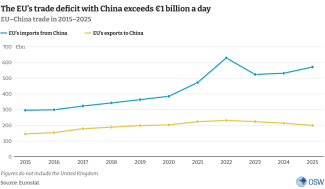
The joint initiative signals a shift in Berlin’s stance, as Germany has for years opposed protectionist measures advocated by Paris and other partners. While the proposals are not explicitly directed at any specific country and could also apply to the US, the wording of the documents indicates a primary focus on China. The Franco-German proposal seeks to diminish Beijing’s leverage in the event of an escalation of the dispute and to enhance the European Commission’s negotiating position. However, successful implementation will require ongoing support from EU member states, which Chinese authorities may attempt to erode through painful retaliatory measures or selective concessions.
Commentary
- The document confirms a fundamental shift in Berlin’s approach to trade policy towards China. Despite having been aware of the risks arising from excessive trade dependence on China for years, successive German governments consistently prioritised expanding cooperation with Beijing. They failed to counter growing dependencies in supply chains, the influx of subsidised Chinese goods into the EU market or discriminatory practices against European companies in China. Germany was also the main obstacle to EU initiatives aimed at addressing these challenges. This stance stemmed primarily from strong pressure exerted by German industry, particularly the automotive sector, which feared retaliation from Beijing and the possible loss of access to the Chinese market. The German government’s position crystallised partly thanks to a shift in the stance of the German Association of the Automotive Industry (VDA) and the CEO of the Volkswagen Group, both of whom supported the plan to impose additional countervailing duties on hybrid cars imported from China this summer. The Federation of German Industries (BDI) and the Machinery and Equipment Manufacturers Association (VDMA), longstanding proponents of similar measures, also played an important role.
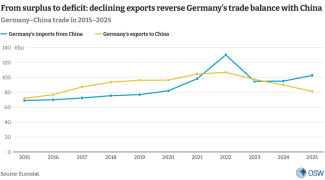
- The German industry’s increasingly assertive stance is driven by a deteriorating balance of benefits and costs in trade with China. As revenues from the Chinese market continue to decline, concerns about potential retaliation by Beijing against European companies have diminished. Profits at Volkswagen’s Chinese joint ventures fell by 45% in 2025, while German machinery exports to China declined by 17.5% year on year between January and May 2026. At the same time, German machinery manufacturers point to growing competition from Chinese companies both domestically and across Europe. The Cologne-based German Economic Institute (IW) attributes the loss of approximately 400,000 manufacturing jobs between 2019 and 2025 to mounting competitive pressure from Chinese firms.
- A key element of the proposal is the adoption of reverse qualified majority voting, which would grant the European Commission increased autonomy and enable it to act more swiftly in trade disputes. Under this mechanism, restrictions on EU market access could only be blocked by a qualified majority of member states, thereby shifting the burden of building a coalition to opponents of the restrictions. This approach enabled the EU to impose countervailing duties on battery electric vehicles imported from China in 2024, despite opposition from Germany.
- The true measure of Berlin’s and Paris’s commitment will be their readiness to endorse the application of new instruments. The EU already has a comprehensive array of trade defence tools at its disposal, including the Anti-Coercion Instrument (ACI), anti-dumping and countervailing duties, and safeguard measures. However, it applies them cautiously due to insufficient political consensus among member states, which arises from divergent interests and concerns about Chinese retaliation. The introduction of new instruments will not eliminate this fundamental obstacle. Merely establishing additional tools enables the EU to demonstrate resolve without having to take more politically costly action.
- The initiative’s effectiveness will depend on the political readiness to enforce restrictions despite retaliation from Beijing. Chinese authorities have criticised the proposals as protectionist and as efforts to shift responsibility for European industry’s competitiveness challenges onto China. They caution that the new instruments could hinder dialogue with the EU and have pledged a firm response to any discriminatory measures. Alongside this, Beijing will seek to persuade individual member states to dilute the proposal or, if adopted, to obstruct the European Commission’s implementation of the new instruments. Such pressure may be accompanied by limited concessions, enabling proponents of a more cautious approach to argue that dialogue is yielding results and that further protection of the EU market against unfair competition is unnecessary.
- Beijing is expected to exploit Germany’s industrial dependence on Chinese components, particularly permanent magnets, while offering enhanced technological cooperation and investment in Germany. The automotive sector will remain a primary focus of Chinese influence. Although German carmakers are losing ground in China, they also need Chinese partners to catch up in software and battery technologies. Volkswagen, for example, cooperates with Xpeng, while BMW works with CATL.
- Restricting access to the EU market would impose significant costs on China, but is unlikely to compel Beijing to make substantial concessions. While exports currently support China’s economic growth amid weak domestic demand, the country has limited alternatives to the large European market. Nevertheless, Chinese authorities are prepared to bear the significant costs of confrontation, believing that they are better positioned than a divided EU to withstand the short-term consequences of a trade dispute. Additionally, Beijing can leverage the EU’s dependence on Chinese supplies, particularly rare-earth permanent magnets, which are essential to sectors such as the automotive and defence industries.