Kyiv’s bridges in the crosshairs of Russian drones. Day 1686 of the war

The Ukrainians are continuing their counterattacks in the Lyman direction as part of Operation ‘Vivaldi’. It appears they have managed to secure another bridgehead along the Zherebets River in the Shandryholove area. However, it is difficult to speak of lasting successes – the task of crossing the river, establishing a foothold on the opposite bank and continuing the advance deep into enemy-controlled territory will be extremely difficult, especially given the deteriorating weather and terrain conditions.
Russian forces are concentrating on the Dobropillia direction, advancing in the area around the villages of Shevchenko and Bilytke. According to some Ukrainian and Russian sources, they are reported to have breached the defences there, enabling them to infiltrate the area west of the Kostiantynivka conurbation. Consequently, the grey zone along the front line most likely extends as far as Dobropillia, which may facilitate the encirclement of Druzhkivka and Kostiantynivka. However, reports of Russian military advances in the town of Kupiansk-Vuzlovyi in Kharkiv Oblast remain unconfirmed; some Russian sources have published photographs of the captured railway station from there, but these appear to have been generated using artificial intelligence.

Kyiv and Kyiv Oblast remain the main target of concentrated Russian air strikes. The largest attack took place on the night of 29–30 September – Russia deployed 188 drones, including 86 jet-powered ones, as well as Zircon, Onyx and Iskander missiles. In the space of just around 20 minutes, at least 20 of these were reported to have struck the capital. Among the targets were the Trypilska Thermal Power Plant (allegedly out of operation since 2024) and Kyiv Combined Heat and Power Plant No. 5 (CHP-5). Four people, including a minor, were killed in the attacks, and 16 were injured. Also among the targets that night were: port infrastructure in Odesa Oblast, including in Izmail and Odesa.
In the days that followed, the main targets were energy, fuel and gas, port and transport infrastructure. In the Poltava, Zhytomyr and Dnipropetrovsk oblasts, strikes were reported on oil and gas processing plants, fuel depots, power stations and other energy facilities, including those in Poltava and Zhytomyr. A fuel depot, a logistics centre in Dnipro, the Prydniprovska Thermal Power Plant, and industrial and energy facilities in Pavlohrad were attacked. The city of Sumy was subjected to daily strikes by guided aerial bombs. On 3 October, Russian forces reportedly used drones to attack three merchant ships in the ports of Odesa and Chornomorsk, as well as in the Black Sea. On 5 October, Ukrainian President Volodymyr Zelensky reported that Russian drones had attacked a civilian vessel belonging to Turkey in neutral waters. There were citizens of Azerbaijan and India on board. The captain was reportedly killed, the fate of one person remains unknown, and 11 crew members were rescued.
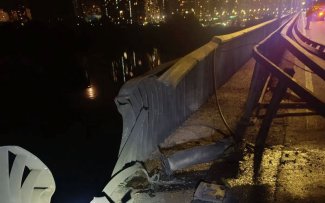
Since 1 October, Russia has been carrying out systematic drone strikes on bridge crossings over the Dnipro in Kyiv. Five strikes targeted the Pivdennyi (South) Bridge (three times on 1 October and twice on 2 October), and two targeted the Pivnichnyi (North) Bridge (on 3 and 4 October). These attacks caused damage to the road surface, a support structure and the overhead line, and led to temporary traffic restrictions.
According to estimates provided by the Ukrainian Air Force Command, between the evening of 29 September and the morning of 6 October, Russia deployed 1,434 unmanned attack vehicles, of which 594 were jet-powered drones. This means they accounted for as much as 41.4% of the total identified unmanned aerial vehicles. A total of 840 piston-engined Shaheds, as well as Gerbera, Parodiya, Banderol, Dan-T and other types of drones, were deployed. Ukrainian air defences claimed to have shot down or neutralised at least 1,221 of the 1,434 unmanned aerial vehicles, i.e. 85.1%.
Nearly half of Ukrainian businesses have felt the impact of Russian attacks on logistics, according to a survey conducted in the second half of August by the Institute for Economic Research, in which 465 businesses took part. 7% of respondents reported direct losses in the form of destroyed goods or damaged property, whilst a further 41% suffered indirectly – as a result of delivery delays and rising prices. The Russian attacks were most severe for companies based in the southern part of Ukraine.

On 1 October, President Zelensky reported that the Ukrainian Defence Forces had carried out a successful attack on a launch and storage site for strike drones in Oryol Oblast; they also struck an oil facility in Samara Oblast and a Russian military supply depot in Bryansk Oblast. On 2 October, Ukrainian military intelligence (HUR) reported that strikes had been carried out against Russian oil infrastructure: the Volgograd Refinery and the ‘Samara’ production and dispatch station. However, the consequences of all the above attacks have not yet been confirmed.
On 4 October, Ukrainian media reported that the Security Service of Ukraine (SBU) had carried out a night-time drone attack on the Russian military air base at Khanskaya in Adygea. Su-35 and Su-34 aircraft were reportedly destroyed, and an ammunition depot was hit. Satellite images published on social media do not allow the scale of the damage to be confirmed.

On 30 September, President Zelensky promoted Colonel Emil Ishkulov, commander of the 11th Army Corps of the Ukrainian Armed Forces’ Land Forces, to the rank of brigadier general. Between 2022 and 2024, Ishkulov commanded the 80th Independent Airborne Assault Brigade, and subsequently served as deputy commander of the 7th Airborne Assault Corps. Prior to this, he had been appointed commander of the 11th Army Corps, which is conducting defensive operations on the Kramatorsk and Sloviansk fronts in Donetsk Oblast.
The SBU and the police uncovered nine schemes to evade mobilisation in six regions and detained 15 people in connection with the case, including the head of a territorial recruitment centre (TRC) and a doctor on the military medical commission. On 5 October, the security services reported an operation covering the Kyiv, Ivano-Frankivsk, Vinnytsia, Zakarpattia, Lviv and Odesa oblasts. According to the SBU, the suspects offered fictitious medical diagnoses, the falsification of military records, illegal border crossings and fictitious employment to enable individuals to be exempted from mobilisation. The prices for these ‘services’ were said to reach up to $20,000. In Zakarpattia, at least 44 people were reportedly entered into the system as eligible to travel abroad. Furthermore, amongst nearly 3,500 users, the administrators of a Viber group were identified; this group provided information on the movements of TRC patrols and security services.
The tightening of criteria for critical enterprises has limited the ability to exempt staff ahead of mobilisation. According to Economy Minister Oleksandr Kravchenko, following the completion of the verification process, around 15% of companies lost the ability to exempt staff. In total, nearly 1.4 million employees are covered by exemptions from military service – the majority of whom work in the manufacturing sector (20%), logistics and transport (12%), retail (10%) and the energy sector (9%).

On 29 September, Russian media reported that a plane belonging to the ‘Ukrainka’ aviation group had crashed near the village of Krasnoyarovo in Amur Oblast. Eight crew members are believed to have been killed, including Major Andrei Lobanov and the deputy commander of the 182nd Heavy Bomber Aviation Regiment. The Russian Ministry of Defence’s had previously stated that the aircraft was on an unarmed training flight, and a technical fault was cited as the preliminary cause of the crash.
On 29 September, Andriy Demchenko, a spokesperson for Ukraine’s State Border Guard Service, reported that Belarus is once again supporting Russian attacks on Ukraine by activating signal-boosting relays for Shahed and Gerbera drones. According to him, in order to use these devices, Russian drones are operating closer to the Belarusian border, which enables them to fly deep into Ukraine, including towards the Rivne, Volyn and Lviv oblasts. Belarusian support was also reportedly used during an attack directed at the border crossing with Poland at Yahodyn.

According to the acting head of the SBU, Oleksandr Poklad, since the start of the full-scale war, the Security Service of Ukraine has foiled over 400 terrorist attacks and sabotage operations. On the same day, the SBU and the police detained two agents of the Federal Security Service (FSB) in Zaporizhzhia who were planning to lure four soldiers to go on fake dates and kill them with a knife. On 2 October, a 16-year-old boy, who had been recruited by the Russian services via the Telegram messaging app, was also detained; according to the SBU, he had prepared an explosive device with the aim of carrying out an attack on a soldier in Khmelnytskyi.
In Kharkiv, the SBU broke up a four-person network of the Russian military intelligence service (GRU) which, amongst other things, had exploited access to a mobile network operator’s data. On 2 October, suspects were detained who had been gathering data on military personnel, as well as police officers and judges, and assisting in directing Russian attacks. The group is believed to have included the head of the security department at a telecommunications company and his subordinate, who exploited access to data on subscribers’ calls and geolocation, as well as an employee of a defence firm. According to the SBU, the entire group was recruited through a Kharkiv resident who had left for Russia before the full-scale war and had become a GRU liaison officer.
The SBU detained a soldier suspected of working for the FSB and gathering data on military facilities and critical infrastructure in Kyiv and Poltava Oblast. Following mobilisation, the suspect left his unit without authorisation and was subsequently recruited by the Russian security services via Telegram. The investigation revealed that between 21 and 24 September, he identified potential targets in Kyiv, passed on their location data, and later assessed the results of the attacks. Furthermore, he is alleged to have been preparing to set fire to Ukrainian military vehicles.
The SBU uncovered an FSB agent in one of the Unmanned Systems Forces brigades, who was allegedly passing on data on his own unit’s positions to Russia. On 30 September, the SBU’s counter-intelligence unit reported the arrest in the Donbas of a gunner from one of the unmanned systems brigades, who had been passing on data to the Russian side enabling them to direct fire at his own unit’s deployment locations in the Kramatorsk area.

On 29 September, President Zelensky announced that Norway and the US had supplied an undisclosed number of NASAMS short-range air defence system batteries, together with AIM-120 AMRAAM missiles. These are most likely systems purchased as part of the Ukraine Security Assistance Initiative (USAI, which involves the procurement of new weapons and military equipment from the US defence industry) announced during Joe Biden’s presidency. He also reported that Ukraine had reached an agreement with Belgium regarding the transfer of three F-16 fighter jets to Ukraine by the end of the year, as well as the supply of ammunition for the F-16s, including from Belgium and Spain.
On 30 September, Ukraine’s Ambassador to Australia, Vasyl Myroshnychenko, said that Ukraine had withdrawn its request for the transfer of 22 Eurocopter Tiger attack helicopters, which Australia had withdrawn from service in September 2026. The withdrawal was reportedly due to staffing issues on the Ukrainian side and the limited availability of spare parts for these helicopters.
On 4 October, during a visit to Kyiv, German Chancellor Friedrich Merz took part in a German-Ukrainian business forum, during which 15 agreements with a total value of 6.5 billion euros were signed (a statement from the Ukrainian authorities puts the figure at 8.5 billion euros). The launch of a further military aid package worth approximately 1 billion euros was also announced.